RELIABILITY ANALYSIS OF HELIUM BLOWER AUXILIARY
BEARINGS FOR HTR-10
Yang Guojun1, Shi Zhengang2, Zhao Jingxiong3, and Yu Suyuan4
1
Associate Professor, Institute of Nuclear and New Energy Technology of Tsinghua University, the key laboratory of advanced reactor engineering and safety, Ministry of Education, Beijing, china, 100084 ([email protected])
2
Associate Professor, Institute of Nuclear and New Energy Technology of Tsinghua University, the key laboratory of advanced reactor engineering and safety, Ministry of Education, Beijing, china, 100084
3
Graduate student, Institute of Nuclear and New Energy Technology of Tsinghua University, the key laboratory of advanced reactor engineering and safety, Ministry of Education, Beijing, china, 100084
4
Professor, INET, Institute of Nuclear and New Energy Technology of Tsinghua University, the key laboratory of advanced reactor engineering and safety, Ministry of Education, Beijing, china, 100084
ABSTRACT
Active magnetic bearing (AMB) instead of mechanical bearing will become the new sustaining assembly for the helium blower of 10MW high-temperature gas-cooled reactor (HTR-10). However, one implication of AMB is the requirement to provide backup support to mitigate the effects of failures or overload conditions. The auxiliary bearing is used to support the rotor when the AMB fails to work. It must support the dropping rotor and bear the great impact force and friction heat. The design of the auxiliary bearing is one of the challenging problems in the whole system. It is very important for the helium blower with AMB of HTR-10 to make success. The rotor’s length of helium blower of HTR-10 is about 1.5 m, its weight is about 450 kg and the rotating speed is 5000 r/min. The preliminary scheme design has been finished. It is difficult to analyze the falling course of the rotor. There are two difficult problems to solve for the design of auxiliary bearing, including great impact force and fiction heat. The preliminary analysis of the rotor was done in the special condition. The Mises stress of auxiliary bearing was computed for the axial and radial impact load by the finite element method. The temperature field will be analyzed and studied also in this paper. The scheme of auxiliary bearing and the simulation results offer the important theoretical base for the protector design of the helium blower with AMB for HTR-10.
1. INTRODUCTION
A 10MW high-temperature gas-cooled reactor (HTR-10) was constructed by the Institute of Nuclear and New Energy Technology (INET) at Tsinghua University of China. Active Magnetic Bearing (AMB) instead of mechanical bearing will become the new supporting system in the helium blower, and the auxiliary bearing will be applied in the system as the backup protector.
AMBs have several advantages: they are free of contact, do not require lubrication, are not subject to the contamination of wear, have endurance, and control performance very well (Gerhard Schweitzer et al., 1994). So the AMB is the appropriate supporting assembly. However the auxiliary bearing must be included in the AMB system. Especially when the rotor is rotating with high speed, the AMB suddenly doesn’t support the rotor for the power off. So it is very important for the auxiliary bearing to protect the rotor system (Guojun Yang et al., 2007; Qingquan Qin et al., 2008).
magnetic bearing to protect it. Typically, fifty percent of the magnetic bearing clearance is used for the auxiliary bearing clearance.
The application of the rolling element bearing as auxiliary bearing is widespread in rotating machinery incorporates magnetic bearing. The function of the auxiliary bearing is to prevent rotor/stator contact, for which the inner ring can experience a high impact force and rapid angular acceleration. Rapid deterioration of the auxiliary bearing can result from rotor impacts and high-speed touchdowns. It is therefore important to ascertain the influence of auxiliary bearing design parameters on the number of touchdowns that can be tolerated before replacement is required (T. Ishii et al., 1996). A prerequisite is to understand the dynamic behavior of the system during a touchdown event, and this is also a necessary step before attempting to predict any thermal transients within the auxiliary bearing. (X.Wang et al., 1998; Jinchen Ji et al., 2000). AMB has not been applied in the system of nuclear power station until now. The auxiliary bearing with no lubrication will endure the great impact force and friction heat. This is a challenging problem.
AMB system has been designed for the helium blower of HTR-10. The academic research for touchdown will be done in this paper. The reliability will be analyzed also. Results may offer the important theoretical base for the protector design of the helium blower with AMB for HTR-10.
2. THE HELIUM BLOW RIG WITH AMB
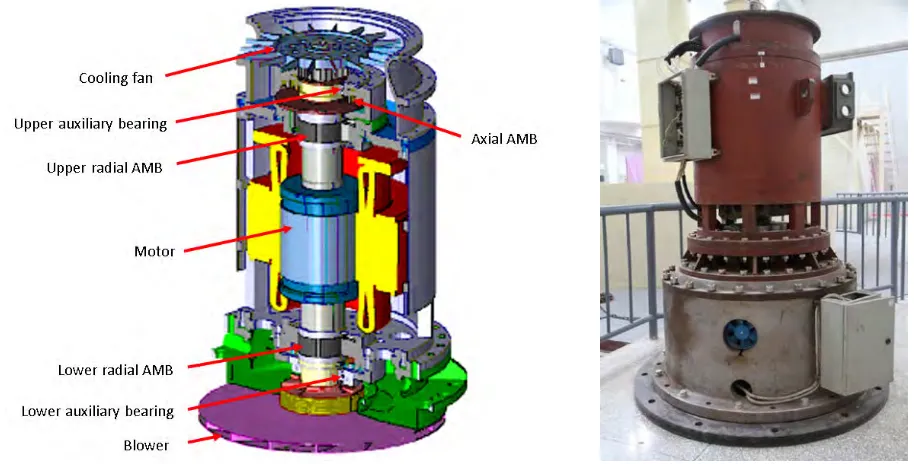
The AMB has been designed for helium blower. The rig has been built for research. The figure 1 shows the structure and picture of the helium blower rig. The parameters are listed in Table 1.
Figure 1. The structure and picture of the helium blower rig
The angle contact ball bearing is applied as the auxiliary bearing for helium blower with AMB. The model is 71926ACD. It is the ceramic bearing with dry lubrication instead of oil or grease. The upper auxiliary bearing carries the radial and axial load, and the lower auxiliary bearing carries the radial load.
is 3.15×10⁵MPa, Poisson's ratio is 0.3 [Jiang Yiping, 2001], the strength limit is 3500MPa [Liu Yuanxin, 2005].
Table 1: Parameters of helium blower
Mass of rotor Rotor: 350kg. Rotor with blower: 450kg.
Length of rotor 1518mm
Distance between two radial AMB 800mm
Axialmoment of inertia 7.9kg•m2
Transverse moment of inertia 78kg•m2
Radial gap between rotor and
auxiliary bearing 0.18mm
Axial gap between rotor and auxiliary
bearing 0.52mm
Rotate speed 5000r/min
3. ANALYSIS OF IMPACT LOAD
The normal rotating speed of the rotor is 5000r/min. If the AMB fails to work under this speed, the rotor will fall off suddenly to the auxiliary bearing. The auxiliary bearing must support the dropping rotor, and can bear the great impact load and fiction heat. So the auxiliary bearing will fail to work because the impact load and fiction heat. The finite element method will be used to analyze the impact load and fiction heat.
3.1 Axial impact load
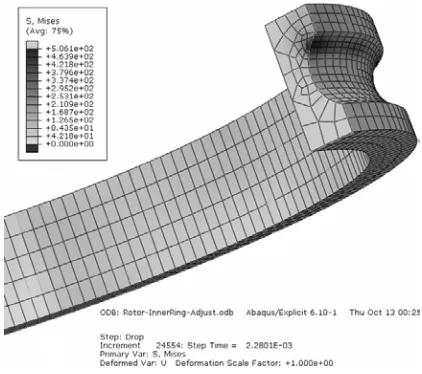
The axial impact load was analyzed by the finite element method. Figure 2 shows the stress distribution of the bearing inner ring.
The maximal Mises stress is about 500MPa from figure 2. It is less than the yielding limit (1600MPa) of bearing steel. The maximal stress occurred in the position of bearing raceway contacting with ceramic ball. It verifies the inner ring is not broken after the first impact load acted on the inner ring.
The figure 3 shows stress distribution of the whole bearing model. The maximal stress focuses on the contact angle (25o). The maximal stress of ceramic ball is 1100MPa, and it is less than the strength limit (3500MPa) of ceramics.
The following impact load will be less than the first impact load, so the auxiliary bearing can bear the axial load.
Figure 3. The stress distribution of whole bearing
3.2 Radial impact load
The radial impact load on the auxiliary bearing is just as important as axial impact load on the bearing. Figure 4 shows the stress distribution.
The maximal stress of inner ring is about 1143MPa, and it is less than the yielding limit (1600MPa) of bearing steel. It is safe.
4. ANALYSIS OF FICTION HEAT
When the rotor with high rotating speed falls to the auxiliary bearing, the bearing will produce great heat energy in a short time. The auxiliary bearing may be burned by the heat energy. So the analysis of fiction heat is very important.
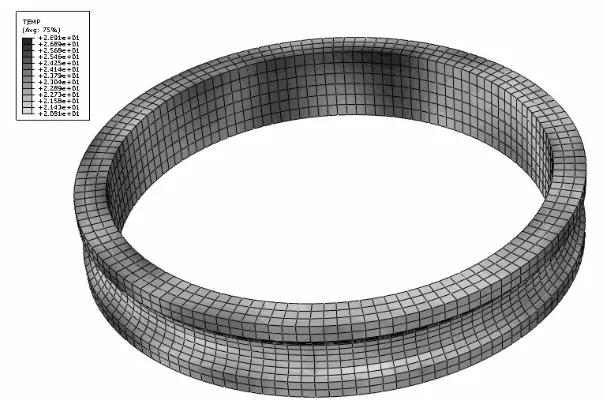
However the fiction is very complicated. A simple simulation was completed by the finite element method in this paper. The initial temperature is supposed to be 20℃. But the time is very short for the first impact time, and the fiction heat is not clearly. The temperature of the auxiliary bearing improves only 6.9℃. The temperature field is showed in figure 5. In fact, the fiction heat may be very high in a short period of time because of the high rotating speed, full load and enclosed environment. But the temperature rises very little in this paper. The reason is on the light load and good heat dissipation.
Figure 5. The temperature field analysis of the inner ring
5. CONCLUSION
The rotor with AMB is becoming the important development direction for supporting system of the nuclear power station. But the auxiliary bearing must be applied in AMB system for accident condition. The great impact force and fiction heat will make the auxiliary bearing failure. So it is difficult to design the auxiliary bearing.
The helium blower with AMB has been designed. The experiments of AMB and auxiliary bearing are implementing. The impact load and temperature field have been analyzed by the finite element method in this paper. The reliability of the auxiliary bearing has been verified in theory. Results offer the important theoretical base for the protector design and experiment of the helium blower with AMB for HTR-10.
ACKNOWLEDGMENTS
REFERENCES
Gerhard Schweitzer, etc. (1994) “Active Magnetic Bearings”. Vdf Hochschulverlag AG an der Eth Zürich. Guojun Yang, Yang Xu, Zhengang Shi, Huidong Gu. Characteristic Analysis of Rotor Dynamics and
Experiments of Active Magnetic Bearing for HTR-10GT. Nuclear Engineering and Design. 2007.7, 237(12-13): 1363-1371
Qingquan Qin, Guojun Yang, Zhengang Shi, Suyuan Yu. Preliminary Research of Auxiliary Bearing in HTR-10GT Project. 2008 Proceedings of the 16th International Conference on Nuclear Engineering(ICONE16). Orlando, FL, United States. May 11-15, 2008, V2: 623-628
T. Ishii, R. Gordon Kirk.. (1996) “Transient Response Technique Applied to Active Magnetic Bearing Machinery During Rotor Drop”. Trans. of the ASME. 118(4): 154-163
X. Wang, S. Noah. (1998) “Nonlinear Dynamics of a Magnetically Supported Rotor on Safety Auxiliary Bearings”. Trans. of the ASME. 120(4): 596-606
Jinchen Ji, Lie Yu. (2000) “Drop Dynamics of a High-Speed Unbalanced Rotor in Active Magnetic Bearing Machinery”. Mech. Struct & Mach. 28(2&3): 185-200
Liu Yuanxin. Marc-based FEA (Finite Element Analysis) of Hybrid Ceramic Ball Bearings and Its’ Experiment Confirmation. Master's thesis. Tianjin University, 2005. 1: 57-60