Evaluating the Performance of Reactive
Unicast Routing Protocols with OPNET
Simulator in MANETS under VOIP
Sandeep Ravikanti, Gadasu Preeti
Assistant Professor, Department of CSE, Methodist College of Engineering and Technology, Hyderabad, Telangana,
India
Assistant Professor, Department of CSE, Methodist College of Engineering and Technology, Hyderabad, Telangana,
India
ABSTRACT: Mobile Ad Hoc Networks (MANETs)[2] are an emerging type of wireless networking, in which mobile nodes associate on an extemporaneous or ad hoc basis. MANETs are self-forming and self-healing, enabling peer-level communications between mobile nodes without reliance on centralized resources or fixed infrastructure. Many ground breaking applications have been suggested for MANETs including the Voice over Internet Protocol (VoIP)[7]. In order to support VoIP application over MANETs a suitable routing protocol is essential. Several routing protocols have been proposed for MANETs. In this paper, the performances of different routing protocols have been investigated and compared for VoIP application. Some popular routing protocols namely Dynamic Source Routing (DSR)[9], Ad hoc On-demand Distance Vector (AODV)[6], Temporally-Ordered Routing Algorithm (TORA)[7] have been considered in this investigation. The OPNET simulation results show that the TORA protocol is a good candidate for VoIP application.
KEYWORDS: AODV, DSR, MANETs, VOIP, Qos metrics, OPNET, TORA.
1. LITERATURE SURVEY
MODERN wireless communication [2] systems are rapidly evolving day by day. The main objective of this evolution is to provide a user with communication services at anytime and from anywhere of the World. Technological advancements and the popularity of the portable computing devices have made this objective an attainable one. In MANETs [6] performance is sensitive to mobility, scalability and traffic load. Examining different protocols performance in dynamic environment plays a vital role in efficient routing. The main objective is to access the performance of protocols whether varying with network size, node speed, traffic, and mobility and simulation time [8].MANET routing protocols are classified into three categories. They are;
1) Proactive routing protocols 2) Reactive routing protocols 3) Hybrid routing protocols
Main related work in our paper is focused only on RIP and OLSR [5] routing protocols. In this paper, we conduct a performance evaluation of RIP[9] and OLSR routing protocols. Goal of the paper is to analyze the DSR, AODV [6] AND TORA routing protocols in MANET [2] on TCP, UDP and FTP traffic under Voice over Internet Protocol. In our paper,
The first work will be to analyze the performance of existing routing protocols RIP and OLSR confined to performance metrics like package delivery ratio, end to end delay, throughput etc. by using OPNET[8] simulator.
Finally CBR, FTP uses TCP[3] for denial of service in existing routing protocols. We are also concentrating on the impact of traffic at two different layers (application and transport layers) to analyze the performance of MANET [4] routing protocols.
Related Work
To analyze throughput, medium access delay, end to end delay on varying network size, throughput, and simulation time.
To investigate the impact of mobility on throughput and delay.
II. INTRODUCTION
Cellular Wireless Networks are Infrastructure dependent network. These networks are Single-Hop Wireless links. This network provides guaranteed bandwidth (designed for voice traffic). These runs with Circuit-Switching (evolving toward packet switching) process. Developing these networks are High cost and time of deployment. Seamless connectivity (low call drops using handoffs). Reuse of frequency spectrum through geographical channel reuse. Cellular networks[8] are easy to achieve the time synchronization. These networks are easy to employ bandwidth reservation. Application domains include mainly civilian and commercial sectors. Maintenance of these networks is of high cost while compared to other networks maintenance (backup power source, staffing etc.). Major goals of routing and call admission are to maximize the call acceptance ratio and minimize the call drop ratio. Cellular Networks are widely deployed and currently in the third generation of evolution.
Ad-Hoc Networks[4] are Multi-hop radio relaying and without support of infrastructure. These are of two types: –Wireless Mesh Networks
–Wireless Sensor Network
Ad-Hoc networks are Infrastructure Less and Multiple-hop wireless links. Ad-Hoc networks are shared radio channel which are more suitable for best-effort data traffic. These are running with Packet-Switching (evolving towards the emulation of circuit switching)[3]. Developing this network is quick and cost-effective deployment. There are frequent path breaks due to mobility in Ad-Hoc networks. These networks reuse Dynamic frequency based on carrier sense mechanism.
In this, time synchronization is difficult and consumes bandwidth which causes some problems. To reserve the bandwidth in Ad-Hoc network[2], it requires complex medium access control protocols. Major application domains include battlefields, emergency search and rescue operations and collaborative computing etc. Mobile Hosts require more intelligence (should have a transceiver as well as routing/switching capability). Self-organization and maintenance properties are built into the network. Main aim of routing is to find paths with minimum overhead and also quick re-configuration of broken paths.
Mobile ad-hoc networks (MANET)
Opposed to the infrastructure wireless networks where each user directly communicates with an access point or base station, a mobile ad-hoc network, or MANET is a kind of wireless ad-hoc network. It is a self configuring network of mobile routers connected by wireless links with no access point. Every mobile device in a network is autonomous. The mobile devices are free to move haphazardly and organize themselves arbitrarily. In other words, ad-hoc network do not rely on any fixed infrastructure (i.e. the mobile ad-hoc network is infrastructure less wireless network. The Communication in MANET is take place by using multi-hop paths.
Fig 1.Mobile Ad-Hoc Network
CHALLENGES OF MOBILE AD-HOC NETWORK:
Regardless of the variety of applications and the long history of mobile ad hoc network, there are still some issues and design challenges that we have to overcome. This is the reason MANET is one of the elementary research field. MANET is a wireless network of mobile nodes; it’s a self organized network. Every device can communicate with every other device i.e. it is also multi hop network.
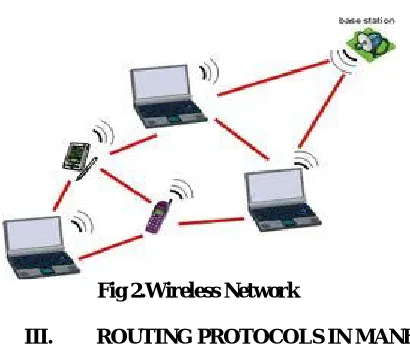
As it is a wireless network it inherits the traditional problem of wireless networking:[4] The channel is unprotected from outside signal.
The wireless media is unreliable as compared to the wired media. Hidden terminal and expose terminal phenomenon may occur. The channel has time varying and asymmetric propagation properties.
Fig 2.Wireless Network
III. ROUTING PROTOCOLS IN MANET’s
Routing is the process of selecting paths in a network along which to send network traffic [5]. The process of finding a route or path along which the data or control packets can be delivered between nodes in the network is also known as routing. Again routing is the process of creating or updating the table, called routing table, which contains the information that a router needs to route packets, that helps in forwarding (the way a packet delivered to the next station). The information may include the network address, the cost, and the address of next hop and so on.
protocol. Proactive routing[5] that means route available immediately. Reactive routing that means discovers the route when needed. And hybrid routing that means combination of both, such as proactive for neighborhood, reactive for far away.
Fig 3.Classification of Routing protocols for MANET’s
3.1 UNICAST ROUTING PROTOCOLS
Most applications in the MANET are based upon unicast communication. Thus, the most basic operation in the IP layer of the MANET [2] is to successfully transmit data packets from one source to one destination. The forwarding procedure is very simple in itself: with the routing table [3], the relay node just uses the destination address in the data packet to look it up in the routing table.
3.1.1PROACTIVE UNICAST ROUTING PROTOCOLS:
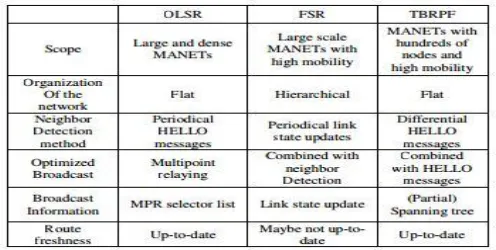
The following table shows the unicast routing protocols scope, organization, nighbour detection method, broadcasting based on optimized route, route freshness etc for all OLSR, FSR, and TBRPF protocols.
Characteristic Comparison of Proactive Unicast Routing Protocol
3.1.2 REACTIVE UNICAST ROUTING PROTOCOLS:
Due to the frequently changing topology of the Mobile Ad hoc Network, the global topology information stored at each node needs to be updated frequently, which consumes lots of bandwidth, because the link state updates received expire before the route between itself and another node is needed. To minimize the wastage of bandwidth, the concept of on demand or reactive routing protocol is proposed. In On demand protocols the routing is divided into the following two steps: first one is route discovery and second one is route maintenance. The most distinctive On Demand unicast routing protocols are Dynamic Source Routing (DSR)[9] protocol, Ad hoc On Demand Distance Vector Routing (AODV)[6] protocol and Temporally Ordered Routing Algorithm etc., in Table 2, gives the Characteristic comparison of Reactive Unicast Routing Protocols.
A) DYNAMIC SOURCE ROUTING PROTOCOL (DSR) :
Dynamic Source Routing (DSR) is an On Demand unicast routing protocol that utilizes source routing algorithm. In source routing algorithm, each data packet contains complete routing information to reach its dissemination. Additionally, in DSR[9] each node uses caching technology to maintain route information that it has discovered. For example, the intermediate nodes cache the route towards the destination and backward to the source. Furthermore, because the data packet contains the source route in the header, the overhearing nodes are able to cache the route in its routing cache.
B) AD-HOC ON-DEMAND DISTANCE VECTOR ROUTING PROTOCOL (AODV):
The Ad Hoc On-demand Distance Vector Routing (AODV) protocol is a reactive unicast routing protocol for mobile ad hoc networks. As a reactive routing protocol, AODV[6] only needs to maintain the routing information about the active paths. In AODV, routing information is maintained in routing tables at nodes. Every mobile node keeps a next-hop routing table, which contains the destinations to which it currently has a route. A routing table entry expires if it has not been used or reactivated for a pre-specified expiration time. Moreover, AODV [6] adopts the destination sequence number technique used by DSDV in an on-demand way.
We used this below algorithm in TORA to calculate results and analysis.
C.TEMPORALLY ORDERED ROUTING ALGORITHM (TORA):
Temporally Ordered Routing Algorithm (TORA) is a On Demand routing algorithm based on the concept of link reversal. This Routing protocol improves the partial link reversal method by detecting partitions and stopping non-productive link reversals. TORA can be used for highly dynamic mobile ad hoc networks. TORA[4] has three basic steps: route creation, route maintenance and route erasure. In TORA[6] the DAG provides the capability that many nodes can send packets to a given destination and guarantees that all routes are loop-free. Because of node mobility the DAG in TORA may be disconnected. So, route maintenance step is a very important part of TORA.This routing protocol has the unique feature that control messages are localized into a small set of nodes near the topology changes occurred.
Characteristic Comparison of Reactive Unicasting Routing Protocols
3.2 MULTICAST ROUTING PROTOCOLs:
Although multicast transmission has not been widely deployed in the current MANETs, it will become very important in multimedia communications in the near future. To send a same data packet to multiple receivers in the MANET simultaneously, the simplest method is to broadcast the data packets.
proposed for MANET. They could be divided into three groups: first one is proactive multicast, second one is reactive multicast and last one is hybrid multicast routing protocol.
3.2.1 PROACTIVE MULTICAST ROUTING PROTOCOLS:
Conventional routing protocols such as Ad-hoc Multicast Routing (AM Route)[8][3], Core-Assisted Mesh Protocol (CAMP) and Ad-hoc Multicast Routing Protocol Utilizing Increasing id-numbers (AMRIS) are proactive multicast routing protocols. Periodic broadcast of network topology updates are needed to compute the shortest path from the source to every destination, which consumes a lot of bandwidth.
A) Ad-hoc Multicast Routing (AM Route)
B) Ad-hoc multicast routing protocol utilizing increase id numbers (AMRIS)
IV. QOS METRICS
A) PACKET DELIVERY RATIO:
It is defined as the ratio of number of data packets [1] delivered to all the receivers to the number of data packets supposed to be delivered to the receivers.
This ratio represents the routing effectiveness [1][3] of the protocol: PDR = Packets delivered
Packets sent
B) AVERAGE END-TO-END DELAY:
It is the average time taken for a data packet to move from the source to the receivers [1]: Avg. EED = Total EED
No. of packets
C) THROUGHPUT:
Throughput refers to how much data can be transferred from the source to the receiver(s) in a given amount of time[1]:
Throughput = Number of packets sent
Time Taken
V. SIMULATION RESULTS AND ANALYSIS
The performances of different routing protocols for VoIP applications have been investigated via OPNET simulator. The default parameters used in the simulations are listed in the table
Simulation parameters and values
Parameters values
Number of nodes 50
Network size 1000m*1000m Mobility . Placed in row an
column based model Communication model Random way point model with continus movement
Placed in row an column based model
Selection by strict channel match 300m
SIMULATED APPLICATION AND PROTOCOLS
DSR simulations: sample DSR scenario with 50 nodes
The below snapshot of the opnet simulator shows the 50 nodes that are connected in the network for finding the performance of the network based in the unicast dynamic source routing protocol .
End to end delay in DSR
The below snapshot of the opnet simulator shows the data transmission delay from one end to another end when we are using the unicast routing protocol dynamic source routing(DSR).at the time of starting of the process the delay is high for finding the node and after some time the delay becomes constant from end to end showed in below graph.
Load vs Medium Access Delay in DSR
This snapshot of the opnet simulator shows the load on the network along with medium access delay when we are trying to deliver the data from one end to another in this DSR method the node it self has to wait when the medium is busy so,in the below graph the node has to wait when the medium is busy at that yime delay graph is raised to high.
Parameters values
Physical layer Segmented calculation of the signal power and SNR
MAC layer IEEE802.11 DCF with transmission rate of 12 Mbps for voice application
Routing AODV,DSR,TORA
Applications Applications
Codec G.711 and GSM-EFR
Compression and Decompression delay
0.02sec
Type of service(TOS) Interactive voice,unicast
Throughput with load in DSR [9]
This snapshot in opnet simulator shows the throughput of the route when we use DSR routing protocol. here the red line in the graph shows the load on the network and blue line shows the throughput of the network.
TORA Results
This following graph shows the performance of routing TORA protocol [4] under load, thoughput, and delay like qos metrics.
Load with throughput in TORA
The below snapshot in opnet simulator shows the throughput of the network under the load condition when we are using the TORA routing protocol for sending the data from one end to another end here if we observe carefully the load and throughput are going equally.
End to end delay with Medium Access delay inTORA.
AODV Results
These below graphs show results in case of AODV [6] routing algorithm when we run in TORA [9] routing algorithm.
End-to-End delay with Medium Access delay in AODV [6]
This below snapshot in opnet simulator shows the end to end delay when the medium is busy with data. In this case for accessing that medium for node will take lot of time so here the delay goes to high state. After getting access to medium it will ready to transfer if we observe carefully the delay in AODV and DSR is almost same.
Load with throughput in AODV
The below snapshot in opnet simulator shows the throughput of the network under the load condition when we are using the AODV routing protocol for sending the data from one end to another end here if we observe carefully the throughput is good even though the load is high.
VI. CONCLUSION AND FUTURE WORKS
current form) is not suitable for VoIP application over MANET in both small scale and large scale scenarios. The reactive nature and failure to control overhead messages make the DSR protocol poorly performs in terms of QoS parameters. In addition, the traffic loads and node mobility degraded the performances of the DSR protocol. In large scale condition GRP and OLSR[7] performs better than small scale condition for their proactive nature and position based routing respectively. But, the performances of these two protocols are not comparable with those of TORA protocol. Although this investigation goes in favor of TORA protocol, for using voice codes G.711 and GSM-EFR[1] in small and large network respectively we need do to a more comprehensive study to confirm this claim. We need to investigate the other routing protocols proposed in the literatures.
REFERENCES
[1] D. Chalmers and M. Sloman, “A survey of quality of service in mobile computing environments,” IEEE Communications Surveys and Tutorials, Vol. 2, No. 2, Second Quarter 1999, pp. 2-10
[2] S. Corson. And J. Macker. “Mobile Ad Hoc Networking (MANET): Routing Protocol Performance Issues and Evaluation Consideration”, available at http://www.ietf.org/rfc/rfc2501.txt
[3] E.M. Royer, C-K. Toh, “A Review of Current Routing Protocols for Ad Hoc Mobile Wireless Networks”, IEEE Personal Communications Magazine, April 1999, pp. 46-55.
[4] Aftab Ahmad. “Wireless and Mobile Data Networks.” John Wiley & Sons, Inc., Hoboken, NJ, USA, 2005. [5] T. Clausen, and P. Jacquet, “Optimized Link State Routing Protocol (OLSR)”, IETF, RFC 3626, 2003.
[6] C. E. Perkins, E. M. Belding-Royer, and S. R. Das, “Ad hoc On-Demand Distance Vector (AODV) routing,” Internet Engineering Task Force (IETF) draft, November 2002.
[7] T. Camp, J. Boleng, and V. Davies, “A survey of mobility models for ad hoc network research,” Wireless Communications and Mobile Computing (WCMC): Special issue on Mobile Ad Hoc Networking: Research, Trends and Applications, Vol. 2, No. 5, 2002, pp.483-502
[8] I. D. Aron and S. K. S. Gupta, “On the scalability of on-demand routing protocols for mobile ad hoc networks: an analytical study,” Journal of Interconnection Networks, Vol. 2, No. 1, pp. 5-29, 2001.