Implementation of Ant Colony Based Energy
Aware Routing Protocol in MANET
Neha Patil
1, S. B. Takale
2P.G. Student, Department of E & TC Engineering, Sinhgad College of Engineering, Vadgaon (BK), Pune, India1 Assistant Professor, Department of E & TC Engineering, Sinhgad College of Engineering, Vadgaon (BK), Pune, India 2
ABSTRACT: In recent times MANET got a lot of attention due to decentralized, infrastructure less networks. The Ad-Hoc network has challenging issues, which can be categorized as energy consumption, routing, overheads, limited bandwidth. Existing basic routing protocols consume considerable amount of energy in the node. To resolve these problems, many researchers have performed research and recently came up with new class of routing algorithms which is based on Swarm Intelligence along with basic routing protocols in MANET. The foraging behavior of ants can be used to obtain the shortest route from the nest to a food source, by deposition of a chemical substance called pheromone. In our technique, the Ant Colony Optimization method is used to find good paths which will consume less energy and less hop count. The efficiency of the proposed protocol is more with respect to the AntHocNet. The protocol is tested and compared under different time intervals.
KEYWORDS: Ant Colony Optimization, MANET, Swarm Intelligence, Pheromone, intervals.
I. INTRODUCTION
MANET consists of entirely of wireless nodes, placed together in an ad hoc manner and without the support of a fixed communication infrastructure. All nodes are mobile, and can enter or leave the network at any time. Data are forwarded among the nodes of the network in multi-hop fashion. MANET routing algorithms can be classified as proactive, reactive or hybrid. Proactive algorithms try to maintain up-to-date routes between all pairs of nodes in the network at all times. The advantage is that routing information is always readily available when data need to be sent, while the main disadvantage is that the algorithm needs to keep track of all topology changes, which can become slightly difficult when there is more number of nodes or mobility of node is more. Examples of proactive algorithms are Destination-Sequence Distance-Vector routing (DSDV) and Optimized Link State Routing (OLSR) [2]. Reactive algorithms only maintain routing information that is strictly necessary. They set up routes on demand when there is need of a new communication session start, or when a running communication session falls without a route. This approach is generally more efficient, but can lead to higher delays as routing information is often not immediately available when needed. Examples of reactive routing algorithms include Dynamic Source Routing (DSR) and Ad-hoc On-demand Distance-Vector routing (AODV). And last, hybrid algorithms use both proactive and reactive elements, trying to combine the best of both worlds [2]. MANET has limitations like low battery power, changing topology, high mobility, etc.
II. RELATEDWORK
A routing protocol is the mechanism by which user traffic is directed and transported through the network from the source node to the destination node. The core basic routing functionalities for MANETs are path generation, path selection, data forwarding and path maintenance. Routing mechanism can be affected by different factors like mobility, energy limitations, etc. so some earlier work done work to improve these limitations is described below.
1. Ehsan Khosrowshahi-Asl, Majid Noorhosseini and Atieh SaberiPirouzin proposed SAMP-DSR protocol [4]. The algorithm is developed to address the shortcomings of both ant colony based as well as the traditional DSR algorithms. Due to the unstable nature of MANETs memory based search algorithms such as ant based methods become inefficient and impractical as the network mobility increases. The ant based routing algorithms suffer from lack of accuracy while incurring extensive memory usage as well as valuable processing power and bandwidth prices in highly dynamic environments. The proposed ANT based routing algorithm exploits a dual-modality access. Each node can independently functions in a local mode as well as in global mode using the information provided by ants. The network topology changes are constantly monitored. When the rate of topology change gets too high for ants to converge efficiently, a node switches to local mode to rely less on the information learnt through the ants.
2. Ahmed M. Abdel-Moniem et. al. proposed the new modified protocol as the Multi-Route AODV Ant routing algorithm (MRAA) [5]. The MRAA handles events like neighbor connectivity, route establishment request, route establishment reply, route's expiry, connection loss and local repair. In this protocol a source node can send data packets to its corresponding destination through one of backup routes pre-established. However MRAA have weak performance in case of average delays.
3. C. K. Toh, proposed Conditional max-min battery capacity routing (CMMBCR) [6] which has the goal to maximize the lifetime of each node and use the battery fairly. The basic idea for CMMBCR is that when all nodes in some possible routes between a source and a destination have sufficient remaining battery capacity, then a route with minimum total transmission power among these routes is chosen. The algorithm uses battery capacity as cost function which is a route selection metric. However, if all routes have nodes with low battery capacity (i.e., below a threshold), routes, including nodes with the lowest battery capacity should be avoided to extend the lifetime of these nodes.
4. S. Chettibi and M. Benmohamed proposed A Multipath Energy-Aware On demand Source Routing Protocol for Mobile Ad-Hoc Networks named as MEA-DSR [7]. It uses route diversity and information about the energy levels of batteries for balancing energy consumption between mobile nodes. Due to routes failure, frequent route discoveries are needed so that broken routes can be re-established. MEA-DSR which is based on DSR protocol, limits the number of routes to two which are a destination node provides to a source node. The primary route is chosen on the basis of two factors. First is the residual energy of nodes belonging to the route and the second is the total transmission power required to transmit data on this route. Limitation of this technique is it has less packet delivery ratio as compared to basic DSR protocol.
In short, the SAMP-DSR protocol exploits a dual-modality access which helps node to function independently in local and global modes. The CMMBCR algorithm helps nodes wih sufficient battery capacity to chose a route with minimum transmission power. The MEA-DSR takes advantage of route-diversity and energy level of batteries for balancing energy consumption between nodes. The ARAMA algorithm controls the forward ant’s generation rate by defining a value called grade. This reduces the route discovery and maintenance overhead.
III.ANT COLONY BASED ENERGY AWARE ROUTING PROTOCOL
A. Motivation
The algorithm has been inspired from an ant colony optimization algorithm that performs better than conventional protocol. Energy-aware protocols should have an algorithm so that they do not have to waste that much energy in finding new paths every time. So proposed work try to reduce energy consumption or wastage so to say, through discovering good paths right from the start. The work in this paper is inspired from AODV and AntHocNet algorithm. AntHocNet [3] is a hybrid multi-path algorithm designed along the principles of ACO-based routing in ad-hoc networks. Here the minimum battery energy of the node of the route is considered and the hop-count of the route as metric for path discovery. A hop count is included as a metric in the algorithm, as the greater the number of hops, the greater will be the transmission, and the more will be the energy consumption and also the minimum battery remaining was taken into consideration. The objective of the paper is to reduce energy consumption in the network, maintaining the shortest path, which reduce dead nodes in the network.
B. Ant Colony Optimization
ACO uses the concept of artificial ants, analogous to the natural ants that behave as packets for ad-hoc networks. A natural ant, while traveling in search of food, deposits a chemical substance called pheromone for other ants to sense and follow their path. While “combing” the area in all directions, if any ant reaches the food source (packet to destination), return ants are created (backward ants), which travel back towards the nest, reinforcing their traversed path, while going back to confirm that the path was successful. This is the wayusing which the discovery is done to find best possible paths, which have more ants traveled on it and as a result, more pheromone deposited on it. [1]
C. Proposed scheme
1. The path discovery mechanism is inspired from AntHocNet but functionality is different. When a source node, s, starts a communication with a destination node, d, and if it does not have routing information for d then, it broadcasts a reactive forward ant. Due to the initial broadcasting, each neighbor of s receives a replica.
2. On receiving any route request, for all routes in S of node, check if the route traveled by the request has previously been used or not. If the route is a subset or the hop count is less than 1.5 times of existing one in the seen set, add route in seen set S and rebroadcast it, else discard it. By this way bad paths are removed.
3. On the arrival of the first reactive forward ant to the destination, calculate the end-to-end delay for this first ant. The destination node will wait for time interval Tw for the rest of the reactive forward ants to come. [1]
Tw= Cw* Td
Where, Cw is an integer factor and Td represents the end-to-end delay for the first received ant.
4. All the ants that came in this time are converted to backward ants as soon as they arrive and they travel back to the source retracing. While moving backwards towards source node, each backward ant updates or makes an entry into the table of node i about pheromone, which equals the inverse of the number of hops (H) multiplied by the minimum residual battery energy of all the nodes traveled up to the current node by the current backward ant (MBR):
5. Also threshold for hop count is added.
6. The data packets are sent through the host will choose the next node from the set of neighbours Nid using probability
β is a value from the set of integer values.
7. The traversal of each data packet increases the pheromone values of each link by a factor π. Tin,d = Tin,d × (1 + π )
8. The other nodes evaporate the pheromone deposits, for a more frequent selection of better paths. For every τ time period, the node will evaporate the pheromone value, Tin,d, automatically using evaporation rate ρ.
Tin,d = Tin,d × (1 − ρ)
9. When a link fails, route error message will be sent to the source and route discovery mechanism will be initiated.
IV.EXPERIMENTAL RESULTS
Performance analysis is done out in LINUX (Fedora 13) using Network Simulator tool NS-2.34. NS-2 is written in C++ and TCL. NS-2 includes a network animator called nam animator which provides visual view of the simulation. NS-2 preprocessing provides traffic and topology generation and post processing provide simple trace analysis. AWK programming is used for trace file analysis Performance parameters used to measure and evaluate the effectiveness of the proposed algorithm are as follows:
1. Number of dead nodes. 2. Total energy consumed. 3. Number of packets delivered.
The following parameterswere set for the simulations performed:
TABLE 1: SIMULATION PARAMETERS
1 Channel Wireless
2 Simulation time 200
3 Terrain area 1000 m X 1000 m
4 Number of nodes 50
5 Node placement Uniform/random
6 Traffic model CBR
7 Interface queue Queue/Drop tail
8 Protocol EAAR, ANTHOCNET
9 Mac-Protocol. IEEE 802.11
10 Packet Size 512 Bytes
11 Initial Energy 1 J
Fig. 1 Network Animator Output
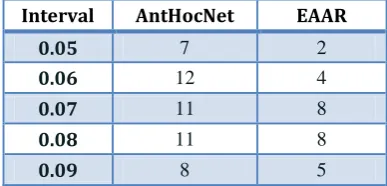
As shown in table 2, it is seen that no. of dead nodes are decreased in EAAR. The total no. of nodes considered in scenario is 50. It is seen that no. of dead nodes are decreased in EAAR due to the existence of multi-path routing and energy awareness in EAAR at each time interval whereas AntHocNet does not have energy awareness.
TABLE 2: NO. OF DEAD NODES
The graphical representation of above table is shown in fig. 2 below.
Fig. 2: Interval vs. No. of Dead Node
Interval AntHocNet EAAR
0.05 7 2
0.06 12 4
0.07 11 8
0.08 11 8
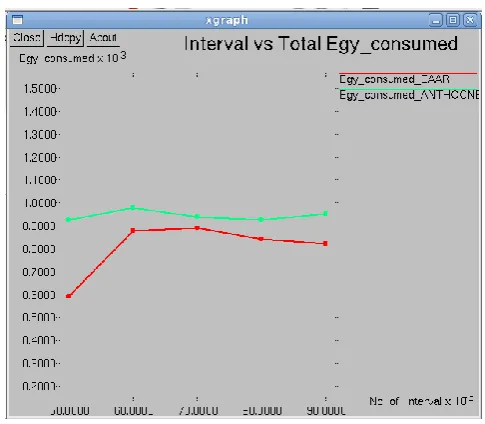
Table 3 shows the total energy consumed in network at different time intervals. As shown in the table, EAAR algorithm performs better than AntHocNet. Initial energy given to the node is 1J and no. of nodes in the network are 50.
TABLE 3: TOTAL ENERGY CONSUMED
The graphical representation of above table is shown in fig. 3 below.
Fig. 3: Interval vs.Total Energy consumed
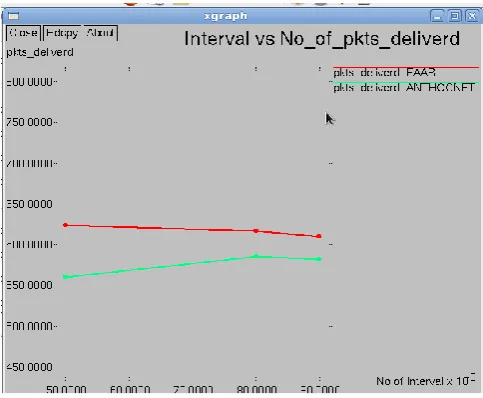
Table 4 shows the tabular results of no. of packets delivered and no. of packets sends for AntHocNet and EAAR. It is seen in table that packets delivered at same time interval for EAAR protocol are more than AntHocNet protocol. So the efficiency of EAAR is increased.
Interval AntHocNet EAAR
0.05 0.00092493 0.000591039
0.06 0.00097891 0.000878989
0.07 0.00093828 0.000891012
0.08 0.00092742 0.00084100
TABLE 4: NO. OF PACKETS DELIVERED
Interval
AntHocNet EAAR
No. of Packets Send
No. of Packets Delivered
Packet Delivery
Ratio %
No. of Packets Send
No. of Packets Delivered
Packet Delivery Ratio %
0.05 592 560 94.5 626 624 99.6
0.08 595 585 98.3 619 617 99.6
0.09 586 582 99.3 613 610 99.5
The graphical representation of above table is shown in fig. 4 below.
Fig. 4: Interval vs. No. of Packets Delivered
V. CONCLUSION
The results show that EAAR is better compared to, AntHocNet in most of the mobility and energy conservation scenarios. The superior energy conservation feature of EAAR, in turn, helps in extending the life of the nodes, which further helps in increasing the lifetime of the network
.
Thus, the performance metrics prove that the EAAR protocol is effective compared to the AntHoc Net.REFERENCES
[1] Sudip Misra, Sanjay K. Dhurandher, Mohammad S. Obaidat, Pushkar Gupta, Karan Verma, Prayag Narula, “An ant swarm-inspired energy-aware routing protocol for wireless ad-hoc networks”, The Journal of Systems and Software, vol. 83, no. 11, pp. 2188–2199, 2010.
[2] Manjula Poojary, B. Renuka, “Ant Colony Optimization Routing to Mobile Ad Hoc Networks In Urban Environments”, International Journal of Computer Science and Information Technologies, Vol. 2 (6), pp. 2776-2779, 2011.
[4] Ehsan Khosrowshahi-Asl, Majid Noorhosseini and Atieh Saberi Pirouz, “A Dynamic Ant Colony Based Routing Algorithm for Mobile Ad-Hoc Networks”, Journal of Information Science and Engineering 27, pp.1581-1596 , 2011.
[5] Ahmed M. Abdel-Moniem, Marghny H. Mohamed, Abdel-Rahman Hedar, “An Ant Colony Optimization Algorithm for the Mobile Ad Hoc Network Routing Problem Based on AODV Protocol”, 10th International Conference on Intelligent Systems Design and Applications, pp. 1332-1337, 2010.
[6] C.-K. Toh, Georgia Institute of Technology, “Maximum Battery Life Routing to Support Ubiquitous Mobile Computing Wireless Ad Hoc Networks”.
[7] S. Chettibi and M. Benmohamed, “A Multipath Energy-Aware On demand Source Routing Protocol for Mobile Ad-Hoc Networks”, computer sciences dpt., university mentouri of constantine, Algeria, 2009.