Copyright to IJIRSET www.ijirset.com 13069
Implementation of Lean Manufacturing Through
The Technique of Single Minute Exchange Oo Die
(SMED) to Reduce Change Over Time.
Mulla M. L.1,Bhatwadekar S.G2, Pandit S.V3
PG Student, Department of Production Engineering, KIT’S College of Engineering, Kolhapur, Maharashtra, India1
H.O.D, Department of Production Engineering, KIT’S College of Engineering, Kolhapur, Maharashtra, India2
Department of Mechanical Engineering, Bharati Vidyapeeth’s College of engineering, Maharashtra, India3
ABSTRACT: Lean production is an integrated management system that emphasizes to a great extent the elimination of
waste and the continuous improvement of operations for the optimization of the benefits derived from its immediate use of scarce resources. It is a complete system that welds the activities of everyone from top management to line workers, to suppliers that can respond almost instantly to marketing demand from consumers. The background of Lean thinking is based in the history of Japanese manufacturing techniques which have now been applied world-wide within many types of industries such as Manufacturing, Construction, Design, Supply Chain, Service industries. This paper revels why changeover time reduction is important in manufacturing industries and the various tool and techniques available within Lean manufacturing mainly SMED for changeover time reduction and its application in Pump Manufacturing industry. This paper also describes principles; benefits and the procedure of application of SMED.
KEYWORDS: Lean, Changeover time, Lean Tools and techniques, SMED.
I. INTRODUCTION
Lean is a culture of real and continuous optimization. Lean as a concept of continuous optimization in the midst of limited resources must be practiced continuously as a long term organizational norm. Imbibing this practice could be carried out even at the expense of short-term financial goals. In making Lean practice a culture in an organization, the five key aspects of satisfying the customer, ensuring real value in the value stream, a well prepared effective and efficient human resource, an in built Just-In-Time system for all activities including deliveries and inventory management and a hallmark of total quality in Process and product must all be built on the foundation of continuous improvement.
The birth of lean was in Japan within Toyota in the 1940s.The Toyota Production System was based around the desire to produce in a continuous flow which did not rely on long production runs to be efficient; it was based around the recognition that only a small fraction of the total time and effort to process a product added value to the end customer[2].
Lean concept was clearly the opposite of what the western world was doing, here mass production based around materials resource planning (MRP) and complex computerized systems was developing alongside the mass production philosophies originally developed by Henry Ford, i.e., large high volume production of standardized products with minimal product changeovers [8].
In comparison, the term lean comes from the upside of the production method which enquires half the human effort, half the manufacturing space, half the investment and half the engineering hours to develop a new product in half the time. Lean Thinking helped us to understand the principles of lean:
Copyright to IJIRSET www.ijirset.com 13070 Company manufactures a variety of pumps, many customers spread across the country. The order quantity of pump was very small because loss of production time at bottleneck machine. Because of bottlenecks, production target of pumps has not achieved as per targeted demand. Thus, there was need to increase the productivity of targeted pump by improving manufacturing performance of pump production line. This includes increasing capacity of machine resources and better utilization of workforces. The company has offered this problem for productivity improvement of targeted pump product. It is proposed to apply Lean Manufacturing approach to current problem by focusing on bottleneck in the production line and improve the productivity of the pump production line by taking care of capacity constraint resource.
II. CASE STUDY
The case study carried out at Pumps Manufacturing industry in Maharashtra. The analysis study applied for selected machine in the manufacturing plant, which is semiautomatic Vertical Boring Machine (VBM). The new emerging approach of lean manufacturing through the technique of SMED applied to manufacturing machine to reduce change over time of pump components. This tool is selected by management of company. The Central planning department, production planning and control department and industrial engineering department have helped us to give past record values of selected manufacturing line. The data such as Central planning department as given monthly customer order, production planning department has given the total existing capacity, machine shop has given classification of simple and complicated jobs depending upon their work experience and industrial department has given vital information like various standard, norms, layout etc.
A. Background of Work
Company manufactures large vertical turbine (LVT) pumps as a tailor made product to fulfil the customer expectation. Also, the order quantity of pump is very small varying from one, two or three in numbers, causing frequent changeovers, average changeovers per month for ‘A’ class components are 160 times and hence loss of production time. This causes delay in delivery of product and the current capacity is not meeting the required delivery schedule. Hence, to meet the current delivery schedule extra capacity is required. Average on-time delivery of vertical turbine pumps from April 2011 to March 2012 is observed to be at 65%.
Manufacturing team analysed this, and came out with basic reasons which affect timely delivery as follows – i. Delay in drawings finalization of pump components,
ii. Customer approvals on general arrangement / cross section ( GA/CS) drawings; iii. Preparation and release of bill of material (BOM),
iv. Material procurement. v. Change over time (COT)
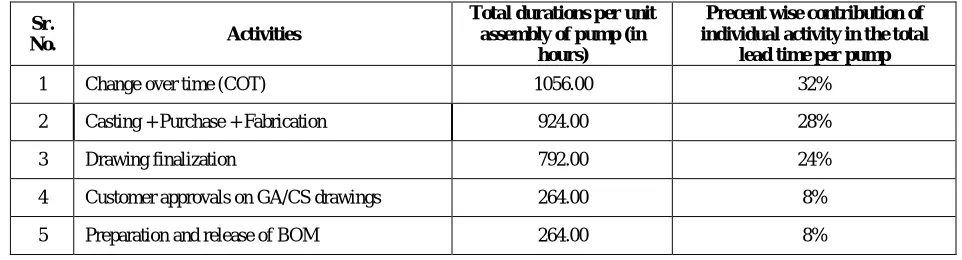
Table I, shows activity wise components of manufacturing lead time for LVT Pump in hours. It is seen that change over time is having major contribution in total lead time per pump as 1056 hours.
TABLE I
ACTIVITY WISE MANUFACTURING LEAD TIME PER (LVT) PUMP
Sr.
No. Activities
Total durations per unit assembly of pump (in
hours)
Precent wise contribution of individual activity in the total
lead time per pump
1 Change over time (COT) 1056.00 32%
2 Casting + Purchase + Fabrication 924.00 28%
3 Drawing finalization 792.00 24%
4 Customer approvals on GA/CS drawings 264.00 8%
Copyright to IJIRSET www.ijirset.com 13071 From table I, the COT as one of the top 5 causes for delay in delivery. While all other causes are affected by some or the other external function / agency, COT was directly under control of Manufacturing section in manufacturing unit. Hence, with an approach that let us first improve ourselves, then ask others to contribute, COT reduction objective is selected for optimization.
B. Problem Definition
To meet customer requirements as per committed delivery schedule by effective utilization of available resources and
eliminating Muda (wastes), it is necessary to reduce changeover time for manufacturing of components of vertical
turbine pump because changeover time is having major contribution in total lead time per pump.
C. Objectives of Case Study
i. To Study of product and assessment of manufacturing facilities for selected division in the case study organization and to identify non value added activity occurring at the identified production area.
ii. Study of product flow process chart.
iii. Collection of production data for past 2 to 3 months.
iv. Collection of capacity data and machine utilization pattern. Thus, Bottleneck machines in a shop will be identified. v. Collection of standard changeover time data from Industrial Engineering Department
vi. Selecting components which require maximum change over time on bottleneck machines.
vii. Study existing changeover practices – It includes study existing changeover process and time required for changeover on a bottleneck machines for components which require maximum change over time under consideration. Time study and Video shooting are the two techniques to be used for understanding and for analyzing the existing practice of set-up changeover. Equipment’s required are Stop watch, Time study forms and Video shooting camera.
a) Finding of major issues from changeover time study.
b) Implementation of lean technique – Implementation of SMED technique will be carried out, as per findings from changeover time study and literature survey.
III. METHODOLOGY
The methodology for proposed case study is based on lean through SMED approach. The important steps in the methodology are as follows,
1. Identification of problem in vertical turbine pump division with help of past data it was observed that on time delivery of vertical turbine pump is majorly affected due to large change over time (COT). It is seen that COT is having major contribution in total lead time per pump.
2. Identify the bottleneck machine.
3. Separate internal and external setup operations 4. Convert internal to external setup
5. Standardize function
6. Use functional clamps or eliminate fasteners altogether 7. Use intermediate jigs
8. Adopt parallel operations 9. Eliminate adjustments 10. Mechanization
Copyright to IJIRSET www.ijirset.com 13072
TABLE II
CHANGE OVER TIME BEFORE IMPLEMENTING SMED TECHNIQUE ON SK-40 VBM
Sr. No
TIME From To ACTIVITIES TIME IN
MIN
1 4.30 to 4.33 Removing of Jig from machine chuck. 3
2 4.33 to 4.38 Removing of shaving from job. 5
3 4.38 to 4.43 Drawing study of next component to load. 5
4 4.43 to 4.58 Unlock the clamps. 15
5 4.58 to 5.00 Cleaning the chuck. 2
6 5.00 to 5.04 Arrangement of crane & hook, to unload the component from machine. 4
7 5.04 to 5.07 Unload the component. 3
8 5.07 to 5.09 Removing of shaving from chuck. 2
9 5.09 to 5.17 Unclamp the fixture. 8
10 5.17 to 5.20 Cleaning of fixture. 3
11 5.20 to 5.22 Tool setting. 2
5.22 to 5.36 Hook positioning to remove the fixture, balancing of fixture. 14 12 5.36 to 5.40 Placing of fixture to desired location. 4
13 5.40 to 5.46 Fixture plate removing. 6
14 5.46 to 5.49 Cleaning T slots of chuck. 3
18 5.49 to 5.53 Positioning of T nuts. 4
19 5.53 to 5.55 Cleaning the outside area of chuck. 2
20 5.55 to 5.57 Cleaning of chuck by cotton waste. 2
21 5.57 to 6.00 Positioning of Screw jacks. 3
22 6.00 to 6.03 Positioning of crane to lift Discharge Head. 3
23 6.03 to 6.13 Setting of jaws. 10
24 6.13 to 6.21 Setting of jack height. 8
25 6.21 to 6.25 Clamping of Jaws. 4
26 6.25 to 6.45 Positioning the Disc Head, clamping. 20
27 6.45 to 6.58 Truing of lower flange, outside dia, adjusting of jack height & clamping of
discharge head. 13
28 6.58 to 7.06 Truing of upper flange, outside dia, adjusting of jack height & clamping of
discharge head. 8
29 7.06 to 7.10 Clamping of Disc head by clamps & jaws tightening. 4
TOTAL TIME(Min.) 160
TABLE III
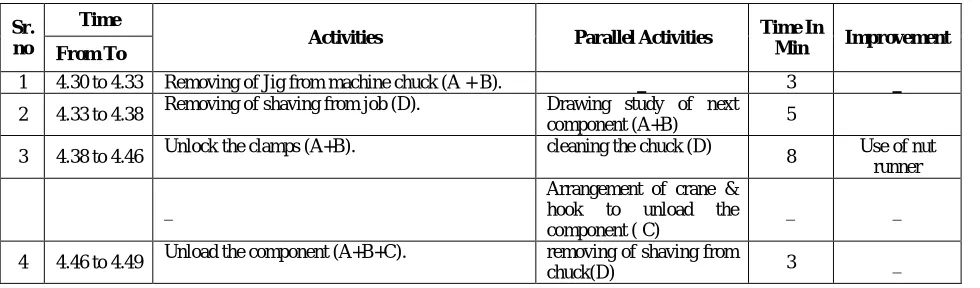
CHANGE OVER TIME AFTER IMPLEMENTING SMED TECHNIQUE ON SK-40 VBM
Change over time after implementing SMED technique on SK-40 VBM is given in table III. A-Permanent operator,B-Floating Manpower,C-Crane operator and D-Sweeper.
Sr. no
Time
Activities Parallel Activities Time In
Min Improvement From To
1 4.30 to 4.33 Removing of Jig from machine chuck (A + B). _ 3 _
2 4.33 to 4.38 Removing of shaving from job (D). Drawing study of next component (A+B) 5
3 4.38 to 4.46 Unlock the clamps (A+B). cleaning the chuck (D) 8 Use of nut runner
_
Arrangement of crane & hook to unload the component ( C)
_ _
4 4.46 to 4.49 Unload the component (A+B+C). removing of shaving from
Copyright to IJIRSET www.ijirset.com 13073 5 4.49 to 4.57
Unclamp the fixture (A+B). cleaning fixture(D), arrangement of crane ( C)
8
6 4.57 to 4.59 Tool setting (A+B). cleaning fixture(D), 2 _
8 4.59 to 5.13 Hook positioning to remove the fixture, balancing of fixture (A+C).
cleaning of chuck T
slots( B+D) 14
7 5.13 to 5.19 Fixture plate removing (A+C), placing of fixture to desired location(C).
cleaning of chuck T
slots( B+D) 6
9 5.19 to 5.23 Cleaning of chuck (B+D). positioning of T nuts
( A) 4 _
10 5.23 to 5.25 Air cleaning of chuck (C). cleaning the outside area
of chuck (D) 2 _
11 5.25 to 5.27 Cleaning of chuck by cotton waste (B+D). _ 2 _
12 5.27 to 5.30 Positioning of Screw jacks (A+B). positioning of crane to lift
Disc Head ( C) 3 _
13 5.30 to 5.40 Setting of jaws (A+B+D). _ 10 _
14 5.40 to 5.45 Setting of jack height (A+B). clamping of Jaws(C+D) 5 Offline height setting of jack 15 5.45 to 5.55 positioning the Disc Head, clamping (A+B+D) C relieved 10 Nut runner
16 5.55 to 6.08
Truing of lower flange, outside diameter adjusting of jack height and clamping of discharge head (A+B+D).
_ 13 _
17 6.08 to 6.16
Truing of upper flange, outside diameter adjusting of jack height & clamping of disc head (A+B+D).
_ 8 _
18 6.16 to 6.20 Clamping of Discharge head by clamps and jaws
tightening. _ 4 _
TOTAL TIME (Min) 110
A-Permanent operator,B-Floating Manpower,C-Crane operator and D-Sweeper.
IV. RESULTS AND DISCUSSION
Copyright to IJIRSET www.ijirset.com 13074
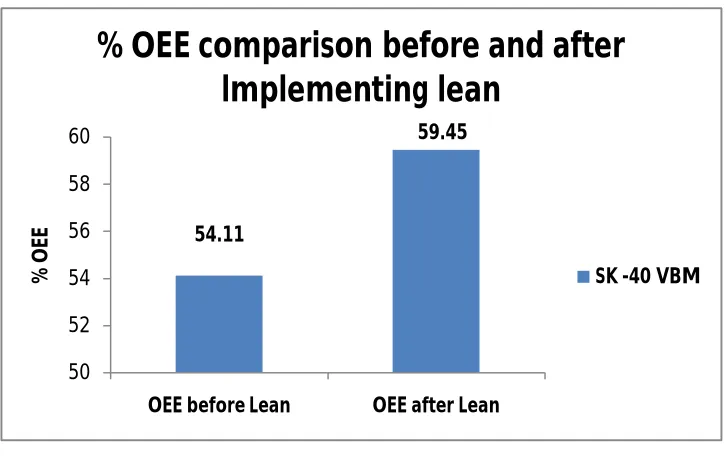
Fig.1 Comparison of OEE before and after implementing Lean
On time delivery is increased from 65% to 77%. Figure 2 shows increase on time delivery from April 2012 to April 2013. Thus, after Lean implementation, on-time delivery is increased up to 12% than previous on-time deliveries.
Fig. 2 On-time delivery for April 2012 vs. April 2013
Improvements observed after implementation of SMED is given below.
Sr.
no Machine name
Current set up time
min
Standard Set up time min
Set up time with SMED approach
min
Time saving per set up in Hr
MHR
Monthly set up
No’s
Annual Saving Rs.
1 SK 40 VBM 160 min 150 min 110min 0.83 min 430
min 31Set up Rs.1,33,300/-
54.11
59.45
50 52 54 56 58 60
OEE before Lean OEE after Lean
%
O
EE
% OEE comparison before and after
lmplementing lean
SK -40 VBM
65
77
55 60 65 70 75 80
April 12 April 13
O
n
t
im
e
d
el
ive
ry
Month
Copyright to IJIRSET www.ijirset.com 13075
V. CONCLUSION
The approach of lean manufacturing through the technique of SMED can be used effectively in any kind of manufacturing machine as it is a world class manufacturing tool. It is evident that production flexibility has been improved with the application of SMED concept. Because of SMED additional capacity gained from the reduction of setup time. SMED is a process and not just a program because a program has a beginning and an end. Therefore, constant sustaining and improvements through SMED must be continuously implemented. The analysed study is case study in Pumps manufacturing industry. The prime objective is to reduce change over time of manufacturing machine. In this study bottleneck machine was identified. Further SMED Tool of lean manufacturing was employed to reduce change over time. This study is carried out on Vertical turbine pump production Line which contributes to 77 % to the total dispatch of Large Pumps and 0.83 minutes save per setup.
VI. FUTURE SCOPE
SMED is a process and not merely a program because a program has a beginning and an end. Therefore, constant sustaining and improvements through SMED must be continuously implemented. Also as studied from literature SMED technique can give maximum of 90% change over time reduction. As we have achieved up to 50% change over time reduction with this project objective still there is further scope for change over time reduction by about 40%. Change over time achieved from SMED again should be reviewed in the same steps and effort should be put for further reduction in Change over time by converting maximum of internal activities to external one and through technical modifications. There is an effort for sustenance of 1 S and 2 S and for implementation of steps 3, 4, and 5 from the 5 S techniques. Various continuous improvements can be carried out under the scope of Kaizen technique such as off line set up chuck, my board concept for storage of drawings, tools, tackles etc. The company can go ahead with the horizontal deployment of this pilot project in whole division and its other divisions also.
REFERENCES
[1] Agustin. R., Santiago, F., 1996, “Single-Minute Exchange of Die”, SEMI Advanced Semiconductor Manufacturing Conference, pp.214-217. [2] Allahverdi, A., Soroush, H., 2008, “The significance of reducing set-up times/set-up costs”, European Journal of Operational Research 187,
pp.978 – 984.
[3] Chung, K., Ming Lin, T., “The impact of set-up cost reduction”, Department of Industrial Management, National Taiwan Institute of Technology, pp.301-303.
[4] Dibia, I., Onuh, S., 2010, “Lean Culturerization: A Long Term Philosophy for Full Optimization of the Human Resource”, Proceedings of the World Congress on Engineering and Computer Science Vol II San Francisco, USA, 1-5.
[5] Goubergen, D., 2000, “Set-up Reduction as an organization-wide problem”, ‘Solutions2000’ conference, Ohio (USA), pp.1- 8.
[6] Goubergena, D., Landeghem, H., 2002, “Rules for integrating fast changeover capabilities into new equipment design”, Robotics and Computer Integrated Manufacturing 18, pp.205–214.
[7] Antonio Carrizo Moreira,Gil Campos Silva Pais (2011) “Single Minute Exchange of Die:-A Case Study Implementation Journal of Technology Management and Innoviation pp29-46 .
[8] Ali Allahverdi H.M. Soroush (2008) “The Significance of reducing setup times /setup costs” Euporean Journal of Operation Research pp978-984.
Copyright to IJIRSET www.ijirset.com 13076 BIOGRAPHY
Mulla M. L Pursuing the PG Program in ME (MECH-PROD) from KIT’s Engg., Kolhapur.
Shamuvel V. Pandit is Assistant Professor at Mechanical Department of Bharati Vidyapeeth college of