The Dynamics of Rigid-Viscoplastic Structures as a Linear Complementarity
Problem
Carmen Lucia Sahlit
Departamento de Engenharia Civil, Universidade de Brasilia 70910-900 Brasilia, DF, Brazil
ABSTRACT
This paper presents a method for establishing the diffuse (non-local) response of a rigid-viscoplastic structure which is subjected to a dynamic loading of such intensity as to cause substantial plastic deformation. The vectorial relations which govern the ensuing motion and which arise from the finite element modelling of the structure are integrated numerically by means of Newmark's method. The evolution of the dynamic response is then expressed by a sequence of linear complementarity problems, which must be solved recursively in a stepwise fashion. Since the values of the plastic multiplier rates are determined at every instant of time in the solution process, the plastic capacities of all yield modes are updated, at every time step, by using a convenient viscoplastic constitutive function.
INTRODUCTION
In a nuclear power plant, the rupture of a pipeline containing high energy fluid results in its high speed motion. To meet design requirements for plant safety, the study of this phenomenon, known as pipe whip, is very important as the whipping pipe may cause damage to other pipes or equipment in the vicinity.
Since in a pipe whip process the imparted dynamic energy is, in general, significantly larger than the maximum amount of strain energy which can be absorbed elastically, a rigid, perfectly plastic beam model for the pipe is widely used. The results of many investigations based upon this model have been published which clarify various aspects of the pipe whip behaviour, e.g. [1 ], [2], [3], [4].
Nevertheless, a literature survey indicates that the assumption of a rigid-plastic material for the pipe may require corrections for other relevant effects such as the dependence of the yield stress on strain rate. In fact, most structural materials are significantly stronger when loaded or strained at the very high rates associated with impacts than they are when subjected to the normal rates associated with long duration service loads. For these materials, the yield stress considerably increases with an increasing rate of straining, being therefore a continuous function of the strain rate throughout the dynamic motion. Clearly this property, referred to as viscoplasticity, should be taken into account in the prediction of the response of dynamically loaded structural systems [5], [6].
In reporting experimental and theoretical investigations of cantilever beams subjected to impulsive loading, Bodner & Symonds [7] have shown that the strain rate sensitivity tends to suppress the travelling hinge mechanisms and to give rise to simpler modes of deformation, with fixed hinge positions, than those predicted by the simple rigid-plastic theory. Some test data, confmned by analytical results, demonstrated that strain rate effects may even increase the final deformation. These characteristics have indicated that, in general, the use of a blanket strain rate correction may introduce serious errors in the analysis. Therefore, Bodner & Symonds have argued the necessity of introducing the effects of viscoplasticity into the constitutive equations of the structural system so that the pattern of deformation, as well as its magnitude, is modified. Further studies of the strain rate influence have been undertaken by Ting & Symonds [8], Ting [9] and, more recently, Stronge & Yu [6], among many others.
In view of the highly nonlinear variation of yield stress with strain rate, the inclusion of this effect unfortunately introduces severe mathematical complications into any analytical treatment. Consequently, finite element numerical methods have been developed. Invariably, since these methods are founded upon elastic structural analysis, they also include the effect of elasticity, and the scale of computation is generally extensive [ 10]. It may therefore be argued that there is a clear need for the development of a simple numerical method for calculating the dynamic response of a rate sensitive, rigid-plastic structure subjected to impact loading.
The objective of this paper is to present a mathematical programming approach to the automatic determination of the dynamic response of a rigid-viscoplastic framed structure (a pipe in the context of pipe whip) subjected to a high intensity, short duration pulse loading and/or an impulsive loading (the blowdown force). The frame is envisaged as a structural network and the mass is assumed to be lumped at the nodes. Plastic deformations are considered to be concentrated at critical sections which are located at some of the element extremities. A nodal description of the kinetic and kinematic laws is given under the restriction of small displacements. The material is assumed to be rigid, perfectly plastic and strain rate sensitive, and a piecewise linear approximation of the yield surface is considered. The fundamental vectorial relations which govern the dynamic response are then integrated numerically by means of the well known method of Newmark. For each
SMiRT 16, Washington DC, August 2001 Paper # 1292
increment of time, there emerges a linear complementarity problem (LCP) which can be solved by a variant of the Wolfe algorithm in its short form [ 11 ].
V I S C O P L A S T I C C O N S T I T U T I V E E Q U A T I O N S
Among the many laws proposed, the viscoplastic equation advanced by Cowper and Symonds [12] seems to be the most extensively used in the pertinent literature. This equation has the form
1
cr ~ p
° 0 - 1 + , ( 1 )
where o-is the dynamic yield stress at an uniaxial plastic strain rate o b , o "° is the associated static yield stress of the material at its origin state, and D and p are material constants, a record of them being presented in [5]. Bending effects are preponderant in many structural problems and a constitutive equation for the strain rate sensitive behaviour of a material subjected to a pure bending moment may be obtained by the integration of (1) through the depth H of a beam with rectangular cross section as
1
M
2 p
¢
")P
(2)
M 0 - 1 + 2 p + 1
In Eq. (2), M and M°are the dynamic and static plastic moments, respectively, and ]¢ is the plastic curvature rate.
In a bending element, plasticity tends to develop in a zone which occupies a finite length of the element, and the plastic curvature k may vary throughout that zone. The modelling adopted in this work, however, concentrates the plastic deformation at a critical section. It follows that the concentrated deformation or plastic-hinge rotation 0 is equivalent to the integral of the plastic curvature along the length of the actual plastic zone. Since the variation of the curvature along the plastic zone is difficult to be defined, an estimate of 0 is obtained by assuming that the curvature is constant along some equivalent length z of the plastic zone. Thus,
O-zk,
O : z k
(3, 4) where, in the second of these relations, z is assumed to remain constant.
Estimations of the length z of the plastic region for impulsively loaded structures have been presented by several authors, being a common practice to adopt a constant value for z in each phase of, or for all, the response [ 13]. It seems that the dynamic response of a structural system is not very sensitive to the choice of this parameter, which is usually adopted as z = (2 to 5)H [5] or z = (2 to 12)H [14], respectively.
F U N D A M E N T A L S T R U C T U R A L R E L A T I O N S
The nodal description of kinetics and kinematics for the problem is of the form suggested in (5) and (6), respectively:
under the restriction of small displacements.
A
~ - A a d
1
Ao
(5, 6)
In these relations, X are the independent member forces and .i: are the corresponding (or dual) member deformation rates at time t; & are the current applied loads and ~ are the dual load-point velocities; Q are the nodal constraint forces, which must remain null for the sake of dynamic equilibrium, and q are the dual velocities, corresponding to the Lagrange or generalised coordinates. Relations (5) and (6) display an adjoint form that is known as kinetic-kinematic duality [15]; they are not independent since the current values of the inertia forces/t may be expressed as
# = - m / i (7)
where m is a diagonal matrix containing the mass, or inertia, coefficients associated with the dynamic degrees of freedom u. It should be noted that the inertia coordinates u form, in general, a subset of the generalised coordinates q .
The appropriate constitutive laws are given by Maier's [ 16] matrix representation of nonholonomic plasticity as
y, >0
(y,)V .i¢,
= 0 5c, > 0 (8 a-e)where vectors S and s contain respectively the stress resultants and the dual strain resultant rates, which contribute to the plastic dissipative energy at the critical sections. The plastic capacities are collected in array X,, the vector of plastic multiplier rates .i:, lists the contribution to s of each yield mode associated with the plastic potentials y., and N is the matrix that contains the unit outward normal vectors to the piecewise linear yield surface.
Since the stress resultants S at the critical sections are not, in general, coincident with the independent member forces X, measured at the element termini, the dual transformations (9) and (10) are necessary:
= T ~ , S = TVX. (9, 10)
THE GOVERNING SYSTEMS
A nodal formulation for the rigid-plastic governing system may be obtained after a proper combination of the dynamic equilibrium and compatibility relations, with the plastic constitutive laws presented above. In principle, the determination of kinetic and kinematic variables throughout the structure, as they develop along a given history of external actions, implies the analytic time integration of such a governing system so as to satisfy the initial conditions. Nevertheless, no work on the mathematical solution of such problems is yet known to the author, and a numerical method of solution is thereby necessary.
In Newmark's integration scheme, the acceleration and displacement components of the generalised coordinates q at time t-- t,+l are calculated approximately by means of
17 n+l ~ b0 ( 17 n+l- 17 n)" bl #n (11)
where the constants are
q,,+l ~ q,, + b2 gl,, + b3 q,, +
b4 #n+l, (12)- b o M q
- A T
0
0
X
0
-Qo
- A 0 T N 0 -
.ic ,
0 N Z T z 0 I X , n+l
Y, n+l
Y*n+l > 0 (Y*n+l)T "~*n+l - 0 "~*n+l > O. (14 a-f)
T
in which
Mq = h a m A a
denotes the mass matrix referred to the accelerations /1 of the generalised coordinates and vector Qn+l is given byQ--~+I =
hro /~,,+l + Mq (bo
C n +bl q
n) (15)1
1 - 7b° - F A t ' bl - 7 _ , b2 = At
b3 = ( 0 . 5 - /~ ) A/2, b4 = j~ At 2. (13 a-e)
The values fl = 0.25 and y = 0.5, which represent a constant average acceleration scheme, seem to give a stable and robust numerical procedure for rigid-plastic dynamics [ 11 ]. Therefore, they have been contemplated herein.
Relations (14), which appear in the form of a symmetric LCP, constitute an approximating representation for the state of the rigid-plastic structure at time t = tn+l. The recursive solution of this LCP, that may be achieved by means of a variant of Wolfe's simplex algorithm in its short form [ 11 ], allows the dynamic evolution of the rigid-plastic structural response to be followed.
The proposed governing system (14) for rigid-plastic dynamics may now be modified to account for the effects of strain rate sensitivity. Clearly, the only modification to be done in system (14) is the updating, at each time station t = tn+l, of the vector X, of plastic capacities. In the context of the present investigation, it is assumed that plasticity is controlled by the bending moment M and the dual plastic-hinge rotation rate t). Therefore, only the corresponding components of X, and
x , must be evaluated at each instant of time.
By considering the viscoplastic law (2), together with equation (4), the plastic capacity
(X~j),,+1
associated with the j- th yield mode at the i-th critical section in the structural system, evaluated at time t = tn+l, may be expressed in the form1
(X~j),,+l -
,j
2p + 1 2zD
t'1
(xi ) 0
(xi )n
i s t h ewhere ,j is the corresponding plastic capacity for the original state of the structural material and ,j corresponding plastic multiplier rate, evaluated at time t = tn.
The dynamic evolution of the viscoplastic structural response can now be followed by a sequence of discrete solutions of the governing LCP (14), which must be solved for each time increment in the required time domain, with successive updating of the right hand side vector Qn+l and of the vector of plastic capacities X,, by employing relations (15) and (16) respectively.
It is worth noting that, in order to sustain accuracy, it is advisable to determine the accelerations ~ of the generalised coordinates through the satisfaction of the kinetic equations (5) at each time increment, instead of using the Newmark expression (11).
I N I T I A T I O N OF T H E S O L U T I O N S E Q U E N C E
As the initial values of the independent member forces X (t = 0) = X0 are generally indeterminate in a rigid-plastic or viscoplastic structure, the initial accelerations cannot be established through the satisfaction of the kinetic equations (5). It therefore becomes necessary to establish the initial governing system in terms of accelerations.
The structure is assumed to be initially at rest and is subjected to a loading pulse ~. and/or a given velocity distribution ( t = 0) = q 0. If the structure is excited by an applied impulse, it is always possible to make the impulse acting on the influence area of a specific mass equal to its momentum, since the lumped mass distribution is known. The initial generalised velocity vector q0 may then be partitioned into two subvectors q k0 and q u0, where q k0 collects the known components of q 0 and q u0 the unknown ones.
In order to determine the yield surfaces which are initially activated, the nonholonomic plasticity laws (8) may be interpreted as the necessary and sufficient conditions for optimal solutions to a pair of dual linear programming problems (LPs). If the primal LP is combined with the compatibility relation (6), partitioned accordingly to the known and unknown components of the velocity vector tl 0, the following LP for time t = 0 is then found:
Minimise
z - [ X f
O r ,0 .L"I uo
Subject to
[TN
-A~lV:l
,0 _ A k q k 0 ;k'~uO
And .i:, o >_ 0 (17 a-c)
The solution of LP (17) def'mes completely the initial structural velocity field. The vector of initial plastic multiplier rates .~, (t = 0) = J:, 0 is now determined and may be partitioned into two subvectors x , yo and .~, ~o, in which subscript y indicates that the subvector is referred to the active yield modes at all critical sections and r denotes that the subvector is referred to the nonactive yield modes. Since the triad of nonholonomic complementarity conditions in relations (8) must hold for all instant of time t, it may be shown [ 11 ] that, for t = 0, y , y0 is unrestricted and
Y, ro > 0 Yfro -r,r0 = 0 "r*~0 -> 0 (18a-c)
Taking into consideration relations (18), the plasticity laws (8) may then be expressed in terms of accelerations. By combining them with the fundamental conditions of kinetics (5) and kinematics (6), it is relatively straightforward to establish the nodal formulation for the initial goveming system in terms of accelerations as
o
o
o
X o
0 T N y TN~ 0 0
/ 0 N r y T T 0 0 0 l X'Y° - X , y o
[o
N ~ T r 0 0 x*~° X,~ oY,ro
Y,~o -> 0 Y,r~o
"~*r0-" 0
"~*r0 -> 0 (19 a-g)LCP (19) is a representation, "exact" within the discrete modelling assumption, for the state of the structure at t = 0. Its solution provides the data necessary for initiating the evolutive sequence of solutions to the approximating goveming system, LCP (14). It is worth noting that it is also necessary to calculate the initial vector of plastic capacities X , (t = 0) =
X , 0, by using expression (16), since the initial vector of plastic multiplier rates is not null.
ILLUSTRATIVE EXAMPLES
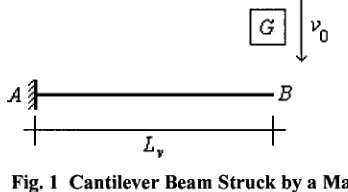
To test the procedure and to verify the influence of strain rate sensitivity in the plastic behaviour, two examples have been selected. The first is that of a uniform cantilever beam which is struck transversely at the tip by a mass G travelling with velocity v0, as shown in Figure 1. It is assumed that the striker remains in contact with the beam after impact.
A,I
I
B
Fig. 1 Cantilever Beam Struck by a Mass
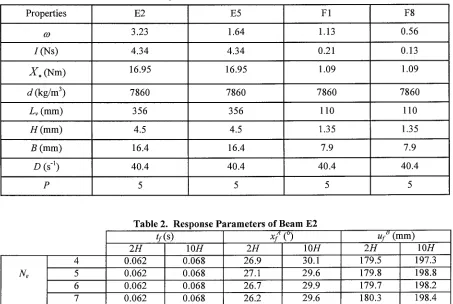
In order to relate the discussion to a more practical context, four mild-steel beams corresponding to the experimental tests E2, E5, F1 and F8, described in [7], are analysed, thus taking into account heavy and light strikers. Table 1 lists the properties of these beams, where Lv is the length of the beam, co is the ratio between the striker and the beam masses, I is the applied impulse, X , is the plastic capacity, d is the specific density of the material, H and B are the depth and width of the rectangular cross section, respectively, and D and p are the viscoplastic constants of the material.
Properties
I (Ns) X , (Nm) d (kg/m 3)
Lv
(mm) H (mm) B (mm) D(s -1)P
Table 1. Properties of Beams E2, E5, F1 and F8
E2 3.23 4.34 16.95 7860 356 4.5 16.4 40.4 E5 1.64 4.34 16.95 7860 356 4.5 16.4 40.4 F1 1.13 0.21 1.09 7860 110 1.35 7.9 40.4 F8 0.56 0.13 1.09 7860 110 1.35 7.9 40.4
Ne
Ref. [6] Rigid-Plastic
Table 2. Response Parameters of Beam E2
¢~(s)
2H 0.062 0.062 0.062 0.062 0.065 0.093 10H 0.068 0.068 0.068 0.068 0.065 2H 26.9 27.1 26.7 26.2 26.4C (o)
42.1 10H 30.1 29.6 29.9 29.6 29.0 2H 179.5 179.8 179.7 180.3 187.9
uf"
(mm) 10H 197.3 198.8 198.2 198.4 204.3 269.2If the columns for
tf in
Table 2 are scanned, it will be observed that the duration of the motion appears not to be influenced by the number of elements adopted in the discrete modelling of the cantilever. Although the results are slightly dependent on the effective lengthz,
they are almost identical to that obtained by means of [6]. It may also be noticed that the viscoplastic duration is much smaller than the rigid-plastic one.It transpires that good results for the final angular deformation
x/A
and the tip desplacement Zlf B a r e also achieved byadopting Are = 4. Once again, the results predicted by the viscoplastic LCP formulation and by the method proposed in [6] are practically equivalent, being much smaller than the corresponding rigid-plastic parameters.
In the classical studies of the uniform cantilever beam [5], [6], [7], [12], particular attention falls on the final angular displacement at the tip
qu a.
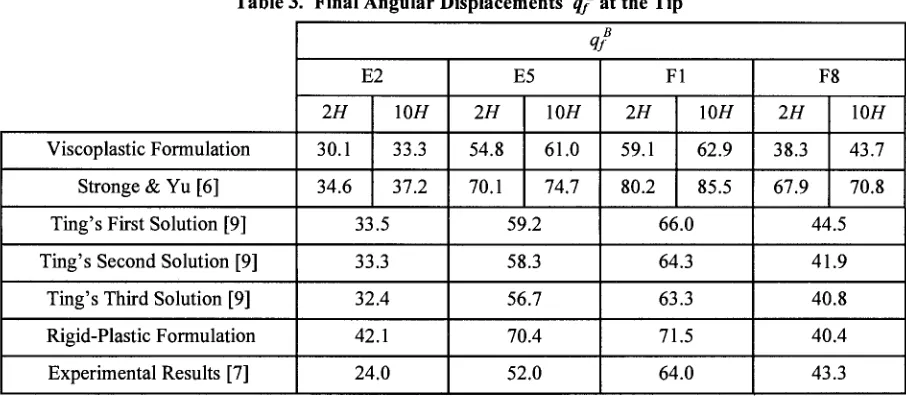
Values of this response parameter have been obtained for E2, E5, F1 and F8 beams by the viscoplastic LCP formulation, adoptingNe
= 4, and by the rigid-plastic LCP formulation, usingNe
- 12. They are listed in Table 3, together with the corresponding experimental results [7]. For comparison, the viscoplastic values given by the technique described by Stronge and Yu [6], and the results obtained by using three analytical viscoplastic solutions, proposed by Ting [9], are also presented in the same table.Certain conclusions may be drawn from the scanning of Table 3. Firstly, the results obtained by the viscoplastic LCP formulation proposed herein are in quite good agreement with Ting's analytical solutions [9]. Also, by comparing the deformations furnished by the rigid-plastic and viscoplastic LCP formulations, it may be verified that the introduction of strain rate sensitivity considerably reduces the rigid-plastic predictions, approximating the results significantly to the experimental values furnished in[7].
As discussed by Stronge & Yu [6], their method furnishes good results only for heavy strikers, which is the case of beam E2. With the progressive reduction of the striker mass, as in tests E5, F1 and F8 respectively, the results obtained by means of [6] begin to be unreliable, presenting the divergences shown in Table 3. In all cases studied herein, the viscoplastic LCP formulation provides much better results than [6], when compared to Ting's solutions [9] and to the experimental values [7].
Table 3. Final Angular Displacements q s ~f at the Tip
Viscoplastic Formulation Stronge & Yu [6] Ting's First Solution [9] Ting's Second Solution [9]
Ting's Third Solution [9] Rigid-Plastic Formulation Experimental Results [7]
B
qy E2
2H 10H
30.1 33.3 34.6 37.2
33.5 33.3 32.4 42.1 24.0
E5
2H 10H
54.8 61.0 70.1 74.7
59.2 58.3 56.7 70.4 52.0
F1
2H 10H
59.1 62.9 80.2 85.5
66.0 64.3 63.3 71.5 64.0
F8
2H 10H
38.3 43.7 67.9 70.8
44.5 41.9 40.8 40.4 43.3
As a second example, the dynamic plastic response of a fully clamped beam of length 2L, shown in Figure 2, when struck at the mid-span by a mass G travelling with an initial velocity v0, is now studied, assuming again that the striker remains in contact with the beam after impact. It is considered that the beam has the properties of the aluminum alloy beam G 1, tested by Bodner and Symonds [7], which are: length 2L = 0.152m; depth H = 0.00648 m and width B = 0.02 m of the rectangular cross section; mass ratio co. = 3.25; applied impulse I = 4.34 Ns; plastic capacity X , = 55 Nm; material density d = 2712 kg/m3; viscoplastic constants D = 6500 s l and p = 4.
I
I
I
Fig. 2 Clamped Beam Struck by a Mass
From these data, it follows that the mass of the striker is G = 0.174 kg and its initial velocity v0 = 24.94 m/s. By using these values and adopting the approach described by Jones [5], the exact rigid-plastic response of the continuum clamped beam may be easily found, the permanent transverse displacement of the beam central point being equal to u, = 0.0170 m.
Values of the rigid-plastic response such as the transverse mid-span displacement u, at standstill and the duration tf of the motion have been found through the application of the rigid-plastic governing system, LCP (14). They are shown in Table 4, where it may be observed that the rigid-plastic final displacement u, ,predicted by the mathematical programming formulation, converges rapidly to the continuum (exact) solution given above, since for Ne = 8, the error is equal to -0.59 %. In order to study the effects of strain rate sensitivity, the same response parameters have been found by employing the viscoplastic formulation developed herein. Their values, which are also indicated in Table 4 for the same discretisations adopted in the rigid-plastic case, have been evaluated by assuming that the effective length z of the plastic region is equal to 2H. Once again, it may be verified that the introduction of strain rate influence considerably reduces the rigid-plastic predictions, the final mid-span displacement ufc and the duration tf of motion in the viscoplastic response being 17.93% and
N~
Table 4. Response Parameters of Clamped Beam
ufo (m)
0.0162
0.0171
Rigid-Plastic
0.00142
0.00146
Rigid-Viscoplastic
uf~ (m)
0.0137
0.0145
tf(s)
0.00124
0.00125
FINAL REMARKS
A systematic procedure, based upon mathematical programming methods, has been given for formulating and automatically solving the problem of a rigid-viscoplastic framed structure (a pipe in the context of pipe whip), excited into motion by a high intensity pressure loading (the blowdown force). The results of numerical examples are compared with analytical and experimental results found in the pertinent literature and it is seen that they are in good agreement, thus validating the present formulation.
It is shown the importance of introducing viscoplasticity effects in the rigid-plastic dynamic analysis since the strain rate sensitivity reduces considerably the duration of motion and the final permanent displacements, approximating the results significantly to the experimental values. Further details of the presented formulation and additional numerical examples may be found in [ 11 ] and [ 17].
REFERENCES
.
.
.
.
10.
11.
12.
13.
14.
15.
16.
17.
Hua, Y.L., Yu, T.X. & Johnson, W., "The plastic hinge position in a bent cantilever struck normal to its plane by a
steady jet applied at its tip", International Journal oflmpact Engineering, Vol. 3, 1985, pp. 233-241.
Yu, T.X., Symonds, P.S. & Johnson, W., "A reconsideration and some new results for the circular beam impact
problem", International Journal of Impact Engineering, Vol. 4, 1986, pp. 221-228.
Reid, S.R., Hua, Y.L. & Yang, J.L, "Development of double hinge mechanisms in a bent cantilever subjected to an
out-of-plane force pulse", International Journal of Impact Engineering, Vol. 9, 1990, pp. 485-502.
Sahlit, C.L. & Smith, D.L., "The Evolution of Rigid-Plastic Dynamic Response by Mathematical Programming",
Transactions of the 13 th International Conference on Structural Mechanics in Reactor Technology (SMIRT 13), Vol. 4, pp. 389-394, Federal University of Rio Grande do Sul, Porto Alegre, Brazil, August 1995.
Jones, N., Structural Impact, Cambridge University Press, Cambridge, 1989.
Stronge, W.J. & Yu, T.X., Dynamic Models for Structural Plasticity, 2 nd edition, Springer-Verlag, London, 1995.
Bodner, S.R. & Symonds, P.S., "Experimental and theoretical investigation of the plastic deformation of cantilever
beams subjected to impulsive loading", Journal of Applied Mechanics, Vol. 29, 1962, pp. 719-28.
Ting, T.C.T. & Symonds, P.S., "Impact of a Cantilever Beam with Strain Rate Sensitivity", Proceedings of the 4 th
U.S. National Congress of Applied Mechanics, ASME, New York, pp. 1153-65, 1962.
Ting, T.C.T., "The plastic deformation of a cantilever beam with strain-rate sensitivity under impulsive loading",
Transactions of the ASME, Journal of Applied Mechanics, Vol, 31, 1964, pp. 38-42.
Raphanel, J.L. & Symonds, P.S., "The estimation of large deflections of a portal frame under asymmetric pulse
loading", Transactions of the ASME, Journal of Applied Mechanics, Vol. 51, 1984, pp. 494-500.
Sahlit, C.L., Mathematical Programming Methods for Dynamically Loaded Rigid Plastic Framed Structures, Ph.D.
thesis, Department of Civil Engineering, Imperial College, University of London, 1992.
Cowper, G. R. & Symonds, P.S., Strain-Hardening and Strain-Rate Effects in the Impact Loading of Cantilever
Beams, Report No. 28, Division of Applied Mechanics, Brown University, Providence, R.I., 1957.
Mosquera, J.M., Symonds, P.S. & Kolsky, H., "On elastic-plastic and rigid-plastic dynamic response with strain rate
sensitivity", Proceedings of the ASCE, Journal of Engineering Mechanics, Vol. 111 (11), 1985, pp. 1380-401.
Symonds, P.S., Survey of Methods of Analysis for Plastic Deformation of Structures under Dynamic Loading, Report
BU/NSRDC/1-67, Division of Engineering, Brown University, Providence, R.I., 1967.
Smith, D.L. & Sahlit, C.L., "Dynamic response of pulse loaded structures as a linear complementarity problem",
Engineering Optimization, Vol. 18, 1991, pp. 23-41.
Maier, G., "Mathematical Programming Methods in Structural Analysis", Proceedings of the International
Symposium on Variational Methods in Engineering, ed. H. Tottenham & C. Brebbia, Southampton University Press, Opening Lecture of Session VIII, Vol. 2, pp. 8/1-8/32, Southampton, 1973.
Reis, E.J.G., Dynamic Analysis of Rigid-Plastic Structures by Mathematical Programming with the Consideration of