Article
Study on Storm Surge Using Parametric Model with
Geographical Characteristics
Yeon-joong Kim 1,*, Tea-woo Kim 2 and Jong-sung Yoon 1,*
1 Department of Civil and Urban Engineering Inje University, Gimhae, 50834, Republic of Korea
2 Department of Construction Technology Institute, Inje University, Gimhae, 50834, Republic of Korea;
* Correspondence: [email protected] (Y.-J. K.); [email protected] (J.-S. Y); Tel.: +80-55-320-3694(Y.-J. K.) ; Tel.: +80-55-320-3434(J.-S. Y.)
Abstract: Recently, the intensities of natural disasters have increased significantly owing to climate change and various other environmental factors, causing unprecedented damage. Measures must be established to reduce damage from large-scale natural disasters caused by the rapidly changing environment. The Japanese government published a hazard map manual in 2015 and obligates the creation of a hazard map as a measure to reduce high-scale storm surges. This manual presents a typhoon model based on a parametric model that is used to create a hazard map. The Myers model assuming concentric circles, which is primarily used in East Asia, is disadvantageous as it cannot consider geographic characteristics. Therefore, a new parametric model is necessary to calculate wind and pressure fields, which change according to geographic characteristics. To improve this limitation of the Myers model, we calculated the wind and pressure fields considering geographical effects by combining the Holland model, which can consider the size of a developing typhoon, and the Mascon model, which changes by geographic characteristics. To determine the gradient coefficient of the Holland model, the coefficient that changes every moment was calculated using grid point value data. The result indicated excellent reproducibility of storm surge height according to the geographic characteristics.
Keywords: storm surge; hazard map; typhoon model; GPV data; typhoon model
1. Introduction
Recently, the intensities of natural disasters have increased significantly owing to abnormal climate and various environmental factors; furthermore, natural disasters have occurred more frequently than before and have caused severe damages. In particular, typhoon no. 21 “Jebi,” in 2018, caused flood damage (Fig. 1) [1] by a storm surge at the Kansai International Airport in Japan for the first time since its construction, in addition to severe property damage and casualties throughout Japan including Osaka. Hence, damage reduction measures against large-scale natural disasters are urgently required in this rapidly changing environment. The establishment of integrated measures is critical for mitigating the current natural disasters because they are characterized by their large scale, possibility of simultaneous occurrence of multiple disasters, and extremely high risk of danger (Kim et al. 2015) [2]. Furthermore, even if the cause of disaster is identical, disasters may appear differently depending on the regional characteristics. Therefore, reduction measures should be established based on studies regarding disaster occurrence mechanism.
Damage cases from large-scale natural disasters are being reported worldwide. In particular, Japan has experienced the Great East Japan Earthquake in 2011 and is still striving to recover from the damage. Large-scale disasters can occur along with multiple disasters even by one single external force, and the damage can threaten the functions of cities and states. Consequently, based on experience gathered from large-scale disasters, the Japanese government is now establishing measures to prevent large-scale external forces and investigating the construction of disaster
prevention systems in all disaster prevention fields. As a measure for large-scale storm surges, Japan has obligated the creation of hazard maps for storm surges by revising the Flood Control Act in 2015, published a hazard map manual (MLIT, 2015) [3], and conducted many reviews regarding frequent storm surge damage regions.
Many studies on storm surge have been conducted worldwide. Several researchers have shown that the coupling of surge, wave and tide is a key element to improve the accuracy of total water level for coastal prediction [4-7]. Storm surge is a natural disaster that causes flooding in lowland and coastal areas due to a rise in sea level resulting from complex factors, including air pressure drop, wind, and high waves [8-11]. To estimate storm surges in North East Asia, the Myers model (Myers and Malkin, 1961) [12] is often used, which approximates pressure distribution near the center of a typhoon using concentric circles. Among the many causes of sea level rise due to storm surges, the rise in storm surge by wind changes significantly by the regional characteristics. Kim et al. (2007) [13] investigated the effects of land surface topography using the Mascon model to estimate sea surface wind in shallow waters. Many researchers have also investigated wave transformation at the coastal area. In particular, Lee et al. (2017) [14] conducted numerical studies on the nonlinear interaction between the seawater and freshwater in a coastal aquifer and Kim et al. (2018) [15] analyzed the river discharge and salinity mixing due to wave on the geographical characteristics. Kim et al. (2019) [16] presented the changes in the sediment budget transport caused by long-term wave change.
The effect of large-scale storm surges was evaluated for the target region of this study, where the risk of flood damage is high owing to the large number of reclaimed lands and lowland flats. In floods caused by storm surges, the duration of flooding is long, complicating disaster recovery and increasing secondary damage. In particular, the shape of a typhoon passing between Korea and Japan and moves to the East Sea is distorted from the shape of a concentric circle. Furthermore, in this region, the maximum sea level occurs after several tens of hours since the time the typhoon approached it the closest.
In this study, among the typhoons that have occurred thus far, those with the possibility of the highest damage have been classified by tracks based on the manual (MLIT, 2015). According to the manual, storm surges are estimated by setting the central pressure and velocity of typhoons to the highest scale according to the moving tracks of past typhoons. The manual recommends the Myers (Myers and Malkin, 1961) [12] typhoon model. However, the Myers model, which is a concentric model, does not consider land topography when calculating wind and pressure fields [25-29]. The typhoon model for the target region must consider geographical characteristics to reproduce the maximum sea levels according to the geographical characteristics, and this study aims to propose a new analysis method that allows for topographic consideration. Consequently, the storm surge height reproducibility of the proposed method was evaluated to be excellent.
.
2. Analysis of Typhoon Characteristics
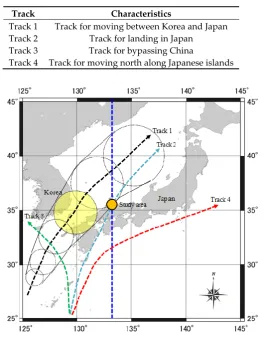
The 460 typhoons that landed or approached the target region were analyzed using digital typhoon data [17] from 1951 to 2016. The moving tracks of typhoons were classified according to the characteristics of the typhoons, as shown in Table 1. The sea level differences observed at the sea level monitoring station (Sakai) located closest to the target region were analyzed for each track. Subsequently, the typhoons in which the maximum sea level occurred are listed in Table 2. According to the analysis result, the maximum sea level occurred in track 1, for which the typhoon moved to the East Sea after passing through Korea and Japan as shown in Fig. 2. In particular, the target region showed that the maximum sea level occurred after approximately 10 to 30 h after the center pressure of the typhoon reached its maximum. Therefore, a storm surge model that considers the maximum sea level occurrence mechanism must be developed to investigate storm surges in the target region. Results of five selected typhoons and characteristics of sea level based on observed data at Sakai station as shown in Fig. 3.
Table 1. Classification of typhoons by track.
Track Characteristics
Track 1 Track for moving between Korea and Japan Track 2 Track for landing in Japan
Track 3 Track for bypassing China
Track 4 Track for moving north along Japanese islands
Figure 2. Classification of typhoons by Typhoon track at study area.
Table 2. The maximum tide and surge of the typhoon from the different track.
Track Number Tide (m) Storm surge (m) Max. Top 5 (Avg.) Max. Top 5 (Avg.)
Track 1 133 1.102 1.041 0.630 0.560
Track 2 159 0.962 0.856 0.400 0.358
Track 3 22 0.776 0.763 0.250 0.227
Figure 3. Results of selected of 5 typhoon and characteristics of sea level based on observed data at Sakai station.
3. Building the Storm Surge Model
In this study, a storm surge prediction model was constructed based on the published manual (MLIT, 2015) [3].
3.1. Structure of the Storm Surge Model
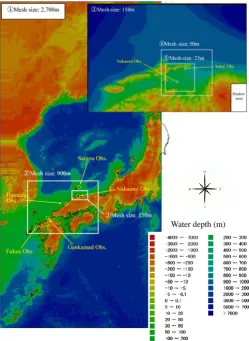
The storm surge model is composed of a model for estimating pressure and wind fields (wind direction and velocity), a wave model, and a storm surge estimation model (Fig. 4). The model was built considering the Coriolis force, air pressure variation, sea surface friction, and wave radiation stress using the Myers typhoon model; the SWAN model [18] for wave calculation; and the nonlinear longwave equation for storm surge estimation. The grid structure of the model is shown in Fig. 5.
Figure 5. Computation domain with observation stations.
3.2. Model Verification
The proposed model was validated by estimating the pressure and wind velocity fields using the method suggested in the manual (Myers model) and by calculating the storm surge height using the grid point value (GPV) [19] analysis results provided by the Japan Meteorological Agency [20]. GPV data is that the archive is maintained by the center for computational sciences, University of Tsukuba, for the purpose of scientific development of the weather and climate forecasting technology. The Myers model is used to calculate sea surface wind by assuming a concentric air pressure distribution and presents a limitation in reproducing wind and pressure fields, which change by geographical characteristics. However, the GPV data (MSM: grid size 5 km), which include the Japanese meteorological model used in this study, reproduce the wind and pressure fields well considering the effect of the wind field that varies by geographical characteristics.
3.3. Results of Model Verification
Fig. 6 shows the reproduced and observation results using the Myers model and GPV data for the air pressure, wind velocity, wave height, sea level, and sea level differences of typhoon no. 14 in 2003, which recorded the highest water level at sea level monitoring stations (Sakai, Nakaumi) near the target region. As shown in this result, the Myers model reproduces peak values of air pressure, wind velocity, and wave height relatively well. The observed value and model result of the maximum sea level difference were 0.63 and 0.60 m, respectively, indicating high reproducibility. However, the observed and estimated values of the maximum occurrence time were 9/13 19:00 and 9/13 5:00, respectively. Hence, the estimated value was reproduced 14 h earlier than the observed value. Meanwhile, the GPV model underestimated the peak value but correctly reproduced the peak
occurrence time. This result validated the proposed model; however, the Myers model presented a limitation in estimating the storm surge height reflecting the geographical characteristics of the region.
Figure 6. Results of the numerical simulation.
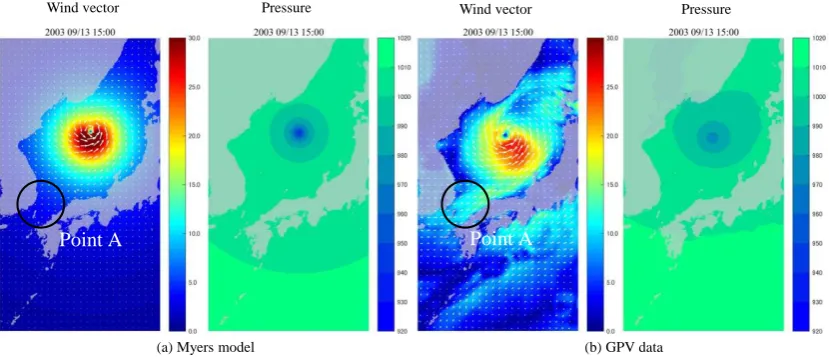
Fig. 7 shows the planar distributions of the wind direction and velocity using the Myers model and GPV data. A planar distribution was observed at 15:00 on September 13, 2003 when the peak wind velocity was recorded at the Sakai station. This result confirmed that the typhoon shape was altered by the geographical characteristics as the typhoon was moving to the north. In particular, the wind velocity at point A in the region between Korea and Japan was less than 5 m/s for the Myers model assuming concentric circles, whereas it was higher than 10 m/s in the GPV data. This difference was presumed to be caused by the geographical characteristics of Korea and Japan while the typhoon was moving north toward the East Sea. Therefore, a new typhoon model must be developed because the Myers model assuming concentric circles failed to correctly reproduce the characteristics of the typhoon moving north toward the East Sea.
Figure 7. Results of wind vector and pressure based on typhoon models.
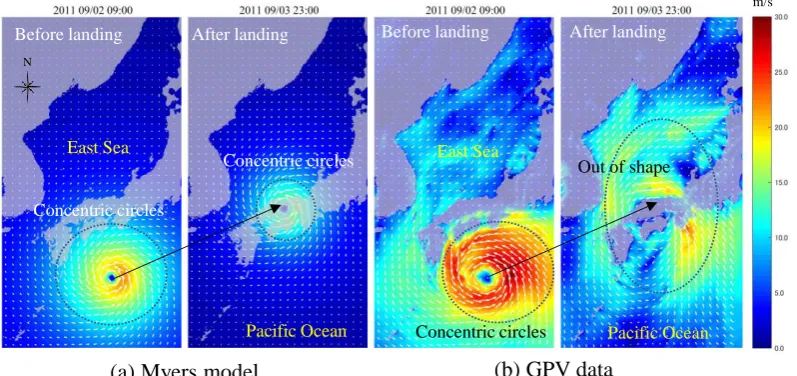
As shown in Fig. 8, typhoons that develop in the ocean have a circular shape because of the lack of terrain influence there. However, as a typhoon approaches the shoreline, the surrounding terrain causes it to change from a concentric to an elliptical shape. This outcome indicates that, for the South
Point A Point A
(a) Myers model (b) GPV data
Sea area facing the Pacific Ocean, it is possible to apply the Myers model assuming concentric circles but that, for the East Sea area, a model that takes into account the terrain influence is needed, because the typhoon shape is affected by this region’s terrain.
Figure 8. Typhoon shape changes based on terrain topography.
4. Typhoon Model
To reproduce the typhoon characteristics that generate the maximum sea level after the typhoon passes through the east coast, it is critical to reproduce the wind field that can consider the effects of land topography. The storm surge height caused by past typhoons can be estimated highly accurately using GPV data (since 2002). However, the ultimate goal of this study is to estimate the expected storm surge height of the highest scale, which requires examining the moving tracks of actual typhoons by setting the conditions of the largest typhoons according to the manual. Therefore, the construction of a new typhoon model that can consider topographical effects is required.
4.1. Analysis of Typhoon Shape Change
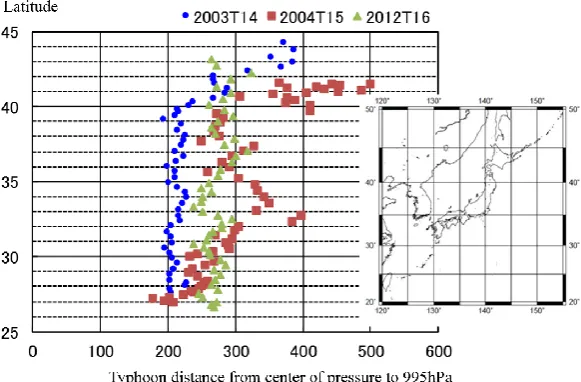
The locations of the center pressure and the air pressure distribution radii of the typhoons based on the GPV data are shown in Fig. 9. When the typhoon passed through approximately 40° north latitude, the air pressure distribution radius (995 hPa: air pressure at the wind velocity (17 m/s) defined as a typhoon) and the effect range of the typhoon increased. This result shows that as the typhoon moved north toward the East Sea, the typhoon shape changed from a concentric circle to an oval owing to the land topography.
(a) Myers model
(b) GPV data
Concentric circles
Concentric circles
Concentric circles
Out of shape
Before landing After landing Before landing After landing
N
East Sea
Pacific Ocean
East Sea
Figure 9. Results of wind direction based on typhoon models.
4.2. Holland Model
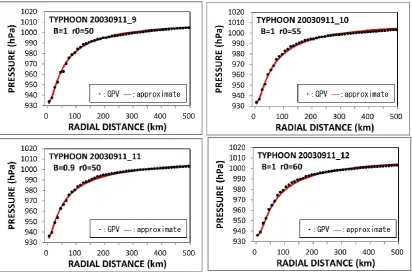
To reproduce a changing typhoon shape as it moves north toward the East Sea, the Holland model (Holland, 1980) (Eq. 2) [21] was adopted to reproduce the pressure filed first, instead of the Myers model (Eq. 1), which is suggested in the manual. The Holland model [24] assumes the same concentric air pressure distribution as in the Myers model, but it can set the shape (gradient) of the air pressure distribution from the typhoon center to the periphery in more detail.
𝑃(𝑟) = 𝑃𝑐+ ∆𝑃 ∙ exp(−
1
𝑥) (1)
𝑃(𝑟) = 𝑃𝑐+ ∆𝑃 ∙ exp(−
1
𝑥𝐵) (2)
𝐵 = 1.5 + (980 − 𝑃𝑐)/120 (3)
Here, P(r) is the air pressure at r km from the typhoon center, Pc is the air pressure at the
typhoon center (hPa), ΔP(= 𝑃∞− 𝑃𝑐) is the air pressure reduction, 𝑃∞is the air pressure at r =∞ (1013 hPa), 𝑟0 is the distance from the typhoon center to the point of maximum wind velocity (km), x is 𝑟/𝑟0, and B is the gradient coefficient.
Figure 10. Variable calculation result of the typhoon model (Typhoon Maemi).
Figure 11. Temporal change of ro and B (Typhoon Maemi).
4.3. Mascon Model
The Mascon model (Sherman, 1978) [22] recalculates the wind velocity to minimize the correction E of the variational equation (Eq. 4) based on the wind field obtained from the typhoon model.
𝐸(𝑢, 𝑣, 𝑤, 𝑟) = ∫ 𝑣 [𝑎12(𝑢 − 𝑢0)2+ 𝑎12(𝑣 − 𝑣0)2+ 𝑎12(𝑤 − 𝑤0)2
+ 𝛾 (𝜕𝑢 𝜕𝑥+ 𝜕𝑣 𝜕𝑦+ 𝜕𝑤 𝜕𝑧)] 𝑑𝑥𝑑𝑦𝑑𝑧 (4)
Here, u, v, and w are the wind velocity components that satisfy the law of mass conservation; 𝑢0, 𝑣0 and 𝑤0 are the initial wind velocity components; γ is the Lagrange coefficient; 𝑎1 and 𝑎2 are the variables related to air stability for the weight coefficient of the wind velocity correction.
0 100 200 300 400 500 600 0.6 0.8 1.0 1.2 1.4 1.6 1.8 9/1 1 1 2: 00
9/11 18:00 9/12 0:00 9/12 6:00 9/12 12:00 9/12 18:00 9/13 0:00 9/13 6:00 9/13 12:00 9/13 18:00 9/14 0:00 9/14 6:00 9/14 12:00 9/14 18:00 9/15 0:00
R ad iu s o f Ma x . o f w in d s p ee d (k m ) Gr ad ien t c o ef ficien t (B )
Temporal change of r0 and B(Typhoon No.15, 2003)
Gradient coefficient (B) Set value (B)
4.4. Calculation of Wind Field Considering Geographical Characteristics
The Holland model was introduced to consider the typhoon model according to the characteristic of typhoons developed in deep sea and propagate to shallow sea, whereas the Mascon model was applied to reproduce the wind field that changes according to geographical characteristics. The application of the Mascon model in the wide area including this region is particularly important to reproduce strong winds that occur at point A in Fig. 7 after the typhoon has passed according to the maximum sea level occurrence mechanism due to geographical characteristics. Therefore, the wind and pressure fields were calculated using the Holland model for the entire region first, and the wind field was calculated using the wind field result value of the Holland model as an input of the Mascon model in mesh ① (mesh size: 2700 m) to evaluate the wind field that is changed by the terrain (Fig. 12.). Using these two results, the wind field change rate due to the topography in mesh ① was calculated. The wind field considering the geographical characteristics was calculated by applying the change rate for each region that was changed by the topography in the detailed regions (mesh: ②–⑤). The estimation flowchart is shown in Fig. 13.
Figure 12. Wind velocity change rate in the topography of mesh (2700 m).
Figure 13. Wind field estimation flowchart considering topography.
Fig. 14 shows the wind field estimation results applying the change rate altered by topography. As shown, strong winds above 10 m/s at point A (Fig. 7) were not reproduced by the Holland model, but the Holland + Mascon models reproduced strong winds above 10 m/s, which were similar to the result of the GPV data.
Hollandモデル
(900m, 150m, 50m, 25mメッシュ)
地形の影響を受けた 風場の再推算
(900m, 150m, 50m, 25mメッシュ)
地形の影響を受けた 風場の算定
2700mメッシュ
900mメッシュ
150mメッシュ
50mメッシュ
25mメッシュ
Hollandモデル
(2700mメッシュ)
Holland・Masconの変換率
(風向、風速)
Masconモデル
(2700mメッシュ)
Holland model (2700m mesh)
Holland model (900m, 150m, 50m, 25m mesh)
Mascon model (2700m mesh)
Holland and Mascon change rates (wind direction and velocity)
Recalculation of wind field considering the change rate
(900m, 150m, 50m, 25m mesh)
Recalculation of wind field considering topography
Figure 14. Results of wind velocity field considering topography (mesh: 900m).
4.5. Storm Surge Height Calculation Result
To create the storm surge flood prediction map, a highly accurate reproducibility of the maximum sea level is required. However, in terms of disaster prevention, an accurate reproduction of the temporal storm surge height is crucial for flood control activities.
The estimation results of the wind velocity and storm surge height using the Myers model, Holland model + Mascon model, and GPV data at the Sakai station are shown in Fig. 15. The reproduced values using the analysis method proposed in this study are similar to the estimation result using the GPV data. These results indicate the extremely high reproducibility of the model.
Figure 15. Results of storm surge based on typhoon models.
Fig. 16 shows the tide levels and storm surge heights that were estimated for typhoon #16 Chaba in 2004 using the Holland+Mascon model and GPV data at the Saigou and Sakai points. The modeling outcomes show that the reproduced results obtained by the analysis method proposed in this study are more accurate than those obtained using the GPV data. Therefore, the reproducibility of the proposed model was evaluated to be very high.
(a)
(a) (b)
Figure 16. Verification results of the numerical simulation of the tide level and storm surge height.
5. Conclusions and Future Works
In order to predict the largest-class typhoon occurrences, a parametric typhoon model that can interpret its wind field is required. To produce a past typhoon simulation, the model's reproducibility is best when GPV data is used, rather than a wind field analysis by typhoon model. However, since an artificial wind field analysis is impossible, a parametric typhoon model that can analyze the wind field distribution changes according to regional topographic features is important.
For the storm surge height estimation of the target region, the prediction accuracy of pressure and wind fields of the typhoon moving north toward the East Sea was critical. Moreover, the reproducibility of pressure and wind fields using the Myers model assuming concentric circles was poor because the typhoon shape was distorted from a concentric circle to an oval owing to the geographical characteristics of Korea and Japan. In the study of storm surge height estimation, the best way to calculate the surge height is to use typhoon wind field and pressure GPV data, which has a very high reproducibility. However, although GPV data presents an advantage in disaster prevention system applications by providing predicted typhoon information based on the past and up to 36 hours in advance of occurrence, it is not suitable for estimating storm surge height because the main typhoon parameters (central pressure and maximum wind speed) cannot be arbitrarily set. Therefore, a parametric model is required. Therefore, a typhoon model that can consider topographical effects is required. The new typhoon model that considered the characteristics of typhoons correctly reproduced the phenomenon where the maximum sea level appeared after the typhoon passed through the target region. Further research will be conducted regarding the construction of a flood hazard map to estimate the storm surge height caused by large typhoons using the new typhoon model, which can consider geographical characteristics.
Author Contributions: Y.-J.K. and J.-S.Y. designed the study concept Y.-J.K. developed the code and performed the model simulations; All authors analyzed the results; Y.-J.K. wrote the paper.
Funding: This research was a part of the project titled 'Practical Technologies for Coastal Erosion Control and Countermeasure', funded by the Ministry of Oceans and Fisheries, Korea. (No. 20180404).
Acknowledgments: We would like to thank the anonymous reviewers and the Editor for their efforts to improve the manuscript.
Conflicts of Interest: The authors declare no conflict of interest.
0.5 1.0 1.5 2.0 2.5
8/17 8/18 8/19 8/20 8/21
(m)
Tide (Saigou station)
-0.2 -0.1 0.0 0.1 0.2 0.3 0.4 0.5 0.6 0.7 0.8
8/17 8/18 8/19 8/20 8/21
(m) Height of storm surge (Sakai station)
0.0 0.5 1.0 1.5 2.0 2.5
8/17 8/18 8/19 8/20 8/21
(m) Tide (Sakai station)
-0.2 -0.1 0.0 0.1 0.2 0.3 0.4 0.5 0.6 0.7 0.8
8/17 8/18 8/19 8/20 8/21
(m) Height of storm surge(Saigou station)
References
1. Mainichi news. https://mainichi.jp/english/articles/20181001/p2a/00m/0na/007000c (accessed on 1. 6.2020) 2. Kim, Y.J.; Yoon, J.S.; Tanaka, K.; Hur, D.S. Prediction of a debris flow flooding caused by probable
maximum precipitation. Journal of Korea water resources association. 2015, 48, 2, 115-126
3. MLIT (Ministry of Land, Infrastructure, Transport and Tourism in Japan). Manual for storm surge hazard map. 2015. https://www.mlit.go.jp/river/shinngikai_blog/saidai_takashio/pdf/takashio_tebiki_151102.pdf (accessed on 1. 5.2019)
4. Brown, J.M.; Wolf, J. Coupled wave and surge modelling for the eastern Irish Sea and implications for model wind-speed. Continental Shelf Research. 2009, 29, 10, 1329-1342
5. Kim, S.Y.; Yasuda, T.; Mase, H. Numerical analysis of effects of tidal variations on storm surges and waves.
Applied Ocean Research. 2008, 30, 4, 311-322
6. Roalnd, A.; Cucco. A.; Ferrarin. C.; Hsu, T.-W.; Liau, J.-M.; Ou, S.-H.; Umgiesser, G.; Zanke, U. On the development and verification of a 2-D coupled wave current model on unstructured meshes. Journal of Marine Systems. 2009, 78, S244-S254
7. Wolf, J.; Coastal flooding: impacts of coupled wave-surge-tide models. Nat Hazards, 2009, 49, 2, 241-260 8. Mayo, T.; Butler, T.; Dawson, C.; Hoteit, I. Data assimilation within the Advanced Circulation(ADCIRC)
modeling framework for the estimation of Manning’s friction coefficient. Ocean Model. 2014, 76, 43-583 9. Irish, J.L; Resio, D.T. A hydrodynamics-based surge scale for hurricanes. Ocean Engineering. 2010, 37, 69-81. 10. Rego, J.L.; Ki, C. Nonlinear terms in storm surge predictions: Effect of tide and shelf geometry with case
study from Hurricane Rita. Journal of Geophysical Research. 2010, 115, C06020
11. Resio, D.T.; Irish, J.; Cialone, M. A surge response function approach to coastal hazard assessment-Part 1: Basic concepts. Nat Hazards, 2009, 51,163-182
12. Myers, V.A.; Malkin, W. Some properties of hurricane wind fields as deduced form trajectories. U.S. Weather Bureau, National hurricane Research Project, Report 49. 1961.
13. Kim, J.M.; Hur, D.S.; Kim, C.H.; Kim, D.S. Shallow water wave hindcasting by the combination of MASCON and SWAN models. Journal of Korean Society of Coastal and Ocean Engineers. 2007, 19, 1, 57-65. 14. Lee, W.D.; Jeong, Y.H.; Hur, D.S. Effects of wave action on seawater intrusion in coastal aquifer and
mitigation strategies. Journal of Ocean Engineering and Technology. 2017, 31, 1, 47-57.
15. Kim, T.W.; Yang, H.S.; Park, B.W.; Yoon, S.J.Study on water level and salinity characteristics of Nakdong river estuary area by discharge variations at Changnyeong-Haman weir. Journal of Ocean Engineering and Technology. 2018, 32, 5, 361-366.
16. Kim, G.S.; Ryu, H.S.; Kim, S.H.Evaluation of coastal sediment budget on east coast maeongbang beach by wave changes. Journal of Ocean Engineering and Technology. 2019, 33, 6, 564-572.
17. Digital typhoon. Available online: http://agora.ex.nii.ac.jp/digital-typhoon/year/ (accessed on 1. 4. 2019) 18. SWAN (Simulation WAves Nearshore) model. Available online: http://swanmodel.sourceforge.net/
(accessed on 1. 4. 2019)
19. GPV (Grid Point Value). Available online: http://agora.ex.nii.ac.jp/digital-typhoon/gpv/index.html.en (accessed on 1. 6.2020)
20. JMA (Japan Meteorological Agency). Numerical weather prediction activities service system.
https://www.jma.go.jp/jma/en/Activities/nwp.html (accessed on 1. 6. 2020).
21. Holland G.J. An analytic model of the wind and pressure profiles in hurricanes. Monthly Weather Review, , 1980, 108(8), 1212-1218
22. Sherman, C.A. A mass-consistent model for wind fields over complex terrain. Journal of Applied Meteorology, 1978. 17, 312-319.
23. Zheng, J.-H.; Wang, J.-C.; Zhou, C.-Y.; Zhao, H.-J.; Sang, S. Numerical simulation of typhoon-induced storm surge along Jiangsu coast, Part II: Calculation of storm surge. Water Science and Engineering, 2017. 10, 1, 8-16
24. Holland, G.J., Lander, M. The meandering nature of tropical cyclone tracks. Journal of the Atmospheric Sciences, 1993. 50, 9, 1254-1266
25. Mayo, T.,Lin, N. The effect of the surface wind field representation in the operational storm surge model of the National Hurricane Center. Atmospheric, 10, 4, 193. doi:10.3390/atmos10040193
27. Ramos Valle, A.N.; Curchitser, E.N.; Bruyere, C.L.; Fossell, K.R. Simulating Storm Surge Impacts with a Coupled Atmosphere-Inundation Model with Varying Meteorological Forcing. Journal of Marine Science and Engineering. 2018, 6, 35. doi:10.3390/jmse6020035
28. Cyriac, R.; Dietrich, J.; Fleming, J.; Blanton, B.; Kaiser, C.; Dawson, C.; Luettich, R. Variability in Coastal Flooding predictions due to forecast errors during Hurricane Arthur. Coast. Engineering. 2018, 137, 59–78. 29. Dietrich, J.C.; Muhammad, A.; Curcic, M.; Fathi, A.; Dawson, C.; Chen, S.; Luettich, R., Jr. Sensitivity of
![Figure 1. Flooding of Kansai International Airport in Japan caused by typhoon "Jebi" [1]](https://thumb-us.123doks.com/thumbv2/123dok_us/8077764.1347712/2.595.179.413.559.688/figure-flooding-kansai-international-airport-japan-caused-typhoon.webp)