4045
Self-Generated Random Pseudonym Public Key
Based Certificateless Signcryption For Privacy
Preserving Authentication In Vanet
K.Nirmala, Dr.S.Prasath
Abstract: Authentication in vehicular ad-hoc network (VANET) is a significant problem to be resolved, as it requires not only secure and efficient authentication, but also privacy preservation. The conventional authentication techniques designed for VANET communication does not provide higher security and privacy preservation with a lower overhead. In order to overcome such limitations, a Self-Generated Random Pseudonym Public Key based Certificateless Signcryption (SGRPPK-CS) technique is proposed. Initially, vehicular nodes register their information to road side units for communicating the location information. After registering process, SGRPPK-CS technique gives identity, self-generated random pseudonym public key and private key to each node in network. Then, SGRPPK-CS technique carried outs signcryption process in order to improve the security level through generating self-generated random pseudonym public key. In signcryption process, the data packets is converted into cipher text by using self-generated random pseudonym public key of receiver and consequently digital signature is created using private key of sender. Then, cipher text is transmitted to the corresponding receiver node or road side units along with the digital signature. At receiver side, private key of vehicular node is employed to decrypt the information and the digital signature verification is performed in SGRPPK-CS technique. By this way, the privacy preservation authentication is carried out in proposed SGRPPK-CS technique to achieve better security rate with a minimal communication overhead in VANET. The SGRPPK-CS technique conducts simulation works using factors such as privacy preserving rate, communication overhead and security rate with respect to number of vehicular nodes and data packets. The simulation result reveals that the SGRPPK-CS technique is able to enhance the privacy preserving rate and also reduces the communication overhead in VANET when compared to state-of-the-art works.
Keywords: Digital Signature, Road Side Units, Self-Generated Random Pseudonym Public Key, Signcryption, Un-Signcryption, VANET, Vehicular Node.
————————————————————
1. INTRODUCTION
Vehicular ad hoc network (VANET) is a promising approach to enhance transportation safety and efficiency. Further, VANET is the key technology in intelligent transportation system. During the communication process in VANET, the vehicles such as cars, trucks, buses, etc. exchange the information (direction, speed, acceleration, vehicle size, etc.) to find and warn safety threats and potential accidents. In conventional works, authentication techniques were utilized to obtain secure data communications in VANET. However, data privacy preservation rate using existing authentication schemes was not sufficient. Therefore, SGRPPK-CS technique is developed using self-generated random pseudonym public key generation in certificateless signcryption. Fast Confidentiality-Preserving Authentication (FCPA) was carried out in [1] to reduce the time of secure communication in VANET. However, data security and privacy rate was not higher. A hash function-based conditional privacy-preserving authentication (HCPA-GKA) was accomplished in [2] to avoid illegal vehicle interference and make sure the legitimacy of the source in VANET. But, communication overhead was not minimized.
A novel and efficient conditional privacy-preserving authentication scheme (NECPPA) was introduced in [3] for securing communications in VANET. But, the privacy preserving rate was lower. Password-based conditional privacy preserving authentication and group-key generation (PW-CPPA-GKA) protocol was introduced in [4] for VANETs. But, large number of vehicle features was required for improving the authentication performance. A vehicular authentication protocol called distributed aggregate privacy-preserving authentication was introduced in [5]. However, the security level was lower. A privacy-preserving authentication scheme was designed in [6] with application of certificateless aggregate signature for secure vehicle-to-infrastructure (V2I) communications. But, time complexity involved during secure communication process was more. A secure privacy-preserving authentication framework was presented in [7] to improve traffic safety in VANET. However, data loss rate using this framework was higher. An efficient privacy-preserving mutual authentication protocol was employed in [8] to get better security for V2V communication in VANETs with a minimal computational complexity. But, security level of data was not adequate.A hash message authentication code (HMAC) was used in [9] to reduce time of certificate revocation list revivification and thereby achieving higher integrity. However, complexity involved during the process of privacy preservation was not reduced. A lightweight authentication scheme was introduced in [10] with application of Timed Efficient Stream Loss-Tolerant Authentication (TESLA) scheme and Bloom Filters to prevent VANET from active attacks. But, privacy preservation was not obtained. In order to addresses the above said existing issues in VANET, SGRPPK-CS technique is introduced. The main contributions of SGRPPK-CS technique is described in below,
To enhance the security and privacy preservation of VANET communication as compared to
state-of-______________________
K..Nirmala Ph.D Research Scholar Part Time), Department of computer Science,
Nandha Arts & Science College,Erode.,Tamil Nadu-India. Email:[email protected]
Dr.S.Prasath Assistant Professor & Research supervisor, Department of computer Science,
the-art works, SGRPPK-CS technique is proposed. The SGRPPK-CS technique is designed with application of Self-Generated Random Pseudonym Public Key generation process in Certificateless Signcryption. By using these concepts, SGRPPK-CS technique minimize the key escrow problems in identity based cryptosystems when compared to existing works.
To reduce the communication overhead in VANET as compared to existing works, certificateless signcryption is applied in SGRPPK-CS technique. SGRPPK-CS technique performs both the functions of digital signature and public key encryption in a single step at a lower cost as compared to existing methods.
The remaining structure of paper is constructed as; Section 2 describes the detailed process of proposed SGRPPK-CS technique. Section 3 explains the simulation settings. Section 4 discusses the comparative result analysis. In Section 5, demonstrates the literature survey. Section 6 shows the conclusion of paper.
2. SELF-GENERATED RANDOM PSEUDONYM
PUBLIC KEY BASED CERTIFICATELESS
SIGNCRYPTION TECHNIQUE
VANET comprises of many unique challenges. The network security must be guaranteed since the adversaries can utilize legitimate vehicles information to find the vehicles travel route and analyze driver‘s habit. In addition to that, the privacy preservation in VANET is significant problem to be resolved as authorities can reveal the identity and other privacy data of the vehicle, in case of crime/car accident and other disputes. Thus, privacy preserving authentication is required in order to improve the security of VANET communication. In existing works, a lot of privacy preserving authentication techniques was designed for VANET. But, most of them are used public key infrastructure to authenticate data which leads to some drawbacks. Therefore, SGRPPK-CS technique is proposed. On the contrary to existing works, SGRPPK-CS technique is introduced by applying the Self-Generated Random Pseudonym Public Key generation in Certificateless Signcryption. The SGRPPK-CS technique is a cryptographic system that provides both authenticity and data privacy with a very low communication overhead. Besides, SGRPPK-CS technique is an identity based cryptography technique which helps to prevent the data from unauthorized users in VANET. The SGRPPK-CS technique contains three main processes namely Self-Generated Random Pseudonym Public Key generation, signcryption and un-signcryption. The detailed processes of SGRPPK-CS technique is explained in below subsections.
2.1 Self-Generated Random Pseudonym Public Key Generation
In VANET, initially vehicular nodes ‗( )‘ and roadside unit ‗( )‘ register their personal data to a trusted authority. After the registration process, the trusted authority generates identity ‗ ‘ for each vehicular nodes and roadside unit in network. Let us consider a VANET comprises of a large number of vehicles and roadside units. The number of
vehicular nodes in network is denoted as ‗
‘.In addition to that, the number of roadside
units in VANET is indicated as ‗ ‘. For every registered vehicular nodes ‗ ‘ and roadside units ‗ ‘, the SGRPPK-CS technique constructs an identity via randomly picking a large prime number ‗r‘ with help of below mathematical expression,
(1)
From the above formula (1), identity ‗ ‘ is generated for each vehicular nodes and roadside units in VANET whereas ‗ ‘ denotes the arbitrary selected large prime number. After completing the registration and identity generation process, each vehicular nodes and roadside units self generates the pseudonym public key randomly. This is called as self-generated random pseudonym public key ‗ ‘. In SGRPPK-CS technique, a vehicular nodes and roadside units is allowed to create pseudonym public key itself. For each time of communication, a vehicular nodes and roadside units only produces one pseudonym public key and keeps a key unique at one time slot. This uniqueness helps for SGRPPK-CS technique to prevent the data from adversaries in VANET. In SGRPPK-CS technique, self-generated random pseudonym public key ‗ ‘ is designed for each vehicular nodes and roadside units to perform data encryption and digital signature generation. In existing works, the signcryption techniques construct a pair of keys where same key is utilized for data encryption and decryption process which may hacked by the adversaries in VANET. This reduces the privacy and security of data in network. To achieve higher privacy preservation as compared to state-of-the-art works, proposed technique creates a self-generated random pseudonym public key ‗ ‘for each session. Once the session is over, then SGRPPK-CS technique de-activates the generated key ‗ ‘and consequently produces a new self-generated random pseudonym public key ‗ ‘ for next session. This assists for SGRPPK-CS technique to avoid the unauthorized access of data in VANET and also improves the confidentiality level. The self-generated random pseudonym public key generation process is mathematically defined as,
(2)
From the above equation (2),
‗ ‘ denotes randomly self-generated
pseudonym public key ‗ ‘ of vehicular node ‗ ‘ for different sessions ‗ ‘, ‗ ‘, ‗ ‘.After that, private key is created where the vehicular nodes and roadside units submits their identity ‗ ‘, global parameters ( ). From that, a private key ‗ ‘ is mathematically constructed using below,
{ } (3)
4047
2.2 Signcryption
In SGRPPK-CS technique, signcryption is a cryptographic system which is designed using self-generated random pseudonym public key in order to increases the security and privacy of data communication in VANET. Signcryption carry outs digital signature generation and encryption process simultaneously and thereby improves privacy preservation rate in VANET with a lower communication overheads. Let us consider the number of data packet are represented as ‗ ‘. The SGRPPK-CS technique carry outs data encryption process with the identity of user i.e. vehicular nodes and roadside units. The signcryption process in SGRPPK-CS technique where it creates cipher text with help of sender self-generated random pseudonym public key and subsequently digital signature is generated using private key of sender. Whenever the vehicular node in VANET wants to sent the data packets to other vehicular node or road side unit, encryption process is carried out. During the encryption process, a cipher text is constructed for each data packet by using self-generated random pseudonym public key ‗( )‘ and identity ‗( )‘ of receiver. From that, the data encryption process using SGRPPK-CS technique is mathematically performed as,
(4)
From the above mathematical formulation (4), ‗ ‘ signifies a cipher text of data packet where ‗E‘ denotes an encryption and ‗ ‘ refers a self-generated random pseudonym public key of receiver. Here, ‗ ‘ indicates an identity of receiver and ‗ ‘ represents data packet. By using the above mathematical expression, SGRPPK-CS technique obtains cipher text for each data packet which is to be transmitted. After completing the encryption process, the SGRPPK-CS technique produces the digital signature for each data using private key of sender ‗ ‘. Thus, the signature generation process is mathematically performed using below
(5)
From the above expression (5), ‗ ‘ represents a signature of data ‗ ‘ and ‗ ‘ indicates a private key of sender in VANET. In proposed SGRPPK-CS technique, a digital signature is created in order to verify the authenticity of original data packet which is sent over a VANET. Hence, SGRPPK-CS technique generates a signature for each data packet in the form of hash value. After completing the signcryption process, the encrypted data packet (i.e. cipher text) is transmitted to the receiver along with the digital signature.
2.3 Un-signcryption
At the receiver side, the un-signcryption is carried out where data decryption and signature verification process is performed with aiming at enhancing the security and privacy in VANET. In SGRPPK-CS technique, private key of receiver ‗ ‘ is used to convert an encrypted data into an original data. On the contrary to existing works, decryption process is performed using SGRPPK-CS technique is a deterministic in nature. Therefore, there is no randomness is employed to get the original data packet without using the private key of receiver. This helps for proposed SGRPPK-CS technique to attain higher data security and privacy
during communication process in VANET. Initially identity and private key of receiver is verified during a un-signcryption process. If both the identity and private key of receiver is legitimate, then SGRPPK-CS technique allows the receiver to perform data decryption process to obtain original data packet. Otherwise, data decryption process is declined which helps for SGRPPK-CS technique to achieve better security and privacy in VANET as compared to conventional works. Whenever receiver gets a cipher text ‗ ‘, decryption is carried out using their private key ‗ ‘ and identity ‗( ‘. Thus, data decryption using SGRPPK-CS technique is mathematically performed as,
(6)
From the above mathematical representation (6), ‗ ‘ denotes an original data packet and ‗ ‘ indicates private key of receiver, ‗ ‘ point outs an identity of receiver. After the decryption process, the receiver gets the original data packet. Then, signature verification is carried out in SGRPPK-CS technique to verify the accuracy of data in VANET. . The process involved in signature verification is demonstrated in below Figure 1.
Figure 1 Signature Verification Process
As presented in above Figure 1, signature verification is carried out at the receiver side where receiver constructs signature for decrypted data using self-generated random pseudonym public key of sender and compare it with the received signature. If the both signature is matched, SGRPPK-CS technique achieve privacy preservation in VANET. From that, SGRPPK-CS technique confirms that only authorized users are allowed to get the decrypted data in VANET. If the both signature is not identical, SGRPPK-CS technique does not attain privacy preservation in network. Thus, SGRPPK-CS technique improves security of data communication in VANET with a lower time. The algorithmic process of SGRPPK-CS technique is explained as follows,
Vehicular
Node (or)
Roadside Unit
Receive
r
If
Attain
privacy
preservat
ion
Privacy
preservat
ion is not
attained
N
o
Y
es
-Received
Signature
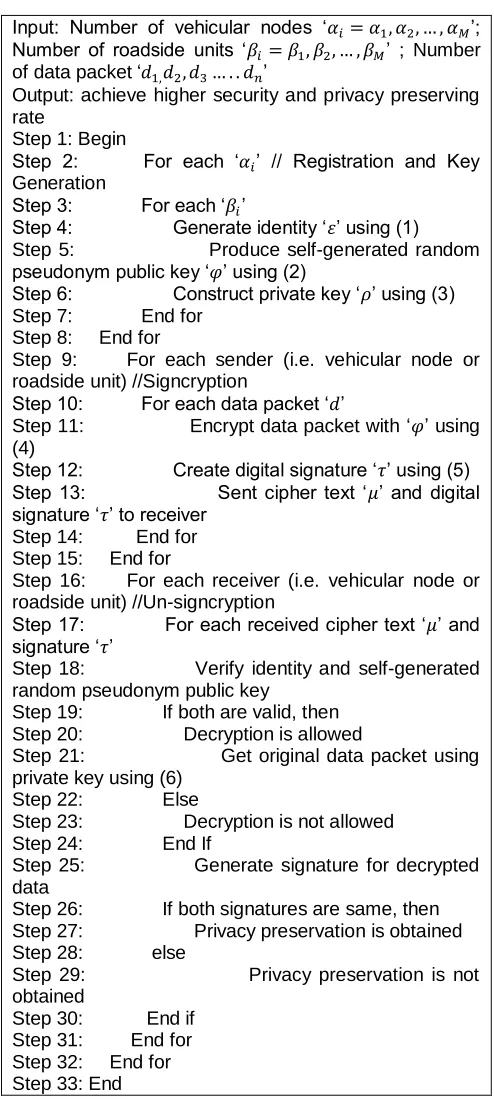
Input: Number of vehicular nodes ‗ ‘; Number of roadside units ‗ ‘ ; Number of data packet ‗ ‘
Output: achieve higher security and privacy preserving rate
Step 1: Begin
Step 2: For each ‗ ‘ // Registration and Key Generation
Step 3: For each ‗ ‘
Step 4: Generate identity ‗ ‘ using (1) Step 5: Produce self-generated random pseudonym public key ‗ ‘ using (2)
Step 6: Construct private key ‗ ‘ using (3) Step 7: End for
Step 8: End for
Step 9: For each sender (i.e. vehicular node or roadside unit) //Signcryption
Step 10: For each data packet ‗ ‘
Step 11: Encrypt data packet with ‗ ‘ using (4)
Step 12: Create digital signature ‗ ‘ using (5) Step 13: Sent cipher text ‗ ‘ and digital signature ‗ ‘ to receiver
Step 14: End for Step 15: End for
Step 16: For each receiver (i.e. vehicular node or roadside unit) //Un-signcryption
Step 17: For each received cipher text ‗ ‘ and signature ‗ ‘
Step 18: Verify identity and self-generated random pseudonym public key
Step 19: If both are valid, then Step 20: Decryption is allowed
Step 21: Get original data packet using private key using (6)
Step 22: Else
Step 23: Decryption is not allowed Step 24: End If
Step 25: Generate signature for decrypted data
Step 26: If both signatures are same, then Step 27: Privacy preservation is obtained Step 28: else
Step 29: Privacy preservation is not obtained
Step 30: End if Step 31: End for Step 32: End for Step 33: End
Algorithm 1 Self-Generated Random Pseudonym Public Key based Certificateless Signcryption
Algorithm 1 shows the step by step process of SGRPPK-CS technique. By using the above algorithmic process, SGRPPK-CS technique performs secure data communication in VANET with a minimal amount of time. This helps for SGRPPK-CS technique to obtain enhanced privacy preservation rate with a lower communication overhead in VANET as compared to state-of-the-art works.
3. SIMULATION SETTINGS
In order to evaluate the performance of proposed, SGRPPK-CS technique is implemented in NS-2 simulator with the network area of 1200m 1200m by considering 500 vehicular nodes. To perform simulation evaluation, SGRPPK-CS technique employs a different number of vehicular nodes and road side units and data packets. The simulation parameters are depicted in below.
Table 1 Simulation Parameters
Simulation parameters Values Simulation Tool NS-2 Simulator Number of vehicular
nodes
50 – 500
Simulation area 1200m × 1200m
Simulation time 300 s
Speed of vehicle 10-30 m/s
Channel Bandwidth 6 Mbps
Number of data packets 25, 50, 75, 100, 125, 150, 175, 200, 225,250
Radio Propagation Model Two Ray Ground
The performance of SGRPPK-CS technique is determined using metrics such as privacy preserving rate, communication overhead and security rate. The simulation result of SGRPPK-CS technique is compared against two conventional works namely Fast Confidentiality-Preserving Authentication (FCPA) [1] and hash function-based conditional privacy-preserving authentication (HCPA-GKA) [2].
4. RESULT AND DISCUSSIONS
In this section, the comparative result of SGRPPK-CS technique is presented and compared with existing Fast Confidentiality-Preserving Authentication (FCPA) [1] and Hash Function-Based Conditional Privacy-Preserving Authentication (HCPA-GKA) [2]. The efficiency of SGRPPK-CS technique is measured using parameters such as privacy preserving rate, communication overhead and security rate with respect to number of vehicular nodes and data packets.
4.1 Simulation Measurement of Privacy Preserving Rate
In SGRPPK-CS technique, Privacy Preserving Rate ‗ ‘ measure the ratio of number of data packets that are only get by the authorized users (i.e. vehicular nodes or roadside units) to the total number of data packets. The privacy preserving rate is measured in terms of percentage (%) and mathematically calculated using below,
(7)
From above mathematical expression (7), privacy preserving rate in VANET is determined with respect to different number of data packets ‗( )‘. Here, ‗ ‘ indicates the number of data that are only obtained by authorized vehicular nodes and roadside units in network. When the privacy preserving rate is higher, the technique is said to be more effective.
4049
Existing FCPA: number of data packets that are obtained only by authentic vehicular nodes and roadside units is 20 and the total number of data packets is 25. Then privacy preserving rate is measured as,
Existing HCPA-GKA: number of data packets that are acquired only by authorized vehicular nodes and roadside units is 18 and the total number of data packets is 25. Then privacy preserving rate is evaluated as,
Proposed SGRPPK-CS: number of data packets that are accessed only by authoritative vehicular nodes and roadside units is 23and the total number of data packets is 25. Then privacy preserving rate is computed as,
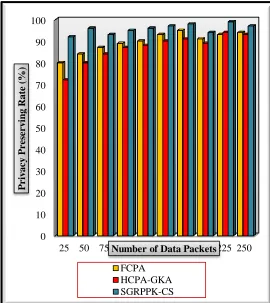
For measuring the privacy preserving rate in VANET, SGRPPK-CS technique is implemented in NS-2 simulator with a varied number of data packets in the range of 25-250. When carried outing a simulation work using 225 data packets in the network, the proposed SGRPPK-CS technique gets 99 % privacy preserving rate whereas state-of-the-art works FCPA [1] and HCPA-GKA [2] obtains 93 % and 94 % respectively. From these results, it is significant that the data privacy preserving rate using SGRPPK-CS technique is very higher when compared to other works FCPA [1] and HCPA-GKA [2]. The simulation result of privacy preserving rate is demonstrated in below Table 2.
Table 2 Tabulation for Privacy Preserving Rate
Number of Data Packets
Privacy Preserving Rate (%)
FCPA HCPA-GKA SGRPPK-CS
25 80 72 92
50 84 80 96
75 87 84 93
100 89 87 95
125 90 88 96
150 93 90 97
175 95 91 98
200 91 89 94
225 93 94 99
250 94 93 97
Figure 4 Comparative Result of Privacy Preserving Rate versus Number of Data Packets
Figure 4 shows the impact of privacy preserving rate based on different number of data packets using three techniques namely FCPA [1] and HCPA-GKA [2] and proposed SGRPPK-CS technique. As demonstrated in above graphical representation, proposed SGRPPK-CS technique provides better data privacy preserving rate in VANET as compared to conventional FCPA [1] and HCPA-GKA [2]. This is because of process of self-generated random pseudonym public key generation in proposed SGRPPK-CS technique on the contrary to state-of-the-art works. In SGRPPK-CS technique, each node generates the public key randomly itself for each session of communication between vehicular nodes in network. When the session is completed, SGRPPK-CS technique disables the old self-generated random pseudonym public key and subsequently creates a new public key for next session. This helps for SGRPPK-CS technique to keep away data from the unauthorized access by using the same public key for all the time of communication between vehicular nodes. Thus, SGRPPK-CS technique enhances the ratio of number of data packets that are only get by the authorized users in VANET as compared to FCPA [1] and HCPA-GKA [2]. Therefore, proposed SGRPPK-CS technique increases the privacy preserving rate by 7 % as compared to FCPA [1] and 11 % as compared to HCPA-GKA [2].
4.2 Simulation Measurement of Communication Overhead
In SGRPPK-CS technique, Communication Overhead ‗ ‘ estimates the amount of time needed for securing the communication between vehicular nodes in VANET. The
0 10 20 30 40 50 60 70 80 90 100
25 50 75 100 125 150 175 200 225 250
P
r
iv
ac
y
P
r
e
se
r
v
in
g
R
ate
(%
)
Number of Data Packets
communication overhead is mathematically obtained using below,
(8)
From above mathematical representation (8), overhead involved during data communication process in VANET is determined with respect to a varied number of vehicular nodes in the network. Here, ‗ ‘ signifies number of vehicular nodes considered for simulation process whereas
‗ ‘ point outs the amount of time used by single
vehicular nodes to secure communication in network. The communication overhead is evaluated in terms of milliseconds (ms).
Sample Calculation for Communication Overhead:
Existing FCPA: time required by a single vehicular node to secure communication is 0.84 ms and the total number of vehicular nodes is 50. The communication overhead is determined as follows,
Existing HCPA-GKA: time employed by one vehicular node to secure communication is 0.89 ms and the total number of vehicular nodes is 50. Then, communication overhead is measured as follows,
Proposed SGRPPK-CS: time consumed by single vehicular nodes for securing communication is 0.75 ms and the total number of vehicular nodes is 50. Then, communication overhead is computed as follows,
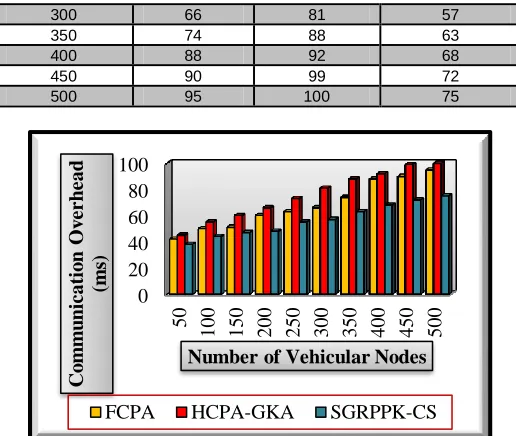
To estimate the time complexity involved during data communication between the vehicular nodes in VANET, the SGRPPK-CS technique is implemented in NS-2 simulator through considering a different number of vehicular nodes in the range of 50-500. When accomplishing simulation process using 450 vehicular nodes, SGRPPK-CS technique acquires 72 ms communication overhead whereas existing works FCPA [1] and HCPA-GKA [2] attains 90 ms and 99 ms respectively. Accordingly, it is clear that the communication overhead using SGRPPK-CS technique is minimal when compared to other works FCPA [1] and HCPA-GKA [2]. The tabulation result of communication overhead is depicted in below Table 3.
Table 3 Tabulation for Communication Overhead
Number of Vehicular
Nodes
Communication Overhead (ms) FCPA HCPA-GKA SGRPPK-CS
50 42 45 38
100 50 55 44
150 51 60 47
200 60 66 48
250 63 73 55
300 66 81 57
350 74 88 63
400 88 92 68
450 90 99 72
500 95 100 75
Figure 5 Comparative Result of Communication Overhead versus Number of Vehicular Nodes
Figure 5 illustrates the impact of communication overhead with respect to various numbers of vehicular nodes using three techniques namely FCPA [1] and HCPA-GKA [2] and proposed SGRPPK-CS technique. As shown in above graphical figure, proposed SGRPPK-CS technique provides better communication overhead in VANET as compared to conventional FCPA [1] and HCPA-GKA [2]. This is owing to process of signcryption and un-signcryption in proposed SGRPPK-CS technique on the contrary to conventional works. During the signcryption process, SGRPPK-CS technique creates a cipher text for each data packet using self-generated random pseudonym public key and identity of receiver with a minimal amount of time consumption. Also during the un-signcryption process, SGRPPK-CS technique performs decryption using private key and identity of receiver to regenerate original data with a lower time complexity. Thus, SGRPPK-CS technique minimizes the amount of time needed for securing the communication between vehicular nodes in VANET. As a result, proposed SGRPPK-CS technique reduces the communication overhead by 15 % as compared to FCPA [1] and 25 % as compared to HCPA-GKA [2].
4.3 Simulation Measurement of Security Rate
In SGRPPK-CS technique, Security Rate ‗ ‘ is determined based on the successful transmission of data packets to receiver in VANET. From that, security rate is measured as the ratio of a number of data packets successfully delivered at the receiver to the total number of data packets sent. The security rate is mathematically computed using below,
(9)
In the above equation (9), ‗ ‘ indicates the number of data packets successfully received whereas ‗ ‘ signifies a number of packets sent. The security rate is measured in terms of percentage (%).
Sample Calculation for Security Rate:
0 20 40 60 80 100
50
100 150 200 250 300 350 400 450 500
C
o
m
m
u
n
ic
ati
o
n
O
v
e
r
h
e
ad
(m
s)
Number of Vehicular Nodes
4051
Existing FCPA: Let us consider the number of vehicular node taken for conducting simulation process is 50. Number of data packets successfully obtained at the receiver is 19 and the number of data packets sent is 25. Then the security rate is measured as follows,
Existing HCPA-GKA: Number of data packets successfully acquired at the receiver is 16 and the number of data packets sent is 25. Then the security rate is estimated as follows,
Proposed SGRPPK-CS: Number of data packets successfully reached to receiver is 24 and the number of data packets sent is 25. Then the security rate is calculated as follows,
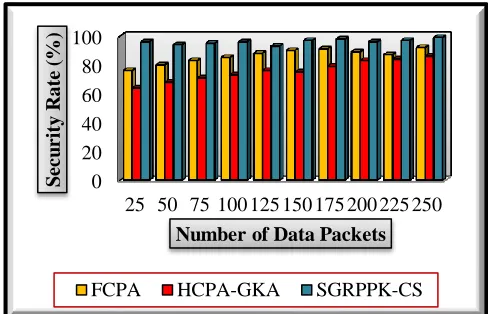
In order to measure the data security rate in VANET, the SGRPPK-CS technique is implemented in NS-2 simulator with help of a diverse number of data packets in the range of 25-250. When considering the 250 data packets to perform simulation process, SGRPPK-CS technique achieves 99 % security whereas state-of-the-art works FCPA [1] and HCPA-GKA [2] gets 92 % and 86 % respectively. For that reason, it is expressive that the communication data security rate using SGRPPK-CS technique is very higher as compared to other conventional works FCPA [1] and HCPA-GKA [2]. The performance result of security rate is presented in below Table 4.
Table 4 Tabulation for Security Rate
Number of Data Packets
Security Rate (%)
FCPA HCPA-GKA SGRPPK-CS
25 76 64 96
50 80 68 94
75 83 71 95
100 85 73 96
125 88 76 93
150 90 75 97
175 91 79 98
200 89 83 96
225 87 84 97
250 92 86 99
Figure 6 Comparative Result of Security Rate versus Number of Data Packets
Figure 6 presents the impact of security rate with diverse numbers of data packets using three techniques namely FCPA [1] and HCPA-GKA [2] and proposed SGRPPK-CS technique. As depicted in above graphical structure, proposed SGRPPK-CS technique provides security rate in VANET as compared to existing FCPA [1] and HCPA-GKA [2]. This is due to process of self-generated random pseudonym public key generation, signcryption and un-signcryption in proposed SGRPPK-CS technique on the contrary to conventional works. In SGRPPK-CS technique, self-generated random pseudonym public key is generated for each time of communication between vehicular nodes with objective of increasing the privacy of data in VANET. Besides to that, SGRPPK-CS technique encrypts the data before transmission with aim of improving the security in network. Furthermore, receiver can only decrypt the cipher text whenever the identity and private key is valid. Therefore, adversaries in VANET cannot easily get the original data. From that, SGRPPK-CS technique successfully delivers all the data packets to receiver in a network when compared to other works. As a result, proposed SGRPPK-CS technique improves the security rate by 12 % as compared to FCPA [1] and 28 % as compared to HCPA-GKA [2].
5. LITERATURE SURVEY
An efficient anonymous batch authentication (EABA) scheme was employed in [11] to decrease the data loss rate of vehicles and roadside units in VANET. Two-Factor Lightweight Privacy-preserving authentication scheme (2FLIP) was designed in [12] to give strong privacy with a lower computation and space complexity. A hybrid approach was developed in [13] to perform privacy-preserving authentication in VANET with a minimal computational and communication overhead. A certificateless conditional privacy preserving authentication (CCPPA) scheme was presented in [14] for VANET. Lattice-based conditional privacy-preserving authentication (LB-CPPA) protocol was employed in [15] to obtain the integrity and authentication and the privacy preservation at the same time. Conditional privacy-preserving authentication (CPPA) scheme was introduced in [16] to address the security and privacy-preserving issues. Decentralized and scalable privacy-preserving authentication (DSPA) scheme was developed in [17] for
0 20 40 60 80 100
25 50 75 100 125 150 175 200 225 250
S
e
c
u
r
ity
R
ate
(%
)
Number of Data Packets
achieving secure VANETs. An efficient identity-based authentication scheme was designed in [18] for conditional privacy-preserving in VANET. A novel method was designed in [19] that address the security and privacy requirements of VANETs in [19]. A highly efficient randomized authentication protocol was developed in [20] to attain full anonymity in VANET.
6. CONCLUSION
An effective SGRPPK-CS technique is designed with goal of attaining higher data security and privacy during process of VANET communication. The goal of SGRPPK-CS technique is obtained with aid of self-generated random pseudonym public key generation in certificateless signcryption. The proposed SGRPPK-CS technique increases the security of data in VANET by constructing the self-generated random pseudonym public key for each time of communication between vehicular nodes as compared to conventional works. Moreover, SGRPPK-CS technique enhances the privacy of data by allowing receivers to get the original data when both the identity and digital signature is authentic. Through a secure VANET communications, SGRPPK-CS technique enhances the road safety. The effectiveness of SGRPPK-CS technique is estimated in terms of privacy preserving rate, communication overhead and security rate as compared with two conventional methods. The simulation result depicts that the proposed SGRPPK-CS technique presents better performance with enhancement of the privacy preserving rate and reduction of communication overhead when compared to state-of-the-art works.
REFERENCES
[1] Siavash Mirzaee, Letian Jiang, ―Fast Confidentiality-Preserving Authentication for Vehicular Ad Hoc Networks‖, Journal of Shanghai Jiaotong University (Science), Springer, Volume 24, Issue 1, Pages 31–40, February 2019 [2] Jie Cui, Xuefei Tao, Jing Zhang, Yan Xu, Hong Zhong, ―HCPA-GKA: A hash function-based conditional privacy-preserving authentication and group-key agreement scheme for VANETs‖, Vehicular Communications, Elsevier, Volume 14, Pages 15-25, October 2018
[3] Seyed Morteza Pournaghi, Behnam Zahednejad, Majid Bayat and Yaghoub Farjami ―NECPPA: A novel and efficient conditional privacy-preserving authentication scheme for VANET‖, Computer Networks, Springer, Volume 134, Pages 78–92, 2018
[4] SK Hafizul Islam, Mohammad S. Obaidat, Pandi Vijayakumar, Enas Abdulhay, Fagen Li, M Krishna Chaitanya Reddy, ―A Robust and Efficient Password-based Conditional Privacy Preserving Authentication and Group-Key Agreement Protocol for VANETs‖, Future Generation Computer Systems, Elsevier, Volume 84, Pages 216-227, July 2018
[5] Lei Zhang, QianhongWu, Josep Domingo-Ferrer, Bo Qin, and Chuanyan Hu, ―Distributed Aggregate Privacy-Preserving Authentication in VANETs‖, IEEE Transactions on Intelligent Transportation Systems, Volume 18, Issue 3, Pages 516 – 526, March 2017
[6] Hong Zhong, Shunshun Han, Jie Cui, Jing Zhang, Yan Xu, ―Privacy-preserving authentication scheme with full aggregation in VANET‖, Information Sciences, Elsevier, Volume 476, Pages 211-221, February 2019
[7] Avleen Malhi, Shalini Batra, ―Privacy-preserving authentication framework using bloom filter for secure vehicular communications‖, International Journal of Information Security, Springer, Volume 15, Issue 4, Pages 433–453, August 2016
[8] Libing Wu, Qianqian Sun , Xinpei Wang, Jing Wang , Shui Yu, Yifei Zou , Bingyi Liu, ―An Efficient Privacy-Preserving Mutual Authentication Scheme for Secure V2V Communication in Vehicular Ad Hoc Network‖, IEEE Access, Volume 7, Pages 55050 – 55063, 2019
[9] Xiaoyan Zhu, Shunrong Jiang, Liangmin Wang, Hui Li, ―Efficient Privacy-Preserving Authentication for Vehicular Ad Hoc Networks‖, IEEE Transactions on Vehicular Technology, Volume 63, Issue 2, Pages 907 – 919, 2014 [10] Shihan Bao, Waleed Hathal, Haitham Cruickshank Zhili Sun, Phillip Asuquo, Ao Lei, ―A lightweight authentication and privacy-preserving scheme for VANETs using TESLA and Bloom Filters‖, ICT Express, Elsevier, Volume 4, Issue 4, Pages 221-227, December 2018
[11] Tao Jing, Yu Pei, Bowu Zhang, Chunqiang Hu, Yan Huo, Hui Li, Yanfei Lu, ―An efficient anonymous batch authentication scheme based on priority and cooperation for VANETs‖, EURASIP Journal on Wireless Communications and Networking, Springer, Volume 277, December 2018
[12] Fei Wang, Yongjun Xu, Hanwen Zhang, Yujun Zhang, Liehuang Zhu, ―2FLIP: A Two-Factor Lightweight Privacy-Preserving Authentication Scheme for VANET‖, IEEE Transactions on Vehicular, Volume 65, Issue 2, Pages 896 – 911, 2016
[13] Ubaidullah Rajput, Fizza Abbas, Hasoo Eun, Heekuck Oh, ―A Hybrid Approach for Efficient Privacy-Preserving Authentication in VANET‖, IEEE Access, Volume 5, Pages 12014 – 12030, 2017
[14] Yang Ming and Hongliang Cheng, ―Efficient Certificateless Conditional Privacy-Preserving Authentication Scheme in VANETs‖, Mobile Information Systems, Hindawi, Volume 2019, Article ID 7593138, Pages 1-19, 2019
[15] Sankar Mukherjee, Daya Sagar Gupta, G. P. Biswas, ―An efficient and batch verifiable conditional privacy-preserving authentication scheme for VANETs using lattice‖, Computing, Springer, Pages 1–26, December 2018 [16] Debiao He, Sherali Zeadally, Baowen Xu, Xinyi Huang, ―An Efficient Identity-Based Conditional Privacy-Preserving Authentication Scheme for Vehicular Ad Hoc Networks‖, IEEE Transactions on Information Forensics and Security, Volume10, Issue 12, Pages 2681 – 2691, 2015
[17] Shrikant Tangade, Sunilkumar S. Manvi, Pascal Lorenz, ―Decentralized and Scalable Privacy-Preserving Authentication Scheme in VANETs‖, IEEE Transactions on Vehicular Technology, Volume 67, Issue 9, Pages 8647 – 8655, September 2018
4053 networks‖, International Journal of Computers and
Applications, Pages 516 – 526, March 2017