A Study on Determinants of Capital Structure and Company Performance
Rakesh H M
Research Scholar, Dept. of MBA, JSS CMS, Mysuru
Dr. Nalina K B
Assistant Professor, Dept. of MBA, JSS CMS, Mysuru
Abstract
In modern corporate finance, the capital structure is an important aspect. Capital structure is determined by numerous factors, and consists of a particular mixture of debt and equity which are used by the firm in financing its investments. The study is being carried out to know the determinants of capital structure and analyze the effect of determinants on company profitability. 13 years data from the year 2000 to 2013 have been considered for the study. The required study has been undertaken using secondary data available in the company balance sheet and journals.
Keyword: Capital Structure, Determinants, Effect, Company Profitability
Introduction
Capital structure should be designed very carefully. The management of the company should set a target capital structure and the subsequent financing decisions should be made with a view to achieve the target capital structure. Once a company has been formed and it has been in existence for some years, the financial manager then has to deal with the existing capital structure. The company may need funds to finance its activities continuously. Every time the funds have to be procured, the financial manager weighs the pros and cons of various sources of finance and selects most advantageous sources keeping in view the target capital structure: Thus the capital structure decision is a continuous one and has to be taken whenever a firm needs additional finance
The debt equity relationship depends upon the nature of industries involved like company's line of business and it development. A company is said to be highly leveraged, if it includes the maximum debt source of finance in its capital structure, which results, the company find its freedom of action restricted by its creditors and may have its profitability affected with the payment of high interest costs. Similarly, one of the basic issues relating to the capital structure decision is whether change in the financing mix affects the valuation of a firm and cost of capital. Therefore, the cost of capital is considered as an important determinant of capital structure. The cost of capital helps the management of an organization move towards its target capital structure, provided there exits relationship between the two. In making up its capital structure over a period of time, a firm will adopt that line of financing during a given time which involves minimum cost to the firm.
In general there are various determinants which affect the capital structure of the firm. Some of the determinants are listed below:
1. Trading on Equity 2. Degree of control
3. Flexibility of financial plan 4. Choice of investors 5. Capital market condition 6. Period of financing 7. Cost of financing 8. Stability of sales 9. Sizes of a company
Literature review
Chowdhury A and Chowdhury S P (2010) found that maximizing the wealth of shareholdersrequires a perfect combination of debt and equity, whereas cost of capital has an inverse. Correlation should be as minimum as possible in this decision. It has been also seen that byChanging the capital structure composition a company can increase its value in the market. Nonetheless, it could be a very significant policy implication for the finance managers, because they can make use of debt to form optimal capital structure to maximize the wealth of the shareholders.
Titman (1984) concludes that firms manufacturing machines and equipment should be financed with the use of relatively less debt. Titman et al (1988), while analyzing the determinants of capital Structure; find that debt levels are inversely related to the uniqueness of a firm’s line of business.
Bhaduri (2002) study the capital structure choice in a sample of 363 Indian firms between 1989 and 1995 by using the factor analytic approach. The findings suggested that the financial mix of the company is influenced by growth,uniqueness and firm size.
(Chiang & et al, 2002) tested connection among “capital structure and financial performance of the company, in property and construction sector in Hong Kong” and reported a negative relationship with profit margin. (Abor, 2005) examined “the relationship between capital structure and financial performance of firms listed in Ghana and reports that the totalliabilities to total assets and current liabilities to total assets affects the firm’s profitability accounting measure ROEpositively, and long term liabilities to total assets affects negatively.
Amidu (2007) conducted a study to investigate the dynamics involved in the determination of the capital structure of Ghana bank. The variables used in this paper are the leverage (LEV) is total debts divided by total capital; short-term debt ratio (SHORT) is total short-term debt to capital while long-term debt ratio (LONG) is the total long-term debt divided by total capital are depend variables. The explanatory variables include (PRE) profitability, (RSK) risk, and asset structure (AST), tax (TAX), size (SZE) and sales growth (GROW). The regression line model is use in this research and the result was a negative relationship between leverage andprofitability. The results of the previous studies show that higher the profits increase the level of internal financing(Titman and Wessels 1988; and Barton 1989).
and high correlation betweenEVA and RONW, ROCE. There was a positive but lowcorrelation between EVA and EPS. By using co – efficient ofdetermination (r2), EVA was compared with traditionalperformance measures and it was found that not a singletraditional performance measure explains to the fullest extentvariation in shareholder wealth.
Huang and Song (2002) have investigated the determinants of capital structure of the companies of China, using the firm level panel data, the mean leverage ratios and the mean ratios of long-term debt to total debt. They found a significant positive relationship between leverage ratios and the firm size.
Pratheepkanth (2011) conducted a study his finding regarding the capital structure (CS) and its impact on financial performance of Sri Lanka during the period 2005 to 2009 of business organizations in Sri Lanka. The final result of the research validated a negative relationship between financial performances andcapital structure (CS)of the Sri Lankan companies.
Buferna, et al., (2005) investigated the determinants of capital structure of Libyan private and public companies utilizing data from 1995 to 1999. Debt was decomposed into three categories: short-term, long-term and total debt. The results indicate that profitable Libyan companies were externally financed and prefer short-term debt sources. The main public companies use both short-term and long-term debt. Growing firm’s tend to depend on their internal funds and large companies tend to have higher leverage.
Jensen and Meckling (1976) demonstrates that in the decisions about a companies’ capital structure, the agency creates conflicts between managers and shareholders and is affected by the leverage levels, as it has to constrain or encourage managers to take decisions in the interest of shareholders and their operating decisions and behaviors affects the companies’ performance. In similar way, importance of capital structure decisions in firm performance were explored both empirically and theoretically. Banerjee and Jain (1999)examined the relationship betweencertain financial variables and shareholder wealth. This research is conducted with a sample of top 50 companies from Drugs and Pharmaceutical industry. This studyconcluded that out of selected independent variables, EVA has been proved to be most explanatory variable and the capital productivity is a predictor of shareholder wealth.
Poornima&Manokaran (2012) in their study have highlighted the influence of capital structure on the profitability of Indian Asset Financing Service Companies. The study was carried out for a sample of 34 companies for a period of 15 years from 1995-96 to 2009-10. It was found that there was significant difference in debt-equity ratios of companies based on their growth, i.e. higher the growth rate of companies, higher will be debt in their capital structure.The collateral value of assets, growth, liquid assets, size, asset structure and corporate tax are the variables which influence the debt equity ratio of Indian private sector companies.
Toy (1974) reported that companies having higher operating risk showed higher the debt ratio. Toy identified that there is a positive relationship between debt ratios and growth related to growth typically measured as sales growth and return on investment was negatively related to debt ratio.
Bhaduri (2002) studied the capital structure choice in a sample of 363 Indian firms between 1989 and 1995 by employing the factor analysis approach. His findings suggested that the financial mix of the company is mainly influenced by growth,firm size and uniqueness.
Objectives of the Study
1.
To analyze the effect of capital structure determinants on company profitability performance2.
To analyze whether corporate financial decisions have impact on the shareholders wealth or not.Research Methodology
To evaluate the research objective of our study, required data was gathered from the financial statements and annual reports published by JK Tyres and Industries Ltd. The secondary data for 13 years from 2000 to 2013 was considered for the study
Statistical tools such as tables, percentages, mean, standard deviation, coefficient of variation Karl Pearson’s method for correlation was used for analyzing the data which helps in arriving at sound conclusions.
Data Analysis and Interpretation
Objective 1 – To analyze the effect of capital structure determinants on company profitability performance
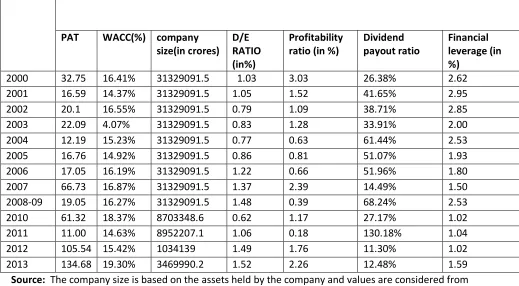
Table 1:Showing the values of various determinants of JK Tyres and industries LTD. Capital Structure from the period of 2000 to 2013.
Years CAPITAL STRUCTURE DETERMINENTS
PAT WACC(%) company size(in crores)
D/E RATIO (in%)
Profitability ratio (in %)
Dividend payout ratio
Financial leverage (in %)
2000 32.75 16.41% 31329091.5 1.03 3.03 26.38% 2.62
2001 16.59 14.37% 31329091.5 1.05 1.52 41.65% 2.95
2002 20.1 16.55% 31329091.5 0.79 1.09 38.71% 2.85
2003 22.09 4.07% 31329091.5 0.83 1.28 33.91% 2.00
2004 12.19 15.23% 31329091.5 0.77 0.63 61.44% 2.53
2005 16.76 14.92% 31329091.5 0.86 0.81 51.07% 1.93
2006 17.05 16.19% 31329091.5 1.22 0.66 51.96% 1.80
2007 66.73 16.87% 31329091.5 1.37 2.39 14.49% 1.50
2008-09 19.05 16.27% 31329091.5 1.48 0.39 68.24% 2.53
2010 61.32 18.37% 8703348.6 0.62 1.17 27.17% 1.02
2011 11.00 14.63% 8952207.1 1.06 0.18 130.18% 1.04
2012 105.54 15.42% 1034139 1.49 1.76 11.30% 1.02
2013 134.68 19.30% 3469990.2 1.52 2.26 12.48% 1.59
The various capital structure determinants are analyzed as mentionedin the table like WACC, co. size, D/E ratio, profitability ratio etc. The WACC value is calculated by using formula. The WACC value was high 19.30 in the year 2013 and low 4.07 in the year 2003. It implies that higher the WACC value, lower the financial efficiency of company and the higher risk. The company size is measured in terms of assets held by the company year as on. The company holds large assets 1884.76 crore in the year 2012 and less in the year 2004 i.e. 693.96 crore. The D/E ratio is 1.52% in the year 2013 and 0.62 % in the year 2010. A high ratio shows a large share of financing by the creditors of the firm, a low ratio implies a small claim of creditors. The profitability ratio is 3.03% in the year 2000 and 0.18% in the year 2008.The payout ratio is less in the year 2012 and high in the year 2011 i.e. 11% and130.18% respectively. The lower the payout ratio safer the dividend is. The financial leverage is 2.95% in the year 2001 which is high compared to other years and 1.02% in the year 2010 and 2012.The ratio shows that the higher the degree of financial leverage, the more volatile is EPS.
Table 2: Showing the Financial performance in terms of Net Profit and Share Price from the year 2000 to 2013.
Year Net Profit(Rs in crores) Share Price(in Rs)
2000 32.75 6.6
2001 16.59 4.3
2002 20.1 4.4
2003 22.09 4.4
2004 12.19 11.1
2005 16.76 21.0
2006 17.05 26.8
2007 66.73 25.3
2008-09 19.05 25.3
2010 61.32 39.3
2011 11.00 18.7
2012 105.54 15.9
2013 134.68 19.6
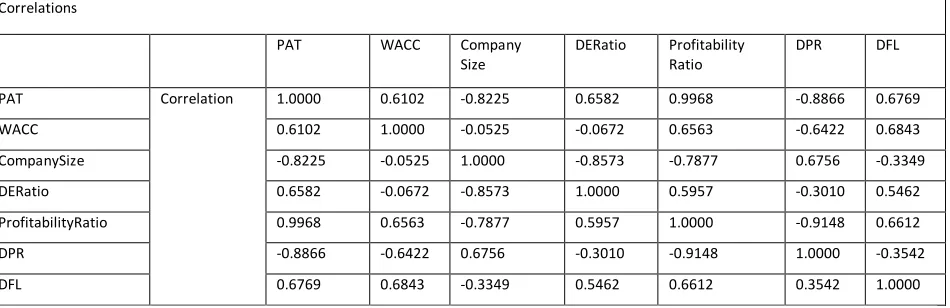
Table 3:Pearson Correlation Coefficients between Net Profit and Independent Variables Correlations
PAT WACC Company
Size
DERatio Profitability Ratio
DPR DFL
PAT Correlation 1.0000 0.6102 -0.8225 0.6582 0.9968 -0.8866 0.6769
WACC 0.6102 1.0000 -0.0525 -0.0672 0.6563 -0.6422 0.6843
CompanySize -0.8225 -0.0525 1.0000 -0.8573 -0.7877 0.6756 -0.3349 DERatio 0.6582 -0.0672 -0.8573 1.0000 0.5957 -0.3010 0.5462 ProfitabilityRatio 0.9968 0.6563 -0.7877 0.5957 1.0000 -0.9148 0.6612 DPR -0.8866 -0.6422 0.6756 -0.3010 -0.9148 1.0000 -0.3542
DFL 0.6769 0.6843 -0.3349 0.5462 0.6612 0.3542 1.0000
The correlation between the variables are analyzed, if there is a change in value by 1% in Net Profit it significantly influence the change 0.572 %. The correlation is 0.572 and significant level is 0.01.
The correlation between Net Profit and Profitability Ratio is 0.572. Also the correlation between Net Profit and Debt Equity Ratio is 0.551. This shows that there is a positive correlation between these variables. But there is a weak negative correlation between Net Profit and Company Size, Financial Leverage respectively.
Table 5: Regression Analysis
The above table represents the estimated results.Explanatory power of the model as indicated by R2 (multiple coefficient of determination) and adjustedR2 is fairly good. The model explains around 95.26% of the variation in the dependent variable/capitalstructure. The adjusted explanation of the model is about 90.53%. The F value which is a measure of overall significance of the estimated regression is above 0.05 in all the cases so it can be said that there is a goodness of fit between the variables. Thesignificant value of F proves that the relationship between the independent variables and Net Profit. SUMMARY OUTPUT
Regression Statistics
Multiple R 0.976058
R Square 0.952689
Adjusted R Square 0.905378 Standard Error 12.19066 Observations 13
ANOVA
Df SS MS F Significance F
Regression 6 17955.3 2992.55 20.13665 0.000985
Residual 6 891.6726 148.6121
Findings
The intended aim of conducting this study was to provide the empirical evidence regarding influence of capital structure determinants and its impact on company performance. This study has tested the influence of six determinants on capital structure, through using the Least Squaremethod by consecutively multiple regression analysis on the data set for the period FY2000 to FY2013 of JK Tyres and industries ltd. The multiple regression analysis suggests that the model explains around 96.3% of the variation in the dependent variable. The adjusted explanation of the model is about 94.4%. The independent variables- WACC, company size, debt-equity ratio, profitability ratio, dividend payout ratio and financial leverage proves to be statistically significant determinants of capitalstructure. The findings of study validate a strong positive dependence of determinants of capital structure on the financial performance of the company.
Suggestions
The succeeding references are recommended to increase the Company’s financial performance basedon capital structure.
Recognizing the weaknesses of investment might be the best one to improve the firm’s financialperformance, because it indicates the area which decision should be taken.
Encouraging the shareholders to help to attain the high level of firm’s financial performance.
Political changes are very important factor in the share marketplace. It is moreover determine the company performance. Therefore, political should possible to increase the financial performance of the listed companies.
Inflation and exchange rate also affect the listed company’s performance. So, governmentshould consider the economic growth to control the inflation.
Conclusion
The study leads to the conclusion that capital structure plays an important role in determining firms’ performance and its impacts are still controversial particularly in the emerging market.The results also indicate that firm’s size plays a significant role in determining capital structure and has significantly positive impact on the presentation of the firm. It shows the larger the size of a company, the higher return to the firm and shareholders. Also other variables like tax rate, corporate risk etc, will also influence on the financial performance of the company.
Reference
Modigliani, F., and Miller, M. H. (1958), The cost of Capital, corporation finance and theory of investment, American Economic Review, vol. 48, No. 3, pp. 261-297.
Myers, S.C. (1977). Determinants of corporate Borrowing, Journal of Financial Economics, vol. 5, pp. 147-175.
Titman, S. (1984).The effect of capital structure on a firm’s liquidation decision.Journal of Financial Economics, vol. 13, No. 1, pp. 137-151
Angelo, H. D., &Masulis, R. W. (1980). Optimal Capital Structure Under Corporate and Personal Taxation. Journal of Financial Economics, vol. 8, pp. 3-29.