FLEXIBLE DISTRIBUTED STORAGE INTEGRITY AUDITING MECHANISM TO ACHIEVE A SECURE AND DEPENDABLE CLOUD STORAGE SERVICE IN CLOUD COMPUTING
N Chandrakala
Christu Jyothi Institute of Technology and Science,Jangaon,TS,India.
Abstract: Cloud storage allows users to remote storage of their data and enables on-demand high
quality cloud applications without the local hardware and software management. Though this type of
storage have many benefits, such a service is also suffers with the problems like physical possession of
their outsourced data, which causes new security risks toward the correctness of the data in cloud. In
order to remove this new problem and to obtain a secure and dependable cloud storage service, this
paper proposes a flexible distributed storage integrity auditing mechanism, which utilises the
homomorphism token and distributed erasure-coded data. The proposed method ensures users to audit
the cloud storage with very lightweight communication and computation cost. This type of auditing
mechanism ensures strong cloud storage correctness guarantee and also achieves fast data error
localization. If the cloud data is dynamic, the proposed method further supports secure and efficient
dynamic operations on outsourced data, including block modification, deletion, and append. The
analysis shows the proposed scheme is efficient and resilient against byzantine failure, malicious data
modification attack, and server colluding attacks.
1. Introduction:
Cloud computing has the potential to dramatically change the landscape of the current IT industry
(Armbrust et al., Goldberg 1989). It is the most powerful processor and even cheaper which is an
internet based technology with Infrastructure as a service (IaaS) computing architecture .For
companies that only have to process large amount of data occasionally running their own data centres
is obviously not an option .Cloud computing has emerged as a promising approach to rent a large IT
infrastructure on a short term pay-per-usage basis .Amazon simple storage service (S3) and Amazon
Elastic Compute Cloud. Moving the data in the cloud provide the user with a great efficiencies, since it
don’t have to care about the complexities of direct hardware management .By internet based online
services, using the huge amount of storage space and customizable computing resources, this
platforms eliminates the responsibilities of the local machines for data maintenance . So for the
integrity of the data users are depended on the cloud service providers. Vendors like Amazons S3 is
Generally users‟ data is protected using different cryptographic algorithms, in order to protect data
from intruders .This approach also used in cloud computing environment. By using the algorithms the
user loses control over the data. Therefore without the knowledge of the data in cloud we should
provide security. So for the long term data safety these methods become even more challenging for
the correctness f the data in the cloud. Secondly in cloud the data is not static, the data is updated,
deleted inserted, appended. So the dynamic data update is the most important challenge in cloud .In
previously in cloud only static operations are done, so by using dynamic operations in the cloud entails
to new solution. The third challenge is that the data should be stored multiple locations so that we can
reduce data integrity threats. The deployment in the cloud computing is powered by data centres
running simultaneous, cooperated and distributed manner [1]. So the distributed data in the cloud is
most important for storage correctness of data in the cloud and also to achieve robust and secure
cloud data in the real world. In the existing system the ensuring data integrity has been highlighted by
the following researchers [3]-[5].These techniques ensures the storage correctness in the cloud but it
can’t address all the security threats in the cloud, since they are focus on single server scenario and
most them uses static data it does not consider dynamic data pupation .
2. System Analysis
After analysing the requirements of the task to be performed, the next step is to analyze the problem
and understand its context. The first activity in the phase is studying the existing system and other is to
understand the requirements and domain of the new system. Both the activities are equally
important, but the first activity serves as a basis of giving the functional specifications and then
successful design of the proposed system. Understanding the properties and requirements of a new
system is more difficult and requires creative thinking and understanding of existing running system is
also difficult, improper understanding of present system can lead diversion from solution.In contrast to
traditional solutions, where the IT services are under proper physical, logical and personnel controls,
Cloud Computing moves the application software and databases to the large data centres, where the
management of the data and services may not be fully trust worthy. This unique attribute, however,
poses many new security challenges which have not been well understood like no user data privacy,
Security risks towards the correctness of the data in cloud.
3 Proposed System design :
We focus on cloud data storage security, which has always been an important aspect of quality of
service. To ensure the correctness of users’ data in the cloud, we propose an effective and flexible
holomorphic token with distributed verification of erasure-coded data, our scheme achieves the
integration of storage correctness insurance and data error localization, i.e., the identification of
misbehaving server(s). Unlike most prior works, the new scheme further supports secure and efficient
dynamic operations on data blocks, including: data update, delete and append. In this paper, we
propose an effective and flexible distributed scheme with explicit dynamic data support to ensure the
correctness of users’ data in the cloud.Cloud Computing is not just a third party data warehouse. The
data stored in the cloud may be frequently updated by the users, including insertion, deletion,
modification, appending, etc. To ensure storage correctness under dynamic data update is hence of
paramount importance. However, this dynamic feature also makes traditional integrity insurance
techniques futile and entails new solutions.
In this paper we are using Reed-Solomon erasure-correcting code to create k redundancy parity
vectors from m data vectors in such a way that the original m data vectors can be reconstructed from
any m out of the m+k vectors on a different server, the original data file can survive the failure of any k
of m+k servers without any data loss, with a space overhead of k/m. For support of original file layout
I/O our file layout is systematic, i.e., the unmodified m data file vectors together with k parity vectors
are distributed across m+k different servers. Linear m/n codes are defined over Galois field with 2f
elements. Let F=(F1 ,F2, ………..,Fm) and Fi=(f1i ,f2i,………fmi)T ( i € ,1,…….,m-),where l≤2p-1.Code
defined by a generator matrix G with m rows and n columns G has a special form ( Im |P) Im is an
identity matrix .Every m×m identity matrix and G is invertible Generation of generator matrix with n=2f
GF elements in a given order: f1, f2,…,fm..It form Vandermonde matrix.
Store vi s locally 12 end procedure The element vi (j) belongs to GF (2p) with small size, it is the
response where the user expect from the server when he challenges in a specified blocks. The user
keeps the token locally or in encrypted form of the pre-computed tokens in the cloud server. But in
our case the user stores the tokens locally, to avoid lower bandwidth which occur due to dynamic data
operation
The final step before file distribution is to blind each parity block gi(j) in (G(m+1),…………,G(n)) by gi(j)
← gi(j) +fkj (sij) , i € ,1,……….,l-, where kj is the secret key for parity vector .This key is used for
protection. After blinding the parity information, the user disperses all the encoded vectors G(j) (j
3.2 Correctness Verification and Error LocalizationCorrectness
Verification and Error localization is the main idea for eliminating the data errors in the system. In the
existing system they do not explicitly consider the error localization, thus they give only binary results.
But in this scheme we get find the misbehaving servers by using challenge –response protocol
Specially, the procedure of the i-th challenge-response for a cross-check over the n servers is described
as follows : 1) The user reveals the άi as well as the i-th permutation key kprp(i) to each servers. 2) The
server storing vector G(j) aggregates those r rows specified by index kprp(i) into a linear combination
3) Upon receiving Ri (j) all the servers, the user takes away blind values in R(j) ( j € ,m+ 1, . . . , n-) 4)
Then the user verifies the code word with the received value which is generated but the secret matrix
P. As the entire server operates over the same subset of indices .So these row specified code word
should be in the encoded file. If the above equation holds the challenge is passed otherwise it
indicates that the specified row has an error which is passed to the server that there is a corruption
The file matrix is symmetric, so the user can get the original file by downloading the data vectors from
the first m servers, assume that they return the correct response value .Generally our verification is
random spot checking that the storage correctness is probabilistic .By choosing system parameters
(e.g., r, l, t) appropriately and conducting enough times of verifications, we can guarantee the
successful file retrieval with high probability On the other hand, whenever the data corruption is
detected, the comparison of pre-computed tokens and received response values can guarantee the
identification of misbehaving server(s), again with high probability, which will be discussed shortly.
Therefore, the user can always ask server to send back blocks of the r specified rows in the challenge
and regenerate the correct blocks. The newly recovered file should be sent to the misbehaving servers
to maintain the correctness of storage
A quality output is one, which meets the requirements of the end user and presents the information
clearly. In any system results of processing are communicated to the users and to other system
through outputs. In output design it is determined how the information is to be displaced for
immediate need and also the hard copy output. It is the most important and direct source information
to the user. Efficient and intelligent output design improves the system’s relationship to help user
decision-making.Since our layout of file matrix is systematic, the user can reconstruct the original file
by downloading the data vectors from the first m servers, assuming that they return the correct
response values. Notice that our verification scheme is based on random spot-checking, so the storage
correctness assurance is a probabilistic one. We can guarantee the successful file retrieval with high
probability. On the other hand, whenever the data corruption is detected, the comparison of
server(s).As discussed in our architecture, in case the user does not have the time, feasibility or
resources to perform the storage correctness verification, he can optionally delegate this task to an
independent third party auditor, making the cloud storage publicly verifiable. However, as pointed out
by the recent work, to securely introduce an effective TPA, the auditing process should bring in no new
vulnerabilities towards user data privacy. Namely, TPA should not learn user’s data content through
the delegated data auditing.
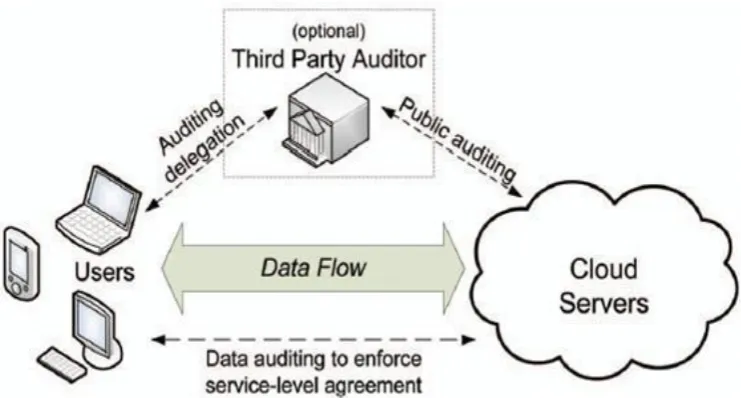
Fig. 1: Cloud storage service architecture
Representative network architecture for cloud storage service architecture is illustrated in Figure 1. Three different network entities can be identified as follows:
• User: an entity, who has data to be stored in the cloud and relies on the cloud for data storage and computation, can be either enterprise or individual customers.
• Cloud Server (CS): an entity, which is managed by cloud service provider (CSP) to provide data storage service and has significant storage space and com-putation resources (we will not differentiate CS and CSP hereafter.).
• Third Party Auditor (TPA): an optional TPA, who has expertise and capabilities that users may not
have, is trusted to assess and expose risk of cloud storage services on behalf of the users upon request.
It is a simple graphical formalism that can be used to represent a system in terms of the input data to
the system, various processing carried out on these data, and the output data is generated by the
system.
Fig:2 Data Flow Diagram: 5.Testing:
Software Testing can be defined as: Testing is an activity that helps in finding out
bugs/defects/errors in a software system under development, in order to provide a bug free and
reliable system/solution to the customer. In other words, let us consider an example as: suppose you
are a good cook and are expecting some guests at dinner. we start making dinner; we make few very
very very delicious dishes (off-course, those which you already know how to make). And finally, when
you are about to finish making the dishes, you ask someone (or you yourself) to check if everything is
fine and there is no extra salt/chili/anything, which if is not in balance, can ruin your evening (This is
what called 'TESTING').
Software Testing Fundamentals:
1) Testing is a process of executing a program with the intent of finding an error.
2) A good test case is one that has a high probability of finding an as yet undiscovered error.
3) A successful test is one that uncovers an as yet undiscovered error.
Testing should systematically uncover different classes of errors in a minimum amount of time
and with a minimum amount of effort. A secondary benefit of testing is that it demonstrates that the
software appears to be working as stated in the specifications. The data collected through testing can
also provide an indication of the software's reliability and quality. But, testing cannot show the
Well, while making food, its ok to have something extra, people might understand and eat the
things you made and may well appreciate your work. But this isn't the case with Software Project
Development. If you fail to deliver a reliable, good and problem free software solution, you fail in your
project and probably you may lose your client. This can get even worse! So in order to make it sure,
that you provide your client a proper software solution, you go for TESTING. You check out if there is
any problem, any error in the system, which can make software unusable by the client.
6.Output Screens
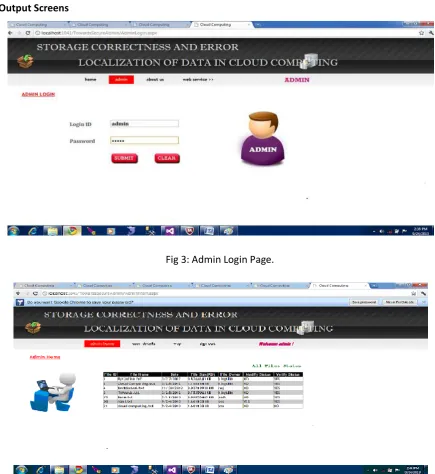
Fig 3: Admin Login Page.
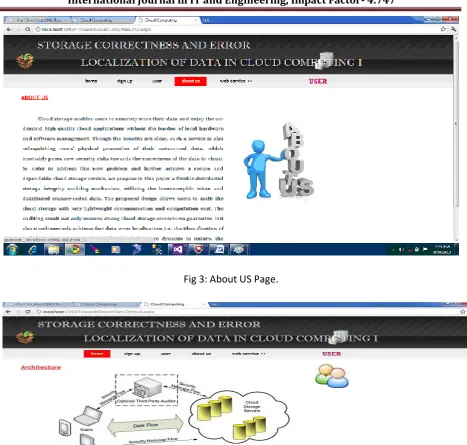
Fig 3: About US Page.
Fig 5: Verified files tab : Used to view the files which are verified by TPA.
Fig 6: all files tab: displays all the files both verified and not verified.
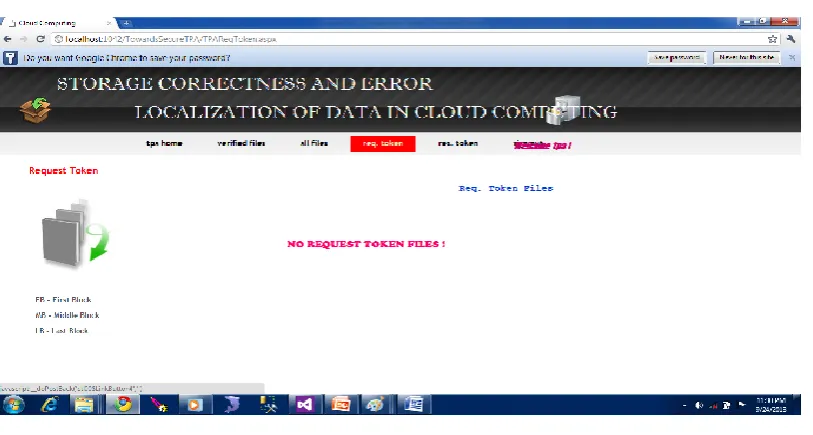
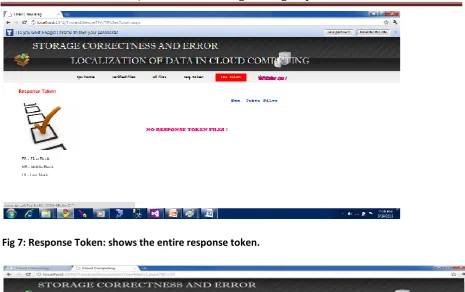
Fig 7: Response Token: shows the entire response token.
Fig 5 View file block: After the Click on the view link at the user home page shows the file with blocks division.
7.Conclusion :
In this paper, we studied the problem of data security in data storage in cloud servers. To
guarantee the correctness of users‟ data in cloud data storage, we proposed an effectual and flexible
scheme with explicit dynamic data support, including block revise, erase, and affix. We use
erasure-correcting code in the file distribution preparation to provide redundancy parity vectors and guarantee
the data dependability. Our scheme accomplishes the integration of storage correctness insurance and
data corruption has been detected during the storage correctness verification across the distributed
servers. Our scheme is highly efficient and resilient to Byzantine failure, malicious data modification
an area full of challenges and of dominance. We also focused on theoretical analysis of parallel data
processing in cloud computing for scheduling the cloud server time.
Growing number of companies have to process huge amounts of data in a cost-efficient manner.
Classic representatives for these companies are operators of Internet search engines. The vast amount
have to deal with every day has made traditional database solutions prohibitively expensive .Instead,
these companies have popularized an architectural paradigm based on a large number of commodity
Consequently, the allocated compute resources may be inadequate for big parts of the submitted job
and unnecessarily increase processing time and cost. The opportunities and challenges for efficient
parallel data processing in clouds and present our research project. It is the first data processing
framework to explicitly exploit the dynamic resource allocation offered by today‟s IaaS clouds for
both, task scheduling and execution. Particular tasks of a processing job can be assigned to different
types of virtual machines which are automatically instantiated and terminated during the job
execution. In recent years a variety of systems to facilitate MTC has been developed. Although these
systems typically share common goals (e.g. to hide issues of parallelism or fault tolerance), they aim at
different fields of application. Map Reduce is designed to run data analysis jobs on a large amount of
data, which is expected to be stored across a large set of share-nothing commodity servers. Once a
user has fit his.
References:
*1+ Amazon.com, “Amazon Web Services (AWS),” Online at http://aws.amazon.com, 2008
*2+ N.Gohring, “Amazon‟s S3 down for several hours,” Online at
http://www.pcworld.com/businesscenter/article/142549/amazons s3down for several hours.html,
2008
*3+ A. Juels and J. Burton S. Kaliski, “PORs: Proofs of Retrievability forLarge Files,” Proc. of CCS ’07, pp.
584–597, 2007.
*4+ H. Shacham and B. Waters, “Compact Proofs of Retrievability,” Proc. of Asiacrypt ’08, Dec. 2008.
*5+ K. D. Bowers, A. Juels, and A. Oprea, “Proofs of Retrievability: Theory and Implementation,”
Cryptology ePrint Archive, Report 2008/175,2008, http://eprint.iacr.org/.
*6+ G. Ateniese, R. Burns, R. Curtmola, J. Herring, L. Kissner, Z. Peterson, and D. Song, “Provable Data
*7+ G. Ateniese, R. D. Pietro, L. V. Mancini, and G. Tsudik, “Scalable and Efficient Provable Data
Possession,” Proc. of SecureComm ’08, pp. 1–10, 2008.
*8+ T. S. J. Schwarz and E. L. Miller, “Store, Forget, and Check: Using Algebraic Signatures to Check
Remotely Administered Storage,” Proc.of ICDCS ’06, pp. 12–12, 2006.
*9+ “A Cooperative Internet Backup Scheme,” Proc. of the 2003 USENIXAnnual Technical Conference
(General Track), pp. 29–41, 2003.
*10+ K. D. Bowers, A. Juels, and A. Oprea, “HAIL: A High-Availability and Integrity Layer for Cloud
Storage,” Cryptology ePrint Archive, Report 2008/489, 2008, http://eprint.iacr.org/.
*11+ L. Carter and M. Wegman, “Universal Hash Functions,” Journal of Computer and System Sciences,
vol. 18, no. 2, pp. 143– 154, 1979.
*12+ J. Hendricks, G. Ganger, and M. Reiter, “Verifying Distributed Erasure coded Data,” Proc. 26th
ACM Symposium on Principles of Distributed Computing, pp. 139–146, 2007.
[13] J. S. Plank and Y. Ding, “Note: Correction to the 1997 Tutorial on Reed-Solomon Coding,”