STUDY OF ULTRASONIC WAVES AND THE TEMPERATURE EFFECTS ON ITS APPLICATIONS
ChattrapatiChakravarti Ashoka1, Dr. Sanjeev Tiwari2
Department of Mechanical Engineering
1,2
Shri Venkateshwara University, Gajraula (Uttar Pradesh)
Abstract
It has been established that ultrasonic flow meters are influenced by thermal conditions. Physical properties of the flowing medium, such as viscosity and density, are influenced by temperature, and temperature gradients will thus influence the flow pattern, the question is exactly how. In order to get a clearer picture of the influence from temperature gradients SFI would like to pose the question of how the meter accuracy is influenced by a radial and longitudinal temperature gradient caused by a temperature difference between the flowing medium and the surroundings. This is a very relevant and important question to answer in this research paper since the specifications allow temperature differences in the range of 200K between the ambient and the flowing medium.
1. ULTRASONIC WAVES
Ultrasonic or ultrasound, got from the Latin words "ultra" which means past and "sonic" which means sound, is a term used to portray sound waves that vibrate more quickly than the human ear can recognize. Sound waves go as concentric empty circles. The surfaces of the circles are compacted air particles, and the spaces between the circles are extensions of the air atoms through which the sound waves travel. Sound waves are along these lines a progression of compressions and expansions in the medium encompassing them. Despite the fact that we are considering sound waves as going through the air, they likewise spread through other media [1].
2. APPLICATION OF ULTRASONIC WAVES
The quantity of applications for ultrasound is by all accounts constrained just by the human creative ability. There are various ways that individuals have effectively found to make utilization of ultrasound. Some essential applications are specified here.
Ultrasonic waves can be utilized to separate fat globules in the drain, so the fat blends with the drain. Likewise, pasteurization, the
evacuation of harmful microscopic
A Monthly Double-Blind Peer Reviewed Refereed Open Access International e-Journal - Included in the International Serial Directories
Application in research
Study of cavitation in liquids IS one of the important areas of research. When a liquid is heated the cavitation process increases.
Since ultrasonic sound can control
cavitation, it is a powerful tool in the investigation of the process. A contemporary subject of research involves emission of light as the cavity produced by a high intensity ultrasonic wave collapses. This effect is called son luminescence. The velocity of ultrasonic wave is strongly
dependent on the density, adiabatic
compressibility, temperature, chemical
structure etc. The relation connecting ultrasonic velocity U, density p and
adiabatic compressibility .f3s of a liquid IS given by,
𝑈2 = 1
𝜌 × 𝛽𝑠
Variation with Temperature
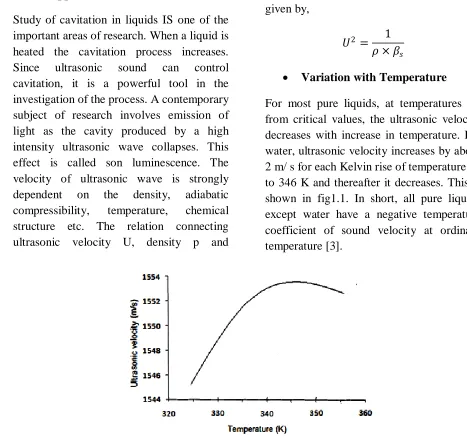
For most pure liquids, at temperatures far from critical values, the ultrasonic velocity decreases with increase in temperature. For water, ultrasonic velocity increases by about 2 m/ s for each Kelvin rise of temperature up to 346 K and thereafter it decreases. This is shown in fig1.1. In short, all pure liquids except water have a negative temperature coefficient of sound velocity at ordinary temperature [3].
Figure 1: Temperature Dependence of Ultrasonic Velocity in Water
For all liquids, the weight coefficient of ultrasonic velocity is a positive steady. This is because of the expansion in mass modulus of a liquid amid the utilization of weight. On account of water, the ultrasonic velocity increments almost at the rate of 0.2 m/s for an expansion of weight of one environment. There has been impressive consideration 1n
Ultrasonic to the improvement of
experimental guidelines relating the sound velocity to the parameters of the medium. The most acclaimed of these is Rao's govern, first exhibited by Rao.M.R in 1940. In its rearranged frame, it expresses that
Where Vis the molar volume and R1 is consistent for a given liquid, once in a while called the Rao steady or Rao number.
Ultrasonic Sensing Technology
Ultrasound waves are like sound waves,
where both go through a medium.
Ultrasound waves comprise of
high-frequency sound waves that are
indiscernible to human creatures. The frequency of the ultrasound waves is typically over 20 kHz. In any case, a few animals, for example, bats can hear and also create the high-frequency ultrasound waves. As the sound waves go through the air, they create vibration noticeable all around particles which changes the thickness and weight of the air particles along the bearing of movement of the wave. On the off chance that a sound wave is moving from left to directly through the air, particles of air will be uprooted both rightward and leftward as the vitality of the sound wave goes through it. If the wellspring of the sound waves vibrates sinusoidal, the weight varieties are additionally sinusoidal [4].
3. EFFECTS OF TEMPERATURE VARIATIONS
As talked about before, the variety in the surrounding temperature impacts the speed of sound. Since the variety in encompassing temperature is consistent, the speed of the ultrasonic wave ought not to be viewed as steady. In vehicular fuel tanks, the temperature can shift from - 40 to 110 C. To
enhance the unwavering quality of
ultrasonic detecting frameworks, for the
most part, a temperature sensor is
incorporated into the framework
configuration to modify the speed of ultrasonic waves utilized as a part of the
level estimation, which depicts the
connection between the speed of the ultrasonic wave and temperature. To decide the fuel level in a storage tank utilizing an ultrasonic sensor by controlling a Motorola's 68HC05 sort microcontroller.
A tube is put inside the tank which contains a buoy that is floated on the surface of the liquid. An ultrasonic transducer is set inside the tube. The ultrasonic transducer emanates ultrasonic pulses coordinated at the buoy, gets the reflected ultrasonic pulses, and responsively creates a resound signal. The buoy has the best bit and a base bit isolated by a round and hollow bit. The circular surface has a foreordained span which is a component of within breadth of the tube, the tallness of the tube-shaped part of the buoy, and the outside measurement of the tube-shaped segment of the buoy. A temperature sensor screens the temperature of the liquid and produces a thermometric signal in light of the liquid temperature.
A Monthly Double-Blind Peer Reviewed Refereed Open Access International e-Journal - Included in the International Serial Directories
numerous versatile robots to work together in a similar situation, regardless of whether their ultrasonic sensors work at similar frequencies [5].
The impacts can cause echoes to be lost or missed, including echoes from the surface and also to the objective. The device utilizes resound vitality as a factor to recognize a genuine reverberates from a false resound. In portable fluid tanks, for example, car fuel tanks, the acceleration will instigate waves in the storage tank. This wonder of fluid change is called sloshing. The greatness of sloshing is reliant on the estimation of the acceleration or deceleration that might be caused by braking, speeding, and sporadic landscape. Level measurement devices watching the fluid level under sloshing conditions will deliver mistaken level readings. The sloshing marvel in moving rectangular tanks (e.g., car fuel tanks) can generally be portrayed by considering just two-dimensional fluid flow if the width of the tank is significantly less than its expansiveness.
Tiltmeters or inclinometers can be utilized as a part of circumstances where the fluid tank can encounter messy surfaces, for example, noisy streets in uneven regions. The level signal from the fuel level sensor can be transmitted to the fuel measure just when the vehicle is tilted not as much as a foreordained degree. To achieve this, a signal from the fuel sensor is gone through to the show by a microprocessor just when the vehicle is significantly level and not quickening or decelerating. At the point when the level condition is met, the signal demonstrative of the measure of fuel left in
the tank is put away in the microprocessor memory and showed on the fuel check, and is refreshed again when the vehicle achieves the following level condition.
4. FLOW MEASUREMENT AND
CONTROL SYSTEM
The industrial application of flow rate measurement and control is very important and essential, especially in petroleum refineries, pharmaceutical and chemical process industries. Flow control is very important in medical appliances also. For maintaining the saline and blood flow rate is playing a very crucial role in hospitals. In
pharmaceutical and chemical process
industries also the flow rate maintenance is essential for perfectness of medicine composition. The flow rate is measured, and control is developed by implementing
software programming FPID. The
performance of flow meters is also influenced by a dimensionless unit called the Reynolds Number.
It is defined as the ratio of the liquid's inertial forces to its drag forces. The Reynolds number is used for determined whether a flow is laminar or turbulent. Laminar flow within pipes will occur when the Reynolds number is below the critical Reynolds number of 2300 and turbulent flow when it is above 2300. The value of 2300 has been determined experimentally, and a certain range around this value is considered the transition region between laminar and turbulent flow [6].
𝑹𝒆 =
𝒖
𝒔𝑳Where,
ѵ𝑠 = Mean Fluid Velocity,
𝜂 - (Absolute) Dynamic fluid Viscosity
𝑣 = Kinematics Fluid Viscosity (𝜈 = 𝜂/𝜌)
𝜌 = Fluid Density
𝐿 = Characteristic Length (Equal to
diameter, 2𝑟 if a Cross Section is Circular)
The system parameters, for example, essential frequency, greatest velocity, and most extreme estimating length et cetera can be planned with the end goal that for some applications in common fluids measurement prerequisites and conditions are satisfied. The normal parameter esteems accessible at present can likewise be found by Met-Flow (1998). As opposed to other measurement
methods, this procedure has the
accompanying three noteworthy focal
points;
(1) It obtains a spatio-temporal
information about the flow field. (2) It is applicable to opaque liquids. (3) It is a line measurement and thus a
flow mapping is practicable.
Each of these advantages will be further explained below. We should emphasize that this measurement method is not a point wise measurement but a line wise measurement. Thus a velocity profile consisting of a multiple number of data points, say 128, is realized and not incrementally scanned from the first through the last data point in the field. This is quite important contrast to the conventional methods, which calls upon the user to re-think the way the data is
interpreted. Moreover the means by which data sets are manipulated and analyzed are inherently different. Thus the advantageous features are [7]:
1. Spatio-temporal information: The velocity field depicted in an Eulerian outline is an element of both space and time. In customary measurement systems, aside from PIV (molecule image velocimetry) and other image recording plans, we can get the velocity field at one moment or velocity esteems at one spatial point as a period arrangement. Because of the natural requirements of such velocimetry, there has been a reasonable need to build up a measurement system by which one can acquire velocity fields as a component of time.
2. Until as of late it was for all intents and purposes difficult to make
velocity measurement of misty
fluids. Flow representation methods
by optical means are clearly
outlandish and different
A Monthly Double-Blind Peer Reviewed Refereed Open Access International e-Journal - Included in the International Serial Directories
3. In a request to approve
computational codes, it is attractive to tentatively quantify a similar velocity field as that ascertained. Ordinarily from numerical codes, velocity fields are produced in vector shape, from which different related flow amounts, for example, flow rate are registered. A subset of these outcomes is regularly contrasted with tests all together with approve the codes. This is, in any case, only a certain and lacking approval strategy since the integration frequently spreads out fine structure existing in the flow. With the UVP utilized, with the end goal of flow mapping the acquired flow fields can be specifically contrasted and numerical outcomes.
5. FLOW MEASUREMENT IN
OPAQUE LIQUIDS
The underlying motivation of the creator to build up a method was to think about liquid metal flow. The main test medium was mercury. The ultrasonic transducer was inundated specifically into mercury, and the flow in aT-branch of a pipe was estimated to affirm the method. Flow measurement in mercury has as of late been reached out to contemplate flow in the quickening agent target geometry. The holder is made of stainless steel, and the transducer is put remotely to the compartment divider. This is conceivable on account of a transmission property of ultrasonic pillar for a mix of mercury and stainless steel.
The nourishment materials are normally murky and non-Newtonian so that to date there was no significant method to explore flow conduct in pipes or different holders. Uriev and collaborators have prevailed with regards to estimating velocity profile of chocolate flow from which a flow rate was assessed. They assess such velocity profiles together with weight distinction to get different parameters, for example, shear rate and consistency, both of which can be utilized as parameters in process control. The attractive fluid is made out of small attractive particles of the distance across having the scope of 5 to 15 nm suspended in water or oil. They are dark liquid, and no optical method can be utilized.
Flow mapping
This information collection is shown utilizing different configurations, for example, vector fields, relative velocity fields, turbulent velocity fields, and neighborhood vitality dispersal shapes. The
outcomes demonstrate that full flow
mapping empowers us to assess the flow wonders utilizing different physical amounts got from the vector velocity field; that is, amounts, for example, the stream work dissemination and vorticity circulation. A comparable report has been made for water flow in a parallel channel flow. A group at PSI is additionally exploring the flow of mercury in a stainless steel holder. The examination is on flow design in a hemispherical end locale of a twofold coaxial tube compose target holder for a spallation neutron source [8].
Other application
The UVP method is being utilized as a part of different configurations where, for the most part, the measure of the fluid collection of intrigue is moderately substantial, normally bigger than 1 m. Such expansive
measurement is regularly experienced in
atomic designing, structural building,
compound building, natural sciences, for example, in maritime and geophysical flows, where even a period arrived at the midpoint of velocity profile is frequently hard to acquire.
The phenomenon to date has been
investigated fundamentally utilizing
temperature information. Hot-icy hot, three-stream configurations recreate flow out of the centre with UVP, PIV and temperature recording the spatiotemporal nature of the warm water power. In the zone of trial gas-liquid flows the UVP method can be connected to a moving interface, for example, air pockets and free surfaces. At display, the application is restricted to a bubbly flow with the low void part, since the ultrasonic pillar is completely reflected or redirected by substantial rises in certain flow
administrations and everywhere voids
division different dissipating among the air pockets brings mistake into the position information to such an extent that the profile is defined.
A Monthly Double-Blind Peer Reviewed Refereed Open Access International e-Journal - Included in the International Serial Directories
On another plant, meters frequently should be supplanted after startup because of mistakes in outline versus real process operation. With the high turndown and, if required, virtual insusceptibility to thickness varieties that ultrasonic multi-way flow meters have, the main issue would change the meter program after startup to acquire wanted working reach. Ten times change in thickness presents just a 1% change in the meter factor K of a distance across the way (e.g., cinch on) ultrasonic flow meter, for
turbulent fluids. The fundamental
explanation for the expansive turndown is the direct reaction of a travel time flow meter, as opposed to square law devices.
6. CONCLUSION
Amid the previous quite a long while ultrasonic meters have turned out to be one
of the quickest developing new
advancements in the gaseous petrol field. The prominence of these devices has expanded because they give significant incentive to the client by decreasing the cost of working together. A standout amongst the
most significant advantages is the
diminishment in support over different advancements. There are a few factors that can be credited to this expanded utilization. Initially, as there are no moving parts to destroy, unwavering quality is expanded. Since USMs make no differential weight, any sudden over-range won't harm the meter. On the off chance that the meter experiences exorbitant liquids, it might stop operation quickly, yet no physical harm will happen, and the meter will come back to typical operation once the liquid has cleared. Most importantly, ultrasonic meters give a
significant measure of symptomatic
information inside their devices. A large portion of an ultrasonic meter's analytic information is utilized to directly translate its "wellbeing."
REFERENCES
1. Jeng-Bin Li, Yun-Kung Chung, “A Novel Back propagation Neural
Network Training Algorithm
Designed by an Ant Colony
Optimization”, IEEE/PES
Transmission and Distribution
Conference & Exhibition: Asia and Pacific Dalian, China 2005
2. Stuart Russell and Peter Norvig, “Artificial Intelligence A Modern Approach”, 3rd Edition, Prentice Hall New York, 2009.
3. P.-Y. Zhang, D.-D. Zheng, T.-S. Xu, L.-X. Zhang, and H.-M. Hu, “Study on the influence of ultrasonic probes on flow field and measurement performance of ultrasonic flow meter,” Journal of Experiments in Fluid Mechanics, vol. 25, no. 3, pp. 60–65, 2011.
4. J. G. Drenthen and G. De Boer, “The manufacturing of ultrasonic gas flow meters,” Flow Measurement and Instrumentation, vol. 12, no. 2, pp. 89–99, 2001.
5. Y. Hu, T. Zhang, and D. D. Zheng, “Estimation on influence of probe protrusion length of ultrasonic flow meter on measurement,” Journal of Tianjin University, vol. 46, no. 9, pp. 776–783, 2013.
6. The American Society of Mechanical
Engineer, ASME PTC18-2011
Hydraulic Turbines and Pump
7. L. Zhang, T. Meng, C. Wang, H. M.
Hu, and C. L. Qin, “Probe
installation effects on the accuracy of
feed thru ultrasonic flow
meters,” Chinese Journal of
Scientific Instrument, vol. 33, no. 10, pp. 2307–2314, 2012.
8. S. He, L. Peng, and H. Nakazato,
“Computational fluid dynamics
based sound path optimization for
ultrasonic flow meter,” Chinese