1724
Bagging Ensemble X-Means Clustering Based
Multicriteria Whale Optimized Data Dissemination
In Vanet
D.Radhika, A.Bhuvaneswari
Abstract: Vehicular Ad-Hoc Network (VANET) is an intelligent transportation system owing to the rapid extension of safety and multimedia applications. But, successful data dissemination and reliable routing in VANET is still a difficult problem. In order to overcome such drawbacks, Bagging Ensemble X-Means Clustering Based Multi-criteria Whale Optimization (BEXCMWO) technique is proposed. At first, BEXCMWO technique applies Bagging Ensemble X-Means Cluster-based Routing (BEXC-R) where the total network is split into a number of groups. Each group contains the number of vehicle nodes. The BEXC-R uses the X-means clustering as a weak cluster to group each vehicle to the closest cluster centroid based on the vehicle‘s density, direction, distances, and velocities. After finishing the clustering process, vehicle node with the minimum average distance among cluster members is selected as the cluster head in BEXCMWO technique for route the data from source to destination. Subsequently, the optimal nearest cluster head is identified with the help of Multi-criteria Whale Optimization-based Data Dissemination (MWO-DD) for distributing the data packets from the source vehicle node to destination vehicle node in VANET. The simulation of BEXCWO technique is conducted using parameters such as reliability, end to end delay and throughput. The simulation results show that the BEXCMWO technique is able to increases the reliability and also reduces the end to end delay of data dissemination in VANET when compared to state-of-the-art methods
Index Terms: Bagging Ensemble X-Means Clustering, Data Dissemination, Multi-criteria Whale Optimization, Optimal Cluster Head, Routing and Vehicle Nodes.
—————————— ——————————
1.
INTRODUCTION
Vehicular ad hoc network (VANET) comprises of many vehicle nodes and roadside units for communication, transmission, and gathering data of nodes and thereby managing traffic loads. Clustering is carried out in the VANET for achieving the needed goals. Clustering mechanisms are one of the more efficient techniques utilized in a dynamic and large-scale network to improve the processing capacity of routing. Moreover, data dissemination in VANET is emerging as a significant area of research to get higher throughput with a minimal delay. In conventional works, a lot of research works have been designed using different clustering and optimization techniques for performing routing and data dissemination in VANET. However, reliable data dissemination was not accomplished to achieve higher throughput. In order to address these limitations, BEXCMWO technique is introduced in this research work. A reliable routing scheme called CEG-RAODV was introduced in [1] to discover the optimal path for data dissemination. The designed scheme improves the packet delivery and minimizes the delay but packet drop was not minimized. A Multi-valued Discrete Particle Swarm Optimization (DPSO) technique was introduced in [2] to find an optimal path for efficient data dissemination in VANET. But the DPSO technique was not minimized the network delay while disseminating the data packets.
A novel data dissemination scheme was presented in [4] using
Clustering and Probabilistic Broadcasting (CPB) to distribute data among vehicles. However, the packet delivery ratio using this scheme was lower. A data dissemination technique was developed in [5] with the application of a time barrier mechanism to lessen the overhead in the network. But, reliability when carried outing data dissemination process was poor. Parallel Swarm Optimization Based Cluster was designed in [6] for emergency message distribution in VANET with low collision probability and overhead. However, the end to end delay was not minimized.Moth flame optimization– driven clustering algorithm was introduced in [7] for VANET where it employed the social behavior of moth flames in generating efficient clusters. But, efficient clustering of vehicle node was not attained. A novel Cluster-based emergency message dissemination strategy was presented in [8] to minimize the message delivery time and to obtain efficient bandwidth consumption in VANET.However, reliable data dissemination was not achieved. Mobility-aware cross-layer based reliable routing protocol was employed in [9] for enhancing data dissemination performance in VANET. But, the amount of time taken to distribute data to the destination was more. A survey of different data dissemination based clustering techniques developed for VANET was analyzed in [10] to attain reliable communication among vehicles. A link reliability-based clustering algorithm (LRCA) was introduced in [11] to present efficient data transmission in VANET. However, clustering performance was poor to attain reliable data dissemination. In order to resolve the above mentioned conventional issues, BEXCMWO technique is developed in this research work. The main contribution of BEXCMWO technique is presented in below,
To improve the reliability in the data dissemination ,the .BEXCMWO technique performs ensemble clustering as well as optimization process.The Bagging Ensemble X-Means Clustering technique initially divides the total network into different groups based on density, direction speed and velocity of the nodes. After that , the cluster head is chosen for each _____________________________
D.Radhika is currently pursuing Research in Computer Science in Cauvery College for Women, Trichy,Tamilnadu,India, PH-9629608765. E-mail: [email protected]
Dr A.Bhuvaneswari is an Associate Professor in PG &Research Department of Computer Science in Cauvery College for Women,Trichy,Tamilnadu,India .
A Mean shift Margin Boost Clustering based Multivariate Dolphin
1725 cluster. Then the Whale Optimization technique is
applied to find the neighboring cluster head based on multiple criterions of the cluster head such as distance, energy and bandwidth availability. Followed by an optimal energy-aware route path from source to destination is selected and routing the data packets.
To minimize the end to end delay the BEXCMWO technique divides the total network into a number of clusters through the bagging ensemble x-means algorithm. On the contrary to the hops selection based routing technique, the source node only sends to the optimal cluster head for sending the data packets to the destination.
To improve the throughput, the BEXCMWO technique selects the optimal route between the source node and destination. The source node finds an optimal cluster head through the fitness calculation. The proposed optimization technique selects as optimal cluster head with minimum distance and higher residual energy as well as bandwidth availability. This helps to improve the link quality between the source and destination resulting increases the network throughput and minimize the packet drop.
The rest of the paper is ordered as follows: In Section 2, BEXCMWO technique is described with the help of the architecture diagram. In Section 3, Simulation settings are described and the result discussion is discussed in Section 4. Section 5 explains the related works. Section 6 depicts the conclusion of the paper.
2
BAGGING
ENSEMBLE
X-MEANS
CLUSTERING
BASED
MULTICRITERIA
WHALE TECHNIQUE
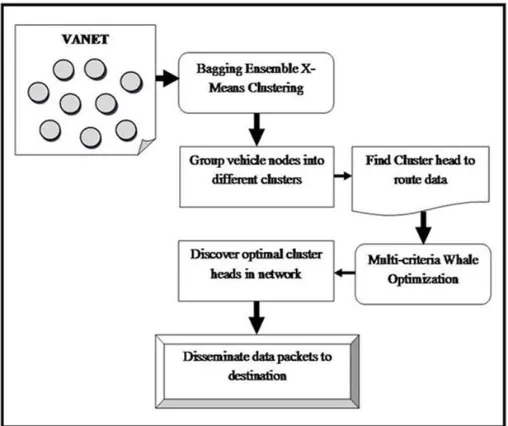
In VANET, several methods have been developed for routing the data packets with minimum delay. The existing MMBC-MDSOR technique was developed for routing as well as reliable data dissemination in VANET. The MMBC-MDSOR technique used boosting ensemble clustering for grouping the nodes based on updating the weights of weak learners. The conventional dolphin swarm optimization technique considered distance, signal strength and bandwidth for solving the multi-objective(ie multivariate) optimization problem. On the contrary to the existing techniques, the BEXCMWO technique uses the Bagging Ensemble X-Means Clustering technique for partitioning the network into the different clusters based on majority voting for minimizing the overfitting. Overfitting is a modeling error. The BEXCMWO uses a whale optimization algorithm and also considers the distance,residual energy and bandwidth availability for solving the objective(ie. multi-criteria) optimization problem in the cluster head selection. To enhance routing efficiency of VANET, Bagging Ensemble X-Means Cluster based Routing(BEXC-R) is designed in the BEXCMWO technique. To get reliable data dissemination with a minimal delay in VANET, Multi-Criteria Whale Optimization based Data Dissemination(MWO-DD) is developed in the BEXCMWO technique. The architecture diagram of the BEXCMWO technique is presented in fig 1.
Fig 1. Architecture Diagram of BEXCMWO technique for Efficient Data Dissemination
Fig 1 shows the overall processes of BEXCMWO technique to achieve reliable data dissemination performance in VANET. As presented in the above figure, at first the vehicle nodes are disseminated randomly in the network. After that, the Bagging Ensemble X-Means Clustering is applied in BEXCMWO technique with aiming at grouping the vehicle nodes according to different stability parameters vehicles density, direction, distances, and velocities. Subsequently, the cluster head is chosen among the group members for routing data from the source node to destination. During the routing process, the selection of optimal cluster head is significant to increases the packet delivery ratio in VANET with a lower end to end delay. Therefore, the cluster heads with minimal distance (i.e. nearest nodes) are selected as an optimal cluster head in BEXCMWO technique with the application of Multi-criteria Whale Optimization. Finally, the source vehicle node disseminates a data to destination vehicles through identified optimal cluster heads. The detailed process of BEXCMWO technique is described in the below subsections.
2.1 Bagging Ensemble X-Means Cluster-Based Routing
In BEXCMWO technique, Bagging Ensemble X-Means Cluster-Based Routing is a powerful ensemble method that combines the predictions from multiple clusters together to make more accurate predictions. The BEXC-R considers X-means clustering as a base cluster that is designed from k-means clustering. The base cluster groups the vehicle nodes based on the Bayesian Information Criterion. In the base cluster, Bayesian Information Criterion is a condition that helps to select a vehicles node in networks to form best clusters in VANET. The Bayesian Information Criterion in BEXC-R considers the different stability parameters such as vehicle density, direction, distance, and velocity to form best clusters in VANET with higher accuracy and minimal time complexity. Let us consider a VANET contains a number of vehicle nodes
represented as ‗ ‘ which are randomly
1726 improve clustering performances with a lower time. For each
vehicle node in bootstrap training samples, BEXC-R builds ‗ ‘ number of base cluster results where it randomly initializes the
number of cluster and centroids. In the base cluster, Bayesian Iinformation Criterion is used to perform clustering process. On the contrary to conventional works, Bayesian information
criterion ( ) considers the different stability parameters such as vehicle density, direction, distance, and velocity to get better node clustering performance in VANET. Thus, Bayesian information criterion ( ) is mathematically defined as follows,
(1)
From the above mathematical equation (1), ‗ ‘ represents the vehicle density, ‗ ‘ indicates moving directions of vehicle and ‗ ‘ refers to the distance between vehicle nodes whereas ‗ ‘ denotes node velocity. In BEXC-R, vehicle density determines the number of vehicles per unit length of the roadway which is mathematically measured using below,
(2)
From the above mathematical expression (2), ‗ ‘ symbolizes the vehicle density whereas ‗ ‘ signifies a total number of vehicles, ‗ ‘ indicates the unit length of road covered by the vehicles (meter). Higher the vehicle density increases the communication between the vehicles in the network. Then, BEXC-R computes moving directions of vehicle node from one place to another with help of below mathematical representation
(3)
From the above mathematical formula (3), ‗ ‘ designates
a tangent function which discover the direction of the node and ‗ ‘ denotes the current coordinate of the vehicle node and ‗ ‘ represents the previous coordinate of the
vehicle. The angle is the radian from the x-axis which is
utilized as a direction of the vehicle. Subsequently, the distance between each vehicle node is measured using the below equation,
(4)
From the above mathematical expression (4), ‗ ‘
denotes the distance between two vehicle nodes whereas ‗ ‘ and ‗ ‘ indicates the location coordinates of two vehicle nodes in the network. Followed by, node velocity is a compute of the movement of the vehicle nodes in the given period of time using below mathematical expression,
(5)
In the above mathematical formula (5), ‗ ‘ signifies a
velocity of the node, ‗ ‘ represents a distance travelled by
the vehicle node whereas ‗ ‘ symbolizes a time. The
velocity is evaluated in terms of a meter per seconds (m/sec). By considering a measured vehicle density, direction, distance,
and velocity, the base cluster group‘s vehicle nodes into diverse clusters. To further increases the accuracy of base X-means clustering, bagging ensemble algorithm i.e. bootstrap aggregation is applied in BEXCMWO technique.
Let consider a BEXC-R construct ‗ ‘ number of base clusters results for each vehicle node in bootstrap samples. Subsequently, BEXC aggregates all base clustering into a
strong cluster with help of below equation (6)
Next, BEXC-R apply vote ‗ ‘ for each base X-means clusters results ‗ ‘ using below,
(7) Consequently, the majority vote of all base X-means clusters results are employed to formulate a strong clustering for exactly grouping the vehicle nodes in the network. Accordingly, strong cluster result is mathematically performed as follows,
(8)
From the above mathematical formulation (8), ‗ ‘ designates the final strong clustering result whereas ‗ ‘ signifies majority votes of base clustering
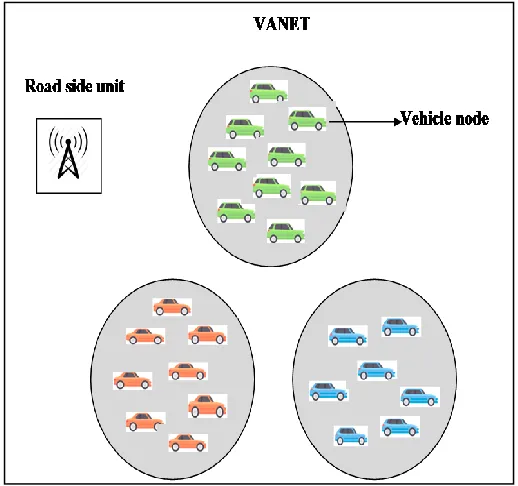
output. The created strong cluster helps for BEXC-R to correctly group all the vehicle nodes in VANET based on vehicle density, direction, distance, and velocity with a minimal amount of time utilization. The vehicle node clustering process using BEXC-R is presented in below Fig 2.
1727 Fig 2 shows the vehicle node grouping in VANET by using
BEXC-R Algorithm. After formulating the clusters, the BEXC-R finds the cluster heads. A vehicle node with the minimum average distance among cluster members is chosen as the cluster head in VANET. The cluster head operates as a data collector within a cluster to route the gathered information of all cluster members to roadside unit in the network. The algorithmic step of BEXC-R is explained in below.
// Bagging Ensemble X-Means Cluster-based Routing Algorithm
Input: Number Of Vehicle Nodes ‗ ‘
Output: groups the vehicle nodes into a different cluster Step 1: Begin
Step 2: For each number of input vehicle nodes ‗ ‘ Step 3: Create bootstrap samples
Step 4: For each vehicle node ‗ ‘
Step 5: Build ‗ ‘ number of base X-means clustering results
Step 6: Ensemble All the base clusters results using (5)
Step 7: Employ a voting scheme using (6)
Step 8: Group the vehicle nodes by considering majority votes using (7)
Step 9: End For Step 10: End For
Step 11: Select the vehicle node with minimum average distance among cluster members as a cluster head to route data
Step12:End
Algorithm 1 Bagging Ensemble X-Means Cluster-based Routing
Algorithm 1 presents the step by step processes of BEXC-R to obtain improved clustering performance for grouping vehicle nodes. As shown in the above algorithmic process, BEXC-R initially gets a number of vehicle nodes as input and then formulates a number of bootstrap training samples. For each vehicle node in bootstrap training samples, next BEXC-R generates ‗ ‘ number of base clusters results. Then, the result of all base X-means cluster results are combined together and consequently voting scheme is applied. After that, majority votes of base cluster results are considered to design strong cluster result that precisely groups the vehicle nodes into the different cluster. Finally, the vehicle node which has minimum average distance among cluster members is selected as the cluster head to route data in VANET.
2.2 Multi-criteria Whale Optimization-based Data Dissemination
After constructing clusters, the Multi-criteria Whale Optimization-based Data Dissemination (MWO-DD) is designed in BEXCMWO technique in order to select an optimal cluster head for disseminating data in VANET. The MWO-DD is developed based on the hunting nature of humpback whales where the whale seeks the position of the prey and spins around the prey to produce different bubbles along a path. In MWO-DD, the whales are considered a
number of cluster heads ‗ ‘. The destination
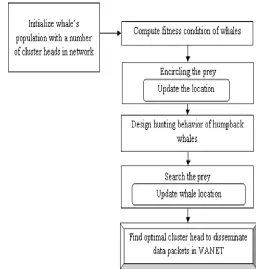
vehicle node is considered as prey. As a result of optimization, the best cluster heads in VANET are selected to distribute data packets to destination vehicle from source vehicle node. The process involved in MWO-DD is shown in below Fig 3.
Fig 3. Process of Multi-criteria Whale Optimization-based Data Dissemination
Fig 3 demonstrates the process of MWO-DD to discover optimal cluster heads in VANET for efficient data dissemination. As shown in the above figure, at first whale population is initialized by considering a number of cluster heads in the network. After that, the fitness of the cluster head is determined for selecting the optimal solution. In MWO-DD, fitness is measured based on multi-criteria such as distance, energy and bandwidth availability. In MWO-DD, fitness condition is mathematically defined as,
(9)
From the above mathematical expression (9), ‗ ‘ represent fitness condition of the whale to broadcast the data packets with a minimal delay in VANET. Here, ‗ ‘ denotes the
distance between two cluster heads ‗ ‘ and ‗ ‘ in a network which is mathematically measured using below,
(10)
From the above mathematical formula (10),
‗ ‗signifies the distance between two cluster heads
1728 (11)
From the above mathematical representation (11), ‗ ‘ is the
total energy (i.e. initial energy) of the cluster head, ‗ ‘ is the amount of energy consumed by cluster head. From equation (9), ‗ ‘ denotes the bandwidth availability of cluster head which is mathematically determined using below,
(12)
In the above equation (12), ‗ ‘ signifies bandwidth availability between the cluster head node, ‗ ‘ indicates the total bandwidth, ‗ ‘ denotes utilized bandwidth by cluster
head. Here, ‗ ‘ and ‗ ‘ represents threshold assigned for
residual energy and bandwidth availabilty respectively. By considering a fitness condition, MWO-DD find out the current best cluster heads. Subsequently, three processes such as encircling prey, bubble-net feeding method and searching the prey are performed in MWO-DD to discover optimal cluster head with a minimal distance in VANET.
In the encircling prey phase, the whale determines the position of prey and surrounds them. Then, MWO-DD assumes that the current solution is optimal. After finding the current best cluster head in a network, the location updates are accomplished in MWO-DD in order to compare the current best solution with other solution (i.e. whale) and thereby identifying nearest cluster head. From that, updating behavior is mathematically represented as,
(13)
(14)
From the above mathematical formulation (13) and (14), ‗ ‘ signifies a distance between the location vector of the prey ‗ ‘ i.e. destination vehicle node and the whale ‗( ‘
i.e. cluster head. Here, ‗ ‘ symbolizes a coefficient vector, ‗ ‘ indicates a current iteration and ‗ ‘ designates an updated location and ‗ ‘ indicates a coefficient vector and it is expressed as follows,
(15)
(16) From above mathematical expression (15) and (16), ‗z‘ is linearly decreased from 2 to 0 over the course of iterations whereas ‗ ‘ point outs a random vector in the range values [0, 1]. Consequently, the bubble-net behavior of whales is created depends on shrinking encircling approach and spiral updating location. Bubble-net behavior denotes the foraging behaviors of the whales. In MWO-DD, the variation range of ‗ ‘ is also minimized by ‗ ‘. The random values for ‗ ‘ are defined as [−1, 1], the new position of the whale is determined in any place in between the initial location of the whale and the location of the current solution. In the second approach, the distance among the location of the whale and prey is evaluated. Followed by the current best solution is updated
and compared with other whales to discover the global optimum using below,
(17)
(18)
From the above equation (17) and (18), ‗ ‘ signifies an updated distance among whale. Here, ‗x‘ represents a constant for describing the structure of the logarithmic curve whereas ‗ ‘ denote exponential function and ‗y‘ is the random number and their ranges are [-1, 1]. Through carried the optimization, location of the whale is updated using below mathematical expression,
(19)
From the above mathematical formula (19), ‗q‘ is a random number in [0, 1]. At last, global optimum values are determined by means of updating the whale's location with an arbitrarily chosen whale rather than the current best whale. The updating behavior is mathematically represented as,
(20)
(21)
From the above mathematical formulation (20) and (21),
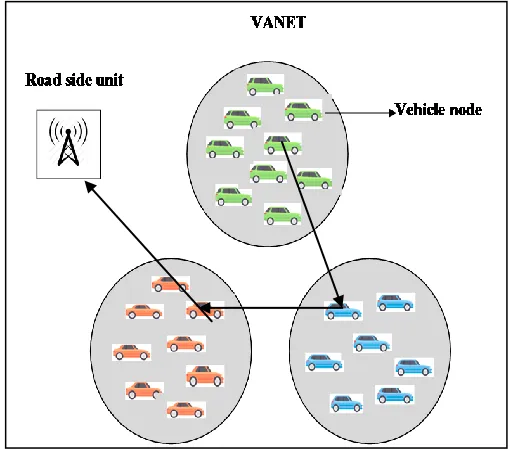
‗ ‘ signifies a random location vector of a random whale. Finally, an updated cluster head is a best solution to disseminate data packets to the destination in VANET. The below Figure 4 show the optimal cluster head selection using MWO-DD for effective data dissemination.
1729 The algorithmic processes of MWO-DD are explained in below
// Multi-criteria Whale Optimization-based Data Dissemination Input: number of cluster heads ‗ (i.e. whales) Output: Select optimal cluster head for data dissemination Begin
Step 1. Initialize the whale's populations Step 2. Initialize the value of , , r, x, y Step 3. For each whale i.e. cluster head
Step 4. Measure the fitness condition to choose the current cluster head using (9)
Step 5. If (q<0.5)
Step 6. If ( <1) then Step 7.
Update the location to choose the whale using (13) Step 8. Else if ( 1)
Step 9. choose a random whale ‗ ‘
Step 10. update the location of the current best solution using (17)
Step 11. End if Step 12. Else if (q
Step 13. update the location of the current best solution (21)
Step 14. End if
Step 15. Reiterate process until the maximum iteration is reached
Step 16: Get the optimal solution to disseminate data packets in VANET
Step 17. End If Step 18: End
Algorithm 2 Multi-criteria Whale Optimization based Data Dissemination
Algorithm 2 shows step by step processes of MWO-DD. As demonstrated in above algorithmic steps, initially the numbers of whales (i.e. cluster heads) are initialized. After that, the fitness is calculated to select the current best optimal cluster head in the network. Next, the current best optimal whale is initialized and compared with the other whales depends on the location update behavior. If the probability value is less than 0.5, then the location of the current best cluster head is updated and chooses the optimal solution. Otherwise, if the probability value is higher than or equal to 0.5, then the location is updated and picks the global best cluster head. This process is frequently performed until an optimal solution is obtained. Finally, the globally best solution is the nearest cluster head for efficient data dissemination. Thus, BEXCMWO technique increases the data dissemination in VANET as compared to conventional works.
3 SIMULATION SETTINGS
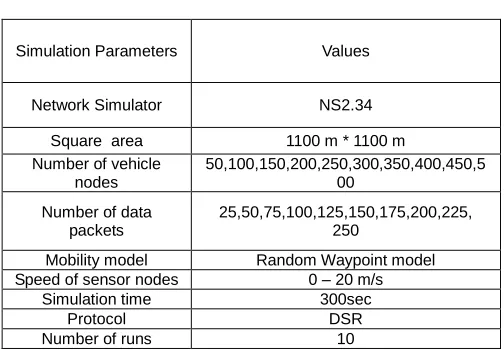
In order to determine the performance of proposed BEXCMWO technique and existing methods CEG-RAODV[1], Multi-valued DPSO [2] and MMBC-MDSOR [3] are implemented using NS2.34 network simulator. The BEXCMWO technique considers 500 vehicle nodes in a square area of 1200 m * 1200 m to conduct simulation evaluation. The BEXCMWO technique used DSR protocol to accomplish routing and data dissemination in VANET. The simulation parameters are depicted in Table1
Table 1 Simulation Parameters
Simulation Parameters Values
Network Simulator NS2.34
Square area 1100 m * 1100 m Number of vehicle
nodes
50,100,150,200,250,300,350,400,450,5 00
Number of data packets
25,50,75,100,125,150,175,200,225, 250
Mobility model Random Waypoint model Speed of sensor nodes 0 – 20 m/s
Simulation time 300sec
Protocol DSR
Number of runs 10
The simulation of BEXCMWO technique is conducted for many instances with respect to a diverse number of vehicle nodes and data packets and average ten results are shown in table and graph for performance analysis.
4
RESULTS
In this section, the comparative result analysis of BEXCMWO technique is discussed. The simulation result of BEXCMWO technique is compared with three conventional methods namely CEG-RAODV,Multi-valued DPSO and MMBC-MDSOR respectively using metrics such as reliability, packet drop rate,end to end delay and throughput with the help of tables and graphs.
4.1 Measure of Reliability
In BEXCMWO technique, reliability ‗ ‘ is
determined in terms of the packet delivery ratio. Thus, reliability is evaluated as the ratio of a number of data packets received at the destination vehicle node to the total number of packets sent from the source node. From that, reliability is mathematically measured using below,
(22)
In the above mathematical formula (22), ‗ ‘ indicates a total number of data packet sent by source vehicle node and ‗
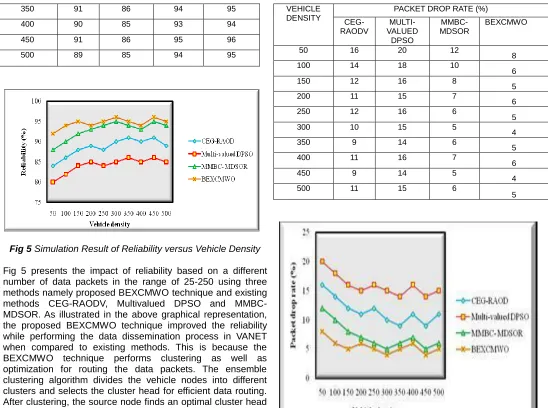
DR‘ refers to a number of data packets received at destination vehicle node. The reliability is estimated in terms of percentage (%).Table 2 Tabulation Result of Reliability
VEHICLE DENSITY
RELIABILITY (%)
CEG-RAODV
MULTI-VALUED
DPSO
MMBC- MDSOR
BEXCMWO
50 84 80 88 92
100 86 82 90 94
150 88 84 92 95
200 89 85 93 94
250 88 84 94 95
1730
350 91 86 94 95
400 90 85 93 94
450 91 86 95 96
500 89 85 94 95
Fig 5 Simulation Result of Reliability versus Vehicle Density
Fig 5 presents the impact of reliability based on a different number of data packets in the range of 25-250 using three methods namely proposed BEXCMWO technique and existing methods CEG-RAODV, Multivalued DPSO and MMBC-MDSOR. As illustrated in the above graphical representation, the proposed BEXCMWO technique improved the reliability while performing the data dissemination process in VANET when compared to existing methods. This is because the BEXCMWO technique performs clustering as well as optimization for routing the data packets. The ensemble clustering algorithm divides the vehicle nodes into different clusters and selects the cluster head for efficient data routing. After clustering, the source node finds an optimal cluster head to forward the data packets to the destination through the multicriteria whale optimization algorithm. Then the optimal route path is identified from source to destination and disseminates the data packets. This helps to improve the number of data packets successfully received at the destination.
4.2 Measure of Packet drop Rate
Packet drop rate is measured as a number of data packets dropped to the total number of packets sent from the source node. The packet drop rate is calculated mathematically as follows,
Packet Drop Rate=(
DD/
n
)
*
100
Where ‗n‘ indicates the total number of data packet sent by source vehicle node and
DD refers to a number of data packets dropped at the destination vehicle node. The packet drop rate is measured in terms of percentage(%). The simulation result of the packet drop rate with respect to various number of vehicle densitities in Table 2 below.VEHICLE DENSITY
PACKET DROP RATE (%)
CEG-RAODV
MULTI-VALUED
DPSO
MMBC- MDSOR
BEXCMWO
50 16 20 12
8
100 14 18 10
6
150 12 16 8
5
200 11 15 7
6
250 12 16 6
5
300 10 15 5
4
350 9 14 6
5
400 11 16 7
6
450 9 14 5
4
500 11 15 6
5
Fig 6 Simulation Result of Packet Drop Rate versus Vehicle Density
1731
4.3 Measure of End-to-End Delay
In BEXCMWO technique, End-to-End Delay ‗ ‘ measures the amount of time needed to disseminate the data packets from source vehicle node to destination vehicle node in VANET. From that, End to end delay is calculated as the time distinction between the data packet arrival time and data packet sending time from the source node. Thus, end to end delay is mathematically determined as follows,
(24)
From the above formulation (24), ‗ ‘ symbolizes the
data packet arrival time whereas signifies a data
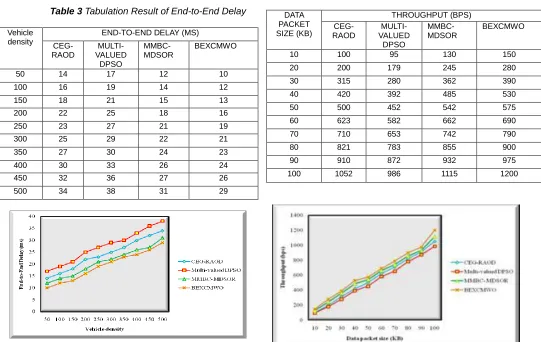
packet sending time. The end to end delay is determined in the terms of milliseconds (ms).The comparative result of an end to end delay with respect to different numbers of vehicle density is presented in below Table 3.
Table 3 Tabulation Result of End-to-End Delay
Vehicle density
END-TO-END DELAY (MS)
CEG-RAOD
MULTI-VALUED
DPSO
MMBC- MDSOR
BEXCMWO
50 14 17 12 10
100 16 19 14 12
150 18 21 15 13
200 22 25 18 16
250 23 27 21 19
300 25 29 22 21
350 27 30 24 23
400 30 33 26 24
450 32 36 27 26
500 34 38 31 29
Fig 7 Simulation Result of End-to-End Delay versus Vehicle Density
Fig 7 shows the impact of an end to end delay with respect to a varied number of vehicle densities in the range of 50-500 using three methods namely proposed BEXCMWO technique and existing methods CEG-RAODV,Multi-valued DPSO and MMBC-MDSOR. As presented in the above graphical diagram, proposed BEXCMWO technique obtain a minimal end to end delay while disseminating data to destination vehicle node from source vehicle node in VANET when compared to existing ones. This is because of cluster based datab
dissemination. The source node sends a data packet to an optimal cluster head instead of send it to neighboring nodes. This helps to minimize the data receiving time at the destination end.
4.4 Measure of Throughput
In BEXCMWO technique, Throughput determines an amount of data packets successfully delivered to the destination vehicle node in a given period of time. The throughput is mathematically measured using below,
(24)
From the above mathematical expression (24), ‗ ‘ symbolizes the amount of data packets successfully delivered. The throughput is estimated in terms of bits per second (bps).
Table 4 Tabulation Result of Throughput
DATA PACKET SIZE (KB)
THROUGHPUT (BPS)
CEG-RAOD
MULTI-VALUED
DPSO
MMBC- MDSOR
BEXCMWO
10 100 95 130 150
20 200 179 245 280
30 315 280 362 390
40 420 392 485 530
50 500 452 542 575
60 623 582 662 690
70 710 653 742 790
80 821 783 855 900
90 910 872 932 975
100 1052 986 1115 1200
Fig 8 Simulation Result of Throughput versus Data Packet Size
1732 This is achieved by the effective communication between the
vehicles in a dynamic environment. Cluster stability is achieved by selecting the cluster head through the fitness measure. The high bandwidth availability and higher residual energy between the cluster heads improves the data dissemination. Let us consider 10 KB size of data packet, the proposed BEXCMWO receives 150bps of throughputs than the CEG-RAODV,Multi-valued DPSO and MMBC-MDSOR respectively.
5 LITERATURE
SURVEY
Chain-Branch-Leaf Clustering was carried out in [12] to optimize network performance by reducing the flooding of broadcast traffic in VANET. An effective and efficient adaptive probability data dissemination protocol (EEAPD) was implemented in [13] for obtaining a high packet delivery ratio and low end-to-end delay through utilizing network resources at a minimal level. The Hierarchical Assisted-node-based Data Dissemination Scheme (HADD) was developed in [14] to enhance the network performance of data dissemination rate in VANET with a minimal delay. A simple and efficient cluster head adaptive data dissemination protocol was presented in [15] to decrease the broadcast storm problem in VANET. Computational Intelligence Inspired Data Delivery scheme was applied in [16] with the aim of achieving high performance for multi-hop end-to-end data transmissions in VANET. A review of various vehicular routing protocols designed for VANET was presented in [17] to obtain inter-vehicle communications. Efficient and stable routing algorithm based on user mobility and node density (ESRA-MD) was developed in [18] to improve the safety and efficiency of traffic in VANET. A channel prediction based scheduling strategy was employed in [19] to lessen the communication overhead and thus improve the system throughput in VANET. A novel clustering algorithm was implemented in [20] with the support of agent technology to get better routing performance in VANET. An enhanced intelligent hybrid routing protocol was introduced in [21] with the help of fuzzy and cuckoo approaches to discover the most stable path between a source and destination node in VANET.
6 CONCLUSION
An efficient BEXCWO technique is proposed with the goal of enhancing the routing and data dissemination performance in VANET. The goal of BEXCWO technique is attained with the application of Bagging Ensemble X-Means Cluster-based Routing (BEXC-R) and Multi-criteria Whale Optimization-based Data Dissemination (MWO-DD). The proposed BEXCWO technique improves the ratio of a number of data packets received at the destination vehicle node as compared to state-of-the-art works with help of BEXC-R and MWO-DD algorithms. Also, the proposed BEXCWO technique reduces the amount of time required to disseminate the data packets from source vehicle node to destination vehicle node in VANET with aid of BEXC-R and MWO-DD algorithms as compared to conventional works. From that, proposed BEXCWO technique increases the amount of data packets successfully delivered to the destination vehicle node in a given period of time as compared to existing works. The performance of BEXCWO technique is evaluated using factors such as reliability, packet drop rate, end to end delay, and throughput and compared with state-of-the-art works. The simulation results depict that BEXCWO technique provides better performance with an enhancement of reliability and
minimization of end to end delay for efficiently performing data dissemination process in VANET when compared to the state-of-the-art works.
REFERENCES
[1] Zahid khan, Pingzhi Fan, Sangsha Fang, Fakhar Abbas,‖An Unsupervised Cluster-Based VANET – Oriented Evolving Graph(CVoEG)Model and Associated Reliable Routing Scheme‖,IEEE Transactions on Intelligent Transportation Systems,2019,pp.1-16.
[2] Manisha Chahal, Sandeep Harit, ―Optimal path for data dissemination in Vehicular Ad Hoc Networks using meta-heuristic‖, Computers & Electrical Engineering, Elsevier, vol. 76, pp. 40-55, June 2019. [3] D.Radhika and A.Bhuvaneswari,‖Margin Boost
Clustering based Multivariate Dolphin Swarm Optimization for Routing and Reliable Data Dissemination in VANET‖,International Journal of
Innovative Technology and Exploring
Engineering‖,Vol.8,Issue.11,pp.1820-1829,September 2019.
[4] Lei Liuy, Chen Cheny, Tie Qiu,Mengyuan Zhangy,Siyu Liy,Bin Zhou,‖Data Dissemination Scheme based on Clustering and Probabilistic Broadcasting in VANETs‖,Vehicular Communications,Vol.13,pp.78-88,May 2018.
[5] Syed Sarmad Shah, Asad Waqar Malik, Anis U. Rahman, Sohail Iqbal, And Samee U. Khan, ―Time Barrier-Based Emergency Message Dissemination in Vehicular Ad-hoc Networks‖, IEEE Access, vol .7, pp. 16494- 16503, 2019.
[6] Dongxu Jin, Jeongwon Yang, Jooseok Song, ―Parallel Swarm Optimization Based Cluster for Emergency Message Dissemination in VANETs‖, Journal of Telecommunication, Electronic and Computer Engineering, vol. 9, no. 2-4, pp. 77-82, 2017.
[7] Atif Ishtiaq, Sheeraz Ahmed, Muhammad Fahad Khan, Farhan Aadil, Muazzam Maqsood and Salabat Khan, ―Intelligent clustering using moth flame optimizer for vehicular ad hoc networks‖, International Journal of Distributed Sensor Networks, vol.15, no. 1, pp. 1-13, 2019.
[8] Saliha Benkerdagh, Claude Duvallet, ―Cluster‐based emergency message dissemination strategy for VANET using V2V communication‖, International Journal of Communication Systems, Wiley Online Library, pp. 1-24, 2019.
[9] Shaik Shafi, D Venkata Ratnam, ―Mobility-aware cross-layer based reliable routing protocol for improved data dissemination in VANETs‖, International Journal of Innovative Technology and Exploring Engineering (IJITEE), vol. 8, no. 6,pp. 1523-1530, April 2019.
[10]Mohammed Saad Talib, Aslinda Hassan, Burairah Hussin, Zaniab Saad Talib, ―Data Dissemination Based Clustering Techniques for VANETS: A Review‖, Journal of Advanced Research in Dynamical and Control Systems, vol 10, no 04, May 2018.
1733 2018, Article ID 9826782, pp. 1-15, 2018.
[12][Lucas Rivoirard ; Martine Wahl ; Patrick Sondi, ―Multipoint Relaying Versus Chain-Branch-Leaf Clustering Performance in Optimized Link State Routing-Based Vehicular Ad Hoc Networks‖, IEEE Transactions on Intelligent Transportation Systems, pp. 1-10, 2019.
[13]John Sospeter, Di Wu, Saajid Hussain and Tesfanesh Tesfa, ―An Effective and Efficient Adaptive Probability Data Dissemination Protocol in VANET‖, Data, vol. 4, no. 1, pp. 1-22, 2019.
[14]Xingzhen Bai, Yongfa Hong, Yuyue Du and Zhengzhong Gao, ―Efficient Data Dissemination Scheme for the Urban Vehicular ad hoc Networks‖, Information Technology Journal, vol. 12pp. 1696-1706, 2013.
[15]Harshita Prakash, A. Agrawal, A.K Jaiswal, ―SECADD: Simple and Efficient Cluster head adaptive data dissemination protocol for application in Intelligent Transportation System‖, International Journal of Engineering Trends and Technology (IJETT), vol. 51, no. 1, pp. 20-26, September 2017.
[16]Celimuge Wu, Tsutomu Yoshinaga, Yusheng Ji, and Yan Zhang, ―Computational Intelligence Inspired Data Delivery for Vehicle-to-roadside Communications‖, IEEE Transactions on Vehicular Technology, pp. 1-11, 2018.
[17]Rashmi Jatain, ―Analysis of Vehicular Routing Protocol In Vanet For Smart City Scenario‖, International Journal of Scientific Research in Computer Science, Engineering and Information Technology, vol. 3, no. 3, pp. 1577-1582, 2018. [18]Yusor Rafid Bahar Al-Mayouf, Mahamod Ismail, Nor
Fadzilah Abdullah, Ainuddin Wahid Abdul Wahab, Omar Adil Mahdi, Suleman Khan, Kim-Kwang Raymond Choo, ―Efficient and Stable Routing Algorithm Based on User Mobility and Node Density in Urban Vehicular Network‖, PLoS ONE, vol. 11, no. 11, pp. 1-24, 2016.
[19]Fanhui Zeng, Rongqing Zhang, Xiang Cheng, Liuqing Yang, ―Channel Prediction Based Scheduling for Data Dissemination in VANETs‖, IEEE Communications Letters, vol. 21, no. 6, pp. 1409 – 1412, June 2017. [20]Samira Harrabi, Ines Ben Jaafar, Khaled Ghedira,
―Message Dissemination in Vehicular Networks on the Basis of Agent Technology‖, Wireless Personal Communications, Springer, vol. 96, no. 4, pp. 6129– 6146, October 2017.