Achiya Bar-On1?
1 Department of Mathematics
Bar Ilan University Ramat Gan, 52900, Israel
Abstract. MISTY1 is a block cipher designed by Matsui in 1997. It is widely deployed in Japan, and is recognized internationally as a Euro-pean NESSIE-recommended cipher and an ISO standard. After almost 20 years of unsuccessful cryptanalytic attempts, a first attack on the full MISTY1 was presented at CRYPTO 2015 by Todo. The attack, using a new technique calleddivision property, requires almost the full codebook and has time complexity of 2107.3 encryptions.
In this paper we present a new attack on the full MISTY1. It is based on a modified variant of Todo’s division property, along with a variety of refined key-recovery techniques. Our attack requires the full codebook, but allows to retrieve 49 bits of the secret key in time complexity of only 264encryptions, and the full key in time complexity of 269.5encryptions. While our attack is clearly impractical due to its large data complexity, it shows that MISTY1 provides security of only 270 — significantly less than what was considered before.
1
Introduction
MISTY1 [10] is a 64-bit block cipher with 128-bit keys designed in 1997 by Matsui. In 2002, MISTY1 was selected by the Japanese government to be one of the e-government candidate recommended cipher, and since then, it became widely deployed in Japan. MISTY1 also gained recognition outside Japan, when it was selected to the portfolio of European NESSIE-recommended ciphers, and approved as an ISO standard in 2005. Furthermore, the block cipher KASUMI [1] designed as a slight modification of MISTY1 is used in the 3G cellular networks, which makes it one of the most widely used block ciphers today.
MISTY1 has an 8-round recursive Feistel structure, where the round function
F Ois in itself a 3-round Feistel construction, whose F-functionF Iis in turn a 3-round Feistel construction using 7-bit and 9-bit invertible S-boxes. The specific choice of S-boxes and the recursive structure ensure provable security against differential and linear cryptanalysis. In order to thwart other types of attacks, after every two rounds an F L function is applied to each of the two halves
?This research was partially supported by the Israeli Ministry of Science, Technology
independently. TheF Lfunctions are key-dependent linear functions which play the role of whitening layers.
In the 18 years since its design, MISTY1 withstood numerous cryptana-lytic attempts. More than a dozen of papers analyzed its reduced-round variants (see, e.g., [2, 7, 13, 14]), yet the full 8-round variant seemed completely out of reach. The situation changed when Yosuke Todo presented at CRYPTO’2015 [11] the first attack on the full MISTY1. The attack is based on a new variant of integral cryptanalysis, called division property, presented by Todo at EURO-CRYPT’2015. Using the new technique, Todo showed that there exist seven in-dependent integral structures of 263plaintexts, whose propagation can be traced
through 6 rounds of MISTY1. (This should be compared with 4 rounds achieved by the best previously known integral characteristics.) These characteristics al-low to break the full MISTY1 with data complexity of 263.994chosen plaintexts
and time complexity of 2107.3 encryptions.
In this paper, we present an improved attack on the full MISTY1, which al-lows to significantly reduce the time complexity. Our attack uses Todo’s division property, along with a new property obtained byreversingTodo’s property that turns out to be more useful than the original one due to key schedule considera-tions. In addition, we use refined key recovery techniques, including the partial sums technique [6], and a two-dimensional meet-in-the-middle attack (like the one is used in [4]). Our attack has two phases. The first phase requires 264
−250
chosen ciphertexts and allows to recover the equivalent of 49 key bits in time of 264encryptions (i.e., only the time required for encrypting the plaintexts!). The
second phase requires the rest of the codebook and allows to recover all remain-ing key bits in time of 269.5encryptions. Alternatively, the rest of the key can be
found in time of 279 encryptions without additional data. A comparison of our
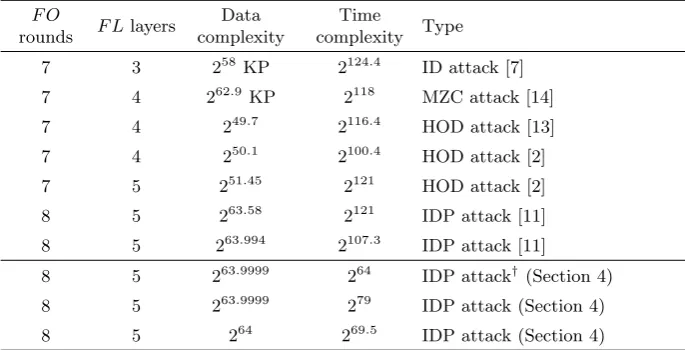
attack with the best previously known attacks on full-round and reduced-round MISTY1 is presented in Table 1.
The paper is organized as follows. In Section 2 we describe the structure of MISTY1 and introduce some notations that will be used throughout the paper. The division property is described in Section 3, as well as the 6-round integral characteristic based on its propagation. Our modified 6-round characteristic and our improved attack on full MISTY1 are presented in Section 4. Finally, in Section 5 we summarize the paper.
2
Brief Description of MISTY1
Table 1: Summary of the best known single-key attacks on MISTY1
F O
rounds F Llayers
Data complexity
Time
complexity Type
7 3 258 KP 2124.4 ID attack [7]
7 4 262.9 KP 2118 MZC attack [14]
7 4 249.7 2116.4 HOD attack [13]
7 4 250.1 2100.4 HOD attack [2]
7 5 251.45 2121 HOD attack [2]
8 5 263.58 2121 IDP attack [11]
8 5 263.994 2107.3 IDP attack [11]
8 5 263.9999 264 IDP attack† (Section 4)
8 5 263.9999 279 IDP attack (Section 4)
8 5 264 269.5 IDP attack (Section 4)
ID attack: Impossible Differential attack HOD attack: Higher Order Differential attack
MZC attack: Multi-Dimensional Zero Correlation attack IDP attack: integral attack using division property
64
F L1 KL1
F L2 KL2
⊕ F O1
KO1, KI1
⊕ F O2
KO2, KI2
F L3 KL3
F L4 KL4
⊕ F O3
KO3, KI3
⊕ F O4
KO4, KI4
F L5 KL5
F L6 KL6
⊕ F O5
KO5, KI5
⊕ F O6
KO6, KI6
F L7 KL7
F L8 KL8
⊕ F O7
KO7, KI7
⊕ F O8
KO8, KI8
F L9 KL9
F L10 KL10
M IST Y function
32
⊕ KOi,1
F Ii,1 KIi,1
⊕
⊕ KOi,2
F Ii,2 KIi,2
⊕
⊕ KOi,3
F Ii,3 KIi,3
⊕
⊕ KOi,4
F Ofunction
16 S9 ⊕ S7 ⊕ ⊕ KIi,j,2
⊕ KIi,j,1
S9
⊕
zero-extend
truncate
zero-extend
F I function
32
⊕
⊕
∩ KLi,1
∪ KLi,2
F Lfunction
∩
bitwise AND
∪
bitwise OR
TheF I function in itself also has a Feistel-like structure. Its 16-bit input is divided into two unequal parts – one of 9 bits, and the second of 7 bits. The left part (which contains 9 bits) enters an S-box,S9, and the output is XORed with the right 7-bit part (after padding the 7-bit value with two zeroes as the most significant bits). The two parts are swapped, the 7-bit part enters a different S-box,S7, and the output is XORed with 7 bits out of the 9 of the right part. The two parts are then XORed with a subkey, and swapped again. The 9-bit value again entersS9, and the output is XORed with the 7-bit part (after padding). The two parts are then swapped for the last time.
Every two rounds, starting before the first one, each of the two 32-bit halves enters an F Llayer. TheF Llayer is a simple linear transformation. Its input is divided into two halves of 16 bits each, the AND of the left half with a subkey is XORed to the right half, and the OR of the updated right half with another subkey is XORed to the left half. We outline the structure of MISTY1 and its parts in Fig.ure 1.
The key schedule of MISTY1 takes the 128-bit key, and treats it as eight 16-bit words K1, K2, . . . , K8. From this sequence of words, another sequence of
eight 16-bit words is generated, according to the ruleKi0 =F IKi+1(Ki).
In each round, seven words are used as the round subkey, and each of theF L
functions accepts two subkey words. We give the exact key schedule of MISTY1 in Table 2.
Table 2: The Key Schedule of MISTY1
KOi,1 KOi,2 KOi,3 KOi,4 KIi,1 KIi,2 KIi,3 KLi,1 KLi,2
Ki Ki+2 Ki+7 Ki+4 Ki0+5 Ki0+1 Ki0+3 Ki+1
2
(oddi)
Ki
2+2(eveni)
Ki+1 2 +6
(oddi)
Ki
2+4 (eveni)
2.1 Notations Used in the Paper
Throughout the paper, we use the following notations for intermediate values during the MISTY1 encryption process.
– The plaintext and the ciphertext are denoted, as usual, byP andC=E(P).
– The input of the i’th round (1 ≤ i ≤ 8) is denoted by Xi. If we want to
emphasize that the intermediate value corresponds to the plaintext P, we denote it byXi(P).
– For odd rounds, we denote byX0
ithe intermediate value after application of
theF Lfunctions.
– The output of theF Ofunction of roundiis denoted Outi.
– For any intermediate valueZ, Z[k–l] denotes bits fromk tol (inclusive) of
Z. The special caseZ[i] denotes thei’th bit ofZ.
– For any intermediate valueZ, the right and left halves ofZ are denoted by
– For any 16 bit key K, the 9 rightmost bits and 7 left most bits of K are denoted byKRandKL, respectively.
– The firstS9 function of F Ii,j is denoted byS9i,j,1 and its input is denoted
by ES9i,j,1. Similarly, S7i,j, ES7i,j and S9i,j,2, ES9i,j,2 denote the other
S-boxes,S7 and the secondS9, and their inputs inF Ii,j.
3
Integral Cryptanalysis using Division Property and its
Application to MISTY1
3.1 Integral Cryptanalysis
Integral cryptanalysis is a powerful cryptanalytic technique presented in [3, 8]. The basic idea behind integral cryptanalysis is to trace the encryption process of a structured set of plaintexts, calledintegral structure, during part of the cipher’s rounds. Usually, the information on the intermediate values gradually reduces as the encryption proceeds, so that eventually, one can predict only thesum of the set of intermediate values in part of the state.
Definition 1. A set of values{Xi}i∈I is called balanced ifLi∈IXi= 0.
Anintegral characteristic predicts that for a structured set V of plaintexts (usually, an affine subspace of the plaintext space), the set of corresponding intermediate values afterirounds is balanced in some bitj. That is,
M
x∈V
Xi[j](x) = 0. (1)
Note that unlike differential and linear cryptanalysis, an integral characteristic is combinatorial and not statistical, meaning that (1) holds with probability 1. A characteristic that satisfies (1) is called an i-round characteristic of order log2|V|.
An example of an integral characteristic is an 8-order 3-round characteristic of AES presented in [3], which predicts that ifV consists of 256 plaintexts that are constant in all bytes but one, and assume all possible values in the remaining byte, then the corresponding set of intermediate values after 3 rounds is balanced in each of the 16 bytes. This property is used in [3] to attack up to 6 rounds of AES with a practical complexity.
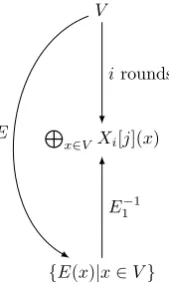
Once an integral characteristic is found, it can be used to mount a key-recovery attack. Suppose that for some block cipherE:{0,1}n→ {0,1}n, there
exists an i-round integral characteristic that satisfies (1). Denote by E1−1 the
Boolean function that represents the mapping from the ciphertext of E to the intermediate state bitXi[j] (see Fig. 2). Then Equation (1) can be rewritten as
M
x∈V
E1−1(E(x)) = 0. (2)
(Equation (2) is calledthe attack equation.) The adversary asks for the encryp-tion of several structured sets of plaintexts of the form V, partially decrypts the corresponding ciphertexts (by guessing the key material used in E−11), and
V
L
x∈VXi[j](x)
{E(x)|x∈V} irounds
E−11
E
Fig. 2: Outline of the Integral Attack
3.2 Division Property
The idea behind the division property is to increase the precision of the in-formation on intermediate values traced by the integral attack. As the idea is rather complex in its general form, we present in this section all definitions and notations required for it (mostly taken from [11]), and in the next section its application to MISTY1. For the general division property technique, we refer the reader to [12].
For a linear subspaceU ⊂Fn2 and a vectorv∈Fn2, we callV ={u+v|u∈U}
anaffine subspace ofFn2. The dimension ofV is, as usual, log2|V|.
Foru∈Fn2 we denote bywuthe Hamming weight ofu(i.e.,wu=Pni=1u[i])
and bySnk ={u∈Fn2 :wu≥k}the set of all values with Hamming weight larger
than (or equal to)k. For x, u∈Fn2 we definexu=
Qn
i=1x[i]u[i]. In general, for
x= (x1, x2, . . . , xm), u= (u1, u2, . . . , um)∈Fn12 ×F n2
2 ×· · ·×F nm
2 , we writexufor
Qm i=1x
ui i andS
n1,n2,...,nm
[k1,k2,...,km] for the set{u∈F n1
2 × · · · ×F nm
2 :wui ≥kifor alli}.
Let X ⊂ Fn12 × · · · ×Fn2m be a multiset. We say that X has the division
propertyDn1,n2,...,nm [k1,k2...,km] if
M
x∈X
xu= 0, for allu∈(Fn12 × · · · ×Fn2m\S n1,...,nm [k1,...,km])
(with no restriction onLx∈Xxu foru
∈Sn1,...,n[k1,...,kmm]). We also define
Snk11,...,,n2,...,nkt m = t
[
i=1
Snk1i,n2,...,nm
(ki∈Fn21× · · · ×F nm
2 ) and define the division propertyD
n1,n2,...,nm
k1,...,kt similarly to
Example 2. Any 4-dimensional affine subspaceV ⊂F72 has the property
M
x∈V
xi1xi2xi3= 0
for all 1≤i1< i2< i3≤7 (wherexj =x[j] denote thejth bit ofx). Hence,V
has the division propertyD7 3.
Example 3. For 1≤i≤m, let Vi ⊂Fn2i be an affine subspace of dimension ki.
ThenX={(x1, . . . , xm)∈Fn21× · · · ×F nm
2 :xi ∈Vi}has the division property Dn1,n2,...,nm
[k1,k2...,km].
Notation 4. Letki,kj ∈Zm. We writeki≤kjifki[`]≤kj[`] for all 1≤`≤m.
Example 5. Let X ⊆ F72 ×F72 be a multiset that has the division property D7[5,,70],[1,4],[2,3]. Then
M
(x,y)∈X
xi1· · ·xityj1· · ·yjs
is unknown if (5,0) ≤ (t, s) or (1,4) ≤ (t, s) or (2,3) ≤ (t, s) and equals 0 otherwise.
Observation 6. Ifki≤kj(⇐⇒ Ski ⊆Skj) then we omitkjfromS
n1,n2,...,nm
k1,...,kt
becauseSn1,n2,...,nk1,...,kt m =S
n1,n2,...,nm
k1,...,kj−1,kj+1,...,kt in this case. For example, we replace D7[5,,70],[1,4],[2,4],[2,3] withD
7,7
[5,0],[1,4],[2,3].
Remark 7. Let Xbe a multiset that has the division property Dn1,n2,...,nk1,...,kt m. If
(2,0,0, . . . ,0)≤kj for some j then
M
x∈X
xi= 0
for 1≤i≤n1. In other words,Xis balanced in then1 first bits.
For the full details of the propagation of the division property, we refer the interested reader to the original paper in [12].
3.3 An Integral characteristic of 6-round MISTY1
In [11], Yosuke Todo presented a new integral characteristic for 6-round MISTY1, constructed by tracing the propagation of a division property. Todo showed that if a setV of values after the firstF Llayer (i.e., a set ofX10 values) has the
divi-sion propertyD[67,,22,7,7,,77,,22,,77,,77,,22,7,7,,77,,22,,77] then the corresponding set ofX7 values has
the division property Dk7,1,...,2,7,7k,2132,7,7,2,7,7,2,7, wherek1, . . . ,k132 is a list of vectors
presented in [11]. For our purposes, it is sufficient to know that one of theki’s is
[2,0,0,0,0,0,0,0,0,0,0,0]. In particular, if we takeV63 to be a 63-dimensional
affine subspace of the values X0
1 of a specific form, then the following equation
holds: M
x∈V63
The “specific form” of V63 is defined as follows: For every 6-dimensional affine
subspaceV6⊂F72, the setV63={(x6, x57) :x6∈V6, x57∈F572 }has the “correct”
form. Note that while there are many “correct” values ofV63, we can construct
only 7 independent setsV6simultaneously (this holds since the dimension of the
space of 6-dimensional subspaces ofF72is 7), and hence, only 7 independent sets
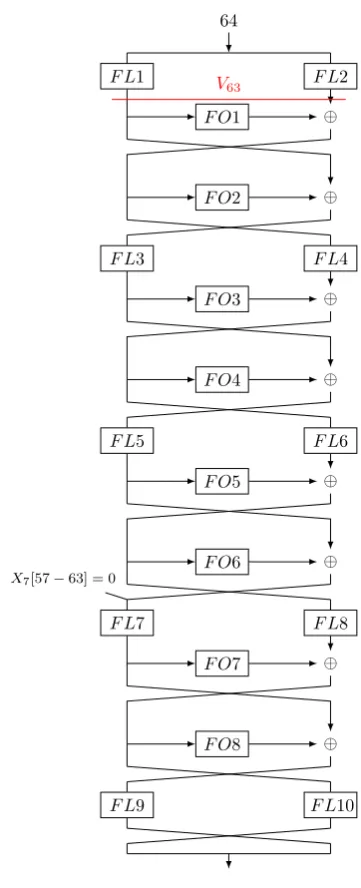
V63. Fig. 3 illustrates the 6-round integral characteristic.
3.4 Todo’s Integral Attack on Full MISTY1
Todo’s integral attack on full MISTY1 [11] uses the 6-round integral character-istic described above and has the following steps.
1. Choose V to be one of the “possible” V63’s and ask for the encryption of
263.58 chosen plaintexts such that V is included in the set of intermediate
X0
1 values.
2. As the values of plaintexts that correspond to the values in V depend on the value of 2 key bits used inF L1, guess those key bits, and for each guess,
perform the following steps assuming that Eq. (3) holds.
(a) Guess the key bits needed to partially decrypt the ciphertexts ofV and get the corresponding values X7[57–63]. (This step is performed
effi-ciently using thepartial sums technique.)
(b) Check whether Eq. (3) holds. A wrong key-guess will pass this seven-bit condition with probability 2−7, and thus, 2128−7= 2121 wrong keys are expected to remain.
(c) Check the 2121 remaining options by exhaustive search.
The time complexity of the attack is dominated by the last step. Hence, the attack requires 263.58 chosen plaintexts and has time complexity of 2121
encryptions.
To reduce the time complexity, moreV63’s can be used. As we can use only
independent subspaces, we can use up to 7 of them. Increasing the number of the V63’s has two effects. On the one hand, there is an increase in the time
complexity of the filtering step and in the data complexity. On the other hand, as the filtering of wrong key-guesses is stronger, the time complexity of the exhaustive search step is reduced. The tradeoff between those two effects was considered in [11]. The optimal time complexity is 2107.3, achieved by using 4
subspaces of the form V63 that require 264−256= 263.994 chosen plaintexts.
4
Improved Attack on Full MISTY1
In this section we present our improved attack on the full MISTY1. Our attack is based on using an additional 6-round integral characteristic (which is a “reverse” of Todo’s characteristic), along with improved key-recovery techniques. First, we present the new characteristic and several observations used in the attack. Then we present the first phase of the attack that requires 264−250chosen ciphertexts
and recovers 49 key bits in time complexity of 264encryptions. Finally, we present
the second phase of the attack that recovers the rest of the key in 269.5 time,
64
F L1 F L2
⊕ F O1
⊕ F O2
F L3 F L4
⊕ F O3
⊕ F O4
F L5 F L6
⊕ F O5
⊕ F O6
F L7 F L8
⊕ F O7
⊕ F O8
F L9 F L10 V63
X7[57−63] = 0
V63 is a 63-dimensional affine subspace of the form
V63={(x6, x57) :x6∈V6, x57∈F572 }.
4.1 A “Reverse” 6-round Integral Characteristic
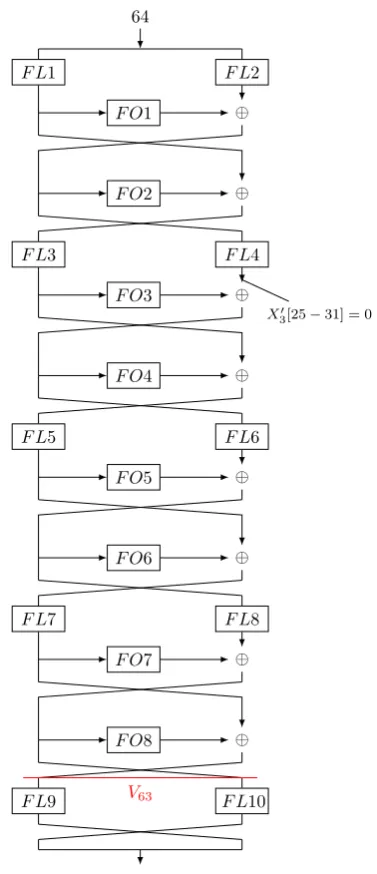
We observe that while Todo’s characteristic (described in Section 3.3 and illus-trated in Fig. 3) is constructed in an “top-to-bottom” manner, one can construct a similar characteristic in the opposite direction as well. Indeed, since Todo’s characteristic exploits only the general structure of MISTY1 and not the ex-act subkeys used in the encryption process, it holds also for the inverse cipher MISTY1−1, which possesses the same general structure.
Hence, we have the following “dual” claim:
Claim 8. The equation:
M
x∈V63
X30[25−31](x) = 0 (4)
holds for every 63-dimensional affine subspaceV63 of the valuesX9 of the form
V63={(x57, x6) :x6∈V6, x57 ∈F572 } (where V6⊂F72 is a 6-dimensional affine
subspace).
Our attack (see Sections 4.3, 4.4) takes advantage of both Todo’s character-istic and the reverse charactercharacter-istic, and by that increases the filtering of wrong key-guesses. The reverse 6-round integral characteristic is illustrated in Fig. 4.
4.2 Preliminaries
In this section we give several useful observations exploited in our attack.
Computing the Attack Equation by Independent Calculations Con-sider the attack equation Lx∈V63X0
3[25–31](x) = 0 (see also Fig. 5a). The
last functions applied during the evaluation of the attack equation are the bit-wise AND and OR of F L4. Since both functions are linear/affine
func-tions, an equivalent function EF L4 can be used. In EF L4 the OR
opera-tion is replaced by AND operaopera-tion and those for every value x it holds that
F L4(x, K40, K6) = EF L4(x, K40, K6⊕116)⊕(K6,016). The constant (K6,016)
can be committed because we sum over even number of values1. So, it is
suf-ficient to compute the contributions of Out1 and F L2(PR) independently and
then XOR them together. Moreover, the bits X30[25–31] depend only on bits
9–15,25–31 of the input of F L4. Thus, it is sufficient to compute the
contri-butions ofOut1[9–15,25–31] and F L2(PR)[9–15,25–31] = F L2(PR[9–15,25–31])
independently.
Another independence appears in computingOut1 given the inputs toF I1,2
and to F I1,3. (As the computation is up to XORs with key bits, we assume
that these bits have already been guessed.) Denoting the inputs to F I1,2 and
to F I1,3 by I2 and I3, respectively, the explicit formula for Out1 is Out1 =
(F I1,2(I2)⊕I3, F I1,2(I2)⊕F I1,3(1,3)⊕I3). Furthermore, we need only the values
inOut1[9–15,25–31] and these values can be found by independent computations
of the four S-boxes S91,2,1, S71,2, S91,3,1, S71,3.
As a result, we get the following Observation: 1
64
F L1 F L2
⊕ F O1
⊕ F O2
F L3 F L4
⊕ F O3
⊕ F O4
F L5 F L6
⊕ F O5
⊕ F O6
F L7 F L8
⊕ F O7
⊕ F O8
F L9 V63 F L10 X0
3[25−31] = 0
V63 is a 63-dimensional affine subspace of the form
V63={(x57, x6) :x6∈V6, x57∈F572 }.
Observation 9. Suppose we want to computeLx∈SX0
3[25–31](x) for some set
Sof plaintexts and we already partially encryptedSusing knownKL1, KO1, KI1.
The rest of the computation can be done as follows. For every x ∈ S and for every guess of the 14 bits ofK0L
4 , K6L:
1. Guess the 14 relevant bits of KL2 (the bits K30L, K5L). For each guess,
cal-culate the contribution ofF L2(PR[9–15,25–31]) toLx∈SX30[25–31](x).
2. Guess the 9 leftmost bits of KO1,2. For each guess, calculate the value
ES91,2,1 (the bits that enter S91,2,1), encrypt it through S91,2,1, and store
in a table its contribution toLx∈SX0
3[25−31](x).
3. Guess the 7 rightmost bits of KO1,2. For each guess, calculate the value
ES71,2, encrypt it through S71,2, and store in a table its contribution to
L
x∈SX30[25–31](x).
4. Guess the 9 leftmost bits of KO1,3. For each guess, calculate the value
ES91,2,1, encrypt it through S91,2,1, and store in a table its contribution
toLx∈SX30[25–31](x).
5. Guess the 7 rightmost bits of KO1,3. For each guess, calculate the value
ES71,2, encrypt it through S71,2, and store in a table its contribution to
L
x∈SX30[25–31](x).
6. Finally, Lx∈SX0
3[25–31](x) is equal to the XOR of the five contributions
listed above.
The addition ofKI1,2andKI1,3was omitted from the calculation in
Obser-vation 9. We give the explanation for this in the next section.
Removing Unnecessary Key-Bits and Equivalent Keys As observed by K¨uhn ([9], see also [5]), the structure ofF OandF Iallows to use equivalent keys. In MISTY1, eachF Ii,j computation involves 32 key bits – 16 bits ofKOi,j and
16 bits of KIi,j. These 32 bits can be replaced by an equivalent 25-bit subkey,
by “pushing” all key additions forward until they meet a non-linear operation, using the fact that linear operations can be interchanged easily. (The 7 leftmost bits ofKIi,j do not meet any S-box ofF Ii,j and therefore are “pushed” outside
F Ii,j and added at a later place where they are merged into another subkey.)
Another way to decrease the key material involved in the computations is removing unnecessary key bits. When we computeLx∈SX0
3[25–31](x) for a set
S of even size, there is no effect of the key bitsKI1,2,1, KI1,2,3andKO1,4since
they all affectX0
3[25–31] in the same (constant) way for every plaintext and their
contributions cancel each other. In our attack we consider equivalent keys and remove unnecessary key bits, as described in Fig. 5a.
Partial Sums and Piles Construction Key guessing becomes more efficient if we combine it with the partial sums technique, presented by Ferguson et al [6]. Here is an example that illustrates the technique.
Suppose there are 2n values
{Di} after the partial encryption of one F I
function in F O1 (the first round) and we want to calculate the XOR of the
outputs fromS91,2,1. If two values are equal in the 9 input bits ofS91,2,1, then
their contributions to the XOR of the output from S91,2,1 cancel each other.
values appears an odd number of times and encrypt throughS91,2,1 only them
(and each of them only once). Hence, it is sufficient to encrypt 29values instead
of 2nvalues. We use the termpilefor a set of the values that appears odd number
of times in the 9 examined bits (so that there are at most 29 vaules in a pile
in total), andconstructing pile for the process of reducing the 2n inputs to 29
values. In general, we define:
Definition 10. LetS ={Di}be a set of n-bit values that are required for some
calculation. Assume that the calculation can be done only with the knowledge of
{Di∩Ω}, whereΩis a mask with Hamming weightdand∩means bitwise AND
(i.e., knowing onlydof thenbits is sufficient for the calculation). Denote byB
the position of thosedbits. Constructing pile of size 2dinBmeans reducing the
number of values from|S|to at most 2d by considering only the values
{Di∩Ω}
that appear an odd number of times.
4.3 A New Integral Attack on Full MISTY1 – The First Phase
In this section we present the first phase of our attack on the full MISTY1. This phase uses only the “reverse” 6-round characteristic presented in Section 4.1. It requires 264−250 chosen ciphertexts and recovers the equivalent of 49 key bits
in time complexity dominated by the decryption of the ciphertexts.
Remark 11. We chose to begin with the “reverse” characteristic due to key scheduling arguments (namely, this allows to exploit the fact that the subkeys
KL1 andKO1 share 16 key bits).
First, we choose seven independent structuresV63 of X9 states, to be used
in the integral characteristics exploited by the attack. Then, we choose 264 −
250 ciphertexts, structured such that for any value of the subkey KL 10, the
corresponding intermediate X9 values contain all seven V63 structures. (The
way to choose ciphertexts such that this property holds is presented in [11].) After choosing the ciphertexts, we guess the subkeysK1andK70. This allows
us to identify the right 263 ciphertexts that yield each of the seven chosen V 63
structures. An efficient procedure for this identification is presented below. The goal of this phase is to discard wrong key guesses using the attack equation Lx∈V63X0
3[25–31](x) = 0 (derived from the “reverse” 6-round
char-acteristic). We use a meet-in-the-middle (MITM) approach: We split the 7-bit attack equation into two equations, a 4-bit equation and a 3-bit equation. We treat each equation separately and then combine the results, getting an extra filtering by comparing the key bits involved in both equations.
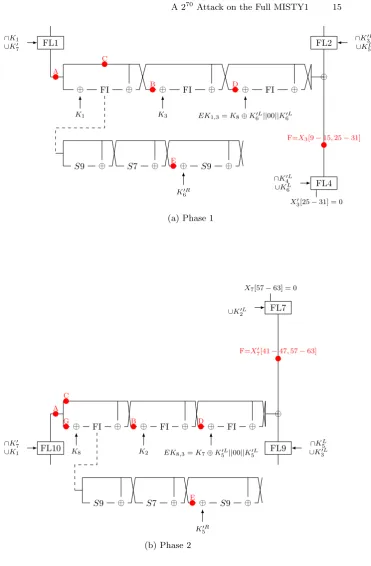
To check whether the attack equation holds, we construct the following piles (see Def. 10 and Fig. 5a):
(i) The pileαR=Lx∈V63PR (which is of size 1).
(ii) A pile of size 29in the 9 leftmost bits of B.
(iii) A pile of size 27in the 7 rightmost bits of B.
(iv) A pile of size 29in the 9 leftmost bits of D.
FL1 ∩K1
∪K07
⊕ FI ⊕ ⊕ FI ⊕ ⊕ FI ⊕
FL2 ∩K30L ∪KL
5
⊕
FL4
X0
3[25−31] = 0 ∩K0L
4 ∪KL
6
K1 K3 EK1,3=K8⊕K60L||00||K60L
S9 ⊕ S7 ⊕ ⊕ S9 ⊕
K0R
6
A
C
B D
E
F=X3[9−15,25−31]
(a) Phase 1
FL10 ∩K0
7 ∪K1
⊕ FI ⊕ ⊕ FI ⊕ ⊕ FI ⊕
FL9 ∩K5L
∪K0L
3
⊕
FL7 X7[57−63] = 0
∪K0L
2
K8 K2 EK8,3=K7⊕K50L||00||K50L
S9 ⊕ S7 ⊕ ⊕ S9 ⊕
K0R
5
A
B D
G C
F=X0
7[41−47,57−63]
E
(b) Phase 2
The total sum Lx∈V63X0
3[25–31](x) is the sum of the contributions of the five
piles. We use the MITM approach once again (thus, getting a two-dimensional MITM attack) by dividing the piles into two sets – piles (i),(ii), and (iii) on the one hand and piles (iv),(v) on the other hand. We then compute the contributions of each set of piles separately and check whether they are equal. For the right key, the contributions must be equal (since the contributions of the five piles sum to zero), while for a wrong key the contributions are equal with probability 2−7 (perV63structure). Since we use seven V63 structures, we obtain 7·7 = 49
bits of filtering overall.
As mentioned above, the sets of ciphertexts that correspond to the seven
V63’s can be computed onceK1 andK70 are guessed. Those key bits are indeed
guessed at the beginning of this phase but if we identify theV63’safter guessing
K1, K70 then the time complexity of this identification would be at least 232·263·7.
We can reduce this time complexity by a precomputation, as follows.
Recall that for each structure V63, the exact 263 ciphertexts that are
de-crypted toV63are determined by the value of only two key bits. For each of the
4 options, we identify the 263ciphertexts {Ci
}, get the corresponding plaintexts
{Pi
} and saveαR=LiPRi. Additionally, construct a pile of size 232inPL and
save it. All information we need for the attack is now contained in the computed piles (so that once K1, K70 are guessed, we can continue the attack with the
right piles). In this way, the time complexity of the identification step becomes 7·4·263= 267.8operations.
The procedure of Phase 1 consists of several steps for each one of the seven
V63’s. First, guessK1andK70, getαR and the pile of size 232. Partially encrypt
the 232 values throughF L
1 to the point A (the time complexity of this step is
232·232= 264) and continue as follows:
1. Construct piles of size 29 and 27in B (piles (ii),(iii)).
1.1. Guess the 9 leftmost bits of K3 and partially encrypt the 29 values of
pile number (ii) to the point F.
1.2. Guess the 7 rightmost bits of K3, encrypt the 27 values of pile number
(iii) to the point F and calculate their XOR. Note that the XOR of the values is sufficient (instead of the values themselves) becauseF L4is
linear. Explicitly, for a set of valuesS, the equation
M
x∈S
F L4(x) =EF L4(
M
x∈S
x)⊕M x∈S
const
holds for the right key (whereconst= (K6,016)).
1.3. GuessK0
3[12–15], K5[12–15] (8 bits ofKL2) and encryptαR[12–15,28–31]
to the point F.
1.4. XOR the results from the previous steps in F and call the joint XORJ1.
1.5. Guess K40[12–15], K6[12–15] (8 bits of KL4), encryptJ1 and save in a
table T1 the contribution toX30[28−31] (4 bits of the attack equation)
2. Partially encrypt the 232 values through S9
1,1,1 and S71,1 (note that we
already knowK1), get partial outputs fromF I1and add them to the values
in C. To construct pile number (iv), we first construct a pile of size 218
corresponding to the 9 leftmost bits in C and the 9 bits in E. Similarly, to construct pile number (v), we first construct a pile of size 216corresponding
to the 7 rightmost bits in C and the 9 bits in E. 2.1. Guess the 9 bits K0R
6 , encrypt the 218 and 216 values through F I1 to
construct piles of size 29and 27in D (piles number (iv) and (v)).
2.2. Guess the 9 leftmost bits ofEK1,3, encrypt the 29values of pile number
(iv) to the point F and calculate their XOR.
2.3. Guess the 7 rightmost bits ofEK1,3, encrypt the 27values of pile number
(v) to the point F and calculate their XOR.
2.4. XOR the results from the previous steps in the point F and call the joint XORJ2.
2.5. Guess K0
4[12–15], K6[12–15] (8 bits of KL4), encrypt J2, calculate the
contribution to X30[28−31] (4 bits of the attack equation) and search
for a collision inT1(i.e., a collision both in the contributions and in the
common key bits). Save the collision in a tableT2.
2.6. The size ofT2is 29+7+8+8·29+9+7+8·2−8·2−4·7= 229, since a match must
occur in K0
4[12–15], K6[12–15] (8 bits of KL4) and in the contribution
toX0
3[28−31] (a 4-bit attack equation, for the sevenV63’s).
3. ProduceT0
2using the 3-bit attack equationLx∈V63X30[25−27] = 0 by a
sim-ilar process. The difference is that we guessK0
4[9−11], K6[9−11] instead of
K0
4[12–15], K6[12–15] andK40[9−11], K6[9−11] instead ofK40[12–15], K6[12–15].
The size ofT2 is 29+7+6+6·29+9+7+6·2−6·2−3·7= 232.
4. There are 9 + 16 + 16 = 41 shared bit-guesses in T2 and T20 (the bits
K0L
6 , K3, EK1,3). Search for a collision in those bits and store them in a
tableT3. The size of T3 is 229·232·2−41= 220.
We save inT3 the corresponding guess ofK1 andK70, and thus, the size ofT3 is
220
·232= 252. For each suggestion in T
3, we guess the subkeyK60L(seven bits),
retrieve the entire subkeyK0
6, and then:
– RetrieveK8 fromK8⊕K60L||00||K60L andK60, – RetrieveK7 fromK70 andK8,
– RetrieveK6 fromK60 andK7. – Compare with the known KL
6 and discard wrong guesses (we guess seven
bits of K0L
6 and have a 7-bit condition, so we remain with a table of the
same size).
– RetrieveKL
4 from K30L andK3.
The output of Phase 1 is two tables. The first is the table Tphase1, that
con-tains 252suggestions for five full subkeysK
1, K3, K6, K70, K8and four 7-bit
sub-keysK0L
3 , K5L, K40L, K4L, sorted according toK1, K70, K8. The second is the table
Tphase10 with the same 252suggestions, but sorted according toK1, K70, K30L, K5L.
The time complexity of Phase 1 for a singleV63and a fixed guess ofK1, K70 is
the sum of time complexities of the steps involving key guessing and (partial) encryption. Since we use sevenV63’s, the total time complexity of Phase 1 (with
the precomputation) is bounded by
T1= 267.8+ 7·232·233.7= 269.2 operations, which is less than 264encryptions.
Table 3: Time complexity of Phase 1
Step Time complexity Description
1.1. 218= 29·29 Guess 9 bits ofK3and partially encrypt 29 values.
1.2. 216= 27·27 Guess 7 bits ofK3and partially encrypt 27 values.
1.3. 28= 28·1 Guess 8 bits ofKL2and partially encryptαR[12–15,28–31].
1.4. 224= 29·27·28 CalculateJ1.
1.5. 232= 224·28 Guess 8 bits ofKL4 and partially encryptJ1.
2.1. 227.3= 29·(218+ 216) Guess 9 bits ofK0R
6 and partially encrypt 218and 216values.
2.2. 227= 29+9·29 Guess 9 bits ofEK1,3 and partially encrypt 29 values.
2.3. 223= 29+7·27 Guess 7 bits ofEK1,3 and partially encrypt 27 values.
2.4. 225= 29·29·27 CalculateJ2.
2.5. 233= 225·28 Guess 8 bits ofKL4 and partially encryptJ2.
3 <step 1+ step 2 Similar to 1 and 2, using⊕X30[25−27] = 0.
4 232.2= 229+ 232 Compare two tables of sizes 229 and 232.
Total <233.7
After the first phase is completed, the rest of the key can be found imme-diately in time complexity of 279 encryptions, by guessing the rest of the key
and checking it by a trial encryption. Of course, this approach does not require additional data. In the following section we show that if more data is available, the time complexity of the second phase can be reduced to 269.5 encryptions.
4.4 A New Integral Attack on Full MISTY1 – The Second Phase
The second phase of our attack uses the 6-round characteristic presented in Section 3.3 to apply a second filtering to the key suggestions remaining from Phase 1.
The goal of this phase is to discard wrong key guesses that pass Phase 1, using the attack equation Lx∈V63X7[57–63](x) = 0 (derived from the 6-round
characteristic).
(i) The pileβR=Lx∈V63CR (which is of size 1).
(ii) A pile of size 29in the 9 leftmost bits of B.
(iii) A pile of size 27in the 7 rightmost bits of B.
(iv) A pile of size 216+9 in the 9 leftmost bits of C + 16 bits of D.
(v) A pile of size 27in the 7 rightmost bits of C + 16 bits of D.
The sumLx∈V63X7[57–63](x) is the sum of the contributions of each pile
sep-arately. As in Phase 1 above, we calculate the contribution of piles number (i),(ii),(iii) and of piles number (iv),(v) separately and check whether the two contributions are equal. For the right key they must be equal, and for a wrong key guess they are equal with probability 2−7 (per V
63 structure). There are 7
optionalV63’s and we use only two of them to get 2·7 = 14 bits filtering.
The procedure of Phase 2 consists of several steps (similarly to Phase 1) for each one of the sevenV63’s.
First, we ask for the encryption of 264
−250chosen plaintexts, such that each
of the seven chosen V63 structures (of X10 values) is covered by the texts. (This
data requirement, combined with the requirement of Phase 1, makes the data complexity equal to 264−236 chosen plaintexts and ciphertexts, which is rather
close to the entire codebook). Second, we construct pile number (i) and a pile of size 232 inC
L for constructing the other piles.
Then, we guessK1andK70 and partially decrypt the 232values throughF L9
to the point A (the time complexity of this step is negligible compared to the total time complexity). The procedure continues as follows:
1. Construct piles of size 29 and 27in B (piles (ii),(iii)).
1.1. Guess the 9 leftmost bits ofK2and decrypt the 29values of pile number
(ii) to the point F.
1.2. Guess the 7 rightmost bits of K2, decrypt the 27 values of pile number
(iii) to the point F and calculate their XOR. 1.3. Guess K0L
3 , K5L (14 bits ofKL9 and decrypt the βR[9–15,25–31] to the
point F.
1.4. XOR the results from the previous steps in the point F and call the joint XORJ1.
1.5. Get theK1, K70, K30L, K5L entry ofTstage10 . The entry consists of 252−46=
26 values for K
3, K6, K8, K40L, K4L. Compute K20 from K2, K3, decrypt
J1 and save in a tableT1 the contribution toX70[57–63], along with the
relevant key (a table of size 29+7+14+6= 236).
2. To construct pile number (iv), we first construct a pile of size 216+9 that
corresponds to the 9 leftmost bits of C + 16 bits of G. Similarly, to construct pile number (v), we first construct a pile of size 216+7 that corresponds to
the 7 rightmost bits in C + 16 bits of G.
2.1. Guess K8 and construct a pile of size 29+9 that corresponds to the 9
leftmost bits of C + 9 bits of E. Construct a pile of size 29+7 that
corresponds to the 7 rightmost bits of C + 9 bits of E. 2.2. Guess the 9 bits K0R
5 , decrypt the 218 and 216 values of the piles from
(piles number (iv) and (v)). For the piles of size 29, this step can be
performed more efficiently by guessing key bits one by one, as described in [2].
2.3. Get the K1, K70, K8 entry of Tstage1. The entry consists of 252−48 = 24
values for K3, K6, K30L, K5L, K40L, K4L. For each value, guess K5R, derive
K5, computeK50 (fromK5, K6) and compare withK50Rthat was guessed.
We remain with 24 values forK0
5and hence 24values for EK8,3.
2.4. With the knownEK8,3, decrypt the 29values of pile number (iv) to the
point F and calculate their XOR. In addition, decrypt the 27 values of
pile number (v) to the point F and calculate their XOR.
2.5. XOR the results from the previous steps at the point F and call the joint XORJ2.
2.6. GuessK0
2[9–15], decryptJ2, calculate the contribution toX7[57–63] and
search for a collision in the tableT1 (i.e., collision in the contributions
+ in the common key bits).
2.7. The expected number of collisions is 29+7+14+6·216+9+4+7·2−7·2−2·7·
2−20= 231, since a match must occur inK0
2[9–15], in the contributions
inX7[57–63] (for twoV63’s) and in the entry of Tstage1.
3. For each of the 231suggestions, guessKR
4, and use the knowledge ofK4, K5, K40L
to get a 7-bit filtering. This yields 265 suggestions for the entire key. Test
them with a single plaintext/ciphertext pair. Only 265
·2−64= 2 suggestions
are expected to remain. Test them with another plaintext/ciphertext pair and find the key.
The time complexity of stage 2 for each structureV63 and each guess ofK1, K70
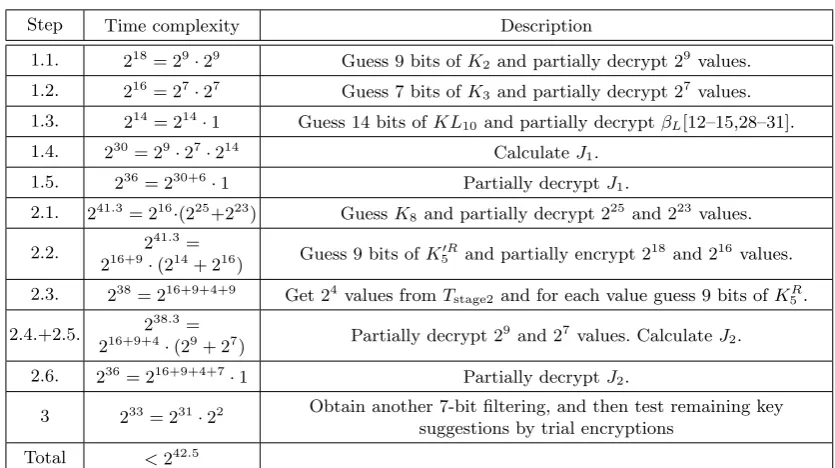
is less than 242.5. The calculation is given in Table 4 and is composed from the
sum of the time complexities of the steps involving key guessing and (partial) decryption. Since we use two V63’s, the total time complexity of Phase 2 is
bounded by
T2= 2·232·242.5= 275.5
Table 4: Time complexity of Phase 2
Step Time complexity Description
1.1. 218= 29·29 Guess 9 bits ofK2 and partially decrypt 29 values.
1.2. 216= 27·27 Guess 7 bits ofK3 and partially decrypt 27 values.
1.3. 214= 214·1 Guess 14 bits ofKL10and partially decryptβL[12–15,28–31].
1.4. 230= 29·27·214 CalculateJ1.
1.5. 236= 230+6·1 Partially decryptJ1.
2.1. 241.3= 216·(225+223) GuessK8and partially decrypt 225 and 223 values.
2.2. 2
41.3
=
216+9·(214+ 216) Guess 9 bits ofK
0R
5 and partially encrypt 218and 216values.
2.3. 238= 216+9+4+9 Get 24 values fromTstage2and for each value guess 9 bits ofK5R.
2.4.+2.5. 2
38.3=
216+9+4·(29+ 27) Partially decrypt 2
9 and 27 values. CalculateJ2.
2.6. 236= 216+9+4+7·1 Partially decryptJ2.
3 233= 231·22 Obtain another 7-bit filtering, and then test remaining key suggestions by trial encryptions
Total <242.5
All the operation of Phase 2 are simple operations besides Step 3 that consists of 265 full MISTY1 encryptions. Thus, the time complexity T2is 275.5 simple
operations + 265full MISTY1 encryptions. Assuming that each simple operation
is comparable to an S-box evaluation, the time complexity of stage 2 (in terms of full encryptions) is 275.5
8·9 + 2
65= 269.5, since MISTY1 has 9 S-boxes in each of
its 8 rounds.
The output of Phase 1 required tables of size 252. In a naive approach, this
is the memory complexity of the attack but maybe it can be reduced.
5
Summary and Conclusions
In this paper we presented a new attack on the full MISTY1. The attack uses two 6-round integral characteristics, one in the “encryption direction” (as used by Todo [11]), and the other in “decryption direction”. The attack equations derived from the characteristics provide a filtering for wrong key guesses. Exploiting the filtering efficiently by using partial sums, two-dimensional meet-in-the-middle and other techniques, our attack has time complexity of 269.5encryptions. This
is a reduction by a factor of 238 over Todo’s attack that has time complexity of
While our attack is clearly impractical due to its high data and memory complexities, it shows that MISTY1 has a rather low security margin, providing only 70 bits of security.
As a problem for further research, it will be interesting to find out whether the data complexity can be reduced. A possible direction for achieving this is finding additional 6-round integral characteristics of a lower order.
We believe that there are otherV63’s that obtain by fix other bits (instead
of the last seven). The result is additional filtering in Phase 1. In this case, the attack is consists only Phase 1 and has time complexity of≈264(dominates by
the data decryption).
6
Acknowledgements
We are grateful to Yosuke Todo for sharing his paper [11] with us, and for useful comments on this manuscript.
References
1. 3rd Generation Partnership Project. Specification of the 3GPP Confidentiality and Integrity Algorithms - Document 2: KASUMI Specification (Release 6). Technical Report 3GPP TS 35.202 V6.1.0 (2005-09), September 2005.
2. Achiya Bar-On. Improved Higher-Order Differential Attacks on MISTY1. InFast Software Encryption, 22nd International Workshop, FSE ’15, Istanbul, TURKEY, March 8-11, 2015, to appear.
3. Joan Daemen, Lars Knudsen, and Vincent Rijmen. The block cipher Square. In Eli Biham, editor, Fast Software Encryption, volume 1267 of Lecture Notes in Computer Science, pages 149–165. Springer Berlin Heidelberg, 1997.
4. Itai Dinur, Orr Dunkelman, and Adi Shamir. Improved attacks on full gost. In Anne Canteaut, editor, Fast Software Encryption, volume 7549 of Lecture Notes in Computer Science, pages 9–28. Springer Berlin Heidelberg, 2012.
5. Orr Dunkelman and Nathan Keller. Practical-Time Attacks Against Reduced Vari-ants of MISTY1. Design, Codes and Cryptography, to appear, 2013.
6. Niels Ferguson, John Kelsey, Stefan Lucks, Bruce Schneier, Michael Stay, David Wagner, and Doug Whiting. Improved Cryptanalysis of Rijndael. InFast Software Encryption, 7th International Workshop, FSE 2000, New York, NY, USA, April 10-12, 2000, Proceedings, pages 213–230, 2000.
7. Keting Jia and Leibo Li. Impossible Differential Attacks on Reduced-Round MISTY1. In Dong Hoon Lee and Moti Yung, editors, WISA, volume 7690 of Lecture Notes in Computer Science, pages 15–27. Springer, 2012.
8. Lars Knudsen and David Wagner. Integral Cryptanalysis. In Joan Daemen and Vincent Rijmen, editors,Fast Software Encryption, volume 2365 ofLecture Notes in Computer Science, pages 112–127. Springer Berlin Heidelberg, 2002.
9. Ulrich K¨uhn. Improved Cryptanalysis of MISTY1. In Joan Daemen and Vin-cent Rijmen, editors, Fast Software Encryption, volume 2365 of Lecture Notes in Computer Science, pages 61–75. Springer Berlin Heidelberg, 2002.
11. Yosuke Todo. Integral Cryptanalysis on Full MISTY1. InAdvances in Cryptology - CRYPTO 2015 - 35th Annual Cryptology Conference, Santa Barbara, CA, USA, August 16-20, 2015, to appear, 2015.
12. Yosuke Todo. Structural Evaluation by Generalized Integral Property. InAdvances in Cryptology - EUROCRYPT 2015 - 34th Annual International Conference on the Theory and Applications of Cryptographic Techniques, Sofia, Bulgaria, April 26-30, 2015, Proceedings, Part I, pages 287–314, 2015.
13. Yukiyasu Tsunoo, Teruo Saito, Takeshi Kawabata, and Hirokatsu Nakagawa. Find-ing Higher Order Differentials of MISTY1. IEICE Transactions, 95-A(6):1049– 1055, 2012.