Life Cycle Cost Study on Embedded Based
Solar Powered Cum Manual Powered
Rickshaw
S.Devaneyan1, Dr. V. Kirubakaran2
Research Scholar [Energy Engineering], Rural Energy Centre, Gandhigram Rural Institute, Deemed University,
Gandhigram, India1
Asst. Professor, Rural Energy Centre, Gandhigram Rural Institute, Deemed University, Gandhigram, Tamilnadu, India2
ABSTRACT: The battery operated conventional auto-rickshaw is charged by national grid whereas the battery bank of the proposed embedded based solar-powered auto-rickshaw is charged by solar power. A PIC microcontroller is programmed to control the duty cycle of the dc motor and thereby reduce the battery discharge time of the battery bank. The life cycle cost (LCC) analysis has been done and compared with the conventional battery operated auto rickshaw. It has been found that LCC/kWh of the projected rickshaw is minimum. The realistic measured results divulge that the recital of the projected rickshaw out performs the conventional battery operated auto-rickshaw.
KEYWORDS: Solar energy, breaking force, driving energy, LCC, Embedded System
I.INTRODUCTION
In India, there are many modes of transport. Especially in the city areas of northern India, the varieties are seen frequently. Rickshaw is one of the most popular vehicles in the capital city New Delhi as well as in the sub-urban areas. But in recent times, the number of rickshaws has increased and the passengers find as a very comfortable mode of transport both cost-effectively and also environmentally. It has gained new popularity among the poor citizens as a basis of income. Most of the riders of these rickshaws belong to the middle class and lower middle class society. Delhi is one of the most populous cities in the world and most of them choose rickshaw as their first priority for transportation. This number is drastically increasing to cater more middle class peoples. A rickshaw is generally a three wheeled mode of transportation that is driven by pedaling of a person. It is normally identified as cycle rickshaw. However scenario of the preceding rickshaws was not the equal what we see nowadays. In the early years of the 19th
century, the rickshaw was hypothetical to be a two wheeled vehicle that is pulled by a human being. The puller used to clutch the two wooden bars attached to the body and ran along the roads. But with time the rickshaws are changed to a new look with an extra wheel and a paddle and also brakes. Nowadays, a new type of rickshaws is seen in the streets which get power from battery. In those rickshaws, the battery produces electrical energy which converts into translational motion. In the past, the human pulled rickshaws were very common in the streets of India. Even now in Kolkata, there are few streets where this type of rickshaw can be seen. The main problem with these rickshaws was the necessity of human efforts in a large scale. So it lost interest and introduces cycle rickshaws. But these rickshaws also create health problems to the puller significantly. Physical strength of the puller is decreasing day by day. They are affected by air pollution and cardiac problems. A rickshaw puller works relentlessly throughout the day for more than 7 to 9 hours a day. With this kind of pollution the DNA can be damaged potentially.
To eliminate the additional power demand and to save our power our work is done by using solar panel. Solar energy is absolutely renewable and environment friendly energy. India is situated in a very suitable geographical position for the solar radiation. Every day we get bright sunshine 4 to 10 hours and solar radiation which is 4 and 6.55KJ/m2. In that
case solar power is very helpful. Our proposed model is thus suitable for those countries that have shortage of electrical power. It is also beneficial to the growing economic activities and the development. The embedded based solar powered battery operated rickshaws are more financially feasible and more effective than the others. Such rickshaws are the best alternative of the present auto rickshaws which is charged by the national grid supply.
II. OUTLOOK OF SOLAR ENERGY
As a developing country like India, there is always a scarcity in the claim of electrical energy. In that case, renewable energy has become one of the most significant subjects of research nowadays. It is produced from natural resources such as sunlight, wind, tides, rain and geometrical heat and so on. There are different types of renewable energy such as solar power, wind power, biomass, bio-fuels and hydroelectricity. So these sources can be used to minimize the pressure on the other non renewable sources. Solar energy is the most widely used source of energy. It is generated from sunlight. The importance of solar energy is more than the other renewable energy. The reason behind it is the availability of the sunlight in all countries of the world. Another reason is the cost of this energy is much less than the other renewable energy.
In most of the countries power sector plays the most essential role in the development. In the last 30 years, the expenditure of solar power system has decreased at a good rate. It’s because of the increasing demand of the system among the common people. In different countries nowadays it is used widely. It is very much popular in those countries where the climate is more suitable for this. Countries like Bangladesh, India, Pakistan, Sub Saharan Africa etc have more demand of this technology than the others. Different countries in the world are using the solar power as an alternative to the other power. Countries that installed highest number of solar power are: Germany 9,785MW, Spain 3,386MW, Japan 2,633MW, United States 1,650MW, Italy 1,167MW, Czech Republic 465MW, Belgium 363MW, China 305MW, France 272MW, India 120MW. So, it has become very clear that the solar power is growing more eagerness among the people to use solar power as their alternative power system.
As India is a developing country, power sector needs a lot of development. It mostly depends on natural gas and hydro power stations to produce electricity. Necessary infrastructure is not at all getable to use the natural gas for producing the power though there is a high amount of natural gas. As the population is growing at a rapid rate, the demand of electricity is increasing day by day at a great speed. So it is high time we had the opportunity to use the solar technologies.
III. PROPOSED MODEL DESCRIPTION AND FEATURES
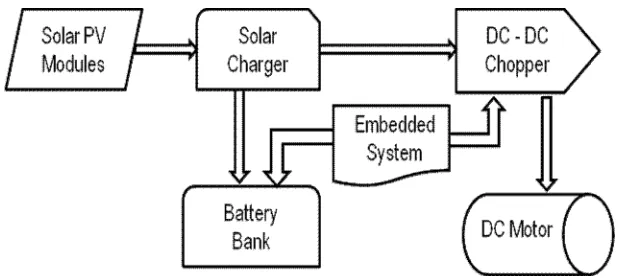
Figure 1 shows the overall block diagram of our proposed auto-rickshaw model. They are solar PV modules, Solar Charger, DC – DC Chopper, Battery bank, DC motor and an Embedded System.
The PV module converts solar radiation to the electrical energy. The energy comes from the sunlight stored in the lead acid battery bank that is controlled by embedded based solar charger. This type of battery is used for its low cost, high current, low initial impedance, tolerance to overcharge capabilities. The charge controller protects the battery from being over charged. Embedded based PWM is used for regulation in speed, it controls the duty cycle of the dc motors situated at the bottom of the structure. An optional emergency power system to charge the battery from the supply lines
IV. SYSTEM COST ASSUMPTION AND LCC INVESTIGATION
The following assumptions have been made on the basis of present market prices to determine the life cycle cost (LCC) and cost of unit energy of the proposed solar powered rickshaw:
The operation and maintenance cost is considered 10% and for solar system it is 5% of the total capital cost.
The installation cost is considered on the basis of an average labor cost of INR 300/day.
Unit cost of the solar panel is Rs 60 (found in local market survey).
The inflation rate of conventional electricity is considered 5%.
The LCC nonrecurring General Escalation (GE) of 3% (typically the value is 3 − 8%), discount rate of 7% (typically the annual value is 7−15%), LCC nonrecurring cost factor of 0.565 are considered [10].
The interest rate is 3%.
The period of analysis is 10 years which is equal to the assumed physical and economic of the PV system.
For the life cycle cost (LCC) analysis, we consider the following four different cases: Case A: Existing battery operated rickshaw charged by the national grid.
Case B: Solar power battery operated rickshaw.
Case C: Existing battery operated rickshaw charged by the national grid. But government is not giving subsidy.
Case D: Microcontroller based proposed rickshaw.
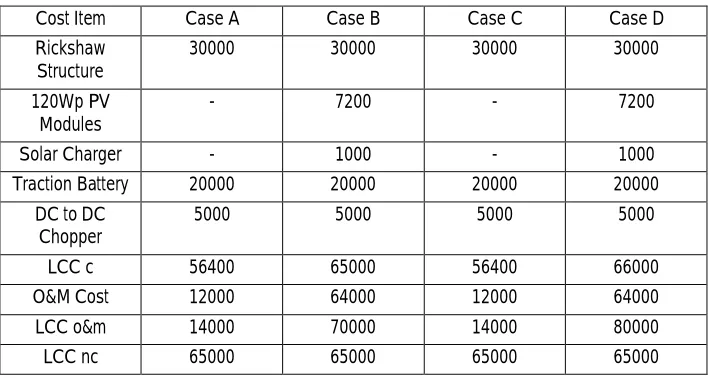
TABLE I: LCC for the Different Cases
Cost Item Case A Case B Case C Case D
Rickshaw Structure
30000 30000 30000 30000
120Wp PV Modules
- 7200 - 7200
Solar Charger - 1000 - 1000
Traction Battery 20000 20000 20000 20000
DC to DC Chopper
5000 5000 5000 5000
LCC c 56400 65000 56400 66000
O&M Cost 12000 64000 12000 64000
LCC o&m 14000 70000 14000 80000
LCC nc 65000 65000 65000 65000
Table I presents the estimated costs for different cases of driving rickshaw. where
LCCc is the Life cycle capital cost,
LCCNC is the Life cycle non-recurring cost and it includes battery replacement cost,
Fig. 2: Current variation with different speed for different passengers
Figure 2 shows the current variation with different speed for different number of passengers. Graph is plotted with the values taken from voltmeter, Clamp meter and Tachometer as well.
The relationship between battery capacity and battery voltage has been shown in the Fig. 3: Relationship between battery capacity and battery Voltage.
Figure 3 depicted that battery discharging time has risen due to the use of microcontroller based speed controller [an embedded system used in here] to drive dc motor of the proposed rickshaw. In the proposed auto-rickshaw a 300 Watt dc motor is used. The voltage rating is 48V and current rating is 3.25 A. If the average time of running this motor is about 6 hours (hr), then the average energy required to drive the motor, denoted by Em, is Em = 3.25A × 6hr × 48V = 780J
Fig. 3: Relationship between battery capacity and battery Voltage
Due to the space constraint on the roof-top and to have good balance in case of speed more than 15 km/hour, we have installed two solar panels. The electrical specification of the solar panel is 100 × 2 i.e., 200 watt. If they are connected in series, then the nominal system voltage is 24 volts and measured current is found to be 8.33 A. Then amp hour (Ah) produced by solar panel
Epv is Epv = 8.33A × 6hr × 12V × 2 = 1199.52J
Battery capacity = 1 × 3.25 × 5 0.5 × 0.75 × 1.56 = 27.78
The battery capacity is 48 V, 4.5 A, then energy supply by the battery Eb is Eb = 40 × 12 × 4 = 1296
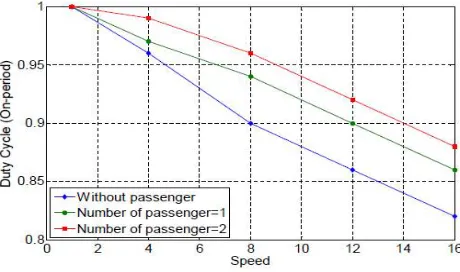
Figure 4 shows the effect of motor speed on the on-period (i.e., duty cycle) generated by PIC microcontroller which used as a heart in the embedded system introduced here. It has been found from the practical measurement that the duty cycle depends on the frictional force.
Fig. 4: Effect of speed on the on-period of the duty cycle
The increase of the speed of the motor reduces the on-period of the dc motor. When the number of passenger increases the more energy is required to overcome the frictional force, thus the duty cycle is increasing.
V.CONCLUSION
This work presents the LCC analysis and performance evaluation of proposed micro-controller based solar powered auto-rickshaw. The results showed that LCC unit price is minimum for our proposed micro-controller based solar powered auto-rickshaw. It has also been found that micro-controller based dc motor control circuit reduced battery discharge rate compared to the traditional battery operated auto-rickshaw. Approximately 200W PV-array is enough to drive a 300 W motor and the system will operate more than 5.5 hours a day.
REFERENCES
[1] A. R. Chowdhury, “Evaluation of Occupational Health Problems of Cycle Rickshaw Pullers and Redesign of Cycle Rickshaw on Ergonomic Principles,” Indian Journal of Renewable Energy, Vol 23, pp. 112–134, 2004
[2] A. K. Pandey, “DNA Damage in Lymphocytes of Rickshaw Pullers As Measured By The Alkaline Comet Assay,” Journal of Environmentaland Molecular Mutagenesis, Vol 47, no. 1, pp. 25–30, 2006
[3] A. R. M. Siddique, A. A. Khondokar, M. N. H. Patoary, M. S. Kaiser, A. Imam, “Financial Feasibility Analysis of a Micro-controller Based Solar Powered Rickshaw,” 1st International Conference on Electrical Information and Communication Technology, KUET, Bangladesh,19-21 December,Dhaka, 2013.
[4] S. K. Nandi, M. N. Hoque, H. R. Ghosh and R. Chowdhury, “Assessment of Wind and Solar Energy Resources in Bangladesh,” Arabian Journal for Science and Engineering, Vol. 38, No. 11, pp.3113–3123, November 2013
[5]Solar Energy Statistics, Source: U.S. Energy Information Administration, Ecoworld Date Verified: 6.18.2013, http://www.statisticbrain.com/solar-energy-statistics/
[6] Farhana Afrin, Twisha Titirsha, Syeda Sanjidah, A. R. M. Siddique,Asif Rabbani, Installing Dual Axis Solar Tracker on Rooftop to Meet the Soaring Demand of Energy for Developing Countries, Impact of Engineering on Global Sustainability (INDICON-2013), IIT Bombay, Mumbai, India, 13-15 December, 2013.
[7] E. Starschich, A. Muetze (2007),Comparison of the Performances of Different Geared Brushless-DC Motor Drives for Electric Bicycles, Electric Machines & Drives Conference IEEE International, Volume 1, pp 140 – 147.
[8] J. Mehdi Etezadi-Amoli, Kent Choma and Jason Stefani, Rapid-Charge Electric-Vehicle Stations, IEEE TRANSACTIONS ON POWER DELIVERY, VOL. 25, NO. 3, JULY 2010.
[9] Jan T. Bialasiewicz, Renewable Energy Systems with Photovoltaic Power Generators: Operation and Modeling, IEEE TRANSACTIONS ON INDUSTRIAL ELECTRONICS, VOL. 55, NO. 7, JULY 2008.
CONVERSION, VOL. 24, NO. 2, JUNE 2009.
[11] Professor Morton, The Electric Bicycle Computer with CAN, Western Washington University, Department of Engineering Technology, Washington, USA, April 19, 2005.
![Figure 3 depicted that battery discharging time has risen due to the use of microcontroller based speed controller [an embedded system used in here] to drive dc motor of the proposed rickshaw](https://thumb-us.123doks.com/thumbv2/123dok_us/7772643.1280455/4.595.194.402.501.655/figure-depicted-discharging-microcontroller-controller-embedded-proposed-rickshaw.webp)