ISSN 2286-4822 www.euacademic.org
Impact Factor: 3.4546 (UIF) DRJI Value: 5.9 (B+)
Analysis of Compression Techniques for DNA
Sequence Data
SHAKEELA BIBI JAVED IQBAL ADNAN IFTEKHAR MIR HASSAN School of Computer Science Wuhan University, China
Abstract:
also avoid from any information loss. The review of existing studies also shows that compression of DNA sequence is significant for understanding the critical characteristics of DNA data in addition to improving storage efficiency and data transmission. In addition, the compression of protein sequence is a challenge for the research community. The major parameters for evaluation of these compression algorithms includes compression ratio, running time complexity etc.
Key words: Huffman Coding, Extended ASCII Illustration, DNA Encryption, Decompression
I. INTRODUCTION
It is a major issue to store large amount of DNA sequence data which consist of long chain of DNA base pair sequence data. DNA and protein sequence data bases amount to hundreds of gigabyte (GB) storage space. This makes data compression in genomics a very important and challenging task. For storing the DNA and protein sequence, publicly available databases are EMBL, Gene bank, and DDBJ. The size of these databases is increasing exponentially [2].
Recently, many scientists have introduced different type of algorithms to solve the compression problem of genetic sequence data. In 1983 Hamori planned Graphical representation aimed at visualizing the DNA classification initially [3]. After this Nandy introduced a graphical method by assigning four bases of DNA A, C, T and G in the different four directions, like (x),(y),(-x),(-y) correspondingly in 1994. This algorithm visualized the DNA arrangement that is directed by certain cost of graphic material associated through crossing then covering of the curve by it while it bounces with abundant natural symbol for extended DNA categorization [4].
DNA sequence data has repetition of information. As we are familiar that recurrent DNA base pair arrangements are accountable for organic specialization proposed by Grechko in 2011 and palindromic structures relate to spots of DNA breakage throughout the gene transformation. Therefore, it‘s not easy for bio scientist to manage the repeated large amount of DNA sequence data so that compression techniques have been introduced to decrease the extent of redundant data and appropriately examine which data is important and should be stored. Discovery of recurring structures has been an elementary step for refining a material structure presentation and falling the quantity of the requiring space. Firmness of the twofold output of DNA datasets to extended ASCII illustration is shown in Figure 1
Figure 1: ASCII representation [5]
Huffman coding algorithm is a lossless compressing algorithm that compresses data without any cost of its statistics. Consequently, it is used for text firmness techniques and therefore for DNA arrangement data. In this paper, the authors explained a graphical demonstration of DNA main classification founded on Huffman coding algorithm, in this algorithm, there is no immorality of material of DNA sequence. DNA sequence analysis is supportive in diverse areas as forensics, medical research, pharmacy, agriculture etc. [6].
and second is condensing in vertical mode. In the first one compression is held on solo sequence based on its genetic materials as Biocompress [7] pursues replications in a sequence data. When this method is applied on standard benchmark datasets then it shows 1.85 BpB compression ratios. To compress the non-reparative part of sequence Biocompress-2[7] Markov model is used, and it shows compression ratio of 1.78 BpB.
This paper is summarized as follows. Section II provides literature review of the related work; Section III presents the main problem and objective of this research work. In Section IV, we proposed comparison of different tools and techniques that are described in detail by different authors in different papers. Results are presented and discussed in the section V. Conclusion is provided in the last section.
II. LITERATURE REVIEW
Various DNA compression techniques have been presented recently, a literature review of few of those techniques is presented in the following section.
implemented as follows AAAC, ACGT, GAGA, ACGT, TAAC, GATC, ACGT, TAAC. Table 1 shows the DNA Words and their occurrence frequency.
Table 1: Vocabulary Table Content [5]
Index Word Frequency
0 ACGT 3
1 GAGA 1
2 GATC 1
3 TAAC 2
4 AAAC 1
The distances of the allocated codes are according to the number of incidences of the chunks. The most common chunk is allocated the least code and the less common chunk is allotted the main code [5]. Table 2 illustrates the words and relevant code to be used in the example data.
Table 2: Vocabulary Table Codes [5]
Index Word Frequency
0 ACGT 00
1 TAAC 10
2 GATC 0001
3 GAGA 0010
4 AAAC 1101
The Results of arrangement will be as 00 00 0001 11 00 11 0001 1101
Figure 2: Additional Data Structure [5]
The output consequence will be condensed to 12.5% of its original representation. The efficiency of this technique is that it has 0.8 BpB compression ratio per base which is better and efficient than all other currently existing compression algorithms [8]. For this technique, authors used the HUMHBB, HUMHDABCD, MPOMTCG and VACCG which have size of more than 180000 nucleotides [5].
In 2016 George Volis et al, has introduced dual innovative techniques for space compaction of biological sequence data. In this work, authors discussed the problem of management of large amount of DNA sequence data. Authors introduced two techniques that are based on n-grams/2L method for compression of DNA sequence data. Authors proposed the solution of eliminating the size of memory for saving the genetic material. The first method is founded on 2L technique that indexed the DNA sequence data for better understanding and compression and it can change the upturned catalog of this standard procedure to an extra flattened presentation. Figure 3 shows the comparisons results achieved through each technique.
These techniques can eradicate the volume of memory for loading genomic material [9] and another indication is a totally innovative method which is entirely different and founded on observing a DNA base pair arrangement as a symmetrical issue. It is joined with the N-grams procedure too. For increasing the efficiency of information system and dropping the volume of required space, finding recurrent arrangements is a basic step [10]. According to equivalent patterns, Refining List is generated as represented in Figure 4.
Figure 4: Refined Subsequence [9]
If there is a competition at the existing location Authors cross scrutinize the Refined List of their design with the quantity of DNA arrangement Refined List that matches to the presence of the design in the classification. If there is a competition, then this design certainly seems in original DNA arrangement at this existing location.
W. De Neve has proposed a new method for DNA read compression using machine learning performances. The authors described that how to manage storage volume for large amount of DNA sequence data. The goal of their work was to accomplish widespread examination on whether it is practicable to brand a changeover to machine learning methods and additional precise deep learning methods.
by assigning them a specific code. Codes are assigned to the bases of DNA according to their frequencies. Figure 5 shows that there will be no loss of information while representation of genes sequence in the shape of binary tree [11].
Figure 5: A binary tree of a DNA sequence frequency (0.05; 0.3; 0.2; 0.45); a) The primary nodes; b) Huffman tree [11].
Multivariable component is used to measure the quantity of nucleotides that are derived from graph. Graphical approaches have appeared as an influential means for the examination and visualization of extensive DNA classifications. The inspection of resemblances and differences between the comprehensive encoding arrangements of b-globin genetic factor of 11 classes and 6 ND6 proteins demonstrates the efficacy of the system [12].
the resulted file. It provides best output on files with recurrent substrings like text files. Here is a ratio of compression
Table 3: Comparison of Compression Results on h3n2 Virus [13]
Algorithm Size Compression ratio
Gzip 101,494 94.92%
Bzip 54,314 97.28%
DNA Compress 474,139 76.26%
Gene Compress 25,837 98.705
Binary 73,901 96.305
Huffman 52,927 97.35%
Markus Hsi-Yang Fritz et al, proposed efficient storage of high throughput DNA sequencing data using reference-based compression in 2017. In this article, authors presented a novel reference-based firmness technique that proficiently compresses DNA bases for loading. According to this technique firstly they line up the new bases arrangements to a references genome after the alignment they encode the dissimilarities among the new bases and existing reference genomes for loading in a memory.
AC ATCTTAATGCCTTACTTGTT- - GG - CATTC G reference
ATC TAAT---TTAC G
ATGCCTTACTTGT mapped reads
ACTTGTTATGG C C
Position Strand Substitutions Insertions Deletions 4 + 4-G none 5-3 6 + none none none 7 + none 8-AT 4-C none
(A). reads aligned reference, (B). Unaligned are pooled to ‗‗compression framework‘‘, (C). information of base pair is stored in specific offsets, with insertions, substitutions, or deletions [2].
In the storage of valuable material and unaligned classifications for measurable loss of information their compression algorithm is more efficient.
With the new methods of compression, we can find out the exponential efficiency by increasing the read lengths, and by changing the volume of valuable information magnitude of this competence improvement can be measured. [2].
David Loewenstern et al, introduced new technique of DNA sequence compression which is named as DNA Sequence Classification Using Compression-Based Induction in 2014. Models are formed for using such methods on DNA base pair identification problems that are dependent on the exact positions of genes and assume the individuality of successive gene positions. This work describes as a compression-based induction (CBI), it is geared to the classification learning methods as that raise during learning DNA classification. Because of these algorithms new models are formed that are founded on the main relative positions of genes and on dependence of successive positions [6].
Table 4: Experimental Result on File Size [14]
Sequence Base
number
File size (our algorithm)
File size(GZip)
R(bits/base)
Atatsgs 9647 18736 20936 1.9422
atef1a23 6022 11448 12272 1.9010
Atrdnaf 10014 20256 22816 2.0228
Atrdnai 5287 10192 9964 1.9277
Chmpxx 121024 237744 276192 1.9644
Chntxx 155939 309256 364104 1.9832
Hehcmvcg 229354 466296 533888 2.0331 HSG6PDGEN 52173 102296 117096 1.9601
HUMDYSTROP 38770 77504 91624 1.9991
HUMHDABCD 66495 118424 131848 1.7809
Average -- -- -- 1.9494
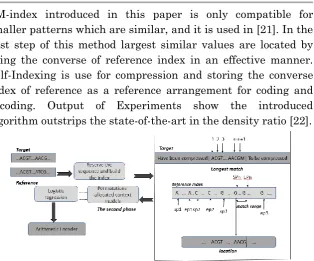
FM-index introduced in this paper is only compatible for smaller patterns which are similar, and it is used in [21]. In the first step of this method largest similar values are located by using the converse of reference index in an effective manner. Self-Indexing is use for compression and storing the converse index of reference as a reference arrangement for coding and decoding. Output of Experiments show the introduced algorithm outstrips the state-of-the-art in the density ratio [22].
Figure 6: The framework of the introduced algorithm. In the primary step, the variable-length substring is matched and located using the reference index. The remaining unencoded symbols are compressed by the synthesis of complementary contextual models in the second pass [22].
III. RESEARCH PROBLEM AND OBJECTIVES
The rapid growth of DNA structures in the DNA collection has been one of the encounters for bio scientists to examine accurately the big capacity of genomic DNA structure data. The firmness of DNA orders is founded on text solidity procedures. However, researchers proved that conservative text solidity methods are inadequate for DNA orders compaction. Therefore, they anticipated special density methods.
DNA sequence information. By reducing size of data whole information about DNA would be easy to store, manage and analyze. Sometimes, DNA sequence may also contain redundant data. The implemented algorithm will also remove such data redundancies. This would be beneficial for bio scientists to manipulate biological data easily and to reduce the dimensions of biological data.
IV. RESULTS AND DISCUSSION
Zhao-Hui Qi et al, proposed Huffman coding method to visualize and analyze DNA sequences in 2011. Huffman Coding Algorithms compress the B-globin gene of 11 distinct species Six ND6 protein without any loss of information. In [13] many techniques have been discussed that shows different results as LZW gives 45.1% compression ratio for H3N2, whereas E-coli, Gzip and Bzip gives 73.1%, 94.3% and 97.23% respectively. In [2], Raw FASTQ gives 19.96 efficiency for NA12878 chrom20, Raw FASTA is used for compression that gives 11.45 (for NA12878 chrom20) and Bzip2 FASTQ gives 6.64 (for NA12878 chrom20). These techniques have some drawbacks as it involves a control loss of accuracy in terms of classification information and there is a tradeoff between efficient storage and lose of information.
It was also found that the illustration through Huffman coding is inimitable when a Huffman compression is well-defined by the incidence distinguishing of base A, T, G, and C in given DNA orders. The key gain of this method is that it permits to have a density ratio per base inferior than 0.8 BpB thus improved than all current density systems. The procedure is also informal to contrivance and stimulating to custom as the five systems bandage the original nucleotide illustration to less than 25%.
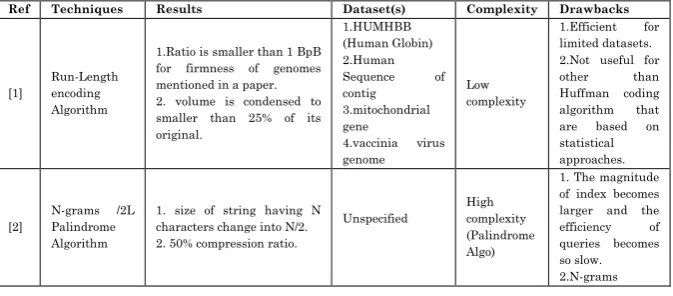
Table 3: Comparison of Sequence Compression Techniques
Ref Techniques Results Dataset(s) Complexity Drawbacks
[1]
Run-Length encoding Algorithm
1.Ratio is smaller than 1 BpB for firmness of genomes mentioned in a paper. 2. volume is condensed to smaller than 25% of its original.
1.HUMHBB (Human Globin) 2.Human
Sequence of
contig 3.mitochondrial gene
4.vaccinia virus genome
Low complexity
1.Efficient for limited datasets. 2.Not useful for
other than
Huffman coding
algorithm that
are based on
statistical approaches.
[2]
N-grams /2L Palindrome Algorithm
1. size of string having N characters change into N/2. 2. 50% compression ratio.
Unspecified
High complexity (Palindrome Algo)
1. The magnitude of index becomes larger and the
efficiency of
Compression based induction, Zdiff, LZ78 and basic-cbi Tryeach-hamming are used for compression in [6] that shows different results as compared to above mentioned DNA sequence compression methods, In these compression algorithms, ECORGNB, ECORPLRPM and EORRNH datasets are used. But these techniques are difficult to understand, with
technique is
difficult to
implement. 3.N-grams/2L algorithm offers space efficiency only on frontend.
[3] Huffman
Coding
Lossless compression of long DNA chain.
B-globin nucleotides of 11 different classes 6-ND6 protein.
O(nlogn)
Only 4 bases of DNA (ACTG) can
be map
graphically not Protein and RNA.
[4] 1.LZW 2.Gzip 3.Bzip 4.RLE 5.Arithmatic
1.H3N2 has 45.1%
compression ratio.
2.E-coli has 73.1%
compression ratio.
3.Gzip gives 4.3%
compression ratio for H3N2. 4.Bzip gives 97.23%.
1.H3N2 2.E-coli 3.Becteria 4.Tomato 5.Rabbit O(n)
1.Run length
algorithm is not suitable for DNA data compression. [5] 1.Reference based compression 2.Raw FASTQ 3.Bzip2FASTQ 4.Bzip2 5.BAM 6.Bzip2 clipped
1.Raw FASTQ gives 19.96
efficiency for NA12878
chrom20.
2. Raw FASTA gives 11.45 (for NA12878 chrom20). 3. Bzip2 FASTQ gives 6.64 (for NA12878 chrom20).
1.NA12878 CHROME20 2.Pathovar syringas B728a
Unspecified
1.Require a
control loss of accuracy in terms of classification material stowed. 2.Tradeoff between efficient storage and lose of information. [6] 1.Compression based induction 2.Zdiff, LZ78 3. basic-cbi Tryeach-hamming Unspecified 1.ECORGNB 2.ECORPLRPM 3.EORRNH High complexity
1. Difficult to understand. 2.More time to compress 3.Due to biased
in negative
training data, the
estimated true
error rate was less than 0.1 %.
[7] LUT & LZ77
1. Compression is 75%. 2. Ratio of compression is
0.2bits/base larger than
theirs commonly. 1.Sequence: atatsgs 2.HSG6PDGEN 3.HUMDYSTROP 4.HUMHDABCD 5.Mtpacg 6.Mm2p3g 10^-3 seconds
1.Time cost by
LZ77 isn‘t so
beneficial. 2.LUT pre-coding can‘t be combined
with other
distinct compression
methods, to
review this
procedure to
recover its
more time to compress and due to biased in negative training data. The estimated true error rate was less than 0.1 % [6].
At the end in [14] LUT (Look-Up Tables) & LZ77 are discussed. It uses the datasets of Sequence as atatsgs, HSG6PDGEN, HUMDYSTROP, HUMHDABCD Mtpacg and Mm2p3g. It reduces the volume of datasets into 75% of the one that is only reduced by pre-coding routine and ratio for compression of this method is almost 0.2bits/base larger than commonly used methods. There are some drawbacks of these two techniques as the time cost by LZ77 is not so beneficial and LUT pre-coding can‘t be merged with other distinct compression methods, to review this process to increase its efficiency. Moreover, the analysis of literature also shows that HUFF+ASCII time execution time is less than CTW+LZ sophisticated than DNA Pack and DNA Compress [5]. For further reduction of time execution, it is possible to parallelize its efficiency.
V. KEY FINDINGS
provides lossless compression. Occurrence frequencies of DNA bases are represented in the form of binary trees. For measurement of the quantity of DNA nucleotides datasets multivariable components are used which are derived from graphical representation of long chain of sequences. Huffman Coding is easy to implement and understand but this technique also has a drawback that it is implemented in literature only for DNA nucleotide datasets. Huffman Coding can be applied for protein sequences for efficient compression of datasets. Furthermore, novel graphical representation methods can be proposed in the future for efficient and simple understanding of this complex structured sequence data. While working on any such methods, the semantics of information should not be lost in any case. The existing techniques also fails to consider particular structure of the mentioned sequence data which might be useful for storing sequence information in a precise manner.
VI. CONCLUSION
further enhanced due to their potential applications. Additionally, we may attempt to subordinate these methods to other density processes grounded on statistical methods to bandage the DNA classifications with a rate sophisticated than the proportion of previous methods.
REFERENCES
[1] Yu Wanga, Igor V. Tetkoa, Mark A. Hallb, Eibe Frankb, Axel Faciusa, Klaus F.X. Mayera, Hans W. Mewesa,c ‗Gene selection from microarray data for cancer classification—a machine learning approach‘‘ Computational Biology and Chemistry 29 (2005) 37–46. [2] Markus Hsi-Yang Fritz, Rasko Leinonen, Guy Cochrane, Ewan Birney, Hans W. Mewesa,c ‗Efficient storage of high throughput DNA sequencing data using reference-based compression‘‘ European Molecular Biology Laboratory‘s European Bioinformatics Institute (EMBL-EBI), Wellcome Trust Genome Campus, Hinxton, Cambridgeshire CB10 1SD, United Kingdom.
[3] 1Rashmi N. Gadbail, 2Aniket Asole ‗‘ Adaptive Huffman Coding Compression Technique Algorithm for XML Database‘‘International Journal of Advanced Research in Computer Science and Software Engineering Volume 5, Issue 5, May 2015.
[4] Zhao-Hui Qi, Ling Li, and Xiao-Qin Qi ‗‘ Using Huffman Coding Method to Visualize and Analyze DNA Sequences‘‘ vol. 8, no.2, V C 2011 Wiley Periodicals, Inc.
[5] Bacem Saada, Member, IAENG, Jing Zhang ‗‘ Hoffman Codation for DNA Sequences compression‘‘ Proceedings of the World Congress on Engineering and Computer Science 2016 Vol II WCECS 2016, October 19-21, 2016, San Francisco, USA.
[6] David Loewenstern, Haym Hirsh, Peter Yianilosy, and Michiel Noordewier ‗‗DNA Sequence Classification Using Compression-Based Induction‘‘ Department of Computer Science, Rutgers University, New Brunswick, NJ 08903, USA yNEC Research Institute, 4 Independence Way, Princeton, NJ 08540, USA.
[8] Ahmed, S., Brickner, D. G., Light, W. H., Cajigas, I., McDonough, M., Froyshteter, A. B., ... & Brickner, J. H. (2010). DNA zip codes control an ancient mechanism for gene targeting to the nuclear periphery. Nature cell biology, 12(2), 111-118.
[9] George Volis, Christos Makris and Andreas ‗Two Novel Techniques for Space Compaction on Biological Sequences‘‘, International Journal of Bio-Science and Bio-Technologyin April 2016.
[10] Bernstein, Y., & Zobel, J. (2004, January). A scalable system for identifying co-derivative documents.x In String Processing and Information Retrieval (pp. 55-67). Springer Berlin Heidelberg.
[11] Zhao-Hui Qi, Ling Li, and Xiao-Qin Qi ‗‘ Using Huffman Coding Method to Visualize and Analyze DNA Sequences‘‘ vol. 8, no.2, V C 2011 Wiley Periodicals, Inc.
[12] H. J. Jeffrey, Chaos game representation of gene structure, Nucleic Acids Res 1990, 18, 2163.
[13] Vilas Machhi1 and Maulika S Patel2 ‗‘Compression Techniques Applied to DNA Data of Various Species‘‘vol. 8, no.3, International Journal of Bio-Science and Bio-Technology.
[14] Sheng Bao, Shi Chen, Zhi-Qiang Jing, Ran Ren ‗‗A DNA Sequence Compression Algorithm Based on LUT and LZ77‘‘, Dept. of Telecommunication Engrg,Nanjing Univ. of P & T,Nanjing 210046,CHINA , 2005 IEEE International Symposium on Signal Processing and Information Technology.
[15] Ascii code. [Online]. Available: http://www.LookupTables.com/
[16] A. J. Pinho, D. Pratas, and S. P. Garcia, ―GReEn: a tool for efficient compression of genome resequencing data,‖ Nucleic Acids Research, vol. 40, no.4, pp. e27-e27, 2012.
[17] S. Kuruppu, S. J. Puglisi, and J. Zobel, ―Relative Lempel-Ziv Compression of Genomes for Large-Scale Storage and Retrieval,‖ in
International Symposium on String Processing and Information Retrieval, 2010, pp. 201-206.
[18] P. Ferragina and R. Venturini, ―Indexing compressed text,‖
Journal of the ACM, vol. 52, no.4, pp. 552-581, 2005.
[19] U. Manber and G. Myers, ―Suffix arrays: a new method for on-line string searches,‖ SIAM Journal on Computing, vol. 22, no.5, pp. 935-948, 1993.
International Conference on Advances in Computing and Communication Engineering, 2015, pp. 133-138.
[21] P. Prochazka and J. Holub, ―Compressing similar biological sequences using fm-index,‖ in Proceedings of the IEEE Data Compression Conference (DCC), Snowbird, Utah, USA, Mar. 26-28, 2014, pp. 312-321.
[22] Wenjing Fan et al, ―Complementary Contextual Models with FM-index for DNA Compression,‖ proceeding in 2017 Data Compression Conference 2375-0359/17 $31.00 © 2017 IEEE, DOI 10.1109/DCC.2017.50, Shanghai 200240, China, CA 92093, USA. [23] P. Y. De Silva and G. U. Ganegoda ‗‗New Trends of Digital Data Storage in DNA‘‘,Hindawi Publishing Corporation BioMed Research International 2016.
[24] Ruben Verhack, Tom Paridaens ‗‗Non-reference-based DNA read compression using machine learning techniques‘‘,Hindawi Publishing Corporation BioMed Research International 2016.
[25] Raghu Kalluri ‗‘The biology and function of exosomes in cancer‘‘, Department of Cancer Biology, Metastasis Research Center, University of Texas MD Anderson Cancer Center, Houston, Texas, USA 2011.
[26] Mamta Sharma ‗‘Compression Using Huffman Coding‘‘, IJCSNS International Journal of Computer Science and Network Security, VOL.10 No.5, May 2010.
[27] Rakhi Seth1, Sanjivani Shantaiya2 ‗‘ Optimization of Image Compression Technique: Huffman Coding by Using PCDA‘‘, International Journal of Science and Research (IJSR) Index Copernicus Value (2013): 6.14 | Impact Factor (2013): 4.438.
[28]E. Hamori, J. Ruskin, H curves, a novel method of representation of nucleotide series especially suited for long DNA sequences, J Biol Chem 1983, 258, 1318.
[29] Shoon Lei Win, Zaw Zaw Htike, FaridahYusof, Ibrahim A. Noorbatcha ―CANCER RECOGNITION FROM DNA MICROARRAY
GENE EXPRESSION DATA USING AVERAGED
ONEDEPENDENCE ESTIMATORS‖ International Journal on Cybernetics & Informatics (IJCI) Vol. 3, No. 2, April 2014.
[31] https://www.ncbi.nlm.nih.gov/pmc/articles/ PMC2705231/
[32] https://www.ncbi.nlm.nih.gov/pmc/articles /PMC3868316/
[33] https://www.biostars.org/p/8722/
[34] https://en.wikipedia.org/wiki/Compression_
of_Genomic_Re-Sequencing_Data.
[35] https://www.biostars.org/p/8722/.
[36] https://www.ncbi.nlm.nih.gov/pmc /articles/ PMC2705231/. [37] http://snap.stanford.edu/higher-order/
[38] https://www.ncbi.nlm.nih.gov/pmc/articles /PMC3868316/.
[39]https://en.wikipedia.org/wiki/Compression_
![Table 1: Vocabulary Table Content [5]](https://thumb-us.123doks.com/thumbv2/123dok_us/7773488.1280920/6.439.59.383.318.429/table-vocabulary-table-content.webp)
![Figure 2: Additional Data Structure [5]](https://thumb-us.123doks.com/thumbv2/123dok_us/7773488.1280920/7.439.131.312.495.597/figure-additional-data-structure.webp)
![Figure 4: Refined Subsequence [9]](https://thumb-us.123doks.com/thumbv2/123dok_us/7773488.1280920/8.439.99.342.211.305/figure-refined-subsequence.webp)
![Figure 5: A binary tree of a DNA sequence frequency (0.05; 0.3; 0.2; 0.45); a) The primary nodes; b) Huffman tree [11]](https://thumb-us.123doks.com/thumbv2/123dok_us/7773488.1280920/9.439.60.372.92.257/figure-binary-tree-sequence-frequency-primary-nodes-huffman.webp)
![Table 3: Comparison of Compression Results on h3n2 Virus [13]](https://thumb-us.123doks.com/thumbv2/123dok_us/7773488.1280920/10.439.84.340.367.579/table-comparison-compression-results-h-n-virus.webp)
![Table 4: Experimental Result on File Size [14]](https://thumb-us.123doks.com/thumbv2/123dok_us/7773488.1280920/12.439.54.391.68.234/table-experimental-result-on-file-size.webp)