A Simpler Variant of Universally Composable Security
for Standard Multiparty Computation
Ran Canetti∗ Asaf Cohen† Yehuda Lindell‡
December 10, 2018
Abstract
In this paper, we present a simpler and more restricted variant of the universally composable security (UC) framework that is suitable for “standard” two-party and multiparty computation tasks. Many of the complications of the UC framework exist in order to enable more general tasks than classic secure computation. This generality may be a barrier to entry for those who are used to the stand-alone model of secure computation and wish to work with universally composable security but are overwhelmed by the differences. The variant presented here (called simplified universally composable security, or just SUC) is closer to the definition of security for multiparty computation in the stand-alone setting. The main difference is that a protocol in the SUC framework runs with afixed set of parties who know each other’s identities ahead of time, and machinescannot be added dynamically to the execution. As a result, the definitions of polynomial time and protocol composition are much simpler. In addition, the SUC framework has authenticated channels built in, as is standard in previous definitions of security, and all communication is done via the adversary in order to enable arbitrary scheduling of messages. Due to these differences, not all cryptographic tasks can be expressed in the SUC framework. Nevertheless, standard secure computation tasks (like secure function evaluation) can be ex-pressed. Importantly, we show a natural security-preserving transformation from protocols in the SUC model to protocols in the full-fledged UC model. Consequently, the UC composition theorem holds in the SUC model, and any protocol that is proven secure under SUC can be transformed to a protocol that is secure in the UC model.
Keywords: universal composability, secure multiparty computation, definitions
∗
Boston University and Tel-Aviv University. Email: [email protected]. Supported by the Check Point Institute for Information Security, an NSF EAGER grant, and NSF Algorithmic Foundations grant no. 1218461.
†
Department of Computer Science, Bar-Ilan University. Email: [email protected]. Work supported bythe israel
science foundation(grant No. 189/11).
‡
Department of Computer Science, Bar-Ilan University. Email: [email protected]. Work supported by the
1
Introduction
1.1 Background
The framework of universally composable security (UC) provides very strong security guarantees. In particular, a protocol that is UC secure maintains its security properties when run together with many other arbitrary secure and insecure protocols. To be a little more exact, if a protocol π UC securely realizes some ideal functionality F, then π will “behave just like F” in whatever arbitrary computational environment it is run. This security notion matches today’s computational and network settings and thus has become the security definition of choice in many cases.
One of the strengths of the UC framework is that it is possible to express almost any cryp-tographic task as a UC ideal functionality, and it is possible to express almost any network envi-ronment within the UC framework (e.g., authenticated and unauthenticated channels, synchronous and asynchronous message delivery, fair and unfair protocol termination, and so on). However, this generality and power of expression comes at the price of the UC formalization being very compli-cated. It is important to note that many of these complications exist in order to enable general cryptographic tasks to be expressible within the framework. For example digital signatures involve local computation alone, and also have no a priori polynomial bound on how many signatures will be generated (by an honest party) since the adversary can determine this. This is very different from standard “secure computation tasks” that involve an a priori known number of interactions between the honest parties.
In this paper, we present a simpler and more restricted variant of the universally composable security (UC) framework; we call this framework simple UC, or SUC for short. Our simplified framework suffices for capturing classic secure computation tasks like secure function evaluation, mental poker, and the like. However, it does not capture more general tasks like digital signatures, and has a more rigid network model (e.g., the set of parties is a priori fixed and authenticated channels are built into the framework). These restrictions make the formalization much simpler, and far closer to the classic stand-alone definition of security which many are more familiar with. Importantly, our simplifications are with respect to theexpressibility of the framework andnot the security guarantees obtained. Thus, we can prove that any protocol that is expressed and proven secure in the SUC framework can be automatically transformed into a protocol that is secure also in the full UC framework (relative to an appropriately modified ideal functionality). This means that it is possible to work in the simpler SUC framework, and automatically obtain security in the full UC framework.
Remark: We assume familiarity with the ideal/real model paradigm and the standard definitions of security for multiparty computation; see [3] and [14, Chapter 7] for a detailed treatment and discussion on these definitions. In addition, we assume that the reader has some basic familiarity and understanding of the notion of universally composable security. This paper is not intended as a tutorial of universally composable security.
1.2 An Informal Introduction to Universally Composable Security
As in other general definitions (e.g., [15,24,1,26,3,14]), the security requirements of a given task (i.e., the functionality expected from a protocol that carries out the task) are captured via a set of instructions for a “trusted party” that obtains the inputs of the participants and provides them with the desired outputs (in one or more iterations). We call the algorithm run by the trusted party anideal functionality. Since the trusted party just runs the ideal functionality, we do not distinguish between them. Rather, we refer tointeraction between the parties and the functionality. Informally, a protocol securely carries out a given task if no adversary can gain more from an attack on a real execution of the protocol, than from an attack on an ideal process where the parties merely hand their inputs to a trusted party with the appropriate functionality and obtain their outputs from it, without any other interaction. In other words, it is required that a real execution can beemulated
in the above ideal process (where the meaning ofemulationis described below). We stress that in a real execution of the protocol, no trusted party exists and the parties interact amongst themselves. In order to prove the universal composition theorem, the notion of emulation in the UC frame-work is considerably stronger than in previous ones. Traditionally, the model of computation includes the parties running the protocol, plus an adversary A that potentially corrupts some of the parties. In the setting of concurrency, the adversary also has full control over the scheduling of messages (i.e., it fully determines the order that messages sent between honest parties are re-ceived); thus, the model is inherently asynchronous. Emulation means that for any adversary A
attacking a real protocol execution, there should exist an “ideal process adversary” or simulator
S, that causes the outputs of the parties in the ideal process to be essentially the same as the outputs of the parties in a real execution. In the universally composable framework, an additional adversarial entity called the environment Z is introduced. This environment generates the inputs to all parties, reads all outputs, and in addition interacts with the adversary in an arbitrary way throughout the computation. (As is hinted by its name, Z represents the external environment that consists of arbitrary protocol executions that may be running concurrently with the given protocol.) A protocol is said to UC-securely computea given ideal functionality F if for any “real-life” adversaryAthat interacts with the protocol there exists an “ideal-process adversary”S, such thatno environment Z can tell whether it is interacting withA and parties running the protocol, or with S and parties that interact with F in the ideal process. (In a sense, here Z serves as an “interactive distinguisher” between a run of the protocol and the ideal process with access to F.) Note that the definition requires the “ideal-process adversary” (or simulator)S to interact withZ
throughout the computation. Furthermore, Z cannot be “rewound”.
The following universal composition theorem is proven in [4, 7]: Consider a protocol π that operates in ahybridmodel of computation where parties can communicate as usual, and in addition have ideal access to an unbounded number of copies of some ideal functionality F. (This model is called the F-hybrid model.) Furthermore, let ρ be a protocol that UC-securely computes F as sketched above, and let πρ be the “composed protocol”. That is, πρ is identical to ρ with the exception that each interaction with the ideal functionality F is replaced with a call to (or an activation of) an appropriate instance of the protocol ρ. Similarly, ρ-outputs are treated as values provided by the functionalityF. The theorem states that in such a case,π andπρ have essentially the same input/output behaviour. Thus, ρ behaves just like the ideal functionality F, even when composed concurrently with an arbitrary protocolπ. This implies the notion of concurrent general composition. A special case of the composition theorem states that if π UC-securely computes some ideal functionalityG in theF-hybrid model, then πρUC-securely computes G from scratch.
gen-erate other programs and dynamically determine their code, and a control function must be defined to determine what operations are allowed and not allowed. This model provides great flexibility, and enables one to model almost any conceivable setting. However, this also adds considerable complexity to the definition, in part due to subtleties that arise with respect to polynomial time, and with respect to the communication rules [17,18,21].
1.3 The SUC Framework
The SUC framework is designed to be as similar as possible to the stand-alone definitions of secure multiparty computation (cf. [3,14]), with the addition of an interactive environment as is required for proving concurrent general composition [22]. In this section we outline the SUC definition, and discuss the main differences between it and the full UC framework.
1.3.1 An Outline of the SUC Framework
The SUC framework was designed by starting with the stand-alone model of secure computation, and adding the seemingly minimal changes required to obtain security under concurrent general composition for standard secure computation tasks, without many of the complications of the UC framework. Thus, in the SUC framework afixed set of parties interact with each other and/or with an ideal functionality (depending on whether an execution is real, ideal or hybrid). An adversary may corrupt some subset of the parties, in which case it sees their state and controls them in the standard way depending on whether it is semi-honest or malicious. As in the UC framework, an environmentmachineZ interacts with the adversary throughout the computation and serves as an “interactive distinguisher” between a real execution of the protocol and an ideal execution.
In order to model the fact that the adversary controls all message scheduling, the parties (and any ideal functionality) are connected in a star configuration via a router machine. The router queues all communication, and forwards messages only when instructed by the adversary. The adversary sees all the messages sent, and delivers or blocks these messages at will. We note that although the adversary may block messages, it cannot modify messages sent by honest parties (i.e., the communication lines are ideally authenticated). Thus messages sent by a party can arrive in a different order or not arrive at all, but cannot be forged unless the adversary has corrupted the sending party. In order to model the fact that inputs sent to ideal functionalities are private, the SUC framework defines that any message between the parties and the ideal functionality is comprised of a public headerand private content. The public header contains any information that is public and thus revealed to the adversary (e.g., the type of message is being sent or what its length is), whereas the private content contains information that the adversary is not supposed to learn.
Composition is defined by replacing the Turing machine code for sending a message to an ideal functionality by the Turing machine code of the protocol that realizes the functionality. Thus, subroutines are executed internally as in the sequential modular composition modeling in [3], and unlike the modeling in the full UC framework where subprotocols are invoked as separate ITMs.
1.3.2 The Main Differences
machine will generate an infinite series of machines and will thus never halt. This makes defining polynomial time in this setting difficult. The definition in the UC framework states that a machine M runs in polynomial time if it runs at mostp(˜n) steps wherepis a polynomial, and ˜nis the length of the input tape ofM plus the security parameter,minus the length of all the inputs M provides to other machines. It can be shown that under this definition, the overall execution is bounded by a polynomial, and pathological examples like the one provided above are ruled out.
In the SUC framework, machines cannot generate other machines, and the set of all machines running is fixed ahead of time. Thus, the aforementioned challenges do not arise. We can therefore define polynomial time in the more standard way by simply requiring that each machine run in p(|x|+n) steps, where |x|is the length of its input andnis the security parameter.
Authentication versus unauthenticated channels. The basic UC framework has plain, unauthenticated channels; authenticated channels are obtained via an ideal functionality Fauth
that provides message authentication. However, almost all secure computation protocols rely on authenticated channels and this is the modeling used in [3,14]. We therefore adopt authenticated channels as the default in the SUC framework, thus simplifying the description of protocols. An-other way of saying this is that the real model of computation in the SUC framework corresponds to the Fauth-hybrid model of computation in the UC framework. Although this is mainly an aestheticdifference, it makes protocol descriptions much more simple.
Defining composition. The dynamic generation of machines in the UC framework also adds complications regarding defining composition. For example, security under composition is only guaranteed to hold forsubroutine respecting protocols, which places limitations on the input/output interface of machines with other machines; see [4, Section 5.1]. These difficulties arise since when a party calls a subroutine in the UC framework, the subroutine machine is a distinct machine. In order to simplify this issue, in the SUC framework a subroutine call is simply a call to a local routine on the same machine, exactly as in the formulation of sequential modular composition in [3].
1.3.3 The UC Security of SUC Protocols
We define a transformation TP : SU C → U C that translates SUC-protocols to UC-protocols, and a transformation φ that translates ideal functionalities from the SUC framework to the UC framework. We prove that a protocol π SUC-securely computes some ideal functionality F if and only if TP(π) UC-securely computes φ(F). SUC composition is derived as a result.
The implication is that one may build secure computation protocols in SUC and automatically derive UC security without working with the complex structures of the UC framework. Composition of SUC and UC protocols can also be done freely.
Since SUC is less expressive than UC, it is not possible to express every functionality in SUC. SUC cannot replace UC, but is intended as a convenient “API” to the UC framework that offers the same security standard, and can simplify the process of proving UC security of protocols.
1.4 Related Work
our aim is to capture concurrency for more restricted tasks, and thus obtain a simpler definition. Due to its simplicity, our work can also act as a bridge for connecting the full UC framework with alternative formalisms like [25]. A similar attempt at providing a simplified framework appeared in [27, Ch. 4]. In particular, the scheduler structure in our work is similar to the one there. That work also gives a way to emulate more complex models on top of the basic one. However, it does not provide a general soundness theorem akin to the one here.
2
The Simpler UC Model and Definition
In this section, we present a simpler variant of universally composable security that is suitable for standard multiparty computation tasks. It does not have the generality and expressibility of the full-fledged UC framework, but suffices for classic secure computation tasks where a set of parties compute some function of their inputs (a.k.a. secure function evaluation). It also suffices for reactive computations where parties give inputs and get outputs in stages.
2.1 Preliminaries
We denote the security parameter byn. A functionµ:N→[0,1] isnegligibleif for every polynomial p(·) there exists a valuen0∈Nsuch that for everyn > n0 it holds thatµ(n)<1/p(n). All entities (parties, adversary, etc.) are interactive Turing machines (ITM); each such machine has an input tape, an output tape, an incoming communication tape, an outgoing communication tape, and a security parameter tape. If the machine is probabilistic then it also has a random tape. The value written on the security parameter tape is in unary.
We say that a machine is polynomial time if it runs in time that is polynomial in the sum of the lengths of the values that are written on its input tape during its execution plus the security parameter (note that in reactive computations there may be many inputs). Thus, we require that there exists a polynomialq(·) so that for any series of inputsx1, x2, ..., x` written on the machine’s input tape throughout its lifetime, it always halts after at most q(n+|x1|+|x2|+· · ·+|x`|) = qn+P`
j=1|xj|
steps. This is equivalent to saying that each machine receives 1n as its first input, andnis polynomial in the sum of the lengths of all of its inputs.
It is important to note that even if the inputs are short (e.g., constant length), a polynomial-time party can still run in polynomial-time that is polynomial in the security parameter in every invocation.
In order to see this, observe that n+P` j=1|xj|
2 >P`
j=1n· |xj|and thus a machine that runs in timenc in every invocation is polynomial-time by taking q(n+P`
j=1|xj|) = (n+ P`
j=1|xj|)2c.
2.2 Interactive Turing Machines
We treat ITMs in the SUC model as universal Turing machines. We assume all ITMs have the same state functionδ of the universal Turing machine.
Definition 2.1 An Interactive Turing Machine in the SUC environment M is a universal Turing machine with the following tapes:
Special tapes:
machine, and is called the code of M. The code of M must also contain a unique integer i called the identifier of M (or identity of M); for identifier i we call M the machine Mi. In the context of protocol parties, the identifier of the party machine is a unique party identifier (or pid).
• A read only dedicated input tape.
• A write only dedicated output tape. This tape is also “write-once”, in the sense that once M writes a value on a cell of this tape, M cannot write again on the same cell.
• A read onlysecurity parameter tapecontaining the security parameter in unary representation.
• A read only incoming communication tape. By convention, data arriving on this tape always begins with a stringσ= (S, R)whereSis the identity of the machine the data originated from, and R is the identity of machine M. M might have several such tapes (e.g., the adversary and router have more than one; see Figure 1).
• A write only outgoing communication tape. By convention, each separate segment of data written on this tape is prefixed with a string σ = (S, R) where S is the identity of machine M, andR is a different identity. M might have several such tapes.
• A read only random tape containing an infinite sequence of random bits.
• A read-write work tape.
In addition, M has the following special features:
• A special read next-message instruction. This instruction specifies either the input or the incoming communicationtape. The effect of this instruction, is that the reading head jumps to the beginning of the next message in a single step.1
• A special HALT input. M may receive a special input denoted as HALT on the input tape; upon receiving such input M halts immediately.
If M is an Interactive Turing Machine in the SUC environment, we denote M ∈IT MSU C. IfM also runs in polynomial time (as defined in Section 2.1) we denote M ∈P P TSU C.
In the next section, we will define what it means for a set of ITMs to interact in the SUC framework. Machines interact via shared tapes. That is, when a machine M1 is activated and writes on its outgoing communication tape, this tape is also the incoming communication tape of another machineM2. When M1 finishes writing the relevant data for the next machine to run, its activation ends and the next machine is activated according to the rules described in Section 2.3.
We assume familiarity with the definition of an ITM in the full UC framework (see [4, 7]). Such ITMs are referred in this paper as UC Interactive Turing Machines, and we denote them by M0∈IT MU C and M0 ∈P P TU C.
2.3 The Communication and Execution Models
We consider a network where the adversary sees all the messages sent, and delivers or blocks these messages at will. We note that although the adversary may block messages, it cannot modify messages sent by honest parties (i.e., the communication lines are ideally authenticated). We consider a completely asynchronous point-to-point network, and thus the adversary has full control over when messages are delivered, if at all.
We now formally specify the communication and execution model. This general model is the same for the real, ideal and hybrid models; we will describe below how each of the specific models are derived from the general communication and execution model.
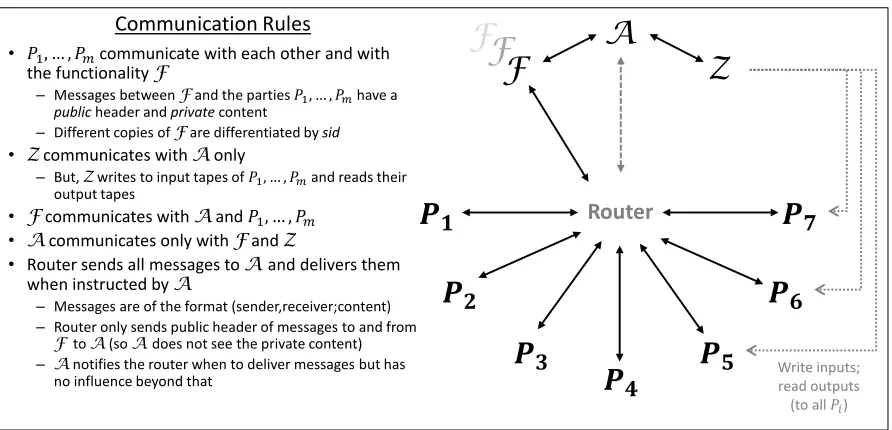
Communication. In each execution there is an environment Z, an adversary A, participating parties P1, . . . , Pm, and possibly an ideal functionality F. The parties, adversary and functional-ity are “connected” in a star configuration, where all communication is via an additional router machine that takes instructions from the adversary (see Figure 1). Formally, this means that the outgoing communication tape of each machine is connected to the incoming communication tape of the router, and the incoming communication tape of each machine is connected to the outgoing communication tape of the router. (For this to work, we define the router so that it has one incom-ing and one outgoincom-ing tape for every other entity in the network except the environment). As we have mentioned, the adversary has full control over the scheduling of all message delivery. Thus, whenever the router receives a message from a party it stores the message and forwards it to the adversary A. Then, whenever the adversary wishes to deliver a message, it sends it to the router who then checks that this message has been stored. If yes, it delivers the message to the designated recipient and erases it, thereby ensuring that every message is delivered only once. If no, the router just ignores the message. If the same message is sent more than once, then the router will store multiple copies and will erase one every time it is delivered.
Router
Z
F
𝑷
𝟏𝑷
𝟐𝑷
𝟒𝑷
𝟓𝑷
𝟕𝑷
𝟑𝑷
𝟔 Communication Rules• 𝑃1, … , 𝑃𝑚 communicate with each other and with
the functionality F
– Messages between F and the parties 𝑃1, … , 𝑃𝑚 have a
public header and private content
– Different copies of F are differentiated by sid
• Z communicates with A only
– But, Z writes to input tapes of 𝑃1, … , 𝑃𝑚 and reads their
output tapes
• F communicates with A and 𝑃1, … , 𝑃𝑚
• A communicates only with F and Z
• Router sends all messages to A and delivers them when instructed by A
– Messages are of the format (sender,receiver;content) – Router only sends public header of messages to and from
F to A (so A does not see the private content) – A notifies the router when to deliver messages but has
no influence beyond that
F
F
A
Write inputs; read outputs
(to all 𝑃𝑖)
Figure 1: The communication model and rules
con-vention, a message x from a party Pi to Pj will be of the form (Pi, Pj, x); after Pi writes this message to its outgoing communication tape, the router receives it and checks that the correct sending party identifierPi is written in the message; if yes, it stores it and works as above (sending only to the Pj designated in the message); if no, it ignores the message. Observe that this means thatPj also knows who sent the message to it.
In addition, we assume that the set of parties is fixed ahead of time and known to all.2
The above communication model is the same regarding the communication between the func-tionality F and the parties and adversary, with two differences. First, the different copies of F
are differentiated by a unique session identifier sidfor each copy. Specifically, each message sent to the ideal functionality has a session identifiersid. When, the “main ideal functionality” receives a message, it first checks if there exists a copy of the ideal functionality with that sid. If not, then it begins a new execution of the actual ideal functionality code with that sid, and executes the functionality on the given message. If a copy with that sid does already exist, then that copy is invoked with the message. Likewise, any message sent from a copy of the ideal functionality to a party is sent together with thesididentifying that copy.
The second difference is that any message between the parties and the ideal functionality is comprised of apublic headerandprivate content. The public header contains any information that is public and thus revealed to the adversary, whereas the private content contains information that the adversary is not supposed to learn. For example, in a standard two-party computation functionality whereF computesf(x, y) for some functionf (wherexisP1’s input andyisP2’s input), the inputs x and y sent by the parties toF are private. The output from F to the parties may be public or private, depending on whether this output is supposed to remain secret (say from an eavesdropping adversary between two honest parties) even after the computation.3 A more interesting example is the commitment functionality, in which the public header would also contain the message type (i.e., “commit” or “reveal”), since we typically do not try to hide whether the parties are running a commitment or decommitment protocol. Formally, upon receiving a message from a participating party Pi for the functionality or vice versa, the router forwards only the sender/receiver identities and thepublic header to the adversary; the private content is simply not sent.4
We stress that in the SUC framework, the adversary determines when to deliver a message from F to participating parties P1, . . . , Pm in the same way as between two participating parties. This is unlike the UC framework where the adversary has no such power. In the UC model ideal functionalities are invoked as subroutine machines, and the protocol parties of the main instance
communicate with the invokedsub-protocol machinedirectly via the input and output tapes, with-out passing through the adversary. Thus, in the class of functionalities that can be expressed in SUC is more restricted. Specifically, we cannot guarantee fairness in the SUC framework, nor model local computation via an ideal functionality (as is used to model digital signatures and public-key encryption in the UC framework).
Finally, the environment Z communicates with the adversary directly and not via the router. This is due to the fact that it cannot send messages to anyone apart from the adversary; this includes the ideal functionality F. However, differently to all other interaction between parties,
2Observe that in contrast to the full UC model, a protocol party here cannot write to the input tapes of other parties. All communication between protocol parties is via the router.
3If one of the parties is corrupted thenf(x, y) is always learned by the adversary. However, if both are honest, then it may or may not be learned depending on how one defines it.
4In order to formalize this, every ideal functionalityFhas an associated public-header functionH
F(x) that defines
the environment Z can write inputs to the honest parties’ input tapes and can read their output tapes (we do not call this “communication” in the same sense since it is not via the communication tapes). The adversary Aitself can send messages in the name of any corrupted party (see Section
2.4below), and can send messages toZ andF (the fact that itcan communicate with F is useful for relaxing functionalities to allow some adversarial influence; see [4,7]). The adversaryAcannot “directly” communicate with the participating parties.
Execution. An execution of a set of machines connected as above and communicating according to the above rules proceeds as follows. First, all machines are initialized to have the same value 1n on their security parameter tapes. Second, the environment is given an initial input z∈ {0,1}∗
and is the first to be “activated”.
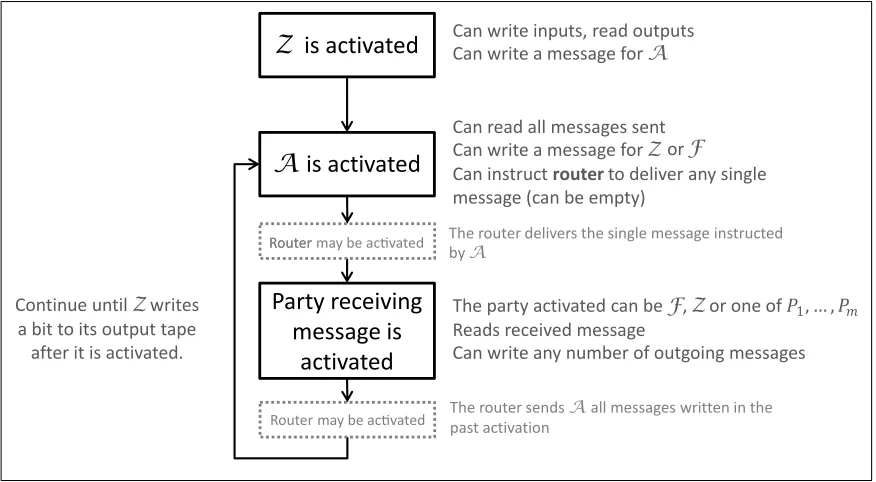
In the concurrent setting, and unlike the classic stand-alone setting for secure computation, there are no synchronous rounds in which all parties send messages, compute their next message, and then send it. Rather, the adversary is given full control over the scheduling of messages sent. In order to model this but still to have a well-defined execution model, an execution is modeled by a series of activations of machines one after another, where the order of activations is determined by the adversary. As we have stated, the environmentZ is activated first. In any activation of the environment, it may write to the input tapes of any of the participating parties P1, . . . , Pm that it wishes to, and read their output tapes. In addition, it can send a message to the adversary by writing on its outgoing communication tape. When it halts, the adversary is activated next. In any activation of the adversary, it may read all messages written to entities’ outgoing communication tapes (apart from the private content sent between a party andF), carry out any local computation, and write a message on its outgoing communication tape to Z. It then completes its activation by doing one of the following:
1. Instructing the router to deliver a message to any single party that it wishes (including messages between the parties andF). In this case the router is activated next to deliver the message. After the router has delivered the message the recipient party (or F) is activated.
2. Sending a direct message to F (this type of communication is not via the router). In this case F is activated next.
3. Sending a direct message to Z. In this case Z is activated next.
We stress that the ideal functionality has no input on its input tape and never writes to its output tape; it only communicates with the participating parties and the adversary.
Z
is activated
Can write inputs, read outputsCan write a message forAA
is activated
Can read all messages sent Can write a message forZ
Can instructrouterto deliver any single message (can be empty)
Party receiving
message is
activated
The party activated can beF,Zor one of𝑃1, … , 𝑃𝑚
Reads received message
Can write any number of outgoing messages Continue untilZwrites
a bit to its output tape after it is activated.
The router sendsAall messages written in the past activation
Router may be ac�vated The router delivers the single message instructedbyA Router
may be ac�vated Router
F
or
Figure 2: The execution flow and order of activations
2.4 Corruptions and Adversarial Power
As in the standard model of secure computation, the adversary is allowed to corrupt parties. In the case ofstatic adversaries the set of corrupted parties is fixed at the onset of the computation. In the adaptive case the adversary corrupts parties at will throughout the computation. In the static corruption case, the environment Z is given the set of corrupted parties at the onset of the computation. In the active corruption case, whenever the adversary corrupts a party,Z is notified of the corruption immediately. The adversary is allowed to corrupt parties whenever it is activated. (Formally, the adversary sends a (corrupt, Pi) message first toPi via the router, and Pi returns its full internal state to the adversary. Then, the adversary sends the corrupt message to Z who is activated at the end of the corruption sequence.)
We stress that unlike in the full UC model, here it is not possible to “partially corrupt” a party. Rather, if a party is corrupted, then the adversary learns everything. This means that we cannot model, for example, the forward security property of key exchange that states that if a party’s session key is stolen in one session, then this leaks nothing about its session key in a different session (since modeling this requires corrupting one session of the key exchange and not another). Also,proactive security cannot be modelled in SUC [10].
2.5 The Real, Ideal and Hybrid Models
We are now ready to define the real, ideal and hybrid models. These are all just special cases of the above communication and execution models:
• The real model with protocol π: In the real model, there is no ideal functionality and the (honest) parties send messages to each other according to the specified protocolπ. We denote the output bit of the environmentZ after a real execution of a protocol π with environment
Z and adversary Aby suc-realπ,A,Z(n, z), wherez is the input to Z and nis the security parameter.
• The ideal model with F: In the ideal model with F the parties follow a fixed ideal-model protocol. According to this protocol, the parties send messages only to the ideal functionality but never to each other. Furthermore, these messages are the inputs that they read from their input tapes, and nothing else (unless they are corrupted and the adversary is malicious, in which case they can send anything toF). In addition, they write any message received back from the ideal functionality to their output tapes. That is, the ideal-model protocol instructs a party upon activation to read any new input on its input tape and send it unmodified toF
as an outgoing message, and to read all incoming messages (fromF) on its incoming message tape and write them unmodified to its output tape. This then ends the party’s activation. We denote the output ofZ after an ideal execution with ideal functionalityF and adversary
S (denoted by S since it is actually a “simulator”) bysuc-idealF,S,Z(n, z), where nand z are as above. We stress that in the ideal model, the adversary/simulator S interacts with Z
in an online way; in particular, it cannot rewind Z or look at its internal state. In addition, in keeping with the general communication model all messages between the parties andF are delivered by the adversary.5
• The hybrid model withπandF: In the hybrid model, the parties follow the protocolπas in the real model. However, in addition to regular messages sent to other parties,π can instruct the parties to send messages to the ideal functionalityF and also instructs them how to process messages received fromF. We stress that the messages sent toF may be any values specified by π and are not limited to inputs like in the ideal model. We denote the output of Z from a hybrid execution of π with ideal calls toF by suc-hybridFπ,A,Z(n, z), whereA,Z, n, z are as above. WhenF is the ideal functionality we call this the F-hybrid model.
In all models, there is a fixed set of participating partiesP1, . . . , Pm, where each party has a unique party identifier. Observe that we formally consider a single ideal-functionality type F, and not
5
multiple different ones.6 This is not a limitation even though protocols often use multiple different subprotocols (e.g., commitment, zero knowledge, and oblivious transfer). This is because one can define a single functionality computing multiple subfunctionalities. Thus, formally we consider one. When defining protocols and proving security, it is customary to refer to multiple functionalities with the understanding that this is formally taken care of as described.
2.6 The Definition and Composition Theorem
We are now ready to define SUC security, and to state the composition theorem. Informally, security is defined as in the classic stand-alone definition of security by requiring the existence of an ideal-model simulator for every real-model adversary. However, in addition, the simulator must work for every environment, as in the aforementioned communication and execution models. The environment behaves as the interactive distinguisher, and therefore we say that a protocolπ SUC-securely computes a functionality if the environment outputs 1 with almost the same probability in a real execution ofπ withA as in an ideal execution withF and S. Recall that the suc-ideal
and suc-realnotation denotes the output ofZ after the respective executions.
Balanced Environments. A balanced environment is an environment for which at any point in time during the execution, the overall length of the inputs given to the parties of the main instance of the protocol is at most n times the length of the input to the adversary [7]. As in the full UC framework, we require balanced environments in order to prevent unnatural situations where the input length and communication complexity of the protocol is arbitrarily large relative to the input length and complexity of the adversary. In such case no PPT adversary can deliver even a fraction of the protocol communication. The definition of UC security considers only balanced environments, and we adopt this same convention.
Definition 2.2 Let π be a protocol for up tom parties and letF be an ideal functionality. We say that π SUC-securely computes F if for every probabilistic polynomial-time real-model adversary A
there exists a probabilistic polynomial-time ideal-model adversaryS such that for every probabilistic polynomial-time balanced environmentZ and every constantd∈N, there exists a negligible function µ(·) such that for every n∈N and every z∈ {0,1}∗ of length at most nd,
Pr[suc-idealF,S,Z(n, z) = 1]−Pr[suc-realπ,A,Z(n, z) = 1]
≤µ(n).
We remark that although Z is a uniform machine, since it receives an arbitrary zas input this essentially makes it non-uniform (zcan be viewed as advice and can be different for every n).
We now conclude by stating the composition theorem. Before formally stating it, we need to define what it means to replace the ideal calls to F in anF-hybrid protocol π with a subprotocol execution of some protocol ρ. Letπ be a protocol for theF-hybrid model, and let ρ be a protocol (that itself may be designed in a hybrid model for some other ideal functionality G). We define the protocolπρ as in [3] as follows: wheneverπ instructs a party to send a message (x) to F with identifiersid, the party inπρbegins an execution ofρwith input (x) and identifiersid. All messages received by the party that are intended for the copy ofρ with identifiersidare internally routed by the party to the appropriate copy of ρ. Finally, the output of the execution of ρ with identifiersid is interpreted by the party as the message received back fromF with identifiersidfrom the call in π. Formally, the above is defined by replacing the Turing machine code for sending a message toF
6
by the Turing machine code of ρ, and so on. Thus, all Turing machines π,ρ and πρ are standard Interactive Turing machines as defined above and πρ is derived from π by adding the code of ρ in place of messages sent to F. This is different than UC composition, where the subprotocol is invoked as separate ITMs. Keeping a fixed number of ITMs throughout the computation simplifies the model and allows us to use the simpler polynomial time definition.
In order for the composition theorem to hold, we need to make one limitation on the use of ideal calls. Specifically, letρbe a protocol that securely computes someF but is itself in the hybrid model with some ideal functionalityG (e.g.,ρ may be a zero-knowledge protocol that uses a commitment functionality, or a commitment protocol that uses a common reference string functionality). Then, we require that two different instances of protocolρcall different copies ofG. That is, the different instances of ρ must use different session identifiers for their calls to G. This can be enforced by a simple naming convention, as follows. The main protocol is given a session identifier sid. Then, each subprotocol of the protocol is given session identifiersidkssid, wheressidis a unique subsession identifier undersid. Thus, if a protocolπ with identifiersiduses two calls to an idealF, then the session identifiers ofF will be somesidkssid1andsidkssid2(withssid1 6=ssid2). Now, when replacing
F with a subprotocolρthat contains two calls toG, we have that the identifiers of the four copies of
G will be “sidkssid1kssid10”, “sidkssid1kssid02”,“sidkssid2kssid01”, and “sidkssid1kssid02”. Observe that ρ always concatenates the same two session identifiers ssid01 and ssid02. However, since different instances of ρ have different session identifiers, and these are concatenated, this ensures that all calls toG have unique identifiers. We stress thatρ is not required to call two different copies of G. Rather, what we require is that different copies of ρ call different copies of G (for however many copies each copy of ρ requires). When this requirement doesn’t hold, the composition theorem below doesn’t necessarily hold. However in that case the joint state composition theorem (JUC) may be applied [12].
The composition theorem states that if ρ SUC-securely computesF, thenπρ behaves just like π in the F-hybrid model. In particular, Z cannot distinguish the cases.
Theorem 2.3 Let π be a protocol for the F-hybrid model, and let ρ be a protocol that SUC-securely computes F in the G-hybrid model. Then, for every probabilistic polynomial-time real-model adversary A there exists a probabilistic polynomial-time ideal-model adversary S such that for every probabilistic polynomial-time environment Z there exists a negligible function µ(·) such that for every z∈ {0,1}∗ and every n∈
N,
Pr[suc-hybrid G
πρ,S,Z(n, z) = 1]−Pr[suc-hybridFπ,A,Z(n, z) = 1]
≤µ(n).
An important special case of the above theorem is where π SUC-securely computes a func-tionality H in the F-hybrid model. In this case, it follows that πρ SUC-securely computes H
in the G-hybrid model. Furthermore, if ρ SUC-securely computes F in the real model, then πρ SUC-securely computes Hin the real model. That is:
Corollary 2.4 Let π be a protocol that SUC-securely computes a functionality H in the F-hybrid model. If protocol ρ SUC-securely computes F in the G-hybrid (resp., real) model, then πρ SUC-securely computes H in the G-hybrid (resp., real) model.
theorem. This is achieved by providing a mapping from SUC protocols and ideal functionalities to corresponding UC protocols and ideal functionalities, and showing that a protocol SUC-securely realizes an ideal functionality if and only if its corresponding UC protocol UC realizes the corre-sponding ideal functionality in the full UC model. This suffices since the protocol and functionality can be mapped to the UC model. Then, UC composition is applied, and finally the composed pro-tocol is mapped back to the SUC model. We prove the first direction (that SUC security implies UC security of the corresponding protocol and ideal functionality) in Section 4; this direction is of independent interest since it shows that it suffices to prove security of a protocol in the SUC model in order to obtain security in the full UC model. The second direction (that UC security of the corresponding protocol and ideal functionality implies SUC security) is proven in Section 5.3.
We remark that it suffices in this work to prove Corollary 2.4, rather than the more general result of Theorem2.3. This is due to the fact that Corollary2.4suffices forconstructingprotocols in a modular way. Once a protocol that securely computes some functionality in the SUC framework is obtained, then Theorem 4.13(Section4) can be used to conclude that it is secure in the full UC model as well. Once this is derived, the general composition result of Theorem2.3can be obtained from the full UC model itself.
3
An Illustrative Example – Proving in the UC vs. SUC Models
Before proving the equivalence between the UC and SUC models, we demonstrate the difference between proving security in the full UC framework and in the SUC framework via a concrete example. We consider the classic commitment functionality Fcom, due to its relative simplicity. We also consider realizing theFzkfunctionality in theFcom-hybrid model, since existing protocols “gloss over” the details of using the composition theorem correctly.
3.1 Differences in Describing the Ideal Functionality for Commitments
Before describing the functionality, we need to introduce thedelayed output terminology, which is a convention that appears in the full UC framework. Quoting from [6, Sec. 6.2]:
More precisely, we say that an ideal functionality F sends a delayed output v to party P if it engages in the following interaction: Instead of simply outputtingv toP,F first sends to the adversary a message that it is ready to generate an output to P. If the output is public, then the value v is included in the message to the adversary. If the output is private then v is not mentioned in this message. Furthermore, the message contains a unique identifier that distinguishes it from all other messages sent by F to the adversary in this execution. When the adversary replies to the message (say, by echoing the unique identifier), F outputs the value v toP.
We now consider the definition of secure commitments. For simplicity, we consider the single
FIGURE 3.1 (Functionality Fcom for the Full UC Framework)
1. Upon receiving an input (Commit, sid, x) fromC, verify thatsid= (C, R, sid0) for someR, else ignore the input. Next, recordxand generate a public delayed output (Receipt, sid) to
R. Oncexis recorded, ignore any subsequentCommitinputs.
2. Upon receiving an input (Open, sid) fromC, proceed as follows: If there is a recorded value
xthen generate a public delayed output (Open, sid, x) toR. Otherwise, do nothing. 3. Upon receiving a message (Corrupt-committer, sid) from the adversary, output a Corrupted
value to C, and send x to the adversary. Furthermore, if the adversary now provides a valuex0, and theReceiptoutput was not yet written onR’s tape, then change the recorded value tox0.
The Ideal Commitment Functionality Fcom
In contrast, in the SUC framework the functionality description is far simpler. Before writing the functionality, we introduce a convention that was used in [11] for the public headers and private contents in functionalities. The “operation labels” (e.g., Commit, Receipt, etc.) and the session identifiers are by convention (and unless explicitly stated otherwise) part of the public header, and the rest of the message constitutes the private contents. In addition, we parameterize the functionality by somem= poly(n), which means that all commitment values are of lengthm. This is needed since SUC parties have a fixed polynomial running time, and so a receiver who does not receive input to the commitment functionality cannot process arbitrarily long strings. Note that all known UC commitment schemes work in this way (i.e., they are either commitments to bits, fixed-length strings, or group elements, etc.). Thus, this definition matches existing constructions.7 We have:
FIGURE 3.2 (Functionality Fcom for the SUC Framework) Fcom runs with length parameterm, as follows:
1. Upon receiving an input (Commit, sid, x) fromC, verify thatx∈ {0,1}m and that sid=
(C, R, sid0) for some R, else ignore the input. Next, record xand send (Receipt, sid) toR. Oncexis recorded, ignore any subsequentCommitinputs.
2. Upon receiving an input (Open, sid) fromC, proceed as follows: If there is a recorded value
xthen send (Open, sid, x) toR. Otherwise, do nothing.
The Ideal Commitment Functionality Fcom
FIGURE 3.3 (Functionality Fcom for the SUC Framework)
1. Upon receiving an input (Commit, sid, x) from C, verify that sid = (C, R, sid0) for some
R, else ignore the input. Next, recordxand send (Receipt, sid) to R. Once xis recorded, ignore any subsequentCommitinputs.
2. Upon receiving an input (Open, sid) fromC, proceed as follows: If there is a recorded value
xthen send (Open, sid, x) toR. Otherwise, do nothing.
The Ideal Commitment Functionality Fcom
7We remark that it is also possible to defineF
comso thatS inputsxandRinputs 1|x|. This ensures thatRcan
Explaining the differences between the functionalities. In the full UC framework, it is necessary to refer to public delayed outputs, since honest parties write their inputs locally to ideal functionalities; to be more exact, an ideal call is a subroutine invocation. Thus, in interactive scenarios, it is necessary for the ideal functionality to explicitly communicate with the adversary to ask permission to send the receipt, and so on. Due to the fact that this is tiresome to describe each time, the convention of a “delayed output” was introduced. In contrast, in the SUC framework, since the adversary automatically controls all delivery, it suffices to naturally send messages. However, this does come at the price of explicitly stating which parts of the messages are public (and seen by the adversary when it delivers) and which parts are private. Nevertheless, by our convention, this is typically simple.
A more significant difference arises in the context of corruption. In the full UC model, an ideal functionality is modeled as a subroutine of the main protocol instance. Therefore, parties “send” messages/inputs to an ideal functionalityF by writing them directly on the input tape ofF. This means that the adversary cannot change the contents of such a written message, even in the case that the party is corrupted before the input was effectively used. In real protocols, it is often possible for the adversary to make such a change. (For example, consider the case that the honest party sends its first message and is corrupted before it is delivered. In this case, the adversary can choose not to deliver that message and instead send a new message in its place for the corrupted party, possibly using a different input. Thus, this has to also be possible in the ideal model.) This forces such treatment to be explicitly defined in the ideal functionality. In contrast, in the SUC framework, this issue does not arise at all. This is because all messages, including inputs to an ideal functionality and messages in a real protocol, are treated in the same way and sent via the router. By the way the router is defined, an adversary can choose not to deliver messages to an ideal functionality in the same way that it can choose not to deliver messages in a real protocol.
3.2 Proving Security of Commitment Protocols and Zero Knowledge Protocols
In this section, we consider the problem of constructing UC commitments in the CRS model, and then zero knowledge protocols using UC commitments. This is the standard way of working; see [9,11], and see [13] for a more recent work following the same paradigm. The authors of [13] claim security of their zero knowledge protocol by referring to the proof of security of zero knowledge from commitments that appears in [9]. However, this proof is much closer to the SUC framework and does not take into account a number of issues that must be considered in the (current version of the) full UC model. We describesome of the additional issues that need to be taken into account in order to prove the full UC security of the zero knowledge protocol from full UC commitments. For the sake of concreteness, when considering polynomial time, we refer specifically to the constructions in [13].
Before proceeding, denote the commitment protocol of [13] by Πcom, the CRS functionality by Fcrs, and the zero knowledge protocol of [9,13] by Πzk. Protocol Πzk works by running the classic zero knowledge Hamiltonicity protocol of Blum [2], while using UC commitments. Actually, since many commitments are needed with respect to the same CRS, the multiple commitment functionalityFmcomis used but for simplicity we will ignore this here. Note that the commitment protocol Πcomin [13] uses a fully-homomorphic encryption scheme denote Qencand a CCA-secure encryption scheme ENCcca.
the protocols involved are polynomial time. The mentioned proofs do not formally prove that the protocols are polynomial time. In the SUC model, the fact that Πcom in [13] is polynomial time is immediate, and simply follows from the fact that the Qenc and ENCcca encryption schemes run in polynomial time (since in each invocation each party trivially runs in time that is polynomial in the security parameter and input; see Section 2.1for why this suffices in the SUC framework). However, in order to prove that Πcom in [13] is polynomial time in the full UC framework, one needs to first pad the input of each party in Πcom with sufficient tokens, so that it runs in time that is polynomial in the length of its (padded) input minus the length of the inputs/messages that it sends toFcrs. IfFcrs is assumed to be a local functionality (e.g., secure setup), then this is not difficult since the only input toFcrs is the pair (CRS, sid). However, ifFcrs is implemented via coin-tossing using a local Fcrs functionality (as suggested in the JUC [12] solution to achieving independent CRS invocations per protocol), then the number of tokens needed to be provided is different. Essentially, a differentFcrs ideal functionality has to be defined for each of these cases. (The reason that a different ideal functionality is needed is that the functionality defines the length of the input, which depends on the number of tokens needed.)
Consider next the case of constructing ΠzkusingFcom. These zero-knowledge protocols make multiple calls to the commitment functionality. The number of calls toFcom, and thus the length of the input written by the parties in Πzk toFcom, differs significantly when the zero-knowledge is based on Hamiltonicity versus when it is based on 3 coloring. The proof of polynomial-time complexity must take into account that for Hamiltonicity, for a graph with n nodes, O(n3) calls to Fcom are made (repeating n times where in each time a matrix of size O(n2) is committed to). However, the size of the graph depends on the Karp reduction of the statement being proven to Hamiltonicity, and this must also be counted. This bound must then be included in the ideal functionality forFcom, since the actual length of the input includes these tokens. Notice, however, that the number of tokens needed in 3 coloring will be different, and so the definition of Fcom
can actually depend on the implementation of Fzk as used by Πcom. To make this even more complex, if Fcom uses Fcrs as described above, then the number of tokens further depends on whether Fcrs is a local functionality or derived by some type of coin-tossing protocol.
We are not aware of any research paper whose focus is protocol construction that relates to the issue of defining the number of tokens–equivalently how much to pad the input–when defining the functionality, and proving that the protocol is polynomial time as defined in the full UC framework.
Subroutine Respecting Protocols. The UC composition theorem demands that protocols are subroutine respecting; see [6]. Informally speaking, this means that subroutines only accept messages from other parties or subsidiaries of the subroutine instance. In addition, upon the first activation, the adversary receives notification of the code and SID of the instance. Since these are messages sent to the adversary, they need to be dealt with by the adversary in the proof of security. To the best of our knowledge, the adversary’s treatment of these notifications are typically not described.
Order of activations. In the full UC framework, the order of activations depends on the adversary and on the protocol, and is derived from the order of external write calls made by the machines in the system. Each machine can only write one external message (be it input to a subroutine, output, or a regular message) per activation, and by writing the message it passes the execution to the receiving machine. This means that multiple invocation patterns are possible, yielding multiple case analyses in the proof. In addition, when writing the proof, one must distinguish between the different types of messages (writing to an ideal functionality is fundamentally different to sending a message to another party). Both of these complicate the presentation and make it harder for one writing the proof to be exact. In contrast, in the SUC model, one of our aims was to make the order of activations the same in all models (real, ideal and hybrid) and to use the same method for all types of messages. (The only exception is the parties’ inputs written by the environment and their outputs read by the environment.) Thus, the scheduling of activations and the terminology with respect to messages is always the same (under full control of the adversary), simplifying the presentation.
Conclusions – current UC research and UC/SUC proofs. We are not aware ofany written proof in the UC framework that actually takes these details into account. Rather, researchers writing protocols in the UC framework do not specify the number of tokens needed in order to be polynomial time (which is the most serious issue), do not describe what the adversary should do with invocation messages, do not consider the varying order of activations, and so on. Es-sentially, researchers today write their proofs as if they are working in something similar to the SUC framework. The main contribution of this paper can therefore be viewed as ajustification of the soundness of working in this way. In addition, we provide an exact model that can be used, instead of handwaving away the full UC details. Finally, our proof that SUC protocols are actu-ally UC secure (with the appropriate adjustments) means that for the standard interactive secure computation tasks, nothing is lost by working with our simpler model.
4
Proving that SUC-Secure Protocols are UC Secure
In this section, we show that any protocol that is secure in the SUC model is also secure in the full UC model. Stating this formally is non-trivial since there are technical differences between the models, as described below. A priori, the UC adversary seems more powerful than the SUC adversary, but we will show that this is in fact not the case, and we can simulate any UC adversary via an SUC adversary. The formal theorem statement is given in Theorem 4.13 in Section 4.3. It states that an appropriately transformed SUC protocol UC realizes an appropriately transformed ideal functionality, where the main difference between the SUC ideal functionality and its trans-formed counterpart is related to the adversary’s capability to determine when inputs are processed and when outputs are delivered. This capability is built into the SUC framework but not the UC framework; thus the capability must be added to the UC ideal functionality (via a mechanism similar to the delayed output methodology described in [7]).
4.1 Overview
under the full definition appearing in [4, 7]. This implies that we do not need to reprove the UC composition theorem, as it is implied by the proof in [4,7]. In addition, protocols proven secure in this model can be easily incorporated into constructions in the full UC model, if desired. Of course, some adjustments to the protocol must be made in order to accommodate the differences between the models; these are made in the aforementioned transformation on the code of the protocol. Before the required adjustments are presented, we discuss the differences in detail.
Runtime complexity: The notion of polynomial-time in the full UC framework needs a way to ensure that it is not possible to invoke machines infinitely and still be considered “polynomial time”. The p-bounded definition prevents this by regarding the bits on the input tape as “run tokens” (nI), and making a machine pay nO tokens every time it writes an input of length nO to another machine. Each machine is allowed to run p(˜n) steps, where p(·) is a polynomial and ˜
n=nI−nO is the number of tokens that were not given to other machines. In [7] it is shown that this mechanism preserves a polynomial bound even with the ability to invoke other machines. It is not immediate that an SUC protocol that runs in polynomial time will run in polynomial time by the full UC definitions. Nonetheless, we will prove that is it indeed possible to transform an SUC protocol to a UC protocol and preserve polynomial time.
Authentication of messages: The SUC model assumes authenticated channels of communi-cation between participating parties; this is not assumed in the full UC framework. The Fauth
functionality that implements authenticated channels in the UC environment is used to bridge this difference.
Communication model: There are a few differences in the rules regarding the communication between machines in both models. We list them here.
In the SUC model, the adversary controls the flow of messages between machines using the router. The messages between protocol parties and also between parties and ideal functionalities are transferred via the router. For each incoming message, the router delivers the message only after being instructed to do so by the adversary. The only exception is messages between the environment and the adversary; these are transferred directly. Message delivery is carried out by the router in the following manner. First the router sends the message public header to the adversary, and keeps the original message inside a queue. If the adversary sends a header to the router, the router checks if a message with the same header exists in the outgoing queue, and if it finds such message, it sends the message to the designated recipient.
!
!
!!
!
!
!
!
!
!
!
!!"#$%!!SUC
UC
!
!
!
!
!
!
!
!
!
!
!!
!
!!
…!
!
!!
Pr
ov
id
es
!in
pu
ts
!
Communicates!via! input/output!tapes!
!
!!
!
!!
…!
!
!!
Communicates!via! in/out!comm!tapes!
Pr
ov
id
es
!in
pu
ts
!
Figure 3: Differences in the communication models
In the SUC model the adversary and environment communicate via theincoming/outgoing com-munication tapes. In contrast, in the UC model the adversary and the environment communicate via their input/output tapes. Specifically, the environment provides input for the adversary and reads its output.8
Observe that since we emulate the authentication of messages in the UC model using the Fauth
ideal functionality, the messages between protocol parties are not transferred via the adversary. However, the Fauth functionality itself asks permission from the adversary to process inputs and return outputs to the parties. Thus, the effect is the same as in the SUC model. This enables us to overcome the main difference regarding the communication flow.
4.2 General Transformation of ITMs
We will first show how to transform Interactive Turing Machines from the SUC model to ITMs as described in the definition of the full UC model.
4.2.1 Run-Time Transformation
Before we present the basic transformation of machines from the SUC model to the UC model, we provide the idea behind its design. First, the transformation works on the code tape of machine M and not on the ITM M itself. That is, a machine in the SUC model has different tapes from a machine in the UC model. Instead of copying data between different tapes (let’s say, copy the content of the security tape of the original machine to the beginning of the input tape of the converted machine) we simply initialize a new machine M0 ∈IT MU C with a modified version of the code of M. This works because in the full UC model ITMs are invoked dynamically, and the way to invoke a new machine with code CM and inputxis by issuing an external write instruction external-write(µ, x) whereµ:= (CM, id) is the identity string corresponding to the new machine.
8
Second,M0 applies an input check in order to ensure a polynomial bound on its runtime. The original machine is polynomial in the security parameter n and inputs x1, . . . , x`. The problem is that the runtime complexity of a UC machine is measured differently as mentioned in section (4.1), and must be polynomial in ˜n=nI−nO. We generally cannot control nO since it depends on the code of machine M. We therefore increasenI artificially by providing longer input to each machine. We then encapsulate the original code (known to be bounded inq(P`
i=1|xj|+n) steps) in a separate section of the converted code calledthe core. We also add a new section to the code called the shell. The shell preprocesses the inputs x01, . . . , x0` of the converted machine, derives new (effective) inputs x1, . . . , x`, and passes them to the core for actual processing.
Definition 4.1 Let CM ∈ {0,1}∗ be the code tape of a universal Interactive Turing Machine M ∈ P P TSU C, and let q(·) be the polynomial bounding the run time of M (i.e. on inputs x1, . . . , x` and security parameter n, M performs at most q(P`
i=1|xi|+n) steps). We define the runtime transformationTR:{0,1}∗×Z[x]→ {0,1}∗ in the following manner. TR(·)receives for input a code tape CM of machine M in the SUC model and a polynomial q ∈Z[x], and generates the code CM0 of machineM0 in the full UC model, as follows:
• Upon receiving theith input from the environment:
1. TR(CM) checks that x0i = (1ki,0, xi) for some ki∈N.
2. TR(CM) checks that Pi
j=1kj =q
Pi
j=1|xj|+n
.9
3. If yes to both, thenTR(CM)saves inputxifor future processing and immediately activates the environment (with an empty external write). Otherwise, TR(CM) halts.
• On its next activation TR(CM) runs the codeCM on input xi.
The machineM0 that runs the codeTR(CM)is called thecorrelated UC machine of M, and we denote TR(M) by M0.
Explanation of the transformation:
• For each input x0i,M0 performs the following checks:
1. First, M0 checks that the input begins with an unary string of arbitrary sizeki (called the token extension of the ith input), followed by a zero, followed by another arbitrary stringxi (called theith effective input). The token extension part is needed for the input check (the shell) while the effective input part is transferred as is to the original code (the core).
2. M0 checks that the total number of token extension bits received until now is enough to guarantee that it runs in time that is polynomial in ˜n. The token extensions ki are used to increase nI without increasing nO as well.
• If these checks passes, xi constitutes a valid input and should be processed. However, this input is only processed on the next activation. This is because in SUC, when the environment
9It is possible to relax this condition so thatPi
j=1kj≥q(Pii=1|xj|+n) as long asPji=1kj=O(q(Pii=1|xj|+n)).
Z writes input to a protocol party, this does not complete its activation. In addition, the adversary is always activated immediately after the environment in the SUC framework. In contrast, in the UC framework each input constitutes an external write and by definition causes the activation of Z0 to end, and the party receiving the input is then activated. In order to to simulate the SUC behaviour in UC we force the UC protocol parties to return the control to the environment before processing the input.
Our first result shows that the basic code transformationTR(·) preserves the runtime complexity of polynomial-time machines.
Lemma 4.2 Let M ∈ P P TSU C be a polynomial-time ITM in the SUC model, and let CM be the code tape of M. Then machine M0 ∈IT MU C that runs the code TR(CM) is locally p-bounded for some polynomial p(·) in the full UC model.
Proof: In order to prove thatM0 is locallyp-bounded for some polynomialp(·), we need to show that at any point during an execution ofM0, the overall number of computational steps is at most p(˜n) where ˜n=nI−nO,nI is the overall number of bits written so far onM0 input tape, andnO is the number of bits written by M so far to input tapes of ITM instances.
We begin by determining the size of ˜n. We know thatM runs in polynomial time and is bounded by q(·). Assuming the security parameter is n and that M already received ` reactive inputs x1, . . . , x`, the amount of steps made by M is at most q(
P`
j=1|xj|+n). The core of M0 runs the same number of steps asM, and so the maximum number of bits passed as input to other machines is alsoq(P`
j=1|xj|+n). The shell itself does not write on other machines’ input tapes, and so does not lose tokens. Hence,nO≤q(P`j=1|xj|+n). The input ofM0is of sizenI=n+P`j=1|xj|+P`j=1kj.
Now, in every invocation the shell checks thatP`
j=1kj =q
P`
j=1|xj|+n
, which is equivalent to
verifying that P`
j=1kj−nO ≥0. Hence, we can conclude that for`reactive inputs:
˜
n=nI−nO=n+ ` X
j=1
|xj|+ ` X
j=1
kj −nO≥n+ ` X
j=1
|xj|
where the inequality follows from the assumption that P`
j=1kj −nO ≥ 0 (since otherwise the machine halts immediately).
It remains to show that M0 runs in time p(˜n) for some polynomial p. For each new reactive input, the shell performs an input check on the input tape; this check evaluates the polynomial q(·) on the effective inputs, and is therefore quadratic in the size of the input tapenI. Regarding the runtime of the core,M0 simply runsM (for simplicity we assume that this simulation ofM by M0 is quadratic in the runtime ofM). We denote bysteps(M0) the total number of steps made by M0 and bystepsi(M0) the steps made in the ith invocation (when receiving the ith input). Since `≤Σ`
j=1|xj|+n≤n˜ we have:
steps(M0) = ` X
i=1
stepsi(shell(M0)) +stepsi(core(M0))
= ` X i=1
n+ i X
j=1
|xj|+q n+ Σij=1|xj|
2
+q2 n+ Σij=1|xj|