Research on an SVM Coupling Algorithm of Image
recognition
Ai-Min Yang1, Yang Han1, Jin-Ze Li2, Yu-hang Pan1, Lei-Jie Shen1, Yan Long1and Yu-Zhu Zhang3,*
1 Hebei Key Laboratory of Data Science and Applications, North China University of Science and
Technology; [email protected]
2 College of Grassland and Environment Sciences, Xinjiang Agricultural University; [email protected]
3 Ministry of Education, Key Laboratory with Modern Metallurgical Technology, North China University of
Science and Technology; [email protected]
* Correspondence: [email protected]; Tel.: +1-863-316-8516
† Current address: North China University of Science and Technology, Tangshan, 063000,China ‡ These authors contributed equally to this work.
Abstract:The key links of face recognition are digital image preprocessing, facial feature extraction and pattern recognition, this article aimed at the current problem of slow speed and low recognition accuracy of face recognition , from the above three key links, on the basic of analyzing the therories of Fractional Differential Masks Operator (FDMO), Principal Component Analysis (PCA) and Support Vector Machine (SVM), design a kind of FDMO+PVA+SVM coupling algorithm that applies to face recognition to improve the speed and accuracy of it. To realize FDMO+PCA+SVM coupling algorithm, first, we should apply FDMO to face image processing binary marginalization, the purpose is getting face contour; Then, we apply PCA to get the feature of face image which is disposed by binary marainalization. At last, we can apply One-Against All of the SVM classifier and LibSVM software package to realize face recognition. Beside, the article with nine different coupling algorithm design four groups of experimental reaults on the ORL face database verified by comparative analysic FDMO+PCA+SVM coupling algorithm in the superiority of face recognition accuracy and speed.
Keywords:Face Recognition; Intelligent Coupling Algorithm; Robustnes; Accuracy; Speed
1. Introduction
algorithm, and formulated the fractional order differential mask and the algorithm of image texture enhancement; Mathieu B, et al [5] (2015) found that the common integer order differential edge detection operator can not keep the details of the image texture. He replaced the first derivative with 0-1 Order Fractional Differential and constructed three new operators for image edge detection. This study used non integer order differential G-L definition and combine with Parabolic edge detection method [6] is proposed for edge extraction of fractional differential mask operator, in order to lay a basis on face digital image preprocessing and image feature extraction. Support Vector Machine (SVM) [7] is developed in recent years in the field of statistical learning theory based on a new pattern recognition method.It can be used to solve the problem of small sample, nonlinear and high dimensional pattern recognition,show many unique advantages, and applied to the function fitting to other machine learning problems [8] .At present, SVM has become a hot research topic in the field of machine learning. It has been widely used in trend analysis, remote sensing image classification and pattern recognition, and so on.Including: the Zhi-feng Li,etc [9] (2007) using support vector machine (SVM) enhancement method based on Bayesian face recognition performance.Even though the method required less training samples, but the accuracy is not ideal;Shu Shuang Bao, etc [10] (2011) using a metric component analysis feature extraction and support vector machine to realize the multi class classification method for face recognition;Yang Yongqiang [11] (2015) proposed a new way of combining a discrete cosine transform with support vector machine (SVM) method for face recognition, reduce the time of face recognition, and improve the efficiency of identification.On the basis of studying a large number of documents, the writer prefers to regard the support vector machine as the classifier, which is used for face recognition. Yang Yongqiang proposed a new way of combining a discrete cosine transform with support vector machine (SVM) method for face recognition, reduce the time of face recognition, and improve the efficiency of identification.On the basis of studying a large number of documents, the writer prefers to regard the support vector machine as the classifier, which is used for face recognition.
2. Theoretical Basis
2.1. Fractional Differential Masks Operator
The fractional differential theory is applied to the digital image edge extraction and strengthen the high if the edge and texture information signal has a significant effect. Therefore, fractional differential for edge detection can effectively extract with high signal to noise ratio of the image edge and texture information [12]. In this study, based on the definition of non integer order differential G-L and the method of parabolic edge detection, this paper proposes a fractional differential mask operator for digital image edge detection based on [13]. G-L fractional order differential expression see formula (1), among them:α ∈ (0, 1), h expresses as differential step length(h = 1), expresses Gamma function,tandarespectively expresses the upper and lower bounds of the fractional order differential.
G
aDtαf(t) =lim h→0
1 hα
[t−a h ]
∑
m=0
(−1)m×m!Γ(α−m+1)
Γ(α+1) f(t−mh) (1)
From formula (1), differential expression (2) of theαorder differential of a one-dimensional signal f(t)can be obtained:
dtα
dαf(t) ≈ f(t) + (−α)f(t−1) +...+
m!Γ(−α+m+1)
Γ(−α+1) f(t−m) (2)
A one dimensional edge detection operator is constructed:
(
(+am, ...,+a1,+a0,−a0,−a1, ...−am) am= (−1)m α
m
= (−1)m m!
α(α−1)...(α−m+1)
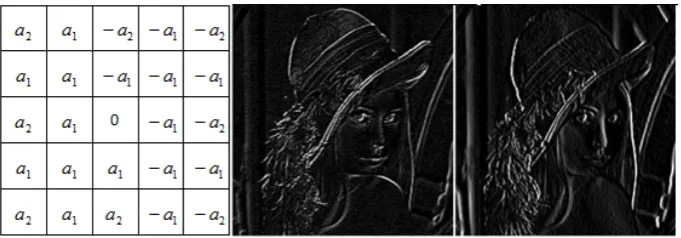
In order to construct a fractional order differential edge detection operator mask with rotation invariance for two-dimensional digital image f(x,y), using 0,π/8,π/4, 3π/8,π/2, 5π/8, 3π/4, 7π/8 and the edge detection operator in 16 directions, at the same time using the 5×5 size of the windoww, the mask is shown in Figure 1-a, the output of the edge imageg(x,y)can be expressed as a discrete convolution (4) as shown in the form:
g(x,y) =
2
∑
s=−2 2
∑
t=−2
f(x+s,y+t)w(s,t) (4)
When testing image edge, the threshold is selected according to the characteristics of the image. By design of the mask can be seen, the mask coefficient and 0, so the convolution of the pixels in the smooth regions response to 0, and the high-frequency edge and texture details but very sensitive, can be keen to capture the texture changes, rich texture edge can be extracted, at the same time the mask mode does not significantly increase the computational complexity. In this study, the image gray level is divided into 256, respectively using the Sobel operator and the designed fractional order differential edge detection operator (α=0) to MATLAB image processing with the edge of the image Lena image to extract, the results are shown in Figure 1-b and Figure 1-c. From the vision, Mask operator detection effect obviously is better, fractional differential edge detection operator is superior to other methods in extracting texture details on.
Figure 1.(1-a) Detection template; (1-b) Sobel operator detection effect; (1-c)FDMO operator detection effect
2.2. Facial Feature Extraction Based on PCA
PCA is principal component analysis, the method is an effective method to analyze the data in statistics, first proposed by Turk and Pentland [11], its basis is the Karhunen-Loeve transform (that is, K-L transform). Using K-L transform, a low dimensional subspace is used to describe the face image, and it can be used to identify the important information. Using the training sample to set as a general walk matrix to generate the matrix of feature vectors, that is:
St= 1
N N
∑
n=1
(Γn−Ψ)(Γn−Ψ)T (5)
2.3. Support Vector Machine (SVM)
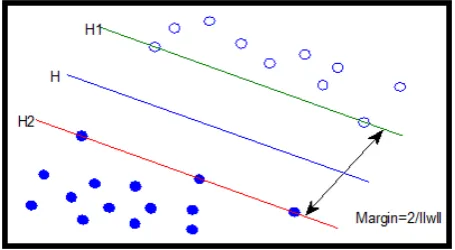
If all vectors in the training set could be correctly divided by a hyperplane and the spacing between heterogeneous being nearest to the hyperplane is maximum, the hyperplane shall be deemed as optimal hyperplane [14]. Heterogeneous vectors being nearest to the hyperplane are called as support vectors (SV), a group of support vectors can uniquely identify a hyperplane. SVM evolves from the optimal classification plane under linearly separable conditions, which basic principle can be shown in Figure 2. The solid points and hollow points represent two kinds of samples. H is the classification hyperplane between them, H1 and H2 are the samples being nearest to classification hyperplane, and parallel to classification hyperplane. The distance between them is called as margin.
Figure 2.Basic principles of SVM
Assuming the linearly separable set of samples is(xi,yi),i=1, 2, ...,n;x∈Rd,u∈+1,−1 is class label; in d-dimensional space, the general form of linear discriminant function isg(x) =w·x+b, then the classification hyperplane equation is . The discriminant function is normalized, and thus all two types of samples meet the condition
g(x)
≥ 1. Even if g(x)
= 1 for the sample being nearest to classification hyperplane, this classification margin is equivalent to 2
ω
. Therefore, the margin
maximum is equivalent to ω
2
minimum. If the classification hyperplane is required to correctly classify all the samples, the equation (6) shall be satisfied:
yi[(w·xi)]−1≥0,i=1, 2, ...,n (6)
Therefore, if satisfying the equation (6) and enabling ω
2
to be minimized, such the hyperplane shall be the optimal classification hyperplane. If the training samples are nearest to the classification hyperplane, and parallel to hyperplanes H1 and H2 in the optimal classification hyperplane [15], they should be able to enable the equation (6) to be equal, and they are called SV. In linear separable case, the optimal hyperplane problem under structural risk minimization is considered as an optimization
problem where objective function is to minimizeΦ(ω) = 12 ω 2
.Therefore, it is available to define as Lagrange function as shown in equation (7) below, in the equationai ≥ 0 is Lagrange coefficient corresponding to each sample.
L(ω,b,a) = 1
2 ω 2 − n
∑
i=1
aiyi(w·xi+bi) + n
∑
i=1
ai (7)
When the solving equation (7) is minimized, variational function seeks partial derivative to and , and make them to be equal to 0; then it is available to transfer optimal classification hyperplane problem into simple dual problem, namely solvingαiin case of the maximum value of the function as shown in equation (3) under the constraint conditions∑n
the weight coefficient vector of optimal classification hyperplane is a linear combination of support vectors in training samples.
Q(α) = n
∑
i=1 αi−1
2 n
∑
i,j=1
αiαjyiyj(xi·xj) (8)
According to the functional theory, as long as a kernel functionK(xi,xj)satisfies Mercer condition, it will correspond to inner product in a transformation space [15-18]. Mercer condition specifies: any symmetric functionK(xi,xj)is a necessary and sufficient condition for inner product operation in a feature space; as for anyϕ(x)6=0 andR ϕ2(x)dx<∞, the equation (9) is established as follows:
Z Z
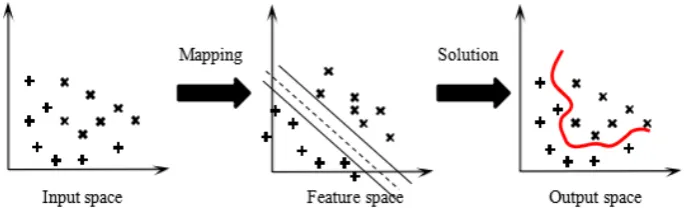
K(x,x0)ϕ(x0)dxdx0≥0 (9) SVM classification function is a set of linear combinations of nonlinear functions with support vectors as parameters. The SVM classification function only related to the number of SVM, and has nothing to do with the space dimensions. Therefore, even if the dimension of the space changes increase a lot, but the optimal classification function does not increase too much time complexity. The working principle of dealing with nonlinear SVM as shown in Figure 3:
Figure 3.The solution of SVM to nonlinear problems
By as shown in type (10) function expressions of support vector machine, shows that the SVM through the inner integral kernel function the original low dimensional space transform to the new high dimension space, and classification of SVM discriminant relate only to be recognition of the sample and the training samples of the support vector.
f(x) =sgn(w∗·x+b) =sgn(
n
∑
i=1
αi∗yiK(xi·x) +b∗) (10)
Using the kernel function included [16]: linear kernel function K(xi,xj) = xTixj , Polynomial inner product function K(xi,xj) = γxTi xj+rd,γ > 0, radial basis kernel function K(xi,xj) = e−γ
xi−xj
2
,γ > 0, sigmoid functionK(xi,xj) = tanh(γxTi xj+r). In this paper, the application of kernel function is radial basis kernel function.
3. Coupling Algorithm Design
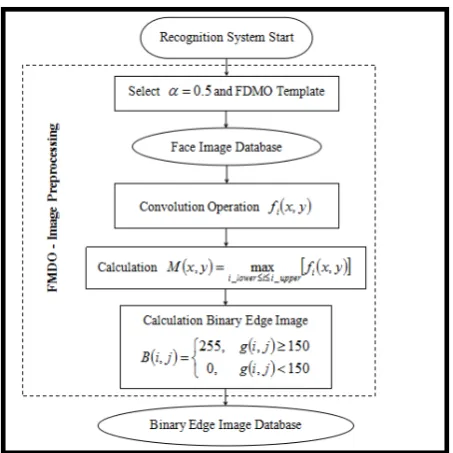
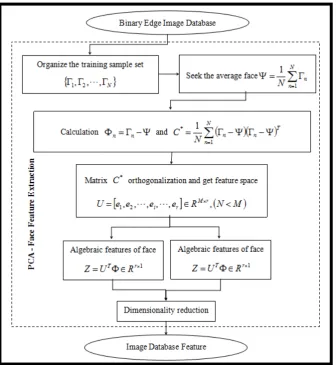
algorithm process of binary edge manage of face feature that based on the measure of FMDO. As shown in Figure 4.
Figure 4.The algorithm process of binary edge manage of face feature that based on the measure of FMDO
Figure 5.Calculating Process of "Eigenfaces"
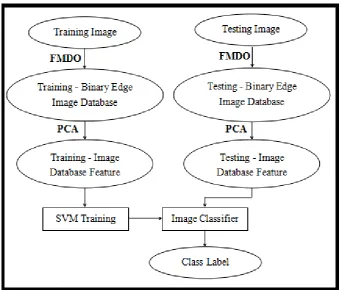
Figure 6.The face recognition algorithm process that based on the coupling of FMDO+PCA+SVM
4. Experiment Design and Result Analysis
4.1. Experiment Design
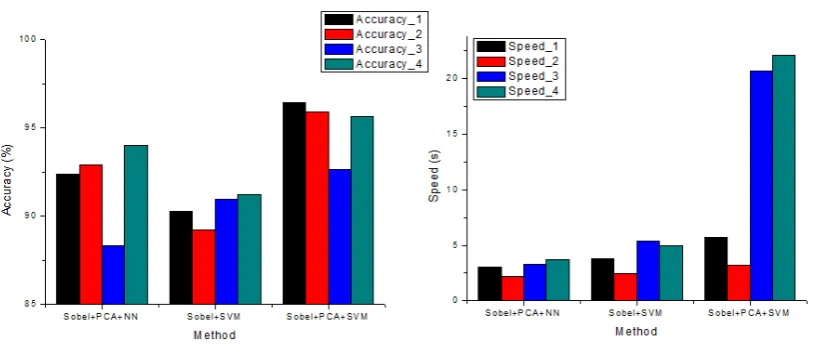
This experiment is carried out on the ORL face database,The ORL database is the University of Cambridge in the United Kingdom AT and T labs acquisition, contains 40 person, 10 images per person, per image to 256 grayscale, 92×112 pixels, in different time, different expressions, different illumination and obtained under different attitude can reaction with a different face image changes and differences.Experiments using ORL face database in each of the first 5 images, different people’s total of 200 images, 20×8 face used to train, 20×2 face to identify. The SVM classifier in the experiment chooses the same design parameters and classification strategies, which include the penalty factor C = 1,γ = 2, and the classification strategy for the OAA method.The recognition algorithm is based on PCA+NN, SVM and PCA+SVM. The nine algorithms in Table 1 are designed to verify the superiority of FDMO+PCA+SVM algorithm. The experimental procedure is as follows: 1) Number of identification algorithm, the number of the table as shown in table 1.
Table 1.The table of recognition algorithm of number.
Number Method Number Method Number Method
1 PCA+NN 4 Sobel+PCA+NN 7 FDMO+PCA+NN
2 SVM 5 Sobel+SVM 8 FDMO+SVM
3 PCA+SVM 6 Sobel+PCA+SVM 9 FDMO+PCA+SVM
sample are 200. 3)Four experiments were carried out using 9 kinds of recognition algorithms in Table 1, then the recognition accuracy and recognition speed were recorded.
4.2. Results and Analysis of Binary Edge Processing of Face Image
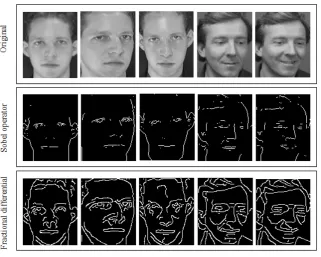
The edge image has better robustness to illumination.In order to reduce the computation time, the fractional differential mask operator is used to extract the edge of the face image, and binarization image edge.Mask operator is shown in Figure 7,Among them:α = 0.5 the fractional order.The fractional order differential of the gray image f convolution operation, the imagewill be enhanced,and select the gray value 150 as the threshold, and threshold value the two edge image
B(i,j) = (
255 ifg(i,j)≥150 0 ifg(i,j)<150.
Figure 7.Operator FDMO based on fractional differential
Figure 8.The partial face images and their binary edge images on ORL face database
is prominent, the edge details are clear, which can eliminate the influence of illumination and facial expression changes, and has strong robustness.
4.3. Face Recognition Result Analysis
Face recognition results are shown in table 2:
Table 2.The comparsion result of recognition accuracy and speed.
Method Acuracy-1 Speed-1 Acuracy-2 Speed-2 Acuracy-3 Speed-3 Acuracy-4 Speed-4
1 90.00 1.235 92.00 0.984 80.36 2.906 88.00 2.484
2 85.71 3.750 85.71 3.422 78.93 12.328 84.00 11.000
3 94.29 11.860 92.00 6.814 81.10 57.334 85.00 44.093
4 92.37 3.017 92.89 2.157 88.33 3.259 94.02 3.735
5 90.25 3.825 89.23 2.474 90.95 5.373 91.21 4.911
6 96.44 5.723 95.91 3.219 92.66 20.715 95.62 22.105
7 93.75 2.530 94.01 2.033 90.91 2.715 92.12 3.153
8 96.92 2.151 95.43 2.421 95.01 3.711 95.75 3.517
9 99.82 2.985 99.21 3.105 98.92 4.426 99.02 6.092
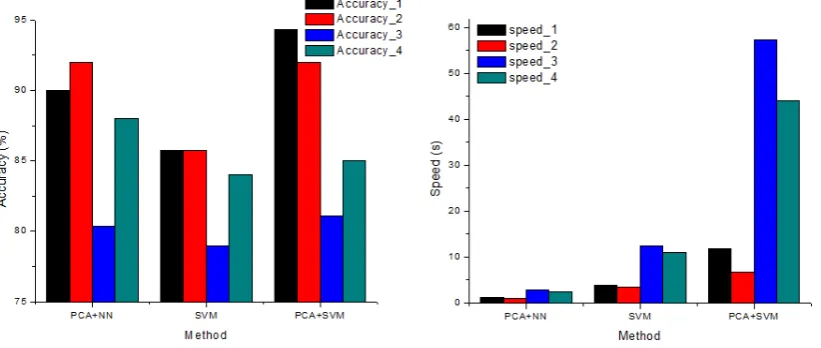
As shown in Figure 9, PCA+NN, SVM, PCA+SVM algorithm four times the results of the experiment:
Figure 9.The comparison of four experimental results in PCA+NN, SVM, PCA+SVM
Figure 10. Comparison of four experimental results in Sobel+PCA+NN, Sobel+SVM, Sobel+PCA+SVM
Figure 11. Comparison of four experimental results in FDMO+PCA+NN, FDMO+SVM, FDMO+PCA+SVM
5. Discussion
Acknowledgments: This work was supported by National Key Research and Development Program (no.2016YFB0601403) and the National Natural Science Foundation of Hebei Education Department (no. QN2016088).
Author Contributions:The idea of this study is proposed by Ai-Min Yang, Yang Han and Yu-Zhu Zhang. Jin-Ze Li, Yu-Hang Pan, Lei-Jie Shen and Yan Long for testing and data analysis. Ai-Min Yang and Yang Han to carry out the design and writing of the paper.
Conflicts of Interest:The authors declare no conflict of interest.
References
1. De Marsico M; Nappi M; Riccio D. FARO: FAce Recognition Against Occlusions and Expression Variations.
IEEE Transactions on Systems Man and Cybernetics Part A Systems and Humans2010,40, 121-132.
2. Sellahewa H; Jassim S. Image-Quality-Based Adaptive Face Recognition. IEEE Transactions on Instrumentation and Measurement2010,59, 805-813.
3. Choi S I; Jeong G M . Shadow Compensation Using Fourier Analysis With Application to Face Recognition.
IEEE Signal Processing Letters2011,18, 23-26.
4. Hu F Y; Si S H; Zhang Y N; Sun J Q. Multi-bilateral filtering algorithm based on adaptive fractional order differentiation.JOURAL OF IMAGE AND GRAPHICS2013,18, 1237-1246.
5. Mathieu B; Melchior P; Oustaloup A. Fractional differentiation for edge detection. Signal Processing2003,
83, 2421-2432.
6. Wright J; Ma Y; Mairal J. Sparse Representation for Computer Vision and Pattern Recognition.Proceedings of the IEEE2010,98, 1031-1044.
7. Wright J; Ma Y; Mairal J. Sparse Representation for Computer Vision and Pattern Recognition.Encyclopedia of the Sciences of Learning2010,41, 3185-3185.
8. Jian G; Huang J; Qin Q. Face Detection Based on Hierarchical Support Vector Machines. Computer Engineering2005,31, 181-183.
9. Li Z F; Tang X O. Using Support vector machines to enhance the performance of bayesian face recognition .IEEE Transactions on Information Forensics and Security2007,02, 174-180.
10. Shu S B; Luo J R; Xu C D; Sun B X. A New Method of Face Recognition Base on Support Vector Machine.
Computer simulation2011,28, 280-283.
11. Yang Y Q. Face Recognition Based on Fusing Discrete Cosine Transform and Support Vector Machine.
Computer Applications and Software2015,32, 150-154.
12. Chen M J; Huang C H; Lee W L. A fast edge-oriented algorithm for image interpolation.Image and Vision Computing2005,23, 791-798.
13. Horn R A; Johnson C R. Matrix Analysis. A fast edge-oriented algorithm for image interpolation.University of Alberta.downloaded on December at from IEEE Xplore.restrictions Apply1985, 1-17.
14. Rodrigues D; Freitas A C; Pereira L. Chemical composition of red, brown and green macroalgae from Buarcos bay in Central West Coast of Portugal.Food Chemistry2015,183197-207.
15. Shi Z; Han M. Support Vector Echo-State Machine for Chaotic Time-Series Prediction.IEEE Transactions on Neural Networks2007,18359-372.
16. Lin M; Zhang L; Jin R. Online kernel learning with nearly constant support vectors. Neurocomputing 2015,17926-36.
c