Higher-Order Threshold Implementations
Beg¨ul Bilgin1,2, Benedikt Gierlichs1, Svetla Nikova1, Ventzislav Nikov3, and Vincent Rijmen1
1
KU Leuven, ESAT-COSIC and iMinds, Belgium {name.surname}@esat.kuleuven.be
2 University of Twente, EEMCS-SCS, The Netherlands 3
NXP Semiconductors, [email protected]
Abstract. Higher-order differential power analysis attacks are a seri-ous threat for cryptographic hardware implementations. In particular, glitches in the circuit make it hard to protect the implementation with masking. The existing higher-order masking countermeasures that guar-antee security in the presence of glitches use multi-party computation techniques and require a lot of resources in terms of circuit area and randomness. The Threshold Implementation method is also based on multi-party computation but it is more area and randomness efficient. Moreover, it typically requires less clock-cycles since all parties can op-erate simultaneously. However, so far it is only provable secure against 1st-order DPA. We address this gap and extend the Threshold Implemen-tation technique to higher orders. We define generic constructions and prove their security. To illustrate the approach, we provide 1st, 2nd and 3rd-order DPA-resistant implementations of the block cipher
KATAN-32. Our analysis of 300 million power traces measured from an FPGA implementation supports the security proofs.
1
Introduction
Differential power analysis (DPA) attacks as introduced by Kocher et al. [19] ex-ploit unintentional information leakage of a device’s internal processing through its power consumption. Over the years, many types of countermeasures against DPA attacks have been proposed. One family of countermeasures is called mask-ing and consists in computmask-ing the algorithm on a randomized representation of the data. For this purpose, the data is split in several shares that are processed sequentially or in parallel. A DPA attack that exploits the information leakage of several shares jointly, be it by combining the leakage from several points in time or by analyzing higher-order statistical moments of the leakage at one point in time, is a higher-order DPA (HO-DPA) attack [6,24].
In a secure masking, alld+ 1 shares are necessary to re-construct the vari-able. Such a secure masking is called dth-order masking and leads to a dth -order secure implementation in software. An implementation of the same secure masking in CMOS-like glitchy hardware, on the other hand, will typically be insecure [22,23,27].
Related Work. Several masking schemes that are secure against HO-DPA
have been proposed so far, e.g. [8,9,14,17,18,34,35]. However the scheme in [17] is shown to be insecure in [10] and [9] discovers and proposes a fix to a leak in [35]. Only one scheme claims to be secure against HO-DPA even in the pres-ence of glitches [34], based on separation of the operations in the time domain. Nevertheless, implementing this scheme within the defined models is a challeng-ing task. Moradi and Mischke [26] provided practical evidence that a simple separation of the operations in the time domain alone is not sufficient when the shares of a sensitive variable are processed in consecutive clock cycles.
Threshold Implementation (TI) is a masking scheme based on secret sharing and multi-party computation [29,30,31]. It provides provable security against 1st-order DPA even in the presence of glitches. The only requirement is that the shares leak independently, but this requirement holds for all masking schemes.
So far, several S-boxes and symmetric-key algorithms have been implemented with this method and the security claim has been confirmed in practical exper-iments [2,28,32]. However, it has also been confirmed that a TI is vulnerable to HO-DPA [2,25].
Contribution. So far, the theory of TI and its practical security is limited
to counteract 1st-order DPA. In this work, we define Higher-Order Threshold
Implementation (HO-TI) to thwart HO-DPA. We define generic constructions
and use results from Ches 2010, Eurocrypt 2010 and 2014 to prove their security. We provide a relation between 1st-order DPA secure implementations of 4×4 S-boxes in the alternating group with 5-shares provided in [4] and 2nd-order DPA secure implementations of these S-boxes. To illustrate the HO-TI approach in a comprehensible example, we provide 1st, 2nd and 3rd-order DPA-resistant implementations of the block cipher KATAN-32. Our analysis of 300 million power traces measured from an FPGA implementation supports the security proofs.
2
Theory of HO-TI
itself (x=P
ixi). For all valuesxwith P r(x$ =x)>0, letSh(x) denote the set of valid share vectors X forx:
Sh(x) ={X∈ Fns|x
1⊕x2⊕ · · · ⊕xs=x}.
We use the terms sharing or masking interchangeably for a valid share vectorX and use the terms-sharing of x to emphasize the number of shares.P r(X$ = X|x$ = x) denotes the probability that X$ = X when the unmasked value equals x, taken over all auxiliary inputs of the masking.
In a TI,f is implemented as a vector of functions F that takesX as input. Each function in this vector is called a component function and represented by fi wherei∈ {1, . . . , s}. From now on, we use the term sharing of the function to describeF ands-sharing off to emphasize the number of component functions ofF.F must satisfy the following property for a correct implementation.
Property 1 (Correctness). ∀y ∈ Fm, ∀X ∈ Sh(x) and ∀Y ∈ Sh(y); F(X) = Y ⇐⇒ f(x) =y.
We call each share ofX an input share and each share ofY an output share.
2.1 HO-TI of an Arbitrary Function
Like for other masking schemes, the masking of the input of a shared func-tion F must be uniform. We call a masking X of a variable x uniform if and only if P r(X$ = X|x$ = x) is equal to the same constant p for each X and P
XP r(X
$=X|x$=x) =P r(x$=x). If the input is a uniform masking, then the shared function F must satisfy the following property in order to achieve security againstdth-order DPA.
Property 2 (dth-order non-completeness). Any combination of up tod compo-nent functionsfiofF must be independent of at least one input share.
One can see that thisdth-order non-completeness property is equivalent to the non-completeness property defined in [31] for 1st-order DPA resistance when d= 1. We define a TI that satisfies Property 1 and Property 2 asdth-order TI.
In 2010, two different works atEurocryptandChes[13,35] show a corre-spondence between the HO-DPA attack model and the so-called “probing model” where thedprobing model considers an adversary that is allowed to observe the value of up todintermediate wires of the circuit during the computation. More-over, atEurocrypt2014, this probing model is used by [12] to prove security against HO-DPA, and a relation between the probing model and the noisy leak-age model is provided in [8]. We make use of the following results.
Lemma 1. The attack order in a higher-order DPA corresponds to the number
This lemma implies that if a circuit is perfectly secure againstdprobes, then combining d power consumption points as in a dth-order DPA will reveal no information. Since TI operates on the component functions in parallel and does not separate these operations in the time domain, this is equivalent to security against DPA exploiting thedth-order statistical moment. However, it should be noted that the models considered in the mentioned papers do not take glitches into account. Thanks to the TI separation of the component functions we are able to use their models and results, and prove stronger security in the presence of glitches.
Theorem 1. If the input masking X of the shared function F is a uniform
masking and F is a dth-order TI then the dth statistical moment of the power consumption of a circuit implementing F is independent of the unmasked input value xeven if the inputs are delayed or glitches occur in the circuit.
Proof. By Lemma 1, it is sufficient to prove that an adversary who can probe d wires does not get any information about x. By construction, if F satisfies Property 1 and Property 2, an adversary who probes d or less wires will get information from all but at least one input share, which is independent of the
input. ut
2.2 On the Number of Shares
The storage of the state of a symmetric key algorithm and hence the storage of the sharing of the state is typically the most expensive part in terms of area in a hardware implementation. In all masking schemes, the number of shares required increases with the order of DPA to protect against. Considering that DPA is a powerful attack especially against constrained devices, defining a higher-order masking that has a small area footprint, therefore with the minimum number of shares, becomes important.
An affine functionf(x) =y can be implemented with s≥d+ 1 component functions to thwartdth-order DPA. One possible way to generateF is to define the first component function to be f1(x1) = y1 = f(x1) and the rest of the component functions to befi(xi) =yi wherefi is equal tof without constant terms and 2≤i≤s. To give an examplef(x) = 1 +xcan be implemented with the following component functions:
f1(x1) = 1 +x1 andfi(xi) =xi, wherei∈ {2, . . . , s}.
using fresh randomness. We adopt the second idea and try to keep the number of input shares that are used by a sharing of a nonlinear operation as small as possible. It is also possible to have different numbers of input and output shares to a nonlinear operation. This idea was already mentioned for 1st-order TI in [3]. Unlike that particular case where the number of input sharessinis greater than the number of output shares sout, we require sout ≥ sin to avoid using fresh randomness for increasing the number of shares back tosin. A way to decrease the number of shares without using extra randomness will be discussed in the following subsection.
Theorem 2. There always exist a dth-order TI of a function of degree t that
requiressin≥t×d+ 1 input andsout≥ sin
t
output shares.
Proof. Consider, without loss of generality, the product x1x2x3. . . xt of firstt variables where Fn3x= (x1, x2, . . . xn) andxj∈ F. We represent the sharing of each variablexj asxj
i wherei∈ {1, . . . , sin}. Then,
x1x2x3. . . xt = (x11+x 1
2+· · ·+x 1
sin). . .(x
t 1+x
t
2+· · ·+x t sin)
= (x11x 2 1. . . x
t 1) + (x
1 1x
2 1. . . x
t
2) +. . .+ (x 1 sinx
2 sin. . . x
t sin).
To satisfy the correctness each term in the above sum should exist in (or belong to) at least one component function. This can be done in the following way. Let each component function use onlytdifferent shares such that anytcombination ofsinshares is used by only one component function. Hence any combination of up to dcomponent functions carries information from at mostt×dshares. To achieve the non-completeness property, sin> t×dwhich implies the equation sin ≥t×d+ 1 for the number of input shares. With the given sharing, there exist sin
t
different ways of choosing t combinations of sin shares and placing them in component functions. Hence, this sharing needssout ≥ sin
t
component functions. The proof can be extended to all degreet terms. ut Theorem 2 shows that the number of input shares of a function depends linearly on the order of security for a TI. Moreover, the required number of input and output shares given in Theorem 2 corresponds to the number of shares for d= 1 in [31].
We point out that a TI using the number of shares defined in the previous theorem is not the only possible construction. Moreover, the theorem does not imply that the number of output shares or the total number of input and output shares (sin+sout) are minimized. As an example, consider y = f(a, b, b) = 1 +a+bc where y, a, b, c ∈ F. For a 2nd-order TI of f, by Theorem 2, one requiressin= 5 input shares which impliessout = 10 output shares. One of the many alternatives for constructing the component functions for that scenario is
y1= 1 +a2+b2c2+b1c2+b2c1 y3=a4+b4c4+b1c4+b4c1 y5=b2c3+b3c2
y7=a5+b5c5+b2c5+b5c2 y9=b3c5+b5c3
y2=a3+b3c3+b1c3+b3c1 y4=a1+b1c1+b1c5+b5c1 y6=b2c4+b4c2
y8=b3c4+b4c3 y10=b4c5+b5c4.
If we do not fixsin = 5, we can also construct a 2nd-order TI with sin= 6 input and sout = 7 output shares as described in Appendix A.2. It is still an open question to find a lower bound forsin+sout.
The component functions provided in Equation (1) for a 2nd-order TI of a degree two function are constructed in a systematic way following the proof of Theorem 2. Namely, they are constructed withsin= 2×2 + 1 = 5 input shares and each component function uses one of the 52
= 10 possible combinations of t= 2 shares exactly. When this construction is reduced to achieve 1st-order DPA security, one gets the equation given in [29] which is repeated in Appendix A.1 for completeness.
Component functions for functions of higher degrees and/or other security levels can be derived with the same construction. We provide an example of a 3rd-order TI off in Appendix A.3.
2.3 Decreasing the Number of Shares
With the construction described in the previous section, we see that the number of output shares becomes greater than the number of input shares whend >1. To avoid further increase in shares and hence in area, we need to decrease the number of shares. This decrease can be done by combining different shares with an affine function as described in the following theorem.
Theorem 3. Givensin≥d+rinput shares wherer≥1that are not necessarily
uniform masking but secure against(d+r−1)st-order DPA, any sharingGthat combines anyrof the input shares linearly in one component function and keeps the rest of the input shares unchanged, is secure againstdth-order DPA.
Given Theorem 3, one can decrease the number of shares fromsout tosin as follows. Let the nonlinear function we want to share bef(x) =y withdth-order TI sharing F(X) =Y such thatX is an sin-sharing andY is an sout-sharing. Consider another sharing G(Y) = Z of a function g as defined in Theorem 3 where Z is again an sin-sharing, andG is a dth-order TI. It is not necessarily required that the input sharing ofGis uniform. As an example, for Equation (1) which represents a 2nd-order TI of a quadratic function, one possible way to decrease the shares such that X and Z are represented with the same number of shares is given below.
zi=yi, wherei <5 andz5=y5+y6+y7+y8+y9+y10. (2)
With this TI, it is important to make sure that Remark 1 is applied by using registers after the nonlinear operationF.
2.4 On Uniformity
We have proved that a function f can be implemented in a way that is secure againstdth-order DPA if Property 1 and Property 2 are satisfied and the masking of the input is uniform (Theorem 1). Hence, we need to make sure that the input to a shared function K of a nonlinear function k which follows H = G◦F is also a uniform masking unless it is equal to the exceptional linear case defined in Theorem 3. This is equivalent to saying that H should be a uniform sharing of the functionhas defined by the following property.
Property 3 (Uniform sharing of functions). The sharing H of h is uniform if and only if ∀z ∈ Fm,∀(z1, z2, . . . , zs
outz)∈ Sh(z),∀x∈ F
n withh(x) =z and soutz ≥d+ 1:
|{(x1, x2, . . . , xsin)∈Sh(x)|H(x1, x2, . . . , xsin) = (z1, z2, . . . , zsoutz)}|=
Fn(sin−1)
Fm(soutz−1).
2.5 Constructing 2nd-order TI of Some 4×4 S-boxes
The majority of the S-boxes used in lightweight implementations are 4×4 S-boxes, therefore it is important to provide hardware implementations of these S-boxes secure against HO-DPA.
In [4], it is shown that all 4×4 S-boxes that are in the alternating group (S-boxes that can be represented as an even number of transpositions, e.g. PRESENT [5], KLEIN [15] and Noekeon boxes and half of the Optimal S-boxes [21]) can be decomposed into quadratic S-S-boxes. Moreover, these S-S-boxes (represented ass(x) or one of their affine equivalentss0(x) =a(s(b(x))) s.t.aand b are affine permutations) have a uniform 1st-order TI with 5 input and output shares with direct sharing. To be more precise, if the sharing in Equation (3) (given forf(a, b, c) = 1 +a+bc) is applied to each term of the vectorial Boolean functions, the resulting TI is 1st-order DPA-resistant and uniform.
y1= 1 +a2+b2c2+b2c3+b3c2+b2c4+b4c2 y2=a3+b3c3+b3c4+b4c3+b3c5+b5c3
y3=a4+b4c4+b4c5+b5c4+b4c1+b1c4 (3) y4=a5+b5c5+b5c1+b1c5+b5c2+b2c5
y5=a1+b1c1+b1c2+b2c1+b1c3+b3c1.
Generating the component functions as in Equation (4) for any of the men-tioned S-boxes would lead to 2nd-order TI withsin= 5 andsout = 10.
y1= 1 +a2+b2c2+b2c3+b3c2 y3=a3+b3c3+b3c4+b4c3 y5=a4+b4c4+b4c5+b5c4 y7=a5+b5c5+b5c1+b1c5 y9=a1+b1c1+b1c2+b2c1
y2=b2c4+b4c2 y4=b3c5+b5c3 y6=b4c1+b1c4 y8=b5c2+b2c5 y10=b1c3+b3c1.
(4)
If the sharing G of g(y) = z described in Section 2.3 is generated as gi = y2i−1+y2i for i ≤ 5, the overall sharing H(X) = G(F(X)) of the S-box (or one of its affine equivalent) is uniform since the sharingH is equivalent to the sharing given in Equation (3). Hence, we can construct uniform 2nd-order TI of all 4×4 S-boxes in the alternating group.
3
Implementation
3.1 Katan
KATAN [11] is a family of block ciphers that is designed to be efficient in hard-ware. The family has three variants with 32, 48 or 64-bit state size. All these variants use an 80-bit key, hence have the same security level. A plaintext block, of the same size as the state, is loaded into the state to start an encryption. After 254 rounds, the content of the state is taken as the ciphertext. The round operation is very similar for all variants and has only a few AND and XOR gates. Our main consideration is to show how to instantiate a higher-order TI of a simple algorithm and to analyze its side channel leakage. For this reason, we implement the smallest variant of KATAN with 32-bit state size and focus on encryption. A description of one round of KATAN-32 is provided in Appendix B.
3.2 TI of KATAN
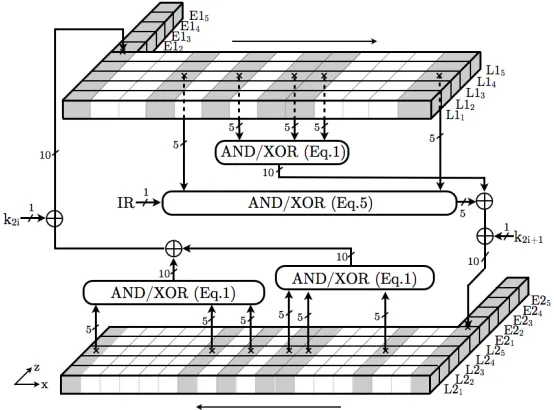
We describe a general TI that hassin input shares, the same number of shares in the state and sout output shares for nonlinear operations. An example of a 2nd-order TI of one round KATAN-32 wheresin= 5 and sout = 10 is depicted in Figure 1 (z coordinate refers tosindifferent shares of the state). In all these versions, we use the same unshared key schedule for simplicity.
Fig. 1.Description of 2nd-order TI of one round of KATAN-32.
already know how to implement an AND and an XOR gate with a uniform TI, we split the operations of the round update accordingly. For all the AND/XOR blocks except the one that receives IR, we use the TI in Equation (1) (resp. Eqn. (6) and Eqn.(8) for 1stand 3rd-order TI) which takessininput shares. For the AND/XOR block that receives IR we use the sharing
yi=ai+IR×bi wherei≤sin (5)
because we do not share the round counter (and hence IR).
The XOR of two AND/XOR blocks is applied oversout shares or over the first sin shares if the output of the AND/XOR block that receives IR is in-volved. Similarly, the key is introduced only in the first of thesout shares. This sout-sharing is written to the first bit of the L1 and L2 registers respectively which havesout shares only for the first bits. One can think of it as having an extension of sout−sinshares for those bits in addition to the sin shares of the state. In the next clock cycle, the sout shares in the first bits of theL1 andL2 registers are reduced tosinshares as described in Section 2.3 and written as the second bits. This implementation does not increase the number of clock cycles compared to the unprotected KATAN-32 implementation. In Table 1, we show the area requirements of these implementations in NAND gate equivalents. The gate counts for the round function include the decrease of the number of shares by means of Equation (2). The key register is included in the gate count of the key schedule together with the LFSR update.
Table 1.Synthesis results for plain and TI of KATAN-32.
State Round Key
Control Other Total Array Function Schedule
Plain 170 54 444 64 270 1002
1st-order TI 510 135 444 64 567 1720
2nd-order TI 900 341 444 64 807 2556
3rd-order TI 1330 760 444 64 941 3539
4
Analysis
component functions and to reduce the chance for crosstalk. The key is hard-coded in the Katan-32 implementation. The PRNG on the control FPGA is implemented as AES-128 in CTR mode. To start an encryption, we share the plaintext in 5 shares using random numbers from the PRNG and send the shares to the Katan-32 implementation. When the PRNG is turned off, it outputs zeros. We measure the power consumption of the crypto FPGA during the first 12 rounds of Katan-32 encryption as the voltage drop over a 1Ω resistor in the FPGA core GND line. The output of the passive probe is sampled with a Tektronix DPO 7254C digital oscilloscope at 1GS/s sampling rate and 1mV/div amplitude resolution. We provide the FPGA with a stable 3 MHz clock signal and use synchronized clocks to obtain high-quality measurements.
The main goal of our evaluation is not to demonstrate that the implementa-tion resists state-of-the-art attacks that exploit the 1stor 2nd statistical moment of the leakage distributions, but beyond that to demonstrate that there is no evidence of leakage in these moments of the leakage distributions, exploitable by state-of-the-art attacks or not. Obviously achieving this goal is much more demanding than resistance to known attacks, but it directly corresponds to our claims regarding provable security. We narrow the evaluation to univariate at-tacks because our implementation processes all component functions in parallel. We use leakage detection to evaluate our implementation. Contrary to the classical approach of testing whether a given attack is successful, this approach decouples the detection of leakage from its exploitation. For our purpose we use thenon-specifict-test based fixed versus random leakage detection methodology of [7,16], see Appendix C for a brief introduction.
For all tests we obtain two sets of measurements. For the first set, we fix the plaintext to some chosen value. We denote this set S0. For the second set, the plaintexts are uniformly distributed and random. We denote this set Srandom. We obtain the measurements for both sets interleaved and in a random order, i.e. before each measurement we flip a coin, to avoid any deterministic or time-dependent external and internal influences on the test result.
We compute Welch’s (two-tailed) t-test
t=qµ(S0)−µ(S1) σ2(S0)
|S0| +
σ2(S1) |S1|
(whereµ() is the sample mean,σ2() is the sample variance and| · |denotes the sample size) to determine if the samples in both sets were drawn from popula-tions with the same mean (or from the same population). The null hypothesis is that the samples in both sets were drawn from populations with the same mean. In our context, this means that the TI is effective. The alternative hypothesis is that the samples in both sets were drawn from populations with different means. In our context, this means that the TI is not effective.
At each point in time, the test statistict together with the degrees of free-domν, computed with the Welch-Satterthwaite equation
ν = (σ
2(S
0)/|S0|+σ2(S1)/|S1|)2 (σ2(S
allow to compute a pvalue to determine if there is sufficient evidence to reject the null hypothesis at a particular significance level (1−α). Thepvalue expresses the probability of observing the measured (or a greater) difference by chance if the null hypothesis was true. In other words, small p values give evidence to reject the null hypothesis.
While this evaluation methodology relieves us from choosing certain parame-ters such as targeted intermediate value, power model and distinguisher, it does not resolve all such issues. As in any evaluation, the tests are limited to the num-ber of measurements at hand and one has to choose a threshold to decide if an observed difference is statistically significant or not. Nevertheless, as we demon-strate below this type of evaluation is very data-efficient, i.e. a small number of measurements is required to provide evidence of leakage, and a decision threshold can be motivated with some basic experiments.
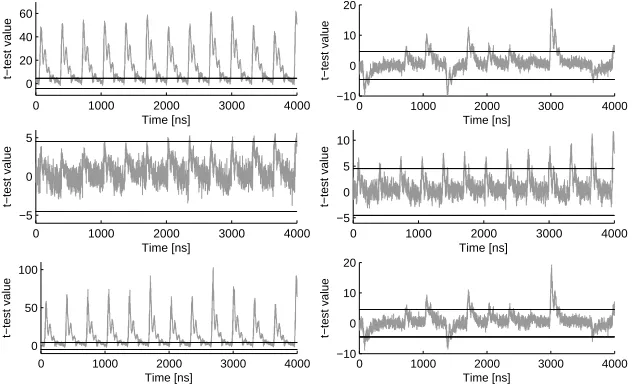
To calibrate our threshold value we apply the test methodology to two groups of 10 000 measurements each for which we know that the null hypothesis is true. For the first group of measurements we switch off the PRNG and use the same fixed plaintext for both sets, i.e. all measurements in both sets are samples from the same population and the only cause of variance is noise. We compute the t statistic, record its greatest absolute value and repeat the experiment 100 times on a random split of the measurements in this group. The highest absolute t value we observed was 4.7944. For the second group we switch on the PRNG and use random plaintexts for both sets, i.e. the measurements in both sets are samples from distributions with the same mean and high variance. We repeat the analysis and the highest absolute t value we observed was 4.8608. Based on these results and the recommendation in [7] we select the significance threshold ±4.5. For large sample sizes, observing a single t value greater/smaller than±4.5 roughly corresponds to a 99.999% probability of the null hypothesis being false. To confirm that our setup works correctly and to get some reference values we first evaluate the implementation with the PRNG switched off. Figure 2 shows the t values of fixed versus random tests with two different fixed plaintexts (left and right) and for the 1st,2nd and 3rd statistical moment of the distributions (for the higher-order moments we pre-process the traces to expose the desired standardized moment before we apply the t-test, e.g. for the 2nd moment we center and then square the traces). Horizontal lines mark the±4.5 thresholds.
The plots clearly show that there is sufficient evidence of leakage in all cases, as there are multiple and systematic crossings of the thresholds. Comparing the plots on the left hand side with the plots on the right hand side, we see that the “shape” of the t curve depends on the fixed plaintext value. This is no longer true when we switch on the PRNG, because all shares of the input are random. We used 1 000 measurements (500 for fixed and 500 for random plaintext) to generate these plots, but less than 100 measurements are required to see evidence of leakage in the 1st statistical moment.
0 1000 2000 3000 4000 0
20 40 60
Time [ns]
t−test value
0 1000 2000 3000 4000 −10
0 10 20
Time [ns]
t−test value
0 1000 2000 3000 4000 −5
0 5
Time [ns]
t−test value
0 1000 2000 3000 4000 −5
0 5 10
Time [ns]
t−test value
0 1000 2000 3000 4000 0
50 100
Time [ns]
t−test value
0 1000 2000 3000 4000 −10
0 10 20
Time [ns]
t−test value
Fig. 2.Fixed versus random t-test evaluation results with PRNG switched off; left: for fixed plaintext 0x00000000, right: for a randomly chosen fixed plaintext; from top to bottom: 1st,2nd and 3rd-order statistical moment; 1 000 measurements.
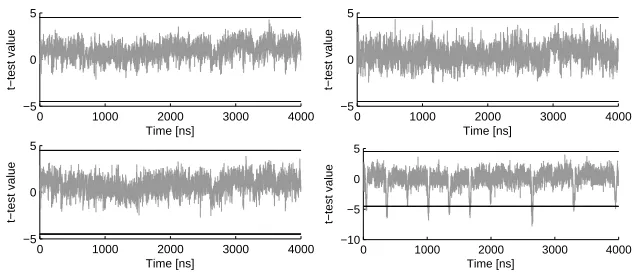
and right) shows plots of the t values for the 1st and 2nd moment. As expected there is not sufficient evidence of leakage. But as mentioned earlier, one may always wonder if the number of measurements at hand is sufficient. For com-pleteness, we also provide evaluation results of the 3rdand 5th moment. The 3rd moment is the smallest moment for which our implementation does not provide provable security in the combinational logic (Property 2) and the 5th moment is the smallest moment for which our implementation does not provide provable security in the memory elements (the state is shared in at least 5 shares). There-fore we may be able to detect leakage in these moments. Figure 3 (bottom left and right) shows plots of the t values.
While there is not sufficient evidence of leakage also in the 3rd moment, we can see multiple and systematic crossings of the threshold in the 5th moment. This result suggests that we use enough measurements, and that we should be able to detect leakage in the lower-order moments, if there was any. Together, the results support our claim regarding provable 2nd-order DPA resistance.
One may wonder why we do not detect leakage in the 3rd moment. Several explanations are possible but their careful investigation is beyond the scope of this paper.
5
Conclusion
0 1000 2000 3000 4000 −5
0 5
Time [ns]
t−test value
0 1000 2000 3000 4000 −5
0 5
Time [ns]
t−test value
0 1000 2000 3000 4000 −5
0 5
Time [ns]
t−test value
0 1000 2000 3000 4000 −10
−5 0 5
Time [ns]
t−test value
Fig. 3. Fixed versus random t-test evaluation results with PRNG switched on for a randomly chosen fixed plaintext; from top left, top right, to bottom right: 1st,2nd, 3rd and 5th statistical moment; 300 million measurements.
desirable to have masking schemes that can be implemented securely at any order. In hardware implementations, glitches make this a challenging task. TI is a masking technique that provides provable security even in the presence of glitches, but the method is limited to 1st-order DPA resistance. We address this gap and extend the technique to higher orders. We define generic constructions, prove their security and provide exemplary 1st, 2ndand 3rd-order DPA-resistant implementations of the block cipher KATAN-32. Our analysis of 300 million power traces from a 2nd-order DPA-resistant implementation in an FPGA with a leakage detection test does not show significant evidence of leakage and supports the security proofs. We also show that this method can be straightaway applied to generate 2nd-order TI of 4×4 S-boxes in the alternating group.
Acknowledgements
This work has been supported in part by the Research Council of KU Leuven (OT/13/071), by the FWO (G.0550.12), by the Hercules foundation (AKUL/11/19) and by GOA (tense). B. Bilgin was partially supported by the FWO project G0B4213N and Benedikt Gierlichs is a Postdoctoral Fellow of the Research Foun-dation - Flanders (FWO).
References
1. AIST. Side-channel Attack Standard Evaluation BOard.
http://staff.aist.go.jp/akashi.satoh/SASEBO/en/.
2. B. Bilgin, B. Gierlichs, S. Nikova, V. Nikov, and V. Rijmen. A more efficient AES threshold implementation. In David Pointcheval and Damien Vergnaud, editors,
3. B. Bilgin, S. Nikova, V. Nikov, V. Rijmen, and G. St¨utz. Threshold im-plementations of all 3 ×3 and 4 ×4 S-boxes. Cryptology ePrint Archive, http://eprint.iacr.org/.
4. B. Bilgin, S. Nikova, V. Nikov, V. Rijmen, and G. St¨utz. Threshold implementa-tions of all 3×3 and 4×4 S-boxes. InCHES, volume 7428 ofLNCS, pages 76–91. Springer, 2012.
5. A. Bogdanov, L.R. Knudsen, G. Leander, C. Paar, A. Poschmann, M.J.B. Robshaw, Y. Seurin, and C. Vikkelsoe. Present: An ultra-lightweight block cipher. In Pascal Paillier and Ingrid Verbauwhede, editors,Cryptographic Hardware and Embedded Systems - CHES 2007, volume 4727 ofLecture Notes in Computer Science, pages 450–466. Springer Berlin Heidelberg, 2007.
6. S. Chari, C. S. Jutla, J. R. Rao, and P. Rohatgi. Towards sound approaches to counteract power-analysis attacks. In CRYPTO, volume 1666 of LNCS, pages 398–412. Springer, 1999.
7. J. Cooper, E. De Mulder, G. Goodwill, J. Jaffe, G. Kenworthy, and P. Ro-hatgi. Test vector leakage assessment (TVLA) methodology in practice. Inter-national Cryptographic Module Conference, 2013. http://icmc-2013.org/wp/wp-content/uploads/2013/09/goodwillkenworthtestvector.pdf.
8. J-S. Coron. Higher order masking of look-up tables. In P. Nguyen and E. Oswald, editors,Advances in Cryptology EUROCRYPT 2014, volume 8441 ofLecture Notes in Computer Science, pages 441–458. Springer Berlin Heidelberg, 2014.
9. J-S. Coron, E. Prouff, M. Rivain, and T. Roche. Higher-order side channel security and mask refreshing. FSE 2013, to appear.
10. J.S. Coron, E. Prouff, and T. Roche. On the use of shamirs secret sharing against side-channel analysis. In Stefan Mangard, editor, Smart Card Research and Ad-vanced Applications, volume 7771 of LNCS, pages 77–90. Springer Berlin Heidel-berg, 2013.
11. C. De Canni`ere, O. Dunkelman, and M. Kne˘zevic. KATAN and KTANTAN : A family of small and efficient hardware-oriented block ciphers. In C. Clavier and K. Gaj, editors, CHES, volume 5747 of LNCS, pages 272–288. Springer Berlin Heidelberg, 2009.
12. Alexandre Duc, Stefan Dziembowski, and Sebastian Faust. Unifying leakage mod-els: From probing attacks to noisy leakage. In PhongQ. Nguyen and Elisabeth Oswald, editors, Advances in Cryptology EUROCRYPT 2014, volume 8441 of
Lecture Notes in Computer Science, pages 423–440. Springer Berlin Heidelberg, 2014.
13. Sebastian Faust, Tal Rabin, Leonid Reyzin, Eran Tromer, and Vinod Vaikun-tanathan. Protecting circuits from leakage: the computationally-bounded and noisy cases. In Henri Gilbert, editor,Advances in Cryptology EUROCRYPT 2010, vol-ume 6110 ofLecture Notes in Computer Science, pages 135–156. Springer Berlin Heidelberg, 2010.
14. L. Genelle, E. Prouff, and M. Quisquater. Thwarting higher-order side channel analysis with additive and multiplicative maskings. In B. Preneel and T. Takagi, editors,CHES, volume 6917 ofLNCS, pages 240–255. Springer Berlin Heidelberg, 2011.
16. G. Goodwill, B. Jun, J. Jaffe, and P. Rohatgi. A testing methodol-ogy for side channel resistance validation. NIST non-invasive attack test-ing workshop, 2011. http://csrc.nist.gov/news events/non-invasive-attack-testtest-ing- events/non-invasive-attack-testing-workshop/papers/08 Goodwill.pdf.
17. L. Goubin and A. Martinelli. Protecting AES with Shamirs secret sharing scheme. In B. Preneel and T. Takagi, editors,CHES, volume 6917 ofLNCS, pages 79–94. Springer Berlin Heidelberg, 2011.
18. H. Kim, S. Hong, and J. Lim. A fast and provably secure higher-order masking of AES S-box. In B. Preneel and T. Takagi, editors,CHES, volume 6917 ofLNCS, pages 95–107. Springer Berlin Heidelberg, 2011.
19. P. C. Kocher, J. Jaffe, and B. Jun. Differential power analysis. In CRYPTO, volume 1666 ofLNCS, pages 388–397. Springer, 1999.
20. Mather L, E. Oswald, J. Bandenburg, and M. W´ojcik. Does my device leak infor-mation? An a priori statistical power analysis of leakage detection tests. In Kazue Sako and Palash Sarkar, editors, ASIACRYPT (1), volume 8269 ofLNCS, pages 486–505. Springer, 2013.
21. G. Leander and A. Poschmann. On the classification of 4 bit s-boxes. In Claude Carlet and Berk Sunar, editors,Arithmetic of Finite Fields, volume 4547 ofLecture Notes in Computer Science, pages 159–176. Springer Berlin Heidelberg, 2007. 22. S. Mangard, T. Popp, and B. M. Gammel. Side-channel leakage of masked CMOS
gates. InCT-RSA, volume 3376 ofLNCS, pages 351–365. Springer, 2005. 23. S. Mangard, N. Pramstaller, and E. Oswald. Successfully attacking masked AES
hardware implementations. In CHES, volume 3659 of LNCS, pages 157–171. Springer, 2005.
24. T. S. Messerges. Using second-order power analysis to attack DPA resistant soft-ware. In C¸ . K. Ko¸c and C. Paar, editors, CHES, volume 1965 ofLNCS, pages 238–251. Springer, 2000.
25. A. Moradi. Statistical tools flavor side-channel collision attacks. In D. Pointcheval and T. Johansson, editors,EUROCRYPT, volume 7237 ofLNCS, pages 428–445. Springer, 2012.
26. A. Moradi and O. Mischke. On the simplicity of converting leakages from multivari-ate to univarimultivari-ate - (case study of a glitch-resistant masking scheme). In G. Bertoni and J.-S. Coron, editors,CHES, volume 8086 ofLNCS, pages 1–20. Springer, 2013. 27. A. Moradi, O. Mischke, and T. Eisenbarth. Correlation-enhanced power analysis collision attack. InCHES, volume 6225 of LNCS, pages 125–139. Springer, 2010. 28. A. Moradi, A. Poschmann, S. Ling, C. Paar, and H. Wang. Pushing the limits: A
very compact and a threshold implementation of AES. InEUROCRYPT, volume 6632 ofLNCS, pages 69–88. Springer, 2011.
29. S. Nikova, C. Rechberger, and V. Rijmen. Threshold implementations against side-channel attacks and glitches. InICICS, volume 4307 ofLNCS, pages 529–545. Springer, 2006.
30. S. Nikova, V. Rijmen, and M. Schl¨affer. Secure hardware implementation of non-linear functions in the presence of glitches. InICISC, volume 5461 ofLNCS, pages 218–234. Springer, 2008.
31. S. Nikova, V. Rijmen, and M. Schl¨affer. Secure hardware implementation of non-linear functions in the presence of glitches. J. Cryptology, 24(2):292–321, 2011. 32. A. Poschmann, A. Moradi, K. Khoo, C.-W. Lim, H. Wang, and S. Ling.
33. E. Prouff and M. Rivain. Masking against side-channel attacks: A formal secu-rity proof. In Thomas Johansson and Phong Q. Nguyen, editors, EUROCRYPT, volume 7881 ofLNCS, pages 142–159. Springer, 2013.
34. E. Prouff and T. Roche. Higher-order glitches free implementation of the AES using secure multi-party computation protocols. InCHES, volume 6917 ofLNCS, pages 63–78. Springer, 2011.
35. M. Rivain and E. Prouff. Provably secure higher-order masking of AES. InCHES, volume 6225 ofLNCS, pages 413–427. Springer, 2010.
36. F.-X. Standaert, T. Malkin, and M. Yung. A unified framework for the analysis of side-channel key recovery attacks. In Antoine Joux, editor,EUROCRYPT, volume 5479 ofLNCS, pages 443–461. Springer, 2009.
A
Component Functions of the Sharing
F
of
f
(
a, b, c
) = 1 +
a
+
bc
A.1 1st order TI and sin= 3
y1= 1 +a2+b2c2+b1c2+b2c1
y2=a3+b3c3+b2c3+b3c2 (6) y3=a1+b1c1+b1c3+b3c1
A.2 2nd order TI andsin= 6
y1= 1 +a2+b2c2+b1c2+b2c1+b1c3+b3c1+b2c3+b3c2 y2=a3+b3c3+b3c4+b4c3+b3c5+b5c3
y3=a4+b4c4+b2c4+b4c2+b2c6+b6c2
y4=a5+b5c5+b1c4+b4c1+b1c5+b5c1 (7) y5=b2c5+b5c2+b4c5+b5c4
A.3 3rd order TI ands
in= 7
y1= 1 +a2+b2c2+b1c2+b2c1 y3=a4+b4c4+b1c4+b4c1 y5=a6+b6c6+b1c6+b6c1 y7=b2c3+b3c2
y9=b2c5+b5c2
y11=a7+b7c7+b2c7+b7c2 y13=b3c5+b5c3
y15=b3c7+b7c3 y17=b4c6+b6c4 y19=b5c6+b6c5 y21=b6c7+b7c6
y2=a3+b3c3+b1c3+b3c1 y4=a5+b5c5+b1c5+b5c1 y6=a1+b1c1+b1c7+b7c1 y8=b2c4+b4c2
y10=b2c6+b6c2 y12=b3c4+b4c3 y14=b3c6+b6c3 y16=b4c5+b5c4 y18=b4c7+b7c4 y20=b5c7+b7c5.
(8)
B
Unmasked KATAN-32
The description of one round of KATAN-32 is provided in Fig. 4 where each block represents one bit. 32-bit plaintext is divided into two chunks of 13 and 19 bits and written to the registersL1 andL2 respectively. In every round, several bits are used to update the first bits of the registers together with a one bit shift to the right forL1 and to the left forL2. The bit depicted byIRis the last bit of a round counter that decides irregularly if the fourth bit ofL1 is used for the round update or not.k2i andk2i+1 are the 2ith and (2i+ 1)st bits of the 80-bit key for rounds i≤40. For the rest of the rounds they are generated from the original key by an LFSR.