President’s Address
LORENZ F. BREDEMEIERFort Worth, Texas
Fellow members of the Society for Range Management and friends, I am pleased and honored to wel- come you to the Silver Anniversary Meeting of our Society.
To have served as your president during the past year has been an honor and an onnortunitv which I deeply and sin&;ely appreciate. I extend sincere thanks to each mem- ber for his support of the Society __ and especially the officers and com- mitteemen of the Society, Sections, and Chapters. * We extend sincere annreciation to the entire Member- sl;iYp Committee for an increase of ne&ly 8% in membership, and to all members of the 1972 Annual Meeting Committee for this fine meeting place, special arrangement, and excellent program-our first annual meeting in any national capital.
I am deeply indebted and grate- ful to Francis and Libby Colbert and the entire staff for their dedi- cated and hard work for the So- ciety, and especially for their help to me.
This being the 25th Anniversary Meeting of the Society, it seems ap- propriate that I highlight progress
l Presented at the Silver Anniversary Meeting, Society for Range Managd- ment, February 5-11, 1972, Wash- ington, D. C.
over the last quarter century, as well as report on our 1971 accom- plishments.
From an inconspicuous, unrecog- nized, and unidentified field of in- terest, our Society has forged a highly qualified, dynamic, and rele- vant profession. Early in the 1940’s, range-minded men in universities and federal agencies of central and western United States held informal meetings to discuss the problems and needs pertinent to their field of interest. This led to a survey in
1946 to determine rangemen’s de- sires about organizing, with the re- sult that a membership drive was launched in July, 1947. The first meeting of the Society was held in January, 1948, in Salt Lake City.
The formation of the Society with its concern for the broad re- source base was particularly timely, because of the growing awareness of a need to conserve renewable re- sources. It is evident our Society has always been concerned with all renewable resources of rang-eland environments,-not grass only.
Communications with and among members was an important initial objective, so the Society encour- aged organization of local Sections. The Wyoming Section, organized in 1948, was the first, and there are now 19 Sections covering almost all of North America.
When the Society was only four years old, members and officers started pondering the question of how large it could be and still maintain its central interest-range management. From a modest be- ginning of 481 charter members, we have grown more than ninefold- to approximately 4,400 members- and our central interest has been greatly strengthened, not diluted. The growing recognition of the amount and importance of range- land indicates, I am sure, that we are still a long way from the po- ten tial. During 197 1, considerable emphasis was put on minimizing suspensions and increasing mem- bership. This paid off with a nice increase and I feel we are now on our way to some permanent mem- bership increases if we all continue
79
to work on this. In 1969, we insti- tuted the Individual Sustaining . membership which led to 28 in
1970, 55 in 1971, and, so far, 114 have registered for 1972! This an- nual doubling is a very good sign, and we urge you to consider join- ing this group to give the Society additional financial support. The new membership certificate ap- proved at the summer Board meet- ing and sent to each member last fall is very neat and practical. Ev- ery member should be proud to display it in his office or home.
From the very beginning, mem- bership has been open to anyone interested, and a place in the So- ciety for ranchers and others who apply the principles of range man- agement on the land has always been emphasized. It was recog- nized that experience of ranchers was necessary to test the soundness of the science being developed in our profession. By 1952, ranchers outnumbered other employment and occupational groups repre- senting nearly 20 percent of the membership and presently are sec- ond largest with nearly 15 percent. And since 1949, there has been at least one rancher on the Board of Directors every year. Three ranch- ers have served as Society presi- dents: Dan Fulton, 1951; A. P. Atkins, 1955; and Donald A. Cox,
1969. Each made important con- tributions to the Society and to the profession.
80
BREDEMEIER
cifically directing its major effort toward the study of problems of this environment (rangeland).”
Youth have always been an im- portant group of members. Stu- dent membership grew from
35
inJanuary, 1949, to 175 by January, 1950, to the present total of about 550. The first student essay con- test was held in 1951 and the first Range Plant Identification Con- test was held in 1952. Soon after Sections were organized they began to sponsor range camps, range plant identification and range judging contests, all of which led to the first Youth Range Forum in 1966. The college students continue with the Range Plant Contest, and addi- tionally have organized their Stu- dent Conclave. Both youth groups are increasingly involved in Society affairs at all levels. They serve on commit tees, organize meetings, give
papers, and in many other ways
contribute to the welfare of this organization.
Society dues started at a modest $3.00 in 1948, and were raised to $5.00 in 1949. In 1953 the Board of Directors, on the recommendation of the Council of Section Presi- dents, agreed to collect the standard $1.00 Section dues, but the actual Society dues were not raised again until 1959 when they went up to $8.00. The next increases were to $10.00 in 1965, and to $15.00 in 1968. Although this money has been stretched to the breaking point-in the face of constant in- flation and increased Society ser- vices-we hope to avoid additional dues increases, at least in the im- mediate future. To determine just how we can be adequately financed is one of the major tasks of this coming year. In this regard, our reclassification as a 501(c)(3) orga- nization by IRS this past year could prove most helpful; in effect, we are now a “public foundation” and, hence, in a much better position to ask for and receive grants, bequests, devises, gifts, and donations.
The Journal of Range Manage- ment, the Society’s principal pub- lication, is now starting its 25th
volume. From 62 pages in Volume 1, it has grown to 488 pages in Volume 24, and it is recognized throughout the world as the source of authoritative, scientific informa- tion regarding the management and use of rangelands-being sent to more than 80 countries. Seven men have served faithfully and well as its editor.
The second periodical publica- tion, Rangeman’s News, first pub- lished in 1969, was initiated to help bridge a specific communications gap. It has been well received. We are now looking at possibilities for emphasizing the best of both publi- cations in order to serve more fully the needs of our membership.
Over the years, the Society has also published: indexes to the first and second ten volumes of the Journal, and in 1964 A Glossary of Terms Used in Range Manage- ment. The glossary has been most useful and much needed, but is presently outdated and out-of-print. Consequently, a small committee has been appointed and has started work on a revision of the glossary. A larger group will review the re- vision and it should be ready for consideration by the Board at the summer meeting. Some of the other publications the Society has cooper- ated on over the past 25 years in- clude: NAS-NRC Publication 890,
Problems and Techniques in Range Research, 1962; Pasture and Re- search Techniques, 1962; and For- age Plant Physiology and Soil- Range Relationships, 1964. We had hoped to publish in 1971 the first of the Sciential Committee’s works, but the lack of ready cash did not permit accomplishing this goal. However, I believe we can look for two or three of these to be pub- lished this coming year.
Very shortly after being orga- nized, the outreach of the Society began to gain recognition for the profession and for the vast re- source base known as rangeland. By 1961 range management had been defined under a separate heading in both the Encyclopedia Britannica and Collier’s Encyclo-
pedia. Later, range management was introduced into the Library of Congress as a separate topical head- ing and in 1961 the U. S. Post Of- fice issued a commemorative range conservation stamp. These may seem like trivial things, but they are indicative of an ever-growing recognition of rangeland, its mul- tiple resources and uses.
PRESIDENT’S ADDRESS 81
joint meeting to be held in Mexico
City in 1973, sponsored by the
American Association for the Ad-
vancement of Science and Mexico’s Consejo National de Ciencia y Tecnologico. One of the purposes of this meeting will be to discuss broadly conceived science-related topics of interest to Latin America, the United States, and Canada. It seems to me that rangelands and range management are indeed ap- propriate topics for such a meeting.
I think all of us are aware that this past July there was a joint meeting in Denver of the officers and directors of SRM, the Ameri- can Fisheries Society, the Society of American Foresters, and The Wildlife Society. This meeting, which resulted from a long-stand-
ing, informal but rather close
liaison that has been maintained between the executive officers of these four societies, was for the pur- pose of getting better acquainted with each other, to examine our similarities and differences, and to explore any and all possibilities for cooperative efforts. Each of us rec- ognizes there are things, particu- larly in the broad area of policy influence and general public rela- tions, that might be more readily accomplished by joint effort. We will continue to work closely with these allied organizations, all con- cerned with renewable natural re- sources.
Considering another aspect of the Society’s outreach in 1971, the I&E Committee directed its efforts at communicating with members of other organizations. With the help of the Sections, this committee de- veloped a list of other organizations which would be potentially recep- tive to including SRM as a part of one of their meeting programs. The committee also prepared a list of SRM members who might serve as speakers for such programs, and the Colorado Section developed an ex- cellent slide program on rangelands and range management to be used on such occasions. Most unfortu- nately, a great many of the slides for this program were just recently
lost in the mail; so now we must undertake to develop suitable al- ternatives for communicating with other groups. Along this line, I note that a number of the Sections have held meetings and tours in cooperation with different organi- zations. They are to be commended for this kind of outreach. More such cooperative meetings should be staged.
Since the formation of the Pacific Northwest, the International Moun- tain, and the Northern Great Plains Sections-which collectively encompass British Columbia, Al- berta, Saskatchewan, and Manitoba in Canada, and Oregon, Washing- ton, Montana, and North Dakota in the United States-the Society for Range Management has also had an international outreach and an international dimension. This international dimension has been greatly helped through various for- eign aid programs which have en- hanced the dissemination of range management throughout the world. Our membership now represents more than 35 countries. In 1957, the Mexico Section of the Society was founded and, although its growth was slow in the early years, progress in the past few years has been most remarkable. In view of this, it is indeed most fitting that our incoming president-elect is Martin Gonzalez, who has done so much to advance the science and art of range management in Mex- ico.
The East Africa Section of the Society was organized in 1967, and as a result of the interest and the hard work of the members of that Section, it became, at the end of 1970, the East Africa Society of Range Management-a separate organization.
Society meetings which have been held outside the United States in- clude summer meetings at Kam- loops, Calgary, and Chihuahua, and our 1969 Annual Meeting in Cal- gary. In keeping with our interna- tional dimension objective, the word “American” was dropped from the Society’s name last year.
And, finally, with regard to this matter of outreach, I think one of our most significant accomplish- ments has been the completion and publication of Benchmarks: A Statement of Concepts and Posi- tions of the Society for Range Man- agement. Everyone had the oppor- tunity to, and a great many people did, contribute to this document. Its importance lies in the fact that it provides us with a common base for communicating with others about rangelands and range man- agement, and for taking sound po- sitions on current issues which affect rangelands in particular and all renewable resources in general. A professional society does have much to offer and we will be remiss in our responsibilities if we con- tinue to “hide our light under a bushel.” I am most pleased that “Benchmarks” is available for dis- tribution at this meeting.
One of the biggest thrills of this past year was the receipt of a letter from Mr. Frederic G. Renner, the Society’s second president, in which he offered a gift of $lO,OOO.OO to be used for the establishment of the Frederic G. Renner Award. This award is intended to be given annu- ally for significant and outstanding current accomplishments in the field of range management and would carry an honorarium of the annual interest from the $lO,OOO.OO fund. It is given with the belief that such individual recognition will foster better use of rangeland resources and a broader under- standing of the contribution of these resources to the welfare of all peoples. I’m most pleased that this gift has been consumated and with grateful appreciation to Fred Ren- ner for his generosity and thought- fulness, the first Frederic G. Renner Award will be presented tomorrow night at the banquet.
Any review of the past 25 years must necessarily make mention of our executive secretaries. The first executive secretary of the Society was W. T. “Terry” White, who was employed on a part-time basis in
160
Individually the papers in the vol- ume will be interesting to any serious student of the Great Plains environ-
ment, but a concise and interpretive summary of the symposium as a whole would have greatly increased the value of the book to the more general reader. The papers as a group illustrate the intensity of effort and diversity of ap- proach now being applied from many
President’s Address
(Continued from page 81)
1952 and served until his death in 1957. John G. Clouston succeeded Terry in this position, and by his prudent management of Society af- fairs put us on a sound enough basis so that by 1968, SRM could employ its first full-time executive secretary-implementing a decision the Board had made in 1966. To these early-day workers and sup- porters of the Society, we owe a great deal. Francis Colbert was selected as the first full-time execu- tive secretary, and during his first year (1968) consumated moving the office to its present location in Denver.
In retrospect, our accomplish- ments of the past 25 years have been many and noteworthy-too numerous to enumerate all of them here. Most importantly, they have brought us to the point where we can and must make substantial con- tributions to the affairs of the na- tion and of the world. It is impera- tive that we emphasize that our members and the Society have 25 years experience in applying eco- logical principles to rangeland eco- sys terns and environmental im- provements. The only danger we face is forgetting our mission; this can only happen by default, so we
BOOK REVIEWS
sources
puzzle of Pleistocene environmental in an attempt to unravel the influences on plants, animals, and man. Especially valuable are the extensive and pertinent literature citations ac- companying most of the papers. This assemblage of interesting and well- documented reports represents a sub- stantial contribution to the understand- ing of the complexity of conditions
must follow through with renewed dedication and give increased em- phasis to the importance of and the role of the world’s rangelands, which comprise nearly 45% of the earth’s land surface. The Society needs from each of us a little more time, talent, money, and energy.
In trying to look ahead, I think one of our most important jobs is to make sure our programs, our activities, and our individual atti- tudes are geared toward providing more membership satisfaction. I have suggested to the Advisory Council that they develop pro- grams to this end, since the Sections are in the best position to make personal contact with our members. We also need additional support and thrust for our I&E programs at all levels, and we should take spe- cific steps towards organizing an international congress on range- lands. The Sciential Committees, after they have completed their initial assignments, can and should provide future guidance to all of us in their respective fields of expertise.
On coming to the end on one’s term as president, one thinks of the many ideas and projects that failed to break dormancy. It seems there are more in dormancy than were brought to fruition. Even so, I be- lieve 197 1 has been a very good
which preceded and ultimately led to the development of our natural Great Plains grasslands. Perhaps, too, they can be interpreted as illustrating the relatively tenuous and insubstantial hold which this vegetation formation may have in the region in which it now exists.-Warren C. Whitman, North Dakota State University, Fargo.
year for the Society. It has been a rewarding and busy one for me and I am grateful for the opportunity to have served in this position.
I thank my wife, Audrey, for her encouragement, help, and tolerance for the long hours that were de- manded.
The president elect has a big task in becoming knowledgeable about all the Society projects and busi- ness, as well as developing plans for his year. In order to give your in- coming president the time and op- portunity to do this, the Committee for Programming Short-Term Proj- ects and Goals was created, which he chaired. He did an excellent job in this position, and has taken steps to implement some changes and ac- tivities which I am confident will please you. With Floyd Kinsinger as president in 1972, and with the help of the dedicated Board and staff, our Society will certainly move forward. Let us each resolve to give them full support.
A Behavioral Study of Angora Goats on
West Texas Range1
Highlight
Behavior of four Angora goats was studied in sixteen observation periods for four seasons on a west Texas range. The goats consistently fed during two definite daylight feeding periods: (a) early morning, and (b) late afternoon to dusk. Bedding generally occurred whenever darkness became evident and little or no feeding activity was observed between that time and daybreak. The four goats differed somewhat in their behavioral activities, but were remarkably similar in their vegetation preference. Seasonal difference seemed to have an imnortant I effect unon both vegetative A preference and behavioral activities.
Un Estudio Sobre las Actividades de Cabras de Angora en un
Pastizal Natural en el Oeste de Texas
Resumen2
Cuatro cabras fueron marcadas y sus actividades fueron observadas a trav& de1 afio. Las cabras mostraron un patrc’m de actividades sistemAtico a travds de1 afio. Empezaron el dia levantkndose y rumiando por un tiempo breve, seguido por una epoca de pas- tore0 de tres horas, luego por 30
minutos de descanso y despuCs pastoreo otra vez hasta mediodia. Tomaron agua y descansaron en la sombra durante medio dia hasta tres horas antes de la puesta de1 sol. Comieron otra vez por tres horas o sea hasta en la noche cuando tomaron agua otra vez y comieron sal, seguido por descanso por toda la noche. Aproximadamente de 34.4% de su tiempo de pastoreo fuC con gramineas y 65.6% fug ramoneo.
result of his observations, suggested the adoption of a system of rotation grazing. Since then many studies have been conducted on the be- havior of cattle. However, despite widespread use of goats, few studies have been conducted on them, and little is known of their behavioral activities.
According to Hughes and Reid (1951), Tribe (1950) reported obser- vations made over 12 consecutive months on the habits of five sheep confined in a l-acre paddock. Rec- ords were kept on one animal in the group. The time occupied in
various activities by the one animal assumed to reflect the actions of the group as a whole.
Parece ser que las estaciones de1 afio tienen un importante efecto en la preferencia de1 forraje pastoreado, y las actividades de las cabras.
Animal behavior studies have
been conducted to help improve
methods of livestock and range management problems. According
to Johnstone-Wallace and Kennedy (l944), animal behavior studies began when James Anderson (1797), a Scottish farmer, described certain grazing habits of cattle, and, as a
Hughes and Reid (195 1) recorded the time spent by sheep in various activities during single 24-hr obser- vation periods over several months, extending from August, 1948, to October, 1949. Hughes and Reid were primarily interested in amount of time spent grazing, idling, and traveling.
Strasia et al. (1970) made a study concerning sheep on an alpine range. Strasia’s main objectives were to determine grazing activities, diet, and performance of sheep on alpine ranges and to evaluate these characteristics under herder and herderless management.
l Received December 30, 1970. 2 Por Edmund0 L. Aguirre y Donald L.
Huss, Dept. Zootecnia, I.T.E.S.M., Monterrey, Mexico.
Cory (1927), working in the Ed- wards Plateau section of Texas be- tween 1923 and 1927, developed
some interesting comparisons of
GARY D. ASKINS AND EVERETT E. TURNER
Graduate Student and Division Director, Division
of
Range Animal Science and Applied Arts, Sul Ross State University, Alpine, Texas.82
beef cattle, sheep and goat activities and habits on the range. He fol- lowed and observed the animals only throughout the “animal day.” Cory considered the “animal day” as that period between arising and going to their rest or bedding down at night, apparently because he was convinced that “animals having gone to their rest will stay at rest during the night.” Also, he as- sumed that the balance of the 24-hr period was spent resting. Cory’s greatest interest was in the amount of time spent in various activities such as grazing, resting, ruminating, idling, and drinking water and the differences in time spent on these activities by different kinds of animals.
The objectives of this study were to obtain definite information con- cerning the behavior of Angora goats on the range, and their pref- erence for range forage. To deter- mine this, observations were made on the type of vegetation consumed and the amount of time spent ruminating, watering, salting, rest- ing, feeding, defecating, and urinat- ing. Also, seasonal differences were recorded.
Experimental Procedure
The study was conducted over a period of one year so that seasonal differences could be noted. Four in- dividual Angora goats were chosen and labeled A, B, C, and D for convenience in recording data. One observation was made on each in- dividual goat for each different season; summer, fall, winter, and spring. Sixteen total observations were made on dates as indicated in Table 1. When it was possible, two goats were observed at the same time. To accomplish this, the two individual goats had to stay within close range of each other through- out the 24-hr period. This was the case with the fall, winter, and spring observations. During these three seasons it was easy to record the data of two goats as the animals tended to remain together as one main herd.
GOAT BEHAVIOR
Table 1. Distribution and dates of observation of goats.
Period and date of observation
Goat SUmmeI Fall winter spring
A 7/26/69
B 10/25/69
C
D
l/IO/70
B 8/16/69
3/28/70
C 10/25/69
D
A l/10/70
C 8/23/69
3/28/70
D II/IS/69
A B
Z/28/70
D g/6/69
5/Z/70
A 11/15/69
B
C Z/28/70 5/Z/70
Texas, seventy miles west of Ozona. The goats were confined to fenced pastures and in which grazing was continuous throughout the year.
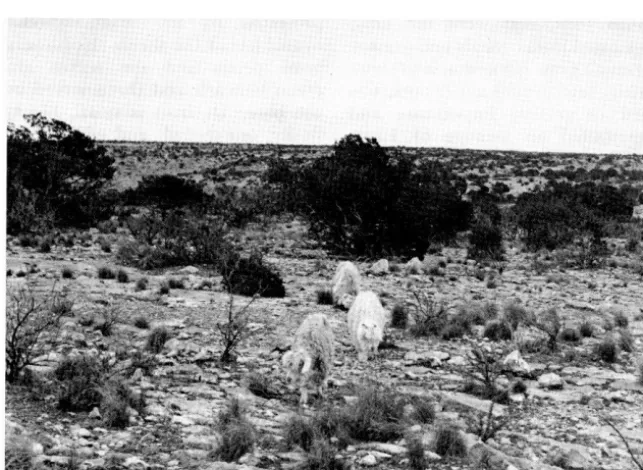
The pasture in which the goats were located is about two and one- half sections in size and is composed of draws that widen as they lengthen and with respect to the upland become deeper so that they are in- cluded between more or less steep slopes that form rocky hillsides and give three types of topography: valleys, slopes, and divides. One main large canyon cuts through the north end of the pasture. The main plants lending character to the range are cedar (.l~ni~erus pin- chat), prickly pear (Op~ntia engel- manni), mesquite (Prosopis jzkli- flora), shin oak (Q~crcus breviloba),
persimmon (Diospyros texana), cat- claw (Mimosa biuncifera), lotewood (Condalia), ocotillo (Foquiera splen- deus), tasajillo (Opuntia lepto- caulis), and evergreen sumac (Rhus ?JiW?LS). The dominant grasses are wrights three-awn (Aristida wrightii) and red grama (lhteloua trifida). Figure 1 is a photograph of the pasture on which the goats grazed during the experiment.
Results and Discussion Feeding Activities of the Goats
In order to fully discuss the feeding activities of the goats,
special interest will he placed upon two different classes of feeding: grazing and browsing.
The first classification, grazing, refers to the feeding of range live- stock on herbaceous plants in their natural state. In this particular study, the weeds, grasses, and leaves that had fallen to the ground are considered to have been consumed by grazing rather than browsing. Leaves and grass and weeds and
83
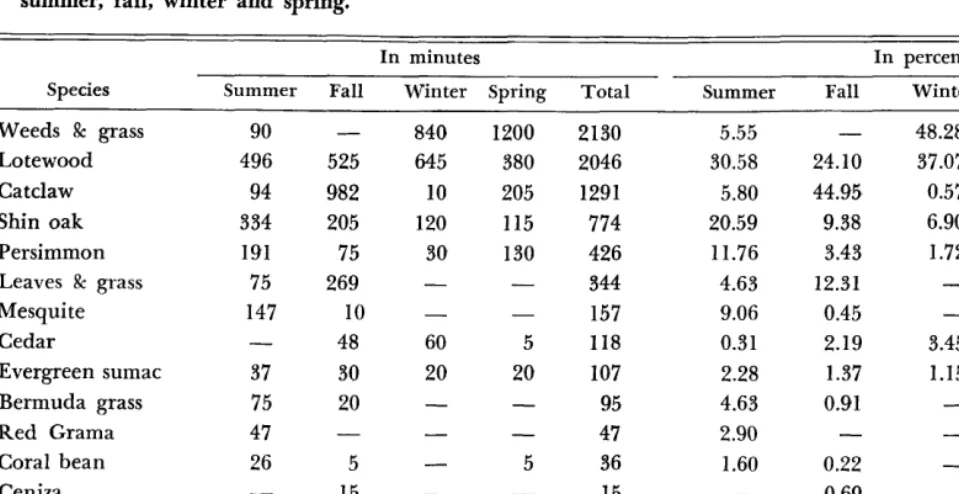
grass are shown as combined data in Table 2. The data were recorded in this manner because even under close observation of the grazing animals, it was difficult to deter- mine what they were grazing. A variety of immature plants that were not readily recognizable made the recording even more difficult. Table 2 presents data for all four goats. The feeding activities of the goats are recorded in minutes and in percentages of the total feeding time. All four goats spent most of their time graring weeds and grass. Goats A, B, C, and D grazed weeds and grass on the average of 39.ZG%, 25.84%, 21.59%, and 23.93% respec- tively, for the total feeding time for the combined observation pe- riods. Table 2 shows that the four goats, together, grazed weeds and grass on the average of 28% for the sixteen study periods. Under this category the major grasses, and weeds were as follows: wrights three-awn, six weeks grama (ISow trloua barb&a), and red grama as grasses, and lindheimer senna (Cas- sia lindheirneviana), wooly dog-weed (Dy.rsodia micropoides), tallow-weed (Plan/ago hell&), and Cmrin T-O-
84
ASKINS AND TURNER
Table 2. Summary of the feeding activities of the four goats in minutes and percentages of the total feeding time for summer, fall, winter and spring.
Weeds 8c grass Lotewood Catclaw Shin oak Persimmon Leaves & grass Mesquite Cedar
Evergreen sumac Bermuda grass Red Grama Coral bean Ceniza Dagger Sacahuista Oco till0 Total 90 496 94 334 191 75 147 - 37 75 47 26 - - - 5 1622 - 525 982 205 75 269 10 48 30 20 - 5 15 - - - 2184
840 1200 2130 645 380 2046
10 205 1291
120 115 774
30 130 426
- - 344
- - 157
60 5 118 20 20 107
- - 95
- - 47
- 5 36
- - 15
10 - 10
5 - 5
- - 5
1740 2060 7606
5.55 30.58 5.80 20.59 11.76 4.63 9.06 0.31 2.28 4.63 2.90 1.60 - - 0.31 100.00 - 24.10 44.95 9.38 3.43 12.31 0.45 2.19 1.37 0.91 - 0.22 0.69 - - 100.00
48.28 58.25 37.07 18.45 0.57 9.95 6.90 5.58 1.72 6.32
- - - - 0.57 0.29 - 100.00 - 0.24 0.97 - - 0.24 - - - 100.90 28.00 26.90 16.97 10.18 5.60 4.52 2.06 1.55 1.41 1.25 0.63 0.48 0.20 0.13 0.06 0.06 100.00
grass which were grazed on an aver- age of 4.52%. The table indicates
that leaves and grass were grazed mostly during the fall season. This was possibly caused from more leaves falling to the ground during that time of year. Under this category the major leaves consumed were persimmon, shin oak, lote- wood, and evergreen sumac. The grasses consumed were the same ones listed under weeds and grasses. Bermuda grass (Cynodon dactylon),
which grew around a dirt tank, was third in grazing importance and contributed an average of 1.25% to the total feeding time.
The second class, browsing, refers to the feeding by range livestock upon the buds, flowers, fruits, twigs, and foliage of those woody plants commonly recognized as trees or shrubs while these parts remain a part of the plant. This purposely excludes the feeding on fallen foliage and fruit, which was con- sidered as grazing. The oaks, sumacs, and the mesquite tree are common examples of browse plants. In this particular study lotewood, catclaw, and shin oak were the most important browse plants. Each will be discussed in order of importance.
Lotewood (Condalia obtusifolia)
is a rigid spiny and much-branched shrub, three to five feet high, of the buckthorn family. It is one of the most abundant shrubs in west- ern and southern Texas, and be- cause of this abundance and the fact that gotats browse its foliage, it is considered an excellent browse plant. The foliage is palatable, but protected by the stout, spinose branchlets of the shrub. Its flowers have petals and the leaves are green beneath and three-nerved at the base. Its fruit is small, black, fleshy, one-seeded, and edible, but not very palatable. Table 2 indi- cates that all four goats spent an average of 26.90% of the total feed- ing time for the combined observa- tion periods browsing upon the foliage of this plant. Goats A, B, and C consumed more lotewood during the observation periods than any of the other browse plants, while Goat D browsed slightly more catclaw; however, most of this was consumed during the fall of the year, whereas lotewood was con- sumed during all four seasons. It appears that all four goats utilized lotewood in a rather uniform man- ner throughout the seasonal periods.
Goats A, B, C, and D browsed lotewood on the average of 26.56%, 29.35%, 29.09%, and 22.73% respec- tively, of the total feeding time. The second most important browse plant was catclaw. Catclaw is a leguminous shrub armed with recurved spines. Its flowers, which are small, are grouped in a head or in a spike. The flowers have either 5 or 10 stamens. The foliage is relished by both goats and sheep, and in spite of the protection af- forded by its spines, it furnishes browse to a considerable extent. Table 2 indicates that all four goats spent an average of 16.97% of the total feeding time for the combined periods of observation, browsing upon catclaw. Average time spent feeding on catclaw for each in- dividual goat was 16.19%, ll.ll%,
17.330/o, and 23.76%. All four goats utilized more catclaw during the fall season and less during the winter season.
GOAT
BEHAVIOR
85
Table 3. Average general activities of the four goats in minutes and in percentages of the total activity for summer, fall, winter and spring.
Minutes Percent of time
Activity Summer Fall Winter Spring Total Summer Fall Winter Spring Total Resting (standing) 311.3 297.5 126.4 217.4 952.6 20.06
Resting (lying) 402.5 330.0 658.8 535.0 1926.3 25.93 Ruminating (standing)* 90.0 92.6 46.3 51.2 280.1 5.80 Ruminating (lying)* 161.3 62.5 93.8 62.4 380.0 10.39
Watering 0.8 0.8 0.1 2.2 3.9 0.05
Salting 2.4 2.8 10.1 10.8 26.1 0.16
Traveling 180.0 172.8 251.5 155.0 759.3 11.60 Feeding 403.7 546.0 435.0 515.0 1899.7 26.0 1
Total 1552.0 1505.0 1622.0 1549.0 6228.0 100.00
19.77 21.93 6.15 4.16 0.05 0.18 11.48 36.28
100.00
7.79 14.04 15.30 40.62 34.54 30.93 2.85 3.31 4.50 5.78 4.03 6.10 .Ol 0.14 0.06 .62 0.70 0.42 15.51 10.00 12.19 26.82 32.24 30.50
100.00 100.00 100.00
+ The ruminating standing and lying time is included with the resting standing and lying time.
twelve feet tall. The leaves are shal- lowly round-lobed, green and shin- ing above and transiently silvery beneath; the bark is gray to silvery brown and scales off in thin strips. Its acorns are about one-half inch long and are half-included in the cup. At certain times the shin oak appears to be a favorite browse plant for goats. During the four seasons, each of the four individual goats consumed shin oak on a rather uniform basis, just as they did lotewood, but in smaller quan- tity. Goats A and B spent 9.21% and 10.75% of their total feeding time browsing on shin oak, while goats C and D spent an average feeding time of 11.36% and 9.57% browsing on shin oak. Data in- dicate that little variation existed between the four goats while con- suming shin oak. The average total time spent feeding on shin oak for the four goats during the combined observation periods was 10.18%. This was 16.72% less than lotewood and 6.79% less than catclaw.
Other browse plants that were of small importance, but were in- cluded in the diet of the goats, are persimmon, mesquite, cedar, ever- green sumac, and coral bean (So-
phora secundiflora). Average total time spent browsing upon these plants by the four goats was 5.60%, 2.06%, 1.55%, 1.41%, and 0.480/o, respectively (Table 2). Plants that were consumed only in very small
amounts were sacahuista (NoEina texana), ceniza (Leuco~hyllum
fru-
tescens), dagger (Yucca torreyi), and ocotillo. Average total time spent browsing upon these plants by the four goats was .06%, .20%, .13%,and .06%, respectively. Data from the vegetative part of the study in- dicate that goats prefer lotewood, catclaw, shin oak, and persimmon, in that order as browse plants.
Feeding time
Feeding time is the time the animals spent on both grazing and browsing. The goats fed in a char- acteristic daily pattern throughout the study. The goats tended to feed in medium sized flocks, and while doing so traveled almost to the back of the pasture, where they made a wide circling turn back to their point of origin. Generally, if the goats started out in early morning from near the water supply, they would make one round trip and then return to water and salt. Each animal day was composed of two major feeding periods. The first major period began with rising about daylight and lasted until lo:30 a.m. Minor feeding periods followed, lasting about an hour each, and occurring around 1l:OO a.m. and 2:30 p.m. The second major period began about three hours before sunset and lasted until darkness. The four goats spent an average of 30.50% (516 min) of their
time feeding during the animal day (Table 3). This is a longer time than the 351 min reported by Cory (1927). On the average, the goats grazed less in the summer and more in the fall than any other time of the year. The former was possibly caused by high temper- atures, which forced the goats to remain in the shade for a longer period of time. The latter was probably caused by late summer rains which provided good forage cover during this time of year. This does not coincide with Cory’s (1927) data, when he reported goats to graze more in the winter and less in the fall. The difference here is possibly due to the condition of the range.
The effect of several extraneous factors on feeding time was con- sidered. Temperature seemed to have some effect. On very hot days the goats preferred to lie down under a shrub or tree until tem- peratures receded, then to graze until after dark and occasionally during the night.
86 ASKINS AND TURNER
that 34.4% of the feeding time throughout the four seasons of study was spent in grazing while 65.6% was spent in browsing.
Behavioral Activities of the Goats
Ruminating
Determination of ruminating time at night was the most difficult of all observations. Use of a flash- light occasionally disturbed the goats; they either stopped rumi- nating and stared in the direction of the light of they walked away. This difficulty undoubtedly intro- duced errors in the results. Total ruminating time for the four goats comprised about 10.60% of the 24 hr activities for the combined obser- vation periods. A division of the ruminating time for the goats was as follows: 4.50% while standing and 6.10% while lying down (Table 3). Total ruminating time for each individual goat was 11.05% (2.70% standing; 8.35% lying), 12.33% (7.08% standing; 5.25% lying), 9.97% (5.4% standing; 4.50% lying), and 8.86% (2.53% standing; 6.33% lying). Data from Table 3 indicate that the goats did most of their ruminating while standing in the summer months and least in the winter months; this is possibly due to the shortness of the days in the winter, which does not permit as much time for ruminating and conse- quently more of it is done while resting at night. The goats were observed ruminating early in the morning, during the day, and after bedding down at night. The results are in agreement with those from Cory’s study in 1927.
Resting
The data on resting were re- corded as that time when the goats ceased all their activities and laid down to rest, or stood idle. For the combined observation periods of the four goats, 46.23% of the total time was spent resting. Of this, 15.30% was spent while stand- ing, and 30.93% while lying down (Table 3). Goats A, B, C, and D spent total average resting times of 44.56%, 48.43%, 46.48%, and
35.25%, respectively. Table 3 pre- sents data indicating that the goats rested most in the winter months and least in the fall months, and more in the spring than in the summer months. This does not agree with Cory’s data stating that goats do most of their resting in the summer months and least in the winter months. However, both studies do agree on the fact that goats rest more in the spring than in the fall. The difference that exists here could be caused by cli- matic conditions, the condition of the range, the differences in the time that the goats were shorn of their fleeces, or to the variability between individual goats.
During the summer months high temperatures caused the goats to seek protection from the sun by bedding down under some shade tree. At times the animals would remain in the shade for five or six hours during the heat of the day. Nevertheless, when this occurred the animals prolonged their feed- ing activities well along into the night. This is possibly the reason that time spent on summer resting was not any larger. The goats spent most of their resting time lying down in the winter (40.62%) and the least in the fall (21.93%) while they spent most of their resting time (standing) in the sum- mer (20.06%) and the least in the winter (7.75%). The goats were shorn of their fleeces in late sum- mer; this possibly caused the ani- mals to spend more time resting while standing during the summer and early fall periods.
Traveling
Traveling was considered as that time spent walking or running from one place to another. The average daily distance traveled for the four goats was approximately 2.8 miles. Most of the traveling was added when the animals grazed and browsed near the water sup ply. According to Cory (1927), the greater amount of travel by goats is due to the flock’s remaining only a short while in any one locality, no matter how good the feeding
may be. Results from this study agree with Cory’s previous state- ment. Only when the goats were browsing on catclaw and lotewood, did they stay in any one locality for a long period of time. The goats traveled their greatest dis- tance, an average of 3.4 miles, in the winter, as compared to their shortest distance, which was 2.2 miles in the spring. The data agree with Cory’s results, with the ex- ception of the winter period. Cory’s results indicate that goats travel less during the winter period, whereas this study indicates that the animals travel more during the winter period. The variation that exists here is most likely caused by the quantity, as well as the quality of the range forage.
The goats spent 188 min or 12.19% of their 24-hr day traveling (Table 3). The greatest amount of the time spent traveling was during the winter months (251.5 min), and the least during the spring months (155.0 min).
Watering
On a percentage basis for the combined observation periods, the goats spent 0.06% of the animal day drinking water. This is an average of 0.9 min, which is identical with the data reported by Cory (1927). The goats spent most time drinking water in the summer months and the least in the winter months, and more in the spring months than in the fall months. These data also coincide with the results from Cory’s study. Apparently a larger amount of water was drunk during the summer months because of high air temperatures.
the day there, and then return to water and salt during the late afternoon.
Salting
occurred in the spring and least in the winter. The significant differ- ence that occurs here is likely caused by the changes in moisture content of the plants.
Whenever the animals drank water, they also salted from blocks of plain salt located about one hundred feet from the water trough. The goats very seldom licked salt without first drinking water. The average frequency of salting was the same as for drinking, two times daily. The goats licked salt an average of 6.7 min per day or 0.42% of their daily activity. This was 50% more time spent salting than the 3 min reported by Cory (1927). There was a highly signifi- cant difference between the four goats in the time spent on salting. The average time ranged from 3.73 to 10.2 min per day.
Summary and Conclusion A study was conducted on the behavior of Angora goats to deter- mine the type of vegetation con- sumed and the amount of time spent ruminating, watering, salting, traveling, resting, feeding, defecat- ing, and urinating.
Generally the goats walked di- rectly from the pasture to water, and after drinking, walked to the salt block and licked for a few minutes. After licking salt the goats performed other activities such as grazing, ruminating, or resting. The goats took more salt in the spring and winter months, and less in the summer and fall months. This is in parital agree- ment with Cory’s data, when he reported goats taking most salt in the winter months.
The goats tended to follow a sys- tematic behavioral pattern through- out the study period. They began their day by rising, standing idle, and ruminating for a short period of time. This was followed by a feeding period which lasted about three hours. Then a short rest period elapsed, lasting about 30 min, which was followed by a feed- ing period extending until noon. At this time the goats would par- take of water and then recline under a shade tree until approxi- mately three hours before sunset. During this three hours, the animals continued to feed until darkness, when they again took water and salt and then retired for the night.
Defecating and urinating
The goats defecated an average of 3.4 times per day for the total observation periods. Data were col- lected which indicated that the ani- mals defecated most in the spring months. Apparently, this was caused from good forage conditions during this time of year.
The goats spent approximately 12.19% of the day in travel, which is equivalent in time to 189 min. The average daily distance traveled by the goats was 2.8 miles.
The time occupied in the feeding activity for the goats was second to resting time. Feeding activities took 30.50% or 474 min of the ani- mal’s allotted day.
Time spent salting was 0.42% of the animal day consuming water. This is equivalent to 0.9 min in time.
The goats urinated an average All range livestock, in the course of 5.0 times per day. Most urinating of the day, will stand idle or lie
GOAT BEHAVIOR
87
down to rest, and frequently there may be repetitions of this action. Average time spent resting by the four goats for the 24-hr day was 46.23% or 719 min.
Data for rumination, as in rest- ing, include both standing and lying time. Approximately 10.60% of the day was spent by the goats at ruminating, the equivalent in time being 165 min.
Grazing formed slightly more than one-third of the total feeding time for the goats. Weeds and grass were the most commonly grazed plants. Time spent in graz- ing these plants was 28% of the total feeding time.
Browsing constituted approxi- mately two-thirds of the total feed- ing time for the goats. Twelve species were recognized separately as browse plants. Lotewood sup- plied slightly less than one-half of the total browse consumed by the goats.
On the average, defecations and urinations occurred 3.4 and 5.0 times, respectively, for the com- bined observation periods.
Literature Cited
CORY, v. L. 1927. Activities of live- stock on the range. Texas Agr. Exp. Sta. Bull. 367.
HUGHES, G. P., AND D. REID. 1951. Studies on the behavior of cattle and sheep in relation to the utiliza- tion of grass. J. Agr. Sci. 41:350. JOHNSTONE-WALLACE, D. B., AND KEITH
KENNEDY. 1944. Grazing manage- ment practices and their relationship to the behavior and grazing habits of cattle. J. Agr. Sci. 34:191.
STRASIA, C. A., M. THORN, R. W. RICE, AND D. R. SMITH. 1970. Grazing habits, diet and performance of sheep on alpine ranges. J. Range Manage. 23:201-208.
SpecSsfs in Qualify N AT I V E G
R A
S S E S
Wheatgrasses l Bluestems l Gramas l Switchgrasses l Lovegrasses l Buffalo l and Many Others We grow, haruest, process these seeds Native Grasses Harvested in ten States
YouC Inquiries
Appreciated
SHARP BROS. SEED CO.
Influence of Competition on the
Response of BluebAch Wheatgrass
to Clipping1
W. F. MUEGGLERZ
Principal Plant Ecologist, Intermountain Forest and Range Experiment Station, Forest Service,
U.S. Department of Agriculture, Ogden, Utah
Highlight
Partial reduction of competition from surrounding vege- tation more than doubled the total herbage and tripled the number of flower stalks produced the following year by bluebunch wheatgrass (Agropyron spicatum). Elimina- tion of competition resulted in a sixfold increase in herbage production and a tenfold increase in number of flower stalks. The relative depressant effects of clipping were significantly reduced by concurrent reductions in com- petition. The beneficial effects of partial reduction of competition offset the adverse effects of heavy clipping, and elimination of competition more than offset the effects of extreme clipping. Number of flower stalks is a more sensitive indicator of vigor than total herbage production. Average flower stalk and foliage culm lengths are not useful indicators of vigor.
The effects of herbage removal on range plants has been studied by many investigators. Reviews by Ellison (1960) and Jameson (1963) thoroughly cover this subject. Bluebunch wheatgrass (Agro- pyron spicatum) has been the object of much of this study because of its importance as forage on many western ranges (e.g., McIlvanie, 1942; Stod- dart, 1946; Blaisdell and Pechanec, 1949; Heady,
1950; Branson, 1956; and Wilson et al., 1966). Such studies have concerned in tensi ty, frequency, and time of clipping. All of these influence the severity of adverse response to clipping.
We know, however, that the amount of compe- tition from surrounding vegetation can have a pro- nounced effect on the outcome of clipping studies. Jameson (1963) points out that when plots rather than individual plants are clipped, it is extremely difficult to tell whether a plant’s response is to the clipping of its herbage or to changes in competition from surrounding vegetation. This complication was evident in a study on the effects of time of clip- ping on mountain grassland species in Montana (Mueggler, 1967). On the other hand, it is unlikely that the clipping response of isolated plants lacking competition from surrounding vegetation will be equivalent to the response of plants grazed on the range. Obviously, we need to understand the rela-
1 Received April 24, 1971.
2 Author stationed in Bozeman, Montana, at Forestry Sci- ences Laboratory, maintained in cooperation with Mon- tana State University.
tive effects of clipping, of competition, and of their interaction to reliably interpret the direct effects of clipping.
The effects of competition on plant growth are known in a general way, but this factor seldom has been evaluated in clipping studies. Risser (1969), in a review of competition studies, concludes that the yield per plant invariably decreases with in- creasing plant density and that widely spaced plants generally produce the maximum number of seeds per individual. In other words, competition is a definite restraint on the herbage and seed yields of individual plants. From studies involving bluebunch wheatgrass, Daubenmire ( 1940) con- cluded that competition checks the stature of even the most dominant plants in a natural community.
Recently, I published the results of a study eval- uating the combined effect of competition and clipping on Idaho fescue (Festuca idahoensis) that clearly demonstrates competition’s suppressing ac- tion (Mueggler, 1970). I concluded that the detri- mental effects of clipping Idaho fescue decline progressively as competition decreases.
This paper reports results of a similar study on bluebunch wheatgrass. It shows the influence of competition on the ability of this grass to with- stand heavy and extremely heavy clipping.
Methods
The study area, a natural mountain grassland in south- western Montana, was ‘on a gently sloping, north-facing swale, approximately 6,000 ft in elevation. The granitic soils were fairly deep and productive. Precipitation 2 miles north of the study area and about 1,000 ft lower in elevation averages 15% inches per year, of which approxi- mately 70% falls from April through September. Effective precipitation on the study area was somewhat greater than this as was evidenced by the more luxuriant growth of vegetation.
The vegetation was dominated by bluebunch wheat- grass, Idaho fescue, and silvery lupine (Lupinus argenteus). Secondary species included yarrow (Achilles millefolium), cerastium (Cerastium arvense), prairiesmoke (Geum tri- florum), needlegrass (Stipa columbiana), sagewort (Arte- misia Zudoviciana), rabbitbrush (Chrysothamnus nauseosus), and pussytoes (Antennaria rosea). Ground cover was rela- tively continuous and little bare soil was exposed, in con- trast to conditions usually found on drier sites dominated by bluebunch wheatgrass. Moreover, plants competing with bluebunch wheatgrass were generally more numerous in quantity and variety than those usually found on drier sites. The vegetation was protected from grazing for 1 year prior to and during the study and had been grazed only moderately earlier.
One hundred and thirty-five mature, vigorous bluebunch wheatgrass plants were selected for study. Selection was based on uniformity of size and vigor and of associated vegetation. All plants were medium-sized bunches; none had the large, coarse “wolfish” characteristics sometimes found in more open stands. Selected plants were ran- domly assigned to nine separate treatments that yielded 15 replications per treatment.
INFLUENCE OF COMPETITION 89
50 -
40 - G 5 2 35- rr,
5 30- u EJ ! 25 -
Clipping
a No
Heavy
Extreme
NO COMPETITION PARTIAL COMPETITION FULL COMPETITION
FIG. 1. Production of bluebunch wheatgrass under different levels of competition the year following clipping. (Column third from the right represents control plants-full com- the same letter do not
petition, no clipping. Columns having differ significantly [P > .05]).
The nine treatments consisted of all combinations of three levels of competition and three levels of clipping. The levels of competition, full, partial, and no competi- tion, were created immediately prior to the clipping treat- ments. Full competition was obtained by permitting the natural vegetation to remain undisturbed Brbund the blue- bunch wheatgrass plants selected for this treatment.
The degree of partial competition was created by clip- ping to ground level all vegetation within a 90-cm radius of the selected bluebunch wheatgrass plants. The clipped material was removed from the plot. This was done with- out disturbing the soil or directly harming the root crowns of the competing vegetation, which was permitted to re- grow without further hindrance. The degree of no com- Petition was achieved by tilling the soil 5- to S-cm deep within a 90-cm radius of the selected bluebunch wheat- grass plants. The soil immediately adjacent to the plants was carefully hoed to effectively remove all competing vegetation. Tilled areas were weeded periodically during the study to maintain competition-free conditions. Con- ceivably, such tillage might- also have affected aeration, infiltration, and nitrogen - availability within the soil, which in turn could have affected subsequent growth of study plants.
The three levels of clipping bluebunch wheatgrass were no, heavy, and extreme. An unclipped control constituted the no-clipping level. The heavy level of clipping consisted of removing 50% of the herbage weight just before full emergence of the flower stalks (June 25). This growth stage is generally recognized as being within the period when bluebunch wheatgrass is most sensitive to clipping (McIlvanie, 1942; Blaisdell and Pechanec, 1949; Wilson et al., 1966). Removal of approximately 50% of the plant’s weight was achieved by clipping to a stubble height equal to 28% of the plant’s height (Heady, 1950). Extreme clip- ping was achieved by removing 50% of the herbage weight just before flower stalk emergence, followed by clipping regrowth to a uniform 8-cm stubble height when the con- trol plants were at the seed-in-dough developmental stage
90 -
80 - 5 4 TO-
O
z
60- Y2
ii I%-c g 40-
= 30- t;
2 9 20-
2 lo-
0,
Clipping
II3 No
Heavy
Extreme
NO COMPETITION PARTIAL COMPETITION FULL COMPETITION
FIG. 2. Flower stalk numbers of bluebunch wheatgrass under different levels of competition the year following clipping.
(Column third from the right represents control plants-full competition, no clipping. Columns having the same letter do not differ significantly [P > .05]).
(July 17). The plants were clipped during the one grow- ing season only.
The response of bluebunch wheatgrass was determined after flowering 1 year following treatment (clipping) by counting vegetative and flower stalk culms and by measur- ing maximum and average lengths of those culms. An in- direct method of determining weight was necesitated to preserve the treated plants for further study. Average weights of individual culms bv length classes were deter- mined from samples collected ‘from”nearbv plants not in-
developed for L flowering and foliage dry weights from culm lengths. These equations were used to compute the dry weight of each cluded in the study. Regression eauations with r* values exceeding .97 were
culms to derive culm
bluebunch wheatgrass plant* from the number and the average length of culms per plant. The data were then subjected to analyses of variance. Wherever appropriate, individual treatment means were compared by the Keuls sequential range test (Snedecor, 1956).
Red ts
90 MUEGGLER
Table 1. Maximum flower stalk and foliage culm lengths
(cm) of bl b unch wheatgrass the year following clipping ue Table 2. Percentage of bluebunch wheatgrass plants pro- and competition treatments. ducing flower stalks the year following clipping and competition treatments.
Competition Treatment No Partial Full Maximum flower stalk lengths
No clipping 58al 58a 52a
Heavy clipping 55a 43bc 37c
Extreme clipping 49ab 36c 38c
Maximum foliage culm length
No clipping 33e 33e 35de
Heavy clipping 38d 33e 33e
Extreme clipping 35de 31e 32e lNumbers having the same letter do not differ significantly
(P > .05).
Clipping No
No 100
Heavy 100
Extreme 100
Competition Partial
100 100
40
Full 80
53 20
the length of foliage culms or the length of flower stalks (Table 1).
Bluebunch wheatgrass subjected to the com- bined stress of heavy clipping and full competition produced 43% less herbage and 95% fewer flower stalks the following year than were produced by unclipped plants growing under full competition. Extreme clipping reduced production 72% and flower stalk numbers 97%. The maximum length of flower stalks was reduced approximately 25% by both clipping treatments, but foliage culm length was not significantly affected.
reduced significantly by clipping plants growing under full and partial competition, clipping did not cause a significant reduction in stalk lengths of plants without competition. This agrees well with the data on herbage production and flower stalk numbers. It reinforces the conclusion that the effects of clipping by itself are not as harmful to bluebunch wheatgrass when it is growing free from competition as when it is surrounded by competing vegetation.
Interaction between the competition and clip- ping treatments significantly affected herbage pro- duction and flower stalk numbers. Although this interaction was not great (less than 3% of the ac- countable variance), it tended to reduce the rela- tive effects of clipping as competition declined. The relative effects of clipping on production were approximately the same under full and par- tial competition; heavy clipping reduced produc- tion 38% and extreme clipping reduced it 75%. However, where competition was eliminated, heavy clipping reduced production only 29% and extreme clipping reduced production only
57%.
Effects of clipping on flower stalk numbers less- ened progressively as competition was reduced. Heavy clipping of plants growing under full com- petition reduced the number of flower stalks 95%, of those under partial competition 68%, and of those without competition only 50%. (Flower stalk numbers on clipped plants were compared to those of unclipped plants growing under the same levels of competition.) Extreme clipping of plants grow- ing under full competition reduced flower stalk numbers 97%, 95% under partial competition, and 79% under no competition.
Only 80% of the unclipped plants growing under full competition flowered (Table 2). Clipping greatly reduced this percentage. Heavy clipping under full competition affected plants more se- verely than the data suggest; most of the 53% of the plants that flowered produced only one flower stalk per plant. Few plants growing under full competition flowered after extreme clipping. All plants flowered under partial competition, except those in the extreme clipping group; only 40% of the latter managed to send up flower stalks the year following treatment. All plants clipped under competition-free conditions flowered the follow- ing year.
Discussion
These data show that natural competition se- verely restricts the growth and vigor of bluebunch wheatgrass. The more than doubling of herbage production the following growing season because of a partial reduction in competition is similar to but somewhat greater than that shown by Mueg- gler (1970) for Idaho fescue. The number of flower stalks more than tripled in both cases. How- ever, Daubenmire (1940) found that in eastern Washington bluebunch wheatgrass released from competition by ground level clipping did not re- spond appreciably until the treatment was repeated for 3 successive years. The reason for this lag in response is speculatory, but it could have resulted from differences in associated vegetation, weather, or because a smaller area of surrounding vegetation was clipped.
Interaction also occurred between the two treat- ments as they affected flower stalk lengths. Al- though the maximum length of flower stalks was