F
L I P
I
T
: The Game of “Stealthy Takeover”
Marten van Dijk
∗Ari Juels
†Alina Oprea
‡Ronald L. Rivest
§February 26, 2012
Abstract
Recent targeted attacks have increased significantly in sophistication, undermining the fundamental assumptions on which most cryptographic primitives rely for security. For instance, attackers launching an Advanced Persistent Threat (APT) can stealfullcryptographic keys, violating the very secrecy of “secret” keys that cryptographers assume in designing secure protocols. In this article, we introduce a game-theoretic framework for modeling various computer security scenarios prevalent today, including targeted attacks. We are particularly interested in situations in which an attacker periodically compromises a system or critical resourcecompletely, learns all its secret information and is not immediately detected by the system owner ordefender.
We propose a two-player game between an attacker and defender calledFL I PIT or The Game of “Stealthy Takeover.” InFL I PIT, players compete to control a shared resource. Unlike most existing games,FL I PITallows
players to move at any given time, taking control of the resource. The identity of the player controlling the resource, however, is not revealed until a player actually moves. To move, a player pays a certain move cost. The objective of each player is to control the resource a large fraction of time, while minimizing his total move cost. FL I PIT
provides a simple and elegant framework in which we can formally reason about the interaction between attackers and defenders in practical scenarios.
In this article, we restrict ourselves to games in which one of the players (the defender) plays with arenewal strategy, one in which the intervals between consecutive moves are chosen independently and uniformly at random from a fixed probability distribution. We consider attacker strategies ranging in increasing sophistication from simple periodic strategies (with moves spaced at equal time intervals) to more complexadaptive strategies, in which moves are determined based on feedback received during the game. For different classes of strategies employed by the attacker, we determinestrongly dominantstrategies for both players (when they exist), strategies that achieve higher benefit than all other strategies in a particular class. When strongly dominant strategies do not exist, our goal is to characterize the residual game consisting of strategies that are not strongly dominated by other strategies. We also prove equivalence or strict inclusion of certain classes of strategies under different conditions.
Our analysis of differentFL I PITvariants teaches cryptographers, system designers, and the community at large some valuable lessons:
1. Systems should be designed under the assumption of repeated total compromise, including theft of crypto-graphic keys.FL I PITprovides guidance on how to implement a cost-effective defensive strategy.
2. Aggressive play by one player can motivate the opponent to drop out of the game (essentially not to play at all). Therefore, moving fast is a good defensive strategy, but it can only be implemented if move costs are low. We believe that virtualization has a huge potential in this respect.
3. Close monitoring of one’s resources is beneficial in detecting potential attacks faster, gaining insight into at-tacker’s strategies, and scheduling defensive moves more effectively.
Interestingly,FL I PITfinds applications in other security realms besides modeling of targeted attacks. Examples include cryptographic key rotation, password changing policies, refreshing virtual machines, and cloud auditing.
Keywords:FL I PIT, security modeling, game theory, advanced persistent threats, repeated stealthy takeovers
∗RSA Laboratories, Cambridge, MA, USA; e-mail:[email protected] †RSA Laboratories, Cambridge, MA, USA; e-mail:[email protected]
‡RSA Laboratories, Cambridge, MA, USA; e-mail:[email protected]; tel.: 617-300-7318,
§Computer Science and Artificial Intelligence Laboratory, Massachusetts Institute of Technology, Cambridge, MA, USA; e-mail:
Contents
1 Introduction 2
2 Game Motivation 7
2.1 Game definition by example . . . 7
2.2 Motivating Applications . . . 8
2.2.1 Advanced Persistent Threats (APTs)–a macro-level game . . . 8
2.2.2 Micro-level games . . . 9
2.2.3 Other applications . . . 10
3 Formal Definition and Notation 11 4 Renewal Games 15 4.1 Playing periodically . . . 16
4.2 General renewal strategies . . . 18
4.3 The residual renewal game . . . 21
4.4 Renewal games with an RP attacker . . . 22
5 LM Attacker 22 5.1 Game definition . . . 23
5.2 Defender playing periodically . . . 23
5.3 Defender playing exponentially . . . 24
5.4 Defender playing with delayed exponential distribution . . . 26
5.5 Experimental evaluation of different defender strategies . . . 26
6 The Greedy strategy for an LM attacker 28 6.1 Algorithm definition . . . 28
6.2 Defender playing exponentially against Greedy . . . 28
6.3 Defender playing periodically against Greedy . . . 29
6.4 Defender playing by the uniform distribution against Greedy . . . 29
6.5 Greedy doesn’t always result in dominant strategies! . . . 30
6.6 Other Greedy variants . . . 31
7 General variations and extensions 31
8 Related Work 32
A Analysis of renewal games 35
B Analysis of renewal defender against LM attacker 43
C Analysis of the LM Greedy algorithm against an uniform defender 45
1
Introduction
persistent for long periods of time in a system, advancing stealthy and slowly to maintain a small footprint and re-duce detection risks. Typically, APTs exploit infrastructure vulnerabilities through an arsenal of zero-day exploits and human vulnerabilities through advanced social engineering attacks.
When designing security protocols, cryptographers and computer security researchers model adversarial behavior by making simplifying assumptions. Traditional cryptography relies for security on the secrecy of cryptographic keys (or of system state). Modern cryptography considers the possibility of partial compromise of system secrets. Leak-age resilientcryptography, for instance, constructs secure primitives under the assumption that a system is subject to continuous, partial compromise. But in an adversarial situation, assumptions may fail completely. For instance, attackers launching an APT can steal full cryptographic keys, crossing the line of inviolate key secrecy that cryptogra-phers assume in designing primitives. Assumptions may also fail repeatedly, as attackers find new ways to penetrate systems.
In this paper, motivated by recent APT attacks, we take a new perspective and develop a model in which an attacker periodically compromises a systemcompletely, in the sense of learning its entire state, including its secret keys. We are especially interested in those scenarios where theft isstealthyorcovertand not immediately noticed by the victim. We model these scenarios by means of a two-player game we callFL I PIT, a.k.a., The Game of“Stealthy Takeovers”.
FL I PIT is a two-player game with a shared resource that both players (called herein attackeranddefender) wish to control. The resource of interest could be, for instance, a secret key, a password, or an entire infrastructure, depending on the situation being modeled. Players take control of the resource by moving, and paying a certain move cost, but unlike most existing games, players do not necessarily alternate turns. InFL I PITplayers instead can move at any given time. Most importantly,a player does not immediately know when the other player moves! A player only finds out about the state of the system when she moves herself. This stealthy aspect of the game is a unique feature of
FL I PIT, which to the best of our knowledge has not been explored in the game theory literature. The goal of each player is to maximize a metric we callbenefit, defined as the fraction of time the player controls the resource minus the average move cost. A good strategy for a given player, therefore, is one that gives the player control of the resource a large fraction of the time with few moves.
Our main goal in this paper is to find best-choice (ideallydominantorstrongly dominant) playing strategies for different variants of theFL I PIT game that achieve maximum benefit for each player. An instance ofFL I PIT is determined by the information players receive before the game, the feedback players obtain while playing the game, and a space of strategies or actions for each player. We have created a hierarchical graphical representation of different classes of strategies for one player in Figure 1. The strategies are ordered (from top to bottom) by increasing amount of feedback received by a player during the game. As we move down the hierarchy, we encompass broader classes of strategies. In the paper, we prove results about the equivalence of different classes of strategies, (strongly) dominant and dominated strategies within a particular class, and strict inclusion of a class in a broader class. We also characterize the residual game consisting of strategies that are not strongly dominated. We detail below severalFL I PITinstances that we define and analyze, and then describe the theoretical results proven in the paper, as well as the results based on experimental evidence. We also discuss some of our conjectures regarding the relationship among different classes in the hierarchy, leading to some challenging open problems.
Categories Classes of Strategies
Non-adaptive (NA) Exponential Periodic Renewal General non-adaptive Adaptive (AD) Last move (LM)
Full history (FH)
Figure 1: Hierarchy of strategies inFL I PIT.
FL I PITinstances Broadly, as graphically shown in Figure 1, we define two main classes of strategies for a player:
In the class of non-adaptive strategies, one subclass of particular interest is that ofrenewal strategies. For a player employing a renewal strategy, the intervals between the player’s consecutive moves are independent and identically distributed random variables generated by arenewal process. Examples of renewal strategies include: theperiodic
strategy in which the interval between two consecutive moves is fixed at a constant value and theexponentialstrategy in which the intervals between consecutive moves are exponentially distributed. The moves of a player employing a non-adaptive (but possibly randomized) strategy can be determined before the game starts, as there is no feedback received during the game.
In the class of adaptive strategies, we distinguish a subclass calledlast-moveorLM, in which the player finds out upon moving the exact time when his opponent moved last. In a general adaptive strategy, a player receives upon moving complete information about his opponent’s moves (this is called full-history or FH). Classes LM and FH collapse in some cases (for instance when the opponent plays with a renewal strategy).
A further dimension to a player’s strategy is the amount of information the player receives before the game starts. Besides the case in which the player receives no information about his opponent before the game, other interest-ing cases are: (1) rate-of-play (or RP), in which the player finds out the exact rate of play of his opponent; (2)
knowledge-of-strategy(KS), in which the player finds out full information about the strategy of the opponent (but not the opponent’s randomness).
Contributions and results Our first contribution in this paper is the definition of theFL I PITgame, and its applica-tion to various computer security scenarios, including APTs. We viewFL I PITas a theoretical framework that helps provide a foundation for the science of cyber-security.
We then analyze several instances of the game of increasing sophistication and complexity. Our main theoretical and experimental results, as well as conjectures, and remaining open questions are summarized in Table 1. To simplify the exposition, we present results for the case when the attacker is more powerful than the defender and organize these results according to the strength of the attacker. Since the game is symmetric, though, analogous results apply when the defender is more powerful than the attacker. In this article, we restrict ourselves to games in which the defender plays with a renewal strategy. We have analyzed broader classes of defensive strategies (including general non-adaptive and adaptive with limited feedback), but defer the presentation of these results to follow-up work.
To elaborate, we start by analyzing the simple game in which both players employ a periodic strategy with a random phase. (In such a strategy, moves are spaced at equal intervals, with the exception of the first randomly selected move called thephase.) We compute the Nash equilibrium point for the periodic game and show that the benefit of the player with higher move cost is always 0 in the Nash equilibrium. When move costs of both players are equal, players control the resource evenly and both achieve benefit 0.
We next consider a variant ofFL I PIT in which both players play with either a renewal or periodic strategy with random phase. We call such gamesrenewal games. Our main result for the renewal game (Theorem 4) shows that the periodic strategy with a random phase strongly dominates all renewal strategies of fixed rate. Therefore, we can completely characterize the residualFL I PIT game when players employ either renewal or periodic strategies with random phases. It consists of all periodic strategies with random phases.
We also analyze renewal games in which the attacker receives additional information about the defender at the beginning of the game, in particular the rate of play of the defender. For this version of the game, we prove that The-orem 4 still holds, and periodic strategies are strongly dominant. Additionally, we determine in TheThe-orem 5 parameter choices for the rates of play of both attacker and defender that achieve maximum benefit.
Attacker Strategy classes Results Open problems category Attacker Defender
NA Periodic Periodic Full analysis
Nash equilibrium (Theorem 1) Renewal Renewal Strong dominance of periodic strategies
(Theorem 4)
General NA General NA Which strategies are (strongly)
dominant or dominated? NA+ Renewal Renewal Strong dominance of periodic strategies
Additional RP (Theorem 4)
information Optimal parameters (Theorem 5)
before the Renewal Renewal Strong dominance of periodic strategies
game RP RP (Theorem 4)
General NA General NA Which strategies are (strongly)
RP or KS (RP) dominant or dominated?
AD LM Periodic The periodic strategy is
strongly dominant for attacker Exponential The periodic strategy is strongly
dominant for attacker (Theorem 6) Optimal parameters (Theorems 7 and 8)
Delayed Strongly dominant attacker strategy Theoretical analysis for benefits
exponential (Theorem 9)
Defender’s benefit increases compared to exponential (Experimental)
Renewal Which renewal strategies are (strongly)
dominant or dominated for the defender? Which LM strategies are (strongly) dominant or dominated for the attacker?
LM Which strategies are (strongly) dominant or
dominated for attacker and defender? Does cooperation help? Greedy Renewal Analyzed for several defender distributions For which classes of defender strategies
Strongly dominant strategy for is Greedy a dominant strategy? exponential defender
Table 1: Paper main results and open problems. Notations used in the table are: NA – non-adaptive strategies; AD – adaptive strategies; LM – last-move strategies; RP – NA strategies with rate-of-play information about opponent; KS – NA strategies with knowledge-of-strategy information about opponent.
parameters that optimize both players’ benefits) for both the exponential defender and periodic attacker distributions in Theorems 7 and 8 .
For both non-adaptive and fully adaptive attacker strategies, we show that by playing periodically at sufficiently high rate, the defender can force the attacker to drop out of the game. The move cost of the defender needs to be significantly lower than that of the attacker, however, for such a strategy to bring benefit to the defender. This demonstrates that the player radically lowering his move cost relative to his opponent obtains a high advantage in the game and can effectively control the resource at all times.
We propose an enhancement to the exponential distribution employed by the defender, a strategy that we call
defender could further increase her benefit?; Is there a strongly dominant strategy for the defender in the class of all renewal strategies against an LM attacker?
Lastly, we explore a Greedy algorithm in which the attacker’s moves are chosen to maximize thelocal benefit
achieved in an interval between two consecutive attacker moves. We analyze the Greedy strategy for several renewal defender strategies and demonstrate that it results in the strongly dominant strategy for an exponential defender strat-egy. We also show one example for which the Greedy strategy does not result in a dominant strategy for the attacker. We leave open the challenging problem of which strategies are (strongly) dominant for an LM attacker against partic-ular classes of defender strategies (e.g., renewal strategies).
Lessons derived fromFL I PIT Our analysis ofFL I PIT teaches cryptographers, system designers, and the com-munity at large some valuable lessons:
1. Systems should be designed under the assumption of repeated total compromise, including theft of cryptographic keys. Many times, attackers cross the line of secrey cryptographers assume in their protocol designs. This view has already been expressed by the head of the NSA’s Information Assurance Directorate [34]: “No computer network can be considered completely and utterly impenetrable—not even that of the NSA. NSA works under the assumption that various parts of their systems have already been compromised, and is adjusting its actions accordingly.”
FL I PITprovides guidance on how and when to implement a cost-effective defense. For instance, our analysis can help defenders determine when they should change cryptographic keys or user credentials, and how often should they clean their machines or refresh virtual machine instances.FL I PITanalysis, conversely, also guides attackers in how to schedule their attacks to have maximal effect, while minimizing attack cost.
2. Aggressive play by the defender can motivate the attacker to drop out of the game (and essentially not to play at all). The best defensive strategy, therefore, is to play fast (for instance by changing passwords frequently, rebooting servers often, or refreshing virtually machines at short intervals) and make the opponent drop out of the game. To be able to move fast, the defender should arrange the game so that her moves cost much less than the attacker’s moves.
An interesting research challenge for system designers is how to design an infrastructure in which refresh/clean costs are very low. We believe that virtualization has huge potential in this respect.
3. As we have shown in our theoretical analysis, any amount of feedback (even limited) received during the game about the opponent benefits a player inFL I PIT. Defenders, therefore, should monitor their systems frequently to gain information about the attacker’s strategy and detect potential attacks quickly after take over. Both monitoring and fast detection help a defender more effectively schedule moves, which results in more control of the resource and less budget spent on moves, increasing the defender’s benefit.
Conjectures and open problems In this paper, we have introduced a new framework, reflected in theFL I PIT game, for modeling different cyber-security situations. TheFL I PIT game is unique in the game theory literature mostly for its stealthy aspect and continuous-time play. We have proved some interesting results about different vari-ants of the game, and the relationships among several classes of strategies. Nevertheless, many interesting questions remain to be answered in order to understand fully all facets of this simple (but challenging-to-analyze) game. We elaborate here on some of the more interesting open problems we have identified, and also state some conjectures for whose truth our results provide strong evidence.
2. In the case in which the attacker receives additional information about the defender at the beginning of the game (e.g., the rate of play of the defender or extra information about the defender’s strategy) and both players employ non-adaptive strategies, which strategies are best choices for both players? From this class of games, we analyzed the renewal game in which one player receives RP information and the other receives no information, RP, or KS. We leave open the analysis of other instances ofFL I PITin this class.
3. We believe that the most interesting open questions arise in the case in which one player (e.g., the attacker) is adaptive. Here we enumerate several of them:
- When the attacker is LM, which renewal strategies for the defender are (strongly) dominant?
- Which LM strategies are (strongly)dominant against a renewal defender?
- For which class of defender strategies is the Greedy algorithm (strongly) dominant for an LM attacker?
- When the attacker is LM, the relationship between the non-adaptive and adaptive classes for the defender is not completely understood. We have though strong evidence (also deferred to follow-up work) to state the following conjecture:
Conjecture 1 Consider an instance of FL I PIT with an LM attacker. Then the defender receiving feedback during the game and playing with an adaptive strategy can strictly improve her benefit relative to non-adaptive play.
4. The most challenging instance ofFL I PIT is when both players utilize adaptive strategies. In this setting, it would be interesting to determine (strongly) dominant strategies (if any), and to what extent they involve cooperation among players.
2
Game Motivation
We start by definingFL I PIT in an informal way. In the second part of this section, we describe several practical applications that motivated the game definition. In Section 3, we give a formal definition ofFL I PIT with careful specification of players’ action spaces, strategies, and benefits.
2.1
Game definition by example
Consider a resource that can be controlled (or “owned”) by either of two players (attacker or defender). Ownership will change back and forth following a move of either player, with the goal of each player being to maximize the fraction of time that he or she controls the resource. A distinctive feature ofFL I PITis itsstealthyaspect, that is the playersdon’t knowwhen the other player has taken over. Nor do they know the current ownership of the resource unless they perform a move. Also important is the fact that to move, a player must pay a move cost; players thus have a disincentive against moving too frequently.
In an example implementation of a basic version ofFL I PIT, each player has a control panel with a single button and a light. The player may push his/her button at any time (in the most general form ofFL I PIT, we consider time to be continuous, but we support discrete variants as well). Pushing the button always causes the button-pusher to take ownership of the resource. We assume that players don’t push their buttons at exactly the same time (or, if they do, then ownership doesn’t change hands).
If pushing the button causes ownership to change hands, then the light flashes when the button is pushed. We call this a “takeover.” If the button-pusher already had ownership of the resource, then the light doesn’t flash and the button-push was wasted.
There is always a cost to pushing the button. In this example, pushing the button costs the equivalent of one second of ownership. Thus, at any time t, each player’s net score is the number of seconds he has had ownership of the resource, minus the number of times he has pushed his button.
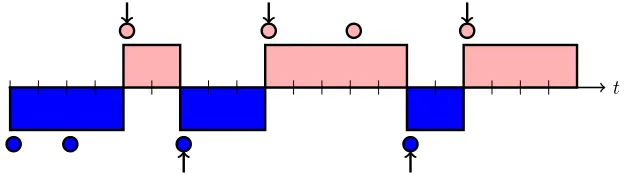
We show a graphical representation of the game in Figure 2. The control of the resource is graphically depicted through shaded rectangles, a blue rectangle (dark gray in grayscale) representing a period of defender control, a red rectangle (light gray in grayscale) one of attacker control. Players’ moves are graphically depicted with shaded circles. A vertical arrow denotes a takeover, when a player (re)takes control of the resource upon moving.
The main focus of the paper is in analyzing “optimal play” for both attacker and defender in this simple game. We wish to explore this question under various assumptions about the details of the rules, or about the strategies the players employ. In what follows, we motivate the choice of this game through several practical applications, and describe various extensions of the basic game needed to model these applications.
t
Figure 2: TheFL I PIT game. Blue and red circles represent defender and attacker moves, respectively. Takeovers are represented by arrows. Shaded rectangles show the control of the resource—blue (dark gray in grayscale) for the defender and red (light gray in grayscale) for the attacker. We assume that upon initialization at time 0, the defender has control.
2.2
Motivating Applications
A prime motivation forFL I PIT is the rise of Advanced Persistent Threats (APTs), which often play out as a pro-tracted, stealthy contest for control of computing resources.FL I PIT, however, finds many other natural applications in computer security, and even in other realms of trust assurance. Most of these applications correspond to slightly modified versions of the basicFL I PITgame. To motivate exploration ofFL I PIT, we describe some of these other applications here, along with the extensions or modifications of the basic game required to model them.
2.2.1 Advanced Persistent Threats (APTs)–a macro-level game
An APT is a concerted, stealthy, and long-lived attack by a highly resourced entity against a critical digital resource. Publicly acknowledged APTs include disablement of an Iranian uranium enrichment facility by means of the Stuxnet worm [8] and the breach of security vendor RSA, an attack whose ultimate objective was reportedly the theft of military secrets or intellectual property from organizations relying on RSA’s authentication tokens [30].
Stealth is a key characteristic: attackers rely on extended reconnaissance and human oversight to minimize the risk of detection by the defender, which can quickly set back or thwart an APT. Similarly, a defender looks to conceal its knowledge of a detected APT, to avoid alerting the attacker and allowing it to achieve renewed stealth by changing its strategy.
In the case where the attacker looks to exercise persistent control over a set of target resources (as opposed to achieving a one-time mission),FL I PITcan serve as a global model for an APT. The defender’s sensitive assets may include computers, internal networks, document repositories, and so forth. In such a macro-level view, we treat all of these assets as an aggregateFL I PITresource that the defender wishes to keep “clean.” The goal of the attacker is to compromise the resource and control it for a substantial fraction of time.
The macro-level view of a defender’s critical resources as a singleFL I PITresource is attractively simple. A more realistic and refined model, however, might model an APT as a series of stages along a path to system takeover, each stage individually treated as a micro-levelFL I PITgame. The attacker’s global level of control at a given time in this case is a function of its success in each of the component games. We now give examples of some micro-level games.
2.2.2 Micro-level games
Host takeover: In this version of the game, the target resource is a computing device. The goal of the attacker is to compromise the device by exploting a software vulnerability or credential compromise. The goal of the defender is to keep the device clean through software reinstallation, patching, or other defensive steps.
An action by either side carries a cost. For the attacker, the cost of host compromise may be that of, e.g., mounting a social-engineering attack that causes a user to open an infected attachment. For the defender, cleaning a host may carry labor and lost-productivity costs.
FL I PIT provides guidance to both sides on how to implement a cost-effective schedule. It helps the defender answer the question, “How regularly should I clean machines?” and the attacker, “When should I launch my next attack?”
A Variant / extension:There are many ways to compromise or clean a host, with varying costs and criteria for success. In a refinement of the game, players might choose among a set of actions with varying costs and effectiveness.
For example, the attacker might choose between two types of move: (1) Use of a published exploit or (2) Use of a zero-day exploit, while the defender chooses either to: (1) Patch a machine or (2) Reinstall its software. For both players, (1) is the less expensive, but (2) the more effective. Action (2) results in takeover for either player, while action (1) will only work if the opponent’s most recent move was action (1). (For instance, patching a machine won’t recover control from a zero-day exploit, but software reinstallation will.)
Refreshing virtual machines (VMs): Virtualization is seeing heavy use today in the deployment of servers in data centers. As individual servers may experience periods of idleness, consolidating multiple servers as VMs on a single physical host often results in greater hardware utilization. Similarly, Virtual Desktop Infrastructure (VDI) is an emerging workplace technology that provisions users with VMs (desktops) maintained in centrally managed servers. In this model, users are not bound to particular physical machines. They can access their virtual desktops from any endpoint device available to them, even smart phones.
While virtualization exhibits many usability challenges, one key advantage is a security feature: VMs can be periodically refreshed (or built from scratch) from “clean” images, and data easily restored from backups maintained at the central server.
Takeover of a VM results in a game very similar to that for a physical host. Virtualization is of particular interest in the context ofFL I PIT, though, becauseFL I PIToffers a means of measuring (or at least qualitatively illustrating) its security benefits. Refreshing a VM is much less cumbersome than rebuilding the software stack in a physical host. In other words, virtualization lowers the move cost for the defender. Optimal defender play will therefore result in resource control for a higher proportion of the time than play against a comparable attacker on a physical host.
An extension: Virtualization also brings about an interesting question at the macro-level. How can refreshes of indi-vidual VMs be best scheduled while maintaining service levels for a data center as a whole? In other words, how can refresh schedules best be crafted to meet the dual goals of security and avoidance of simultaneous outage of many servers / VDI instances?
Password reset: When an account or other resource is password-protected, control by its owner relies on the pass-word’s secrecy. Password compromise may be modeled as aFL I PITgame in which a move by the attacker results in its learning the password. (The attacker may run a password cracker or purchase a password in an underground forum.) The defender regains control by resetting the password, and thus restoring its secrecy.
password whether it has been compromised by an attacker. Thus, the defender can only playnon-adaptively, while the attacker has a second move option available, a probe move that reveals the state of control of the resource.
2.2.3 Other applications
Key rotation: A common hedge against the compromise of cryptographic keys iskey rotation, the periodic genera-tion and distribugenera-tion of fresh keys by a trusted key-management service. Less common in practice, but well explored in the research literature iskey-evolving cryptography, a related approach in which new keys are generated by their owner, either in isolation or jointly with a second party. In all of these schemes, the aim is for a defender to change keys so that compromise by an attacker in a given epoch (interval of time) doesn’t impact the secrecy of keys in other epochs.
Forward-secure protocols [15] protect the keys of past epochs, but not those of future epochs. Key-insulated [7] and intrusion-resilient [7] cryptography protect the keys of both past and future epochs, at the cost of involving a second party in key updates. Cryptographic tamper evidence [14] provides a mechanism for detecting compromise when both the valid owner and the attacker make use of a compromised secret key.
Key updates in all of these schemes occur at regular time intervals, i.e., epochs are of fixed length. FL I PIT provides a useful insight here, namely the potential benefit ofvariable-length epochs.
The mapping of this scenario ontoFL I PIT depends upon the nature of the target key. An attacker can make use of a decryption key in a strongly stealthy way, i.e., can eavesdrop on communications without ready detection, and can also easily detect a change in key. In this case, the two players knowledge is asymmetric. The defender must play non-adaptively, while the attacker has the option of aprobemove at any time, i.e., can determine the state of the system at low cost.
Use of a signing key, on the other hand, can betray compromise by an attacker, as an invalidly signed message may appear anomalous due to its content or repudiation by the key owner.
Variant / extension: To reflect the information disclosed by use of a signing key, we might consider a variant of
FL I PITin which system state is revealedprobabilistically. Compromise of a signing key by an attacker only comes to light if the defender actually intercepts a message signed by the attacker and determines from the nature of the signed message or other records that the signature is counterfeit. Similarly, the attacker only learns of a key update by the defender when the attacker discovers a signature by the defender under a new key. (In a further refinement, we might distinguish between moves that update / compromise a key and those involving its actual use for signing.)
Cloud service auditing: Cloud computing is a recent swing of the pendulum away from endpoint-heavy computing toward centralization of computing resources [20]. Its benefits are many, including, as noted above, certain forms of enhanced security offered by virtualization, a common element of cloud infrastructure. Cloud computing has a notable drawback, though: it requires users (often called “tenants”) to rely on the trustworthiness of service providers for both reliability and security.
To return visibility to tenants, a number ofauditprotocols have been proposed that enable verification of service-level agreement (SLA) compliance by a cloud service provider [1, 16, 2, 3, 4, 31]. The strongest of these schemes are challenge-response protocols. In a Proof of Retrievability (PoR), for instance, a tenant challenges a cloud service provider to demonstrate that a stored file is remotely retrievable, i.e., is fully intact and accessible via a standard application interface. Other protocols demonstrate properties such as quality-of-service (QoS) levels, e.g., retention of a file in high-tier storage, and storage redundancy [4], i.e., distribution of a file across multiple hard drives.
Execution of an audit protocol carries a cost: A PoR, for instance, requires the retrieval of some file elements by the cloud and their verification by a tenant. It’s natural then to ask: What is the best way for a tenant to schedule challenges in an audit scheme?. (Conversely, what’s the best way for a cloud service provider to cheat an auditor?) This question goes unaddressed in the literature on cloud audit schemes. (The same question arises in other forms of audit, and does see some treatment [5, 24].)
SLA (e.g., relegation of a file to a low storage tier). The metric of interest is the fraction of time the provider meets the SLA.
3
Formal Definition and Notation
This section gives a formal definition of the stealthy takeover game, and introduces various pieces of useful notation.
Players There are two players: the defender is the “good” player, identified with0(or Alice). The attacker is the “bad” player, identified with1(or Bob). It is convenient in our development to treat the game as symmetric between the two players.
Time The game begins at timet= 0and continues indefinitely ast→ ∞. In the general form of the game, time is viewed as beingcontinuous, but we also support a version of the game withdiscretetime.
Game state The time-dependent variableC =C(t)denotes the current player controlling the resource at timet; C(t)is either0or 1at any timet. We say that the game is in a “good state” ifC(t) = 0, and in a “bad state” if C(t) = 1.
Fori= 0,1we also let
Ci(t) =I(C(t) =i)
denote whether the game is in a good state for playeriat timet. HereI is an “indicator function”: I(·) = 1if its argument is true, and0otherwise. Thus,C1(t) =C(t)andC0(t) = 1−C1(t). The use ofC0andC1allows us to present the game in a symmetric manner.
The game begins in a good state:C(0) = 0.
Moves A player may “move” (push his / her button) at any time, but is only allowed to push the button a finite number of times in any finite time interval. The player may not, for example, push the button at times 1/2, 2/3, 3/4, . . . , as this means pushing the button an infinite number of times in the time interval[0,1]. (One could even impose an explicit lower bound on the time allowed between two button pushes by the same player.)
A player cannot move more than once at a given time. We allow different players to play at the same time, although with typical strategies this happens with probability0. If it does happen, then the moves “cancel” and no change of state happens. (This tie-breaking rule makes the game fully symmetric, which we prefer to alternative approaches such as giving a preference to one of the players when breaking a tie.) It is convenient to have a framework that handles ties smoothly, since discrete versions of the game, wherein all moves happen at integer times, might also be of interest. In such variants ties may be relatively common.
We denote the sequence of move times, for moves by both players, as an infinite nondecreasing sequence
t=t1, t2, t3, . . . .
The sequence might be nondecreasing, rather than strictly increasing, since we allow the two players move at the same time.
We letpkdenote the player who made thek-th move, so thatpk∈ {0,1}. We letpdenote the sequence of player
identities:
p=p1, p2, p3, . . . .
We assume thatt1= 0andp1= 0; the good player (the defender) moves first at timet= 0to start the game. Fori= 0,1we let
ti =ti,1, ti,2, ti,3, . . . denote the infinite increasing sequence of times when playerimoves.
The sequencest0andt1are disjoint subsequences of the sequencet. Every elementtkoftis either an element
The game’s state variableC(t)denotes the player who has moved most recently (not including the current instant t), so that
C(t) =pk for tk < t≤tk+1 and for all k≥1.
WhenC(t) = i then playerihas moved most recently and is “in control of the game”, or “in possession of the resource.” We assume, again, thatC(0) = 0.
Note thatC(tk) = pk−1; this is convenient for our development, since if a player moves at timetk thenC(tk)
denotes the player who was previously in control of the game (which could be either player).
For compatibility with our tie-breaking rule, we assume that iftk=tk+1(a tie has occurred), then the two moves at timestkandtk+1have subscripts ordered so that no net change of state occurs. That is, we assume thatpk= 1−C(tk)
andpk+1= 1−pk. Thus, each button push causes a change of state, but no net change of state occurs.
We letni(t)denote thenumber of moves made by playeriup to and including timet, and let
n(t) =n0(t) +n1(t)
denote thetotal number of moves made by both playersup to and including timet. Fort >0andi= 0,1, we let
αi(t) =ni(t)/t
denote theaverage move rate by playeriup to timet.
We letri(t)denote the time of the most recent move by playeri; this is the largest value ofti,kthat is less thant
(if playerihasn’t moved since the beginning of the game, then we defineri(t) =−1). Player 0 always moves at time
0, and thereforer0(t)≥0. We letr(t) = max(r0(t), r1(t))≥0denote the time of the most recent move by either player.
Feedback during the game We distinguish various types of feedback that a player may obtain during the game (specifically upon moving).
It is one of the most interesting aspects of this game that the players donotautomatically find out when the other player has last moved; moves arestealthy. A player must move himself to find out (and reassert control).
We letφi(tk)denote the feedback playeriobtains when the player moves at timetk. This feedback may depend
on which variant of the game is being played.
• Nonadaptive [NA].In this case, a player does not receive any useful feedback whatsoever when he moves; the feedback function is constant.
φi(tk) = 0
• Last move [LM].The player moving at timetk >0 finds out the exact time when the opponent played last
before timetk. That is, playerilearns the value:
φi(tk) =r1−i(tk)
• Full history [FH].The mover finds out the complete history of moves made by both players so far:
φi(tk) = ((t1, t2, . . . , tk),(p1, p2, . . . , pk)).
Views and History Aviewis the history of the game from one player’s viewpoint, from the beginning of the game up to timet. It lists every time that player moved, and the feedback received for that move.
For example, the view for playeriat timetis the list:
vi(t) = ((ti,1, φ(ti,1)),(ti,2, φ(ti,2)), . . . ,(ti,j, φ(ti,j)))
whereti,jis the time of playeri’sj-th move, her last move up to timet, andφ(ti,j)is the feedback playeriobtains
when making herj-th move.
Ahistoryof a game is the pair of the players’ views.
Strategies Astrategyfor playing this game is a (possibly randomized) mappingSfrom views to positive real num-bers. IfSis a strategy andva view of lengthj, thenS(v)denotes the time for the player to wait before making move j+ 1, so thatti,j+1=ti,j+S(v).
The next view for the player following strategySwill thus be
((ti,1, φ(ti,1)),(ti,2, φ(ti,2)), . . . ,(ti,j+1, φ(ti,j+1))).
We define now several classes of strategies, and we refer the reader to Figure 1 for a hierarchy of these classes.
Nonadaptive strategies: We say that a strategy isnonadaptiveif it does not require feedback received during the game, and we denote byN the class of all nonadaptive strategies. A player with a nonadaptive strategy plays in the same manner against every opponent. A player with a nonadaptive strategy can in principle generate the time sequence for all of his moves in advance, since they don’t depend on what the other player does. They may, however, depend on some independent source of randomness; nonadaptive strategies may be randomized.
Renewal strategies: Renewal strategies are non-adaptive strategies for which the intervals between consecutive moves are generated by a renewal process (as defined, for instance, by Feller [9]). Therefore, the inter-arrival times between moves are independent and identical distributed random variables chosen from a probability density function f. As the name suggests, these strategies are “renewed” after each move: the interval until the next move only depends on the current move time and not on previous history.
Periodic strategies: An example of a simple renewal strategy is aperiodicstrategy. We call a strategyperiodic
if there is aδsuch that the player always presses his button again once exactlyδseconds have elapsed since his last button-push. We assume that the periodic strategy has arandom phase, i.e., the first move is selected uniformly at random from interval[0, δ](if the strategy is completely deterministic an adaptive opponent can find out the exact move times and schedule his moves accordingly).
Exponential strategies: We call a strategy exponential or Poissonif the player pushes his button in a Poisson manner: there is some rateλsuch that in any short time increment∆the probability of a button-push is approximately λ·∆. In this case,S(v)has an exponential distribution and this results in a particular instance of a renewal strategy.
Adaptive strategies: The class of adaptive strategies encompasses strategies in which players receive feedback during the game. In the LM class of strategies, denotedALM, a player receives last-move feedback, while in the FH-adaptive class, denotedAFH, a player receives full history feedback, as previously defined.
No-play strategies: We denote byΦthe strategy of not playing at all (effectively dropping out of the game). We will show that this strategy is sometimes the best response for a player against an opponent playing extremely fast.
Information received before the game starts Besides receiving feedback during the game, sometimes players receive additional information about the opponent before the game starts. We capture this withφi(0), which denotes
the information received by playeribefore the game starts. There are several cases we consider:
• Rate of Play [RP].In this version of the game, playerifinds out the limit of the rate of playα1−i(t)of its
opponent at the beginning of the game (assuming that the rate of play converges to a finite value):
φi(0) = lim
t→∞α1−i(t).
• Knowledge of Strategy [KS]. Playerimight find additional information about the opponent’s strategy. For instance, if the opponent (player1−i) employs a renewal strategy generated by probability density functionf, then KS information for playeriis the exact distributionf:
φi(0) =f.
Knowledge of the renewal distribution in this case does not uniquely determine the moves of player1−i, as the randomness used by player1−iis not divulged to playeri. In this paper, we only use KS in conjunction with renewal strategies, but the concept can be generalized to other classes of strategies.
RP and KS are meaningfully applicable only to a non-adaptive attacker. An adaptive attacker from class LM or FH can estimate the rate of play of the defender, as well as the strategy during the game from the information received when moving. But a non-adaptive attacker receiving RP or KS information before the game starts can adapt his strategy and base moves on pre-game knowledge about the opponent’s strategy.
Pre-game information received at the beginning of the game, hence, could be used, in conjunction with the feed-back received while moving, to determine the strategy of playing the game. We can more formally extend the definition of views to encompass this additional amount of information as:
vi(t) = (φi(0),((ti,1, φ(ti,1)),(ti,2, φ(ti,2)), . . . ,(ti,j, φ(ti,j)))
Gains and Benefits Players receive benefit equal to the number of time units for which they are the most recent mover, minus the cost of making their moves. We denote the cost of a move for playeribyki; it is important for our
modeling goals that these costs could be quite different.
Playeri’s totalgainGiin a given game (before subtracting off the cost of moves) is just the integral ofCi:
Gi(t) =
Z t
0
Ci(t)dt
ThusGi(t)denotes the total amount of time that playerihas owned the resource (controlled the game) from the start
of the game up to timet, and
G0(t) +G1(t) =t .
Theaverage gain ratefor playeriis defined as:
γi(t) =Gi(t)/t;
so thatγi(t)is the fraction of time that playerihas been in control of the game up to timet. Thus, for allt >0:
γ0(t) +γ1(t) = 1.
We letBi(t)denoteplayeri’s net benefitup to timet; this is the gain (total possession time) minus the cost of
playeri’s moves so far:
Bi(t) = Gi(t)−kini(t).
We also callBi(t)thescoreof playeriat timet. The maximum benefitB0(t) =t−k0for player0would be obtained if neither player moved again after player 0 took control at timet= 0.
We letβi(t)denoteplayeri’s average benefit rateup to timet:
βi(t) = Bi(t)/t
= γi(t)−kiαi(t) ;
this is equal to the fraction of time the resource has been owned by playeri, minus the cost rate for moving. In a given game, we define playeri’sasymptotic benefit rateor simplybenefitas
We uselim inf sinceβi(t)may not have limiting values astincreases to infinity.
An alternative standard and reasonable approach for summarizing an infinite sequence of gains and losses would be to use adiscount rateλ < 1so that a unit gain at future timetis worth onlyλt. Our current approach is simpler
when at least one of the players is nonadaptive, so we’ll omit consideration of the alternative approach here.
While we have defined the benefit for a given game instance, it is useful to extend the notion over strategies. Let Si be the strategy of player i, for i ∈ {0,1}. Then the benefit of player i for the FL I PIT game given by
strategies(S0, S1)(denotedβi(S0, S1)) is defined as the expectation of the benefit achieved in a game instance given by strategies(S0, S1)(the expectation is taken over the coin flips ofS0andS1).
Game-theoretic definitions We denote byFlipIt(C0,C1)theFL I PIT game in which playerichooses a strategy from classCi, fori ∈ {0,1}. For a particular choice of strategiesS0 ∈ C0 andS1 ∈ C1, the benefit of playeriis defined as above. In our game, benefits are equivalent to the notion ofutilityused in game theory.
Using terminology from the game theory literature:
- A strategy S0 ∈ C0 isstrongly dominatedfor player 0 in game FlipIt(C0,C1)if there exists another strategy
S00 ∈ C0such that:
β0(S0, S1)< β0(S00, S1),∀S1∈ C1.
- A strategy S0 ∈ C0 is weakly dominated for player 0 in gameFlipIt(C0,C1)if there exists another strategy
S00 ∈ C0such that:
β0(S0, S1)≤β0(S00, S1),∀S1∈ C1,
with at least oneS1for which the inequality is strict.
- A strategyS0isstrongly dominantfor player 0 in gameFlipIt(C0,C1)if:
β0(S0, S1)> β0(S00, S1),∀S00∈ C0,∀S1∈ C1.
- A strategyS0isweakly dominantfor player 0 in gameFlipIt(C0,C1)if:
β0(S0, S1)≥β0(S00, S1),∀S00∈ C0,∀S1∈ C1.
Similar definitions can be given for player 1 since the game is fully symmetric.
There is an implicit assumption in the game theory literature that a rational player does not choose to play a strategy that is strongly dominated by other strategies. Therefore, iterative elimination of strongly dominated strategies for both players is a standard technique used to reduce the space of strategies available to each player (see, for instance, the book by Myerson [22]). We denote byFlipIt∗(C0,C1)theresidualFL I PITgame consisting of surviving strategies after elimination of strongly dominated strategies from classesC0 andC1. A rational player will always choose a strategy from the residual game.
ANash equilibriumfor the gameFlipIt(C0,C1)is a pair of strategies(S0, S1)∈ C0× C1such that:
β0(S0, S1)≥β0(S00, S1),∀S00 ∈ C0;
β1(S0, S1)≥β1(S0, S10),∀S01∈ C1.
4
Renewal Games
In this section, we analyzeFL I PITover a simple but interesting class of strategies, those in which a player “renews” play after every move, in the sense of selecting each interval between moves independently and uniformly at random from a fixed distribution. Such a player makes moves without regard to his history of previous moves, and also without feedback about his opponent’s moves. The player’s next move time depends only on the time he moved last.
and Gallager [11] that offer a formal treatment of renewal theory.) We are interested in analyzing theFL I PITgame played with either renewal or periodic strategies (with random phases as defined in Section 4.1), finding Nash equilibria for particular instances of the game, determining strongly dominated and dominant strategies (when they exist), and characterizing the residualFL I PITgame.
These questions turn out to be challenging. While simple to characterize, renewal strategies lead to fairly complex mathematical analysis. Our main result in this section is that renewal strategies are strongly dominated by periodic strategies (against an opponent playing also a renewal or periodic strategy), and the surviving strategies in the residual
FL I PITgame are the periodic strategies. In addition, in the subclass of renewal strategies with a fixed rate of play, the periodic strategy is the strongly dominant one.
We also analyze in depth theFL I PITgame in which both players employ a periodic strategy with a random phase. We compute the Nash equilibria for different conditions on move costs, and discuss the choice of the rate of play when the attacker receives feedback according to NA and RP definitions in Section 3.
4.1
Playing periodically
We start this section by analyzing a very simple instance of theFL I PITgame. We consider a non-adaptive continuous game in which both players employ a periodic strategy with a random phase. If the strategy of one player is completely deterministic, then the opponent has full information about the deterministic player’s move times and therefore can schedule his moves to control the resource at all times. We introduce phase randomization into the periodic strategy for this reason, selecting the time of the first move uniformly at random from some interval.
More specifically, aperiodic strategy with random phaseis characterized by the fixed interval between consecutive moves, denotedδ. We assume that the first move called thephasemove is chosen uniformly at random in interval
[0, δ]. The average play rate (excluding the first move) is given byα= 1/δ. We denote byPαthe periodic strategy
with random phase of rateαandP the class of all periodic strategies with random phases:
P ={Pα|α >0}
An interesting game to consider is one in which playeriemploys strategyPαi. Letδi = 1/αibe the period, and
kithe move cost of playeri, fori∈ {0,1}. This game is graphically depicted in Figure 3.
As an initial exercise, and to get acquainted to the model and definitions, we start by computing benefits for both players in the periodic game.
t δ1
δ0
Figure 3: TheFL I PITgame with both players playing periodically with respective periodsδ0andδ1.
Computing benefits For the periodic game defined above, the benefits of both players depend on rates of playα0 andα1. We thus denote the benefit of playeribyβi(α0, α1)(this is the expected benefit computed over the random phase selections of the two players as in the definition given in Section 3). To compute both players’ benefits, we consider two cases:
Case 1: α0≥α1(The defender plays as least as fast as the attacker.)
δ0 ≤δ1) and his move is distributed uniformly at random. Thus the expected period of attacker control within the interval isr/2. We can therefore express the players’ benefits as:
β0(α0, α1) = 1−
r
2 −k0α0= 1−
α1
2α0
−k0α0;
β1(α0, α1) =
r
2−k1α1=
α1
2α0
−k1α1.
Case 2: α0≤α1(The defender plays no faster than the attacker.)
Similar analysis yields benefits:
β0(α0, α1) =
α0
2α1
−k0α0;
β1(α0, α1) = 1−
α0
2α1
−k1α1.
Nash equilibria As a second step, we are interested in finding Nash equilibria, points for which neither player will increase his benefit by changing his rate of play. More formally, a Nash equilibrium for the periodic game is a point
(α∗0, α1∗)such that the defender’s benefitβ0(α0, α∗1)is maximized atα0=α∗0and the attacker’s benefitβ1(α∗0, α1)is maximized atα1=α∗1.
To begin with, some useful notation. We denote byopt0(α1)the set of values (rates of playα0) that optimize the benefit of the defender for a fixed rate of playα1of the attacker. Similarly, we denote byopt1(α0)the set of values (rates of playα1) that optimize the benefit of the attacker for a fixed rate of playα0of the defender. The following theorem specifies Nash equilibria for the periodic game and is proven in Appendix A.
Theorem 1 TheFL I PIT gameFlipIt(P,P)in which both players employ periodic strategies with random phases
has the following Nash equilibria:
k0< k1 α∗0=
1 2k1
, α∗1= k0 2k2
1
;
k0=k1 α∗0=α∗1=
1 2k0
;
k0> k1 α∗0=
k1
2k2 0
, α∗1= 1 2k0
.
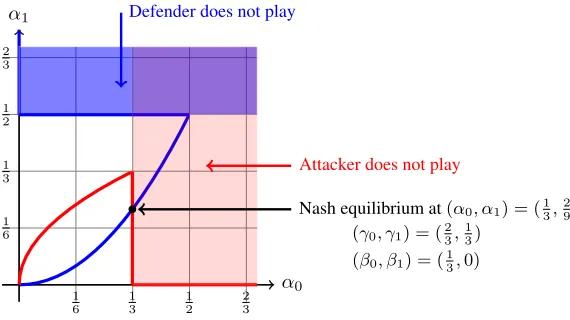
We illustrate the case fork0 = 1andk1 = 1.5in Figure 4. We depict in the figure the two curvesopt0andopt1 and the unique Nash equilibrium at their intersection. (See the proof of Theorem 1 for an explicit formula foropt0
andopt1.) The highlighted blue and red regions correspond to cases for which it is optimal for the defender, and the attacker, respectively, not to move at all (whenopt0(α1) = 0oropt1(α0) = 0, respectively).
Parameter choices Finally, we’d like to show the impact the parameter choice has on the benefits achieved by both players in the game. The periodic strategy with random phase for playeriis uniquely determined by choosing rate of playαi. Again, in the non-adaptive version of the game neither player has any information about the opponent’s
strategy (expect for the move costs, which we assume are known at the beginning of the game). Therefore, players need to decide upon a rate of play based only on knowledge of the move costs.
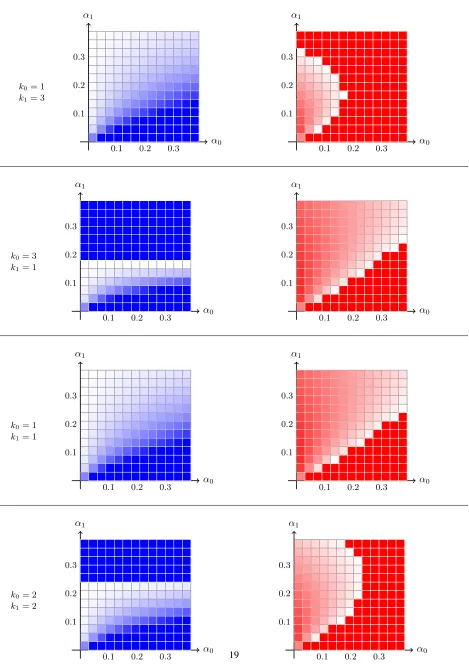
We show in Figure 5 the benefits of both players as a function of play ratesα0andα1. We plot these graphs for different values of move costsk0andk1. Darker shades correspond to higher values of the benefits, and white squares correspond to negative or zero benefit.
α0
2 3 1 2 1 3 1 6 α1
2 3
1 2
1 3
1 6
Defender does not play
Attacker does not play
Nash equilibrium at(α0, α1) = (13,29)
(γ0, γ1) = (23,13)
(β0, β1) = (13,0)
Figure 4: Nash equilibrium for game with periodic attacker and periodic defender and move costsk0= 1andk1= 1.5. The optimal strategyopt0of the defender is depicted in blue (dark gray in grayscale), and the optimal strategy of the attackeropt1is depicted in red (light gray in grayscale).
benefit, no matter how the opponent plays! The bottom two graphs compare the benefits of both players for equal move costs (set at 1 and 2, respectively). The graphs show that when move costs are equal, both players can achieve similar benefits, and neither has an advantage over the other. As expected, the benefits of both players are negatively affected by increasing the move costs. We also notice that in all cases playing too fast results eventually in negative benefit (depicted by white squares), as the cost of the moves exceeds that of the gain achieved from controlling the resource.
Achieve good benefits in any game instance We notice that if both players play periodically with random phase, the choice of the random phase could result in gain 0 for one of the players (in the worst case). This happens if the opponent always plays “right after” and essentially controls the resource at all times. The benefits computed above are averages over many game instances, each with a different random phase.
We can, nevertheless, guarantee that expected benefits are achieved inany game instanceby “re-phasing” during the game. The idea is for a player to pick a new random phase at moves with indicesa1, a2, . . . , an, . . .. It turns out
that foraj=j2, the expectation ofβi(t)(the benefit up to timet) over all random phases converges toβi(α0, α1)as
t → ∞and by the law of large numbers its standard deviation converges to0ast → ∞. This can be used to show that each game instance achieves benefitsβ0(α0, α1)andβ1(α0, α1)computed above.
Forcing the attacker to drop out We make the observation that if the defender plays extremely fast (periodic with rateα0 > 1/2k1), the attacker’s strongly dominant non-adaptive strategy is to drop out of the game. The reason is that in each interval between defender’s consecutive moves (of lengthδ0= 1/α0<2k1), the attacker can control the resource on average at most half of the time, resulting in gain strictly less thank1. However, the attacker has to spend
k1for each move, and therefore the benefit in each interval is negative. We can characterize the residualFL I PITgame in this case:
FlipIt∗(Pα0,N) =FlipIt(Pα0,Φ),∀α0>
1 2k1
.
4.2
General renewal strategies
k0= 1
k1= 3
α0
0.1 0.2 0.3
α1
0.1 0.2 0.3
α0
0.1 0.2 0.3
α1
0.1 0.2 0.3
k0= 3
k1= 1
α0
0.1 0.2 0.3
α1
0.1 0.2 0.3
α0
0.1 0.2 0.3
α1
0.1 0.2 0.3
k0= 1
k1= 1
α0
0.1 0.2 0.3
α1
0.1 0.2 0.3
α0
0.1 0.2 0.3
α1
0.1 0.2 0.3
k0= 2
k1= 2
α0
0.1 0.2 0.3
α1
0.1 0.2 0.3
α0
0.1 0.2 0.3
α1
0.1 0.2 0.3
Figure 5: Defender’s (left, depicted in blue, dark gray in gray scale) and attacker’s (right, depicted in red, light gray in gray scale) benefit for various move costs. Benefits are represented as a function of rates of playα andα . Darker
Renewal theory results Let{Xj}j≥0be independent and identically distributed random variables chosen from a common probability density functionf. LetFbe the corresponding cumulative distribution function.{Xj}j≥0can be interpreted as inter-arrival times between events in a renewal process: then-th event arrives at timeSn =P
n j=0Xj.
Letµ=E[Xj], for allj≥0.
A renewal process generated by probability density function f is calledarithmetic if interarrival times are all integer multiples of a real numberd. The span of an arithmetic distribution is the largestdfor which this property holds. A renewal process withd= 0is callednon-arithmetic.
For a random variableXgiven by a probability density functionf, corresponding cumulative distributionF, and expected valueµ=E[X], we define thesize-bias density functionas:
f∗(z) =1−F(z)
µ .
and thesize-bias cumulative distribution functionas:
F∗(z) =
Rz
x=0(1−F(x))dx
µ .
Theage functionZ(t)of a renewal process is defined at time intervaltas the time since the last arrival. Denote by fZ(t)andFZ(t)the age density and cumulative distribution functions, respectively. The following lemma [9] states that astgoes to∞, the age density and cumulative distribution functions converge to the size-bias density and cumulative distribution functions, respectively:
Lemma 1 For a non-arithmetic renewal process given by probability density functionf, the age density and cumula-tive distribution functions converge as:
lim
t→∞fZ(t)(z) =f ∗(z);
lim
t→∞FZ(t)(z) =F ∗(z).
PlayingFL I PITwith renewal strategies Arenewal strategy, as explained above, is one in which a player’s moves are generated by a renewal process. In a arithmetic renewal strategy, the player’s moves are generated by a non-arithmetic renewal process. We denote byRfthe renewal strategy generated by a non-arithmetic renewal process with
probability density functionf, and byRthe class of all non-arithmetic renewal strategies:
R={Rf|fis a non-arithmetic probability density function}.
Here we consider theFL I PITgame in which both players employ non-arithmetic renewal strategies: playeriuses strategyRfi. Let us denote the intervals between defender’s moves as{Xj}j≥0and the intervals between attacker’s moves as {Yj}j≥0. {Xj}j≥0 are identically distributed random variables chosen independently from probability density functionf0with averageµ0, while{Yj}j≥0are independent identically distributed random variables chosen from probability density functionf1with averageµ1. Letαi= 1/µibe the rate of play of playeri.
We denote the corresponding cumulative distribution functions asF0andF1. Since both renewal processes are non-arithmetic, we can apply Lemma 1 and infer that the age density and cumulative distribution functions of both processes converge. Denote byf0∗, f1∗andF0∗, F1∗the size-bias density and cumulative distribution functions for the two distributions.
A graphical representation of this game is given in Figure 6.
In this context, the following theorem (proven in Appendix A) gives a formula for the players’ benefits:
Theorem 2 In the non-adaptiveFL I PITrenewal gameFlipIt(R,R), the players’ benefits for strategies(Rf0, Rf1)∈ R × Rare:
β0(Rf0, Rf1) = Z ∞
x=0
f1∗(x)F0∗(x)dx−k0α0;
β1(Rf0, Rf1) = Z ∞
x=0
t
X0 X1 X2 X3
Y0 Y1 Y2 Y3 Y4
{Xj}j≥0iidf0 {Yj}j≥0iidf1
Figure 6: TheFL I PITgame with both players playing with renewal strategies. The defender and attacker play with inter-arrival times iid from probability distributionsf0andf1, respectively.
Interestingly, Theorem 2 can be generalized to strategies from classR ∪ P. We observe that for strategyPα∈ P,
the density and cumulative distribution of the underlying periodic distribution are:
f(x) =
(
1, x= α1
0, x6= α1 F(x) =
(
0, x < α1
1, x≥ 1 α
The size-bias density and cumulative distribution functions for the periodic distribution are:
f∗(x) =
(
α, x < 1 α
0, x≥ 1 α
F∗(x) =
(
αx, x < 1 α
1, x≥ 1 α
Based on these observations, we obtain the following theorem, whose proof is given in Appendix A.
Theorem 3 In the non-adaptiveFL I PITgameFlipIt(R ∪ P,R ∪ P), the players’ benefits for strategies(S0, S1)∈
(R ∪ P)×(R ∪ P)are:
β0(S0, S1) =
Z ∞
x=0
f1∗(x)F0∗(x)dx−k0α0;
β1(S0, S1) =
Z ∞
x=0
f0∗(x)F1∗(x)dx−k1α1.
4.3
The residual renewal game
We are now able to completely analyze theFL I PITgame with strategies in classR ∪ P. We show first that for a fixed rate of playαiof playerithe periodic strategy with random phase is the strongly dominant strategy for playeri(or,
alternatively, all non-arithmetic renewal strategies are strongly dominated by the periodic strategy with the same rate). As a consequence, after both players iteratively eliminate the strongly dominated strategies, the surviving strategies in the residual gameFlipIt∗(R ∪ P,R ∪ P)are the periodic strategies.
For a fixedα >0, we denote byRαthe class of all non-arithmetic renewal strategies of fixed rateα, and byPα
the class of all periodic strategies of rateα. As there exists only one periodic strategy of rateα,Pα={Pα}.
Theorem 4 1. For a fixed rate of playα0 of the defender, strategyPα0 is strongly dominant for the defender in
gameFlipIt(Rα0∪ Pα0,R ∪ P). A similar result holds for the attacker.
2. The surviving strategies in the residualFL I PITgameFlipIt(R ∪ P,R ∪ P)are strategies from classP:
Remark While we have proved Theorem 4 for the non-adaptive case, the result also holds if one or both players receive information at the beginning of the game according to the RP definition. This follows immediately from the proof of Theorem 4. (See the proof in Appendix A for details.)
4.4
Renewal games with an RP attacker
In the case in which one player (assume the attacker) receives feedback according to RP (i.e., knows the rate of play of the defender), we can provide more guidance to both players on choosing the rates of play that achieve maximal benefit. In particular, we consider a scenario in which the attacker finds out the rate of play of the defender before the game starts, and we assume that the attacker plays rationally in the sense that he tries to maximize his own benefit: for a fixed rate of playα0 of the defender, the attacker chooses to play with rateα∗1 = argmaxβ1(α0,·). Under this circumstance, the defender can also determine for each fixed rate of playα0, the rate of play α∗1 of a rational attacker. In a pre-game strategy selection phase, then, a rational defender selects and announces the rate of playα∗0 that maximizes her own benefit:α∗0=argmaxβ0(·, α∗1). The following theorem provides exact values ofα0∗andα∗1, as well as maximum benefits achieved by playing at these rates.
Theorem 5 Consider the periodicFL I PITgame with NA defender and RP attacker. Assume that the attacker always chooses his rate of play to optimize his benefit: α∗1 =argmaxβ1(α0,·)given a fixed rate of play of the defenderα0,
and the defender chooses her rate of playα∗0that achieves optimal benefit:α∗0 =argmaxβ0(·, α∗1). Then:
1. Fork1<(4− √
12)k0the rates of play that optimize each player’s benefit are:
α∗0= k1 8k2
0
; α∗1= 1 4k0
.
The maximum benefits for the players are:
β0(α∗0, α
∗
1) =
k1
8k0
; β1(α∗0, α
∗
1) = 1−
k1
2k0
.
2. Fork1 ≥ (4− √
12)k0the rates of play that optimize each player’s benefit are (↓denotes convergence from
above):
α∗0↓ 1
2k1
; α∗1= 0.
The maximum benefits for the players are (↑denotes convergence from below):
β0(α∗0, α
∗
1)↑1−
k0
2k1
; β1(α∗0, α
∗
1) = 0.
5
LM Attacker
In the previous section, we analyzed a non-adaptive instance ofFL I PITin which both players employ (non-arithmetic) renewal or periodic strategies. We consider now aFL I PITgame in which the defender is still playing with a renewal or periodic strategy, but the attacker is more powerful and receives feedback during the game. In particular, the at-tacker finds out the exact time of the defender’s last move every time he moves, and is LM according to our definition in Section 3. It is an immediate observation that for a defender playing with a renewal strategy, an LM attacker is just as powerful as an FH one.
against an adaptive attacker; second, we are interested in finding good adaptive strategies for the attacker, given a fixed distribution for the defender.
We analyze this game for the defender playing with periodic and exponential distributions. The periodic defender strategy is a poor choice against an LM attacker, as the defender’s benefit is negative (unless the defender can afford to play extremely fast and force the attacker to drop out of the game). For the defender playing with an exponential distribution, we prove that the attacker’s strongly dominant strategy is periodic play (with a rate depending on the defender’s rate of play). We also define a new distribution calleddelayed exponential, in which the defender waits for a fixed interval of time before choosing an exponentially distributed interval until her next move. We show experimen-tally that for some parameter choices, the delayed exponential distribution results in increased benefit for the defender compared to exponential play.
5.1
Game definition
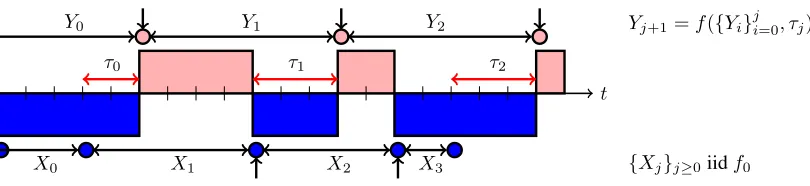
In this version of the game, the defender plays with either a non-arithmetic renewal strategy from classRor with a pe-riodic strategy with random phase from classP. Hence, the inter-arrival times between defender’s consecutive moves are given by independent and identically distributed random variables{Xj}j≥0from probability density functionf0. The attacker is LM and his inter-arrival move times are denoted by{Yj}j≥0. At itsj-th move, the attacker finds out the exact time since the defender’s last move, denotedτj. The attacker determines the interval until his next move
Yj+1taking into consideration the history of his own previous moves (given by{Yi} j
i=0), as well asτj. Without loss
of generality, the attacker doesn’t consider times{τi}i<jwhen determining intervalYj+1for the following reason. The defender “restarts” its strategy after each move, and thus knowledge of all the history{τi}i<j doesn’t help the
attacker improve his strategy. This game is depicted graphically in Figure 7.
t
X0 X1 X2 X3
τ0 τ1 τ2
Y0 Y1 Y2
{Xj}j≥0iidf0
Yj+1=f({Yi} j i=0, τj)
Figure 7: TheFL I PITgame with renewal defender and LM attacker. The defender plays with inter-arrival times iid from distributionf0. The attacker finds out upon moving the interval since defender’s last moveτj.
Observation We immediately observe that an LM attacker is as powerful as an FH attacker against a renewal or periodic defender:
FlipIt∗(R ∪ P,ALM) =FlipIt∗(R ∪ P,AFH).
The reason is that an FH attacker, while receiving more feedback during the game than an LM one, will only make use of the last defender’s move in determining his strategy. Information about previous defender’s moves does not provide any additional advantage, as the defender’s moves are independent of one another.