Definition patterns for predicative terms in specialized lexical resources
Antonio San Martín
(1), Marie
-Claude L
’Homme
(2) (1)LexiCon Research GroupDepartment of Translation and Interpreting
University of Granada
Calle Buensuceso, 11. 18002. Granada, Spain (2)Observatoire de linguistique Sens-Texte
Department of Linguistics and Translation University of Montreal
CP 6128 Succursale Centre-Ville
H3C3J7 Montreal, Quebec, Canada
E-mail: [email protected], [email protected]
Abstract
The research presentedin this paper is part of a larger project on the semi-automatic generation ofdefinitions of semantically-related terms in specialized resources. The work reported hereinvolvesthe formulation ofinstructions to generate the definitions of sets of morphologically-related predicative terms, based onthe definition of one of the members of the set. In many cases,it is assumed that the definition of a predicative termcan be inferredby combining the definition of a relatedlexical unit with the information provided by the semantic relation (i.e. lexical function) that links them. In other words, terminographers only need to know the definition of polluteand the semantic relation that links it to other morphologically-related terms (polluter, polluting, pollutant, etc.)in order to createthe definitions of the set. The results show that rules can be used to generate a preliminaryset of definitions (based on specific lexical functions). They also show that more complex rules would need to be devised for other morphological pairs.
Keywords:terminological definition, predicative term, lexical function
1.
Introduction
Definitions are the privileged medium for providing users with a representation of the meaning of a lexical unit (LU). Even if many resources contain very rich semantic and/or conceptual information, definitions are still extremely useful and help users to fully grasp the meaning of LUs or concepts. For instance, a recent survey showed that ontologists consider that definitions are a very important element to gain a clear understanding of the terms in an ontology (Seppälä & Ruttenberg 2013: 19). Although terminological definitions have already been extensively studied in the literature (De Bessé 1990; Sager & Ndi-Kimbi 1995; Lorente 2001;Faber 2002, Seppäla 2012, inter alia), the focus has been on terms denoting entities (e.g., computer, Earth, habitat). Predicative terms (e.g., download,pollute, warm)have been largely ignored. The research described in this paper is part of a larger project that targets the semi-automatic formulation of definitions of semantically-related terms in specialized resources. The work reported here creates a set of instructions that are able to generate the definitions of
sets of morphologically-related predicative terms from the definition of one of the members of a given set. It is assumed that in many cases the definition of a predicative term can be generated by combining the definition of another related LU with the information provided by the semantic relation that links them. In
other words, the definition of pollute and the semantic relation that links it to other morphologically-related terms (polluter, polluting, pollutant, etc.) would suffice to generate the definition of the latter. The long-term objective of this research is to automate definitions with only the minimal revision of the terminographer. This paper presents the results of an analysis of a preliminary set of specialized terms in order to assess the extent to which this type of generation is possible. The paper has the following structure. Section 2 gives a short description of the terminological resources from which the data were extracted. Section 3 provides general rules for writing terminological definitions. Section 4 lists the instructions for the generation of definitions and discusses the problems encountered. Section 5 presents the conclusions derived from this research and mentions the areas to be covered in future work.
2.
Di
CoInfo and DiC
oEnviro
This work was undertaken within the framework of two terminological databases: DiCoEnviro1(environmental terminology) and DiCoInfo2 (computer and Internet terminology). The compilation of these databases follows chieflythe theoretical and methodological principles of Explanatory Combinatorial Lexicology (ECL) (Mel’ćuk
1http://olst.ling.umontreal.ca/dicoenviro
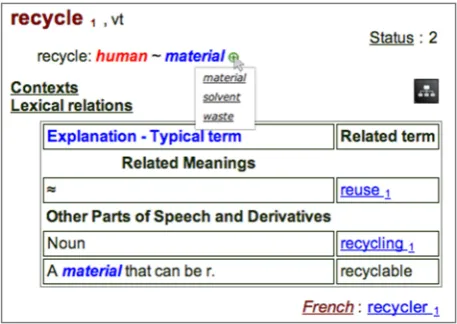
et al., 1995). Their entries provide rich lexico-semantic information for nouns, verbs, adjectives and adverbs (Figure 1): actantial (i.e. argument) structure, linguistic realizations of actants (i.e. arguments), contexts, and lexical relationships.
Very few of these entries currently contain definitions, and up until now, the writing of these definitions has only been subject to very basic rules. In Section 3, we formulate an initial set of definition rules based on the lexico-semantic information already provided in the
entries (actantial structure and lexical relationships).
Actantial structures state the number of obligatory participants, i.e. those that are necessary to understand the meaning of terms. Figure 1 shows an example with two participants: an AGENT, instantiated by human, and a PATIENT, instantiated by material.3
Lexical relationships between terms are encoded with lexical functions(LFs) (Mel'!uk et al., 1995) that capture the syntactic and semantic properties of lexical relationships. It should be highlighted that such relationships can be paradigmatic or syntagmatic (i.e. collocational). This paper focuses on a reduced set of paradigmatic relationships. For instance, the relationship between degradeand degradedis represented by the LF A2(the adjective that applies to the second actant). This LF is also applicable to other term pairs: compile !
3In DiCoInfo and DiCoEnviro, actants in are represented by a
combination of semantic roles and the typical terms that
instantiate them. Currently, typical terms are displayed in a
color that represents their semantic roles. Users can place the pointer over the typical terms to obtain the name of the semantic role and place it on a green plus icon to visualize other possible realizations for that actant. Since ECL (the framework on which the resources are based) does not implement semantic roles (actants are represented with the variables X, Y, and Z), a system was created to assign them to the actants of predicative terms in the databases. This methodology is described in L’Homme (2012). The set of labels for semantic roles is designed especially for DiCoEnviro and DiCoInfo although some roles can be more frequently used in one database than the other (e.g. CAUSEis more frequent in DiCoEnviro).
compiled; partition!partitioned. LFsare not visible in the online version of the databases. However, a simplified explanation designed to capture their expressiveness is provided. For instance, A2is translated as “That is or that has been+ verb”.4
3.
Definitional methodology in
DiCoInfo
and DiCoEnviro
In order to create amethodology fordefinition writing in DiCoInfo and DiCoEnviro, we adapted the ECL definitional rules (Mel’!uk et al., 1995: 72-111) to the terminological nature of the two resources as well as to some oftheir special characteristics.
3.1
Actantial Structure Rule
If the LU to be defined is predicative (or if it is a
quasi-predicate), all the actants must be reflectedin the definition. Examples (1-3) show definitions for a verb, noun, and adjective in DiCoInfo and DiCoEnviro.
(1)
impact2(v): CAUSE (change1a.1)~PATIENT (biodiversity1, resource1)
Definition: CAUSE (change1a.1)has an important effect on PATIENT (biodiversity1, resource1).
(2)
clipboard1 (n): ~ used by AGENT (user1) to act on PATIENT (data1)
Definition: temporary memory1 area used by AGENT
(user1) to store1b PATIENT (data1) briefly for pasting1 PATIENT (data1)in a file1.
(3)
hot1(adj): ~[PATIENT (water1)]
Definition: [PATIENT (water1)] that is at high
temperature1.
As can be observed in the examples, the definitions of verbs and nouns follow the Aristotelian structure of genus and differentiae. In other words, averb is defined in terms of a more general verb plus differentiating characteristics, and a noun is also defined in terms of another more general noun plus differentiating characteristics. However, adjectives and adverbs are not defined using the same pattern since these definitions are introduced by a relative pronoun.
3.2
Decomposition Rule
This rule states that a definition must be a decomposition of the meaning expressed in semantically simpler LUs. An LU is considered to be semantically simpler than another LU if the latter can be defined in terms of the formerbut not vice versa (Mel’!uk et al., 1995:79-83).
4Figure 1 shows that LFs are replaced in the online version of
DiCoEnviro by a natural language explanation: “A material that can be r.”.These explanations mirror the LFs that are encoded by terminologists in the entry.
However, in order to apply this rule to aterminological resource, a distinctionmust be madebetween those LUs that are terms that are recordedor could be recordedin the resource, and other kindsof LUs.
With the exception of those LUs that instantiateactants, no term can appear in the definition of another term if the former needs the latter in its definition. Furthermore, the use of terms that aremorphologically related to the definiendum is not permitted. This is to prevent users from consultingotherentries to understandthe meaning of the term.
Definitions inevitably contain LUs that are not encoded in the resource and will never be since they do not correspond to terms.In these cases,the terminographer is required to use only the LUscontained inthe Longman Communication 30005 (Longman Dictionaries, 2007) and morphologically-relatedwords. This ensures that any speaker of English will be able to understand the definition without needing to consult a general-language dictionary.6
3.3
Standardization
Rule
All the LUs in a definition that appear in the resource
need to be linked and disambiguated by their sense number. Moreover, the use of pronouns to substitute
actants in the definition shouldbe avoided.
To ensure uniformity, each meaning to be representedin a definitionshouldalwaysbe expressed in the same way. For instance, the expressions in example (4) are all synonymous, and therefore, terminographers must always use “activity in which AGENT…” whenever they want to represent this meaning in the definitions.
(4)
activity in which AGENT… (preferred option) activity consisting ofAGENT…
activity during which AGENT…
activity performed by AGENTconsisting of…
This procedure involves systematic ongoing work to identifysynonymous expressions beingcurrentlyused in the definitions, which could be standardized. Indeed, in many cases, the choice of one expression instead of another is arbitrary. A closed inventory of permitted expressions and the use of the Longman Communication 3000 can be regarded as a sort of incipient controlled language for definitions.
In addition, the standardization of definitions in DiCoInfo and DiCoEnviro could be achieved with the use of definitional patterns based on LFs for the creation
5The Longman Communication 3000is a list that contains the
3,000 most common English LUs. The definitions in Longman dictionaries are written using only the words in the Longman Defining Vocabulary (Longman Dictionaries, 2008), which contains about1,000 LUs less.
6Other lists would naturally be necessary to implement this
principle in the versions of DiCoEnviro and DiCoInfo in other
languages.
of the definitions of morphologically-related terms. As shall be seen in Section 4, this implies that the definitions of all adjectives related to a verb withtheLF A1 share the same structure and that their semantic contentis based on the content of their respectivestarter verbs.
3.4
Mutual Substitutability Rule
Asuitable definitionis one that can replacethe LU thatit represents in any context. This rule is one of the most traditional in definition writing. Substitution is used to check whether definitional components are necessary and sufficient.
In the framework of DiCoInfo and DiCoEnviro, substitution isverified using all the typical terms of the actants of the definiendum as well as the annotated contexts of the entry.
4.
Definition patterns for recurrent lexical
relationships
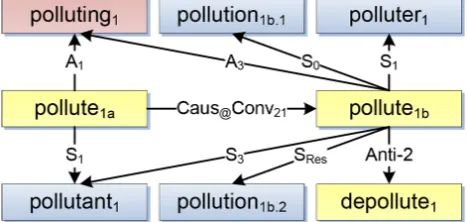
As previously mentioned, paradigmatic LFs allow the systematic encoding of semantic relations between morphologically-related LUs.7Figure 2 shows how the semantic relations between terms morphologically related to the verb pollute are represented by means of LFs.
This paper presents a preliminary study to test whether it is possible to generate the definition of a predicative LU using the definition of an LU to which it is morphologically related, and the LF that links the two terms.
Since our model requires the definition of an LU to be used as a starting point, this study has been limited to those cases where this LUis a verb. When there is more than one verb in the family, the one with feweractants is chosen. In the example of Figure 2, pollute1awould be chosen over pollute1band depollute1.
Since the scope of this preliminary analysis has been limited to those lexical families where a verb is the starting point, only those LFsencoded in DiCoInfo and DiCoEnviro with a verb as the first element were
7 Paradigmatic LFs can also relate LUs that are not
morphologically related. However,the focus in this paper is only on morphologically-related terms.
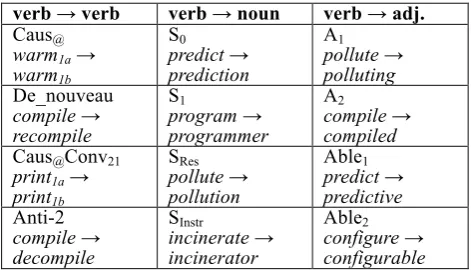
considered. Then, theLFs forwhich there were less than threeexamples in the resources were discarded.The list of LFs studied was the following:
verb → verb verb → noun verb → adj.
Table 1: List of LFs considered in this study
The next step was to find a definitional pattern for each LU that allowed the generation of definitions without the introduction of non-predictable elements. The following sections show the resulting instructions and explain how they were developed.
established by an iterative process. As will be explained, it was not possible to create a rule for Anti-2.
De_nouveau
Cases in DiCoInfo and DiCoEnviro: 7 LU1: verb
LU2: verb
Semantic change: LU2 expresses that the action of LU1 is repeated.
Definition: AGENT (user1) transfers PATIENT
(application1, file1)from local1 SOURCE (computer1) to remote2 DESTINATION (computer1, network1) so that DESTINATION (computer1, network1) keeps a copy3.2 of
PATIENT (application1, file1).
re-upload1: AGENT (user1)~ PATIENT (application1, file1) from SOURCE (computer1) to DESTINATION (computer1, network1)
Definition: AGENT (user1) transfers PATIENT
(application1, file1)from local1 SOURCE (computer1) to remote2 DESTINATION (computer1, network1) so that DESTINATION (computer1, network1) keeps a copy3.2 of
PATIENT (application1, file1)once again.
write1:AGENT (drive1, program1, processor1) ~ PATIENT (data1)to DESTINATION (memory1, storage_device1)
Definition: AGENT (drive1, program1, processor1)records PATIENT (data1) in or on DESTINATION (memory1, storage_device1).
rewrite1: AGENT (drive1, program1, processor1) ~ PATIENT (data1) to DESTINATION (memory1, storage_device1)
Definition: AGENT (drive1, program1, processor1)records PATIENT (data1) in or on DESTINATION (memory1, storage_device1) once again.
Table 2: Generation rule for De_nouveau
Caus@
Cases in DiCoInfo and DiCoEnviro: 23 LU1:verb
LU2:verb
Semantic change: An external participant (LU2’sfirst actant) causes the action expressed by LU1 to happen. Syntactic change: From intransitive verb to transitive verb. LU1’s first actant becomes LU2’s second actant. Instructions
1. Change LU1 definition into a subordinate clause of the main clause whose subject is the instantiation of LU2’s first actant and whose verb is cause.
Examples to change1afrom solid1to liquid1state.
run1a: PATIENT (program2) ~ on ENVIRONMENT1
(computer1) or under ENVIRONMENT2 (operating_system1)
Definition: PATIENT (program2) operates on
ENVIRONMENT1 (computer1) or under ENVIRONMENT2 (operating_system1)
run1b: AGENT (user1) ~ PATIENT (program2) on
ENVIRONMENT1 (computer1) or under ENVIRONMENT2 (operating_system1)
Definition: AGENT (user1) causes PATIENT (program2)to
operate on ENVIRONMENT1 (computer1) or under ENVIRONMENT2(operating_system1)
Table 3: Generation rule for Caus@
Caus@Conv21
Cases in DiCoInfo and DiCoEnviro: 7 LU1:verb
LU2:verb
Semantic change: An external participant (LU2’sfirst actant) causes the action expressed by LU1 to happen. Syntactic change: LU1’s first actant becomes LU2’s third actant.
Instructions
the main clause whose subject is the instantiation of LU2’s first actant and whose verb is use.
Examples
print.1a: INSTRUMENT (printer1)~PATIENT (data1)
Definition: INSTRUMENT (printer1) copies PATIENT (data1) on paper.
print.1b: AGENT (user1) ~ PATIENT (data1) with INSTRUMENT (printer1)
Definition: AGENT (user1) uses INSTRUMENT (printer1) to copyPATIENT (data1) on paper.
predict1a: METHOD (model1)~ PATIENT (change1a.1)
Definition: METHOD (model1) estimates PATIENT
(change1a.1) to be likely to happen in the future.
predict1b: AGENT (expert1) ~ PATIENT (change1a.1) with METHOD (model1)
Definition: AGENT (expert1) uses METHOD (model1) to estimate PATIENT (change1a.1) to be likely to happen in the future.
Table 4: Generation rule for Caus@Conv21
The specification of the rules for De_Nouveau and Caus@ was unproblematic. However, Caus@Conv21was more difficult. The rule in Table 4 works for all the cases currently contained in DiCoInfo and DiCoEnviro, but further research (with a larger set of examples) will be required to determine whether the rule should be adapted
depending on the nature of the first actant of LU1. For Anti-2, which is an LF that relates an LU to its reversive antonym (e.g. zip ! unzip, stabilize ! destabilize), rule generation was impossible because the process ofundoing something (unzip, destabilize) is not always the same as performing the original action (zip, stabilize)in reverse.
4.2 From verb to noun: S0
, S
1, S
Res,and S
InstrThe creation of rules for S0involved analyzing how such LUs are usually defined in other lexical resources in order to identify regular patterns. S0is the LF that relates an LU to the noun that expresses the same meaning (e.g.
absorb ! absorption, develop ! development, access (v)!access (n)).
The difficulty in generating an S0 definition from its starter verb is the choice of genus. An analysis of the generaused in definitions of deverbal nouns in various lexical resources showed that the most common are process, action, activity, act, state, fact, and event. In order to find a way of predicting the right genus, we analyzed the choice of genus, based on the four features used in Van Valin’s adaptation (2005) of Vendler’sverb classification (1967): [± static] (does the verb imply a change of state?), [±telic] (does the verb imply a temporal termination point?), [±dynamic] (does the verb involve action?), and [±punctual] (does the verb imply
internal duration?). The analysis indicated that the choice of genus is largely dependent on these distinctions. In order to choose the right genus and follow the standardization rule, a schema was developed based on the analysis (Figure 3). However, we discarded the notion of dynamicity and substituted it with the more
restricted notion of animate agentivity (Is the first actant of the verb exclusively an animate agent?). The resulting instructions for S0are shown in Table 5.
S0
Cases in DiCoInfo and DiCoEnviro: 193 LU1:verb
LU2:noun
Semantic change:None
Syntactic change:From verb to noun. Instructions
1. Change LU1 definition into a prepositional relative clause (preposition: in) whose head is the genus of LU2 definition. To choose the genus, refer to Figure 38. In case of doubt on the application of Figure 3, refer to the tests in Van Valin (2005: 35-42).
Examples9
click1: AGENT (user1) ~ on PATIENT (icon1) with INSTRUMENT (mouse1)
Definition: AGENT (user1) selects2 PATIENT (icon1) by pressing and releasing a button of INSTRUMENT (mouse1).
click1.1: ~ on PATIENT (icon1) with INSTRUMENT (mouse1) by AGENT (user1)
Definition: action in which AGENT (user1) selects2 PATIENT (icon1) by pressing and releasing a button of INSTRUMENT (mouse1).
migrate1: AGENT (species1)~ from SOURCE (region1)to DESTINATION (region1)
8Terminographers need to make use of Figure 3 because
DicoInfo and DicoEnviro still not systematically include aspectual information for verbs. Nonetheless, some of this information can be stored in the form of LFs.
9No example of anS0definition whose genus is state is offered
because there are currently no applicable cases in DiCoInfo or DiCoEnviro.
Definition: AGENT (species1) travels from SOURCE (region1)to DESTINATION (region1)seasonally1.
migration1: ~ of AGENT (species1) from SOURCE (region1)to DESTINATION (region1)
Definition: activity in which AGENT (species1) travels from SOURCE (region1) to DESTINATION (region1) seasonally1.
adapt1: PATIENT (ecosystem1, species1) ~ to CAUSE (change1a.1)
Definition: PATIENT (ecosystem1, species1) changes1a according to CAUSE (change1a.1).
adaptation1: ~ of PATIENT (ecosystem1, species1) to CAUSE (change1a.1)
Definition: process in which PATIENT (ecosystem1, species1) changes1aaccording to CAUSE (change1a.1).
crash1a: PATIENT (computer1, program2)~
Definition: PATIENT (computer1, program2) stops
responding.
crash1a.1: PATIENT (computer1, program2)~
Definition: event in which PATIENT (computer1, program2) stops responding.
Table 5: Generation rule for S0
Finally, the LFs S1, SRes, and SInstr did not allow a complete definition generation in all cases. In the case of S1,which linksanLU with the typical noun given to the first actant (e.g. develop → developer, pollute → polluter), the problem lies in the fact that the genus of
the definition of the noun cannot be entirely predicted from that of the verb. The same problem arises with SRes, and SInstr,which relate an LU with the typical noun that designates its result (e.g. format(v) → format(n), damage(v) → damage(n)), and its instrument (eg. incinerate → incinerator, debug → debugger), respectively. At this stage of the research, the instructions for S1, SRes, and SInstr can only partially generate the definition, which the terminographers must then complete.
4.3
From verb to
adjective:
A1
,
Able
1, A2,and
Able
2The creation of rules for A1(Table 6), and Able1(Table 7) were fairly simple given that the A1and Able1definitions are very similar to the definitions of their starter verbs, and no change in the order of actants is required.
A1
Cases in DiCoInfo and DiCoEnviro: 3
LU1: verb LU2: adjective
Semantic change: LU2 expresses the typical attribute for LU1’s first actant.
Syntactic change: From verb to adjective. Instructions
1. Change LU1 definition into a relative clause whose head is the instantiation of LU1’s first actant.
Examples
migrate1: AGENT (species1)~ from SOURCE (region1)to DESTINATION (region1)
Definition: AGENT (species1) travels from SOURCE (region1)to DESTINATION (region1)seasonally1.
migrating1: ~ [AGENT (species1)]
Definition: [AGENT (species1)] that travels from SOURCE (region1)to DESTINATION (region1)seasonally1.
reside1: PATIENT (data1, program2) ~ in LOCATION1
(memory1)or on LOCATION2 (storage_device1)
Definition: PATIENT (data1, program2) is located in
LOCATION1 (memory1) or on LOCATION2 (storage_device1) permanently.
resident1: ~ [PATIENT (data1 , program2)]
Definition: [PATIENT (data1, program2)] that is located in
LOCATION1 (memory1) or on LOCATION2 (storage_device1) permanently.
Table 6: Generation rule for A1
Able1
Cases in DiCoInfo and DiCoEnviro: 5 LU1: verb
LU2: adjective
Semantic change: LU2 expresses the typical attribute
for an LU that can instantiate LU1’s first actant.
Syntactic change: From verb to adjective. Instructions
1. Default A1 instructions.
2. Add modal verb can before genus verb. Examples
adapt1: PATIENT (ecosystem1, species1) ~ to CAUSE (change1a.1)
Definition: PATIENT (ecosystem1, species1) changes1a according to CAUSE (change1a.1).
adaptive1:~ [PATIENT (ecosystem1, species1)]
Definition: [PATIENT (ecosystem1, species1)] that can change1aaccording to CAUSE (change1a.1).
predict1a: METHOD (model1)~ PATIENT (change1a.1)
Definition: METHOD (model1) estimates PATIENT
(change1a.1) to be likely to happen in the future. predictive1: ~ [METHOD (model1)]
Definition: [METHOD (model1)] that can estimate PATIENT (change1a.1) to be likely to happen in the future.
Table 7: Generation rule for Able1
As for A2 (Table 8), the formulation of instructions required the specification of exceptions largely stemming
from two factors. The first factor is related to the fact
based on Van Valin’s (2005) verbal features revealed that
only telicity was relevant in these cases.These factors do not affect Able2(Table 9).
A2
Cases in DiCoInfo and DiCoEnviro: 16
LU1: verb LU2: adjective
Semantic change: LU2 expresses the typical attribute for an LU that can instantiate LU1’s second actant. Syntactic change: From verb to adjective.
Default Instructions (LU1 does not involve a termination point, and the genus verb does not have LU1’s second actant as direct object or as modifier of the direct object in a prepositional phrase headed by of) 1. Change LU1 definition into a relative clause whose
head is the instantiation LU1’s second actant. Example
threaten1: CAUSE (change1a.1) ~ PATIENT (forest1, species1)
Definition: CAUSE (change1a.1)is a source of danger1for PATIENT (forest1, species1)
threatened1: ~[PATIENT (forest1, species1)]
Definition: [PATIENT (forest1, species1)] for which CAUSE (change1a.1)is a source of danger1.
Exception 1Instructions (LU1 involves a termination point,and the genus verb does not have LU1’s second actant as direct object or as modifier of the direct object in a prepositional phrase headed by of)
1. Follow default instructions.
2. Change the genus verb into present perfect. Example
impact2: CAUSE (change1a.1) ~ PATIENT (biodiversity1, resource1)
Definition: CAUSE (change1a.1) has an important effect on PATIENT (biodiversity1, resource1).
impacted1: ~ [PATIENT (biodiversity1, resource1)]
Definition: [PATIENT (biodiversity1, resource1)] on which CAUSE (change1a.1) has had an important effect. Exception 2 Instructions (LU1 does not involve a termination point,andthegenus verb hasLU1’s second actant as direct object or modifier of the direct object in a prepositional phrase headed by of)
1. Follow default instructions, but relative clause must be in passive voice.
Example
protect1: AGENT (human1) ~ PATIENT (change1a) from THREAT (threat1)
Definition: AGENT (human1) keeps PATIENT (change1a)
from being damaged2by THREAT (threat1). protected1: ~ [PATIENT (ecosystem1)]
Definition: [PATIENT (ecosystem1)] that is kept by AGENT (human1) from being damaged2 by THREAT (threat1).
Exception 3 Instructions (LU1 involves a termination point,and the genus verb has LU1’s second actant as direct object or modifier of the direct object in a prepositional phrase headed by of)
1. Follow Exception 1 instructions.
2. Follow Exception 2 instructions. Example
degrade1: CAUSE (change1a.1) or AGENT (pollutant1) ~ PATIENT (ecosystem1)
Definition: CAUSE (change1a.1) or AGENT (pollutant1) worsens the condition ofPATIENT (ecosystem1).
degraded1: ~[PATIENT (ecosystem1)]
Definition: [PATIENT (ecosystem1)] whose condition has been worsened by CAUSE (change1a.1) or AGENT (pollutant1).
Table 8: Generation rule for A2
Able2
Cases in DiCoInfo and DiCoEnviro: 19 LU1: verb
LU2: adjective
Semantic change: LU2 expresses the typical attribute for an LU that can instantiate LU1’s second actant. Syntactic change: From verb to adjective.
Instructions
1. Follow default A2 instructions10
2. Add modal verb can before genus verb. Examples
parse1: AGENT (program1) ~ PATIENT (string1)
Definition: AGENT (program1) processes1 PATIENT (string1) in order to check if PATIENT (string1) is well-formed according to specific rules.
parsable1: ~ [PATIENT (string1)]
Definition: [PATIENT (string1)] that can be processed1by AGENT (program1) in order to check if PATIENT (string1) is well-formed according to specific rules.
click1: AGENT (user1) ~ on PATIENT (icon1) with INSTRUMENT (mouse1)
Definition: AGENT (user1) selects2 PATIENT (icon1) by pressing and releasing a button of INSTRUMENT (mouse1).
clickable1: ~ [PATIENT (icon1)]
Definition: [PATIENT (icon1)] that can be selected2 by AGENT (user1) by pressing and releasing a button of INSTRUMENT (mouse1).
Table 9: Generation rule for Able2
4.4. Definition rules to ensure proper generation
In the formulation ofthe instructions for the generation of definitions,two preliminary ruleswere establishedfor definition writing in order to ensure proper generation. In subsequent stages of this study, after a larger set ofexamples have been tested, if they are still found to be
necessary, they will be added to the definitional methodology in DiCoInfo and DiCoEnviro.
The first preliminary rule dictates that, wherever
possible, the order of the actants in the actantial structure shouldbe maintained as it is in the starterdefinition.In example (5), the definition provided for click1 needs to
be changed to conform to this rule, because otherwise it would not allow the generation of its Able2 definition (clickable1).
(5)
click1: AGENT (user1) ~ on PATIENT (icon1) with INSTRUMENT(mouse1)
Definition: AGENT(user1)presses and releases a button of INSTRUMENT (mouse1)in order to select1PATIENT (icon1).
Definition: AGENT (user1) selects2 PATIENT (icon1) by pressing and releasing a button of INSTRUMENT (mouse1). clickable1: ~ [PATIENT (icon1)]
Definition: PATIENT (icon1) can be selected2 by AGENT (user1) by pressing and releasing a button of INSTRUMENT (mouse1).
The second rule refers to the preference for infinitive
clauses over that-clauses wherever possible. In example (6), the use of a that-clause would prevent the proper generation of the A2definition.
(6)
authenticate1: RECIPIENT(computer1) ~ PATIENT (user1) with INSTRUMENT (password1)
Definition: RECIPIENT (computer1) recognizes that PATIENT (user1)has permission to perform certain actions based on INSTRUMENT (password1).
Definition: RECIPIENT (computer1) recognizes PATIENT (user1) to have permission to perform certain actions based on INSTRUMENT (password1).
authenticated1: ~[PATIENT (user1)]
Definition: [PATIENT (user1)] that is recognized by
RECIPIENT (computer1) to have permission to perform certain actions based on INSTRUMENT (password1).
5.
Conclusions
This preliminary study has shown that it is possible to generate the definition of predicative LUs from the definition of a morphologically-related verb provided
that the former is related to the latter by means of the LFs De_nouveau, Caus@, Caus@Conv21, S0, A1, A2, Able1, or Able2. Our method assumes that the typical terms that instantiate the actants of morphologically-related predicative units are the same. However, in the course of our analysis, we noticed some
minor differences that would need to be analyzed in the
future.
The instructions for the generation of definitions presented in this paper allow terminographers to comply with the standardization rule, since the same kind of
definition will be written, following the same patterns.
Furthermore, in the future, these instructions could constitute the basis for an automatic definition writing system. Such a system would ideally interact with an ontology so that the terminographers’ work would be
limited to encoding the semantic information in the
ontology and performing minimal stylistic correctionsof the definitions produced automatically. The use of an ontology would also have the advantage of ensuring a
higher level of consistency and would allow a hierarchical organization of genera to avoid circularity. In addition to validatingthe preliminary results presented here on a larger set of data, subsequent studies will include other paradigmatic LFs and LUs other than verbs as starting points.
6.
A
cknowledge
ments
The authors would like to thank the anonymous
reviewers for their comments on a previous version of this paper, andProfessor Pamela Faberfor proofreading the manuscript.
This research was funded by the Spanish Ministry of Economy and Competitiveness (FFI 2011-22397), the Spanish Ministry of Education, Culture, and Sports (FPU AP2009-4519), and by the Quebec funding agency Fonds de recherche sur la société et la culture.
7.
R
eferences
De Bessé, B. (1990). La définition terminologique. In Centre d’études du lexique (Ed.), La Définition. Paris: Larousse, pp252--261.
Faber, P. (2002). Terminographic Definition and Concept Representation. In B. Maia, J. Haller, & M. Ulyrich (Eds.), Training the Language Services Provider for
the New Millennium,Porto: Universidade do Porto, pp.
343--354.
L’Homme, M.C. (2012). Adding Syntactico-semantic Information to Specialized Dictionaries: An Application of the FrameNet Methodology. Lexicographica 28(1), pp. 233--252.
Longman Dictionaries. (2007). Longman
Communication 3000. Harlow: Pearson Longman.
Longman Dictionaries. (2008). Longman American
Defining Vocabulary.
(http://www.webcitation.org/6O48nGWbq).
Lorente, M. 2001. Teoría e innovación en terminografía: la definición terminográfica.InM.T. Cabré, & J. Feliu (Eds.)La Terminología Científico-Técnica,Barcelona:
IULA, pp.81--112.
Mel’čuk, I., ClasA., PolguèreA. (1995). Introduction à
La Lexicologie Explicative et Combinatoire. Louvain-la-Neuve: Duculot.
Sager, J.C., Ndi-Kimbi, A. (1995). The Conceptual Structure of Terminological Definitions and Their
Linguistic Realisations. Terminology, 2(1), pp. 61--81. Seppälä, S, and Ruttenberg, A. (2013). Survey on
Defining Practices in Ontologies. Concordia
University: Montreal.
(http://www.webcitation.org/6O2zethfp).
Seppälä, S. (2012). Contraintes sur la sélection des informations dans les définitions terminographiques: vers des modèles relationnels génériques pertinents. PhD Thesis. University of Geneva.
Van Valin, R. (2005). Exploring the Syntax-Semantics
Interface. Cambridge; New York: Cambridge
University Press.