Using Contextual Information for Machine Translation Evaluation
Marina Fomicheva, N ´uria Bel
IULA, Universitat Pompeu FabraBarcelona, Spain
[email protected], [email protected]
Abstract
Automatic evaluation of Machine Translation (MT) is typically approached by measuring similarity between the candidate MT and a human reference translation. An important limitation of existing evaluation systems is that they are unable to distinguish candidate-reference differences that arise due to acceptable linguistic variation from the differences induced by MT errors. In this paper we present a new metric, UPF-Cobalt, that addresses this issue by taking into consideration the syntactic contexts of candidate and reference words. The metric applies a penalty when the words are similar but the contexts in which they occur are not equivalent. In this way, Machine Translations (MTs) that are different from the human translation but still essentially correct are distinguished from those that share high number of words with the reference but alter the meaning of the sentence due to translation errors. The results show that the method proposed is indeed beneficial for automatic MT evaluation. We report experiments based on two different evaluation tasks with various types of manual quality assessment. The metric significantly outperforms state-of-the-art evaluation systems in varying evaluation settings.
Keywords:Machine Translation, Evaluation, Local Context, Alignment
1.
Introduction
Automatic evaluation of Machine Translation (MT) is based on the idea that the closer the MT output is to a human reference translation, the higher its quality. Thus, the task is typically approached by measuring some kind of similarity between the MT (also called candidate transla-tion) and a reference translation. Most widely used evalua-tion systems follow a simple strategy of counting the num-ber of matching words and word strings in the MT and a human reference. For example, the well known metric BLEU (Papineni et al., 2002) measures the number of word n-grams in the candidate translation that are also present in the reference. This approach, however, is not reliable since the same source sentence can be correctly translated in many different ways. The fact that the MT output does not match one of the possible translation options is not nec-essarily indicative of low MT quality.
Substantial work has focused on improving reference-based evaluation with various strategies: use of additional ref-erences (Albrecht and Hwa, 2008; Madnani and Dorr, 2013; Fomicheva et al., 2015a), integration of linguistic information (Pad´o et al., 2009; Gim´enez and M`arquez, 2010; Comelles et al., 2012; Denkowski and Lavie, 2014; Guzm´an et al., 2014) and use of machine learning tech-niques (Gupta et al., 2015; Herrera et al., 2015). Despite important achievements, automatic evaluation is still a poor substitute for manual quality assessment. The correlation between the metrics’ scores and human judgments of trans-lation quality at sentence level continues to be low. The rea-son is that when comparing candidate and reference trans-lations, the metrics are not able to distinguish acceptable linguistic variation from the differences that are indicative of MT errors. In this work we propose to use local context to discriminate between acceptable and non-acceptable dif-ferences. Thus, variation between the MT and a human translation can be considered meaning-preserving if they contain semantically similar words and the words occur in
syntactically equivalent contexts. In case of translation er-rors either the lexical choice is inappropriate or the syntac-tic contexts of the matching words are not equivalent (word order errors, wrong choice of function words, etc.). We have developed a new evaluation system, UPF-Cobalt, that exploits contextual information for estimating to what extent lexical matches between candidate and reference words are indicative of sentence-level translation quality. Following the success of Meteor (Denkowski and Lavie, 2014) we adopt a two-stage approach to evaluation. The MT output is first word-aligned to the reference and then scored based on the proportion of aligned words.
The novel contribution of our method is that a score for each pair of aligned words is calculated combining the in-formation on their lexical similarity with the difference of their syntactic contexts, if any. The number and the syn-tactic functions of the context words are taken into con-sideration. In this way, the metric can make fine-grained distinctions regarding the relative importance of the differ-ences between the MT and the reference translation. Fur-thermore, we increase the coverage of the cases of accept-able differences. At lexical level distributed representations of words (Mikolov et al., 2013) are used in order to identify contextual synonyms. At syntactic level, we take advantage of the classes of equivalent dependency types proposed by Sultan et al. (2014).
Using contextual information with the aforementioned enhancements helps to distinguish Machine Translations (MTs) that are different from the human translation and still essentially correct from those that share a high number of words with the reference but alter the meaning of the sen-tence due to translation errors.
Linguistics (ACL) Workshop on Statistical Machine Trans-lation (WMT) where it was ranked among the 4 best per-forming systems (Mach´aˇcek and Bojar, 2015). Experimen-tal results thus confirm that the integration of syntactic con-text into word-level candidate-reference comparison is in-deed highly beneficial for MT evaluation.
The rest of this paper is organized as follows. Section 2 examines relevant pieces of related work. Section 3 de-scribes our evaluation metric. In Section 4 we present the experiments and analyze the results. Finally, conclusions are given in Section 5.
2.
Related Work
Evaluation systems based on surface-level similarity be-tween the MT and a reference translation penalize accept-able differences induced by the use of semantically equiva-lent expressions that do not match in their surface forms. At the same time, the matches between the words that happen to have the same form but play totally different roles in the corresponding sentences incorrectly increase the evaluation score.
The issue of acceptable variation has been addressed by us-ing additional references. It has been shown that the per-formance of BLEU is improved when various human trans-lations are used as benchmarks (Dreyer and Marcu, 2012). Having multiple human references is expensive. Albrecht and Hwa (2008) use pseudo-references as additional source of information. Data-driven (Owczarzak et al., 2006) and rule-based paraphrase generation (Fomicheva et al., 2015a) have also been explored. These approaches, however, fail to estimate the varying impact of different types of candidate-reference mismatches on MT quality.
An alternative strategy is to refine the comparison between the candidate MT and the available human translation. Me-teor (Denkowski and Lavie, 2014) allows for stem, syn-onym and paraphrase matches, thus addressing the prob-lem of acceptable variation at lexical level. Liu and Gildea (2005) propose a series of syntactic features based on the degree of overlap between the syntactic trees of candidate and reference translations.
Translation quality is a complex object involving different aspects. A number of successful approaches, therefore, combine different types information. Thus, Gim´enez and M`arquez (2010) propose a combination of specialized sim-ilarity measures operating at various linguistic levels (lex-ical, syntactic and semantic). Guzm´an et al. (2014) fur-ther enrich this metric set with discourse level information, obtaining a marginal improvement. Our work follows this line of research. But instead of adding new sources of lin-guistic evidence, we propose a refined way of combining lexical and syntactic similarity at word level, that allows to estimate the impact of candidate-reference differences on sentence-level quality.
3.
UPF-Cobalt
For a meaningful comparison, not only the number but also the nature of the correspondences between the words in the MT and the human reference must be taken into considera-tion. Therefore, we have chosen to perform the evaluation
in two stages. First, the MT output is aligned to the refer-ence. Next, the MT is scored taking into account both the number of aligned words and their roles in the correspond-ing sentences.
3.1.
Alignment
In our setting, it is important to establish the relations be-tween candidate and reference words correctly. Research in the area of monolingual alignment demonstrates that ex-ploiting syntactic context to discriminate between possible alignments results in significant improvements (Thadani et al., 2012). The alignment module of UPF-Cobalt builds on an existing system Monolingual Word Aligner (MWA) which takes context information into account and has been shown to significantly outperform state-of-the-art results (Sultan et al., 2014).
3.1.1. Monolingual Word Aligner
MWA makes alignment decisions based on lexical similar-ity and contextual evidence. The lexical similarsimilar-ity com-ponent identifies the word pairs that are possible candi-dates for alignment. Two levels of similarity are de-fined. In addition to the exact or lemma match, Paraphrase Database (Ganitkevitch et al., 2013) of lexical and phrasal paraphrases is employed to recognize semantically similar words.
Context words are considered as evidence for alignment if they are lexically similar and have the same or equivalent syntactic relations with the words to be aligned. Syntactic equivalence is established through a mapping between dif-ferent syntactic functions that instantiate the same seman-tic relation. Some examples of such functions are: posses-sion modifier and noun compound modifier, indirect object and prepositional modifier, relative clause modifier and re-duced non-finite verbal modifier, nominal subject of an ac-tive clause and by-agent in a passive clause. See Sultan et al. (2014) for a complete list of functions. We use this mapping at the scoring stage in order to avoid penalizing syntactic variation.
3.1.2. Distributional Similarity
To get better lexical coverage, we integrate two additional levels to the MWA’s lexical similarity component. In ad-dition to the Paraphrase Database, UPF-Cobalt employs WordNet synonyms (Miller and Fellbaum, 2007) and dis-tributed word representations (Mikolov et al., 2013). Word-Net and paraphrase databases are commonly used in MT evaluation for dealing with lexical variation. By contrast, to the best of our knowledge, distributional similarity has not yet been exploited.
Using distributional similarity in combination with con-textual information is highly beneficial for MT evaluation, since it helps to identify quasi-synonyms, i.e. words that can be considered synonymous only given the similarity of their contexts. Consider the following example.
Ref: I understand that the Council has also signalled its agreement in principle.
MT: I understand that the Council has also given its consent in principle.
The correspondence between the words ”agreement” and ”consent” can be easily established with the help of com-mon lexical similarity resources such as WordNet. This is not the case, however, with the words ”signalled” and ”given”, which can be considered semantically equivalent only given the equivalence of their contexts.
Recently it has been proposed to represent words as dense vectors derived by various training methods inspired from neural-network language modeling (Mikolov et al., 2013). These representations, referred to as word embeddings, have been shown to outperform previous approaches (Ba-roni et al., 2014). We use dependency-based word embed-dings developed by Levy and Goldberg (2014) and cosine similarity as a distance measure. The words that have co-sine similarity higher than a threshold1and at least one pair of exact matching content words in their contexts are con-sidered candidates for alignment.
3.2.
Scoring
At the scoring stage we want to know if the word corre-spondences identified by the aligner are actually indicative of MT quality. UPF-Cobalt calculates a score for each pair of aligned words as a combination of their lexical similar-ity and a context penalty which measures the difference in their syntactic contexts.
3.2.1. Lexical Similarity
The values for different types of lexical similarity are de-fined as follows: same word forms - 1.0, lemmatizing or stemming - 0.9, WordNet synsets - 0.8, paraphrase database - 0.6, distributional similarity - 0.5. These values were es-tablished heuristically, depending on the accuracy of the lexical resource that was used for aligning the correspond-ing words.
3.2.2. Context Penalty
Context penalty is applied at word level to identify cases where the words are aligned (i.e. lexically similar) but play different roles in the sentences and therefore should con-tribute less to the sentence-level evaluation score. Thus, for each pair of aligned words, the words that constitute their syntactic contexts are compared. The syntactic context of a word is defined as its head and dependent nodes in a depen-dency graph.2 Both the context words and their dependency labels are compared.
1
Based on data observation, we currently define the threshold as 0.25.
2Stanford dependency parser (de Marneffe et al., 2006) is used
to extract the dependencies.
The following issues are taken into consideration when measuring contextual differences. First, mistranslating the words with argument functions (subject, direct object, prepositional object, etc.) changes the context to a greater extent than dropping a determiner or an adjunct. Therefore, context words are assigned different weights depending on the relative importance of their syntactic functions. Sec-ond, to account for the possible equivalence of certain syn-tactic relations we use the mapping described in Section 3.1.1. As shown by Fomicheva et al. (2015a), syntactic variation is a regular source of differences between human reference and MT. By taking it into consideration, we avoid penalizing perfectly acceptable MTs that contain different syntactic structures but are semantically similar to the ref-erence translation. Finally, the number of context words is taken into account assuming that a candidate-reference dif-ference involving a word with more syntactic dependents has a higher impact on the MT quality.
For each pair of aligned words,tin the candidate transla-tion andrin the reference translation, the context penalty is calculated as follows:
CP(t, r) =
P 1..iw(C
∗
i) P
1..iw(Ci)
×ln X
1..i
w(Ci) + 1 !
P en(t, r) = 2
1 +e−CP(t,r) −1
(1)
WhereCP stands for context penalty,Crefers to the words that belong to the syntactic context of the wordrandCi∗ refers to the context words that arenotequivalent.3For the words to be equivalent two conditions are required to be met: a) they must be aligned and b) they must be found in the same or equivalent syntactic relation with the wordr. The weightswthat reflect the relative importance of the de-pendency functions of the context words are defined as fol-lows: argument/complement functions - 1.0, modifier func-tions - 0.8, specifier funcfunc-tions - 0.2.
The number of context words is taken into consideration as-suming that the higher the number of syntactic dependents a word has, the higher will be the impact of a candidate-reference difference involving this word. We use the natu-ral logarithm of the weighted count of context words, since this impact saturates above a threshold. Thus, a context dif-ference receives a higher value when the number of context words is high (it is not the same translating zero words out of one and zero words out of ten), while limiting the in-crease if the number of context words continues to grow (the difference between translating six words out of eight and eight words out of ten is less relevant). To obtain the final value for context penalty (P en), CP is normalized from 0 to 1 using logarithmic function. Then, given the in-formation on lexical similarity and contextual differences, the score for each pair of aligned words is:
score(t, r) =LexSim(t, r)−P en(t, r) (2)
Finally, sentence-level score is calculated as a weighted
3Context penalty is calculated both on reference and on
Ref: The government has discussed the document .
nsubj dobj Equivalent dep.
types
Scores
UPF-Cobalt Meteor
MT1: The document was discussed by the government .
nsubjpass agent
nsubj≈agent
dobj≈nsubjpass 0.908 0.408
MT2: The document has discussed the government .
nsubj dobj
nsubj6=dobj
dobj6=nsubj 0.642 0.464
Table 1: Example of candidate and reference translations with the corresponding Meteor and UPF-Cobalt scores
combination of precision and recall over the sum of the in-dividual scores for aligned candidate and reference words. We note that word-level context penalty captures the prop-agation of translation errors. If the mistranslated word have many syntactic dependents all of them will receive a con-text penalty, which will strongly affect the score at sentence level. By contrast, if the error involves a word that has few syntactic dependents its impact will be low.
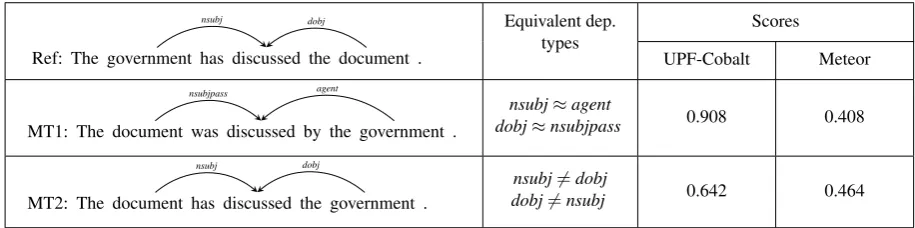
To appreciate the advantages of the method proposed, Ta-ble 1 provides a qualitative comparison of the performance of UPF-Cobalt and Meteor. Here MT1 is assigned a low score by Meteor due to the change in surface word order. UPF-Cobalt correctly assigns a high score to this sentence. All the content words are aligned and no context penalty is applied as the syntactic contexts of the aligned words are equivalent. Thus,agentrelation in the candidate translation is equivalent to nominal subject relation (nsubj) in the ref-erence, and subject of a passive clause (nsubjpass) in the candidate corresponds to the direct object (dobj) in the ref-erence.
By contrast, Meteor assigns a higher score to MT2 because of a matching auxiliary verb which in this case is not in-dicative of candidate-reference semantic similarity. MT2 is assigned a much lower score by UPF-Cobalt. Although all content words are matched they occur in different contexts and receive a high context penalty (0.90 for the main verb ”discussed” and 0.80 for the arguments ”government” and ”documents”). Thus, UPF-Cobalt is capable of distinguish-ing the use of equivalent constructions (active/passive alter-nation) from translation errors. The context penalty values calculated for each pair of aligned words can be used for locating translation errors.
Examples of acceptable syntactic variation are frequently found in professional human translation (Ahrenberg, 2005). Translators often introduce optional changes to the original sentence in order to adhere to specific principles of target language use, resulting in the existence of various possible translations with a varying distance from the source sen-tence. If the available human reference contains optional changes with respect to the source, surface-level compari-son is not informative, as the absence of such changes is not indicative of low MT quality.
4.
Experiments
The performance of evaluation systems is typically as-sessed by comparing the scores produced by the metrics
with the results of manual MT evaluation. Over the years, various settings have been developed for human evalua-tion in order to increase its reliability. Tradievalua-tionally, MT is evaluated in terms of absolute quality, on a multi-point scale. The two main criteria used for absolute scoring are adequacy and fluency (Linguistic Data Consortium, 2005). Adequacy measures how much of the meaning of the source sentence (or human reference translation) is preserved in the MT. Fluency refers to the well-formedness of the trans-lation. This type of evaluation is thus based on the defining properties of the translation and constitutes a powerful and intuitive instrument for assessing MT quality. Measuring absolute quality on a interval level scale, however, presents a problem of low inter-annotator agreement. The scale is arbitrary and no precise instructions are given to the anno-tators. As a result, different judges may assign different scores for the same sentence.
To overcome this issue an alternative setting has been intro-duced, in which the judges are asked to rank different MTs of the same source sentences in terms of their relative qual-ity (Callison-Burch et al., 2007). While this formulation of the task results in a higher inter-annotator agreement, it is less informative than absolute quality judgments.
It has been shown that the performance of automatic eval-uation systems varies significantly depending on the type of human judgments and the error metric (Denkowski and Lavie, 2010). Different types of human judgments pose dif-ferent challenges to automatic evaluation systems. Rank-ing can be more difficult when very similar MTs have to be compared, in which case fine-grained distinctions be-tween different kind of errors have to be made. On the other hand, in the ranking task the scores produced by a metric are not assessed directly. Ranking judgments pro-vide little insight regarding how well the magnitude of the differences in quality between the MTs of different source sentences is reflected in automatic evaluation.
Metric fr-en fi-en de-en cs-en ru-en Avgτ
UPF-Cobalt 0.386 0.437 0.427 0.457 0.402 .422±.011 DPMFcomb(Yu et al., 2015) 0.395 0.445 0.482 0.495 0.418 .447±.011 BEER Treepel(Stanojevic and Sima’an, 2015) 0.389 0.438 0.447 0.471 0.403 .429±.011 RATATOUILLE(Marie and Apidianaki, 2015) 0.398 0.421 0.441 0.472 0.393 .425±.010 BLEU(Papineni et al., 2002) 0.358 0.308 0.360 0.391 0.329 .349±.011 Meteor(Denkowski and Lavie, 2014) 0.380 0.406 0.422 0.439 0.386 .407±.012 Asiya(Gim´enez and M`arquez, 2010) 0.360 0.351 0.391 0.424 0.358 .377±.011
Table 2: Sentence-level evaluation results for WMT15 dataset in terms of Kendall rank correlation coefficient (τ)
We conduct experiments with different types of human judgments and show the robustness of our method in vary-ing evaluation settvary-ings. See Fomicheva et al. (2015b) for a detailed analysis of the importance of different components of the metric.
4.1.
Relative Quality
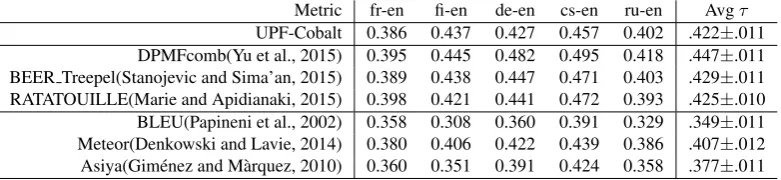
In this scenario human annotators are asked to judge trans-lations in terms of their relative quality. We use the data from 2015 Workshop on Statistical Machine Translation (WMT). The dataset consists of source texts, human refer-ence translations and the outputs from the participating MT systems, for five different language pairs. Manual evalu-ation was performed using an ordinal level scale. Anno-tators were presented with the source sentence, its human translation and the output of five MT systems and asked to rank the MTs from best to worst. Kendall rank correlation coefficient (τ) is used to measure the correlation between metrics’ scores and human ranking. Specifically, we use the definition of Kendallτpresented in Mach´aˇcek and Bo-jar (2015) which was the official measure for the WMT15 Metrics Task. Table 2 shows the results for all into-English translation directions.4
Our metric participated in the WMT15 Metrics Task and was ranked among the 4 best performing systems for sentence-level evaluation. Similar results were obtained for previous WMT workshops and are reported in Fomicheva et al. (2015b). For the sake of comparison the first group of results in Table 2 reproduces the correlations of the metrics that outperformed UPF-Cobalt at WMT15 Metrics Task. DPMFComb and RATATOUILLE use a learnt combina-tion of the scores from different evaluacombina-tion metrics, while BEER Treepel employs leaning-to-rank approach to com-bine string-level and syntax-level features.
The second group of results corresponds to the baseline n-gram based evaluation system BLEU and a strong baseline Meteor that uses synonyms and paraphrases to address lex-ical variation. Also, we calculate the correlation for ULC system developed by Gim´enez and M`arquez (2010). This is a uniform linear combination of metrics based on various levels of linguistic information. At syntactic level, ULC uses the degree of overlap between dependency trees of candidate and reference translations, and is thus compara-ble to our approach.
First, we observe that UPF-Cobalt significantly outper-forms the baseline systems, as well as the linguistically in-formed ULC metric, which considers lexical and syntactic
4The 95% confidence intervals are obtained using bootstrap
resampling method as reported in Mach´aˇcek and Bojar (2015).
aspects separately. As shown in Fomicheva et al. (2015b), the gain in performance is mainly due to the use of context penalty. Secondly, we note that the performance of the met-ric varies depending on the source language. The improve-ment over baseline systems is small for French-English and German-English. Our intuition is that the metric achieves better results when evaluating translations involving distant language pairs. In case of typologically related languages, the syntactic parser may assign acceptable structures to ill-formed MT outputs, thus increasing the noise when consid-ering the equivalence of different syntactic functions.
4.2.
Absolute Quality
To test the metric’s performance on absolute quality judg-ments, we conduct experiments with the MTC-P4 Chinese-English dataset, produced by Linguistic Data Consortium (LDC2006T04). This dataset contains 919 source sen-tences from news domain, 4 reference translations and MTs generated by 10 translation systems. The translations pro-duced by 6 of the systems were assigned quality scores fol-lowing the Linguistic Data Consortium evaluation guide-lines (Linguistic Data Consortium, 2005), based on fluency and adequacy criteria, on a 5-point scale. In total, human assessment is provided for 5,514 MT sentences.
Fluency and adequacy scores are normally averaged to ob-tain global quality scores. We report sentence-level Pearson correlation with the averaged scores, as well as for fluency and adequacy scores separately. We compare the perfor-mance of our metric with BLEU (Papineni et al., 2002) and Meteor (Denkowski and Lavie, 2014).
MTC-P4 dataset contains 4 different human reference translations. The metrics are evaluated in both single-reference and multi-single-reference scenarios. For the case when only one human reference is used, the reference is chosen at random and is the same for all the evaluation systems. BLEU was specifically designed to be used with multiple references. It counts the n-gram matches between the MT and any of the available human translations. To adapt Me-teor and UPF-Cobalt to the multi-reference scenario, we follow a simple approach of selecting for each sentence the highest of the 4 sentence-level scores obtained with differ-ent references. (See Qin and Specia (2015) for a description of alternative strategies). The results are summarized in Ta-ble 3.
Single Reference Multiple References
Metric A F Avg A F Avg
UPF-Cobalt 0.460 0.279 0.418 0.491 0.306 0.450 Meteor 0.450 0.262 0.405 0.488 0.302 0.447 BLEU 0.295 0.200 0.278 0.342 0.252 0.332
Table 3: Sentence-level evaluation results on MTC4-P4 dataset in terms of Pearson correlation with Adequacy (A), Fluency (F) and Averaged (Avg) adequacy and fluency judgments
between UPF-Cobalt and Meteor were found to be signif-icant for fluency scores and average scores in the single-reference scenario.5
Secondly, all the metrics present a lower correlation for flu-ency. The reason is that neither of the reference-based eval-uation systems explicitly addresses this aspect of transla-tion quality. However, BLEU and Meteor are outperformed by UPF-Cobalt in terms of the correlation with fluency judgments. The reason is that syntactic similarity between MT and the reference reflects, although indirectly, the MT fluency. In general, adequacy and fluency are related as-pects. If the MT is very similar to a reference, it is proba-bly well-formed. Thus, a metric that is better for predicting adequacy will also show an improvement in predicting flu-ency judgments.
Finally, the results show that the benefit of using multiple references is much higher in the case of BLEU. This is not surprising, since the evaluation systems that allow for fuzzy matches between words and constructions are designed pre-cisely to overcome the limitations of using single refer-ence as benchmark. Furthermore, the differrefer-ence between UPF-Cobalt and Meteor is minimal in the case of multi-reference evaluation. This suggests that the gain in perfor-mance achieved by UPF-Cobalt in the single-reference sce-nario is related to addressing the issue of acceptable varia-tion between the candidate translavaria-tion and the human refer-ence.
5.
Conclusion
We have presented an alignment-based MT evaluation met-ric, UPF-Cobalt, that combines the information on lexical similarity and the syntactic context of the words. We have shown that comparing the syntactic contexts of the aligned words helps to distinguish cases of acceptable linguistic variations from the differences that are indicative of MT er-rors. Our word-level context penalty allows for a better esti-mation of the impact of candidate-reference differences on the sentence-level MT quality. Also, we have enhanced ex-isting methods for addressing meaning-preserving variation between candidate and reference translations by exploiting distributed word representations at lexical level and classes of equivalent dependency types at syntactic level.
We have performed experiments using two main types of human evaluation: absolute quality scores based on adequacy and fluency criteria and ranking of different MTs in terms of their relative quality. The results show that UPF-Cobalt achieves stable and highly com-petitive results in varying evaluation settings. The
met-5The Hotelling-Williams (Williams, 1959) test for dependent
correlations was used for significance testing.
ric and the code are freely available for download at https://github.com/amalinovskiy/upf-cobalt.
6.
Acknowledgments
This work was supported by IULA (UPF) and the FI-DGR grant program of the Generalitat de Catalunya.
7.
Bibliographical References
Ahrenberg, L. (2005). Codified Close Translation as a Standard for MT. In Proceedings of the 10th Annual Conference of the European Association for Machine Translation.
Albrecht, J. S. and Hwa, R. (2008). Regression for Ma-chine Translation Evaluation at the Sentence Level. Ma-chine Translation, 22(1-2):1–27.
Baroni, M. and Lenci, A. (2010). Distributional Mem-ory: A General Framework for Corpus-based Semantics. Computational Linguistics, 36(4):673–721.
Baroni, M., Georgiana, D., and Kruszewski, G. (2014). Don’t Count, Predict! A Systematic Comparison of Context-counting vs. Context-predicting Semantic Vec-tors. InACL (1), pages 238–247.
Callison-Burch, C., Fordyce, C., Koehn, P., Monz, C., and Schroeder, J. (2007). (Meta-) Evaluation of Machine Translation. InProceedings of the Second Workshop on Statistical Machine Translation, pages 136–158. ACL. Comelles, E., Atserias, J., Arranz, V., and Castell´on, I.
(2012). VERTa: Linguistic Features in MT Evaluation. InProceedings of the International Conference on Lan-guage Resources and Evaluation (LREC), pages 3944– 3950.
de Marneffe, M.-C., MacCartney, B., and Manning, C. D. (2006). Generating Typed Dependency Parses from Phrase Structure Parses. InIn LREC, pages 449–454. Denkowski, M. and Lavie, A. (2010). Choosing the Right
Evaluation for Machine Translation: an Examination of Annotator and Automatic Metric Performance on Hu-man Judgment Tasks. In Proceedings of the Ninth Bi-ennal Conference of the Association for Machine Trans-lation in the Americas.
Denkowski, M. and Lavie, A. (2014). Meteor Universal: Language Specific Translation Evaluation for any Target Language. InProceedings of the Ninth Workshop on Sta-tistical Machine Translation, pages 376–380.
Fomicheva, M., Bel, N., and da Cunha, I. (2015a). Neutral-izing the Effect of Translation Shifts on Automatic Ma-chine Translation Evaluation. In Alexander Gelbukh, ed-itor,Computational Linguistics and Intelligent Text Pro-cessing: 16th International Conference, CICLing 2015, pages 596–607. Springer.
Fomicheva, M., Bel, N., da Cunha, I., and Malinovskiy, A. (2015b). UPF-Cobalt Submission to WMT15 Met-rics Task. InProceedings of the Tenth Workshop on Sta-tistical Machine Translation, pages 373–379.
Ganitkevitch, J., Durme, B. V., and Callison-Burch, C. (2013). PPDB: The Paraphrase Database. In Proceed-ings of the 2013 Conference of the North American Chapter of the ACL, pages 758–764.
Gim´enez, J. and M`arquez, L. (2010). Linguistic Mea-sures for Automatic Machine Translation Evaluation. Machine Translation, 24(3-4):209–240.
Gupta, R., Orasan, C., and van Genabith, J. (2015). ReVal: A Simple and Effective Machine Translation Evaluation Metric Based on Recurrent Neural Networks. In Pro-ceedings of the 2015 Conference on Empirical Methods in Natural Language Processing, pages 1066–1072. Guzm´an, F., Joty, S., M`arquez, L., and Nakov, P. (2014).
Using Discourse Structure Improves Machine Transla-tion EvaluaTransla-tion. InACL (1), pages 687–698.
Harris, Z. S. (1954). Distributional Structure. Word, 10(2-3):146–162.
Herrera, F. G., Joty, S. R., Marques, L., and Nakov, P. (2015). Pairwise neural machine translation evaluation. InACL(1), pages 805–814.
Levy, O. and Goldberg, Y. (2014). Dependency-Based Word Embeddings. In Proceedings of ACL (2), pages 302–308.
Linguistic Data Consortium. (2005). Linguistic Data An-notation Specification: Assessment of Fluency and Ade-quacy in Translations. Technical report.
Liu, D. and Gildea, D. (2005). Syntactic Features for Evaluation of Machine Translation. In Proceedings of the ACL Workshop on Intrinsic and Extrinsic Evaluation Measures for Machine Translation and/or Summariza-tion, pages 25–32.
Mach´aˇcek, M. and Bojar, O. (2015). Results of the WMT15 Metrics Shared Task. In Proceedings of the Tenth Workshop on Statistical Machine Translation, pages 256–273.
Madnani, N. and Dorr, B. J. (2013). Generating Targeted Paraphrases for Improved Translation. ACM Transac-tions on Intelligent Systems and Technology (TIST), 4(3):40.
Marie, B. and Apidianaki, M. (2015). Alignment-based Sense Selection in METEOR and the RATATOUILLE Recipe. InProceedings of the Tenth Workshop on Statis-tical Machine Translation, pages 385–391.
Mikolov, T., Sutskever, I., Chen, K., Corrado, G. S., and Dean, J. (2013). Distributed Representations of Words and Phrases and their Compositionality. In Advances in Neural Information Processing Systems, pages 3111– 3119.
Miller, G. and Fellbaum, C. (2007). Wordnet.
Owczarzak, K., Groves, D., Genabith, J. V., and Way, A. (2006). Contextual Bitext-derived Paraphrases in Auto-matic MT Evaluation. InProceedings of the Workshop on Statistical Machine Translation, pages 86–93. ACL. Pad´o, S., Galley, M., Jurafsky, D., and Manning, C. (2009).
Robust Machine Translation Evaluation with Entailment Features. InProceedings of the Joint Conference of the 47th Annual Meeting of the ACL and the 4th Interna-tional Joint Conference on Natural Language Processing of the AFNLP, volume 1, pages 297–305. ACL.
Papineni, K., Roukos, S., Ward, T., and Zhu, W.-J. (2002). Bleu: a Method for Automatic Evaluation of Machine Translation. InProceedings of the 40th Annual Meeting of the ACL, pages 311–318. ACL.
Qin, Y. and Specia, L. (2015). Insight into Multiple Ref-erences in an MT Evaluation Metric. InChinese Com-putational Linguistics and Natural Language Processing Based on Naturally Annotated Big Data, pages 131–140. Springer.
Stanojevic, M. and Sima’an, K. (2015). BEER 1.1: ILLC UvA Submission to Metrics and Tuning Task. In Pro-ceedings of the Tenth Workshop on Statistical Machine Translation, pages 396–401.
Sultan, M. A., Bethard, S., and Sumner, T. (2014). Back to Basics for Monolingual Alignment: Exploiting Word Similarity and Contextual Evidence. Transactions of the ACL, 2:219–230.
Thadani, K., Martin, S., and White, M. (2012). A Joint Phrasal and Dependency Model for Paraphrase Align-ment. InProceedings of COLING 2012: Posters. Williams, E. J. (1959). Regression Analysis, volume 14.
Wiley, New York, USA.