On the Compensation of Delay in
the Discrete Frequency Domain
Gareth Parker
Defence Science and Technology Organisation, P.O. Box 1500, Edinburgh, South Australia 5111, Australia Email:[email protected]
Received 31 October 2003; Revised 19 February 2004; Recommended for Publication by Ulrich Heute
The ability of a DFT filterbank frequency domain filter to effect time domain delay is examined. This is achieved by comparing the quality of equalisation using a DFT filterbank frequency domain filter with that possible using an FIR implementation. The actual performance of each filter architecture depends on the particular signal and transmission channel, so an exact general analysis is not practical. However, as a benchmark, we derive expressions for the performance for the particular case of an allpass channel response with a delay that is a linear function of frequency. It is shown that a DFT filterbank frequency domain filter requires considerably more degrees of freedom than an FIR filter to effect such a pure delay function. However, it is asserted that for the more general problem that additionally involves frequency response magnitude modifications, the frequency domain filter and FIR filters require a more similar number of degrees of freedom. This assertion is supported by simulation results for a physical example channel.
Keywords and phrases:frequency domain, FDAF, transmultiplexer, equaliser, delay.
1. INTRODUCTION
The term “frequency domain adaptive filter” (FDAF) [1] is often applied to any adaptive digital filter that incorporates a degree of frequency domain processing. Some time do-main adaptive filtering algorithms, such as the least mean square (LMS), may be well approximated using such “fre-quency domain” processing, by employing fast Fourier trans-form (FFT) algorithms to pertrans-form the necessary convolu-tions [1]. The computational complexity of such implemen-tations of these adaptive filters can be, for a large number of taps, considerably less than the explicit time domain forms. It is this computational advantage that is often the main mo-tivation for using these architectures. Other advantages also exist, such as the ability to achieve a uniform rate for all con-vergence modes (see, e.g., [1]).
Architectures that could be more deservedly labelled “fre-quency domain” can be achieved by transforming the time domain input signal into a form in which individual fre-quency components can be directly modified. This process can be approximated using a filterbank “analyser” [2], shown inFigure 1, which channels the inputx(n) into relatively nar-row, partially overlapping subbands, or “bins.” For clarity of illustration, the complex oscillator inputs to the multi-pliers in the analyser,e−j2πn fk/ fs, are denoted simply by−f
k,
k=0· · ·K−1. In the synthesiser, the conjugate oscillators ej2πn fk/ fsare similarly denoted by f
k.
With a sampling frequency fsHz, the output of a K
bin filterbank analyser with decimationMat timemM/ fsis
a vector of binsX(m)=[X(m,f0),. . .,X(m,fK−1)]. Thekth bin contains an estimate of the complex envelope of the nar-row bandpass filtered component ofx(n) centred at fkHz. If
the bins are uniformly spaced between−fs/2 and fs/2, then
the filterbank can be implemented using the discrete Fourier transform (DFT) and it is then known as a DFT filterbank [2]. As with other frequency domain filters, computation-ally efficient implementations of the DFT filterbank, incor-porating FFT algorithms, also exist [2]. When used for fre-quency domain filtering, the DFT filterbank is sometimes also known as a transmultiplexer [1,3].
The contents of the bins can be modified by mul-tiplication with possibly time varying, complex scalar weights W(m) = [W(m,f0),. . .,W(m,fK−1)], so that fil-tering is performed in a manner that is analogous to the explicit application of a transfer function to the Fourier transform of a continuous time signal. A filter-bank synthesiser reconstitutes a time domain output y(n) by appropriately combining the modified bins Y(m) =
[Y(m,f0),. . .,Y(m,fK−1)].
−f0
−f1
−fk
−fK−1 x(n)
h(n)
h(n) . . .
h(n)
. . .
h(n) M
M
M
M
X(m, f0)
X(m, f1)
X(m, fk)
X(m, fK−1) W0
W1
Wk
WK−1
Y(m, f0)
Y(m, f1)
Y(m, fk)
Y(m, fK−1) M
M
M
M
f(n)
f(n) . . .
f(n)
. . .
f(n) f0
f1
fk
fK−1
y(n)
Analyser Synthesiser
Figure1:K-channel DFT filterbank conceptual diagram.
and f(n), respectively, so that only adjacent bins experi-ence significant spectral overlap. This can be achieved, to almost arbitrary precision, by using appropriately long im-pulse responses, Nh andNf for h(n) and f(n). In FDAF
applications, it is typical [1] to design Nh = Nf = RK,
where R is around 3 or 4. Approximate bin indepen-dence is ideal for filtering functions whose main objective is the modification of spectral magnitude, such as “inter-ference excision” (see, e.g., [4,5]), a narrowband interfer-ence mitigation technique in which frequency components that comprise strong interference have weights set equal to zero. In that application, the smaller the overlap be-tween adjacent filterbank bins, the better. However, this is not necessarily the case in applications that require a de-lay to be applied to the signal. The ability to effect de-lay is important in applications such as channel equalisa-tion, echo cancellaequalisa-tion, and the exploitation of cyclostation-arity [6]. The requirement may vary from the need to ef-fect a constant delay, as in a noise canceller, through to the equaliser requirement that the delay may be frequency de-pendent.
Figure 2shows an example to illustrate the limitations of the DFT filterbank FDAF. A source signals(n) is transmitted over a channel and is received asx(n). A delayed version of s(n) is available as a desired response signal,d(n)=s(n−λ). A filter is to be designed to processx(n) to make it as “close” as possible tod(n). Assume that the channel is such thatx(n) is equal to s(n), other than for a delay that may vary with frequency, but that is constant within each bin width of an FDAF solution. A time domain adaptive filter solution may be to filterx(n) using a finite impulse response (FIR) filter,
s(n) Channel c(n)
x(n)
Filter y(n)
e(n) −
+ d(n)
Figure2: Example filtering problem.
with a tap weight vectorw(n) that is adapted according to the errore(n)=d(n)−y(n) using an algorithm such as LMS [7]. With an FDAF solution, both x(n) and d(n) are chan-nelised into approximate frequency domain representa-tions X(m,fk) and D(m,fk). Each frequency component,
X(m,fk), is multiplied by a complex scalar W(m,fk) so
that Y(m,fk) = W(m,fk)X(m,fk), and the inverse
trans-form is then applied to generate y(n), the estimate of d(n). Figure 3 shows an illustration of this filtering pro-cess.
If bin independence is assumed, the objective can be achieved by making, for every bin,Y(m,fk) as close as
possi-ble toD(m,fk) and the frequency domain weights vector can
x(n)
Figure3:K-channel frequency domain adaptive filter.
respectively, and we require
Equality is clearly not possible. In general, modification of the magnitude and phase within a filterbank bin is not suffi -cient to perfectly achieveanynontrivial delay. In this paper, we present an analysis to quantitatively determine the degree to which a filterbank FDAF can compensate or effect delay. The paper is structured as follows. A discussion of previous related research is given in the next section. InSection 3, an analysis is presented of the accuracy with which an FIR fil-ter can compensate a delay that varies linearly over a speci-fied bandwidth. This is useful both for the explicit purpose of analysis of the FIR filter and also for the analysis inSection 4
of the FDAF, which can be viewed as comprising a single tap FIR filter operating within each filterbank bin.Section 4 in-cludes a comparison between FIR and FDAF delay compen-sation for linear delay channels, as well as a simulation exam-ple for a real-world channel. Conclusions are summarised in
Section 5.
2. PREVIOUS ANALYSES OF THE FREQUENCY DOMAIN DELAY COMPENSATION PROBLEM
In 1981, Reed and Feintuch [8] compared the performance of an adaptive noise canceller, implemented using the time domain LMS algorithm, with an early “frequency domain” LMS approximation. The particular frequency domain ar-chitecture that was studied was that of Dentino et al. [9], which approximated the LMS algorithm using a combina-tion of FFT/IFFT algorithms that resulted in circular convo-lutions. A particular observation in [8] is that if the time and frequency domain filters are implemented using the same
number of degrees of freedom1and if there exists diff eren-tial delay between the primary and desired response inputs, then excessive noise appears in the frequency domain solu-tion. Although the amount of excess noise is quantified, the results in [8] are applicable only to that particular “frequency domain” filter.
Sometimes, particularly for the equaliser and echo can-celler problems, a subband adaptive filter (SAF) is adopted [10,11,12,13,14,15]. A SAF is a generalisation of a FDAF, where a multitap FIR adaptive filter operates within each fil-terbank channel. The ability of the SAF to effect a perfor-mance that is comparable to a time domain implementation has been recently addressed in [10,12,16]. In [12], the use of critically sampled filterbanks for the system identification problem has been examined. For the identification of a sys-tem with an impulse response comprising Lssamples, it is
stated that the number of FIR taps within each subband filter should be around
L=Ls+Nh+Nf
M , (2)
where the filterbank analysis and synthesis filters have lengths Nh and Nf, respectively, and the filterbank decimates the
sampling rate by a factorM. In [16], the result of [12] is ap-plied to the equaliser problem, and it is argued that to achieve the same performance as anLtdtap time domain equaliser, the number of samples in each FIR filter must be around
L=Ltd+Nh
M . (3)
In [10], a similar expression is provided, although the fac-torNhin the numerator of (3) is doubled. This is essentially
the same as (2), except that the application is different. The correctness of the expression for the equalisation problem is justified in [10] through simulation results, but it is acknowl-edged as a conservative relationship. Although it is appropri-ate for the case whereL1, whereLis close to one or, in the case of the FDAF, equal to one, the expression is less suitable. Equation (3) suggests that there is no filterbank FDAF which can achieve the performance of a FIR filter. For instance, if Nh =RK =RMI, whereIis the oversampling factor, then
even asK→ ∞,L→RI. There is a need to determine guide-lines for the choice ofK in a filterbank FDAF, whereL=1, and this is the focus of this paper.
3. EFFECTING DELAY USING AN FIR FILTER
In order to determine the degree to which a DFT filterbank FDAF can effect delay, we will determine the estimation er-ror that is associated with each filterbank bin and then com-bine these errors in a frequency domain SNR measure. In some applications, this may be the most appropriate measure of quality. In others, including conventional equalisers and
noise cancellers, it may be more appropriate to measure the SNR associated with the filterbank output. These two SNR measures will be identical for an “ideal” filterbank; that is, one that exhibits perfect reconstruction and which has in-dependent bins. If the bins are not inin-dependent but exhibit some spectral overlap, then the relationship between the fre-quency and time domain SNR measures is only approximate. In the following discussion, we will analyse the error within the filterbank bins by treating each bin as an optimal single tap, linear time invariant (LTI) FIR filter. Consequently, we first obtain a general expression for the performance of an optimal FIR equaliser. This will also be useful for the purpose of comparison between the FIR and the filterbank. Further comparison with an SAF is detailed in [6].
Consider anL-tap FIR filter, with fsHz sampling rate. A
delay can be exactly effected if it is equal to an integer mul-tiple, less than L, of 1/ fssecond. For delays not equal to a
multiple of 1/ fs, the delay will be an approximation [17], the
accuracy of which can be determined by considering the op-timum FIR filter.
To analyse this, we will elaborate on the example shown inFigure 2. Consider the transmission of a zero-mean signal s(t) through a channel with impulse responsec(t). At a re-ceiver, this is sampled and applied to anL-tap FIR filter as the observation signal,x(n)=s(n)∗c(n), wheres(n) andx(n) are the sampled signals and c(n) is the equivalent discrete-time channel. The filter produces the output y(n) = wxn,
where xn = [x(n−L+ 1),. . .,x(n)]T contains the last L
signal samples and the FIR filter impulse response is con-tained within the row vector w = [w(0),. . .,w(L−1)]. A desired response,d(n), is provided, which is related tos(n) byd(n)=s(n)∗g(n), whereg(n) is assumed to have an FIR. Ideally,s(n) would be available at the receiver andg(n) would then be a simple delay, designed into the adaptive filter and chosen so that the equalisation problem has a causal solution. Assume thats(n) is stationary and define the autocorrelation matrix and cross-correlation vector as
R=
τ)]. The weights vector that minimises the mean square esti-mation error (MSE) is the Wiener solution,w=pR−1. Stan-dard analysis (see, e.g., [7]) shows that the error power is equal to
J=Ed(n)−y(n)2
=Rdd(0)−pR−1pH
(5)
and so the SNR at the filter output can be expressed as
SNR= Rdd(0)
Rdd(0)−pR−1pH. (6)
This can be further manipulated in terms of the source signal powerσ2 = E[s(n)s∗(n)] and the impulse responses of the
channels c(n) andg(n). Assuming thats(n) is stationary, it can be shown [6] that
Now lets(n) be a white stationary signal and consider the ideal equalisation problem whereg(n) is a delay ofλsamples, chosen to facilitate a causal solution. Thusg(n)=δ(n−λ) so thatd(n)=s(n−λ) andRdd(0)=Rss(0)=σ2. Then, from
and the SNR is equal to
SNR= 1
1−L−1
i=0 c∗(λ−i)
2. (10)
Let the channel c(n) have a bandpass frequency response with a delay that varies linearly frommin to max samples, over a filter bandwidth of 2b bins, in anN-sample DFT of the impulse responsec(n). It can be shown [6] that the dis-crete magnitude frequency response can be written as
C(k)=rect
where the phase response is given by
Φ(k)=min−max
Example 1 (constant delay channel). A particularly simple special case of the linear delay channel is when the delay is constant, equal to samples, where is not necessarily an integer. In this case, if the channel bandwidth extends over the sampling frequency range, then fc = fs/2 and c(n) =
60 50 40 30 20 10 0
SNR
(dB)
101 102 103
L(samples)
Figure4: Reconstruction SNR for FIR equalisation of linear delay channel.
This verifies the earlier statement that an FIR filter is capable of perfectly achieving delays which are a multiple of the tap spacing. However, recall thatis not necessarily an integer. If a noninteger delay is required, then the sinc function will not be sampled at its zero crossings and the SNR is finite. A perfect noninteger delay cannot be achieved for finiteL.
Example2 (general linear delay channel). Next we look at the equalisation of a channel with a delay which varies linearly over a 100-sample range. In this case, we examine both the-oretical and experimental performances. In order to assure a causal experimental channel with a delay response which closely approximates the desired response, we let the number of samples in the channel impulse response beNch = 2048
and design the delay to vary from sample 975 to sample 1075, symmetric aboutn0 =1025.Figure 4shows the theoretical SNR for an optimalLpoint FIR equaliser for this channel. The curve was generated using (12) and (11) to numerically evaluate (10). Also shown by crosses are the experimental re-sults. The parameterλwas chosen to maximise the summa-tion of equasumma-tion (10). As|c(n)|is symmetric about sample n0, this means choosingλ =(L−1)/2 +n0and, in this ex-ample, we haveλ=(L−1)/2 + 1025 samples. Experimental results, obtained for a unity variance complex Gaussian white noise signal and using an LMS algorithm to approximate the optimal filter, are indicated by crosses.
4. FILTERBANK
The analysis ofSection 3can be used to determine the accu-racy with which a filterbank FDF can compensate delay by considering the FIR case withL=1 taps. However, by allow-ing an arbitrary number of FIR taps, the study can be gen-eralised to a SAF [6]. A subband adaptive equaliser can be implemented using identical filterbanks to generate each of the primaryX(m,fk) and desiredD(m,fk) response signals
x(n) h(n) M X(m, fk)
xk(n) e−j2πn fk/ fs
Figure5: Signal flow diagram for thekth channel of the filterbank analyser, processing the observation signalx(n).
from the time domain inputsx(n) andd(n). An FIR filter is independently applied to each channel ofX(m,fk) to
min-imise the performance criterion, which is assumed here to be the MSE. The error power associated with each bin is readily determined using the analysis ofSection 3for the FIR filter. If the filterbanks are capable of perfect reconstruction with in-dependent bins, then the sum of the error power within each bin of this equaliser equals the MSE of the time domain es-timate ofd(n). An expression for the equaliser SNR can be readily determined. If the filterbank does not satisfy these properties, then such an expression is only approximate.
To facilitate the application of the general FIR filter anal-ysis ofSection 3, let the signals(n) pass through the trans-mission channels c(n) and g(n) to produce the observa-tion and desired response signals x(n) = s(n)∗c(n) and d(n)= s(n)∗g(n). The signal within thekth observation filterbank bin is, prior to decimation,
xk(n)=
s(n)∗c(n)e−j2π fkn/ fs∗h(n), (14)
as illustrated inFigure 5. Similarly,
dk(n)=
s(n)∗g(n)e−j2π fkn/ fs∗h(n). (15)
These can be shown to be equivalent to
xk(n)=
s(n)e−j2π fkn/ fs∗c(n)e−j2π fkn/ fs∗h(n),
dk(n)=
s(n)e−j2π fkn/ fs∗g(n)e−j2π fkn/ fs∗h(n). (16)
Let sk(n) = s(n)e−j2π fkn/ fs, ck(n) = c(n)e−j2π fkn/ fs, and
gk(n)=g(n)e−j2π fkn/ fsso that we can write
xk(n)=sk(n)∗ck(n)∗h(n),
dk(n)=sk(n)∗gk(n)∗h(n).
(17)
Writingck(n)=ck(n)∗h(n) andgk(n)=gk(n)∗h(n) gives
us expressions forx(n) andd(n) in the form of the general FIR analysis. That is,
xk(n)=sk(n)∗ck(n),
dk(n)=sk(n)∗gk(n).
(18)
This means that expressions for Rxkxk(n), Rdkdk(n), and
Rdkxk(n), and thus the SNR within each channel, can be
easily determined. After decimation by M, the observa-tion and desired response signals are X(m,fk) = xk(mM)
and D(m,fk) = dk(mM), respectively. Assuming no
RDkXk(m) = Rdkxk(mM). Further analysis requires
particu-lar cases to be treated separately. We assume throughout that s(n) has unity variance and is white over the frequency range
−fs/2 to fs/2.
4.1. Frequency domain filter
A filterbank FDAF hasL=1 and expression (6) for the SNR within thekth bin reduces to
SNRk= RDkDk(0)
RDkDk(0)−RDkXk(0)
2
/RXkXk(0)
. (19)
We now proceed to determine the correlation functions for a channel that has flat magnitude response with linear de-lay. This is achieved by inverse Fourier transforming the corresponding spectra. The magnitude of the cross-spectrum between the desired response and observation sig-nals within a particular bin is bandpass from approximately
−fs/2K to fs/2KHz. Under the assumption that the
trans-mission channelsc(n) andg(n) are flat with unity gain over the bandwidth of each bin, the shape of the cross-spectrum is determined solely by the frequency response of the anal-ysis filters and Sss(f), the power spectral density of s(n).
That is,Sdkxk(f)= |H(f)|2Sss(f − fk), as shown in the
ap-pendix. Since we assume thats(n) is white over the frequency range between−fsandfsHz, thenSss(f)=σ2/ fs. The
cross-spectral phase is bin dependent but is simply the difference between the phase response of the channels over this fre-quency range. This can be determined from the correspond-ing delay difference. Thus the cross-correlation function for each bin, RDkXk(m), can be determined using an algorithm
for designing a linear delay FIR filter.
Although we derive results for a filterbank with a prac-tical analysis filter, it is also essential to consider the ideal, independent bin case. The reason for this is threefold; first, the assumption of independent bins is frequently made in frequency domain filtering applications; second, we will see that this extreme filterbank architecture achieves the worst possible delay performance; and third, simple closed-form expressions can be obtained for its performance. If the filter-bank satisfies the perfect reconstruction property and has in-dependent bins, then the analysis filter has an ideal brick-wall frequency response that is flat between−fs/2Kandfs/2KHz.
That is,H(f)=rect(f /2fc), wherefc= fs/2KHz.
4.1.1. Equalisation of a constant delay channel using an ideal filterbank
It is useful to explicitly consider the case where the chan-nel delay is constant since, as will now be shown, a closed-form expression for the SNR can be derived. Let the trans-mission channelc(n) have a constant delay equal to sam-ples, whereis not necessarily an integer, and letg(n) have a constantλsample delay. The delay difference betweeng(n) andc(n) is thusλ−. The bandwidth of each bin is equal to 2fc = fs/K and so the magnitude ofSdkxk(f) is equal to Sss(f)rect(f K/ fs). At the decimated sample rate, fs= fs/M,
the cross-spectral bandwidth becomes 2fc= fsM/Kand the
“filter” group delay is (λ−)/M. The impulse responsep(m),
whose discrete-time Fourier transform equals the cross-spectrumSdkxk(f), can be shown to equal
To determine RDkXk(m), this impulse response must be
scaled by a factor fs so that its DFT produces a discrete
power spectrum whose bins sum to the correct power. With this scaling, the cross-correlation becomes
RDkXk(m)=
similarly be shown to equal
RXkXk(m)=RDkDk(m)=
Using equation (19), the SNR is the same within each bin and is equal to
SNRk=
1
1−sinc2(λ−)/K. (23)
This is also equal to the total frequency domain SNR, since the channels through which both observation and desired response signals have passed have frequency-independent magnitude and delay response. Under the assumption of independent bins, this SNR is also equal to the SNR of the reconstructed time domain output. Equation (23) illustrates an important result; due to the SNR dependence on the magnitude of the differential delay |λ −|, the filterbank FDAF effects signaladvanceto the same accuracy as it can effect delay. Consequently for frequency domain equalisa-tion, in the absence of detailed channel knowledge, the most generally optimum design would useλ=0.
The SNR given by (23) is plotted as the solid trace in
Figure 6, for the case whereM=K/2,=64,λ=0, andKis varied over the rangeto 32. The horizontal axis is the ratio K/, to clarify that the curve depends only on this ratio and not on the values of andK themselves. Experimental re-sults were also obtained by approximating the independence of the bins by using a DFT filterbank with very little overlap of adjacent frequency bins. This was achieved by using analy-sis filters with very long impulse responses,Nh=RK, where
R=32. The details of this filter design, based on a Hamming window, are given in [6].
Theoretical ideal filter bank Experimental time domain Experimental frequency domain
0 5 10 15 20 25 30 35
Ratio of number of bins to delay 0
Figure6: Reconstruction SNR for “ideal” filterbank FDAF equali-sation of constant delay.
4.1.2. Channel with linear delay
Now consider an allpass channel, c(n), with a delay that varies linearly from minto maxsamples over the sampling bandwidth. Let the delay associated with channelck(n) vary
frombmin to bmax samples over the bandwidth of the kth bin, at the input sampling rate. The delay difference between the desired response and observation signal thus varies over λ−bmaxtoλ−bminsamples. It is easy to show [6] that
The cross-spectral delay between the decimated desired re-sponse and observation signals then varies linearly from1= (λ−bmax)/Mto2=(λ−bmin)/Msamples at the decimated rate, fs= fs/MHz.
Let ν represent the discrete frequency index for a fre-quency domain representation of the kth subband data. To determine the cross-correlation function RDkXk(m), the
cross-spectrumSDkXk(ν) can be sampled atNpoints and an
inverse DFT computed. Under our assumption that s(t) is white, the power spectral magnitude|Sss(f)|is constant and
equal toσ2/ f
sunits squared per Hz. Thus the magnitude of
the cross-spectral densitySDkXk(ν) is equal toσ2|H(ν)|2/NM
units squared per bin2and the cross-spectral densityS
DkXk(ν)
is equal to
SDkXk(ν)=SSS(ν)H(ν)
2
ejΦk(ν). (25)
2Since the subband data is sampled atf
s =fs/MHz, the bandwidth of each of theNbins is equal to fs/NMHz and the power within each bin is equal toσ2/NMunits squared.
Within the kth filterbank channel, theN point correlation function between the decimated reference and the primary signal component,RDkXk(m), is then approximately given by3
RDkXk(m)=N×IDFT
where the bandwidth 2b = MN/K. Although not explicitly indicated in (27), the delays1 and2are a function of the bin number,k. The autocorrelation functionsRXkXk(m) and
RDkDk(m) can similarly be computed by specifying a linear
phase term in (26). The SNR within each bin is computed using (19) but the total filterbank SNR should be computed by the ratio of total signal to total error power. That is,
SNRFB=
where the power of the desired response signal is equal to RDkDk(0), and from (5), the error power within thekth bin is
If the filterbank exhibits perfect reconstruction and the bins are independent, the SNR associated with the reconstructed time domain output satisfies the relationship SNRtd = SNRFB, otherwise this relationship is only approximate.
We used this general analysis to determine the equalisa-tion performance for a constant delay channel using a prac-tical filterbank FDAF. The analysis and synthesis filters were designed to have identical impulse responses, where only ad-jacent bins exhibit any significant spectral overlap, resulting in near-perfect reconstruction4 and so that the sum of the power within each analyser bin equals the time domain in-put signal power. The length of the analysis and synthesis fil-ters was Nh = RK, whereR = 4, and the filterbank had a
decimation factorM = K/2. Equation (26) was computed using these parameters, with K = 512 and N = 100. The magnitude response of the analysis filter was determined by performing anN-point DFT on the decimated impulse re-sponseh(mM)=h(n).
3In general, the discrete power spectrumSxx(ν) of a signalx(m) can be estimated by 1/N times the periodogram |X(ν)|2, where X(ν) = DFT[x(m)]. Since the autocorrelation function,Rxx(m), estimated by time averagex(m)∗x∗(−m) is equal to the inverse DFT of|X(ν)|2, it follows that Rxx(m) is equal toNtimes the inverse DFT ofSxx(ν).
Theoretical frequency domain SNR Experimental time domain SNR Experimental frequency domain SNR
0 5 10 15 20 25 30 35
Ratio of number of bins to delay 0
5 10 15 20 25 30 35
SNR
(dB)
Figure7: Reconstruction SNR for filterbank FDAF equalisation of constant delay.
The solid trace of Figure 7 shows the theoretical fre-quency domain SNR as a function of the ratio K/. Fre-quency domain SNR measurements, computed from exper-imental results, are shown as crosses and the correspond-ing time domain output SNR points are shown as circles. By comparison with Figure 6, it can be seen that the fre-quency domain SNR is almost the same as that obtained when the bins are independent. However, the experimen-tal results show that the SNR of the filterbank time domain output is better. This can be explained by considering the power spectra of the subband error signals. Simulations have shown that the error power spectrum is distributed towards the edges of the bins, rather than about the bin centre as is the signal power spectrum. By design, the action of the synthesis filters is to constructively combine the signal components of adjacent bins, but the error is attenuated by these filters. So while the signal power is preserved by the synthesis process, the error power is reduced. The result is the superior SNR of the time domain filterbank output compared with the trans-form domain SNR.
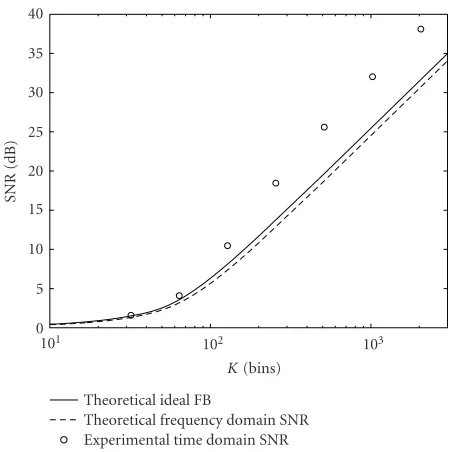
Next, we look at the performance of a filterbank FDAF for equalising the linear delay channel which was defined in Example 2. The channel has delay that varies linearly frommax−min =100 input samples over the full discrete frequency range. The theoretical frequency domain SNR is shown as the solid trace inFigure 8, for a perfect reconstruc-tion filterbank with nonoverlapping bins. The delay in the desired response channel was chosen to maximise the SNR. Since the filterbank is capable of effecting a noncausal re-sponse, where a delay of − samples is as readily approxi-mated as a delay of samples, the optimum choice is λ =
n0=(max+min)/2. The example channel hasminandmax
Theoretical ideal FB
Theoretical frequency domain SNR Experimental time domain SNR
101 102 103
K(bins) 0
5 10 15 20 25 30 35 40
SNR
(dB)
Figure8: Reconstruction SNR for filterbank FDAF equalisation of the linear delay channel.
equal to 975 and 1075, respectively, so that the channel delay is symmetric aboutn0 =1025. Justified by the closeness of the time and frequency domain SNR measures for the con-stant delay channel (Figure 6), we assert that this solid trace also represents the time domain SNR measure for the “ideal” filterbank. Also shown inFigure 8is the theoretical frequency domain (dashed) and experimental time domain (circles) SNR achieved by the R = 4 practical filterbank FDAF that was introduced earlier in this section. As anticipated from the results of the constant delay channel, the frequency do-main SNR associated with the practical filterbank is very sim-ilar, but slightly inferior, to the ideal filterbank. However, also in similarity to the results of the constant delay channel, the time domain SNR is superior to the frequency domain mea-sure.
0 1 2 3 4 5 6 7 8 9 10 Time (µs)
−0.4 −0.2 0 0.2 0.4 0.6 0.8
A
m
plitude
Figure9: Real (black) and imaginary (grey) parts of example chan-nel impulse response.
The results of the previous paragraph can be compared with the relationship in (3). In this example, the ideal filterbank has an infinite number of analysis filter samples. According to (3), the number of subband FIR taps must also be infinite, yet we have shown that there exists a filterbank FDAF (equivalent to an SAF with one tap per subband FIR filter) that can achieve the FIR performance. This clearly illustrates the conservative nature of (3).
4.2. Channel equalisation example
It is important to compare the specialised results discussed thus far with the equalisation performance of a real-world channel and signal. In this section, we provide an example where a simulation signal is passed through such a channel and is subsequently equalised using both an FDAF and a time domain LMS equaliser.
Consider the microwave channel with an equivalent baseband impulse shown in Figure 9, obtained with a 60 MHz sampling rate. This is “channel 14,” taken from the Rice University microwave channel database, currently avail-able at the Internet site “http://spib.rice.edu/spib/microwave. html.” Analysis shows that there is considerable variation in both the delay and the magnitude of the frequency response, with nonminimum phase zeros located close to the unit cir-cle. We used, for the example signal, a baseband 12 Mbaud BPSK signal with root raised cosine pulse shaping.
Each of the FDAF and LMS filter parameters was adjusted so that in the steady state, the output signal was restored to a similar SNR. So that the example represents, as realis-tically as possible, a typical equalisation problem, the delay parameterλwas chosen without incorporating knowledge of the length of the channel impulse response. Consequently, in accordance with the discussions in Sections 3and4.1,λ was chosen equal toL/2 for the time domain filter and 0 for the FDAF. WithL =4096 taps and convergence coefficient µ=10−5, the FIR filter achieved approximately 19 dB steady state SNR. In the filterbank case, we used an oversampling
factorI=2 and length 4Kanalysis and synthesis filters. The FDAF filter weights were determined using the single tap RLS algorithm withγ=0.99 and it was found that withK=4096 bins, the filterbank FDAF also achieved approximately 19 dB SNR.
In this example, to achieve the same output SNR, a sim-ilar number of degrees of filtering freedom are required for each of the time domain FIR filter and the FDAF. This obser-vation has also been found to be consistent with other real-world channel examples, including a number of others from the Rice University database. For these other cases, the FDAF required at most twice the number of degrees of freedom of the time domain filter.
This is a significantly different observation to that which could be anticipated from studying the results of the linear delay channel. In that case, the experimental results showed that to achieve approximately 26 dB SNR, the FIR and FDAF requiredL=250 taps andK =1000 bins, respectively; con-siderably more degrees of freedom are required by the FDAF. That in these real-world examples a comparable number of degrees of freedom are required by each of the two filter types can be well explained by considering the duality be-tween FIR and FDAF filters. The FIR filter is inherently well suited to effecting pure delay functions; it can localise in time, since it is a time domain operation. On the other hand, an FDAF can effect narrowband modification of the frequency response. It is not surprising then that for an operation such as real-world channel equalisation, that requires modifica-tion of both delay and frequency response, a similar number of degrees of freedom are required by both FIR and FDAF fil-ters. We should again emphasise that there are additional rea-sons why, in practice, the FDAF may or may not be adopted in preference to a time domain approach, as discussed in the introduction to this paper. The most notable advantages in these real-world examples are the superior convergence rate and computational efficiency of the FDAF.
This relationship between the number of degrees of free-dom required by an FDAF and an FIR filter to achieve similar delay compensation clearly depends on the particular chan-nel type. Importantly, however, in any of the cases consid-ered here5, it has been shown that it is possible to design an FDAF to achieve equivalent delay compensation perfor-mance to that of an FIR filter.
5. CONCLUSION
In this paper, we have addressed an important issue associ-ated with the application of a DFT filterbank FDAF to chan-nel equalisation. We have shown that a fundamental diff er-ence between the DFT filterbank and an FIR filter is the ac-curacy of delay compensation. While an L-tap FIR filter is capable of perfect compensation for a set ofLdiscrete delays, a DFT filterbank FDAF, with independent bins, is incapable
of perfect delay compensation except asymptotically as the number of bins approaches infinity. For other delays, how-ever, we have shown that it is possible to determine filter-bank FDAF parameters that result in equivalent performance to that of an FIR filter.
For equalisation of a linear delay channel, a filterbank FDAF can require in excess of an order of magnitude more bins than the number of taps required by a FIR filter. The ability of a filterbank FDAF to compensate delay is directly related to the degree of spectral overlap that exists between bins and results indicate that the greater the independence between bins, the poorer the quality of FDAF delay compen-sation.
Notwithstanding these conclusions, the linear delay channel represents an extreme condition and counter exam-ples have suggested that for compensation of more typical communications channels, the number of bins required by an FDAF is around the same as the number of taps required by a similarly performing FIR filter.
It has been shown that for the majority of the chan-nels considered, it is possible to design a filterbank FDAF to achieve a delay compensation performance that is equivalent to that possible using an FIR filter. This is a new observation that would otherwise not be clear from previously published work.
APPENDIX
In this appendix, the expression for the cross-spectrum,
Sdkxk(f)= |H(f)|2Sss(f−fk), used inSection 4.1, is derived.
Then, from linear systems theory, the cross-spectrum
Sxkfk(f) is given by
g(n) have unity gain, flat frequency responses over the band-width of thekth analysis filterbank bin, we have, as required, that
Sxkdk(f)=Sss
f −fkH(f)2. (A.5)
ACKNOWLEDGMENTS
The author thanks Ken Lever, John Tsimbinos, and Lang White for their helpful discussions relating to this work. The work was undertaken while the author was also affiliated with the Institute for Telecommunications Research, University of South Australia.
REFERENCES
[1] E. R. Ferrara Jr., “Frequency-domain adaptive filtering,” inAdaptive Filters, C. F. N. Cowan and P. M. Grant, Eds., Prentice-Hall, Englewood Cliffs, NJ, USA, 1985.
[2] R. E. Crochiere and L. R. Rabiner, Multirate Digital Signal Processing, Prentice-Hall, Englewood Cliffs, NJ, USA, 1983. [3] J. R. Treichler, S. L. Wood, and M. G. Larimore, “Some
dy-namic properties of transmux-based adaptive filters,” inProc. 23rd Asilomar Conference on Signals, Systems and Comput-ers, vol. 2, pp. 682–686, Pacific Grove, Calif, USA, October– November 1989.
[4] L. B. Milstein and P. K. Das, “Spread spectrum receiver using surface acoustic wave technology,” IEEE Trans. Communica-tions, vol. COM-25, no. 8, pp. 841–847, 1977.
[5] L. B. Milstein and P. K. Das, “An analysis of a real-time trans-form domain filtering digital communication system: part I: narrow-band interference rejection,” IEEE Trans. Communi-cations, vol. COM-28, no. 6, pp. 816–824, 1980.
[6] G. Parker, Frequency domain restoration of communications signals, Ph.D. dissertation, University of South Australia, Ade-laide, South Australia, Australia, March 2001.
[7] B. Widrow and S. D. Stearns, Adaptive Signal Processing, Prentice-Hall, Englewood Cliffs, NJ, USA, 1985.
[8] F. A. Reed and P. L. Feintuch, “A comparison of LMS adaptive cancellers implemented in the frequency domain and the time domain,” IEEE Trans. Circuits and Systems, vol. 28, no. 6, pp. 610–615, 1981.
[9] M. Dentino, J. McCool, and B. Widrow, “Adaptive filtering in the frequency domain,” Proceedings of the IEEE, vol. 66, no. 12, pp. 1658–1659, 1978.
[10] S. Weiss, On Adaptive Filtering in Oversampled Subbands, Ph.D. dissertation, University of Strathclyde, Glasgow, UK, 1998.
[11] S. Weiss, S. R. Dooley, R. W. Stewart, and A. K. Nandi, “Adap-tive equalisation in oversampled subbands,” IEE Electronics Letters, vol. 34, no. 15, pp. 1452–1453, 1998.
[12] A. Gilloire and M. Vetterli, “Adaptive filtering in subbands with critical sampling analysis, experiments, and application to acoustic echo cancellation,” IEEE Trans. Signal Processing, vol. 40, no. 8, pp. 1862–1875, 1992.
[13] A. Fertner, “Frequency-domain echo canceller with phase ad-justment,” IEEE Trans. on Circuits and Systems II: Analog and Digital Signal Processing, vol. 44, no. 10, pp. 835–841, 1997. [14] W. Kellermann, “Analysis and design of multirate systems for
[15] T. Gansler, “A robust frequency-domain echo canceller,” in Proc. IEEE Int. Conf. Acoustics, Speech, Signal Processing, vol. 3, pp. 2317–2320, Munich, Germany, April 1997.
[16] R. W. Stewart, S. Weiss, D. Garcia-Alis, and G. Freeland, “Sub-band adaptive equalization of time-varying channels,” inProc. 33rd Asilomar Conference on Signals, Systems and Computers, vol. 1, pp. 534–538, Pacific Grove, Calif, USA, October 1999. [17] T. I. Laakso, V. Valimaki, M. Karjalainen, and U. K. Laine,
“Splitting the unit delay,” IEEE Signal Processing Magazine, vol. 13, no. 1, pp. 30–60, 1996.