University of Huddersfield Repository
Mungovin, Ben
Aspects of openness and specificity in postminimal music
Original Citation
Mungovin, Ben (2014) Aspects of openness and specificity in postminimal music. Masters thesis, University of Huddersfield.
This version is available at http://eprints.hud.ac.uk/id/eprint/23701/
The University Repository is a digital collection of the research output of the University, available on Open Access. Copyright and Moral Rights for the items on this site are retained by the individual author and/or other copyright owners. Users may access full items free of charge; copies of full text items generally can be reproduced, displayed or performed and given to third parties in any format or medium for personal research or study, educational or notforprofit purposes without prior permission or charge, provided:
• The authors, title and full bibliographic details is credited in any copy; • A hyperlink and/or URL is included for the original metadata page; and
• The content is not changed in any way.
For more information, including our policy and submission procedure, please contact the Repository Team at: [email protected].
Aspects of Openness and Specificity
in Post-minimal Music
Ben Mungovin
A thesis submitted to the University of Huddersfield in partial fulfilment of the requirements for the degree of Master of Arts by Research.
Table of Contents
Portfolio...3-5 Copyright Statement...6 Abstract...7
1. Precedents...8 2. Influences...9-10 3. Post-minimalism defined...10-11 4. 'Totalism'...11-12 5. Composer/Performer...12-13 6. Attitudes to repetition...13 7. 'Catharsis'...13-15 8. Minimalism on a shoestring...15-16 9. 'Metro' & 'Loops #2'... 17-19 10. Enculturation...19-20 11. Openness and Specificity...20 12. 'Loops #1'....20-21 13. The composition-rehearsal-performance paradigm...22 14. 'Soundpainting'...22-23 15. Physical and Mental Virtuosity...24-25 16. 'Neuron Doctrine'...26-28 17. Further Considerations...28-30 18. Bibliography...31-33
Portfolio
1. 'Totalism' for mixed ensemble (2013)
Ben Mungovin (Electric Guitar), Josh Dibble (Bass), Tom Owen (Violin), Megan Swinchin (Viola), Phil Maguire (Electronics), Dom Norde (Drums), Alex Murray (Cornet); Phipps Hall, University of Huddersfield, Nov 2013 approx. 12 min
2. 'Catharsis' for solo acoustic guitar (2013)
Ben Mungovin (Acoustic Guitar); Topic Folk Club, Glyde House, Bradford, Jun 2014
approx. 9 min
3. 'Metro' for improvising ensemble (2013)
Ben Mungovin (Electric Guitar; Guitar & Electronics), Josh Dibble (Bass), Tom Owen (Violin), Megan Swinchin (Viola), Daniel Mungovin (Electric Guitar), Dom Norde (Drums)
University of Huddersfield, Dec 2013 approx. 7 min
4. 'Loops #1' for Solo/Duo Electric Guitar (2014) Unperformed
approx. 10 min
5. 'Loops #2 ' for Improvising ensemble (2014)
Ben Mungovin (Electric Guitar), Josh Dibble (Bass), Tom Owen (Violin), Megan Swinchin (Viola), Daniel Mungovin (Electric Guitar);
University of Huddersfield, Dec 2013 approx. 7 min
6. 'Soundpainting' for soundpainting ensemble (2014) Unperformed
7. 'Neuron Doctrine' for solo viola d'amore (2014)
Garth Knox (Viola d'Amore), St Paul's Hall, University of Huddersfield, 13th March 2014
approx. 9 min
8. Sound Recordings
i) 'Catharsis' (2013)
Ben Mungovin (Acoustic Guitar) approx. 9 min
[online] Available: http://tinyurl.com/l4rvwqt
ii) 'Metro' (2013) ver. 1
Ben Mungovin (Electric Guitar), Josh Dibble (Bass), Tom Owen (Violin), Megan Swinchin (Viola),
Daniel Mungovin (Electric Guitar) approx. 6 min
[online] Available: http://tinyurl.com/pudsrc3
iii) 'Metro' (2013) ver. 2
Ben Mungovin (Electric Guitar & Electronics; found sounds)
approx. 7 min
[online] Available: http://tinyurl.com/q5sk86d
iv) 'Metro' (2013) ver. 3
Ben Mungovin (Electric Guitar), Josh Dibble (Keyboard), Tom Owen (Violin), Megan Swinchin (Viola), Daniel Mungovin (Electric Guitar), Dom Norde (Drums) approx. 6 min
v) 'Loops #2' (2014) ver. 1
Ben Mungovin (Electric Guitar), Josh Dibble (Bass), Tom Owen (Violin), Megan Swinchin (Viola),
Daniel Mungovin (Electric Guitar) approx. 7 min
[online] Available: http://tinyurl.com/q4xgag2
vi) 'Loops #2' (2014) ver. 2
Ben Mungovin (Electric Guitar), Josh Dibble (Bass), Tom Owen (Violin), Megan Swinchin (Viola),
Daniel Mungovin (Electric Guitar) approx. 3 min
[online] Available: http://tinyurl.com/kqwyfrh
vii) 'Neuron Doctrine' (2014)
Garth Knox (Viola d'Amore), St Paul's Hall, University of Huddersfield, 13th March 2014
approx. 9 min
[online] Available: http://tinyurl.com/ossaqnv
9. Video Recordings i) 'Totalism' 2013
Ben Mungovin (Electric Guitar), Josh Dibble (Bass), Tom Owen (Violin), Megan Swinchin (Viola), Phil Maguire (Electronics), Dom Norde (Drums), Alex Murray (Cornet); Phipps Hall, University of Huddersfield, Nov 2013
approx. 3 min (clip)
Copyright statement
i. The author of this thesis (including any appendices and/or schedules to this thesis) owns any copyright in it (the “Copyright”) and s/he has given The
University of Huddersfield the right to use such Copyright for any administrative, promotional, educational and/or teaching purposes.
ii. Copies of this thesis, either in full or in extracts, may be made only in accordance with the regulations of the University Library. Details of these regulations may be obtained from the Librarian. This page must form part of any such copies made.
Abstract
This commentary discusses my exploration in applying openness to minimalist
compositional methods in the forms of inclusivity, democracy, intuition, improvisation and non-teleology. Additionally, I consider methods of balancing such openness with the
specificity of virtuosity, idiom and process within my Master of Arts by Research portfolio of compositions. Each section of the thesis details my approach to different aspects of openness and specificity as a post-minimalist composer and how I have considered them in my music, including; contextualising my music within contemporary and historical manifestations of minimalist music and wider discourse; paradigms of role, format and protocol in the musical process; enculturation in the process of musical learning. I have referred to a wide range of academic and informal literature, music and media to
Precedents
Historically, minimalism is seen as an impersonal, 'hands-off' approach to composition: “Once the process is set up and loaded, it runs by itself” (Reich 1968). For the most part, this principle has remained a distinctive feature of the minimalist's compositional method. Typically, there can be interventions in the harmonic and rhythmic flow of a minimalist piece (Mertens 1983), but these are strictly organised to be implemented exactly and there is little, if no room for idiosyncrasies, let alone improvisation in performance. “Subjective intervention is strictly ruled out in favour of a complete determinacy” (Mertens 1983). However as early as 1964, Terry Riley's seminal minimalist piece 'In C' explored a
compositional method which allowed and embraced relative openness. 'In C' provides a balanced model of music making which balances openness and specificity:
“An important feature of In C is the limited improvisational freedom it gives to the performers. Riley almost exclusively concentrates on the definition of form that has to be simple enough to lead the improvisational ensemble of the musicians through good channels. Nobody is allowed to play as a soloist, but at the same time even though the form has to be respected, this does not hinder the performer's free expression” (Mertens 1983, p.42).
In the autumn of 2013, preceding any compositional activity, I ran a series of rehearsals of 'In C' with a mixed ensemble of performers from various different performance
backgrounds: classical, rock, gospel/jazz, electronic/experimental and folk. I allowed a 'bending of the rules' by giving performers the freedom to embellish the 'modules' and have some control of the structure through predetermined cues and visual
communication. This was most prominent in the drums, which did not follow the
Influences
Additional preliminary research also included studying various other pieces that can be identified within the stylistic boundaries of minimalism, to different degrees, including those by: Steve Reich, John Adams, The Necks, Graham Fitkin, Michael Hedges, Animals as Leaders, and various West African musical traditions, including; 'Electric Counterpoint' and 'Music for 18 musicians'; 'Shaker Loops'; 'Silverwater' and 'Aquatic'; 'Log, Line, Loud'; 'Aerial Boundaries'; the album 'Weightless'; and various Malian popular musicians via a Youtube Channel featuring recordings of the annual Afrikafestival at Hertme, Netherlands,
respectively. I identified and analysed their constituent processes and performance styles to gain insight into their contrasting, but related compositional and performative methods. These pieces have had a significant impression on my musicality, and traces can be found in many of the pieces within my portfolio. However I am not interested in copying the working methods of any of the above composers who rely principally on notation and autocracy as a means of communicating music. The aim of my research is to develop a working method for the entire process of minimalist music making which balances the specificity of process-based composition with the opennesses of a democratic ensemble and provides a format for musicians of disparate performance backgrounds with which to blend organically.
Much West African music, particularly Malian popular music, feature a similar method, particularly the use of polyrhythm as a foundation for generative musical material. Given the available time and resources to travel to conduct ethnographic research, it would be a rich and fascinating area of research to utilise, regarding the pragmatic application of those such structures, processes and ensemble dynamics shared with the music I am writing. However I will be mainly focussing on music within a Western musical context as I am writing for musicians familiar to this background; to maintain a manageable breadth of source materials and depth of research, enculturation is a key factor. To investigate
“It is precisely in the freedom that Riley gives to his performers ... that he differs most obviously from Young, Reich and Glass, who write music that is much more strictly organized. First of all Riley is a performer who composes and not a
composer in the narrow sense of the word” (Mertens 1983, p.44).
Post-minimalism defined
This return to the composer who performs is prevalent in many modern idioms, as is the influence of minimalism on extra-classical music idioms. Such current music that appeals to my taste combines a minimalist, almost mechanical aesthetic and structure with rich harmonic sound-worlds, but also contain elements of intuition, intervention, and occasionally improvisation; Michael Hedges (a solo acoustic guitarist) uses original but idiomatic guitar techniques economically, with a focus on layering, repetition, rhythmic devices and harmonic sequence; The Necks (a minimalist improvisation trio) employ a linear, accumulative and gradual approach to development which culminates organically in an arch form; Graham Fitkin (post-minimalist composer) writes music which features many of the respective parameters, but without improvisation or openness on the part of the performer. Each exhibits some or all of these elements in their music, however they do not share a common lineage, tradition or aesthetic as may be expected.
Music under the umbrella term 'post-minimalism' has increasingly recently been assimilating these such features, as the minimalist aesthetic and processes have been themselves assimilated into vernacular/popular genres. This cross-pollination of influence between vernacular or pop music and composed 'notated' music is where my musical interests lay. Within this context, the term post-minimalism will be used in a post-modern sense, as it is more useful to refer to such music with which I share technical and aesthetic parallels, than to a group of musicians or chronological movement.
"Our current musical language arose in the 1960s and 1970s. In its nascent, simplistic state, it was at first mistaken for a full-blown style in itself, and was termed 'Minimalism'...." (Gann 2001).
'Totalism'
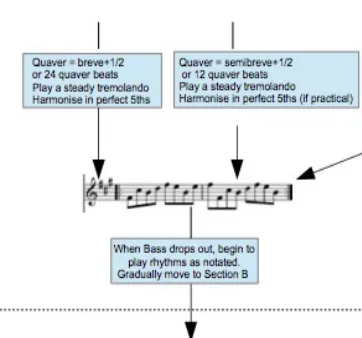
[image:12.595.58.239.395.564.2]'Totalism' (2013), was written whilst running rehearsals of 'In C ' and considering Kyle Gann's article on post-minimal music 'MINIMAL MUSIC, MAXIMAL IMPACT' (2001) in which he contextualises and defines 'Totalism': a particular development of minimalism characterized by complex polyrhythms, “formal and textural clarity”, “the energy of rock”, and the use of “drums and electric guitars” (Gann 2001). This piece aimed to circumvent the 'unperformed' and 'inaudible' intermediate tasks in the realisation of composed minimalist music and be accessible to 'non-readers', particularly electric guitarists and drummers (Fig.1).
Fig. 1: 'Totalism'., Scoring flexible processes Fig. 2: 'Totalism'., Sonic landscapes
The structure of the piece is influenced by 'In C', however unlike Terry Riley's piece the performer is not limited to linear direction of consecutive movement through the modules. The score's interface has analogues with video-game design, which I have dabbled in in the past, specifically level design; the environment, its structures, rules, limitations and aesthetic are predetermined, but it is up to the player how they choose to navigate. The score can be seen as a sonic landscape or map; instead of observing and following a set path as is the case in most notated minimalist music, the aspect of openness allows a performer to explore the interface within a performance (Fig.2).
Composer/Performer
The music I have written over the past year has been a direct product of what I 'do' as a practicing musician. As a guitarist who came to composition through writing music for bands, the music I now write has elements of this working method; a preoccupation with harmony and pulse, rhythmic devices, repetition, performer idiosyncrasies, a use of 'vernacular' musical material and informal/open scores. This model has largely been absent from 'notated' minimalist music since 'In C', as composers such as Steve Reich, and more recently Graham Fitkin have elicited a more autocratic, fixed method of composition and performance. However there have been several musicians who have been directly influenced by minimalist composers whose music, whilst fitting well within the
definitions of minimalism, contains aspects of openness and even improvisation.
Michael Hedges composed many solo acoustic guitar pieces which combine extended and percussive techniques within a minimalist framework. This is relevant to my interest in openness as the music is composed in a modular fashion, and similarly to In C, the performer combines them freely and intuitively. This type of composition is more performance-centric than traditional minimalism and allows for music to be expanded, embellished or even improvised, as can be seen in various live versions of 'Aerial
Boundaries'.
Attitudes to Repetition
Aside from purely technical similarities, Michael Hedges' music and personality featured eastern ideas and philosophies, often labelled as new age.
“... a distinguished line of Western composers drawn not only to Asian musical practices, but also to the philosophies and theologies that sustain them... Several of these went far beyond the simple imitation of alien musical styles: compelled first by the non-violent and non-linear cyclic-sound patterns they heard, then eventually converted to Buddhism and now strive to live their lives in accordance with its precepts” (McClary 1991, p.292).
Such ideas surrounding the roles of repetition and meditation can be found within my music, most explicitly in 'Catharsis', a solo acoustic guitar piece based on a repetition-based, modular score format inspired by Buddhist attitudes to repetition.
'Catharsis'
“...In the Soto Zen tradition from which Suzuki's Saino-Kyoiku sprung, repetitive practice was valued for its own sake. The endless repetition of what Soto
method transmuted one of the least inspiring aspects of Western musical culture, its use of repetitive practice in soul-destroying industrial models of pedagogy and performance, into an avant-garde redemption of musical repetition as a self-justifying act” (Fink 2005, p.15).
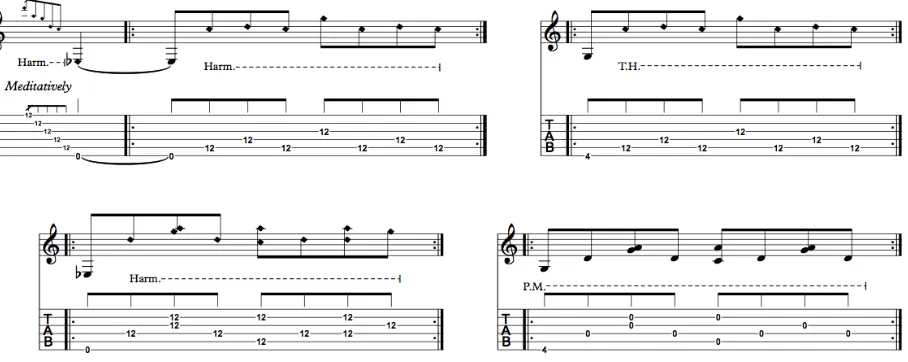
The materials, or modules, that the piece is comprised of are visually disconnected as separate systems. The aim of this is not to create a fragmented performance, as the
[image:15.595.79.533.286.467.2]materials are connected thematically and the performer is expected to maintain a rhythmic and dynamic flow, but to cajole the performer into exploring single modules through repetition in a non-teleological and intuitive manner (Fig. 3).
Fig. 3: 'Catharsis',. Modular notation
“In repetitive music perception is an integral and creative part of the musical process since the listener no longer perceives a finished work but actively
participates in its construction. Since there is no absolute point of reference a host of interpretative perspectives are possible” (Mertens 1983, p.90).
This is even more the case with improvised, repetition-based music. The Necks are a trio who play fully improvised music based on repeated figures and performer interplay. This is not a particularly new or original idea, especially within popular and jazz music,
however the sheer scale, discipline and dedication to a figure and the attention to detail and nuance put it in on the intellectual level of art music, specifically minimalism.
'Silverwater' and 'Aquatic', both typical pieces by the Necks use a small range of materials which are developed very gradually through a combination of process and
'inter-performer feedback'. This economically focussed method of composition clearly takes influence from minimalism (i.e. Steve Reich's early process pieces), but rather than rely on process alone, openness, improvisation and intuition are the driving forces.
Minimalism on a Shoestring
A factor that has shaped my music almost as much as my aesthetic predispositions has been the economic aspect of music composition. Until very recently with the advent of affordable multitrack recording software, it was uncommon for anyone to write and record acoustic ensemble music with the freedom and room for experimentation usually
restricted to established 'full-time' composers with the financial and logistical means to use massed performers in an appropriate rehearsal space.
Practically speaking, with online communication and networking possible and many people having access to some basic recording software at the very least, it is possible to rehearse, record and produce an acoustic ensemble composition without any physical contact. One recent example of this breakdown of the composition-rehearsal-performance paradigm are Eric Whitacre's virtual choir projects, the most recent of which used “8,409 videos; 5,905 singers from 101 countries” (http://ericwhitacre.com). The composition was written and scored in the traditional 'notes on the page' fashion, however the rehearsals, performances and recordings are undertaken by each singer independently, culminating in a video which is then combined with others to produce the 'virtual choir's' performance, manifest as a youtube video (http://youtu.be/V3rRaL-Czxw).
'
Metro
' &
'Loops #2'
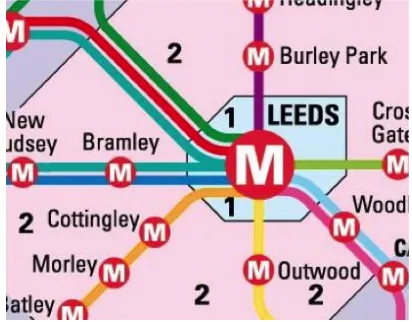
[image:18.595.194.400.189.350.2]This was an experiment in scoring a guided improvisation. The idea was to use a familiar visual aid, a rail network diagram, in which the schematic map would function as a graphic score; a prompt for the treatment of materials, pacing and structuring within an improvisation (Fig. 4).
Fig. 4: 'Metro': Found score
Extract from the score of 'Metro':
• The different train lines act as different paths each performer can traverse. • The coloured zones are designated a keyword which can be interpreted
freely.
• The stops on the lines are 'events' or prompts for action/variation, based on the accumulated keywords.
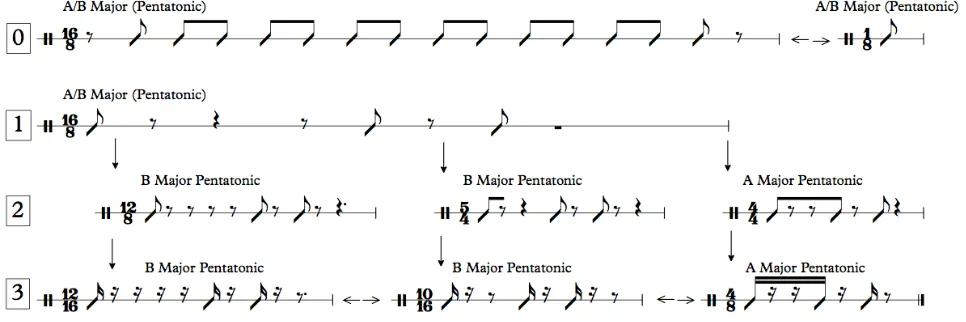
Fig. 5: 'Loops #2',. Rhythm and Tonality
“... what happens is that we borrow rhythms within the same state ...The two rhythms together are so exciting... That’s when people hear, and they say, ‘Oh, he is improvising.’ No, it is part of the rhythm, but because he switched from his basic rhythm, to respond to that rhythm, the Westerners say, ‘Oh, it’s an improvisation.’ No. It’s something that is within the system. It’s just like a dictionary. You have so many vocabularies, so many words. And you refer to whatever words you want to.” (Adzenyah, A. 2005)
'Loops #2 ' uses both specified materials and rules, but as improvisation is a large component of the construction of the piece, openness is a more significant aspect than many of my other pieces. All aspects of the musical material, aside from rhythm and tonality, are left open to the performer to develop. To help generate and develop material, the performers are given a structural framework and limited choice of parameters, in the guise of a detailed graphic score ('Metro'). The addition of a set structure, and text to the overall score puts further limitations on how material is treated. The subsumation of multiple specified independent parameters causes and allows the performers to improvise their own processes. This proved quite demanding, requiring almost constant
There were performances and recordings of both scores as separate pieces ('Metro' Ver 1, 3; 'Loops#2' Ver 2) and together ('Loops#2' Ver 1), with one solo multi-tracked recording of 'Metro' ('Metro' Ver 2); I have included various different versions to demonstrate the versatility of the score and the variety of interpretations, albeit by the same group of performers. This does however illustrate various aspects of opennesses and specificity as each recording represents a different facet of the relative score. As there were no rehearsals (in the usual sense of the term), and minimal discussion and pre-planning, the one-take live recordings demonstrate how specific processes can be open and yield quite different results. 'Metro' and 'Loops #2 ' balances openness (improvisation, performer idiosyncrasies and its compound effects when combined) with specific notated processes and materials to produce organised minimalist music with complex textures and autonomous structures.
Enculturation
One of the most important factors for this process to be successful is an adequate level of enculturation. “ The concept of musical enculturation refers to the acquisition of musical skills and knowledge by immersion in the everyday music and musical practices of one's social context” (Green 2001, p.22). Both in the contexts of inter-performer rapport and stylistic awareness there needs to be 'common ground' with which to connect the disparate idiomatic and idiosyncratic languages, and their approaches to learning music. This was as much an ideology as a pragmatism; my own musical and social contexts overlap many disparate idioms and backgrounds, therefore naturally I want my music to reflect this; to facilitate a medium for musicians of disparate performance backgrounds to blend
organically would be not only desirable but also economical.
An awareness and concern for enculturation in my compositional process has provided a platform for process-based post-minimalist music that is open to aurally-based musicians (non-readers) who make use of their vernacular or habitually learned musical language, where such assets as idiosyncrasy, flexibility and democracy can be used practically, and where improvisation and virtuosity can flourish. The result is a that the traditional partitioning and linear nature of the composition, rehearsal and performance processes common to composed, 'fully notated' music is not only unnecessary, but undesirable for my music as it represses the aspects of openness I am promoting.
Openness and Specificity
Openness is more common in solo music as the issues of communication and
synchronisation are not relevant. Another example of an openly scored, module based piece is Stockhausen's 'Klavierstück IX' ; “...the instrumentalists freedom is a function of the combinative structure of the piece which allows him to “mount” the sequence of musical units in the order he chooses” (Eco 1989, pp.167-168). This piece, although not sharing any stylistic grounds, along with 'In C' was an influence in my score designs, particularly those compositions for solo performers. These scores however, feature a greater balance of
openness and specificity with regard to directionality, form and structure. The format I chose for many of my compositions, based on flowcharts serves as a familiar and logical method for generating structure and combining materials in an intuitive, improvisatory and ad hoc musical context.
Loops #1
(2014)
Similarly to 'Catharsis', this piece focuses on the superimposition and impromptu ordering and reordering of materials featuring discrete electric guitar techniques. Intended as either a live loop pedal, solo or duo piece, it calls for challenging extended techniques,
This piece has several parallels with 'In C ': it features a module-based notation,
musematic repetition, and an open form. It differs mostly in the respect that it does not have a designated structure, or beginning and end, and the act of superimposition and polyrhythm is one of conscious decision and not a result of separate linear paths
overlapping. There is also the aspect of idiom; the modules in 'Loops #1' are idiomatically written for the guitar and require some practice and/or a high level of technical ability; 'In C' uses much simpler materials, open in their scoring and instrumentation (Fig. 6).
Fig.6: 'Loops #1',. Specific materials; Open form
The vertical layering and reorganisation of discrete materials is a compositional method I have explored and researched extensively within my portfolio ('Neuron Doctrine'; 'Loops #1'; 'Loops #2'; 'Metro'). The performer's sensory and psychological experience is an important aspect of this, hence the overall focus and concern for live performance; each superimposition, or polyrhythmic sequence is treated as meditation, or a transcendental act of accomplishment. Simply repeating and reordering the chosen materials is an act of “shikan tazu (just sitting)” (Fink 2005). This is what is meant by the music's ontology being performer-centric, and much more than just the score, audio recording, or even physical performance:
“...repetition is not the negation of desire, but a powerful and totalising
The composition-rehearsal-performance paradigm
Aside from 'Catharsis', and 'Neuron Doctrine', my compositions also employ unspecified scoring. The reason for this is twofold: it is economical to allow a flexible number of people to rehearse and perform the music ad hoc, allowing me to freely collaborate with anyone without any alteration to the score; secondly it promotes original and unexpected instrumental combinations. Because much of my music relies on the performer's
idiosyncrasies and performance tradition, the aspect of scoring and interface is modelled closely on the jazz lead sheet, where a minimal amount of specified information is given with respect to idiomatic boundaries, while certain aspects are left open and retain flexibility, allowing for impromptu performances and a high degree of variety.
Another parallel with jazz is that unlike minimalism, my music seeks to not only spectate a predetermined form, but explore it and interact with it. In my 'notation-based'
compositions, in various capacities and to various degrees performers can independently influence the music in real-time by reacting to the duality of restraint (set parameters and structures) and freedom (the dynamic interplay of performers). The next step towards breaking down the composition-rehearsal-performance paradigm and eliciting a more democratic system required an emancipation from traditional notation systems. Two methods I have explored are module-based and flowchart scores, and soundpainting. The latter is a system of live semiotic communication similar to sign language, and almost always never uses any prescribed written musical material.
Soundpainting
“The Soundpainter (the composer) standing in front (usually) of the group
Fig.7: 'Soundpainting',. Terminology
My research exploring soundpainting yielded the text-score composition 'Soundpainting' during my engagement with a 'soundpainting ensemble' (Fig.7); this experience gave me a new perspective and a deeper understanding of the dichotomy of openness and specificity in post-minimal music. Instead of global processes determining forms and structures, as is the case with much notated minimal music, performers are provided with modules of music and set rules and processes which are combined freely and individually to produce the resulting compound textures in my music. The democratic aspect creates a degree of indeterminacy in that I cannot fully predict certain musical parameters, as one could with autocratically notated scores.
Physical and Mental Virtuosity
These limitations have helped to develop my compositions to get as much as possible of the performer from a focussed range of materials. This is equally the case with the
performer's interaction with the instrument; in 'Neuron Doctrine', 'Loops #1' and 'Catharsis', the solo performer is very 'busy' playing with both hands independently, combining contrasting materials in polyrhythm and counterpoint (Fig. 8). This is a trait I have
absorbed from studying and playing music by such solo guitarist performer/composers as Michael Hedges and his contemporaries, where the instrument is a large part of the
ontology of the music. Particularly with my solo compositions, I like to see an instrument as a 'vital body' with its own vocabulary, countless phrases and inflections; an infinite musical composition in itself.
Fig. 8: 'Neuron Doctrine',. Idiomatic techniques combined virtuosically
transformations. This definition of virtuosity is explicit on the outset, and is easily identified.
Fig. 9:'Catharsis',. Two-handed tapping (see score for scordatura tuning)
Despite the seemingly specific nature of constituent processes and materials, openness and choice are substantial factors in the performance of my music, and require a virtuosic level of concentration and awareness on multiple sources. Whether it be the focussing on
multiple unsynchronised processes and maintaing the transient flow of transforming materials in a schematic network as a solo performer (Fig. 10), the constant concentration on decoupled parametric information within quasi-synchronous ensemble music (i.e. 'Metro'), or simply executing complex polyrhythmic textures, a high level of mental effort is required. This is not immediately apparent from the scores, recordings or even visually in performance, however the performer's experience is a significant part of the ontology of my music.
[image:26.595.177.523.559.687.2]'
Neuron Doctrine
' (2014)
This piece was written specifically for the virtuosic violist, Garth Knox. The piece, written for solo Viola d'amore features a high level of improvisation and has no prescribed
structure or form. Rather the performer is encouraged to rely on their short-term aural memory and intuition to build the structure from the constituent materials accumulatively during the performance.
Extract from the score of 'Neuron Doctrine':
Through searching for methods to pragmatically structure materials which are specific, yet have a degree of openness, I adopted terms and models of memory formation from neuroscience to explain the rationale, inner workings and semiotics of the score:
• Neuron doctrine: the concept that the nervous system is made up of discrete individual cells (materials which the music is structured from).
• Specialization : cells may differ in size, shape, and structure according to their location or functional specialization (different musical material types).
• Chemical synapses: allow neurons to form circuits within the central nervous system. They are crucial to the biological computations that underlie
perception and thought (arrowed lines).
• Electrical synapses: conduct nerve impulses faster. An important characteristic of electrical synapses is that most of the time, they are bidirectional; allow impulse transmission in either direction (unarrowed lines).
• Law of Dynamic polarization: Although the axon can conduct in both
• The strength of two connected neural pathways is thought to result in the storage of information, resulting in memory (synthesis & superimpositions).
I intend for the score and its inner workings to be as close as possible to the way a performer would mentally process musical ideas, with as little conceptualisation and abstraction from the ontology (where and how the music exists) of the music; primarily the sensory experience of the performer. This piece attempts to
deconstruct the 'composition-rehearsal-performance' paradigm, and makes
perceivable the entire process of music making. The apparent simplicity of the score is due to the 'composed' materials being only the foundation, which have written into them a pluralistic nature which emerges through interpretation,
superimposition and synthesis in the realisation of the music.
Memory plays an important part in the formation and synthesis of the materials: the performer is expected to be familiarised with the musical cells and their various superimposed compound forms so as to allow uninhibited and spontaneous
decisions to take place moment to moment within the performance. The musical cells and their interconnecting lines should be explored during performance to discover interesting combinations and progressions which appeal to the performers' sensibilities. The resultant superimpositions and progressions can be dedicated to memory allowing compound combinations and progressions of a larger scale. Musical structure and unity will arise naturally though these processes.
The musical structure and choices should reflect and be influenced by the performer's memory and idiosyncrasies: there is no one 'right way' to pace, structure or interpret the musical materials, but the performer should apply pragmatic thinking, and use their own ears. As composer, my own idiosyncrasies and idiomatic choices should also be present in the background at some level. Use:
• Repetition to give significance to and emphasise,
• Synthesis to provide direction and unity,
'Neuron Doctrine' was the only piece in my portfolio of compositions that was not written to be performed by myself, either as a solo performer or within an ensemble, therefore it has provided a valuable insight into how well the format I have designed communicates processes and sound-worlds which are to be realised with a vernacular musical language, idiosyncrasy and an encultured musical context. Additionally I was able to compare my 'interpretation' and methods of recreating the score with another performer's reception in isolation to my own musicality and influence.
After discussing such aspects of Neuron Doctrine with the performer Garth Knox, both during rehearsals and after the concert, his feedback led me to several conclusions about the application of openness and specificity in my post-minimalist musical framework; the score is most effective when the format is both familiar with the musical context and coordinated to the performer's cognitive processing of the musical material and its transient temporality (i.e. the format of the score and its precepts resonate with the performer's thought processes and organisation); the notational system should only contain what is necessary to prompt the type and detail of action desired; the musical language requires a balance of openness and specificity to create the resistance to interpretation necessary to permit and promote improvisation to forefront performer idiosyncrasy and exploration.
Further Considerations
These reflections, in addition to discussions with other performers recorded during rehearsals have proved enlightening as they inform my perspective on my own
compositional methodology and clarify various aspects of its application and reception; the issue of how to transcribe materials that are contingent on cognitively-based processes which support an open, transient and 'ad hoc' musical context, can be resolved by using a notational interface which is universal in its visual and semiotic familiarity to the
layout of the modules in 'Catharsis' promotes a sense of 'space' and allows the performer to determine the pacing and explore individual moments, despite the overall specificity of the materials and the linear global structure.
The logical, methodical and flexible ordering of materials I have employed lends itself well to the incorporation of extra-musical concepts; as in 'Neuron Doctrine' where the score and its constituent rules mirror the structure and functions of memory formation in a
biological neural network, and in 'Metro' where the score emulates various experiential qualities of a train journey. This is an aspect I am focussing on in a current 'composition in progress', 'Pacem in Terris'; commissioned by choral director Alexander Kyle for the
chamber choir Vocalis, for 40 voices, organ and unspecified ensemble. The musical material is built partly on phasing and additive processes, which are executed
independently by each performer. The text is the phrase 'peace on earth' in Latin ('pacem in terris'), Arabic ('salam ala alard') and Hebrew ('shalom al ha-aretz'). The combination of a different number of syllables within each phrase and a fragmentation of the text
produces phasing and additive processes. The music's modus operandi and its concept are one and the same: a reflection of the fragile, asynchronous and transient nature of
harmony within different ethnic and cultural standpoints vying for peace. The unity and perceivable clarity of concept, technique and mechanism in my music is both concurrent with the aesthetic and technical aims of my research and a characteristic trait of my aforementioned minimalist musical influences.
By focussing on pragmatic approaches and maintaining sensitivity to the constituent cognitive processes involved in composing, rehearsing and performing music, the
performer has a larger degree of engagement with music making than is traditionally so in post-minimal music. The resultant music has more scope for certain aspects of openness; idiosyncrasy, improvisation and democracy, normally absent from much post-minimal music, are in a balance closer to popular and vernacular musics as the performers are essential to the music's ontology. Furthermore, the visual clarity of the structures,
To summarise, I have developed a compositional methodology which focusses on
Reference List
Adzenyah, A; Eyre, B. (2005). Improvisation: Musicians and Scholars Speak. [Online].
Available: http://www.afropop.org/wp/12953/improvisation-musicians-and-scholars-speak. Accessed 21 July 2014
Eco, U (1959). The poetics of the open work. In: Cox, C; Warner; D (2004). Audio Culture: Readings in Modern Music. New York: Continuum.
Fink, R (2005). Repeating Ourselves: American Minimal Music as Cultural Practice. California: University of California Press.
Gann, K. (2001). Minimal Music, Maximal Impact. [Online].Available:
http://www.newmusicbox.org/articles/minimal-music-maximal-impact. Accessed 31st July 2014.
Green, L (2001). How Popular Musicians Learn. Ashgate.
Manuel, P (1988). Popular Musics of the Non-Western World. New York: OUP.
McClary(1959). Rap, Minimalism and Atructures of Time in Late Twentieth Century Music. In: Cox, C; Warner; D (2004). Audio Culture: Readings in Modern Music. New York: Continuum.
Mertens, W (1983). American Minimal Music. London: Kahn & Averill.
Middleton, R (2003). Reading Pop: Approaches to Textural Analysis in Popular Music. New York: OUP.
Reich, S (1968). Music as a Gradual Process. In: Cox, C; Warner; D (2004). Audio Culture: Readings in Modern Music. New York: Continuum.
Thompson, W. (1974) Soundpainting. [Online]. Available:
http://www.soundpainting.com/soundpainting. Accessed 21st July 2014.
Whitacre, E. (2014). The Virtual Choir [Online]. Available: http://ericwhitacre.com. Accessed 27st July 2014
Scores
Riley, T. (1964) In C. NP. [Online]. Available: http://imslp.org/wiki/In_C_(Riley,_Terry)
Hedges, M. (1984). Aerial Boundaries. NP. [Online] Available:
http://ww.classclef.com/pdf/Aerial%20Boundaries%20by%20Michael%20Hedges.pdf
Reich, S. (1987). Electric Counterpoint. New York: Boosey and Hawkes
Stockhausen, K. (1967) Klavierstück IX. London : Universal Edition
Recordings
Abumrad, J. (2009) In C Remixed. [Online]. Available:
http://www.radiolab.org/story/91934-in-c. Accessed 2nd Aug 2013
Animals as Leaders (2011). Weightless. [CD] Prosthetic Records
Hedges, M. (1984) Aerial Boundaries. [CD]. Sony
Piano Circus. (1992) Graham Fitkin: Log, Line, Loud. [CD] Decca
San Francisco Symphony Orchestra, (1978) John Adams: Shaker Loops [CD] Philips Records.
Steve Reich and Musicians (1978) Steve Reich: Music for 18 Musicians [CD]. ECM
The Necks (1994). Aquatic.[CD] Fish of Milk
The Necks (2009). Silverwater. [CD]. Fish of Milk
Video
Afrikafestival Hertme. (2014). AFH258 - Adama Yalomba. [Online]. Available:
http://youtu.be/4Xybyd8eMBg. Accessed 21st July 2014.
Eric Whitacre's Virtual Choir. (2012). Water Night. [Online]. Available:
http://youtu.be/V3rRaL-Czxw. Accessed 21st July 2014.
Heavy Mental, Thrash Acoustic, Deep Tissue Gladiator Guitar. (2006) Michael Hedges -
Aerial Boundaries [Online]. Available: http://youtu.be/tLXBABH2JuY. Accessed 21st July