R E S E A R C H A R T I C L E
Open Access
How effective are the components of active
management of the third stage of labor?
Wendy R Sheldon
1,2*, Jill Durocher
2, Beverly Winikoff
2, Jennifer Blum
2and James Trussell
1,3Abstract
Background:Active management of the third stage of labor is recommended for the prevention of post-partum hemorrhage and commonly entails prophylactic administration of a uterotonic agent, controlled cord traction, and uterine massage. While oxytocin is the first-choice uterotonic, it is not known whether its effectiveness varies by route of administration. There is also insufficient evidence regarding the value of controlled cord traction or uterine massage. This analysis assessed the independent and combined effectiveness of all three interventions, and the effect of route of oxytocin administration on post-partum blood loss.
Methods:Secondary data were analyzed from 39202 hospital-based births in four countries and two clinical regimens: one in which oxytocin was administered following delivery of the baby; the other in which it was not. We used logistic regression to examine associations between clinical and demographic variables and post-partum blood loss≥700 mL.
Results:Among those with no oxytocin prophylaxis, provision of controlled cord traction reduced hemorrhage risk by nearly 50% as compared with expectant management (P < 0.001). Among those with oxytocin prophylaxis, provision of controlled cord traction reduced hemorrhage risk by 66% when oxytocin was intramuscular (P < 0.001), but conferred no benefit when oxytocin was intravenous. Route of administration was important when oxytocin was the only intervention provided: intravenous administration reduced hemorrhage risk by 76% as compared with intramuscular administration (P < 0.001); when combined with other interventions, route of administration had no effect. In both clinical regimens, uterine massage was associated with increased hemorrhage risk.
Conclusions:Recommendations for active management of the third stage of labor should account for setting-related differences such as the availability of oxytocin and its route of administration. The optimal combination of interventions will vary accordingly.
Keywords:Post-partum hemorrhage, Oxytocin, Controlled cord traction, Uterine massage, Active management
Background
Post-partum hemorrhage is a leading cause of maternal death in low resource settings [1]. Clinical guidelines for the prevention of post-partum hemorrhage widely rec-ommend provision of a package of interventions known collectively as Active Management of the Third Stage of Labor (AMTSL) [2-4]. Although there is some variation across AMSTL guidelines, the interventions common-ly include prophylactic administration of a uterotonic agent, controlled traction of the umbilical cord, and uterine massage. AMTSL is intended to reduce
post-partum blood loss through expediting placental delivery and preventing uterine atony [5].
Uterotonic agents are administered shortly following delivery of the baby to stimulate uterine contractions. Oxytocin is the first-choice agent due to its high efficacy and low incidence of adverse side effects [6-9]. In a 2001 systematic review of seven randomized or quasi-randomized controlled trials involving more than 3000 women, oxytocin prophylaxis was associated with a 50% reduction in the risk of post-partum bleeding≥500 mL, as compared with no uterotonics [6]. Oxytocin can be administered intravenously or intramuscularly and it has been widely assumed that its effect on post-partum blood loss does not vary with route of administration * Correspondence:[email protected]
1
Office of Population Research, Princeton University, Princeton, NJ, USA 2Gynuity Health Projects, 15 East 26th Street, Suite 801, New York, NY, USA
Full list of author information is available at the end of the article
[7]. This assumption is based largely on a 1972 pharma-cokinetic study (N = 26) that found little difference in the absorption rates of intramuscular (IM) and intraven-ous (IV) oxytocin [10]. Since then, no published studies have further examined this question [11].
Controlled cord traction is intended to facilitate pla-cental separation and delivery. It involves manual appli-cation of gentle downward tension on the umbilical cord while maintaining counter pressure on the uterus, and is administered in conjunction with uterine contractions [2,3,12]. So far no studies have assessed the independent effect of controlled cord traction on post-partum blood loss, and only a few have assessed its effect in combin-ation with other AMTSL components. Most recently, a large randomized controlled trial involving more than 24000 participants found that provision of controlled cord traction had only a small, non-significant effect on the risk of severe hemorrhage among women who were already receiving oxytocin prophylaxis (intravenous or intramuscular) [13]. In contrast, a 1997 trial involving more than 1600 women found that controlled cord traction combined with intramuscular oxytocin reduced the risk of post-partum bleeding≥500 mL by 50% as compared with expectant management [14]. Lastly a 2009 pilot study (N = 204) found a non-significant de-crease in median blood loss among those who received all three AMTSL components, as compared with receipt of uterine massage plus oxytocin (intramuscular or intravenous) [15].
Uterine massage is believed to stimulate uterine contrac-tions through prompting the release of prostaglandins. As a result, in 2004 the International Confederation of Midwives (ICM) and International Federation of Gyna-ecologists and Obstetricians (FIGO) added uterine mas-sage to their updated AMTSL guidelines [2]. To date, two trials have assessed the effect of uterine massage on post-partum blood loss. The first was a pilot study (N = 200) in which provision of all three AMTSL interventions was associated with a non-significant decrease in the risk of post-partum hemorrhage (> 500 mL), as compared with oxytocin plus controlled cord traction [16]. In the second trial uterine massage was associated with increased blood loss, although treatment was initiated before placental delivery rather than after, as per current AMTSL guide-lines [17].
Numerous studies have also attempted to assess the cumulative effectiveness of the full AMTSL package. Findings from a 2010 systematic review of three ran-domized controlled trials, all comparing active with ex-pectant management, indicated that provision of all three interventions reduced the average risk of severe post-partum hemorrhage (≥1000 mL) by two-thirds [5]. The studies in this review, however, used an early defin-ition of AMTSL that did not include uterine massage.
There are a number of important, unanswered ques-tions about the effect of the AMTSL components on post-partum blood loss. While this is partly due to a paucity of evidence, it also results from heterogeneity across studies in selection of treatment and control groups, measurement of blood loss (e.g. visual assess-ment versus more objective means), and variation over time in the AMTSL package. The primary objectives of this analysis, therefore, were to assess systematically the independent and combined effectiveness of all three current AMTSL components, and to examine the effect of route of oxytocin administration on measured post-partum blood loss.
Methods
Data were collected as part of two trials that were conducted simultaneously and compared two uterotonic options (oxytocin versus misoprostol) for the treatment of post-partum hemorrhage, the details of which have been reported elsewhere [18,19]. The trials took place between August, 2005 and January, 2008 and involved nine secondary- and tertiary-level hospitals from five countries and two distinct clinical regimens. In the first regimen oxytocin was not routinely provided during the third stage of labor, while in the second oxytocin was routinely provided. Study sites included hospitals in Egypt (one), Ecuador (one) and Vietnam (two) in the no oxytocin prophylaxis regimen; and Burkina Faso (one), Egypt (one), Turkey (one) and Vietnam (two) in the oxytocin prophylaxis regimen. The original research was approved by the Western Institutional Review Board (Seattle, WA, USA) and relevant institutional review boards in participating countries.
All women were screened for eligibility and provided written informed consent upon admission to the hospital labor ward. Women were excluded if they delivered by caesarean section, delivery occurred outside the hospital facility, or they were enrolled in the no oxytocin prophy-laxis regimen but received uterotonics for any reason during labor. The study protocols were identical with ex-ception of the provision of oxytocin prophylaxis. For women in the oxytocin prophylaxis regimen, oxytocin (10 IU or 5 IU) was administered intramuscularly or intravenously in accordance with standard hospital prac-tice. For women in both clinical regimens, controlled cord traction and uterine massage were provided at the discretion of each site and in accordance with standard hospital practices.
a Hemocue device (HemocueW, Ängelholm, Sweden). Blood loss was measured using a polyurethane recep-tacle with calibrated funnel (Brasss-V DrapesW, Excellent Fixable Drapes, India) beginning immediately after birth of the baby and continuing for the first hour post-partum or, if hemorrhage was diagnosed, until the cessa-tion of active bleeding. Treatment for hemorrhage was provided if bleeding reached 700 mL within the first hour post-partum or, prior to that, by clinical judgment.
For this analysis we used data from eight of the nine study sites. We excluded all 1625 participants from Quito, Ecuador, the only high elevation site in the study, due to atypical blood loss patterns across the AMTSL groups studied (overall, rates of hemorrhage were 30% in Quito versus 2–12% at all other sites). We examined bivariate relationships between clinical and demographic variables and outcomes of mean and median post-partum blood loss, blood loss≥500 mL, and blood loss≥700 mL. For the multivariate analyses we used logistic regression with an outcome of blood loss≥700 mL in order to cap-ture the more serious cases, and because most women di-agnosed with post-partum hemorrhage received treatment at this level of blood loss. We also conducted multivariate analyses using an outcome of blood loss≥500 mL, and the results (not shown) were largely consistent with those obtained using the 700 mL cutpoint.
All analyses were stratified by receipt of oxytocin prophylaxis in order to adjust for heterogeneity that may have been due to clinical regimen. We were unable to include site controls directly in the regression models due to lack of within-site variation in the provision of AMTSL components.
The protocol for this analysis was approved by Princeton University’s Institutional Review Board on 19 December 2009, protocol number 0000004672.
Results
8427 women were enrolled in the no oxytocin prophy-laxis regimen, 8221 of whom were included in these ana-lyses. Among the 206 excluded from analysis, 45 had caesarean sections, 153 were missing information on post-partum blood loss, and eight were missing informa-tion on AMTSL components. 31180 women were en-rolled in the oxytocin prophylaxis regimen, 30981 of whom were included in these analyses. Among the 199 excluded from analysis, four delivered outside the hos-pital, 79 had caesarean sections, 45 were missing infor-mation on post-partum blood loss, 39 were missing information on AMTSL components, and nine did not receive oxytocin during the third stage of labor. 23 others received oxytocin plus uterine massage and were excluded due to the small number of participants for that AMTSL group.
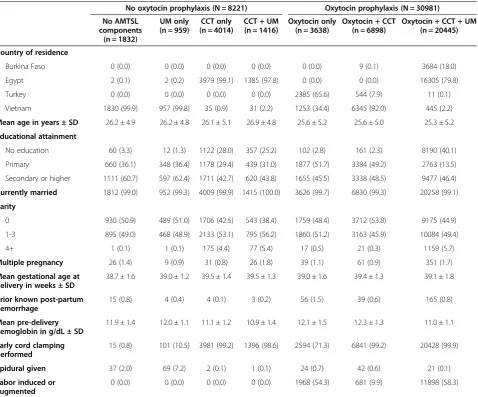
The demographic and obstetric characteristics of study participants by AMTSL group are summarized in Table 1. There were important country-level differences in provision of AMTSL components that were largely site-driven. There were few other demographic differences across AMTSL groups with exception of educational attainment, which primarily reflected country-level dispar-ities; and obstetric practices such as the timing of umbil-ical cord clamping and receipt of epidural and labor induction/augmentation, all of which reflected site-level differences.
The distribution of post-partum blood loss across AMTSL groups is summarized in Table 2. The variation in median blood loss was greatest in the no oxytocin prophylaxis regimen and ranged from 300 mL among those receiving uterine massage only, to 135 mL among those receiving controlled cord traction only. Within the oxytocin prophylaxis regimen, median blood loss was highest (300 mL) among those who received intramus-cular oxytocin only or intramusintramus-cular oxytocin plus con-trolled cord traction, and lowest (200 mL) among those who received all three AMTSL components, irrespective of route of oxytocin administration.
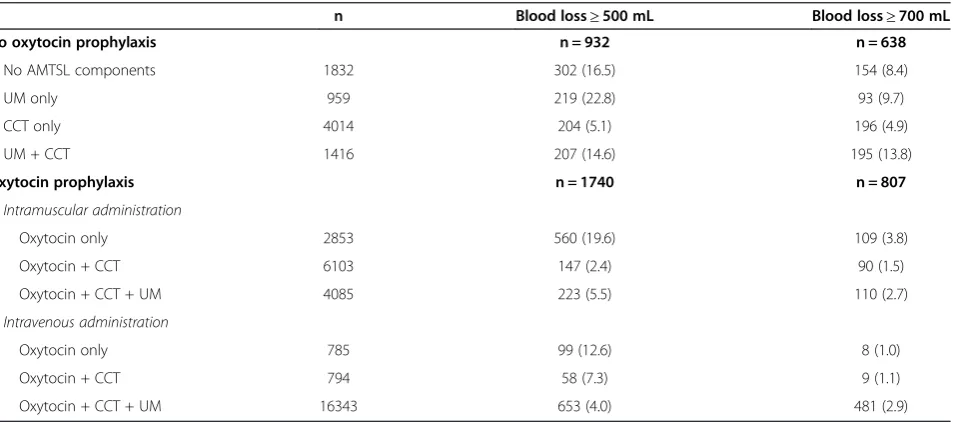
The incidence of post-partum hemorrhage across AMTSL groups is presented in Table 3. With no oxyto-cin prophylaxis, the rate of blood loss≥700 mL was highest among those who received uterine massage plus controlled cord traction (13.8%) and lowest among those who received controlled cord traction only (4.9%). With oxytocin prophylaxis, the rate of blood loss≥700 mL was highest among those who received oxytocin only by intramuscular administration (3.8%) and lowest among those who received oxytocin only by intravenous admin-istration (1.0%).
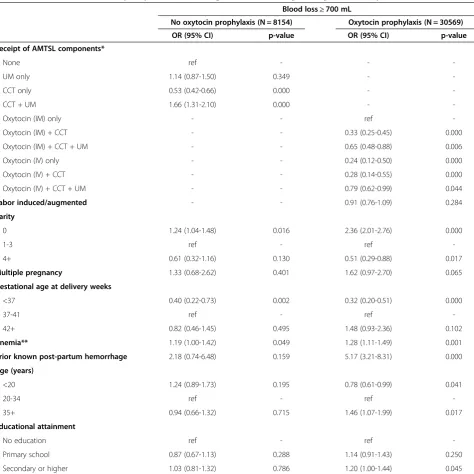
Table 4 shows logistic regression results for both clinical regimens using an outcome of blood loss≥700 mL. In the no oxytocin prophylaxis regimen, provision of controlled cord traction reduced post-partum hemorrhage risk by nearly 50% as compared with no AMTSL components (OR = 0.53, 95% CI 0.42–0.66). Provision of uterine mas-sage was associated with increased hemorrhage risk, al-though these differences were only statistically significant for those receiving controlled cord traction plus massage (OR = 1.66, 95% CI 1.31–2.10). Other predictors of post-partum hemorrhage risk were nulliparity (OR = 1.24, 95% CI 1.04–1.48) and anemia (OR = 1.19, 95% CI 1.00–1.42).
who received all three AMTSL components with those who received oxytocin plus controlled cord traction, the risk of blood loss≥700 mL was nearly twice as high among those with intramuscular oxytocin (OR 1.94, 95% CI 1.43–2.65)*
, and nearly three times as high among those with intravenous oxytocin (OR = 2.86, 95% CI 1.46–5.59)*
.
Route of oxytocin administration was important when oxytocin was the only intervention provided: in such cases intravenous administration reduced hemorrhage risk by 76% as compared with intramuscular administra-tion (OR = 0.24, 95% CI 0.12-0.50). Route of adminis-tration had no effect, however, when oxytocin was combined with other active management interventions. There were no differences in the relative risks of blood loss≥700 mL among those who received oxytocin (IV) plus controlled cord traction, as compared with oxytocin
(IM) plus controlled cord traction (OR = 1.21, 95% CI 0.60-2.46)*; or for receipt of oxytocin (IM) plus controlled cord traction and uterine massage, as com-pared with oxytocin (IV) plus controlled cord traction and uterine massage (OR = 0.83, 95% CI 0.64-1.07)*.
Other factors associated with post-partum blood loss≥700 mL in the oxytocin prophylaxis regimen were nulliparity (OR = 2.36, 95% CI 2.01–2.76), anemia (OR = 1.28, 95% CI 1.11–1.49), prior post-partum hemor-rhage (OR = 5.17, 95% CI 3.21–8.31), age 35 or older (OR = 1.46, 95% CI 1.07–1.99), and completion of second-ary school or higher (OR = 1.20, 95% CI 1.00–1.44). In contrast with prior research, labor induction/augmentation did not increase bleeding risk and, in both clinical regimens, neither did multiple pregnancy [20-22]. Early clamping of the umbilical cord was also not significantly associated with hemorrhage risk in either clinical regimen
Table 1 Demographic and obstetric characteristics of study participants by receipt of AMTSL components (N = 39202)
No oxytocin prophylaxis (N = 8221) Oxytocin prophylaxis (N = 30981)
No AMTSL components
(n = 1832)
UM only (n = 959)
CCT only (n = 4014)
CCT + UM (n = 1416)
Oxytocin only (n = 3638)
Oxytocin + CCT (n = 6898)
Oxytocin + CCT + UM (n = 20445)
Country of residence
Burkina Faso 0 (0.0) 0 (0.0) 0 (0.0) 0 (0.0) 0 (0.0) 9 (0.1) 3684 (18.0)
Egypt 2 (0.1) 2 (0.2) 3979 (99.1) 1385 (97.8) 0 (0.0) 0 (0.0) 16305 (79.8)
Turkey 0 (0.0) 0 (0.0) 0 (0.0) 0 (0.0) 2385 (65.6) 544 (7.9) 11 (0.1)
Vietnam 1830 (99.9) 957 (99.8) 35 (0.9) 31 (2.2) 1253 (34.4) 6345 (92.0) 445 (2.2)
Mean age in years ± SD 26.2 ± 4.9 26.2 ± 4.8 26.1 ± 5.1 26.9 ± 4.8 25.6 ± 5.2 25.6 ± 5.0 25.3 ± 5.2
Educational attainment
No education 60 (3.3) 12 (1.3) 1122 (28.0) 357 (25.2) 102 (2.8) 161 (2.3) 8190 (40.1)
Primary 660 (36.1) 348 (36.4) 1178 (29.4) 439 (31.0) 1877 (51.7) 3384 (49.2) 2763 (13.5)
Secondary or higher 1111 (60.7) 597 (62.4) 1711 (42.7) 620 (43.8) 1655 (45.5) 3338 (48.5) 9477 (46.4)
Currently married 1812 (99.0) 952 (99.3) 4009 (99.9) 1415 (100.0) 3626 (99.7) 6830 (99.3) 20258 (99.1)
Parity
0 930 (50.9) 489 (51.0) 1706 (42.5) 543 (38.4) 1759 (48.4) 3712 (53.8) 9175 (44.9)
1-3 895 (49.0) 468 (48.9) 2133 (53.1) 795 (56.2) 1860 (51.2) 3163 (45.9) 10084 (49.4)
4+ 1 (0.1) 1 (0.1) 175 (4.4) 77 (5.4) 17 (0.5) 21 (0.3) 1159 (5.7)
Multiple pregnancy 26 (1.4) 9 (0.9) 31 (0.8) 26 (1.8) 39 (1.1) 61 (0.9) 351 (1.7)
Mean gestational age at delivery in weeks ± SD
38.7 ± 1.6 39.0 ± 1.2 39.5 ± 1.4 39.5 ± 1.3 39.0 ± 1.6 39.4 ± 1.3 39.1 ± 1.8
Prior known post-partum hemorrhage
15 (0.8) 4 (0.4) 4 (0.1) 3 (0.2) 56 (1.5) 39 (0.6) 165 (0.8)
Mean pre-delivery hemoglobin in g/dL ± SD
11.9 ± 1.4 12.0 ± 1.1 11.1 ± 1.2 10.9 ± 1.4 12.1 ± 1.5 12.3 ± 1.3 11.0 ± 1.1
Early cord clamping performed
15 (0.8) 101 (10.5) 3981 (99.2) 1396 (98.6) 2594 (71.3) 6841 (99.2) 20428 (99.9)
Epidural given 37 (2.0) 69 (7.2) 2 (0.1) 1 (0.1) 24 (0.7) 42 (0.6) 21 (0.1)
Labor induced or augmented
0 (0.0) 0 (0.0) 0 (0.0) 0 (0.0) 1968 (54.3) 681 (9.9) 11898 (58.3)
and was thus dropped from the final regression models. These results were consistent with those from prior re-search [23].
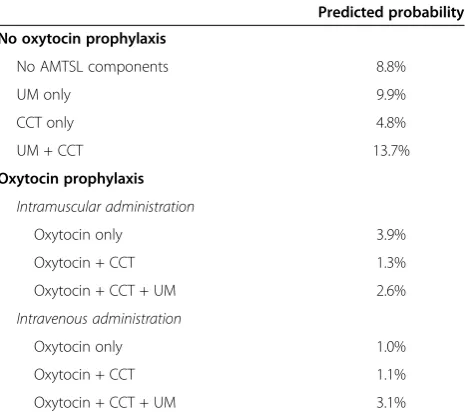
Table 5 shows the predicted probabilities of post-partum bleeding≥700 mL for all AMTSL groups. In general, the predicted probability of blood loss≥700 mL was consider-ably higher among all groups in the no oxytocin regimen, as compared with those in the oxytocin prophylaxis regimen. There was also greater variability in predicted hemorrhage risk among those who did not receive oxyto-cin prophylaxis, with probabilities ranging from 4.8% for
receipt of controlled cord traction, to 13.7% for receipt of uterine massage plus controlled cord traction. In the oxy-tocin prophylaxis regimen, the predicted probability of hemorrhage ranged from 1.0% for receipt of oxytocin (IV) only to 3.9% for receipt of oxytocin (IM) only.
Discussion
This is the first systematic assessment of the relative effectiveness of almost every possible combination of AMTSL interventions. There were important findings related to the provision of controlled cord traction. Our
Table 2 Distribution of post-partum blood loss (mL) by receipt of AMTSL components (N = 39184)*
n Mean total blood loss (SD) Median total blood loss (IQR) Range
No oxytocin prophylaxis
No AMTSL components 1832 325 (240) 250 (200) 50-1800
UM only 959 368 (268) 300 (250) 50-2000
CCT only 4014 181 (167) 135 (95) 10-1550
CCT + UM 1416 247 (255) 145 (125) 25-1350
Oxytocin prophylaxis
Intramuscular administration
Oxytocin only 2853 335 (234) 300 (200) 25-3000
Oxytocin + CCT 6103 279 (115) 300 (100) 100-2500
Oxytocin + CCT + UM 4085 240 (195) 200 (180) 0-2250
Intravenous administration
Oxytocin only 785 277 (175) 250 (200) 50-2000
Oxytocin + CCT 794 272 (149) 250 (120) 50-1700
Oxytocin + CCT + UM 16343 235 (152) 200 (100) 30-2000
*Total blood loss was recorded upon cessation of active bleeding.
AMTSL denotes active management of the third stage of labor;CCT, controlled cord traction;UM, uterine massage;SD, standard deviation; andIQR, inter-quartile range.
Table 3 Incidence of post-partum hemorrhage by severity of blood loss and receipt of AMTSL components (N = 39184)
n Blood loss≥500 mL Blood loss≥700 mL
No oxytocin prophylaxis n = 932 n = 638
No AMTSL components 1832 302 (16.5) 154 (8.4)
UM only 959 219 (22.8) 93 (9.7)
CCT only 4014 204 (5.1) 196 (4.9)
UM + CCT 1416 207 (14.6) 195 (13.8)
Oxytocin prophylaxis n = 1740 n = 807
Intramuscular administration
Oxytocin only 2853 560 (19.6) 109 (3.8)
Oxytocin + CCT 6103 147 (2.4) 90 (1.5)
Oxytocin + CCT + UM 4085 223 (5.5) 110 (2.7)
Intravenous administration
Oxytocin only 785 99 (12.6) 8 (1.0)
Oxytocin + CCT 794 58 (7.3) 9 (1.1)
Oxytocin + CCT + UM 16343 653 (4.0) 481 (2.9)
results suggest this intervention plays an important role in preventing post-partum hemorrhage under two circum-stances: 1) when oxytocin prophylaxis is unavailable during the third stage of labor, and 2) when oxytocin prophylaxis is available but administered intramuscularly. On the other hand, it may be unnecessary if oxytocin
prophylaxis is administered intravenously. Our findings are especially relevant in light of recent evidence that suggests controlled cord traction has little effect on post-partum blood loss when combined with oxytocin [13]. In this study, however, oxytocin was provided intra-muscularly and intravenously, and the analyses did not the
Table 4 Factors associated with post-partum hemorrhage: Results from logistic regression analyses
Blood loss≥700 mL
No oxytocin prophylaxis (N = 8154) Oxytocin prophylaxis (N = 30569)
OR (95% CI) p-value OR (95% CI) p-value
Receipt of AMTSL components*
None ref - -
-UM only 1.14 (0.87-1.50) 0.349 -
-CCT only 0.53 (0.42-0.66) 0.000 -
-CCT + UM 1.66 (1.31-2.10) 0.000 -
-Oxytocin (IM) only - - ref
-Oxytocin (IM) + CCT - - 0.33 (0.25-0.45) 0.000
Oxytocin (IM) + CCT + UM - - 0.65 (0.48-0.88) 0.006
Oxytocin (IV) only - - 0.24 (0.12-0.50) 0.000
Oxytocin (IV) + CCT - - 0.28 (0.14-0.55) 0.000
Oxytocin (IV) + CCT + UM - - 0.79 (0.62-0.99) 0.044
Labor induced/augmented - - 0.91 (0.76-1.09) 0.284
Parity
0 1.24 (1.04-1.48) 0.016 2.36 (2.01-2.76) 0.000
1-3 ref - ref
-4+ 0.61 (0.32-1.16) 0.130 0.51 (0.29-0.88) 0.017
Multiple pregnancy 1.33 (0.68-2.62) 0.401 1.62 (0.97-2.70) 0.065
Gestational age at delivery weeks
<37 0.40 (0.22-0.73) 0.002 0.32 (0.20-0.51) 0.000
37-41 ref - ref
-42+ 0.82 (0.46-1.45) 0.495 1.48 (0.93-2.36) 0.102
Anemia** 1.19 (1.00-1.42) 0.049 1.28 (1.11-1.49) 0.001
Prior known post-partum hemorrhage 2.18 (0.74-6.48) 0.159 5.17 (3.21-8.31) 0.000
Age (years)
<20 1.24 (0.89-1.73) 0.195 0.78 (0.61-0.99) 0.041
20-34 ref - ref
-35+ 0.94 (0.66-1.32) 0.715 1.46 (1.07-1.99) 0.017
Educational attainment
No education ref - ref
-Primary school 0.87 (0.67-1.13) 0.288 1.14 (0.91-1.43) 0.250
Secondary or higher 1.03 (0.81-1.32) 0.786 1.20 (1.00-1.44) 0.045
AMTSL denotes active management of the third stage of labor;CCT, controlled cord traction; andUM, uterine massage, IM, intramuscular; and IV, intravenous. *Additional tests for differences between AMTSL groups in the oxytocin prophylaxis regimen were obtained by re-running the regression model with alternate reference categories. Results were as follows:
a. Oxy (IV) + CCT vs. oxy (IV) (ref): OR = 1.13, 95% CI 0.43-2.96.
b. Oxy (IM) + CCT + UM vs. oxy (IM) + CCT (ref): OR = 1.94, 95% CI 1.43-2.65. c. Oxy (IV) + CCT + UM vs. oxy (IV) + CCT (ref): OR = 2.86, 95% CI 1.46-5.59. d. Oxy (IV) + CCT vs. oxy (IM) + CCT (ref): OR = 1.21, 95% CI 0.60-2.46.
potential effect of route of oxytocin administration. Our findings are also important in light of recent concerns about whether controlled cord traction increases risks for uterine inversion or placental separation from the umbil-ical cord [15]. There were no reported complications related to AMTSL practices in either clinical regimen. However, the providers administering controlled cord traction were all highly skilled physicians and nurses working in hospital settings. On the other hand, this pro-cedure may be most valuable in non-hospital settings where oxytocin is either unavailable or available by IM in-jection only. Since providers in these settings often have less training than those in hospital settings, this could in-crease procedure-related complication risks.
We found no evidence to support provision of uterine massage for the prevention of post-partum hemorrhage. In fact, our findings uniformly suggest that uterine mas-sage either increases post-partum blood loss or confers no added benefits. This was true in both clinical regi-mens and is consistent with findings from prior research [17]. These findings likely reflect some selection bias, however, since uterine massage is often provided in re-sponse to heavy post-partum bleeding. We suspect this may have occurred to some degree in our study, particu-larly among those for whom uterine massage was initi-ated either before or during placental delivery, rather than after as per current AMTSL guidelines [2]. Further-more application of abdominal pressure may facilitate expulsion of blood into the measurement receptacle at a more rapid pace than would otherwise occur. If so, this
may also explain at least some of the positive association between uterine massage and time dependent measures of post-partum blood loss, even if the intervention itself was not a source of increased bleeding.
Our analysis also provided an opportunity to examine the effect of route of oxytocin administration on post-partum blood loss. The results indicate that the longstanding assumption of equivalent effect may be in-correct, and that intravenous administration is superior to intramuscular administration. The evidence for this can be found in the large differences in hemorrhage risk among those who received oxytocin only. The fact that route of administration had no discernible effect on hemorrhage risk when oxytocin was combined with other active management interventions suggests that any underlying differences due to route of administration are mediated by the presence of controlled cord traction and possibly also by uterine massage.
While one of the key strengths of this analysis was the large number of participants in each AMTSL group with objectively measured blood loss post-partum, there were also several limitations. The studies were carried out in hospital facilities only, and thus may not be generalizable to other delivery settings. In addition, the provision of AMTSL components was not randomly assigned. Fi-nally, there was some variation in procedures for admin-istering AMTSL interventions, and these differences occurred both within- and between-sites. This variation is also a strength, however, since it reflects real differ-ences in implementation of active management of the third stage of labor [24-27].
Conclusions
Our findings call into question current consensus re-garding the provision of AMTSL components and sug-gest that practice guidelines should account for setting-related differences such as the availability of oxytocin and its route of administration. The optimal combin-ation of interventions will vary accordingly.
Endnote a
See results listed at the bottom of Table 4 for additional tests for differences between AMTSL groups.
Competing interests
All authors declare that we have no competing interests.
Authors’contributions
All authors contributed to data analysis, interpretation of results, and drafting of the manuscript. BW, JB and JD also contributed to conception, planning and carrying out of the original trials which provided the data for this analysis. All authors read and approved the final manuscript.
Acknowledgements
We thank all the women who participated in both trials, the authors of the two previous publications from which these data are derived, and the study Table 5 Predicted probability of post-partum blood
loss≥700 mL by AMTSL components and route of oxytocin administration
Predicted probability
No oxytocin prophylaxis
No AMTSL components 8.8%
UM only 9.9%
CCT only 4.8%
UM + CCT 13.7%
Oxytocin prophylaxis
Intramuscular administration
Oxytocin only 3.9%
Oxytocin + CCT 1.3%
Oxytocin + CCT + UM 2.6%
Intravenous administration
Oxytocin only 1.0%
Oxytocin + CCT 1.1%
Oxytocin + CCT + UM 3.1%
staff who carried out the data collection for these analyses. We also thank Germán Rodríguez for statistical advice.
This analysis was funded by the Bill and Melinda Gates Foundation and in part by the Eunice Kennedy Shriver National Institute of Child Health and Human Development grants to Princeton University for infrastructure for population research, Grant R24HD047879 (JT) and for demography training, Grant T32HD007163 (WS). The funders had no role in the design, collection, analysis and interpretation of the data; or the decision to submit this manuscript for publication.
Author details 1
Office of Population Research, Princeton University, Princeton, NJ, USA. 2Gynuity Health Projects, 15 East 26th Street, Suite 801, New York, NY, USA. 3
The Hull York Medical School, Hull, England.
Received: 12 June 2012 Accepted: 14 February 2013 Published: 21 February 2013
References
1. Khan KS, Wojdyla D, Say L, Gülmezoglu AM, Van Look PFA:WHO analysis of causes of maternal death: a systematic review.Lancet2006,
367:1066–1074.
2. International Confederation of Midwives (ICM), International Federation of Gynaecologists and Obstetricians (FIGO):Joint statement: management of the third stage of labour to prevent post-partum haemorrhage.J Obstet Gynaecol Can2004,26:1110–1112.
3. WHO, UNFPA, Unicef, World Bank Group:Integrated management of pregnancy and childbirth. Pregnancy, childbirth, postpartum and newborn care: A guide for essential practice [online] 2006. http://www.who.int/ maternal_child_adolescent/documents/924159084x/en/index.html]. Last accessed 26 October 2011.
4. National Collaborating Centre for Women’s and Children’s Health: Intrapartum care: care of health women and their babies during childbirth. London: RCOG Press; 2007.
5. Begley CM, Gyte GML, Murphy DJ, Devane D, McDonald SJ, McGuire W: Active versus expectant management for women in the third stage of labour.Cochrane Database Systematic Rev2010, (7):CD007412. doi:10.1002/ 14651858.CD007412.pub2.
6. Cotter AM, Ness A, Tolosa JE:Prophylactic oxytocin for the third stage of labour.Cochrane Database Systematic Rev2001, (4):CD001808. doi:10.1002/ 14651858.CD001808.
7. Gülmezoglu AM, Villar J, Ngoc NTN, Piaggio G, Carroli G, Adetoro L, Abdel-Aleem H, Cheng L, Hofmeyr GJ, Lumbiganon P, Unger C, Prendiville W, Pinol A, Elbourne D, El-Refaey H, Schulz KF:WHO multicentre randomised trial of misoprostol in the management of the third stage of labour. Lancet2001,358:689–695.
8. McDonald S, Abbott JM, Higgins SP:Prophylactic ergometrine-oxytocin versus oxytocin for the third stage of labour.Cochrane Database Systematic Rev2004, (1):CD000201. doi:10.1002/14651858.CD000201.pub2. 9. Gülmezoglu AM, Forna F, Villar J, Hofmeyr GJ:Prostaglandins for
preventing post-partum haemorrhage.Cochrane Database Systematic Rev 2007, (3):CD000494. doi:10.1002/14651858.CD000494.pub3.
10. Gibbens D, Boyd NRH, Crocker S, Baumber S, Chard T:The circulating levels of oxytocin following intravenous and intramuscular administration of syntometrine.J Obstet Gynaecol Br Commonwealth1972,79:644–646. 11. Oladapo OT, Okusanya BO, Abalos E:Intramuscular versus intravenous
prophylactic oxytocin for the third stage of labour.Cochrane Database Systematic Rev2012, (2):CD009332. doi:10.1002/14651858.CD009332.pub2. 12. Spencer PM:Controlled cord traction in management of the third stage
of labour.Br Med J1962,1(5294):1728–1732.
13. Gülmezoglu AM, Widmer M, Merialdi M, Qureshi Z, Piaggio G, Elbourne D, Abdel-Aleem H, Carroli G, Hofmeyr GJ, Lumbiganon P, Derman R, Okong P, Goudar S, Festin M, Althabe F, Armbruster D:Active management of the third stage of labour with and without controlled cord traction: a randomised controlled, non-inferiority trial.Lancet2012,379:1721–1727. 14. Khan GQ, John IS, Wani S, Doherty T, Sibai BM:Controlled cord traction
versus minimal intervention techniques in delivery of the placenta: a randomized controlled trial.Am J Obstet Gynecol1997,177:770–774. 15. Althabe F, Alemán A, Tomasso G, Gibbons L, Vitureira G, Belizán JM,
Buekens P:A pilot randomized controlled trial of controlled cord traction to reduce post-partum blood loss.Int J Gynecol Obstet2009,107:4–7.
16. Abdel-Aleem H, Hofmeyr GJ, Shokry M, El-Sonoosy E:Uterine massage and post-partum blood loss.Int J Gynecol Obstet2006,93:238–239.
17. Abdel-Aleem H, Singata M, Abdel-Aleem M, Mshweshwe N, Williams X, Hofmeyr GJ:Uterine massage to reduce post-partum hemorrhage after vaginal delivery.Int J Gynecol Obstet2010,111:32–36.
18. Blum J, Winikoff B, Raghavan S, Dabash R, Ramadan MC, Dilbaz B, Dao B, Durocher J, Yalvac S, Diop A, Dzuba I, Ngoc NTN:Treatment of post-partum haemorrhage with sublingual misoprostol versus oxytocin in women receiving prophylactic oxytocin: a double-blind, randomised, non-inferiority trial.Lancet2010,375:217–223.
19. Winikoff B, Dabash R, Durocher J, Darwish E, Ngoc NTN, León W, Raghavan S, Medhat I, Chi HTK, Barrera G, Blum J:Treatment of post-partum haemorrhage with sublingual misoprostol versus oxytocin in women not exposed to oxytocin during labour: a double-blind, randomised, non-inferiority trial.Lancet2010,375:210–216.
20. Combs CA, Murphy EL, Laros RK:Factors associated with postpartum hemorrhage with vaginal birth.Obstet Gynecol1991,77:69–76. 21. Stones RW, Paterson CM, Saunders NJ:Risk factors for major obstetric
haemorrhage.Eur J Obstet Gynecol Reprod Biol1993,48:15–18. 22. Magann EF, Evans S, Hutchinson M, Collins R, Howard BC, Morrison JC:
Postpartum hemorrhage after vaginal birth: an analysis of the risk factors.Southern Med J2005,98:419–422.
23. McDonald SJ, Middleton P:Effect of timing of umbilical cord clamping of term infants on maternal and neonatal outcomes.Cochrane Database Systematic Rev2008, (2):CD004074. doi:10.1002/14651858.CD004074.pub2. 24. Stanton C, Armbruster D, Knight R, Ariawan I, Gbangbade S, Getachew A, Portillo JA, Jarquin D, Marin F, Mfinanga S, Vallecillo J, Johnson H, Sintasath D:Use of active management of the third stage of labour in seven developing countries.Bull World Health Organ2009,87:207–215. 25. Winter C, Macfarlane A, Deneux-Tharaux C, Zhang WH, Alexander S,
Brocklehurst P, Bouvier-Colle MH, Prendiville W, Cararach V, Van Roosmalen J, Berbik I, Klein M, Ayres-de-Campos D, Erkkola R, Chiechi LM, Langhoff-Roos J, Stray-Pederson B, Troeger C:Variations in policies for management of the third stage of labour and the immediate management of postpartum haemorrhage in Europe.BJOG2007,114:845–854. 26. Festin MR, Lumbiganon P, Tolosa JE, Finney KA, Ba-Thike K, Chipato T,
Gaitán H, Xu L, Limpongsanurak S, Mittal S, Peedicayil A, Pramono N, Purwar M, Shenoy S, Daly S:International survey on variations in practice of the management of the third stage of labour.Bull World Health Organ2003, 81:286–291.
27. Farrar D, Tuffnell D, Airey R, Duley L:Care during the third stage of labour: a postal survey of UK midwives and obstetricians.BMC Pregnancy Childbirth2010,10:23.
doi:10.1186/1471-2393-13-46
Cite this article as:Sheldonet al.:How effective are the components of active management of the third stage of labor?.BMC Pregnancy and Childbirth201313:46.
Submit your next manuscript to BioMed Central and take full advantage of:
• Convenient online submission
• Thorough peer review
• No space constraints or color figure charges
• Immediate publication on acceptance
• Inclusion in PubMed, CAS, Scopus and Google Scholar
• Research which is freely available for redistribution