Synthesis and Structural
Studies of Heteroatom
Substituted Aluminophosphates
and Related Materials
Gavin Muncaster
ProQuest Number: 10042806
All rights reserved
INFORMATION TO ALL USERS
The quality of this reproduction is dependent upon the quality of the copy submitted.
In the unlikely event that the author did not send a complete manuscript and there are missing pages, these will be noted. Also, if material had to be removed,
a note will indicate the deletion.
uest.
ProQuest 10042806
Published by ProQuest LLC(2016). Copyright of the Dissertation is held by the Author.
All rights reserved.
This work is protected against unauthorized copying under Title 17, United States Code. Microform Edition © ProQuest LLC.
ProQuest LLC
789 East Eisenhower Parkway P.O. Box 1346
Table o f Contents
Table o f Contents 3
List o f Figures 6
List o f Tables 10
Acknowledgements 12
Abstract 14
Chapter 1 Introduction and Background 17
1.1 Overview o f Microporous Aluminophosphates 18
1.2 Nomenclature 20
1.3 Structure and Properties o f aluminophosphates 22
1.4 Synthesis 26
1.4.1 General Description 26
1.4.2 Template Effects 26
1.4.3 Heteroatom Effects 28
1.4.4 Reaction Conditions 29
1.5 properties o f AIPO ’ s and their derivative 31
1.5.1 Acidity 31
1.5.2 REDOX properties 34
1.5.3 Stability 36
1.6 Objectives 37
1.7 References 38
Chapter 2 Experimental Techniques 43
2.0 Summary 44
2.1 Introduction 45
2.2 Synchrotron Radiation 47
2.3 X-Ray Diffraction 49
2.3.1 Powder X-Ray Diffraction 49
2.3.1.1 Experimental 53
2.3.2 Single Crystal X-Ray Diffraction 54
2.3.2.1 Structure Solution and Refinement 54
2.3.2.2 Experimental 56
2.3.3 Energy Dispersive X-Ray Diffraction 60
2.3.3.1 Experimental 62
2.4 Infra-Red Spectroscopy 63
2.4.1 Experimental 63
2.5 Solid State Nuclear Magnetic Resonance 65
2.6 References 67
Chapter 3 In Situ, high temperature structural studies o f the 71
Cobalt and Silicon Substituted Aluminophosphate CoAPSO-44
3.0 Summary 72
3.1 Introduction 73
3.2 Synthesis 78
3.3 In Situ Single Crystal studies CoAPSO-44 81
3.3.1 Structure refined from data collected at 150K. 84
3.3.3 Structure from data collected at 673K 90
3.3.4 Structures from data collected at 773K and 473K 91
(after cooling).
3.4 Diffuse Reflectance Infra-Red Spectroscopy (DRIFT) 95
3.5 Discussion 98
3.6 Conclusions 101
3.7. References. 102
Chapter 4. Energy Dispersive Diffraction Studies on the effect o f 107 gel pH in the Synthesis o f Heteroatom substituted
Aluminophosphates.
4.0 Summary 108
4.1 Introduction 110
4.2 Experimental 115
4.2.1 Sample Preparation 115
4.2.2 Data Collection 117
4.2.3 Data Analysis 118
4.3 Results 120
4.3.1 Pure Aluminophosphate Reactions. 122
4.3.2 Iron Substituted Aluminophosphates. 124
4.3.3 Cobalt Substituted Aluminophosphates 128
4.3.4 Reaction Time 132
4.4 Discussion 133
4.5 References. 136
Chapter 5 Synthesis, Structure and Properties o f Silicon and 138
Zinc Substituted Aluminophosphate type -4 4 materials.
5.0 Summary 139
5.1 Introduction 140
5.2 Synthesis 142
5.3 Characterisation 145
5.4 Chemical analysis 148
5.5 Structure 150
5.6 Stability 155
5.7 Infra-Red Spectroscopy 161
5.8 Thermal Gravimetric Analysis 166
5.9 Solid State Nuclear Magnetic Resonance 168
5.9.1 ^■'AINMR 169
5.9.2 ^’SiN M R 171
5.9.3 ^‘PN M R 173
5.10 Conclusions 176
5.11 References 178
Chapter 6. Structural Studies o f Cobalt Hetero-polytungstate 181
materials.
6.0 Summary 182
6.1 Introduction 183
6.2 Synthesis 186
6.3.2 K6[Co"Wi204o]12H 20 194
6.4 Conclusions 198
6.5 References 199
Chapter 7. Conclusions 201
7.1 Conclusions 202
List of Figures
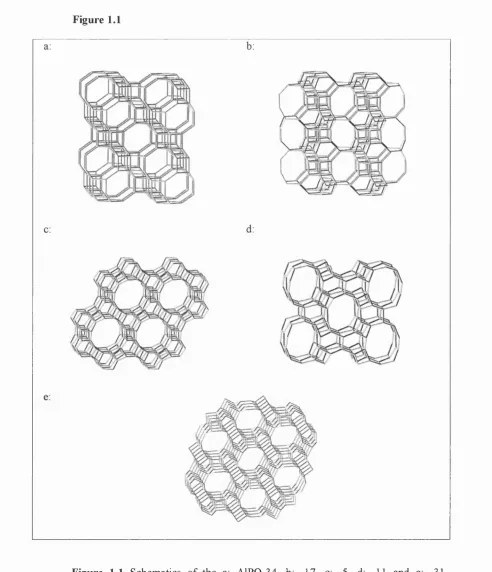
1.1 Schematics o f the a: AlPO-34, b: -17, c: -5, d: -11 and e: -31 19
frameworks.
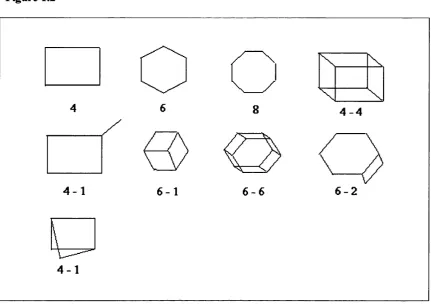
1.2 Secondary Building Units used on the description o f aluminophosphate 21
and zeolite frameworks. Points denote T atoms, and the straight line joining 2 T-atoms denotes the T-O-T bonds
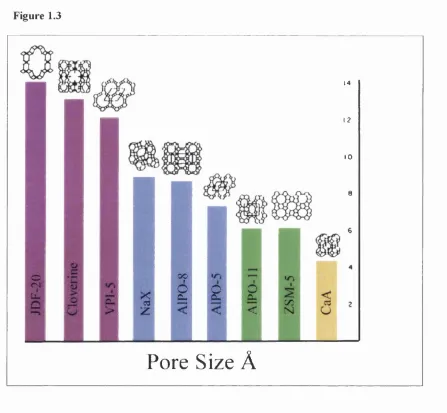
1.3 Structures from each size group, extra large structures are highlighted in 24
purple, large pore in blue, medium pore in green and small pore in yellow.
1.4 a: Shows the formation o f a Bronsted acid site in a metal substituted 32
aluminophosphate, while b: shows the formation o f the alternative Lewis
acid site as proposed by Barret et a l
2.1 Simple Schematic o f a Synchrotron Radiation Source 47
2.2 Schematic o f a Powder diffractometer, with moveable arm detector 51
2.3 Photo o f Station 9.1 at the Daresbury SRS, set up to use the curved 52
image plate detector for high resolution powder diffraction studies. In this picture there is also a heating unit allowing high temperature
studies.
2.4 Schematic o f the layout o f station 9.8 o f the Daresbury SRS. 57
2.5 Photographs o f station 9.8 o f the Daresbury SRS. In a) it is possible to 59
see the whole transition tube, diffractometer and cryostream, while in b)
you can see a close up o f the goniometer with the cryostream and microscope used for aligning the crystal with the CCD detector in the background.
2.6 Schematic o f the EDXRD station. Station 16.4 at the Daresbury SRS 61
employing
2.7 In Situ sample cell for FTIR experiments. Samples are heated and 65
scanned while held in the sealed In Situ cell.
3.1 (a) shows the basic unit o f the CHA structure, formed o f a double 6-ring 74
with 3 sets o f 4 rings attached, (b) and (c) show how these join together to progressively form the microporous framework.
3.2 A section o f the CHA (Chabazite) type framework is given in (a) as 75
3.3 Powder X-Ray Diffraction patterns for a standard chabazite sample 80 (blue) and our CoAPSO-44 sample. Intensities are arbitrary and the
spectra have been offset vertically for clarity.
3.4 Optical picture o f a crystal form the CoAPSO-44 material. 81
3.5 Schematic views o f the CoAPSO-44 structure refined from data 87
collected at 150K. 2 views o f 2 cage units are shown for clarity, and to show clearly the template location and orientation. Note the 3-fold disorder o f the template species allowing us to see the three possible
locations o f the N-H2 groups.
3.6 2 Cage units o f the as-prepared CoAPSO-44 structure with simple Van- 89
der-Waals surfaces added to indicate the close potential close proximity o f inter-cage template molecules.
3.7 Schematic o f the CoAPSO-44 structure derived from the in situ single 93
crystal refinements.
3.8 DRIFT Spectra for the CoAPSO-44 sample recorded over the 97
temperature range 293-55OK similar to that o f the single crystal
experiment. Two regions are shown for clarity, 2700-3100cm'^ showing the loss o f intensity o f the C-H stretching peak as the template species breaks down, and 3400-3 800cm'^ showing the appearance o f a peak due to the Al-O-H stretch indicating formation o f Bronsted acid centres.
3.9 High Resolution Powder Diffraction Patterns o f CoAPSO-44 containing 100
K+ ions. Data recorded in situ using image plate technology at the
temperatures indicated in the key.
4.1 Diffraction patterns o f the two samples produced using the reaction 113
conditions described in table 4.1.
4.2 Schematic o f the 3-element detector set up on station 16.4 o f the 118
Daresbury SRS along with a typical spectra taken from each detector.
4.3 Typical growth curve seen in our EDXRD experiments with an initial 119
induction period followed by a period o f rapid growth.
4.4 Typical spectra from the bottom detector. This sample showing 120
competitive formation o f CHA and AFl in the same reaction.
4.5 Typical raw spectra from the bottom detector o f the 3-element detector 121
4.6 EDXRD Patterns from the middle detector on station 16.4 o f the 131 Daresbury SRS. Spectra are shown for AEI, CHA and AEI standards
and for AEI and CHA formed in situ. Note the distinct differences that
are seen between the AEI and CHA spectra. The differences are only visible on the middle detector as both materials have identical spectra on the bottom detector.
5.1 Powder X-Ray Diffraction patterns o f each SAPO, ZnAPSO or ZAPO 145
sample used in the study.
5.2 SEM images o f each o f the 5 ZnAPSO materials. 147
5.3 Schematics o f the structures o f the ZAPO, SAPO and 0. lZn(0.3)Si 152
materials. A single cage unit is shown from 2 directions to highlight the template orientation in each material. Zn and Si sites are not shown explicitly.
5.4 Diffraction patterns for the 5 ZnAPSO structures, along with patterns 154
simulated from the single crystal structures.
5.5 Stacked X-Ray Diffraction plots recorded in situ as the ZnAPSO 155
materials were calcined, a) shows the pure SAPO material, b) 0.1Zn(0.3Si) ZnAPSO, c) 0.2Zn(0.2Si) ZnAPSO, d)
0.3Zn(0. lSi)ZnAPSO and e) shows the spectra for the pure (0.4)Zn ZAPO material.
5.6 Stacked X-Ray Diffraction plots o f the CoAPSO materials recorded 159
during calcination o f the materials confirming similar behaviour to the ZnAPSO analogues.
5.7 (a) Shows a stack plot o f the initial FTIR spectra collected at ambient 162
temperature, (b) shows the spectra recorded at 550°C after full calcination. The region peaks seen relate to the C-H stretching o f the organic template species.
5.8 (a) Shows a stack plot o f the initial FTIR spectra collected at ambient 163
temperature, (b) shows the spectra recorded at 550°C after full calcination. The region peaks seen relate to the C-H stretching o f the organic template species.
5.9 FTIR Spectra o f the 0. IZn 0.3 Si ZnAPSO sample, a: Shows the drop in 165
intensity o f the peaks relating to the organic template molecule while b; shows the corresponding growth appearance o f bands due to the 0 -H stretching o f Bronsted acid sites
5.10 Thermal Gravimetric Analysis curves for each ZnAPSO sample. 2 main 166
5.11 ^’Al NMR Spectra for the (a) SAPO, (b)O.lZn (0.3 Si) ZnAPSO, (c) 170 0.2Zn (0.2Si) ZnAPSO, (d) 0.3Zn (0.1 Si) ZnAPSO and (e) ZAPO
materials. 172
5.12 ^’Si NMR Spectra for the (a) SAPO, (b)O.lZn (0.3Si) ZnAPSO, (c) 172
0.2Zn (0.2Si) ZnAPSO and (d) 0.3Zn (0.1 Si) ZnAPSO
5.13 Schematic o f a section o f a Silicon substituted aluminophosphate 173
framework in which a ‘silicon island’ has formed.
5.14 ^‘P NMR Spectra for the (a) SAPO, (b)O.lZn (0.3Si) ZnAPSO, (c) 174
0.2Zn (0.2Si) ZnAPSO, (d) 0.3Zn (0.1 Si) ZnAPSO and (e) ZAPO materials.
6.1 The final refined structure o f K5[CoWi2 0 4o]‘2 0H2 0. A single Keggin 190
unit o f the structure is shown for clarity. The C0O4 tetrahedral unit is
shown, with bond distances, in the inset.
6.2 Refined structure o fK6[CoWi2 0 4o] I2H2O. A single Keggin Unit o f the 196
structure is shown for clarity. The inset shows the Co° - 0 4 tetrahedral
List o f Tables
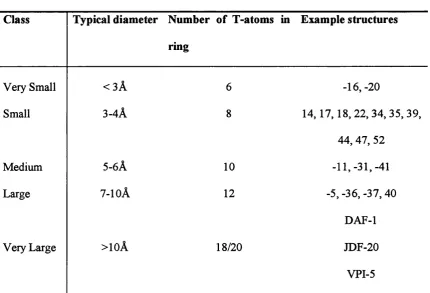
1.1 Summary o f the details for each o f the classes o f microporous 23
materials, typical values for the very small, small, medium, large and extra large materials are given.
1.2 Percentage o f estimated oxidisable cobalt centres in a range o f CoAlPO 35
structures - taken from Barrett et al, 1996.
3.1 Crystallographic details for CoAPSO-44. Chemical Formula o f 83
structures from refinement were refined to
F ^ = C o o . o 6 A I 0 . 9 4 P 1 . 0 O 4 C 2 N 0 . 3 3 H 4 . 3 3 , F ^ = C 0 0 . 0 6 A I 0 . 9 4 P 1 . o 0 4 C 2 N o . 3 3 N a o . 1, F ^ = C o o . o6A I 0 . 9 4 P i . o 0 4 N a o . 1 4 , F ^ = C o 0 . 0 6 A l 0 . 9 4 P 1 . 0 O 4 N a 0 . 0 9
3.2 3.2 Factional X, y, z coordinates and U(eq) for as-prepared CoAPSO-44 86
(data recorded at 150K).
3.3 Fractional Coordinates, U(eq) and occupancy o f the framework atoms 94
in calcined CoAPSO-44. (Recorded at 473K to prevent any water molecules entering the pores.)
4.1 Gel compositions and reaction conditions required to produce pure 112
phase AFl or CHA CoAIPO structures.
4.2 Summary o f gel compositions studied. 115
4.3 Summary o f pure aluminophosphate structures formed at three molar 122
ratios o f TEAOH template, and at three different pH values.
Approximate percentages o f each structure type formed are given in parenthesis in the cases where a mixture o f both materials are produced.
4.4 Summary o f FeAlPO structures formed at varying template and Fe 125
molar compositions, and with three different pH values. Approximate amounts o f each structure formed are given in parenthesis.
4.5 Summary o f CoAIPO structures formed at varying template and Co 129
levels, and with 3 different pH levels. Where distinguishable
approximate amounts o f each structure formed are given in parenthesis.
5.1 Gel compositions, pH, and reaction times for the 5 ZnAPSO-44 144
5.2 Chemical Analysis results for the 5 ZnAPSO samples. Individual Zn, 148 Al, P and Si levels are indicated along with Zn/P ratio and Zn+Al, Si+P totals.
5.3 Crystallographic details for the structures o f the ZAPO, SAPO-34 and 151
0. lZn(0.3)Si materials
5.4 Summary o f Thermal Analysis results. 167
6 . 1 Crystallographic data for K5[CoW 12O4 0].2OH2O and 189
K6[CoWi2O40]12H2O.
6.2 Fractional coordinates and Uiso values for K5[CoW 12O4 0] 2OH2O with 192
e.s.d’s in parentheses.
6.3 Selected bond distances showing C o-0 distances, and the maximum 194
and minimum W -0 distances for terminal (W-Ot) and bridging (W-Oy) bonds.
6.4 Fractional coordinates and Uiso values for K6[CoWi2 0 4o] I2H2O with 196
e.s.d’s in parentheses.
U(iso) recorded at 293K. 206
U(iso) recorded at 473K. 207
U(iso) recorded at 673K 208
Acknowledgements
To start I’d like to thank my supervisors. Professor C .R A Catlow and Dr, G.
Sankar whose constant guidance throughout my time at the D.F.RL. helped make sure
that myself and my research was always heading along the right roads. I also feel Dr.
Sankar deserves a special thanks for all the help and time he gave me at Daresbury, right
from helping me stay awake on the really late ones, to ensuring that there was (nearly)
always a need for an extra long run or experiment at around 10pm every night so we
could go and relax (and plan the night shift) in the Ring o f Bells. As well as this I always
knew I could count on Sankar for advice and help with any aspects o f the research both at
DL and in the RI for which I am very grateful.
A big thank you is also due for all the other people who I spent time with at DL,
for the moral support, the company at the 4am coffee breaks and as people to share the
Daresbury catering with, in particular Dave Gleeson, Andy Davies, Jo Wyles, Andrew
Beale, Matt Johnson and Richard Stephenson. I must also thank two people who helped
me enormously with my crystallography. Dr Simon Teat at DL and Dr Simon Cole at DL
and later Southampton University - two people without whom much o f this work would
have been much more difficult if not impossible.
Of course Daresbury wasn’t the only part o f the PhD, and there are many other
people I’d like to thank at the RI for making my time there very enjoyable. One o f the
great things about the RI is there is always someone around to talk to about whatever you
weekend. There are too many people to name them all but needless to say there were
many who made my three years in Mayfair a great time, as well as those mentioned
above a big cheers goes to Justin, Matt, Toni, Nicola, Steve, Howard, Spencer and Sam.
I’d also like to thank Mike Sheehy and Dave Madill for their help in making various bits
and pieces, as well as helping on the design o f the different apparatus used at DL.
Throughout writing up I always knew the acknowledgments would one o f the
most difficult bits, not because I don’t have people to thank, but because I am sure I am
going to forget to mention someone who deserves a big thank you from me - so
apologies if you’ve not been mentioned.
I look back on my time at the Royal Institution and Davy Faraday Research
Laboratories with some very fond memories. I feel honoured that I had the chance to
work in an Institution with such a fine Scientific History, and if the standard o f work
continues as it did while I was there, an institution that will have a fine Scientific future
ahead.
So thanks again to all those involved in making my PhD not only possible, but
very memorable and enjoyable.
Abstract
The aim o f this work has been to employ a range o f techniques to study some of
the factors that affect the synthesis and structure o f microporous aluminophosphate
materials. Using these results we aim to gain a greater insight into which fectors may be
altered to produce a specific microporous framework, or materials with a particular
fi*amework composition or catalytic properties. To this end we have employed a range of
powerful X-Ray techniques, which require a synchrotron radiation source to perform a
variety o f experiments. The synchrotron based studies have been complimented by
various laboratory techniques such as nuclear magnetic resonance, thermal gravimetric
analysis and infi*a-red spectroscopy.
In particular Microcrystal Diffraction facilities at the Daresbury Synchrotron
Source has been used to collect high quality diffraction data on single crystals as small
10xl0x20|o,m in size. This has given us detailed information on the location o f the
template species within the as-prepared aluminophosphate materials. Further to this a
newly developed heating unit was used to perform in situ, high temperature single crystal
study tracking the breakdown o f the organic template species, to study in detail any
changes to the aluminophosphate fi'amework which occur during this process of
calcination. Further complimentary studies were performed using techniques including
Solid State NMR studies have been preformed on a range o f Silicon and Zinc
substituted aluminophosphate materials to study the stabilising effect of substituting
silicon into the framework. This allows us to study the environment o f the different
heteroatom species within the framework and investigate whether this is related to the
resultant stability of the materials upon calcination.
Energy Dispersive X-Ray Diffraction (EDXRD) performed on station 16.4 at the
Daresbury Synchrotron source, using a specially designed hydrothermal cell, was
employed to study the effect o f altering the initial pH o f a range o f aluminophosphate
(and heteroatom substituted aluminophosphate) reaction gels with regards to the final
product produced. The technique allows us to collect diffraction data with a time
resolution o f approximately 1 minute, and as a result we can follow, in situ, the formation
of any crystalline products from the reaction gel. A relatively new 3-element detector was
used in the experiments providing us with the ability to study a large d-spacing range
simultaneously. Using this extra data we are able to identify subtle differences in the
products forming which previously have been very difficult to record.
Finally we have re-investigated the crystal structure o f the Cobalt containing
heteropolytungstate material Kg [CoW12O4 0]. 2OH2O. This is one o f only a few materials
that contain tetrahedral Co°^ ions co-ordinated to 4 oxygen atoms. We have obtained
accurate information on the Co-0 bond distances that can be used as a model for
investigating the structural properties of Co™ ions substituted into an aluminophosphate
framework. In turn this model can be applied to the appropriate data and used to estimate
the amount of oxidisable Co" ions in as-prepared CoAIPO materials and thus the
Chapter 1
Introduction and
Bacl^round.
1.1 Overview o f Microporous Aluminophosphates.
In the early 1980’s Wilson and co-workers discovered a new class o f materials,
collectively known as aluminophosphates (AlPO's), with the basic chemical formula
AIPO4/ ’ ^ The materials are made up o f strictly alternating AIO4 and PO4 tetrahedra that
join together to form a massive number o f different framework structures. The basic
linkage can be summarised:
[= A l-0 -P =]
Many o f the materials are structurally analogous to Zeolites, aluminosilicates,
both naturally occurring and synthetic. Zeolites were first discovered in the 1750’s and
have now become important materials for a number o f industrial processes including gas
separation, and as ion exchangers.^’ * Some of the aluminophosphates were found to have
unique stmctures not seen in the aluminosilicates.^ For example the stmctures AlPO-5,
AlPO-l 1 and AlPO-31 have structures unique to the aluminophosphates, while AlPO-34
and AIPO-17 have structures analogous to the naturally occurring zeolites Chabazite and
Erionite, see figure 1.1 below. Since the initial discovery o f a family o f 20 AlPO's (17
with novel, and 3 with known structures) many more structures have been synthesised
Figure 1.1
Figure 1.1 Schematics of the a: AlPO-34, b; -17, c: -5, d: -11 and e; -31 frameworks.
1.2 Nomenclature
Initially the materials were named by a numbering system, AIPO4-M where n
denoted the structure type as in AlPO-5, AIPO-11 and so on. More recently the
International Zeolite Commission (IZC) has given each structure type a 3-letter structure
code name, for example API 5), CHA (AJPO-34, -44 and -47) and AEI
(AlPO-18).^ Some of the structure codes relate to the hill name o f related zeolites or minerals
such as CHA, for structures related to the zeolite chabazite. Complete listings are given in
the Zeolite Atlas.^ A further type of classification is derived from the Secondary Building
Units (SBU’s) which make up the structure. The SBU’s denote the positions o f the T sites
(in the case of the aluminophosphates the T atoms are the Al and P ions) relative to each
other in space, with Oxygen atoms are omitted for simplicity as shown in figure 1.2.
Describing the structure from the SBU’s that make up the framework is often considered
much less cumbersome than describing the complex unit cell fully. The IZA also
Figure 1.2
4 - 4
6 - 2
Figure 1 2 Secondary Building Units used on the description o f aluminophosphate and
zeolite frameworks. Points denote T atoms, and the straight line joining 2 T-atoms
denotes the T-O-T bonds.
In this thesis structures are described by either their original form, AIPO4-M, or if
appropriate by their 3-letter structure code.
1.3 Structure and properties o f aluminophosphates.
As noted above there are a large number of different aluminophosphate
frameworks, and indeed with the different possible variations in TO4 units bonding
together there is potentially an almost infinite number o f possible framework
configurations. Of the initial 20 aluminophosphate stmctures found, 14 were
microporous, while the rest were predominantly 2-dimensional layered structures.^’ ^
Typically it is found that the layered stmctures collapse when the organic template
species used in the synthesis are removed. (Synthesis is described in detail later.) Only
microporous materials are studied in this thesis. Of the microporous (3-dimensional)
stmctures there are 5 sub-categories, based on the size o f the pores within the framework,
denoted very small, small, medium, large and extra large pore materials, see figure 1.3
below.
Generally the very small pore materials have 6-membered rings with diameter
<0.3nm. (As with the SBU’s the oxygen atoms are omitted from the description and
8-membered actually refers to the number of T-atoms in the ring.) Small pore materials
have 8-membered ring pores, diameter ca 0.35-0.45nm as in AlPO-34. Medium pore
materials have pore apertures o f 0.5-0.65nm with 10-membered rings (AIPO-11), or
occasionally puckered 12-membered rings (AlPO-31). Large pore materials cover the
region 0.7-0.8nm and have essentially planar 12-membered rings, as in AIPO-5; and
finally the extra large pore materials cover the 0.8+ nm range and include stmctures such
for each group, typical diameter, number of T-atoms in the largest ring and examples of
each structure are given in table 1.1. Schematics o f structures in each group are shown in
figure 1.3^
Table 1.1 Summary o f the details for each o f the classes of microporous materials,
typical values for the very small, small, medium, large and extra large materials are
given.
Class Typical diameter Number
ring
o f T-atoms in Example structures
Very Small < 3 Â 6 -16, -20
Small 3-4Â 8 14,17,18, 22, 3 4 ,3 5 ,3 9 ,
44, 47, 52
Medium 5-6Â 10 -11,-31,-41
Large 7-1 oA 12 -5,-36, -37,40
DAF-1
Very Large >10A 18/20 JDF-20
VPI-5
Figure 1.3 o <N I Lu D I
El
>
14 1 2 10 XCQ Z ooI2 2
6Cl.
1
V:
< N
Pore Size Â
Figure 13 Structures from each size group, extra large structures are highlighted in purple, large pore in blue, medium pore in green and small pore in yellow.
The structures have a uniform distribution of pores and this regularity is a major reason why they have potential uses in shape selective processes such as phase separations and shape selective catalysis. However, unlike their zeolite analogues the standard aluminophosphate framework is neutral and therefore not suitable for ion exchange or acid catalysed reactions.^’ ^ In 1984, two years after the initial discovery of
the AlPO's Lok and co-workers made an important development. They isomorphously
substituted some o f the framework ions for Si^ ions forming the so-called SAPO’s.^’ *
This was taken one step further in 1986 when a small percentage of Al°^ ions were
substituted by Me° ions producing MeAlPO’s.^’ (Sometimes called MeAPO’s where
Me includes Co, Mg and Zn) It is also possible to simultaneously substitute both Me° and
Si^ into the framework, in this case producing the MeAPSO’s (or sometimes
MeSAPO’s).
As the substituted ions in each case are lower valency than the ion they are
replacing a net negative charge is placed on the framework. This charge is initially
balanced by the organic species used in the synthesis and after template removal the
charge is balanced by a loosely bound proton, making the materials a c i d i c . W i t h this
property the materials become potentially useful in acid mediated reactions, or in ion
exchange reactions.
In some cases it is possible to substitute a Me° ion that can undergo a change in
oxidation state while remaining in the framework. For example in some cases if Co° is
substituted into the framework when the template species is removed the oxidation state
of some o f the Co° species is increased, forming Co™ ions. If this process can be
performed reversibly then the materials have potential for use in REDOX mediated
r e a c t i o n s . T h e s e properties are described later in more detail.
1.4 Synthesis
1.4.1 General Description
Most microporous aluminophosphates are synthesised from an aqueous gel
containing the relevant sources of aluminium, phosphorus, heteroatom and organic
structure directing template.^’ Aluminium hydroxide, aluminium isopropoxide, or
pseudoboehmite are typically used as the A1 source. Phosphorus is almost always added
as phosphoric acid, or occasionally pyrophosphoric acid. For heteroatom substituted
materials silicon can be added in a number o f forms, including fumed silica and Ludox.
Metal ions, such as Co^, Zn°, Mn^, Fe°, are added in the form o f the metal acetate. The
template is added straight into the gel, either as a pure organic, or solution depending on
what form it is available in. The typical mixing procedure is to make a solution
containing the phosphoric acid, and aluminium source. The heteroatom is dissolved in
H2O and then added to the A1 containing solution, and at the final stage the template is
added. Once mixed until homogenous the gel is placed in a Teflon lined stainless steel
autoclave, and reacted under hydrothermal conditions, at temperatures between 120 and
250°C, for anything between 4 hours and 6 weeks. Different aspects o f the
synthesis are discussed in detail below.
1.4.2 Template Effects.
The organic templating species is veiy important as a structure directing agent in
phase AIPO4 or AIPO4.11H2O hydrates form. Often these are known structures such as
tridymite or berlinite.^ The template usually takes the form o f a small amine species, such
as triethylamine, or a quaternary ammonium ion such as tetraethylammonium
hydroxide. The template species can have more than one role. In the pure
aluminophosphate materials the main role is a steric one, directing the formation o f a
particular framework, although size and shape is not the only &ctor, borne out by the feet
some templates will form many different frameworks, and similarly some frameworks
can be formed by a variety o f template species. Two of the best examples of this are the
framework AlPO-5 (API) and the template species di-n-propylamine. AlPO-5 is a large
pore material with straight channels, pore aperture ca 0.78A, which can be formed by no
less than 25 different template species including triethylamine (TEA), tripropylamine
(TPA), tetraethylammonium hydroxide (TEAOH) and hexamethyleneimine. This is
probably due to the fact the relatively large, uni-dimensional channels, do not impose
very much restriction on the shape or size of potential template species.*’
Alternatively the organic molecule di-n-propylamine will form at least 8 different AlPO
frameworks, ranging from the small pore structure type -39, medium pore types - 1 1 and
-31 to the very large pore material VPI-5.^^’ ^ As can be seen choice o f template is one
of the most important aspects of synthesis.
Advances the understanding of the effects of template in the synthesis o f
aluminophosphates, in particular by computational techniques, have indeed made it
possible to predict what structure a given organic species is likely to form. Indeed the
computer program ZEBEDDE successfully predicted the template 4-piperidinopiperidine
for the synthesis of a chabazite related structure DAF-5.^’
1.4.3 Heteroatom effects
In structures wiiere lower valent heteroatoms have been substituted into the
framework, the template species has to play a second role o f charge compensation. This
can have a profound effect on the structure formed and indeed the introduction of
heteroatom species can change the resultant framework.^^’ For example when
TEAOH is used as the template and a pure aluminophosphate is being produced the AFI
structure forms. However the introduction o f small amounts o f Co° ions into the gel,
Co/P ratio o f 0.04, the reaction forms a mixed phase o f the AEI (AlPO-18) and AFI
structures. Increasing the Co/P ratio to 0.1 changes the end product again, with pure
phase CHA (CoAlPO-34).^^ Other effects can also occur, the choice o f heteroatom can
influence the reaction time of the materials, stability o f the final product and influence the
1.4.4 Reaction Conditions
The many different microporous AlPO frameworks form under large range of
conditions. The temperature can be anything from 100 to 250°C and reaction times as
short as 30 minutes to longer than 6 weeks. The reaction conditions are dependant on
what structure is being produced, the constituents of the mother gel and also any
intermediates that may form in the course of the reaction. Some gels will form more than
one structure, although by choosing the appropriate reaction conditions it is often possible
to ensure a pure phase is obtained. For example a Co AlPO gel made with
cyclohexylamine as the template forms pure CHA when reacted at 180°C for 8 days,^^
whereas the same gel reacted at 130°C for 20 hours produces the UHM-5 structure33
In recent years there has been an increasing number o f synthesis from
non-aqueous reaction gels, used in the production of both AlPO and SAPO materials.
Ethylene Glycol is one of the most common solvents used in such preparations, as used
by Huo and co-workers in one o f the first series o f non-aqueous reactions.T here are
advantages to such reactions, including being able to use template molecules which are
not soluble in aqueous media. Also, it is a tool for changing the reaction kinetics to
promote the growth of larger single crystals.^^ Non-aqueous preparations provide a
further route for producing new and novel frameworks.
As can be seen there are a large number of variables which can be changed in the
synthesis o f AlPO's, SAPO’s and MeAlPO’s when just considering the gel composition
and reaction conditions. In some cases other factors can also have an effect including
ageing times/^' fill level o f the autoclave, the pH of the starting gel"^^ and the choice of
starting materials all being important considerations.^^’ In some respects this
is very useful for the synthetic chemist as it provides a number o f different approaches to
synthesising desired products whether that is a framework with specific dimensions or a
particular framework composition. For example, later in this thesis by altering the pH of
the gel we can produce high cobalt containing CoAlPO-5 structure materials from a gel
that would normally produce CoAlPO-34 (chabazite related) structures.
However, despite the possibilities for designing the synthesis that arise as a result
of all the different variables which can be changed, there are some inherent problems.
Producing a pure phase can often be difficult, with small changes causing the formation
of 2 or more phases concurrently. As a result some framework structures can only be
formed with certain framework compositions that may not be optimal for their relevant
applications.
Although great strides have been made in the understanding of aluminophosphate
synthesis the sheer number o f different fectors that affect the end products means there
are still a lot o f unknowns. In this work we look at a number o f relevant aspects to try and
gain a greater understanding of the synthesis and resultant properties of
1.5 Properties o f AlPO's and their derivatives
1.5.1 Acidity
The regular pore dimensions o f the microporous AlPO's means they have
potential uses in shape selective processes such as phase separation, and the formation of
both intermediate final reaction products. However aluminophosphates are neutral and
this means that unlike their zeolite (aluminosilicates) analogues they have no uses in acid
catalysis. ^ The substitution o f Me° in place o f Al°^ and/or Si^ in place o f P^, as
described above,^ introduces a negative charge onto the framework that can then impart
acidity onto the calcined solid.
In the as-prepared materials the organic template molecules still inside the pores
or channels balance any framework charge. The organic template is usually removed by
the process o f calcination, heating the as-prepared samples to a temperature typically
around 550°C in flowing air or oxygen. The organic molecules then bum off and leave
behind the microporous solid with empty pores. Once the template species has been
removed the charge is usually balanced by a loosely bound proton, in effect forming a
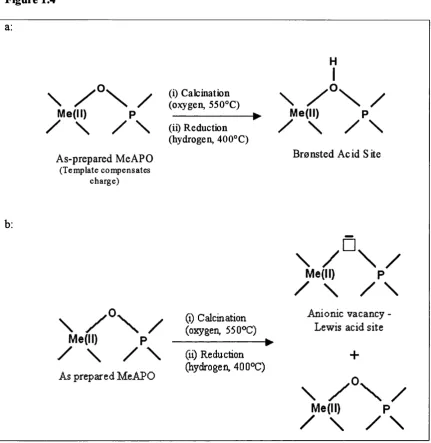
Bronsted acid site.'*^'^* This is shown schematically in figure 1.4a below. In some cases it
is also known that calcination can cause the formation o f lewis acid sites, where an
oxygen vacancy in the framework is the cause o f the acidity.'^*’^® Figure 1 4b below.
Figure 1.4
a:
\ / X /
Me(ll) p
/ \ / \
As-prepared MeAPO
(Template com pensates charge)
(i) Calcination (oxygen, 550°C) (ii) Reduction (hydrogen, 400°G)
H
\ / ° \ /
Me(ll) p
/ \ / \
Bronsted Acid Site\ / X /
Me(ll) p
/ \ / \
As prepared MeAPO(i) Calcination (oxygen, 550°C)
1 (ii) Reduction (hydrogen, 400°C)
\ / ° \ /
Me(ll) p/ \ / \
Anionic vacancy -Lewis acid site
\ / X /
Me(ll) F
/ \ / \
Figure 1.4 a: Shows the formation of a Bronsted acid site in a métal substituted
aluminophosphate, wdiile b: shows the formation o f the alternative Lewis acid site as
The acid centres are studied using a range of techniques including Fourier Transform
Infrared spectroscopy (FTIR)/^’ EXAFS and adsorption experiments/^ The Bronsted
acid centres are characterized by a distinct band in the FTIR sprectra arising from the
bridging hydroxyl, at ca 3600 cm'\ The EXAFS spectrum shows evidence o f 3 short
Co-O bonds (-1.90A) and one long bond (-2.05 A) due to the bridging hydroxyl species. The
Lewis sites are detected by a combination of FTIR and temperature programmed
desorption (TPD).^^’ The FTIR spectra has a band at 3670cm-1 due to the P-OH group,
at a slightly higher wavenumber, and usually producing a sharper peak than that seen for
Bronsted acid sites, while adsorbents such as acetonitrile are used to distinguish the acid
sites using TPD.
Which type of acid site predominates is largely dependant on the structure. In a
study o f four different Co AlPO structures, types -5, -36, -44 and -18 striking differences
were found. In the chaimel type structures, -5 and -36, the majority of the acid sites were
found to be Lewis type, while in the cage like structures, -44 and -18, Bronsted sites were
the most abundant.
The acidic nature o f the calcined materials make them potentially useful in a
number of reactions, and combined with the regular pore dimensions this acidity is
combined with high shape selectivity. Indeed such materials have been shown to be
useful in a number o f reactions, including the conversion o f methanol to lower olefins,
being very selective for ethylene and propylene over the higher olefins.^'
1.5.2 REDOX Properties
The introduction o f heteroatoms into the aluminophosphate framework also
introduces the possibility of redox centres being included. If the substituted Me° can be
raised to the Me^\ reversibly, and while remaining in the framework, the materials will
have potential for uses in redox mediated processes such as oxidation of alkanes and
alkenes in the presence o f air and hydroperoxides.^^’ More recently a chabazite
related material has been shown to be highly selective in the oxidation of hexane,
selectively oxidising the terminal carbon producing adipic acid, a pre-cursor to many
nylon products.
This is known to occur in many materials with Cobalt ions incorporated into the
framework, and has been closely linked with the presence o f Bronsted acid centres.
Also it is believed that the Co^VCo"^ centres are important in many of the catalytic
properties exhibited by the CoAlPO’s.^^’ hi the Co” form the negative charge on the
framework is balanced by a proton (Bronsted acid centre) as seen in FTIR studies, and
when the Co” is oxidised to Co”^ there is no longer a charge imbalance and
correspondingly there is no Bronsted acidity seen in the FTIR spectra. Heating the
materials in hydrogen reduces the cobalt centres, again producing the acid sites.
EXAFS is often the chosen technique for following the change o f oxidation state
o f cobalt ions while remaining in the framework by monitoring the shift in adsorption
compared to -1.93Â for Co°-0) Provided we have a good enough model for C0-O4 bond
distances, it is possible to estimate the degree of oxidisable cobalt from the change in
average Co-0 bond distance/* Using this it has been found that not all the cobalt centres
within a framework can be raised from Co" to Co™, and the degree o f oxidisable cobalt is
dependant on the particular framework. In Co AlPO-18 it was found that 100% o f the
cobalt centres could be oxidised while in CoAIPO-5 only 20% o f cobalt centres could be
raised from Co" to Co™"** Structure types -3 6 and -4 4 were also studied, with the results
summarised in table 1.2 below.
Table 1.2. Percentage o f estimated oxidisable cobalt centres in a range o f Co AlPO
structures - taken from Barrett et al, 1996. 48
Stmcture Type Average C o-0 bond length, Â % Oxidisable cobalt.
CoAlPO-5 1.92 20
CoAlPO-18 1.83 100
CoAlPO-36 1.87 40
CoAlPO-44 1.85 80
One of the essential elements o f analysing the EXAFS results is the presence o f a
good model o f the system being studied. There are very few systems that contain
tetrahedral Co™ bound to 4 oxygens. One such system is the heteropolytungstate
K5[CoWi2 0 4o] 2OH2O. The crystal structure o f this material is re-investigated in this
thesis to provide us with a good model for Co"^ substituted into aluminophosphate
frameworks.^^
1.5.3 Stability.
An important property of a microporous catalyst is that the framework is stable
under operating conditions. However, this is not always the case, particularly once the
organic template species has been removed. The layered materials, as noted previously,
collapse upon removal o f the organic template as in most cases it is the organic which
separates the aluminophosphate layers. In the microporous materials there are also some
materials which are unstable to calcination, often collapsing to form dense phase
aluminophosphate materials such as berilinite and tridymite. As with the many factors
involved with synthesis of these materials the exact reasons why some materials collapse
and others do not is still largely unknown.
A common cause o f instability is the inclusion of heteroatom species in the
framework. Some frameworks are stable with respect to calcination in the pure
aluminophosphate form, and if only small amounts (ca 10 wt %) of heteroatom are
incorporated. However, as in the case o f CoAlPO-44, a chabazite related structure, the
inclusion o f too much cobalt in the framework (~ 25 wt %) makes the material unstable
with respect to calcination, collapsing once the organic template is rem o v ed .T h is case
material) was also studied and it was found that in this case the silicon in the framework
had a stabilising effect and unlike it’s Co AlPO analogue this material can be calcined,
leaving the inorganic framework intact.^^ The stabilising effect o f silicon is studied later
in this thesis.
1.6 Aims and Objectives
As has been shown in this introduction, the area o f microporous
aluminophosphate materials and their derivatives is both varied and complex. In this
thesis we report a series o f studies which investigate aspects o f the synthesis of
heteroatom substituted aluminophosphates including an in situ study into the effect o f pH
of the starting gel on the final product formed and the effect o f the substitution o f silicon
into a chabazite framework structure with respect to the stabihty o f the final product. We
also describe a number of structural studies investigating initially the location o f template
species within the microporous framework, and then o f the framework during and after
calcination. Finally the structure of the heteropolytungstate K5[CoWi2 0 4o]'2 0H2 0, one of
only a few materials that contain Co™ ions tetrahedrally co-ordinated to four oxygen
atoms is re-investigated to provide us with a good model for Co™ species substituted into
aluminophosphate frameworks.
1.7 References
^ S. T. Wilson, B. M. Lok, and E. M Flanigen, in "Patent # 4,310,440', U.S., 1982.
^ S. T. Wilson, B. M. Lok, C. A. Messina, T. R. Cannan, and E. M. Flanigen,
Journal o f the American Chemical Society, 1982,104,1146.
^ R. M. Barrer, 'Zeolite and Clay Minerals', Academic Press, 1978.
^ A. Dyer, 'An Introduction to Zeolite Molecular Sieves', Wiley & Sons Ltd., 1988.
^ W. M. Meier and D. H. Olson, 'Atlas o f Zeolite Structure Types',
Butterworth-Heinemann, 1996.
^ M E . Davis, Acc. Chem. Res., 1993, 26, 111.
^ B. M. Lok, C. A. Messina, R L. Patton, R T. Gajek, T. R. Cannan, and E. M.
Flanigen, J. Chem. Soc., 1984, 106, 6092.
* B. M. Lok, C. A Messina, R L. Patton, R T. Gajek, T. R Cannan, and E. M.
Flanigen, in 'Patent # 4,440,871', U.S., 1984.
^ S. T. Wilson and E. M. Flanigen, in 'Patent # 4,567,029', U.S., 1986.
E. M. Flanigen, B. M. Lok, R. L. Patton, and S. T. Wilson, Proc 7th IZC, Tokyo,
1986, p. 103.
J. Chen and J. M. Thomas, J. Chem. Soc. Chem. Commn., 1994, 603.
J. M. Thomas, Angewandte Chemie-Intemational Edition in English, 1994, 33,
913.
G. Sankar, R. Raja, and J. M Thomas, Catalysis Letters, 1998, 55, 15.
R Raja, J. M. Thomas, and G. Sankar, Chemical Communications, 1999, 525.
J. M. Bennett and B. K. Marcus, 'Innovation in Zeolite Materials Science',
16 17 18 19 20 21 22 23 24 25 26 27 28
J. M. Thomas, Æggw. Chem. Int. Ed. Engl., 1988, 27,1673.
S. T. Wilson and E. M. Flanigen, Acs Symposium Series, 1989, 398, 329.
R. Szostak, 'Molecular Sieves; Principles o f Synthesis and Identification', Van
Norstrand Reinhold, 1989.
A. F. Ojo and L. B. McCusker, Zeolites, 1991,11, 460.
D. W. Lewis, C. R A Catlow, and J. M. Thomas, Chemistry o f Materials, 1996, 8, 1 1 1 2.
A. T. Davies, G. Sankar, C. R A. Catlow, and S. M. Clark, Journal o f Physical Chemistry B, 1997,101,10115.
E. M. Flanigen, Stud. Surf. Sci. Catal, 1988,37, 3.
M. E. Davis, C. Saldarriage, C. Montes, J. Garces, and C. Crowder, Nature, 1988, 331, 698.
G. Cheetham and M. M. Harding, Zeolites, 1996,16, 245.
D. W. Lewis, D. J. Willock, C. R. A. Catlow, J. M. Thomas, and G. J. Hutchings,
Nature, 1996,382, 604.
G. Sankar, J. K. Wyles, R H. Jones, J. M. Thomas, C. R. A Catlow, D. W.
Lewis, W. Clegg, S. J. Coles, and S. J. Teat, Chemical Communications, 1998,
117.
A. T. Davies, G. Sankar, C. R. A Catlow, and S. M. Clark, 12th IZC, Baltimore
U.S.A., 1998.
F. Rey, G. Sankar, J. M. Thomas, P. A Barrett, D. W. Lewis, and C. R A.
Catlow, Chem. Mater., 1995, 7,1435.
29 30 31 32 33 34 35 36 37 38 39 40 41 42
A. T. Davies, 'Stuctural Studies o f the Crystallisation o f Microporous Materials',
PhD, University College London, London, 1999.
C Urbina de Navarro, F. Machado, M. Lopez, D. Maspero, and J. Perez-Pariente,
Zeolites, 1995,15, 157.
P. A Barrett, G. Sankar, C. R. A. Catlow, and J. M Thomas, Journal o f Physics and Chemistry o f Solids, 1995, 56, 1395.
J. Batista, V. Kaucik, N. Rajic, and D. Stojakovic, Zeolites, 1992,12, 925.
A. M. Prakash, M. Hartmann, and L. Kevan, Chemical Communications, 1997,
2221.
N. Venkatathri, G. S. Hedge, P. R Rajamohanan, and S. Sivasanker, J. Chem.
Soc. Faraday Trans., 1997, 93, 3411.
H. Qisheng and X. Ruven, J. Chem. Soc. Chem. Commn., 1990, 783.
Q. M. Gao, J. S. Chen, S. G. Li, and R R. 'Xw, Microporous Materials, 1996, 7, 219.
Q. M. Gao, S. G. Li, and R R Xu, Journal o f the Chemical Society-Chemical
Communications, 1994, 1465.
Q. Huo and R Xu, J. Chem. Soc. Chem. Commn., 1990, 783.
R. E. Morris and S. J. Weigel, Chemical Society Reviews, 1997,26, 309.
S. Oliver, A. Kuperman, A Lough, G. A. Ozin, J. M. Garces, M. M. Olken, and
P. Rudolf, Studies in Surface Science and Catalysis, 1994, 84, 219.
M. E. Davis, C. Montes, and J. GdncQS, Acs Symposium Series, 1989, 398, 291.
J. R. Anderson, W. R Jackson, D. Hay, Z. P. Yang, and E. M Campi, Zeolites,
43 44 45 46 47 48 49 50 51 52 53 54 55
X. Ren, S. Komameni, and D. M. Roy, Zeolites, 1991,11, 142.
S. Prasad and S. B. Liu, Chemistry o f Materials, 1994,6, 633.
J. S. Chen, P. A. Wright, J. M. Thomas, S. Natarajan, L. Marchese, S. M. Bradley,
G. Sankar, C. R. A. Catlow, P. L. Gaiboyes, R. P. Townsend, and C. M. Lok,
Journal o f Physical Chemistry, 1994,98,10216. D. B. Akolekar, Zeolites, 1994,14, 53.
R B. Borade and A. Clearfield, Journal o f Molecular Catalysis, 1994, 88, 249.
P. A Barrett, G. Sankar, C. R. A. Catlow, and J. M. Thomas, Journal o f Physical Chemistry, 1996,100, 8977.
P. A. Barrett, 'Structural Studies o f Cobalt-Substituted Aluminophosphates', PhD,
University ofKeele, 1996.
M P. J. Peeters, J. H. C. van H oof, R. A Sheldon, L. M. Kustov, and V. B.
Kazansky, Proc. 9th IZC, 1992.
J. Chen, J. M. Thomas, and G. Sankar, J. Chem. Soc. Faraday Trans., 1994, 90, 3455.
W. P. J. H. Jacobs, J. H. M. C. Van Wolput ., and R. A. van Santen, Zeolites,
1994,14, 98.
J. Janchen, M. P. J. Peters, J. H. M. C. Van W olput., J. P. Wolthuzien, J. H. C.
van Hoof, and U. Lohse, J. Chem. Soc. Faraday Trans., 1994, 90,1033.
L. Marchese, J. S. Chen, J. M Thomas, S. Coluccia, and A. Zecchina, Journal o f Physical Chemistry, 1994, 98,13350.
U. Lohse, B. Parlitz, D. Muller, E. Schreier, R Bertram, and R. Fricke,
Microporous Materials, 1997,12, 39.
56
57
58
59
60
61
62
63
64
65
U. Lohse, R. Bertram, K. Janke, I. Kurzawski, B. Parlitz, E. Loffer, and E.
Schreier, J. Chem. Soc. Faraday Trans., 1993, 91, 1163.
H. Bemdt, A. Martin, and Y. Z20\g, Microporous Materials, 1996, 58,139.
L. E. Iton, I. Choi, J. A. Desjardins, and V. A Maroni, Zeolites, 1989,9, 535.
L. N. Radev and V. J. Penchev, Reaction Kinetics and Catalysis Letters, 1996, 58,
139.
J. M. Thomas, G. N. Greaves, G. Sankar, P. A. Wright, J. S. Chen, A J. Dent, and
L. Marchese, Angewandte Chemie-Intemational Edition in English, 1994, 33,
1871.
D. L. Vanoppen, D. E. Devos, M. J. Genet, P. G. Rouxhet, and P. A. Jacobs,
Angewandte Chemie-Intemational Edition in English, 1995,34, 560.
S. S. Lin and H. S. Weng, Catal. A., 1994, 84, 1869.
J. M. Thomas, R Raja, G. Sankar, and R G. Bell, Nature, 1999, 398,227.
B. Kraushaar-Czametzki, W. G. M. Hoogervorst, R R Andrea, C. A. Emeis, and
W. H. J. Stork, J. Chem. Soc. Faraday Trans., 1991, 87, 535.
G. Muncaster, G. Sankar, C. R. A. Catlow, J. M. Thomas, S. J. Coles, and M.
Chapter 2
2.0 Summary
In Chapter 1 we introduced and described the Aluminophosphates and their
Metal substituted analogues. In this chapter we discuss the various experimental
techniques used throughout the project and described later in this thesis.
Both Synchrotron radiation and laboratory based X-Ray techniques were used,
employing single crystal and powder X-ray diffraction (XRD) along with energy
dispersive X-ray diffraction (EDXRD). Accompanying the diffraction studies further
techniques were also used, including Fourier transform infra-red spectroscopy (FTIR)
and solid state nuclear magnetic resonance (NMR), to study the materials and provide
2.1. Introduction
X-Ray Diffraction techniques are one o f the most powerful tools that can be
employed in Solid State Chemistry to aid with phase identification and structure
solution o f materials that possess long-range structural order, such as in most o f the
aluminophosphates. Indeed such techniques have been commonly used to gain
structural information on the aluminophosphate and related materials.
If single crystals o f sufficient size are available, single crystal diffraction
generally affords the best opportunity for structure solution. With the advent o f micro
single crystal diffraction, as employed in this project, it is now routinely possible to
perform single crystal investigations on crystals with sizes smaller than
However it is not always possible to produce single crystals even o f this size,
and therefore single crystal studies are not possible. As a result, in these cases the
technique o f choice is therefore powder x-ray diffraction - in particular (if available)
high resolution powder diffraction (HRPD). Using this technique with the often
highly ordered crystalline aluminophosphate structures the data is good enough that
structures can be solved and refined using only HRPD data.
The other use for powder diffraction data, and in fact the main use o f it in this
thesis, is for phase identification. The powder diffraction pattern for each crystalline
structure is unique and can be used as a ‘fingerprint’ for identifying the crystalline
phase (or phases) p r e s e n t ^ I f there is more than one phase present, as is often the
not only help identify which phases are present but also give an indication o f the
relative amounts o f each.
The third diffraction technique employed is energy dispersive x-ray
diffraction, (EDXRD). Although this technique is not as high resolution as single
crystal and HRPD it does allow very quick data collection times providing the
possibility o f time resolved experiments being performed, studying the formation o f
materials or how they react under operating conditions^^'^^.
To complement the X-Ray diffraction studies we performed a range o f other
experiments. These included Infra-Red spectroscopy which was used primarily to
monitor the breakdown o f the organic template species and the formation (or absence)
o f Bronsted acid sites in the aluminophosphate materials as they were calcined. Solid
state nuclear magnetic resonance was used to study the local environment o f silicon,
zinc and aluminium within a series o f ZnAPSO (zinc and silicon substituted
aluminophosphate) materials. Thermal and chemical analysis were also used to
2.2 Synchrotron Radiation.
Synchrotron radiation is the name given to the X-Rays or light that is emitted
from a beam of electrons, travelling at relativistic speeds, (near the speed o f light) in a
circular orbit around a storage ring, as shown in the schematic in figure 2.1 below.
Electrons
Magnet
Synchrotron
Radiation
Figure 2.1 Simple Schematic of a Synchrotron Radiation Source
In a synchrotron radiation source (SRS), such as the Daresbury SRS where the
studies discussed in this thesis were performed, electrons are initially accelerated in a
linear accelerator (LINAC) before being injected into the storage ring. Once in the
storage ring the electrons are held in a constant orbitand orbit by a series of powerful
electromagnets. As the electron beam travels round the ring it emits white radiation
tangentially from it’s orbit. The white radiation, which is typically in the range from
infra Red to hard X-Ray, is then channelled to the various experimental stations via
high vacuum lines.