South Asian Students’ Adaptation Experiences in an Australian Postgraduate Coursework Environment
By Waliul Islam and Helen Borland1
{Key words: South Asian students, international students, academic expectations, adjustment experiences, Postgraduate coursework students, class participation, cultural difference.}
Introduction
Globalization of education has become a significant trend economically in the worldwide free market operations. As a result of 'the evolution of the knowledge-based economy' (Mok, 2003) education providers perceived to offer high quality education are drawing students from all over the world. Australian universities are among those to which students flock, meaning that such students now constitute a significant part of their student population and provide a proportion of their revenue. In 2001 overseas students contributed 79 per cent of the Australian universities' fee-paying revenue (AVCC Fact Sheet 2, 2001, cited in Feast 2002). AEI (2006) reports a further growth of 8.6% of the international students in Australia in June 2006 over that of June 2005.
Australia has been increasing every year. AEI (July, 2005) records that the market for Australian education in India and Bangladesh has grown further by 29.8 % and 14.1% respectively. The input from India only in January 2006 amounts to 18,002 enrolments, a 23.6 % increment over that of January 2005 (AEI Monthly Summary of International Student Enrolments, 2006). AEI July 2006 statistics reveal that these South Asian countries have continued contributing increasing number of students to Australian education providers. Pouring $5,622 million into the Australian economy in 2003-04, international students constituted its 9th largest export-earning sector (AVCC Fact Sheet 2004). In justifying the need for cross-cultural research, Magala (2005) most appropriately observes that ‘cross-cultural management is a crucial challenge for the successful development of international business. ‘Misunderstandings arise because culture affects both individuals and organizations’. Looking at the international students perspective from a different angle, Humfrey (1999) has underscored the significance of further studies about international students stating that ‘the participation of these students is no longer seen as a privilege for them, but a necessity’ for the education providers. What it all means is that such an important area deserves a better understanding in the interest of all its stakeholders.
Whilst students from South Asian countries share a British colonial heritage that has left as its legacy some level of familiarity with English, and Anglophone educational traditions, for most of these students English is either a second or foreign language. Although they may have undertaken a part of their undergraduate studies through the medium of English, their proficiency in English is generally not particularly highly developed, in comparison with Australian educated students, and also reflects features of their regional variety of English (e.g.Indian English for Indian students), which is distinct from Australian English and other world "Englishes" (Kachru, 1995).
has been to recognize cultural differences in learning and teaching styles and the impact these have on student performance, for example, the body of research on students from Confucian Heritage Cultures (CHC) (Zhang 2002, & Lee 1996). However, Biggs (1997) has critiqued the assumption that Asian students, particularly those with CHC background, have a rote learning style and suggested not to make simplistic connections between cultures and learning styles.
This paper, drawn from data collected for a broader study about South Asian postgraduate coursework students’ initial understandings, expectations of Australian postgraduate studies and their gradual adaptation experiences, will limit itself to analyzing a few themes that emerge in their initial expectations and experiences.
More specifically the paper aims at:
- providing an overview of the students’ diverse experiences as international students in Aus tralia
- exploring some of their initial expectations as postgraduate students - exploring some of their initial academic experiences of lectures, class
participation.
Methodology
This qualitative study has followed a longitudinal approach in the setting of an Australian metropolitan university with a large cohort of South-Asian postgraduates and involved regular in-depth interviewing of approximately 10 participating students from South Asia as defined earlier, over a period of 9 months (2 full semesters).
the students, and journal observations of non-verbal communications were taken into consideration.
The recorded interviews were transcribed, and coded using Nvivo software and then analysed thematically. Whilst aspects of the students’ varied experience are intertwined and interrelated, the discussion and analysis that is presented here focus on insights that have emerged in relation to some key themes, and each theme will be discussed separately.
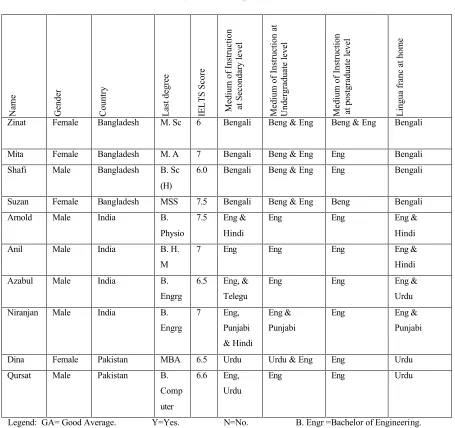
Table 1
Summary of the Respondents
Name Gender Country Last degree IELTS Score Medium of Instruction at Secondary level Medium of Instruction at Undergraduate level Medium of Instruction at post
graduate level
Lingua franc at home
Zinat Female Bangladesh M. Sc 6 Bengali Beng & Eng Beng & Eng Bengali
Mita Female Bangladesh M. A 7 Bengali Beng & Eng Eng Bengali
Shafi Male Bangladesh B. Sc
(H)
6.0 Bengali Beng & Eng Eng Bengali
Suzan Female Bangladesh MSS 7.5 Bengali Beng & Eng Beng Bengali
Arnold Male India B.
Physio
7.5 Eng &
Hindi
Eng Eng Eng &
Hindi
Anil Male India B. H. M
7 Eng Eng Eng Eng &
Hindi
Azabul Male India B. Engrg
6.5 Eng, & Telegu
Eng Eng Eng & Urdu
Niranjan Male India B. Engrg
7 Eng, Punjabi & Hindi
Eng & Punjabi
Eng Eng & Punjabi
Dina Female Pakistan MBA 6.5 Urdu Urdu & Eng Eng Urdu
Qursat Male Pakistan B. Comp
uter
6.6 Eng, Urdu
Eng Eng Urdu
Initial diverse experiences of a new country and context
Motivation and Expectations prior to Arrival
The South Asian postgraduate coursework students, each of whom, the researchers would like to imagine, as travelling on a symbolic epic journey to a foreign land (Australia) in search of higher knowledge, leaving their respective families and homes several thousand kilometres behind. Considering the amount of investment in terms of time, energy and money, the researchers expected that these students had all been well motivated by a genuine interest in obtaining an Australian postgraduate qualification. However, it is recognised that a range different long term goals and career expectations may be influencing students’ decisions to come to Australia for postgraduate study. Although none of the respondents volunteered to talk about whether they planned to seek permanent residence in Australia, our background knowledge suggests that for some of them permanent residence is the main motivation for coming to Australia. This was indicated by their prior study in South Asia and / or choices made to change course once they had arrived in order to achieve more points for permanent residence requirements. There may be multiple reasons for not sharing their intention for permanent residency. One of these may be that it is a private and hidden agenda, and another may be that they do not want to risk losing their face by openly sharing this desire in case their attempt to become a permanent resident fails.
At the very beginning, when they arrived they were both excited by its newness, and also challenged by its odds and alien context. They came with a lot of expectations. All expected ‘difference’ that was related to the fact that they were moving from a developing to a developed country. As Dina explained,
“I know that my country is a developing country and I am going to a developed country, so there will be there would be - there sho uld be a difference in the classroom….”.
But there are differences in their imaginings of what being “developed” means from an educational perspective. For Shafi, a telecommunication student, the expectation was that his education would be comparatively more strongly grounded in practical learning and application:
Whereas, for Qursat, the motivation as well as expectation was related to the reputational value of a ‘foreign’ education:
“The name of foreign university is of high value in Pakistan. Basically we look forward for the name- that we are qualified from foreign university.”
Arnold, like the others, focused on expectations of the superior quality of education, but specifically in his field of specialisation:
“Before coming here I had a picture or I had a thought like Australia is pretty good in the exercise rehabilitation and physiotherapy field, so that’s what I thought and opted for Australia as compared to any other country.”
Suzan’s expectations are more grounded in a person al development paradigm:
“I am not looking for permanent residence or anything else. My aim is to get the best experience from here and enrich myself and go back to my country.”
Initial Experiences of the New Environment
In recounting their expectations, none of the students focussed on expectations with reference to living in Australia, which suggests that their assumptions were that this aspect of their postgraduate experience would be straight forwards. However, they talked about their initial experiences in some specific areas.
Physical facilities:
As they go on evaluating their initial experiences, during the first couple of weeks, some of the students have found their expectations fulfilled, as Niranjan, another telecommunication postgraduate, explains in relation to material facilities:
“ I was thinking … Australian education will be far more different from (that of) our country, and I find the same. It is different from our universities- our universities … are not well equipped as the universities in Australia are.”
Qursat in his initial reaction expressed a kind of satisfaction about the physical facilities:
Suzan cautiously commented on classroom facilities:
“Technologically ………. it is available here but not that much that I should be very surprised.”
University Bureaucracy:
In relation to the provision by the University of service to students, their narratives highlight that some had an unanticipated initial experience of status change and of having assumed membership of a minority. Before coming to Au stralia, these postgraduates back home enjoyed the status of being members of the majority community and were from fairly privileged middle class families. They had never felt themselves as a minority. Immediately after her arrival in Australia, Mita explains how she felt quite traumatised by the manner in which a student centre front counter staff member spoke to her aggressively and made what Mita interpreted as quite a derogative and insulting remark to her because she had not arrived at the right time. As Mita approached the front desk late, leaving her husband waiting with luggage on the roadside, the staff responded, she narrates:
“ ‘You came at 12’. And there’s already tension. … there is discrimination; they don’t just talk to us in a way that they talk to locals. She said, ‘I don’t understand why you people come here to study’. … in front of my face she said that.”
All the students, were naturally emotionally distressed after leaving behind th e friends and families, and majority explained how they felt diminished in themselves, and suddenly realised their lessened and reduced selves in the new context through one or more interactions in the initial period after their arrival. The communication to them in various ways of their perceived negativities or deficiencies – their different looks, alien culture, language deficiency – created for some an overall impression that they are inferior. This aggravated their sense of minority among the international students and left an impact, which lasted for some (e.g. Niranjan) throughout their first and second semesters.
When asked how often she visited the international office, Zinat - an Aus Aid grantee- recollects how she felt threatened by the unwanted level of surveillance
More than 60% of the participants indicated that they had had s imilar experiences of feeling reduced.
Socio-Cultural and Economic Adaptation
The new environment required the students to negotiate with the new system, and challenged them and forced them to renegotiate their own lifestyles and work frames. Students coming from South Asian countries usually belong to the upper middle class of their respective societies and have had a relaxed life style, with full time student status and hardly any family responsibilities, such as paying bills, shopping, or even family cooking. Outside the home household functions like paying bills and shopping are normally done by the father or a male member of the family, and rarely by female members. When they arrive in Australia all these responsibilities suddenly come down on the student him/herself, and some, particularly the female students, feel a pressure for which they had neither training nor any mental preparation, and they find it difficult to manage. Before coming to Australia, Mita had had only her studies to concentrate on, but now she has got the whole world of responsibilities to take care:
“(I have to) think about my food, if do wanna buy something from outside and to carry home and bear that damn luggage everywhere- it’s like troublesome. There in my home country … I have to attend my classes only and that’s all. … I did not have to think about anything- t his bill and that gas bills, electricity bills - like too much pressure”.
Another marked initial experience of the South Asian students involves the comparative perspective they have of costs. They visualise any expenditure, at the initial stage, in terms of their local currency, which converts in a low exchange ratio with Australian currency, in spite of its distinctive purchasing power in their local economy. When Arnold was asked to pay a tuition invoice he perceived the amount in terms of Indian currency and this caused him a lot of stress:
“I am spending a hell lot of money – it is not just a thousand dollar or few thousand dollars – it is 35 times of the Australian currency in my currency.”
Academic Adjustment Issues The Role of Teacher:
In the academic context, these students have been confronted by some p ractices and norms and requirements that are different from their own. An area of particular focus for them in their initial experiences is a perception of differences in the teacher’s status and relationship to his/her students. The understanding they have developed in their home countries about a teacher is something more than a mere teacher. The teacher’s job is not only to impart knowledge of their respective field(s). They are expected to mould their students with certain values and a certain philosophy of life. Teachers are treated as ‘Guru’, a mentor like a godfather or mother. Calling a teacher by his/her first name, as is the Australian norm, is seen as compromising the teacher’s status. As Arnold observes this is seen as indicating a lack of appropriate respect:
“One thing I found very odd is the students here don’t respect their lecturers with their designations or something. They just interact with them with t heir direct names … yeah, with their first name … . Because back in India whoever be the tutor, we always respect them with either ‘SIR’ or ‘MADAM”, and that maintains … respect between students and teachers”.
And Anil perceives the lecturer in Australia as having a lesser role:
“… in India, all the teachers were mentors to me. But in here (one) is just a lecturer.”
It was unthinkable for Niranjan that he would not be calling his lecturer ‘sir’ because of their greater age. He notes his discomfort and astonishment:
“I used to respect them by calling ‘Sir’ … ‘Madam’. Here I have to call them by name and it is very difficult. They are older than me and I am calling them by name ….. ”
Even after spending the first semester in Australia he feels uncomfortable in calling a teacher by name:
“… even today when I call [sic] them – I said ‘Sir’ and then when I realise [sic] that I am in Australia, I called them by name.”
Cagility and Bichelmeyer (2000) have noted similar observation in their study with Turkish students in the U.S. context, who found aspects of teacher-student interaction, such as use of teachers’ first names, quite inappropriate
assumed knowledge about their international students. Qursat explains these expectations in his observation notes:
“I thought that the Australian lecturers would be highly qualified- they would understand the psyche of the international students- they should understand what kind of medium they have been taught in Pakistan.”
As he continues, Qursat indicates his expectation of teacher’s knowledge-dome as well as his expectation of teacher’s role in giving knowledge to students:
“… teacher has knowledge – he knows everything – he [almost] knows the course 80% -90% of the course (subject) he is teaching. He has to give us what he has got in his possession.”
Dina compares the teachers’ roles in her home country and in Australia and makes evaluative judgement:
“… in our country teacher had the final, you can say, authority to give marks to the students .
This is the biggest drawback, which I have observed during my student life, … they give high
grades or good marks to students who are friends to them. …Here (in Australia) I think there is
no such kind of thing, … up till now I haven’t seen such kind of things.”
What this highlights, besides the expectation of the teacher having broad inter-cultural knowledge, is a belief about the teacher’s authority and didactic role in passing his/her knowledge to the students. Whilst the researchers do not feel that it can be confidently claimed that this expectation amounts to what Cook (in Cagility and Bichelmeyer, 2000) calls ‘indoctrination’, such assertions do suggest the need for further research on what learning style the students are assuming. Comments such as this obviously refer to an expectation of teacher-centred education. When these students from such academic culture are rocketed to a Western academic environment, which is perceived to enhance ‘the knowledge base through participatory, learner-centred, analytical approach’ (Ballard and Clancy, 1997), some students have found the requirements of the new academic culture challenging.
Classroom Participation:
India, they are segregated, as Kachru (1992 pp.66-67) puts it, by their ‘linguistically identifiable, geographically definable … non-native models of English’. The ‘accent bar’ stops many of them in getting into class interaction, as well as affecting their interactions in other spoken contexts. When asked what causes difficulty in her spoken interaction, Mita comments:
“Because of accent…. we messed up everything …we cannot speak point to point- sometime …
he just wonders, “What he or she is talking about”.
In spite of feeling that she has improved her spoken communication over the first four months, she still faces difficulty in transmitting her message:
“I don’t have difficulties understanding my Australian lecture but the teacher - sometimes he
doesn’t understand {us} in general. … Umm… I understand them more than they understand me.”
Dina also identifies accent as main problem with spoken interaction:
“Accent, yeah, accent, because if they (Australian classmates) thought that my grammar was not OK, still they could understand… they don’t take it so seriously. … If they can’t understand the accent …. they take it seriously.”
When Azabul was asked why he did not take part in class interaction he admitted that: “I don’t understand the lecturer‘s point of delivery- so that I can’t ask question regarding the lecture”.
Attributing this to a “language problem” that he feels also stops him from being able to adequately explain his problem. However, some students did not experience much language related difficulties. For example, Niranjan felt that his language difficulties were limited compared to some others, explaining:
Suppose we are talking for five minutes- and it could be just one or two words that we have to repeat or they have to repeat.
And Anil seemed to be very confident about his spoken interaction: “Yes, yes. No communication problem at all.”
Social integration
such as psychological and cultural adjustment factors. When asked how conducive she finds her class and academic environment, Suzan explains:
“ I think we feel a bit isolated sometimes and that creates…psychological pressure.”
The perceived individualistic grooming of the local students may be another reason of segregation. In her comment Zinat reiterates what she was told in the IAP class:
“I think the international students are little bit isolated, because in my classes, …we were informed by our IAP course teacher that Aussies are very inconsistent, they won’t approach us but still … they have their pride, they won’t approach international students.”
One factor that could be contributing to the segregation of international students is their clustering into certain postgraduate courses with many students from their same background. In some engineering classes, most of the students are from South Asia and they feel bunched together on the basis of homogeneity of culture, language, and sometimes, also gender. Shafi talks about his classmates:
“Actually in my class … no Australian pupils here. All of them are Indian – Indian continent al people. One from Pakistan. Most of them are Indians.”
Dina describes her class:
“There are very few Australian classmates in all the four subjects…. Most of them are Chinese and Indians.”
Regarding her group selection Dina says:
“In our group I had one friend from India- we had common language – that’s why there was no problem.”
As she tell her experience of group work, she continues:
“… Me and Farah - the other (female) friend from India- we were working …. and she (the Chinese girl) came and we asked her to sit – but she did not participate and she was not feeling comfortable, we had to repeat sentences many times for her. That’s why I was saying she was not feeling comfortable. One factor could be that when we were talking in our common language as well and she felt something like …. isolated … . “
Conclusion and Recommendations
Australian university. It is interesting to note also that most of them, in their initial stage, are inclined to view everything comparatively and through the lens of their own home experiences, and their observations are judgmental in nature.
Students coming from a multi-lingual environment like India, and who have had an English as medium instruction background reported relatively less difficulty in spoken communication than those coming from primarily monolingual societies like Bangladesh and Pakistan, where all or most instruction has been in their native language..
As we realise that the students experience multifarious and multi level difficulties when they approach this new social and academic environments, some efforts may be made to lessen their initial shocks and facilitate their adjustment to Australian setting. Most of the respondents reported that they had come here without any pre-departure briefing. Those who came under the AusAid program observed that their pre-departure briefing was too brief. In this context, the Australian High Commission, DIMIA, or IDP could profitably organise intensive and comprehensive pre-departure briefing sessions to give the prospective students a clear idea about Australian culture, life style, educational requirements at postgraduate level. Alternatively, pre-academic programs like Introductory Academic Programme (IAP) can be reconstructed in the light of the needs of the new international students, and such programs may include a linguistic component like a contrastive analysis of Australian English and other major varieties of English used in other parts of the world as well as modules of non-linguistics cultural issues such as Australian social and academic norms, and of academic requirements like class participation, assignment writing, presentations. This type of training will not only help build confidence about the required skills but also would at least provide them with a sense awareness that will facilitate their adaptation to this culture and reduce any possible cultural shock.
References:
AEI, (2005), Year 2005 Market Indicator Data, viewed on 04,04.’06,
<http://aei.dest.gov.au/AEI/MIP/Statistics/StudentEnrolmentAndVisaStaistics/Recent_
TableD_pdf,pdf>
AEI, (2006), Monthly Summary of International Student Enrolment Data, March 2006, viewed
on 14.6.2006 http://aei.dest.gov.au/AEI/MIP/ItemsOfInterest/06Interest19.htm AEI, (2006), Monthly Summary of International Student Enrolment Data, June 2006, viewed
on14.6.2006<http://aei.dest.gov.au/AEI/MIP/Statistics/StudentsEnrolmentAndVisaStais tics/pdf>
AVCC Fact Sheet, (2004), International Education: The facts viewed on 14.06.06
http://www.avcc.edu.au/content.asp?page=/publications/stats/students.htm
Ballard, B. & Clanchy,J. (1997), Teaching International Students: A brief guide for lecturers and supervisors, IDP Education Australia, Deakin, ACT, Australia pp.11-14.
Biggs, J. (1997). Teaching Across and Within Cultures: The issues of International Students. Learning and Teaching in Higher Education: Advancing International Perspectives, HERDSA
Conference, July 1997, Special Edition, pp.1-22
Borland, H and Pearce, A. (1999), Valuing Diversity: experiences and achievements of NABS
students at Victoria University. The Centre for Educational Development and Support,
Victoria University f Technology, Melbourne
Cagility, K and Bichelmeyer, B (2000), Differences in Learning Styles in Different Cultures: A
Qualitative Study, Paper presented at the Annual Meeting of the American Educational Research Association, New Orleans, LA, April 24-28, 2000
Feast, V (2002), The Impact of IELTS Scores on Performance at University. International Education Journal, 3:4: 70-85
Humfrey, C( 1999) Managing International Students, Open University Press, Buckingham,
U.K.
IDP, (2002), Annual Report on website: viewed on 10.07. 2006< www.idp.edu.au/>, IDP, (2003), Annual Report on website: viewed on 10.07. 2006< www.idp.edu.au/>,
IDP, (2005), International Students in Australian Higher Education, Updated: Semester 2,2005 viewed on 04-04-’06 < www.idp.com/research/ fastfacts/article 406.asp>
Kachru, B. B. (ed) (1992), The Other Tongue: English across Cultures, University of Illinois Press, Urbana and Chicago, pp.66-67.
Kachru, B. B.(1995), Contrastive Rhetoric in World Englishes. English Today, 41 pp 21-31. Lee,W.O. (1996) The Cultural Context for Chinese Learners: Conceptions of Learning in the
Centre(CERC) & the Australian Council for Educational Research Ltd.(ACER) Hong
Kong and Melbourne pp.25-41.
Magala, S 2005, Cross-Cultural Competence, Routledge, New York and London, pp1- 46
Mok, K. H 2003, Globalisation and Higher Education Restructuring in Hong Kong, Taiwan and Mainland China. Higher Education Research and Development, 22:2 117-129
Wu, S., Griffiths, S.,Whisker,G., Waller,S & Illes,K. (2001) The learning Experience of Postgraduate Students: Matching methods to aims. Innovation in Education and
Teaching International 38:3:pp.292-308.
Zhang, C. M.(2002). Valuing Cultural Diversity: The Academic Adjustment Experince of Undergraduate Chinese International Students at Victoria University, Master of