Two-round secure MPC from Indistinguishability Obfuscation
Sanjam Garg IBM T. J. Watson [email protected]
Craig Gentry IBM T. J. Watson [email protected]
Shai Halevi IBM T. J. Watson [email protected] Mariana Raykova
IBM T. J. Watson [email protected]
September 17, 2013
Abstract
One fundamental complexity measure of an MPC protocol is itsround complexity. Asharov et al. recently constructed the first three-round protocol for general MPC in the CRS model. Here, we show how to achieve this result with only two rounds. We obtain UC security with abort against static malicious adversaries, and fairness if there is an honest majority. Additionally the communication in our protocol is only proportional to the input and output size of the function being evaluated and independent of its circuit size. Our main tool is indistinguishability obfuscation, for which a candidate construction was recently proposed by Garg et al.
The technical tools that we develop in this work also imply virtual black box obfuscation of a new primitive that we call adynamic point function. This primitive may be of independent interest.
1
Introduction
Secure multiparty computation (MPC) allows a group of mutually distrusting parties to jointly compute a function of their inputs without revealing their inputs to each other. This fundamental notion was introduced in the seminal works of [Yao82, GMW87], who showed thatanyfunction can be computed securely, even in the presence of malicious parties, provided the fraction of malicious parties is not too high. Since these fundamental feasibility results, much of the work related to MPC has been devoted to improvingefficiency. There are various ways of measuring the efficiency of a MPC protocol, the most obvious being its computational complexity. In this paper, we focus on minimizing thecommunication complexityof MPC, primarily in terms of the number of rounds
of interaction needed to complete the MPC protocol, but also in terms of the number of bits
transmitted between the parties.
1.1 Our Main Result: Two-Round MPC from Indistinguishability Obfuscation
Our main result is acompilerthat transformsanyMPC protocol into a2-roundprotocol in the CRS model. Our compiler is conceptually very simple, and it uses as its main tool indistinguishability obfuscation (iO) [BGI+12]. Roughly, in the first round the parties commit to their inputs and randomness, and in the second round each party provides an obfuscation of their “next-message” function in the underlying MPC protocol. The parties then separately evaluate the obfuscated next-message functions to obtain the output.
A bit more precisely, our main result is as follows:
Informal Theorem. Assuming indistinguishability obfuscation, CCA-secure public-key encryp-tion, and statistically-sound noninteractive zero-knowledge, any multiparty function can be com-puted securely in just two rounds of broadcast.
We prove that our MPC protocol resists static malicious corruptions in the UC setting [Can01]. Moreover, the same protocol also achieves fairness if the set of corrupted players is a strict minority. Finally the communication in our protocol can be made to be only proportional to the input and output size of the function being evaluated and independent of its circuit size.
Minimizing round complexity is not just of theoretical interest. Low-interaction secure compu-tation protocols are also applicable in the setting of computing on the web [HLP11], where a single server coordinates the computation, and parties “log in” at different times without coordination.
1.2 Indistinguishability Obfuscation
Obfuscation was first rigorously defined and studied by Barak et al. [BGI+12]. Most famously, they defined a notion of virtual black box (VBB) obfuscation, and proved that this notion is impossible to realize in general – i.e., some functions are VBB unobfuscatable.
Barak et al. also defined a weaker notion of indistinguishability obfuscation (iO), which avoids their impossibility results. iO provides the same functionality guarantees as VBB obfuscation, but a weaker security guarantee. Namely, that for any two circuits C0, C1 of similar size thatcompute
It is clear that iO is a weaker primitive than VBB obfuscation. In fact, it is not hard to see that we cannot even hope to prove that iO implies one-way functions: Indeed, if P = N P then one-way functions do not exist but iO does exist (since the canonicalizing iO from above can be implemented efficiently). Therefore we do not expect to build many “cryptographically interesting” tools just fromiO, but usually need to combine it with other assumptions. (One exception is witness encryption [GGSW13], which can be constructed from iO alone.)
It is known thatiOcan be combined with one-way functions (OWFs) to construct many power-ful primitives such as public-key encryption, identity-based encryption, attribute-based encryption (via witness encryption), as well as NIZKs, CCA encryption, and deniable encryption [SW13]. How-ever, there are still basic tools that are trivially constructible from VBB obfuscation that we do not know how to construct from iO and OWFs: for example, collision-resistant hash functions, or compact homomorphic encryption. (Compact homomorphic encryption implies collision-resistant hash functions [IKO05].) The main challenge in constructing primitives from iO is that the in-distinguishability guarantee holds only in a limited setting: when the two circuits in question are perfectly functionally equivalent.
1.3 Our Techniques
To gain intuition and avoid technical complications, let us begin by considering how we would construct a 2-round protocol if we could use “perfect” VBB obfuscation. For starters, even with VBB obfuscation we still need at least two rounds of interaction, since a 1-round protocol would inherently allow the corrupted parties to repeatedly evaluate the “residual function” associated to the inputs of the honest parties on many different inputs of their choice (e.g., see [HLP11]).
It thus seems natural to split our 2-round protocol into a commitment round in which all players “fix their inputs,” and then an evaluation round where the output is computed. Moreover, it seems natural to use CCA-secure encryption to commit to the inputs and randomness, as this would enable a simulator to extract these values from the corrupted players.
As mentioned above, our idea for the second round is a simple compiler: take any (possibly highly interactive) underlying MPC protocol, and have each party obfuscate their “next-message” function in that protocol, one obfuscation for each round, so that the parties can independently evaluate the obfuscations to obtain the output. Partyi’s next-message function for roundj in the underlying MPC protocol depends on its inputxi and randomnessri (which are hardcoded in the
obfuscations), it takes as input the transcript through roundj−1, and it produces as output the next broadcast message.
If we used VBB obfuscation, we could argue security intuitively as follows. Imagine an aug-mented version of the underlying MPC protocol, where we prepend a round of commitment to the inputs and randomness, after which the parties (interactively) follow the underlying MPC protocol, except that they provide NIZK proofs that their messages are consistent with their committed in-puts and randomness and the developing transcript. It is fairly easy to see that the security of this augmented protocol (with some minor modifications to how the randomness is handled) reduces to the security of the underlying MPC protocol (and the security of the CCA encryption and NIZK proof system). Now, remove the interaction by providing VBB obfuscations of the parties in the second round. These VBB obfuscations “virtually emulate” the parties of the augmented protocol while providing no additional information – in particular, the obfuscations output ⊥ unless the input conforms exactly to the transcript of the underlying MPC protocol on the committed in-puts and randomness; the obfuscations might accept many valid proofs, but since the proofs are statistically sound this gives no more information than one obtains in the augmented protocol.
Instead, we use indistinguishability obfuscation, and while the our protocol is essentially as described above, the proof of security is more subtle. Here, we again make use of the fact that the transcript in the underlying MPC protocol is completely determined by the commitment round, but in a different way. Specifically, there is a step in the proof where we change the obfuscations, so that instead of actually computing the next-message function (with proofs), these values are extracted and simply hardcoded in the obfuscations as the output on any accepting input. We show that these two types of obfuscations are functionally equivalent, and invoke iO to prove that they are indistinguishable. Once these messages have been “hardcoded” and separated from the computation, we complete the security proof using standard tricks. The most interesting remaining step in the proof is where we replace hardcoded real values with hardcoded simulated values generated by the simulator of the underlying MPC protocol.
1.4 Additional Results
Two-Round MPC with Low Communication. In our basic 2-round MPC protocol, the communication complexity grows polynomially with the circuit size of the function being computed. In Section 3.2, we show how to combine our basic 2-round protocol withmultikey fully homomorphic encryption [LATV12] to obtain an MPC that is still only two rounds, but whose communication is basically independent of the circuit size. Roughly speaking, this protocol has a first round where the players encrypt their inputs and evaluate the function under a shared FHE key (and commit to certain values as in our basic protocol), followed by a second round where the players apply the second round of our basic protocol to decrypt the final FHE ciphertext.
Dynamic Point Functions. As a side effect of our technical treatment, we observe that iO can be used to extend the reach of (some) known VBB obfuscators. For example, we can VBB obfuscate dynamic point functions. In this setting, the obfuscation process is partitioned between two parties, the “point owner” Penny and the “function owner” Frank. Penny has a secret string (point) x ∈ {0,1}∗, and she publishes a commitment to her point cx = com(x). Frank has a
function f : {0,1}∗ → {0,1}∗ and knows c
x but not x itself. Frank wants to allow anyone who
an obfuscated version of the point function
Ff,x(z) =
f(x) ifz=x
⊥ otherwise.
The security requirement here is that Ff,x is obfuscated in the strong VBB sense (and that cx
hides xcomputationally). We believe that this notion of dynamic point functions is interesting on its own and that it may find future applications.
1.5 Other Related Work
The round complexity of MPC has been studied extensively: both lower and upper bounds, for both the two-party and multiparty cases, in both the semi-honest and malicious settings, in plain, CRS and PKI models. See [AJLA+12, Section 1.3] for a thorough overview of this work.
Here, we specifically highlight the recent work of Asharov et al. [AJLA+12], which achieves 3-round MPC in the CRS model (and 2-round MPC in the PKI model) against static malicious adversaries. They use fully homomorphic encryption (FHE) [RAD78, Gen09], but not as a black box. Rather, they construct threshold versions of particular FHE schemes – namely, schemes by Brakerski, Gentry and Vaikuntanathan [BV11, BGV12] based on the learning with errors (LWE) assumption. (We note that Myers, Sergi and shelat [MSS11] previously thresholdized a different FHE scheme based on the approximate gcd assumption [vDGHV10], but their protocol required more rounds.)
In more detail, Asharov et al. observe that these particular LWE-based FHE schemes have a key homomorphic property. Thus, in the first round of their protocol, each party can encrypt its message under its own FHE key, and then the parties can use the key homomorphism to obtain encryptions of the inputs under a shared FHE key. Also, in the last round of their protocol, decryption is a simple one-round process, where decryption of the final ciphertext under the individual keys reveals the decryption under the shared key. In between, the parties use FHE evaluation to compute the encrypted output under the shared key. Unfortunately, they need a third (middle) round for technical reasons: LWE-based FHE schemes typically also have an “evaluation key” – namely, an encryption of a function of the secret key under the public key. They need the extra round to obtain an evaluation key associated to their shared key.
Recently, Gentry, Sahai and Waters [GSW13] proposed an LWE-based FHE scheme without such an evaluation key. Unfortunately, eliminating the evaluation key in their scheme does not seem to give 2-round MPC based on threshold FHE, since their scheme lacks the key homomorphism property needed by Asharov et al.
We note that our basic two-round protocol does not rely on anyparticular constructions foriO (or CCA-secure PKE or NIZK proofs), but rather uses these components as black boxes.
Our low-communication two-round protocol uses multikey FHE, but only as a black box. This protocol can be seen as a realization of what Asharov et al. were trying to achieve: a first round where the players encrypt their inputs and evaluate the function under a shared FHE key, followed by a second round where the players decrypt the final FHE ciphertext.
2
Preliminaries
parameter isλ, and all other quantities are implicitly assumed to be functions ofλ. We use standard big-O notation to classify the growth of functions. We let poly(λ) denote an unspecified function
f(λ) =O(λc) for some constantc. Anegligible function, denoted generically by negl(λ), is an f(λ) such thatf(λ) =o(λ−c) for every fixed constant c. We say that a function isoverwhelming if it is 1−negl(λ).
2.1 Indistinguishability Obfuscators
We will start by recalling the notion of indistinguishability obfuscation (iO) recently realized in [GGH+13b] using candidate multilinear maps[GGH13a].
Definition 1 (Indistinguishability Obfuscator (iO)). A uniform PPT machine iO is called an
indistinguishability obfuscator for a circuit class{Cλ} if the following conditions are satisfied:
• For all security parameters λ∈N, for all C∈ Cλ, for all inputsx, we have that
Pr[C0(x) =C(x) :C0 ←iO(λ, C)] = 1
• For any (not necessarily uniform) PPT distinguisher D, there exists a negligible function α
such that the following holds: For all security parameters λ ∈ N, for all pairs of circuits
C0, C1∈ Cλ, we have that ifC0(x) =C1(x) for all inputs x, then
Pr
D(iO(λ, C0)) = 1
−PrD(iO(λ, C1)) = 1
≤α(λ)
Definition 2 (Indistinguishability Obfuscator for N C1). A uniform PPT machineiO is called an
indistinguishability obfuscator forN C1 if for all constantsc∈N, the following holds: LetCλ be the class of circuits of depth at mostclogλand size at mostλ. TheniO(c,·,·) is an indistinguishability obfuscator for the class{Cλ}.
Definition 3 (Indistinguishability Obfuscator forP/poly). A uniform PPT machine iO is called an indistinguishability obfuscator for P/poly if the following holds: LetCλ be the class of circuits of size at most λ. Then iO is an indistinguishability obfuscator for the class {Cλ}.
2.2 Semi-Honest MPC
We will also use a semi-honestn-party computation protocolπfor any functionalityf in the stand-alone setting. The existence of such a protocol follows from the existence of semi-honest 1-out-of-2 oblivious transfer [Yao82, GMW87] protocols. Now we build some notation that we will use in our construction.
Let P = {P1, P2, . . . Pn} be the set of parties participating in a t round protocol π. Without
loss of generality, in order to simplify notation, we will assume that in each round ofπ, each party broadcasts a single message that depends on its input and randomness and on the messages that it received from all parties in all previous rounds. (We note that we can assume this form without loss of generality, since in our setting where we have broadcast channels and CCA-secure encryption, and we only consider security against static corruptions.) We letmi,j denote the message sent by
mi,j is thejth message generated by party Pi in protocol π with inputxi, randomness ri and the
series of previous messagesMj−1
Mj−1 =
m1,1 m2,1 . . . mn,1
m1,2 m2,2 . . . mn,2
..
. . ..
m1,j−1 m2,j−1 . . . mn,j−1
sent by all parties in π.
3
Our Protocol
In this section, we provide our construction of a two-round MPC protocol.
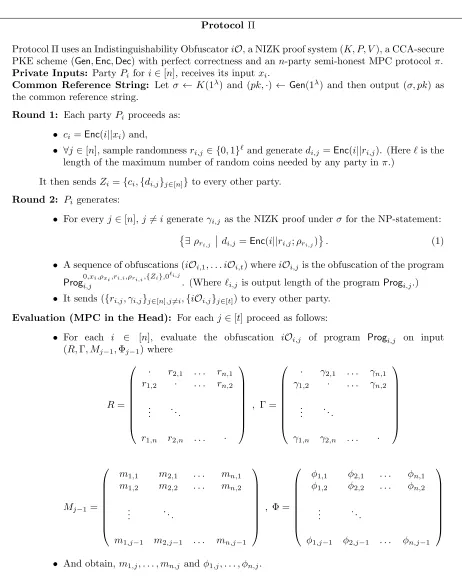
Protocol Π. We start by giving an intuitive description of the protocol. A formal description appears in Figure 1. The basic idea of our protocol is to start with an arbitrary round semi-honest protocol π and “squish” it into a two round protocol using indistinguishability obfuscation. The first round of our protocol helps set the stage for the “virtual” execution ofπ via obfuscations that all the parties provide in the second round.
The common reference string in our construction consists of a CRSσ for a NIZK Proof system and a public key pk corresponding to a CCA-secure public key encryption scheme. Next, the protocol proceeds in two rounds as follows:
Round 1: In the first round, the parties “commit” to their inputs and randomness, where the commitments are generated using the CCA-secure encryption scheme. The committed ran-domness will be used for coin-flipping and thereby obtaining unbiased random coins for all parties. Specifically, every partyPi, proceeds by encrypting its inputxi under the public key
pk. Let ci be the ciphertext. Pi also encrypts randomness ri,j for every j ∈ [n]. Let the
ciphertext encrypting ri,j be denoted bydi,j. Looking ahead the random coinsPi uses in the
execution of π will besi =⊕jrj,i. Pi broadcasts{ci,{di,j}j}to everyone.
Round 2: In the second round parties will broadcast obfuscations corresponding to the next mes-sage function of π allowing for a “virtual emulation” of the interactive protocol π. Every party Pi proceeds as follows:
• Pi reveals the random values {ri,j}j6=i∈[n] and generates proofs {γi,j}j6=i∈[n] that these are indeed the values that are encrypted in the ciphertexts{di,j}j6=i∈[n].
• Recall that the underlying protocol π is a t round protocol where each party broad-casts one message per round. Each playerPi generates t obfuscations of its next-round
function, (iOi,1, . . . , iOi,t).
In more detail, each iOi,k is an obfuscation of a function Fi,k that takes as input the
ri,j values sent by all the parties along with the proofs that they are well-formed, and
Protocol Π
Protocol Π uses an Indistinguishability ObfuscatoriO, a NIZK proof system (K, P, V), a CCA-secure PKE scheme (Gen,Enc,Dec) with perfect correctness and ann-party semi-honest MPC protocolπ. Private Inputs: PartyPi fori∈[n], receives its inputxi.
Common Reference String: Let σ←K(1λ) and (pk,·)←Gen(1λ) and then output (σ, pk) as the common reference string.
Round 1: Each partyPiproceeds as:
• ci=Enc(i||xi) and,
• ∀j∈[n],sample randomnessri,j∈ {0,1}`and generatedi,j =Enc(i||ri,j). (Here`is the length of the maximum number of random coins needed by any party inπ.)
It then sends Zi={ci,{di,j}j∈[n]}to every other party.
Round 2: Pi generates:
• For every j∈[n],j 6=igenerateγi,j as the NIZK proof underσfor the NP-statement:
∃ρri,j di,j=Enc(i||ri,j;ρri,j) . (1)
• A sequence of obfuscations (iOi,1, . . . iOi,t) whereiOi,jis the obfuscation of the program
Prog0,xi,ρxi,ri,i,ρri,i,{Zi},0
`i,j
i,j . (Where `i,j is output length of the programProgi,j.) • It sends ({ri,j, γi,j}j∈[n],j6=i,{iOi,j}j∈[t]) to every other party.
Evaluation (MPC in the Head): For eachj∈[t] proceed as follows:
• For each i ∈ [n], evaluate the obfuscation iOi,j of program Progi,j on input (R,Γ, Mj−1,Φj−1) where
R=
· r2,1 . . . rn,1
r1,2 · . . . rn,2
.. . . ..
r1,n r2,n . . . ·
, Γ =
· γ2,1 . . . γn,1
γ1,2 · . . . γn,2
.. . . ..
γ1,n γ2,n . . . ·
Mj−1=
m1,1 m2,1 . . . mn,1
m1,2 m2,2 . . . mn,2
..
. . ..
m1,j−1 m2,j−1 . . . mn,j−1
, Φ =
φ1,1 φ2,1 . . . φn,1
φ1,2 φ2,2 . . . φn,2
..
. . ..
φ1,j−1 φ2,j−1 . . . φn,j−1
• And obtain, m1,j, . . . , mn,j andφ1,j, . . . , φn,j.
Finally each party Pi outputsmi,t.
Progflagi,j,xi,ρxi,ri,i,ρri,i,{Zi},fixedOutput
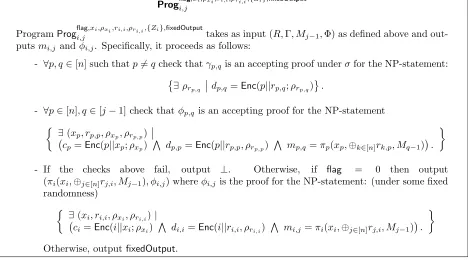
ProgramProgi,jflag,xi,ρxi,ri,i,ρri,i,{Zi},fixedOutput takes as input (R,Γ, Mj−1,Φ) as defined above and
out-puts mi,j andφi,j. Specifically, it proceeds as follows:
- ∀p, q∈[n] such thatp6=qcheck thatγp,q is an accepting proof underσfor the NP-statement:
∃ ρrp,q
dp,q =Enc(p||rp,q;ρrp,q) .
- ∀p∈[n], q∈[j−1] check that φp,q is an accepting proof for the NP-statement
∃ (xp, rp,p, ρxp, ρrp,p)
cp=Enc(p||xp;ρxp) V dp,p=Enc(p||rp,p, ρr
p,p)
V mp,q=πp(xp,⊕
k∈[n]rk,p, Mq−1).
- If the checks above fail, output ⊥. Otherwise, if flag = 0 then output (πi(xi,⊕j∈[n]rj,i, Mj−1), φi,j) whereφi,j is the proof for the NP-statement: (under some fixed
randomness)
∃ (xi, ri,i, ρxi, ρri,i)|
ci=Enc(i||xi;ρxi)
V d
i,i=Enc(i||ri,i, ρri,i)
V m
i,j=πi(xi,⊕j∈[n]rj,i, Mj−1)
.
Otherwise, outputfixedOutput.
Figure 2: Obfuscated Programs in the Protocol
generated in first round and the revealed ri,j values.) The output of the functionFi,j is
the next message ofPi in π, along with a NIZK proof that it was generated correctly.
Pi broadcasts all the values {ri,j}j6=i∈[n],{γi,j}j6=i∈[n], and {iOi,k}k∈[t].
Evaluation: After completion of the second round each party can independently “virtually” eval-uate the protocol π using the obfuscations provided by each of the parties and obtain the output.
Theorem 1. Let f be any deterministic poly-time function with n inputs and single output. Assume the existence of an Indistinguishability Obfuscator iO, a NIZK proof system (K, P, V), a CCA secure PKE scheme (Gen,Enc,Dec) with perfect correctness and ann-party semi-honest MPC protocolπ. Then the protocol Π presented in Figure 1 UC-securely realizes the ideal functionality Ff in the FCRS-hybrid model.
3.1 Correctness and Proof of Security
Correctness. The correctness of our protocol Π in Figure 1 follows from the correctness of the underlying semi-honest MPC protocol and the other primitives used. Next we will argue that all the messages sent in the protocol Π are of polynomial length and can be computed in polynomial time. It is easy to see that all the messages of round 1 are polynomially long. Again it is easy to see that the round 2 messages besides the obfuscations themselves are of polynomial length.
We will now argue that each obfuscation sent in round 2 is also polynomially long. Consider the obfuscation iOi,j, which obfuscatesProgi,j; we need to argue that this program for every i, j is
Φj−1 consist of polynomially many NIZK proofs. This program roughly proceeds by first checking that all the proofs in Γ and Φj−1 are accepting. If the proofs are accepting then Progoutputsmi,j
and φi,j.
Observe that Γ and Φj−1 are proofs of NP-statements each of which is a fixed polynomial in the description of the next message function of the protocol π. Also observe that the time taken to evaluate mi,j and φi,j is bounded a fixed polynomial. This allows us to conclude that all the
computation done byProgi,j can be bounded by a fixed polynomial.
Security. LetA be a malicious, static adversary that interacts with parties running the protocol Π from Figure 1 in theFCRS-hybrid model. We construct an ideal world adversaryS with access to the ideal functionalityFf, which simulates a real execution of Π with Asuch that no environment
Z can distinguish the ideal world experiment withS and Ff from a real execution of Π withA. We now sketch the description of the simulator and the proof of security, restricting ourselves to the stand-alone setting. The fully detailed description of our simulator is provided in Appendix B and the proof of indistinguishability provided in Appendix C. Those more formal proofs are given for the general setting of UC-security.
Our simulatorS roughly proceeds as follows:
• Common reference string: Recall that the common reference string in our construction consists of a CRS σ for a NIZK Proof system and a public key pk corresponding to a CCA secure public key encryption scheme. Our simulator uses the simulator of the NIZK proof system in order to generate the reference string σ. Note that the simulator for NIZK proof system also generates some trapdoor information that can be used to generate simulated NIZK proofs. Our simulator saves that for later use. S also generates the public key pk
along with its secret key sk, which it will later use to decrypt ciphertexts generated by the adversary.
• Round 1: Recall that in round 1, honest parties generate ciphertexts corresponding to en-cryptions of their inputs and various random coins. Our simulator just generates enen-cryptions of the zero-string on behalf of the honest parties. AlsoS uses the knowledge of the secret key
sk to extract the input and randomness that the adversarial parties encrypt.
• Round 2: Recall that in the second round the honest parties are required to “open” some of the randomness values committed to in round 1 along with obfuscations necessary for execution of π.
Sproceeds by preparing a simulated transcript of the execution ofπusing the malicious party inputs previously extracted and the output obtained from the ideal functionality, which it needs to force onto the malicious parties. S opens the randomness on behalf of honest parties such that the randomness of malicious parties becomes consistent with the simulated tran-script and generates simulated proofs for the same. The simulator generates the obfuscations on behalf of honest parties by hard-coding the messages as contained in the simulated tran-script. The obfuscations also generate proofs proving that the output was generated correctly. Our simulator hard-codes these proofs in the obfuscations as well.
made, in a sequence of hybrids we change from honest execution of the underlying semi-honest MPC protocol to a the simulated execution. We refer the reader to Appendix C for a complete proof.
3.2 Extensions
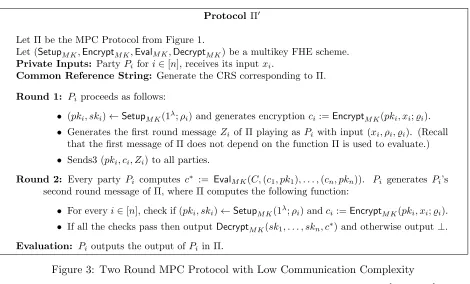
Low Communication. Our protocol Π (as described in Figure 1) can be used to UC-securely realize any functionality Ff. However the communication complexity of this protocol grows
poly-nomially in the size of the circuit evaluating function f and the security parameter λ. We would like to remove this restriction and construct a protocol Π0 whose communication complexity is independent of the the function being evaluated.
Protocol Π0
Let Π be the MPC Protocol from Figure 1.
Let (SetupM K,EncryptM K,EvalM K,DecryptM K) be a multikey FHE scheme. Private Inputs: PartyPi fori∈[n], receives its inputxi.
Common Reference String: Generate the CRS corresponding to Π.
Round 1: Pi proceeds as follows:
• (pki, ski)←SetupM K(1λ;ρi) and generates encryptionci:=Encrypt
M K(pki, xi;%i). • Generates the first round message Zi of Π playing asPi with input (xi, ρi, %i). (Recall
that the first message of Π does not depend on the function Π is used to evaluate.)
• Sends3 (pki, ci, Zi) to all parties.
Round 2: Every party Pi computes c∗ := EvalM K(C,(c1, pk1), . . . ,(cn, pkn)). Pi generates Pi’s
second round message of Π, where Π computes the following function:
• For everyi∈[n], check if (pki, ski)←SetupM K(1λ;ρi) andci:=EncryptM K(pki, xi;%i).
• If all the checks pass then output DecryptM K(sk1, . . . , skn, c∗) and otherwise output ⊥.
Evaluation: Pi outputs the output ofPi in Π.
Figure 3: Two Round MPC Protocol with Low Communication Complexity
A key ingredient of our construction ismultikey fully homomorphic encryption[LATV12]. Intu-itively, multikey FHE allows us to evaluate any circuit on ciphertexts that might be encrypted under different public keys. To guarantee semantic security, decryption requires all of the corresponding secret keys. We refer the reader to Appendix A.4 for more details.
Our protocol Π0works by invoking Π. Recall that Π proceeds in two rounds. Roughly speaking, in the first stage parties commit to their inputs, and in the second round the parties generate obfuscations that allow for “virtual” execution of sub-protocol π on the inputs committed in the first round. Our key observation here is that the function that the sub-protocol π evaluates does not have to be specified until the second round.
We will now give a sketch of our protocol Π0. Every partyPi generates a public keypki and a
secret keyski using the setup algorithm of the multikey FHE scheme. It then encrypts its input xi
under the public key pki and obtains ciphertext ci. It then sends (pki, ci) to everyone along with
the first message of Π with input the randomness used in generation ofpki and ci. This completes
encryption of f(x1, . . . xn), where f is the function that we want to compute. The second round
of protocol Π can be used to decrypt this value. A formal description of the protocol appears in Figure 3.
Theorem 2. Under the same assumptions as in Theorem 1 and assuming the semantic security of the multikey FHE scheme, the protocol Π0 presented in Figure 3 UC-securely realizes the ideal functionalityFf in theFCRS-hybrid model. Furthermore the communication complexity of protocol Π0 is polynomial in the input lengths of all parties and the security parameter. (It is independent of the size off.)
Proof. The correctness of the our protocol Π0 follows from the correctness of the protocol Π and the correctness of the multikey FHE scheme. Observe that the compactness of the multikey FHE (Appendix A.4) implies that the ciphertextc∗ evaluated in Round 2 on the description of Protocol Π (Figure 3) is independent of the size of the function f being evaluated. Also note that no other messages in the protocol depend on the function f. This allows us to conclude that the communication complexity of protocol Π0 is independent of the size of f.
We defer the formal description of our simulator and the proof of indistinguishability to Ap-pendix D.
General Functionality. Our basic MPC protocol as described in Figure 1 only considers de-terministic functionalities (Appendix A.1.5) where all the parties receive the same output. We would like to generalize it to handle randomized functionalities and individual outputs (just as in [AJW11, Appendix D]). First, the standard transformation from a randomized functionality to a deterministic one (See [Gol04, Section 7.3]) works for this case as well. In this transformation, instead of computing some randomized functiong(x1, . . . xn;r), the parties compute the
determin-istic functionf((r1, x1), . . . ,(rn, xn)) def
= g(x1, . . . , xn;⊕ni=1ri). We note that this computation does
not add any additional rounds.
Next, we move to individual outputs. Again, we use a standard transformation (See [LP09], for example). Given a function g(x1, . . . , xn)→(y1, . . . , yn), the parties can evaluate the following
function which has a single output:
f((k1, x1), . . . ,(kn;xn)) = (g1(x1, . . . , xn)⊕k1||. . .||gn(x1, . . . , xn)⊕kn)
wherea||bdenotes a concatenation ofawithb,gi indicates theith output ofg, andki is randomly
chosen by the ith party. Then, the parties can evaluate f, which is a single output functionality, instead of g. Subsequently every partyPi uses its secret input ki to recover its own output. The
only difference is that f has one additional exclusive-or gate for every circuit-output wire. Again, this transformation does not add any additional rounds of interaction.
Common Random String vs Common Reference String. Our basic MPC protocol as described in Figure 1 uses a common reference string. We can adapt the construction to work in the setting of common random string (Appendix A.1.4) by assuming the existence of a CCA secure public-key encryption scheme (Appendix A.3) with perfect correctness and pseudorandom public keys.
Fairness. We note that the same protocol Π can be used to securely and fairly UC-realize the generalized functionality in the setting of honest majority, by using a fair semi-honest MPC protocol forπ.
4
Applications
In this section we will discuss additional applications of our results.
4.1 Secure Computation on the Web
In a recent work, Halevi, Lindell and Pinkas [HLP11] studied of secure computation in a client-server model where each client connects to the client-server once and interacts with it, without any other client necessarily being connected at the same time. They show that, in such a setting, only limited security is achievable. However, among other results, they also point out that if we can get each of the players to connect twice to the server (rather than once), then their protocols can be used for achieving the standard notion of privacy.
One key aspect of the two-pass protocols of Halevi et. al [HLP11] is that there is a preset order in which the clients must connect to the server. Our protocol Π from Section 3 directly improves on the results in this setting by achieving the same two-pass protocol, but without such a preset order. Also, we achieve this result in the common reference/random string model, while the original protocols of Halevi et. al [HLP11] required a public key setup.
4.2 Black-Box Obfuscation for More Functions
In this subsection, we generalize the class of circuits that can be obfuscated according to the strong (virtual black box (VBB) notion of obfuscation. This application does not build directly on our protocol for two-round MPC. Rather, the main ideas here are related to ideas (particularly within the security proof) that arose in our MPC construction.
Our Result. Let C be a class of circuits that we believe to be VBB obfuscatable, e.g., point functions or conjunctions. Roughly speaking, assuming indistinguishability obfuscation, we show that a circuitCcan be VBB obfuscated if there exists a circuitC0such thatC0∈ CandC(x) =C0(x) for every input x. The non-triviality of the result lies in the fact that it might not be possible to efficiently recoverC0 from C. We refer the reader to Appendix E for a formal statement and proof.
f that allows an arbitrary Player 3, if he knows x, to evaluate f on input x alone (and nothing other thanx). Our construction above enables such obfuscation. We stress that the challenge here is that Player 2 is not aware of the valuex, which is in fact computationally hidden from it.
References
[AJLA+12] Gilad Asharov, Abhishek Jain, Adriana L´opez-Alt, Eran Tromer, Vinod Vaikun-tanathan, and Daniel Wichs. Multiparty computation with low communication, com-putation and interaction via threshold FHE. In Advances in Cryptology - EURO-CRYPT 2012, volume 7237 of Lecture Notes in Computer Science, pages 483–501, 2012.
[AJW11] Gilad Asharov, Abhishek Jain, and Daniel Wichs. Multiparty computation with low communication, computation and interaction via threshold fhe. Cryptology ePrint Archive, Report 2011/613, 2011. http://eprint.iacr.org/.
[BCL+05] Boaz Barak, Ran Canetti, Yehuda Lindell, Rafael Pass, and Tal Rabin. Secure com-putation without authentication. In Victor Shoup, editor, Advances in Cryptology – CRYPTO 2005, volume 3621 of Lecture Notes in Computer Science, pages 361–377, Santa Barbara, CA, USA, August 14–18, 2005. Springer, Berlin, Germany.
[BFM88] Manuel Blum, Paul Feldman, and Silvio Micali. Non-interactive zero-knowledge and its applications. In STOC, pages 103–112, 1988.
[BGI+01] Boaz Barak, Oded Goldreich, Russell Impagliazzo, Steven Rudich, Amit Sahai, Salil P. Vadhan, and Ke Yang. On the (im)possibility of obfuscating programs. In Joe Kil-ian, editor, Advances in Cryptology – CRYPTO 2001, volume 2139 of Lecture Notes in Computer Science, pages 1–18, Santa Barbara, CA, USA, August 19–23, 2001. Springer, Berlin, Germany.
[BGI+12] Boaz Barak, Oded Goldreich, Russell Impagliazzo, Steven Rudich, Amit Sahai, Salil P. Vadhan, and Ke Yang. On the (im)possibility of obfuscating programs. J. ACM, 59(2):6, 2012.
[BGV12] Zvika Brakerski, Craig Gentry, and Vinod Vaikuntanathan. (leveled) fully homomor-phic encryption without bootstrapping. InITCS, 2012.
[BV11] Zvika Brakerski and Vinod Vaikuntanathan. Efficient fully homomorphic encryption from (standard) lwe. InFOCS, pages 97–106, 2011.
[Can01] Ran Canetti. Universally composable security: A new paradigm for cryptographic protocols. In 42nd Annual Symposium on Foundations of Computer Science, pages 136–145, Las Vegas, Nevada, USA, October 14–17, 2001. IEEE Computer Society Press.
[Can04] Ran Canetti. Universally composable signature, certification, and authentication. In
[CF01] Ran Canetti and Marc Fischlin. Universally composable commitments. In Joe Kil-ian, editor, Advances in Cryptology – CRYPTO 2001, volume 2139 of Lecture Notes in Computer Science, pages 19–40, Santa Barbara, CA, USA, August 19–23, 2001. Springer, Berlin, Germany.
[CLOS02] Ran Canetti, Yehuda Lindell, Rafail Ostrovsky, and Amit Sahai. Universally compos-able two-party and multi-party secure computation. In34th Annual ACM Symposium on Theory of Computing, pages 494–503, Montr´eal, Qu´ebec, Canada, May 19–21, 2002. ACM Press.
[CLP10] Ran Canetti, Huijia Lin, and Rafael Pass. Adaptive hardness and composable security in the plain model from standard assumptions. In51st Annual Symposium on Founda-tions of Computer Science, pages 541–550, Las Vegas, Nevada, USA, October 23–26, 2010. IEEE Computer Society Press.
[DDN91] Danny Dolev, Cynthia Dwork, and Moni Naor. Non-malleable cryptography. In
23rd Annual ACM Symposium on Theory of Computing, pages 542–552, New Orleans, Louisiana, USA, May 6–8, 1991. ACM Press.
[DH76] Whitfield Diffie and Martin E. Hellman. New directions in cryptography. IEEE Trans-actions on Information Theory, 22(6):644–654, 1976.
[FLS99] Uriel Feige, Dror Lapidot, and Adi Shamir. Multiple non-interactive zero knowledge proofs under general assumptions. SIAM Journal of Computing, 29(1):1–28, 1999.
[Gen09] Craig Gentry. A fully homomorphic encryption scheme. PhD thesis, Stanford Univer-sity, 2009. crypto.stanford.edu/craig.
[GGH13a] Sanjam Garg, Craig Gentry, and Shai Halevi. Candidate multilinear maps from ideal lattices. In EUROCRYPT, 2013.
[GGH+13b] Sanjam Garg, Craig Gentry, Shai Halevi, Mariana Raykova, Amit Sahai, and Brent Waters. Candidate indistinguishability obfuscation and functional encryption for all circuits. In FOCS’13, to appear. IEEE, 2013. Available from http://eprint.iacr. org/2013/451.
[GGSW13] Sanjam Garg, Craig Gentry, Amit Sahai, and Brent Waters. Witness encryption and its applications. In STOC, 2013.
[GM84] Shafi Goldwasser and Silvio Micali. Probabilistic encryption. Journal of Computer and System Sciences, 28(2):270–299, 1984.
[GMR89] Shafi Goldwasser, Silvio Micali, and Charles Rackoff. The knowledge complexity of interactive proof systems. SIAM Journal on Computing, 18(1):186–208, 1989.
[Gol01] Oded Goldreich. Foundations of Cryptography: Basic Tools, volume 1. Cambridge University Press, Cambridge, UK, 2001.
[Gol04] Oded Goldreich. Foundations of Cryptography: Basic Applications, volume 2. Cam-bridge University Press, CamCam-bridge, UK, 2004.
[GOS06] Jens Groth, Rafail Ostrovsky, and Amit Sahai. Perfect non-interactive zero knowledge for np. In Proceedings of Eurocrypt 2006, volume 4004 of LNCS, pages 339–358. Springer, 2006.
[GSW13] Craig Gentry, Amit Sahai, and Brent Waters. Homomorphic encryption from learn-ing with errors: Conceptually-simpler, asymptotically-faster, attribute-based. In Ran Canetti and Juan A. Garay, editors, CRYPTO (1), volume 8042 ofLecture Notes in Computer Science, pages 75–92. Springer, 2013.
[HLP11] Shai Halevi, Yehuda Lindell, and Benny Pinkas. Secure computation on the web: Computing without simultaneous interaction. In Phillip Rogaway, editor, CRYPTO, volume 6841 ofLecture Notes in Computer Science, pages 132–150. Springer, 2011.
[IKO05] Yuval Ishai, Eyal Kushilevitz, and Rafail Ostrovsky. Sufficient conditions for collision-resistant hashing. In Joe Kilian, editor, TCC, volume 3378 of Lecture Notes in Com-puter Science, pages 445–456. Springer, 2005.
[LATV12] Adriana L´opez-Alt, Eran Tromer, and Vinod Vaikuntanathan. On-the-fly multiparty computation on the cloud via multikey fully homomorphic encryption. InSTOC, pages 1219–1234, 2012.
[LP09] Yehuda Lindell and Benny Pinkas. A proof of security of Yao’s protocol for two-party computation. Journal of Cryptology, 22(2):161–188, April 2009.
[MSS11] Steven Myers, Mona Sergi, and Abhi Shelat. Threshold fully homomorphic encryption and secure computation. IACR Cryptology ePrint Archive, 2011:454, 2011.
[NY90] Moni Naor and Moti Yung. Public-key cryptosystems provably secure against cho-sen ciphertext attacks. In 22nd Annual ACM Symposium on Theory of Computing, Baltimore, Maryland, USA, May 14–16, 1990. ACM Press.
[RAD78] Ron Rivest, Leonard Adleman, and Michael L. Dertouzos. On data banks and privacy homomorphisms. In Foundations of Secure Computation, pages 169–180, 1978.
[RS92] Charles Rackoff and Daniel R. Simon. Non-interactive zero-knowledge proof of knowl-edge and chosen ciphertext attack. In Joan Feigenbaum, editor, Advances in Cryptol-ogy – CRYPTO’91, volume 576 ofLecture Notes in Computer Science, pages 433–444, Santa Barbara, CA, USA, August 11–15, 1992. Springer, Berlin, Germany.
[RSA78] Ronald L. Rivest, Adi Shamir, and Leonard M. Adleman. A method for obtaining digital signature and public-key cryptosystems. Communications of the Association for Computing Machinery, 21(2):120–126, 1978.
[vDGHV10] Marten van Dijk, Craig Gentry, Shai Halevi, and Vinod Vaikuntanathan. Fully ho-momorphic encryption over the integers. In EUROCRYPT, pages 24–43, 2010.
[Yao82] Andrew C. Yao. Protocols for secure computations. In 23rd Annual Symposium on Foundations of Computer Science, pages 160–164, Chicago, Illinois, November 3–5, 1982. IEEE Computer Society Press.
A
Additional Background
A.1 UC Security
In this section we briefly review UC security. For full details see [Can01]. A large part of this introduction has been taken verbatim from [CLP10].
A.1.1 The basic model of execution
Following [GMR89, Gol01], a protocol is represented as an interactive Turing machine (ITM), which represents the program to be run within each participant. Specifically, an ITM has three tapes that can be written to by other ITMs: theinputandsubroutine output tapes model the inputs from and the outputs to other programs running within the same “entity” (say, the same physical computer), and the incoming communicationtapes and outgoing communicationtapes model messages received from and to be sent to the network. It also has an identity tape that cannot be written to by the ITM itself. The identity tape contains the program of the ITM (in some standard encoding) plus additional identifying information specified below. Adversarial entities are also modeled as ITMs.
We distinguish between ITMs (which represent static objects, or programs) and instances of ITMs, or ITIs, that represent interacting processes in a running system. Specifically, an ITI is an ITM along with an identifer that distinguishes it from other ITIs in the same system. The identifier consists of two parts: A session-identifier (SID) which identifies which protocol instance the ITM belongs to, and aparty identifier(PID) that distinguishes among the parties in a protocol instance. Typically the PID is also used to associate ITIs with “parties”, or clusters, that represent some administrative domains or physical computers.
The model of computation consists of a number of ITIs that can write on each other’s tapes in certain ways (specified in the model). The pair (SID,PID) is a unique identifier of the ITI in the system.
With one exception (discussed within) we assume that all ITMs are probabilistic polynomial time (PPT). An ITM is PPT if there exists a constant c > 0 such that, at any point during its run, the overall number of steps taken by M is at most nc, where n is the overall number of bits written on theinput tape ofM in this run. (In fact, in order to guarantee that the overall protocol execution process is bounded by a polynomial, we define n as the total number of bits written to the input tape of M,minus the overall number of bits written by M to input tapes of other ITMs.; see [Can01].)
A.1.2 Security of protocols
do not communicate with each other. Instead they have access to an “ideal functionality,” which is essentially an incorruptible “trusted party” that is programmed to capture the desired functionality of the task at hand. A protocol is said to securely realize an ideal functionality if the process of running the protocol amounts to “emulating” the ideal process for that ideal functionality. Below we overview the model of protocol execution (called thereal-life model), the ideal process, and the notion of protocol emulation.
The model for protocol execution. The model of computation consists of the parties running an instance of a protocol Π, anadversaryAthat controls the communication among the parties, and an
environment Z that controls the inputs to the parties and sees their outputs. We assume that all parties have a security parametern∈N. (We remark that this is done merely for convenience and is not essential for the model to make sense). The execution consists of a sequence of activations, where in each activation a single participant (eitherZ,A, or some other ITM) is activated, and may write on a tape of at mostone other participant, subject to the rules below. Once the activation of a participant is complete (i.e., once it enters a special waiting state), the participant whose tape was written on is activated next. (If no such party exists then the environment is activated next.) The environment is given an external input z and is the first to be activated. In its first activation, the environment invokes the adversary A, providing it with some arbitrary input. In the context of UC security, the environment can from now on invoke (namely, provide input to) only ITMs that consist of a single instance of protocol Π. That is, all the ITMs invoked by the environment must have the same SID and the code of Π.
Once the adversary is activated, it may read its own tapes and the outgoing communication tapes of all parties. It may either deliver a message to some party by writing this message on the party’s incoming communication tape or report information to Z by writing this information on the subroutine output tape of Z. For simplicity of exposition, in the rest of this paper we assume authenticated communication; that is, the adversary may deliver only messages that were actually sent. (This is however not essential as shown in [Can04, BCL+05].)
Once a protocol party (i.e., an ITI running Π) is activated, either due to an input given by the environment or due to a message delivered by the adversary, it follows its code and possibly writes a local output on the subroutine output tape of the environment, or an outgoing message on the adversary’s incoming communication tape.
The protocol execution ends when the environment halts. The output of the protocol execution is the output of the environment. Without loss of generality we assume that this output consists of only a single bit.
Let EXECπ,A,Z(n, z, r) denote the output of the environmentZ when interacting with parties running protocol Π on security parameter n, input z and random input r = rZ, rA, r1, r2, . . . as described above (zand rZ forZ;rAforA,ri for partyPi). LetEXECπ,A,Z(n, z) random variable describing EXECπ,A,Z(n, z, r) wherer is uniformly chosen. LetEXECπ,A,Z denote the ensemble
{EXECπ,A,Z(n, z)}n∈N,z∈{0,1}∗.
ITIF. The SID ofF is the same as the SID of the ITIs running the ideal protocol. (the PID ofF is null.)) In addition,F can interact with the adversary according to its code. WheneverF outputs a value to a party, the party immediately copies this value to its own output tape. We call the parties in the ideal protocol dummy parties. Let Π(F) denote the ideal protocol for functionality F.
Securely realizing an ideal functionality. We say that a protocol Π emulates protocol φ
if for any adversary A there exists an adversary S such that no environment Z, on any input, can tell with non-negligible probability whether it is interacting with A and parties running Π, or it is interacting with S and parties running φ. This means that, from the point of view of the environment, running protocol Π is ‘just as good’ as interacting with φ. We say that Π securely realizes an ideal functionality F if it emulates the ideal protocol Π(F). More precise definitions follow. A distribution ensemble is calledbinary if it consists of distributions over{0,1}.
Definition 4. Let Π and φ be protocols. We say that Π UC-emulates φ if for any adversary A there exists an adversaryS such that for any environmentZ that obeys the rules of interaction for UC security we haveEXECφ,S,Z ≈EXECπ,A,Z.
Definition 5. LetF be an ideal functionality and let Π be a protocol. We say that ΠUC-realizes F if Π UC-emulates the ideal process Π(F).
A.1.3 Hybrid protocols
Hybrid protocols are protocols where, in addition to communicating as usual as in the standard model of execution, the parties also have access to (multiple copies of ) an ideal functionality. Hybrid protocols represent protocols that use idealizations of underlying primitives, or alternatively make
trust assumptions on the underlying network. They are also instrumental in stating the universal composition theorem. Specifically, in anF-hybrid protocol(i.e., in a hybrid protocol with access to an ideal functionality F), the parties may give inputs to and receive outputs from an unbounded number of copies ofF.
The communication between the parties and each one of the copies of F mimics the ideal process. That is, giving input to a copy ofF is done by writing the input value on the input tape of that copy. Similarly, each copy ofF writes the output values to the subroutine output tape of the corresponding party. It is stressed that the adversary does not see the interaction between the copies of F and the honest parties.
The copies ofFare differentiated using their SIDs. All inputs to each copy and all outputs from each copy carry the corresponding SID. The model does not specify how the SIDs are generated, nor does it specify how parties “agree” on the SID of a certain protocol copy that is to be run by them. These tasks are left to the protocol. This convention seems to simplify formulating ideal functionalities, and designing protocols that securely realize them, by freeing the functionality from the need to choose the SIDs and guarantee their uniqueness. In addition, it seems to reflect common practice of protocol design in existing networks.
The definition of a protocol securely realizing an ideal functionality is extended to hybrid pro-tocols in the natural way.
that securely realizes F. The composed protocol ρΠ is constructed by modifying the code of each ITM inρso that the first message sent to each copy ofFis replaced with an invocation of a new copy of Π with fresh random input, with the same SID, and with the contents of that message as input. Each subsequent message to that copy of F is replaced with an activation of the corresponding copy of Π, with the contents of that message given to Π as new input. Each output value generated by a copy of Π is treated as a message received from the corresponding copy of F. The copy of Π will start sending and receiving messages as specified in its code. Notice that if Π is aG-hybrid protocol (i.e.,ρ uses ideal evaluation calls to some functionality G) then so isρΠ.
The universal composition theorem. Let F be an ideal functionality. In its general form, the composition theorem basically says that if Π is a protocol that UC-realizesF then, for anyF -hybrid protocolρ, we have that an execution of the composed protocolρΠ“emulates” an execution of protocol ρ. That is, for any adversary A there exists a simulator S such that no environment machineZ can tell with non-negligible probability whether it is interacting withAand protocolρΠ
or withS and protocolρ, in a UC interaction. As a corollary, we get that if protocolρ UC-realizes F, then so does protocol ρΠ.1
Theorem 3(Universal Composition [Can01].). LetFbe an ideal functionality. Letρbe aF-hybrid protocol, and let Π be a protocol that UC-realizesF. Then protocolρΠ UC-emulatesρ.
An immediate corollary of this theorem is that if the protocolρ UC-realizes some functionality G, then so doesρΠ.
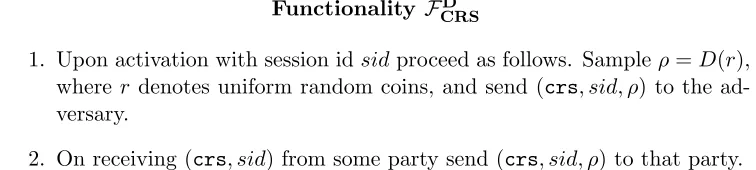
A.1.4 The Common Reference/Random String Model
In the common reference string (CRS) model [CF01, CLOS02], all parties in the system obtain from a trusted party a reference string, which is sampled according to a pre-specified distribution
D. The reference string is referred to as the CRS. In the UC framework, this is modeled by an ideal functionalityFD
CRS that samples a string ρ from a pre-specified distributionD and setsρ as
the CRS.FD
CRS is described in Figure 4.
Functionality FD CRS
1. Upon activation with session idsidproceed as follows. Sampleρ=D(r), where r denotes uniform random coins, and send (crs, sid, ρ) to the ad-versary.
2. On receiving (crs, sid) from some party send (crs, sid, ρ) to that party.
Figure 4: The Common Reference String Functionality.
When the distribution DinFD
CRS is sent to be the uniform distribution (on a string of
appro-priate length) then we obtain the common random string model.
1The universal composition theorem in [Can01] applies only to “subroutine respecting protocols”, namely protocols
A.1.5 General Functionality
We consider the general-UC functionality F, which securely evaluates any polynomial-time (pos-sibly randomize) function f : ({0,1}`in)n → ({0,1}`out)n. The functionality F
f is parameterized
with a function f and is described in Figure 5. In this paper we will only be concerned with the
static corruption model.
Functionality Ff
Ff parameterized by an (possibly randomized)n-ary functionf, running with
parties P = {P1, . . . Pn} (of which some may be corrupted) and an adversary
S, proceeds as follows:
1. Each party Pi (and S on behalf of Pi if Pi is corrupted) sends
(input,sid,P, Pi, xi) to the functionality.
2. Upon receiving the inputs from all parties, evaluate (y1, . . . yn) ←
f(x1, . . . , xn). For every Pi that is corrupted send adversaryS the
mes-sage (output,sid,P, Pi, yi).
3. On receiving (generateOutput,sid,P, Pi) from S the ideal functionality
outputs (output,sid,P, Pi, yi) to Pi. (And ignores the message if inputs
from all parties inP have not been received.)
Figure 5: General Functionality.
Our protocol in Figure 1 (also Theorem 1) is for UC-securely realizing general functionality Ff when the function f is restricted to be any deterministic poly-time function withn inputs and single output. This functionality has been formally defined in Figure 6.
As explained in Section 3 the same protocol can be used to obtain a protocol that UC-securely realizes the general functionality Ff for any functionf.
Fairness. Our default notion of UC-security, as described above, is “security-with abort” meaning that the ideal adversary (simulator) can abort the computation and cause the functionality to not give output to honest parties. In addition, we say that a protocol π securely and fairly realizes a functionality F ifS does not get the ability to abort. Meaning the functionality always sends the outputs to the honest parties.
A.2 Non-Interactive Zero-Knowledge Proofs
Let R be an efficiently computable binary relation. For pairs (x, w) ∈R we call x the statement and wthe witness. Let Lbe the language consisting of statements in R.
Functionality Ff
Ff parameterized by an n-ary deterministic single output functionf, running with parties P ={P1, . . . Pn} (of which some may be corrupted) and an
adver-saryS, proceeds as follows:
1. Each party Pi (and S on behalf of Pi if Pi is corrupted) sends
(input,sid,P, Pi, xi) to the functionality.
2. Upon receiving the inputs from all parties, evaluate y ← f(x1, . . . , xn).
Send adversaryS the message (output,sid,P, y).
3. On receiving (generateOutput,sid,P, Pi) from S the ideal functionality
outputs (output,sid,P, y) to Pi. (And ignores the message if inputs from
all parties in P have not been received.)
Figure 6: General Functionality for Deterministic Single Output Functionalities.
outputs 1 if the proof is acceptable and 0 if rejecting the proof. We call (K, P, V) a non-interactive proof system forR if it has the completeness and statistical-soundness properties described below.
Perfect completeness. A proof system is complete if an honest prover with a valid witness can convince an honest verifier. Formally we have
Prhσ←K(1λ) :∃(x, π) :x /∈L:V(σ, x, π) = 1i= 1.
Statistical soundness. A proof system is sound if it is infeasible to convince an honest verifier when the statement is false. For all (even unbounded) adversariesA we have
Prhσ ←K(1λ); (x, π)← A(σ) :V(σ, x, π) = 1 :x6∈Li=negl(λ).
Computational zero-knowledge [FLS99]. A proof system is computational zero-knowledge
if the proofs do not reveal any information about the witnesses to a bounded adversary. We say a non-interactive proof (K, P, V) is computational zero-knowledge if there exists a polynomial time simulator S = (S1, S2), where S1 returns a simulated common reference string σ together with a simulation trapdoor τ that enables S2 to simulate proofs without access to the witness. For all non-uniform polynomial time adversariesAwe have for all x∈L
Prhσ←K(1λ);π←P(σ, x, w) :A(x, σ, π) = 1i≈Prh(σ, τ)←S1(1λ);π←S2(σ, τ, x) :A(x, σ, π) = 1
i .
A.3 CCA secure encryption
c=Enc(pk, m) for any messagem and a valid public key pk and (iii) Dec is the deterministic de-cryption algorithm such thatDec(sk, c) that outputs a message or{⊥}. All algorithms additionally take (implicitly) as input the security parameter λ. We sometimes need to make the randomness used byEnc explicit: In these cases, we writeEnc(pk, m;r) to highlight the fact that random coins
r are used to encrypt the message m.
Perfect Correctness. We say that the encryption scheme has perfect correctness if for over-whelming fraction of the randomness used by the key generation algorithm, all all messages we have Pr[Dec(sk,Enc(pk, m)) =m] = 1.
CCA Security. The CCA security [RS92, NY90, DDN91] of the (Gen,Enc,Dec) is defined via the following security game between a challenger and an adversary A:
1. The challenger generates (pk, sk)←Gen(1λ) and b← {0,1}, and gives pk toA.
2. The adversary Aask decryption queries c, which are answered with the messageDec(sk, c).
3. The adversaryAinputs (m0, m1) with|m0|=|m1|to the challenger, and receives a challenge ciphertext c∗←Enc(pk, mb).
4. the adversary A asks further decryption queries c 6= c∗, which are answered with message Dec(sk, c).
5. The adversary Aoutputs a bit b0, and wins the game if b0 =b.
We say that a PKE scheme is CCA secure if for all (non-uniform) probabilistic polynomial time adversaries Awe have that the probability Pr[b0 =b]− 12
is negligible.
A.4 Multikey Fully Homomorphic Encryption
In this section, we define multikey fully homomorphic encryption (taken verbatim from [LATV12]). However here we will present a special case of their primitive. This simple primitive suffices for our purposes.
Intuitively, multikey FHE allows us to evaluate any circuit on ciphertexts that might be en-crypted under different public keys. To guarantee semantic security, decryption requires all of the corresponding secret keys.
Letnbe the number of distinct keys in the system. We let all algorithms depend polynomially on n. This is similar to the definition of “leveled” FHE from [BGV12]. However, we note that in this definition, the algorithms depend on n but are independent of the depth of circuits that the scheme can evaluate. Thus, we consider schemes that are “leveled” with respect to the number of keysn, but fully homomorphic (“non-leveled”) with respect to the circuits that are evaluated. We now define multikey FHE as follows, for arbitrary circuits.
Definition 6 (Multikey Homomorphic Encryption). (SetupM K,EncryptM K,EvalM K,DecryptM K)
is a multikey homomorphic encryption scheme if it has the following properties:
• (pk, sk) ← SetupM K(1λ), for a security parameter λ, outputs a public key pk, a secret key
• c←EncryptM K(pk, m), given a public key pk and messagem, outputs a ciphertextc.
• c∗ := EvalM K(C,(c1, pk1), . . . ,(cn, pkn)), given a (description of) a boolean circuit C along
with n tuples (ci, pki), each consisting of a ciphertext ci and a public key pki, outputs a
ciphertext c∗.
• m0 := DecryptM K(sk1, . . . skn, c), givenn secret keys, and a ciphertext c outputs a message
m0.
We require absence of decryption failures and compactness of ciphertexts. Formally: for ev-ery circuit C, all sequences of n key tuples {(pkj, skj)}j∈[n] each of which is in the support of SetupM K(1λ), and all plaintexts (m1, . . . , mt) and ciphertexts (c1, . . . , ct) such that ci is in the
support ofEncryptM K(pki, mi),EvalM K satisfies the following properties:
Correctness: Let c∗ := EvalM K(C,(c1, pk1), . . . ,(cn, pkn)). Then DecryptM K(sk1, . . . , skn, c∗) =
C(m1, . . . , mn).
Compactness: Let c∗ := EvalM K(C,(c1, pk1), . . . ,(cn, pkn)). There exists a polynomial P such
that |c∗| ≤ P(λ, n). In other words, the size of c is independent of |C|. Note, however, that we allow the evaluated ciphertext to depend on the number of keys,n.
Semantic security of a multikey FHE follows directly from the semantic security of the under-lying encryption scheme.
B
Description of our Simulator
Let A be a malicious, static adversary that interacts with parties running the protocol Π from Figure 1 in the FCRS-hybrid model. We construct an ideal world adversary S with access to the ideal functionality Ff, which simulates a real execution of Π withA such that no environment Z
can distinguish the ideal world experiment with S and Ff from a real execution of Π withA.
Recall that S interacts with the ideal functionalityFf and with the environmentZ. The ideal adversary S starts by invoking a copy of A and running a simulated interaction of A with the environmentZ and the parties running the protocol. Our simulatorS proceeds as follows:
Simulated CRS: The common reference string is chosen by S in the following manner (recall thatS chooses the CRS for the simulatedA as we are in the FCRS-hybrid model):
1. S generates (σ, τ) ← S1(1λ), the simulated common reference string for the NIZK proof system (K, P, V) with simulator S= (S1, S2).
2. S runs the setup algorithm Gen(1λ) of the CCA secure encryption scheme and obtains a public key pkand a secret key sk.
S sets the common reference string to equal (σ, pk) and locally stores (τ, sk). (The secret keysk
Simulating the communication with Z: Every input value thatS receives fromZ is written on A’s input tape. Similarly, every output value written by A on its own output tape is directly copied to the output tape ofS.
Simulating actual protocol messages in Π: Note that there might be multiple sessions ex-ecuting concurrently. Let sid be the session identifier for one specific session. We will specify the simulation strategy corresponding to this specific session. The simulator strategy for all other ses-sions will be the same. Let P ={P1, . . . , Pn} be the set of parties participating in the execution of
Π corresponding to the session identified by the session identifier sid. Also let PA ⊆ P be the set of parties corrupted by the adversaryA. (Recall that we are in the setting with static corruption.) In the subsequent exposition we will assume that at least one party is honest. If no party is honest then the simulator does not need to do anything else.
Round 1 MessagesS → A: In the first roundSmust generate messages on behalf of the honest parties, i.e. parties in the setP\PA. For each partyPi∈ P\PA our simulator proceeds as:
1. ci =Enc(i||0`in) and, (recall that `in is the length of inputs of all parties)
2. ∀j∈[n],and generatedi,j =Enc(i||0`). (Recall that`is the length of the maximum number
of random coins needed by any party in π.)
It then sends Zi ={ci,{di,j}j∈[n]}toA on behalf of partyPi.
Round 1 Messages A → S: Also in the first round the adversaryA generates the messages on behalf of corrupted parties inPA. For each party Pi ∈ PA our simulator proceeds as:
1. Let Zi = {ci,{di,j}j∈[n]} be the message that A sends on behalf of Pi. Our simulator S
decrypts the ciphertexts using the secret key sk. In particular S sets x0i = Dec(sk, ci) and
ri,j0 =Dec(sk, di,j). Obtain xi ∈ {0,1}`in such thatx0i =i||xi. Ifx0i is not of this form the set
xi =⊥. Similarly obtain ri,j from ri,j0 for every j setting the value to ⊥in case it is not of
the right format.
2. S sends (input,sid,P, Pi, xi) to Ff on behalf of the corrupted party Pi. It saves the values
{ri,j}j for later use.
Round 2 Messages S → A: In the second round S must generate messages on behalf of the honest parties, i.e. parties in the setP\PA. S proceeds as follows:
1. S obtains the output (output,sid,P, y) from the ideal functionality Ff and now it needs to force this output onto the adversaryA.
2. In order to force the output, the simulatorSexecutes the simulatorSπand obtains a simulated
transcript. The simulated transcript specifies the random coins of all the parties inPA and the protocol messages. Let si denote the random coins of party Pi ∈ PA and let mi,j for
i∈[n] andj ∈[t] denote the protocol messages. (Semi-honest security of protocolπ implies the existence of such a simulator.)
3. For eachPj ∈ PAsampleri,j randomly in{0,1}`for eachPi ∈ P\PAsubject to the constraint
that⊕n
4. For eachPi∈ P\PA,S proceeds as follows:
(a) For every j ∈ [n], j 6= i generate γi,j as a simulated NIZK proof under σ for the
NP-statement:
∃ρri,j
di,j =Enc(i||ri,j;ρri,j) .
(b) A sequence of obfuscations (iOi,1, . . . iOi,t) whereiOi,j is the obfuscation of the program
Progi,j1,xi,ρxi,ri,i,ρri,i,{Zi},fixedOutput, wherefixedOutputis the value (mi,j, φi,j) such thatφi,j
is the simulated proof that mi,j was generated correctly. (Recall that the flag has been
set to 1 and this program on accepting inputs always outputs the value fixedOutput.)
(c) It sends ({ri,j, γi,j}j∈[n],j6=i,{iOi,j}j∈[t]) to Aon behalf of Pi.
Round 2 Messages A → S: Also in the second round the adversary A generates the messages on behalf of corrupted partiesPA. For each partyPi ∈ P\PAthat has obtained “correctly formed”
second round messages from all parties in PA, our simulator sends (generateOutput,sid,P, P
i) to
the ideal functionality.
This completes the description of the simulator.
C
Proof of Security
In this section, via a sequence of hybrids, we will prove that no environmentZ can distinguish the ideal world experiment with S and Ff (as defined above) from a real execution of Π withA. We will start with the real world execution in which the adversaryAinteracts directly with the honest parties holding their inputs and step-by-step make changes till we finally reach the simulator as described in Appendix B. At each step will argue that the environment cannot distinguish the change except with negligible probability.
- H1: This hybrid corresponds to theZinteracting with the real world adversaryAand honest parties that hold their private inputs.
We can restate the above experiment with the simulator as follows. We replace the real world adversary A with the ideal world adversary S. The ideal adversary S starts by invoking a copy of Aand running a simulated interaction of A with the environment Z and the honest parties. S forwards the messages that Agenerates for it environment directly to Z and vice versa (as explained in the description of the simulator S). In this hybrid the simulator S holds the private inputs of the honest parties and generates messages on their behalf using the honest party strategies as specified by Π.
- H2: In this hybrid we change how the simulator generates the CRS. In particular we will change howS generates the public keypkof the CCA secure encryption scheme. We will not change the way CRS for the NIZK is generated.