Effects of social and epistemic
cooperation scripts on collaborative
knowledge construction
Armin Weinberger
Effects of social and epistemic
cooperation scripts on collaborative
knowledge construction
Armin Weinberger
Dissertation
an der Fakultät für Psychologie und Pädagogik
der Ludwig-Maximilians-Universität
München
vorgelegt von
Armin Weinberger
Diese Arbeit entstand im Rahmen des DFG-Projektes
Zusammenfassung ... IX
1 CHANGING LEARNING THROUGH CSCL... 1
2 PROCESSES OF COLLABORATIVE KNOWLEDGE
CONSTRUCTION IN CSCL ENVIRONMENTS... 8
2.1 Socio-Cognitive Theories of Collaborative Knowledge
Construction ... 10
2.1.1 Socio-constructivist theories and social processes ... 10
2.1.2 Socio-cultural theories and cognitive processes ... 19
2.2 Relations between Processes and Outcomes of Collaborative Knowledge Construction ... 23
2.3 Context Factors Influencing Processes of Collaborative
Knowledge Construction ... 25
2.4 CSCL Technology and its Influence on Collaborative
Knowledge Construction ... 30
2.4.1 Technology for CSCL environments: Text-based CMC in web-based discussion boards... 30
2.4.2 Influence of CMC on social and cognitive processes of
collaborative knowledge construction ... 32
2.5 Conclusions and Limitations: Socio-Cognitive Processes in
3.1 Types and Qualities of Knowledge ... 39
3.1.1 Types of knowledge... 39
3.1.2 Qualities of knowledge ... 42
3.2 Knowledge as Co-Construct and as Individual Acquisition ... 44
3.2.1 Knowledge as co-construct... 45
3.2.2 Individual acquisition of knowledge ... 45
3.3 Focused and Multi-Perspective Applicable Knowledge ... 46
3.3.1 Applicability of knowledge ... 46
3.3.2 Perspectivity of knowledge... 47
3.4 Conclusions and Limitations: Dimensions of Applicable Knowledge as Outcomes of Collaborative Knowledge Construction ... 48
4 INSTRUCTIONAL SUPPORT FOR COLLABORATIVE KNOWLEDGE CONSTRUCTION: COOPERATION SCRIPTS FOR CSCL ENVIRONMENTS ... 50
4.1 Facilitating CSCL by Media Choice and Interface Design ... 52
4.1.1 Media choice approaches... 52
4.1.2 Interface design approaches... 54
4.2 Functions of Media for Collaborative Knowledge Construction ... 55
4.3 Script Approaches ... 59
4.3.1 Scripted cooperation ... 61
4.3.2 Guided peer questioning ... 65
4.4 Blending Scripted Cooperation and Guided Peer Questioning: Prompt-Based Cooperation Scripts ... 67
4.5 Implementing Prompt-Based Cooperation Scripts in CSCL
Environments... 69
4.6 Conclusions and Limitations: Prompt-Based Cooperation
Scripts Realized in CSCL Environments ... 71
5 CONCEPTUAL FRAMEWORK OF THE STUDY AND
RESEARCH QUESTIONS ... 75
5.1 The Conceptual Framework of the Study... 75
5.2 Research Questions ... 80
5.2.1 Research questions on facilitation of social and cognitive processes by cooperation scripts... 81
5.2.2 Research questions on facilitation of learning outcomes by cooperation scripts ... 83
5.2.3 Research questions on relations of processes with
outcomes of collaborative knowledge construction ... 83
6.2 Experimental Phases... 88
6.2.1 Introduction and pre-tests ... 89
6.2.2 Individual learning phase... 90
6.2.3 Collaborative learning phase ... 90
6.2.4 Post-tests and debriefing... 91
6.2.5 Experimenter Training and Surveillance of the Experiment .. 91
6.3 Learning Material and CSCL Environment ... 92
6.3.1 Theoretical text ... 93
6.3.2 Problem cases ... 94
6.3.3 Web-based learning environment ... 95
6.4 Experimental Conditions... 99
6.4.1 Discourse without cooperation scripts (DWS) ... 99
6.4.2 Social cooperation script (SCOS)... 100
6.4.3 Epistemic cooperation script (ECOS)... 103
6.4.4 Epistemic and social cooperation script (ESCOS) ... 104
6.5 Operationalization of the Dependent Variables ... 104
6.5.1 Process data and their measurement ... 105
6.5.2 Learning outcome measures ... 109
6.9 Case Studies ... 114
6.9.1 Procedure of the case studies... 115
6.9.2 Selection of the discourses for the case studies ... 120
7 RESULTS OF THE EMPIRICAL STUDY ... 122
7.1 Treatment Check ... 122
7.2 Effects of Scripts on Processes of Collaborative Knowledge Construction ... 123
7.2.1 Effects of scripts on social processes ... 124
7.2.2 Effects of scripts on cognitive processes ... 128
7.3 Effects of Scripts on Outcomes of Collaborative Knowledge Construction ... 132
7.3.1 Effects of scripts on knowledge as co-construct ... 133
7.3.2 Effects of scripts on individually acquired knowledge... 135
7.4 Relations between Processes and Outcomes of Collaborative Knowledge Construction ... 137
7.4.1 Relations between social processes and outcomes of collaborative knowledge construction ... 138
7.5.1 DWS – discourse without cooperation script ... 140
7.5.2 SCOS – discourse with social cooperation script ... 147
7.5.3 ECOS – discourse with epistemic cooperation script... 157
7.5.4 ESCOS – discourse with social and epistemic cooperation scripts... 164
8 DISCUSSION... 179
8.1 Instructional Support by Social Cooperation Scripts ... 180
8.1.1 Effects of social cooperation scripts on social processes ... 181
8.1.2 Effects of social cooperation scripts on cognitive processes ... 182
8.1.3 Effects of social cooperation scripts on outcomes of collaborative knowledge construction ... 183
8.2 Instructional Support by Epistemic Cooperation Scripts ... 184
8.2.1 Effects of epistemic cooperation scripts on social processes ... 184
8.2.2 Effects of epistemic cooperation scripts on cognitive processes ... 186
8.3.2 Interaction effects on cognitive processes ... 190
8.3.3 Interaction effects on outcomes of collaborative knowledge construction ... 191
8.4 Relations between Processes and Outcomes of Collaborative Knowledge Construction ... 192
8.4.1 Relations between social processes and outcomes of collaborative knowledge construction ... 193
8.4.2 Relations between cognitive processes and outcomes of collaborative knowledge construction ... 195
8.4.3 Relations between knowledge as co-construct and individual acquisition of knowledge... 196
8.5 Discussion of Processes and Discourse Structures in the Case Studies ... 196
8.6 Summary of the Results ... 201
8.7 Implications of the Study for the Facilitation of CSCL and for further Research Questions ... 202
8.8 Limitations of the Study ... 205
8.9 Conclusion... 210
Im Bereich der Aus- und Weiterbildung wird durch textbasierte computervermittelte Kommunikation eine Reihe neuer Lernszenarien er-möglicht. Lernende können von unterschiedlichen Orten aus, zeitgleich oder zeitversetzt miteinander kommunizieren und dabei z. B. in virtuellen Semi-naren gemeinsam Wissen konstruieren. Unter gemeinsamer
Wissenskon-struktion wird verstanden, dass Lernende in Kleingruppen zusammen
Lern-aufgaben mit dem Ziel bearbeiten, eine gemeinsame Lösung anzufertigen und dabei individuell Wissen erwerben. Mehrere Evaluationsstudien geben allerdings Hinweise darauf, dass in computervermittelter Kommunikation die gemeinsame Wissenskonstruktion suboptimal ist. Zusätzlich zu Proble-men gemeinsamer Wissenskonstruktion selbst, stellt computervermittelte Kommunikation neue Anforderungen an gemeinsam Lernende. Lernende partizipieren unzureichend in textbasierter computervermittelter Kommuni-kation und in unterschiedlichem Ausmaß an wichtigen Prozessen gemein-samer Wissenskonstruktion (z. B. das kritische Aushandeln mehrerer Per-spektiven). Lernende scheinen insbesondere komplexe Aufgaben weniger effizient gemeinsam bearbeiten zu können. Allerdings gibt es auch Hinwei-se darauf, dass textbasierte computervermittelte Kommunikation spezifische Vorteile in Bezug auf die gemeinsame Wissenskonstruktion aufweist. Ler-nende konzentrieren sich stärker auf die Aufgabe und reflektieren ihre Äu-ßerungen. Lernende können unabhängig von sozialem Status gleichberech-tigt und aktiv an Lernprozessen teilnehmen. Darüber hinaus ist es möglich, über die Gestaltung der Kommunikationsschnittstelle die gemeinsame Wis-senskonstruktion zu strukturieren.
Dieses Befundmuster deutet darauf hin, dass gemeinsame Wissens-konstruktion in computervermittelter Kommunikation zusätzlicher
Förde-rung bedarf, um die spezifischen Nachteile computervermittelter
können klassische Förderansätze, wie z. B. Kooperationstrainings oder Mo-deration, ergänzt und eine gleichbleibende Qualität gemeinsamer Wissens-konstruktion erreicht werden.
Die Förderung der gemeinsamen Wissenskonstruktion durch die Gestaltung der Kommunikationsschnittstelle ist ein Ansatz aus der
For-schung zum computerunterstützten kooperativen Lernen. Ein typisches Ziel
dieses Ansatzes ist, spezifische Defizite computervermittelter Kommunika-tion (z. B. mangelnde KoordinaKommunika-tion) zu kompensieren, um computerver-mittelte Kommunikation der Face-to-Face-Kommunikation anzugleichen. Demgegenüber stehen instruktionale Ansätze der pädagogischen
Psycholo-gie, die über die Unterstützung der Koordination von Lernenden hinaus
un-mittelbar auf bestimmte Prozesse der gemeinsamen Wissenskonstruktion abzielen.
Der Kooperationsskript-Ansatz stellt eine Möglichkeit dar, Prozesse der gemeinsamen Wissenskonstruktion unmittelbar zu fördern. Der Koope-rationsskript-Ansatz wurde für Studierende von Universitäten für das ge-meinsame Lernen mit Texten entwickelt. Kooperationsskripts gliedern die gemeinsame Wissenskonstruktion, indem sie detaillierte Anweisungen dar-über geben, welche Aktivitäten von den Lernenden auszuführen sind. Ko-operationsskripts lassen sich durch die Sequenzierung von Lernaktivitäten und die Zuweisung von Aufgaben an verschiedene Teilnehmer einer Lern-gruppe charakterisieren. Untersuchungen zeigen, dass gemeinsame Wis-senskonstruktion mit Kooperationsskripts effizienter gestaltet werden kann.
dere die Bedeutung sozialer und kognitiver Prozesse der gemeinsamen Wis-senskonstruktion betont. Allerdings gibt es bislang nur wenige Kooperati-onsskripts-Studien, die in vergleichbarer Weise spezifische soziale und kog-nitive Kooperationsskripts untersucht haben. Insbesondere für virtuelle Se-minare wurden Kooperationsskripts nicht hinlänglich dahingehend unter-sucht, inwiefern bestimmte Prozessdimensionen unterstützt werden sollten. Vielmehr zielt die Förderung computerunterstützten kooperativen Lernens häufig in unsystematischer Weise auf Aspekte ab, deren Bezug zu pädago-gisch psycholopädago-gischen Ansätzen gemeinsamer Wissenskonstruktion unklar ist (z. B. die Unterstützung der Koordination von Sprecherwechsel). Die Kombination der Forschung zum computerunterstützten kooperativen Ler-nens sowie die Forschung zur gemeinsamen Wissenskonstruktion könnte dazu beitragen, dass anerkannte pädagogisch-psychologische instruktionale Ansätze für die gemeinsame Wissenskonstruktion in computervermittelten Lernszenarien realisiert werden können.
imp-zu untersuchen, die in eine Kommunikationsschnittstelle einer computer-vermittelten, problemorientierten Lernumgebung implementiert sind. Dabei werden sowohl zentrale Prozesse der gemeinsamen Wissenskonstruktion als auch der Erwerbs anwendbaren Wissens analysiert. Insbesondere wird un-tersucht, inwiefern Kooperationsskripts, die auf spezifische soziale und kognitive Prozesse abzielen, Prozesse und Ergebnisse der gemeinsamen Wissenskonstruktion in Computernetzen mittels unterstützen können.
Als theoretischer Hintergrund der Studie dienen soziokonstruktivisti-sche und soziokulturelle Ansätze zur gemeinsamen Wissenskonstruktion in Computernetzen. Soziale sowie kognitive Prozesse der gemeinsamen Wis-senskonstruktion erscheinen vor dem Hintergrund soziokonstruktivistischer und soziokultureller Ansätze wichtige Indikatoren für das Lernergebnis zu sein. Ausgehend von diesen theoretischen Ansätzen können Kooperations-skripts konzeptualisiert werden, die auf die spezifischen sozialen und kog-nitiven Prozesse gemeinsamer Wissenskonstruktion abzielen.
Soziokonstruktivistische Ansätze beschreiben, wie mittels
samer Wissenskonstruktion ist aus soziokultureller Perspektive die Interna-lisierung von Prozessen, die auf der sozialen Ebene angesiedelt sind. Bei-spielsweise erproben Lernende gemeinsam die Anwendung von Wissen auf Probleme, internalisieren diese Prozesse und können dann diejenigen An-forderungen, die sie zuvor nur mit sozialer Unterstützung meistern konnten, alleine bewältigen. Diese kognitiven Prozesse der Aufgabenbearbeitung sollten aus soziokultureller Perspektive also Aufschlüsse über internale Lernprozesse gestatten. Kognitive Prozesse können durch epistemische
Ak-tivitäten repräsentiert werden. Epistemische AkAk-tivitäten beziehen sich auf
die Art der Wissenskonstruktionsaufgabe. Auf der Ebene der epistemischen Aktivitäten können also Handlungen differenziert werden, die mit der Kon-struktion und Veränderung von Wissen zu tun haben. Beispiele für solche Handlungen sind Definieren, Elaborieren, Bewerten und Begründen. We-sentliche Einflussgrößen auf der Ebene der epistemischen Aktivitäten sind die Lernumgebung und der Gegenstandsbereich. Für die gemeinsame, com-puterunterstützte Wissenskonstruktion sind insbesondere solche epistemi-schen Aktivitäten von Bedeutung, die Relationen zwiepistemi-schen Konzepten und Fallinformationen konstruieren. Ein epistemisches Kooperationsskript, zielt auf die Ebene der epistemischen Aktivitäten ab und sollte bestimmte aufga-benbezogene Handlungen Lernender fördern.
kussiertes Wissen ist Wissen, das auf zentrale Aspekte eines komplexen
Problems angewendet werden kann. Mehrperspektivisches Wissen hingegen ist Wissen, das auf mehrere, möglicherweise widersprüchliche Problemas-pekte angewendet werden kann.
Es werden sowohl quantitative als auch qualitative Methoden für die
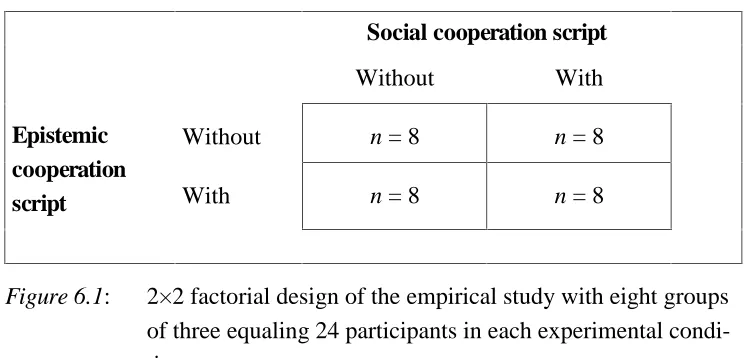
empirische Studie verwendet. In einem 2×2-Design wurden die Faktoren
„soziales Skript“ (nicht vorhanden vs. vorhanden) und „epistemisches Skript“ (nicht vorhanden vs. vorhanden) variiert. 96 Hochschulstudenten der Pädagogik wurden in Dreiergruppen zufällig einer der vier Bedingungen zugeordnet. Die Studie zielt auf folgende Fragestellungen ab:
- Inwiefern beeinflussen soziales Skript und epistemisches Skript und ihre Kombination soziale und kognitive Prozesse der ge-meinsamen Wissenskonstruktion?
- Inwiefern beeinflussen soziales Skript und epistemisches Skript und ihre Kombination die Ergebnisse der gemeinsamen Wis-senskonstruktion?
- Inwiefern hängen Prozesse und Ergebnisse der gemeinsamen Wissenskonstruktion zusammen?
- Inwiefern können in den einzelnen experimentellen Bedingungen bestimmte Diskursmuster identifiziert werden?
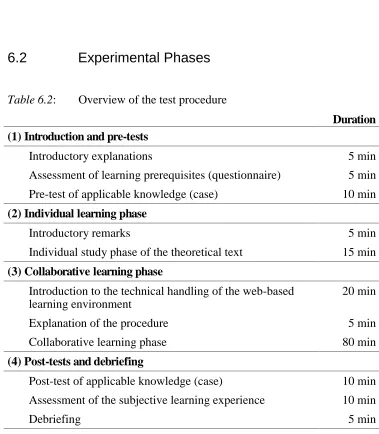
heitsorientierung) und einem Vorwissenstest zu anwendbarem Wissen. Nach der Pre-Test-Phase sollten die Teilnehmer in einer individuellen
Lern-phase einen dreiseitigen Text zu Weiner‘s (1985) Attributionstheorie
sorg-fältig lesen. Diese Attributionstheorie ist ein typischer Inhalt der Einfüh-rungsveranstaltung und Lernziel der computerunterstützten Lernumgebung. Dabei wurde es den Probanden ermöglicht, sich Notizen zu machen. Nach-dem die Lernenden in die computerunterstützte Lernumgebungen eingeführt wurden, war es die Aufgabe der Dreiergruppen, in einer kooperativen
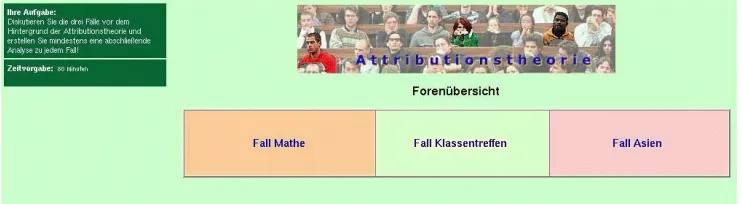
Lern-phase drei Fälle auf Basis der Attributionstheorie zu diskutieren und sich für
jeden Fall auf eine gemeinsame Analyse zu einigen. Dafür war für jede Ex-perimentalgruppe ein Zeitrahmen von insgesamt 80 Minuten vorgesehen. Die Teilnehmer kommunizierten dabei über eine textbasierte computerver-mittelte Lernumgebung. Die Teilnehmer verfügten bis zum Ende der koope-rativen Lernphase über den Text zur Attributionstheorie. Während der ko-operativen Lernphase wurden alle Interaktionen der Lernenden mittels der WWW-basierten Lernumgebung aufgezeichnet. Als zentrale Aspekte des kooperativen Lernprozesses wurden die sozialen Modi der Ko-Konstruktion sowie die epistemischen Aktivitäten erfasst. In einer individuellen
Post-Test-Phase wurde der individuelle Wissenstransfer in Bezug auf
anwendba-res Wissen sowie einige Kontrollvariablen (z. B. computerspezifische Ein-stellungen) erfasst.
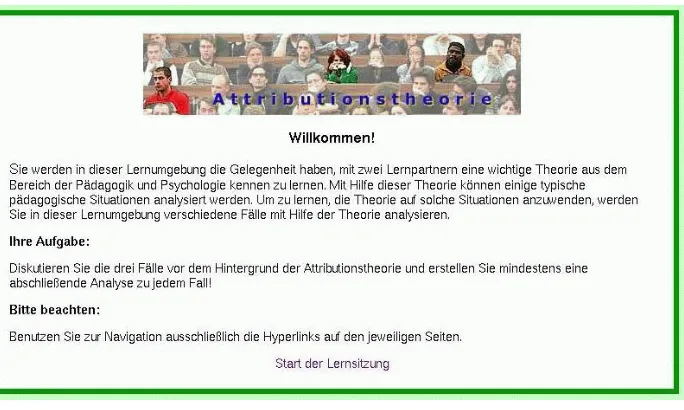
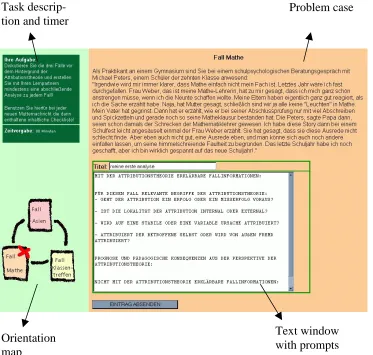
Die Lernumgebung für die kooperative Lernphase bestand aus einer Reihe passwortgeschützter Webseiten. Vor dem Versuch wurden die einzel-nen vernetzten Computersysteme in die passwortgeschützte Lernumgebung unter dem jeweiligen Codenamen der Versuchsteilnehmer eingeloggt.
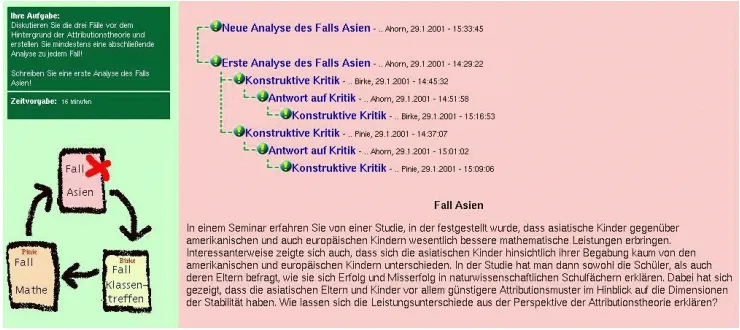
In der Bedingung „soziales Skript“ verfügten die Teilnehmer über dieselbe Technik wie in der Bedingung „Diskurs ohne Skript“. Darüber hin-aus sollte jeder Proband zwei Rollen einnehmen, nämlich (a) Fallanalytiker für einen der drei Fälle und (b) Konstruktiver Kritiker für die Analysen der Lernpartner in Bezug auf die beiden anderen Fälle. Rolle (a) beinhaltete die Übernahme der Verantwortung für eine erste und eine abschließende Analy-se eines Falles und die Beantwortung der Kritiken der Lernpartner. In ihrer Funktion als konstruktive Kritiker – Rolle (b) – sollten die Probanden die Analysen der beiden anderen Fälle kritisieren, die von ihren Lernpartnern erstellt wurden. Diese Funktion des konstruktiven Kritikers wurde durch Prompts unterstützt, die automatisch den Nachrichten der Kritiker und die Antworten der Fallanalytiker angefügt wurden. Diese Prompts lauteten „Folgende Punkte sind mir noch unklar:“, „Punkte bei denen wir noch nicht einer Meinung sind:“ sowie „Meine Vorschläge für eine Änderung der A-nalyse:“. Die Antworten der Fallanalytiker wurden mit korrespondierenden Prompts unterstützt, nämlich „Zu den Unklarheiten:“, „Zu unseren Mei-nungsverschiedenheiten:“ sowie „Zu den Änderungsvorschlägen:“. Die Aufgabe der Lernenden lautete, auf diese Prompts entsprechend zu reagie-ren. Darüber hinaus beinhaltete das soziale Skript eine gesprächssteuernde Komponente. Jede der beschriebenen Aktivitäten sollte von den Teilneh-mern in einem bestimmten Zeitrahmen ausgefüllt werden, wobei insgesamt 80 Minuten für die Analyse der drei Fälle zur Verfügung stand. Die Studie-renden wurden dabei durch alle drei Fälle geleitet und dazu aufgefordert, abwechselnd die Rolle des Fallanalytikers und des Kritikers zu übernehmen. Dabei wurden für jeden Fall 8 Beiträge verfasst: eine erste Analyse, zwei Kritiken, zwei Antworten auf diese Kritiken, zwei neue Kritiken und eine abschließende Analyse.
Die Prompts wurden durch leere Zeilen voneinander getrennt, in die die Probanden jeweils die Antworten auf diese Prompts schreiben sollten.
In der Kombination beider Skripts wurden wiederum alle initialisie-renden Nachrichten durch die Prompts der epistemischen Skriptkomponente vorstrukturiert. Die Rollenverteilung inklusive der entsprechenden Prompts entsprach der sozialen Skriptkomponente. D. h. dass die erste und die ab-schließende Analyse des Fallanalytikers mit Hilfe der Prompts des epistemi-schen Skripts vorstrukturiert wurde und alle weiteren Abläufe der Bedin-gung des sozialen Skripts entsprachen.
Treatmentchecks zeigen, dass der Kooperationsskript-Ansatz mit
Hilfe der Strukturierung von Schnittstellen zur computervermittelten Kom-munikation erfolgreich umgesetzt werden konnte.
Die Ergebnisse zeigen, dass das soziale Kooperationsskript gleich-verteilte Partizipation am Diskurs unterstützt. Gleichzeitig sinkt der Anteil nicht-epistemischer Aktivitäten. Das soziale Skript führt zu einer stärkeren Bezugnahme der Lernpartner und fördert bestimmte soziale Modi der Ko-Konstruktion, z. B. kritisches Aushandeln. Darüber hinaus fördert das sozi-ale Kooperationsskript den individuellen Erwerb multi-perspektivischen anwendbaren Wissens. Das soziale Skript scheint Lernende dabei zu unter-stützen, ihre Ideen mit den Ideen ihrer Lernpartner zu konfrontieren und verschiedene Perspektiven einzunehmen.
sozialen Kooperationsskript unterstützt werden. Effekte des sozialen Koope-rationsskripts scheinen in Bezug auf die sozialen Modi der Ko-Konstruktion dominant zu sein, so dass Effekte des epistemischen Skripts nivelliert wer-den. Weiterhin findet sich ein Interaktionseffekt beider Faktoren in Bezug auf die epistemische Aktivität der Konstruktion von Relationen zwischen konzeptuellem Raum und Problemraum. Die Ergebnisse legen nahe, dass ein ähnlich hohes Niveau dieser epistemischen Aktivität mit jeder Art von Skript gefördert werden kann. In Bezug auf die Ergebnisse gemeinsamer Wissenskonstruktion kann ein Interaktionseffekt hinsichtlich des individu-ellen Erwerbs fokussierten anwendbaren Wissens gefunden werden. Dabei muss allerdings festgestellt werden, dass die Kombination beider Skripts dieses Lernergebnis nicht über den Durchschnittswert der Kontrollgruppe hinaus fördern kann. Möglicherweise zeigt sich hier eine Tendenz, dass Wissen, das durch eine epistemische Skriptkomponente bei der gemeinsa-men Fallbearbeitung gefördert werden kann, mit Hilfe der sozialen Skript-komponente internalisiert werden kann.
Insgesamt zeigt die Studie, dass durch die Strukturierung der Kom-munikationsschnittstelle mittels promptbasierter Kooperationsskripts erheb-licher Einfluss auf Prozesse und Ergebnisse der gemeinsamen Wissenskon-struktion genommen werden kann. Aus den Ergebnissen können also fol-gende Schlüsse gezogen werden: Epistemische Skripts eignen sich insbe-sondere zur Unterstützung der gemeinsamen Wissensanwendung z. B. für
kooperatives Problemlösen, bei denen die gleichberechtigte Partizipation
1
Changing Learning through CSCL
Computers and the internet have enabled learners to construct knowledge in virtual or online seminars together with learning partners from all over the world, who share interests rather than time and location (Collins & Bielayczyc, 1997). Learners may engage through computer-mediated
communication (CMC) in a specific form of computer-supported collabora-tive learning (CSCL, Koschmann, 1996). Learners choose, for example,
from a course catalogue of virtual universities, such as the Virtual Univer-sity of Bavaria, and access virtual seminars via the internet from any con-venient place at any time. In virtual seminars, locally distant students may engage in collaborative knowledge construction at different times. They work on tasks together through CMC in order to acquire knowledge. In this way, learners who may have demanding schedules, such as jobholders or single parents, can access further education more easily.
Some CSCL environments may not only aim to improve access to education, but also to qualitatively change learning (e.g., Computer
Sup-ported Intentional Learning Environment – CSILE, Scardamalia & Bereiter,
some CSCL environments have been found to engage in more complex, coherent social and cognitive activities, to acquire more knowledge, and to apply knowledge from multiple perspectives (Scardamalia & Bereiter, 1994).
In contrast to these results, several studies indicate that collaborative knowledge construction is not superior to traditional classroom teaching per se, because students are rarely accustomed to constructing knowledge col-laboratively (Mandl, Gruber, & Renkl, 1996). Students may therefore be even less familiar with CSCL. Furthermore, the little that students know about ‘learning together’ may not be transferable to CSCL. Because of this, CSCL may pose particular difficulties for students. In the following para-graph known problems of collaborative knowledge construction will be out-lined. Subsequently, it will be shown how these problems may become more complicated in CSCL.
and are not enabled to take multiple perspectives on a subject matter (e.g., Tudge, 1989).
How may these problems reemerge in CSCL? In addition to the de-mands of collaborative knowledge construction, CSCL requires new cultural techniques, e.g., handling computers as media for communication. CMC is demanding, because discussants may not immediately react to others’ con-tributions. Especially in text-based CMC discussants may take their time to formulate their own written reactions. As a consequence, CMC discussants may have difficulties inferring where in discourse their partners are. This may cause discussants to reach different focal points and to lack in under-standing one another. Accordingly, some studies found CMC to be sub-optimal with respect to discourse coordination and coherence (e.g., Hiltz, Johnson, & Turoff, 1986; Kiesler & Sproull, 1992). Incoherence and coor-dination difficulties of CMC have been argued to impede collaborative knowledge construction (Gräsel, Fischer, Bruhn, & Mandl, 2001; Kiesler, 1992). In order to generate productive collaborative knowledge construc-tion, neither bringing students together nor providing access to a shared da-tabase via CMC seems to suffice.
Still, there has been little empirical or theory-based research and systematic experimental variation with respect to instructional support that is oriented towards specific processes of collaborative knowledge construc-tion realized within CSCL environments. Much is known in educaconstruc-tional psychology about how collaborative knowledge construction can be facili-tated. However, this knowledge is seldom applied in designing instructional support for CSCL environments. Although CSCL research produces fasci-nating technical scenarios, only a few CSCL environments build on instruc-tional approaches developed and analyzed in educainstruc-tional psychology. The design of CSCL environments is typically based on what is technologically feasible or aims to assimilate CMC to face-to-face (FTF) communication, which is implicitly assumed to be an ‘ideal and normal’ context for collabo-rative knowledge construction. Therefore, some CSCL environments are designed to support discourse coordination, e.g., turn taking, in order to compensate differences between CMC and FTF. Beyond facilitating dis-course coordination, more specific processes of collaborative knowledge construction may be facilitated by design of CSCL environments. Acknowl-edged instructional approaches based on educational psychological research explain what specific processes are essential to collaborative knowledge construction.
Probably the most influential theoretical approaches to explain, pre-dict, and facilitate the mechanisms of collaborative knowledge construction in educational psychology derive from a socio-cognitive perspective (see Slavin, 1996; Webb, 1989). According to this perspective, when working in small groups, learners construct knowledge by discussing and sharing knowledge with their learning partners. Thus, collaborative knowledge con-struction is believed to build on specific social and cognitive processes. Stu-dents actively engage in social and cognitive processes when jointly work-ing on learnwork-ing tasks, such as applywork-ing theoretical concepts to problems, asking and answering questions, and building consensus with respect to the learning task. These specific processes may facilitate multiple perspectives on learning content and may foster applicable knowledge.
Some socio-cognitive instructional approaches aim to facilitate
to changing conditions of collaborative knowledge construction, e.g., by training the individual learners prior to collaboration or providing a specific incentive structure (see Slavin, 1993). Several process-oriented instructional approaches provide an external structure to facilitate specific interactions of learners (e.g., reciprocal teaching, Palincsar & Brown, 1984; Rosenshine & Meister, 1994). In reciprocal teaching, learners are provided with a structure for comprehending text material in small groups. This structure contains several activities in a specific sequence, which are modeled by the teacher. These activities include specific text comprehension fostering strategies that the learners are expected to apply, namely questioning, summarizing, clari-fying, and predicting. First, learners read the beginning section of a text. Subsequently, one learner takes the role of the teacher. The learner’s task is to ask questions on the text that should be answered by another learner. Then, the student in the teacher role tries to summarize the main ideas of the text. If necessary the learning partner completes missing subjects. Thereafter the ‘teacher’ identifies difficult passages of the text and tries to clear them up in collaboration with the learning partner. Finally, all learners try to pre-dict the contents of the following text passages. Learners change teacher and learner roles for following text passages in order to assure equal involve-ment of all learners in collaborative knowledge construction. The adopted strategies tend to enhance learning by facilitating the learners to engage in effective processes of knowledge construction. Approaches that provide structure to collaboration have been subsumed in O’Donnell and Dan-sereau’s (1992) scripted cooperation approach (cf. Derry, 1999). This ap-proach has been well researched and has proven to effectively facilitate learning (O’Donnell, 1999). In this approach, an externally induced struc-ture of collaborative knowledge construction processes is called a
coopera-tion script. Typically, cooperacoopera-tion scripts combine the facilitacoopera-tion of social
and cognitive processes. Therefore, an important, but rarely answered ques-tion is, how cooperaques-tion scripts that are oriented towards social processes, and cooperation scripts that are oriented towards cognitive processes, as well as the combination of both, facilitate collaborative knowledge con-struction?
The facilitation of both process dimensions should result in specific
classroom teaching and individual studying, collaborative knowledge con-struction is meant to foster specific qualities of knowledge. Learners are expected to apply knowledge to a problem jointly. Collaborative knowledge construction may therefore pose a test bed for the adequacy of learners’ ini-tial problem-solving strategies. In this way, applicable knowledge can be regarded to as a specific learning outcome of collaborative knowledge con-struction. When learners establish and maintain shared conceptions of a problem in collaborative knowledge construction, they need to discuss and integrate multiple perspectives on a subject matter. Learner may not only acquire individual problem-solving strategies, but examine problems more closely considering alternative approaches. However, there is little research explaining to what extent instructional approaches to facilitate specific pro-cesses and specific outcomes of collaborative knowledge construction apply in CSCL environments.
In chapter 2, theoretical perspectives to explain and predict processes of collaborative knowledge construction will be discussed. In the first part of this chapter, collaborative knowledge construction will be defined and socio-cognitive theories will be portrayed. Based on ideas of transactive discourse (Teasley, 1997) and social modes of co-construction (Fischer, 2001; Fischer, Bruhn, Gräsel, & Mandl, 2002), social processes as they come forth in discourse will be addressed. With respect to cognitive
proc-esses, a model of epistemic activities (Fischer, 2001; Fischer et al., 2002)
will be discussed, describing how learners work on the learning task.
In chapter 3, a systematic approach towards types and qualities of knowledge will be introduced. Specific outcomes of collaborative knowl-edge construction referring to applicability and perspectivity of knowlknowl-edge will be classed with this systematic approach.
In chapter 5 the theoretical framework will be summarized and the
research questions regarding processes and outcomes of CSCL supported
with social and epistemic cooperation scripts will be formulated.
In chapter 6 the methods of how the study was conducted and how the variables were operationalized will be introduced. Additionally, the CSCL environment of the study including the learning material will be pre-sented.
Chapter 7 gives an overview of the results. First, effects of social and
epistemic cooperation scripts on social and cognitive processes of collabo-rative knowledge construction will be reported; subsequently, effects on learning outcomes will be presented. Then, relations between processes and outcomes of collaborative knowledge construction in CSCL environments will be reported. Finally, one case study for each of the four experimental conditions will be presented.
Chapter 8 will discuss, interpret, and compare the findings of the
2
Processes of Collaborative
Know-ledge Construction in CSCL
Environments
Thus far, collaborative knowledge construction has described several forms of learning together. This description does not include information about specific socio-cognitive processes of ‘learning’ or what ‘together’ means (cf. Dillenbourg, 1999; Mandl & Renkl, 1992).
In fields of practice, ‘learning together’ may have diverse meanings. When asking a student to ‘learn together,’ he or she might associate control and evaluation by another student in simple learning tasks, such as vocabu-lary testing. A teacher might associate silent group work with students tak-ing over specific individual tasks of a major project assigned to a small group. There are many more examples of what ‘learning together’ might include. In accordance to Mandl and Renkl (1992), more local theories of learning together need to be applied. Thus, ‘learning together’ needs to be specified as collaborative knowledge construction for the purpose of this study.
involvement of more knowledgeable peers (Chan, 2001; Cohen, 1986; Reis-erer, 2003). Based on these specifications, collaborative knowledge con-struction can be defined:
Collaborative knowledge construction refers to mutual
engage-ment of peers of equivalent learning prerequisites in learning tasks with intertwined layers of socio-cognitive processes (cf. Dillenbourg et al., 1995) as “the result of a continued attempt to construct and maintain a shared conception of a problem” (Roschelle & Teasley, 1995, p. 70) with the goals to solve the problem and to individually acquire knowledge (Chan, 2001).
A criterion not yet addressed by the above definition is the group
size, indicating how many learners are collaboratively constructing
knowl-edge. Typically, learning groups should be small enough to allow any mem-ber of the group to participate in socio-cognitive processes of collaborative knowledge construction (cf. Cohen, 1994). Therefore, typical small groups consist of three to five participants (Dillenbourg, 1999). In many studies on collaborative knowledge construction, only dyads are subject to research. In dyads, however, several phenomena, which are known to affect collabora-tive knowledge construction, may not arise. For instance, learners may only have the opportunity for free riding (Kerr & Bruun, 1983) in larger groups. Learners in dyads must address each other more frequently, thus lowering the possibility of free riding.
2.1
Socio-Cognitive Theories of Collaborative
Knowledge Construction
There are several socio-cognitive perspectives on collaborative knowledge construction. For an elaborate overview of the most recent proaches see Fischer (2002). In this work, only a sample of theoretical proaches will be discussed. This selection should include influential ap-proaches of modern educational psychology that explain mechanisms and predict effects of collaborative knowledge construction as defined above. The theoretical approaches should have particular explanatory power for the specific research questions of this study.
The underlying assumption of socio-cognitive approaches is that processes and outcomes of collaborative knowledge construction are related. The two most influential socio-cognitive approaches towards collaborative knowledge construction are (1) socio-constructivist approaches, and (2), socio-cultural approaches. The most influential research of these approaches originates within the field of developmental psychology. The most impor-tant exponents of both approaches, however, Piaget and Vygotsky respec-tively, have strongly influenced modern socio-cognitive perspectives on collaborative knowledge construction (see O’Donnell & King, 1999) and have been particularly linked to CSCL (see Koschmann, 1996).
Social processes will be outlined in reference to socio-constructivist approaches and cognitive processes will be linked with socio-cultural ap-proaches. Based on Fischer’s (2001) framework, social modes of co-construction as well as epistemic activities will be discussed with reference to social and cognitive processes.
2.1.1 Socio-constructivist theories and social processes
coherence in understanding (cf. De Lisi & Goldbeck, 1999). Individuals aim to establish and maintain consistent, equilibrated models of their contexts*. Knowledge construction occurs, when individuals accommodate cognitive structures to better describe this context. Concepts are refined and/or new knowledge is constructed. Individuals may also assimilate a given situation into existing cognitive structures. In this way, individuals may deal with concepts without changing existing cognitive structures. Therefore, indi-viduals may sometimes disregard or misperceive information that contra-dicts existing cognitive structures (Kuhn, 2001). Another option is imitation (cf. De Lisi & Goldbeck, 1999; Fischer, 2002). Individuals may simply pretend to adopt the perspective of another person, but do not restructure their perspective. They achieve pseudoconsensus rather than actual accom-modation (see Brown & Palincsar, 1989). Furthermore, individuals may only make momentary adjustments. For instance, a student being corrected by a teacher may change his/her response, but not the misconceptions re-sponsible for the original wrong response. Another equilibration strategy is to respond playfully, making light of the inconsistencies of the cognitive structures. Complex subject matters are thus often oversimplified (cf. Koschmann, Kelson, Feltovich, & Barrows, 1996).
This perspective on knowledge construction underlines the impor-tance of inducing perturbations or disequilibrium of cognitive structures in order to foster processes of equilibration as a motivation and first prerequi-site to knowledge construction. Perturbations may evolve in social interac-tion, when divergent views are being discussed. Neo-Piagetians therefore consider socio-cognitive conflict as one of the central mechanism of col-laborative knowledge construction (e.g., Doise & Mugny, 1984). It has been argued that socio-cognitive conflict evolves in peer interaction rather than in traditional classroom practice (= teacher learner interaction). Peer interac-tion may make it more likely for learners to enter into a negotiainterac-tion of mul-tiple perspectives (Hogan et al., 2000). As learners may engage in socio-cognitive conflict during more equal or horizontal interaction with peers
*
rather than during more hierarchical or vertical interaction with teachers, a change of learners’ cognitive structures can be initiated more easily in peer interaction than in teacher learner interaction (Hatano & Inagaki, 1991; Piaget, 1985).
Socio-cognitive conflict is not a sufficient condition for knowledge construction, but needs to be productively dissolved by coordinating diver-gent views in order to achieve more highly developed solutions to problems (Chan, 2001; Nastasi & Clements, 1992). Several empirical studies within the Piagetian framework have been conducted aiming to specify productive interactions (Berkowitz & Gibbs, 1983; Kruger, 1992; Kruger & Tomasello, 1986). These studies examined in particular discourse interactions of learn-ers. Berkowitz and Gibbs (1983) focused on interactions that relate to dis-equilibrium from the perspective of transactive discourse (Dewey & Bent-ley, 1949). Transactive discourse is defined as “reasoning that operates on the reasoning of another” (Berkowitz & Gibbs, 1983, p. 402). Interactions may be more or less transactive. An example for a less transactive discourse is when collaborative learners juxtapose their contributions without refer-ring to contributions of other discussants. An example for a highly transac-tive discourse move is integration-oriented consensus building, which is when discussants directly point out aspects of the contribution of learning partners that they themselves have not considered and build them into their own line of argumentation. Peer interaction has proven to produce more transactive discourse than teacher-learner interaction (Kruger, 1992; Kruger & Tomasello, 1986). The degree of transactivity of social interactions has been found to be positively correlated with outcomes of collaborative knowledge construction (Teasley, 1997).
The individual social interactions have not only been rated on a scale of transactivity, but have also been respected for their individual functions of collaborative knowledge construction (Fischer, 2001; Hakkarainen & Palonen, 2003). For example, integration-oriented consensus building has been regarded to as relevant for learning, not only due to its transactivity, but because integration-oriented consensus building may indicate the con-struction of a shared conceptual understanding. This idea of specific social
2001; Fischer et al., 2002), who identified a range of social modes of in-creasing transactivity.
In the following paragraphs the increasingly transactive social modes of knowledge co-construction and their distinct knowledge construction function will be introduced in more detail. These social modes are externali-zation, elicitation, quick consensus building, integration-oriented consensus building, and conflict-oriented consensus building.
Externalization
Externalization (of knowledge) can be a task-related activity directed towards other group members, but is of a low level of transactivity. Never-theless, externalization has been regarded to as a central mechanism of col-laborative knowledge construction (Webb, 1989). Learners explicate their knowledge, which may make (mis-)conceptions accessible for the learners in a group. Furthermore, when externalizing, learners need to restructure knowledge to convert it into linear form. Thus, knowledge is simultaneously reorganized when is externalized (Huber, 1987). Consequently, the require-ment to externalize knowledge has been connected to knowledge construc-tion. Only the expectancy to externalize knowledge has shown to facilitate learning (King, 1989b; Renkl, 1997). Individual learners do not engage in externalization on their own, but rather, learn ‘silently.’ Externalization is thus mainly motivated by social situations (see Cobb, 1988).
have a mediating function, but cannot be made responsible for variances resulting from collaborative knowledge construction.
The uncertainty of the exact function of externalization for collabo-rative knowledge construction is further increased by the fact that there is disagreement on whether externalization is more beneficial for the individ-ual who is externalizing knowledge or for the learner who listens to other group members (Renkl, 1997). In contrast to most theoretical perspectives and research on externalization (Lambiotte et al., 1988; Lambiotte et al., 1987; Nastasi & Clements, 1991; Webb, 1989), Renkl (1997) found that listening to externalization can be superior to externalizing knowledge. In his study he grouped dyads of listeners and explainers. The explainers had to externalize their knowledge on complex stochastic tasks. Listeners could question and comment on the externalization, but were asked to stay in their roles as listeners. Results show clear advantages for listeners in several transfer tasks. Renkl proposes that active externalization can be connected to considerable stress and detrimental effects on motivation and time spent on a task. Learners who externalize may have less time to reflect on a com-plex subject matter than listeners, but need to concentrate on coordination of communication. Therefore, beneficial effects of externalization on knowl-edge construction have been limited to more simple learning tasks such as text comprehension, rather than complex problem-solving (Renkl, 1997).
Elicitation
Elicitation is a more transactive social mode than externalization. Elicitation has been described as using learning partners as a resource by asking questions (Fischer, 2001). Elicitation aims at initiating a reaction from the learning partners. In this way, elicitation has been regarded to as important for collaborative knowledge construction, because it may foster externalization. Therefore, a learning group may access a larger knowledge base by elicitation (cf. Dillenbourg et al., 1995; Fischer, 2001).
This may also help to discover socio-cognitive conflict (cf. Renkl, 1997). The individuals who ask questions and receive elaborate explanations may be enabled to fill in the gaps of their understanding and correct misconcep-tions (Webb, Jonathan, Fall, & Fall, 1995). In this respect, elicitation may be beneficial for the eliciting individual as well as for the responding group members.
Some studies showed that in more successful groups more task-related questions have been asked (e.g., King, 1994). Based on these find-ings, some approaches successfully foster group learning by facilitating the generation of questions, e.g., with the help of prompts (see chapter 4; King, 1999; Rosenshine, Meister, & Chapman, 1996). There are however indica-tions that elicitation and receiving help can be detrimental when learners become dependent on this help (Webb, Ender, & Lewis, 1986). Instead of attempting to work on the learning task, students may rather seek help from teachers.
Quick consensus building
In collaborative knowledge construction learners need to coordinate themselves to reach a common goal (typically to solve a complex problem). However, there are rarely objective criteria determining when this goal has been reached. Therefore, learners need to build consensus regarding the learning task in a process of negotiation. In Teasley’s work on transactive discourse (Teasley, 1997), consensus building is more transactive than ex-ternalization and elicitation. There are different styles of reaching consen-sus, however, that vary in their degrees of transactivity. Quick consensus building is moderately transactive. Quick consensus building can be de-scribed as learners simply pretending to accept the contributions of their learning partners in order to continue discourse. In this way, quick consen-sus building may not indicate an actual change of perspective, but is rather a coordinating discourse move (Fischer, 2001).
does not need to correspond to actual mutual understanding, but to the be-lief, “that the partners have understood what the contributor meant to a
crite-rion sufficient for current purposes” (Clark & Schaefer, 1989, p. 262, italics
added by the author). There are indications that the main ‘current purpose’ of learners is discourse coordination (e.g., turn taking; Weinberger, 1998) rather than “to construct and maintain a shared conception of a problem” (Roschelle & Teasley, 1995, p. 70). Thus, quick consensus building has been explicitly distinguished from other forms of consensus building rele-vant to collaborative knowledge construction (see Fischer, 2001).
In Weinberger’s (1998) study, dyads in CMC compared to FTF dy-ads were asked to analyze problem cases together. Their discourse was analyzed with a coding system based on Clark’s (1992) grounding approach. Although some grounding moves were found to relate to learning outcome, quick consensus building did not affect knowledge construction in CMC or in FTF. These results indicate that quick consensus building is not linearly related to outcomes of collaborative knowledge construction. Quick consen-sus building may instead be detrimental, when learners disregard other forms of consensus building (cf. Keefer, Zeitz, & Resnick, 2000; Leitão, 2000; Leitão & Almeida, 2000; Linn & Burbules, 1993; Nastasi & Clements, 1992). When grounding is impeded, however, e.g., in CSCL envi-ronments, quick consensus building might become a more relevant factor with respect to collaborative knowledge construction. Most suggestions to improve CSCL therefore aim to facilitate coordination and quick consensus building (Hesse, Garsoffky, & Hron, 1997).
Integration-oriented consensus building
This mode is often implicitly suggested by collaborative knowledge con-struction scenarios when asking learners to collaborate instead of to com-pete. Collaborative tasks state a common goal for learners or require learn-ers to come to a joint solution (Littleton & Häkkinen, 1999; Pea, 1994). Learners synthesize their ideas and jointly try to make sense of a task (Nastasi & Clements, 1992).
Several aspects of integration-oriented consensus building need to be considered. Integration-oriented consensus building must be carefully dis-tinguished from quick consensus building. As opposed to quick consensus building, integration is not mere agreement, repetition or juxtaposition of individual perspectives (Roschelle, 1996). Integration is rather characterized by the combination and sublation of positions. Integration occurs when in-dividual learners give up initially held positions and correct themselves on the basis of peers’ contributions. Learners who modify initial positions may have learned by the integration-oriented co-construction modus. An indica-tion for integraindica-tion-oriented consensus building may be that “participants show a willingness to actively revise or change their own views in response to persuasive arguments” (Keefer et al., 2000, p. 77).
indicator of knowledge construction and needs to be discussed against the background of this possible distortion.
Conflict-oriented consensus building
The beneficial influence of conflict-oriented consensus building on learning has been considered as the most transactive social mode and has been well examined (Teasley & Roschelle, 1993). Conflict-oriented consen-sus building has been regarded to as a component of a central learning mechanism by Piaget (1928). Learners who are confronted with divergent perspectives may experience disequilibrium as “shock” (Piaget, 1928, p. 204). Disequilibrium may induce learners to reconsider their conceptions in order to resolve the conflict in the process of (re-)equilibration. In this way, conflict-oriented consensus building may initiate other transactive modes like externalization and integration-oriented consensus building. Reflective and constructive resolution of conflict has been related to learning (Chan, 2001; Nastasi & Clements, 1992).
Similar to elicitation, conflict-oriented consensus building is char-acterized by explorative behavior of the participating learners. Learners may be pushed to test multiple perspectives or find more and better arguments for their positions. This indirect effect of conflict-oriented consensus build-ing has been confirmed by several studies (e.g., Chan, Burtis, & Bereiter, 1997).
collaborative learning, than male students learning with male students (Palincsar & Herrenkohl, 1999; Tudge, 1992).
2.1.2 Socio-cultural theories and cognitive processes
In contrast to Piagetian perspectives, socio-cultural theories recog-nize social interaction not only as a setting eventually beneficial to individ-ual knowledge construction, but knowledge construction as being funda-mentally social and mediated by language (Vygotsky, 1978). Knowledge is constructed by internalization of social processes in discourse. The basic assumption of socio-cultural theories and Neo-Vygotskians is that knowl-edge construction is happening twice: on an internal plane and on an exter-nal, social plane. The social speech corresponds with internal speech, meaning that discourse represents cognitive processes (Vygotsky, 1986) Learners successively master cultural practices in social interaction. Prior knowledge of the individual learner is activated in discourse and becomes object to comparison. As a consequence, prior knowledge may be reorgan-ized (cf. Cobb & Bowers, 1999). Internalization describes the process in which the knowledge that is being negotiated on a social plane becomes part of the individual cognitive structures. Vygotsky stresses that learners need to be guided by more competent partners in discourse to solve problems they could not solve alone. Thus, knowledge that they do not yet possess is discussed and may be subject to internalization.
A more competent partner guides learners in a zone of proximal
de-velopment to apply adequate strategies to solve a problem. These task
strategies may be more or less domain bound. The learners internalize these task strategies. Finally, they may individually acquire the knowledge to solve problems on their own without additional support. This idea has been re-conceptualized for collaborative knowledge construction by Neo-Vygotskian researchers.
construct knowledge. Empirical findings on processes of collaborative knowledge construction mirror an inconsistent picture regarding the ques-tion whether only specific interacques-tions or already active, goal-oriented par-ticipation in discourse, i.e. the amount of task-related contributions, are beneficial to learning outcome.
According to Cohen’s (1994) analysis of several studies, task-related activities affect learning outcome only if learners collaborate on tasks that are complex and resource interdependent. Complex tasks can be character-ized by the fact that they do not provide one single, correct solution or problem-solving procedure. Resource interdependent tasks cannot be solved by one learner alone. An effect of mere participation in collaborative work on tasks with one defined correct solution that may also be solved by indi-vidual learners cannot be found (Webb, 1991).
In more recent studies, several different task-related or epistemic
ac-tivities have been identified in collaborative knowledge construction. An
epistemic dimension refers to the tasks learners are confronted with, e.g., categorizing or defining new concepts (Fischer, 2001; Fischer et al., 2002). Therefore, epistemic activities may describe how learners work on the task in more detail and in a more systematic way within a specific domain. Pontecorvo and Girardet (1993) developed a system of domain- and con-tent-specific epistemic activities to analyze how learners explain problem cases, e.g., defining categories and words. In problem-based learning sev-eral phases and activities have been identified (Barrows & Tamblyn, 1980; De Grave, Boshuizen, & Schmidt, 1996; Schmidt, 1983), e.g., identification of various problems and linking theoretical concepts to case information (see also Stonewater, 1980; Voss, Greene, Post, & Penner, 1983; Vye et al., 1997). Hakkarainen and Palonen (2003) classified the objects of inquiry as cognitive activities of learners. They analyzed whether learners referred to linguistic form, research questions, research methods, information, explana-tion or other, unspecified objects when constructing knowledge together, and found those learners who were more explanation-oriented to acquire knowledge better.
information, to what extent learners relate to theoretical concepts, and to what extent learners construct relations between theoretical concepts and case information. More successful learners have often left the concrete level of case information in these studies behind, and related to theoretical con-cepts instead. This may indicate that there are different qualities of how learners relate to the task. Epistemic activities, which have been applied by Fischer et al. (2002) for an analysis of collaborative learning with complex problem cases, will next be discussed in more detail. These epistemic ac-tivities include construction of problem space, construction of conceptual
space, and construction of relations between conceptual and problem space.
Additionally, learners may also engage in non-epistemic activities. Whereas all epistemic activities are on-task, non-epistemic activities can be described as off-task behavior. At this point, there is little research on how knowledge is collaboratively applied in discourse (Fischer et al., 2002; Teasley & Ro-schelle, 1993). From a Vygotskian perspective the tasks learners collabora-tively complete should relate to what tasks learners can accomplish indi-vidually after collaboration. Learners who are able to apply knowledge when they are supported in collaboration should also be able to transfer and apply this knowledge in subsequent tasks individually.
Construction of problem space
re-flect better strategies in learning scenarios based on complex problems (Fischer et al., 2002; Hogan et al., 2000).
Construction of conceptual space
In order to solve problems on the grounds of theoretical concepts, learners need to share the understanding of a theory. To this end, learners construct relations between individual theoretical terms or principles. The construction of conceptual space also implies to distinguish concepts from each other. During this process, concepts are being defined and categorized by the learners (cf. Pontecorvo & Girardet, 1993). Within collaborative knowledge construction environments the construction of conceptual space has been argued to be essential for successful problem-solving (De Grave et al., 1996).
Construction of relations between conceptual and problem space
Non-epistemic activities
Learners may not only deal with the contents of the learning task, but may also digress off-topic. For instance, learners may choose to talk about themselves or coordinate off-task aspects of their environment, e.g., asking learning partners how much time is left. A high frequency of non-epistemic activities has been connected to detrimental effects on knowledge construc-tion as cognitive resources may be occupied and learners can be distracted (cf. Cannon-Bowers & Salas, 1998; Cannon-Bowers & Salas, 2001; Fischer, Bruhn, Gräsel, & Mandl, 2000).
2.2
Relations between Processes and Outcomes of
Collaborative Knowledge Construction
Socio-cognitive perspectives on collaborative knowledge construc-tion are based on the assumpconstruc-tion that processes influence outcomes of col-laborative knowledge construction, e.g., the individual acquisition of knowledge. Therefore, this relation between processes and outcomes of collaborative knowledge construction has been subject to research from so-cio-cognitive perspectives on collaborative knowledge construction. Some approaches have considered the frequency of individual phenomena in dis-course of learners, e.g., giving explanations (Webb, 1992). Other ap-proaches have analyzed discourse on a global scale of transactivity (Teasley, 1997) or of being epistemic or not (Cohen, 1994). In any way, utterances of individual learners have been successfully linked to individual knowledge acquisition.
dis-course phenomenon may poorly relate to learning outcome (cf. Sellin, 1990). Furthermore, the distinct discourse phenomena may interact with each other. Therefore, individual utterances as well as sequences and struc-tures of discourse may need to be analyzed (Chan, 2001; Chinn et al., 2000). Consequently, instead of counting only individual discourse phenomena, discourse types of collaborative knowledge construction may be identified. Some studies, for instance, report substantial relations between argumenta-tive structures in learners’ discourse and individual knowledge acquisition (Anderson, Chinn, Chang, Waggoner, & Yi, 1997; Chinn et al., 2000; Keefer et al., 2000; Leitão, 2000).
2.3
Context Factors Influencing Processes of
Col-laborative Knowledge Construction
What are the factors that influence the processes of collaborative knowledge construction? There has been ample research on context factors that are believed to affect how learners collaboratively construct knowledge. These include the organizational background, incentive structure, learning task, individual learning prerequisites, and cooperation scripts (cf. Renkl & Mandl, 1995). In this section, these context factors will be briefly intro-duced.
Organizational background
With regard to organizational background, the pivotal concern is, to what extent collaborative knowledge construction is an accepted learning form in an educational institution. It has been shown that the individual en-deavors of teachers to encourage students to practice collaborative knowl-edge construction rarely lead to the desired outcomes (McLaughlin, 1976). Instead, collaborative knowledge construction needs to be embedded into school routine, and needs to be supported by school administration as well as by the students. Learners may need to systematically experience the benefits of collaborative knowledge construction in order to better accept and to develop the prerequisite competencies of collaborative knowledge construction (Renkl, Gruber, & Mandl, 1996; Renkl & Mandl, 1995). Fur-thermore, organizational background also includes aspects such as group size, room size, time frames, and the financial conditions which collabora-tive knowledge construction may afford (Huber, 1999).
Incentive structure
perform-ance need to be salient in this model, meaning that the performperform-ance of the individual group member needs to be identifiable. Cohen (1994) restrains the validity of this approach to training tasks, in contrast to complex prob-lem-solving tasks. The extent to which the typical incentive structure in educational institutions facilitates motivation to engage in collaborative knowledge construction has been discussed. Evaluation of students’ per-formances is typically based on individual tests on conceptual knowledge, which can also be individually constructed. Knowing that collaborative knowledge construction may be demanding and may require much effort, learners may wonder why they should learn together. In this way, incentive
structure has been argued to define the goal motivation of learners. In school
contexts, for instance, the motivation of students in learning environments may be different from those intended by teachers. Students may focus on certification, i.e. passing the exam, or may try to impress peers. These goal orientations may conflict with goals of teachers to facilitate conceptual un-derstanding. Similarly, goal orientation of participants in experimental learning environments may differ from that of learning, e.g., receiving a certificate, earning money (cf. Ng & Bereiter, 1991). To these ends, learners may not aim to be dependent on learning partners and establish shared goals and conceptions (see also Johnson & Johnson, 1992).
Learning task
Technology Group at Vanderbilt (1992), for instance, has developed a video format to present complex problems as learning tasks. In these videos, learners are requested to help a ‘hero’ saving a wounded eagle by calculat-ing distances, gas consumption etc. in order to foster the motivation of learners.
Individual prerequisites
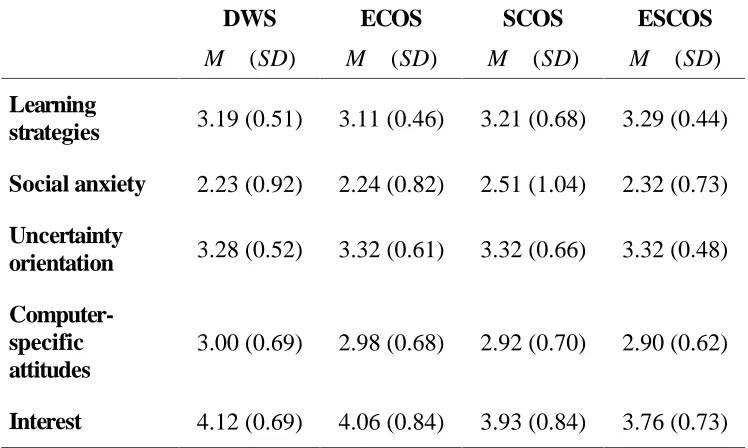
Several individual learning prerequisites have been discussed as im-portant factors for collaborative knowledge construction. These individual learning prerequisites may be categorized as cognitive (prior knowledge and learning strategies) or emotional and motivational (social anxiety, uncer-tainty orientation, interest). With respect to CSCL, computer-specific atti-tudes have also been discussed.
Prior knowledge is a central prerequisite to collaborative knowledge
construction (e.g., Stark & Mandl, 2002). According to constructivist ap-proaches and perspectives of cognitive elaboration, new knowledge needs to be connected to prior knowledge. The more prior knowledge, the more po-tential connection points for new knowledge are available (Dochy, 1992). This influence of prior knowledge on learning outcome can be particularly found in learning environments that are based on complex learning tasks (Weinert, 1994). Furthermore, prior knowledge has been reported to interact with facilitation of collaborative knowledge construction (see chapter 4; O’Donnell & Dansereau, 2000). Some facilitation tools may be particularly useful for learners with high prior knowledge. Some other facilitation tools may support learners with low prior knowledge, but will impede progress of learners with high prior knowledge (Cohen, 1994; O’Donnell & Dansereau, 2000).
Learning strategies, which describe how learners deal intentionally
Social anxiety is a condition, which results from the perception of a
socially demanding situation that is interpreted as a threat, typically to self value. Particularly for collaborative knowledge construction, social anxiety correlates negatively with performance (cf. Seipp & Schwarzer, 1991). It has been argued that anxiety also influences the application of learning strategies (e.g., Naveh-Benjamin, 1991). The cognitive capacity of anxious learners seems to be consumed by the anxiety. Anxious learners may have difficulties concentrating on the learning task or applying adequate task strategies. Learning groups in discourse without instructional support re-ported higher levels of social anxiety than dyads provided with cooperation scripts (O’Donnell, Dansereau, Hall, & Rocklin, 1987).
Uncertainty orientation has been found to be an individual
charac-teristic relevant to motivation, learning strategies, and learning outcome in collaborative knowledge construction environments (Huber, Sorrentino, Davidson, Eppler, & Roth, 1992; Sorrentino, Short, & Raynor, 1984; Stark, Gruber, Renkl, & Mandl, 1997). This construct explains and predicts to what extent individuals seek additional information, explore inconsistencies, or try to get along with available knowledge and avoid conflicting informa-tion (Dalbert, 1996; Huber et al., 1992). The socio-constructivist theories on collaborative knowledge construction, which are outlined in this work, strongly build on the idea that learners engage in productive equilibration of socio-cognitive conflicts. Thus, uncertainty orientation has been found to positively relate to outcomes of collaborative knowledge construction (Huber et al., 1992; Stark et al., 1997). Certainty oriented learners, in con-trast, aim to avoid socio-cognitive conflicts, which is detrimental for indi-vidual knowledge acquisition in collaborative knowledge construction envi-ronments. Therefore, certainty oriented learners often aim to avoid collabo-rative knowledge construction environments altogether. These learners pre-fer individual learning environments.
Interest in the subject matter of the learning environment can be
per-spectives. Learners with little interest, however, may show satisficing and aim to accomplish minimal requirements of a collaborative learning task.
Computer-specific attitudes have been argued to be individual
char-acteristics strongly influencing CSCL (Richter, Naumann, & Groeben, 2001). Richter et al. (2001) have differentiated several dimensions of atti-tudes towards computers, for instance, perceiving computers as a threat to society. These attitudes towards computers have shown to influence the motivation to learn in CSCL environments (Richter et al., 2001).
Cooperation scripts, too, have been denounced a context factor for
collaborative knowledge construction (O’Donnell & Dansereau, 1992; Renkl & Mandl, 1995). The activities of collaborative learners may be guided by cooperation scripts. Cooperation scripts provide a structure to collaborative knowledge construction by specifying, sequencing, and
as-signing roles or activities to learners. A number of instructional approaches
have been designed to foster collaborative knowledge construction based on the idea of cooperation scripts (O’Donnell & Dansereau, 1992). For in-stance, in the jigsaw method, learners are assigned an expert role for one specific question regarding the subject matter that is to be learned (Aronson, Blaney, Stephan, Silkes, & Snapp, 1978). Then, learners build expert groups, in which they discuss this one specific question. Subsequently, learners of the various expert groups build basis groups in a way that for any question on the subject matter one expert is present. In these basis groups, learners are expected to convey their specific expert knowledge. By speci-fying, sequencing, and assigning roles and activities, cooperation scripts do not only suggest activities to learners, which are believed to facilitate knowledge construction in turn. They also assure that learners are equally involved in establishing and maintaining shared conceptions and can ap-proach a problem from multiple perspectives. This is typically achieved with cooperation scripts that require learners to change roles during collabo-ration (e.g., reciprocal teaching, Palincsar & Brown, 1984). The coopecollabo-ration script approach is the issue of this work and will be discussed in more detail in chapter 4.