
ISSN(Online): 2319-8753 ISSN (Print): 2347-6710
I
nternational
J
ournal of
I
nnovative
R
esearch in
S
cience,
E
ngineering and
T
echnology
(A High Impact Factor, Monthly, Peer Reviewed Journal) Visit: www.ijirset.com
Vol. 8, Issue 7, July 2019
BER Analysis of Filter Optimization of
Multicarrier Transceiver for 5G Technologies
Prakash Kumar Jha
1, Prof.Pravesh Aasati
2, Prof.Muneshwar Kumar
3M. Tech. Scholar, Dept. of Electronics Communication, Iasscom Fortune Inst. of Technology, Bhopal, M.P. India1
Head of Dept., Dept. of Electronics Communication, Iasscom Fortune Inst. of Technology, Bhopal, M.P. India2
Assistant Professor, Dept. of Electronics Communication, Iasscom Fortune Inst. of Technology, Bhopal, M.P. India3
ABSTRACT: -Filter bank Multicarrier (FBMC) is a novel technique evolved from OFDM which resolves most of these problems by taking a filtering approach to multicarrier communication system. FBMC signals can easily meet the Adjacent Channel Leakage Ratio (ACLR) and they do not use cyclic prefix thus improves spectral efficiency. The Filter bank Multicarrier (FBMC) transmission technique also leads to enhanced physical layer for future communication systems and it is an enabling technology for cognitive radio environment. Due to the inclusion of band-limited pulse shaping filters into the signal model in FBMC technique, the design of efficient transceiver architectures for multicarrier systems becomes a challenging task.Due to the inclusion of band-limited pulse shaping filters into the signal model in FBMC technique, the design of efficient transceiver architectures for multicarrier systems becomes a challenging task. In this paper the simulations of MIMO technique for FBMC transceiver for 5G technologies is presented and calculate BER, magnitude and attenuation.
KEYWORDS: Filter Bank Multicarrier (FBMC), Filter Bank, MIMO System, 5G Technology
I. INTRODUCTION
ISSN(Online): 2319-8753 ISSN (Print): 2347-6710
I
nternational
J
ournal of
I
nnovative
R
esearch in
S
cience,
E
ngineering and
T
echnology
(A High Impact Factor, Monthly, Peer Reviewed Journal) Visit: www.ijirset.com
Vol. 8, Issue 7, July 2019
And also, 5G is relied upon to accomplish enhanced framework limit and throughput. The main aim of 5G research and development is to improve device-to-device communications, at lower cost, lower latency and better implementation than previous generation. This can be enabled by developing sophisticated machines, like advanced field programmable gate arrays and digital signal processors. These hardware devices allow the use of efficient algorithms implementation for communication system. The potential applications of 5G technology is to facilitate to the users for high speed video downloads, vehicle-to-vehicle communications, and general cellular communication systems.
II. FILTER BANK MULTICARRIER (FBMC) TECHNIQUE
The filter bank multicarrier scheme was introduced first time by Saltzberg and Chang in the year 1971. FBMC is also a family of OFDM technique. In the beginning this approach were adopted to support the OFDM technique. The main intention to identify this technique is to overcome the limitations of existing multicarrier modulation schemes. FBMC uses specific pulse shaping filters which generates good confine sub-band in time and frequency domain with the help of filter bank and its polyphase structure. In communication system, digital signal processing signals have high bandwidth in the range of GHz. Most of the presently available FPGA„s and DSP Hardware kits are having clock rate in the range of some MHz‟s. In order to reduce the clock frequency, multiplexing techniques are used to sort out the required data rate at lesser clock frequency. The efficient way of achieving this task, is through adopting filter bank multicarrier modulation (FBMC) technique for sub-band processing of input signals. FBMC is considered as a promising alternative multicarrier technique for future communication systems. The next generation of mobile communications (5G) is ambitious by more spectral efficient wave-forms. FBMC has gained a high degree of interest to provide flexibility for 5G mobile communications system, as a 5G waveform candidate. In the advancement in digital signal processing (DSP) capabilities, research has been carried out to identify alternative to existing multicarrier modulation technique for next generation communication system.
Figure 1: Time domain response of FBMC prototype filter and OFDM technique
ISSN(Online): 2319-8753 ISSN (Print): 2347-6710
I
nternational
J
ournal of
I
nnovative
R
esearch in
S
cience,
E
ngineering and
T
echnology
(A High Impact Factor, Monthly, Peer Reviewed Journal) Visit: www.ijirset.com
Vol. 8, Issue 7, July 2019
III. BLOCK DIAGRAM OF FBMC
Most of the investigated and analyzed new communication techniques are algorithmic stage. Hardware and software implementation cost are considered as main parameters required for future mobile communication systems. But, for practical implementation of any wireless communication system are bound by many parameters. These parameters include economic, social, hardware complexity and essential need of users. These constraints can be achieved effective use of resources and technology. Therefore, this thesis mainly deals with design and implementation of advanced and efficient hardware architecture, which may be suitable for the physical layer of future communication (5G) transceiver architecture prototype on FPGA. With this essence, a novel hardware architecture design for future communication (5G) system, based on Filter Bank Multicarrier modulation technique is presented. This technique is being studied and considered these days by recent researches for the future adoptable 5G air interface. It provides enhanced range of spectrum compartment compared to conventional multicarrier modulation technique and allows enhanced mobility management. There are some other alternative and subcategories for FBMC as well.
Figure 2: Block diagram of FBMC transceiver
IV. PROPOSED METHODOLOGY
ISSN(Online): 2319-8753 ISSN (Print): 2347-6710
I
nternational
J
ournal of
I
nnovative
R
esearch in
S
cience,
E
ngineering and
T
echnology
(A High Impact Factor, Monthly, Peer Reviewed Journal) Visit: www.ijirset.com
Vol. 8, Issue 7, July 2019
Figure 3: Simplified FBMC transceiver
The multiplication of IFFT with phase rotation vector θ k in frequency domain leads to circular shift of N/4 in time domain,which results in reconstruction of the FBMC signal N-IFFT Signal Separation Shifting by N/4 Polyphase Filtering Polyphase Filtering + FBMC Signal Input Signal Polyphase Filtering Polyphase Filtering Received N-FFT Signal Output Signal by utilizing two polyphase filter modules as depicted in the above Figure 3. To construct the FBMC signal in transmitter, we can use NK-IFFT and Polyphase filters. In receiver, we may use polyphase filtering stage and NK-FFT to recover data. In order to retrieve the original signal back, pipelined FFT Architecture is used. By using pipelined FFT Architecture it is easy to compute higher FFT point by making short variations in the code. Therefore, with this architecture, the complexity level and area utilization get reduces while the speed of communication system improves.
V. SIMULATION RESULTS
ISSN(Online): 2319-8753 ISSN (Print): 2347-6710
I
nternational
J
ournal of
I
nnovative
R
esearch in
S
cience,
E
ngineering and
T
echnology
(A High Impact Factor, Monthly, Peer Reviewed Journal) Visit: www.ijirset.com
Vol. 8, Issue 7, July 2019
MIMO-OFDM 2×1 System with filter optimization based FBMC technique discussed in this research work in term of magnituderesponse (dB) is shown in figure 5.
Figure 5: MagnitudeResponse of 2×1 MIMO system based Optimization Filter
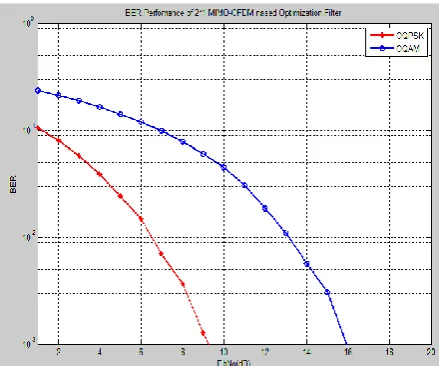
MIMO-OFDM 2×1 System with filter optimization based FBMC technique discussed in this research work in term of bit error rate (BER) is shown in figure 6. The offset quadrature amplitude modulation (OQAM) is increase signal to noise ratio (SNR) compared to OQPSK.
Figure 6: BER Analysis of 2×1 MIMO system based Optimization Filter
ISSN(Online): 2319-8753 ISSN (Print): 2347-6710
I
nternational
J
ournal of
I
nnovative
R
esearch in
S
cience,
E
ngineering and
T
echnology
(A High Impact Factor, Monthly, Peer Reviewed Journal) Visit: www.ijirset.com
Vol. 8, Issue 7, July 2019
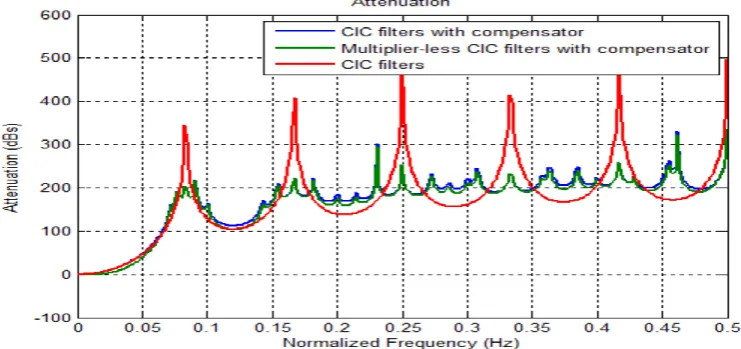
Figure 7: Attenuation Graph of 2×2 MIMO system based Optimization Filter
Figure 8: MagnitudeResponse of 2×2 MIMO system based Optimization Filter
ISSN(Online): 2319-8753 ISSN (Print): 2347-6710
I
nternational
J
ournal of
I
nnovative
R
esearch in
S
cience,
E
ngineering and
T
echnology
(A High Impact Factor, Monthly, Peer Reviewed Journal) Visit: www.ijirset.com
Vol. 8, Issue 7, July 2019
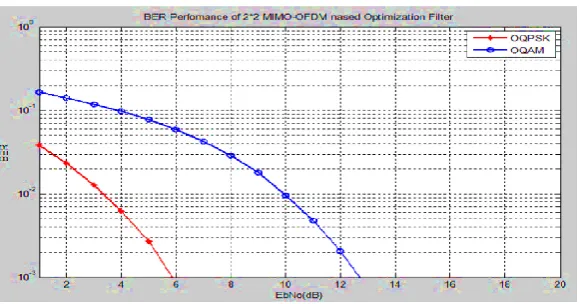
Figure 9: BER Analysis of 2×2MIMO system based Optimization Filter
MIMO-OFDM 2×2 System with filter optimization based FBMC technique discussed in this research work in term of bit error rate (BER) is shown in figure 6. The offset quadrature amplitude modulation (OQAM) is increase signal to noise ratio (SNR) compared to OQPSK.
VI. CONCLUSION
Both OFDM and FBMC strategies depend on the basic working principles of IFFT/FFT computational engines. However, the procedure of adding CP in OFDM prompts an overhead that adversely impacts on the transmission bandwidth efficiency. Though cyclic prefix is absent in case of FBMC and blend of filter banks prompts greatest productivity and information transmission speed. A similar channel bank can be utilized for transmission and reception in FBMC transceiver architecture which ensures low BER and high performance compatibility in terms latency and throughput. The out-of-band reduction of the prototype filter amplitude curve in FBMC system assures spectral preservation of other subscribers which leads to new physical layer containment for future communication system.
REFERENCES
[1] Zongmiao He, Lingyu Zhou, Yiou Chen, Xiang Ling, “Filter Optimization of Out-of-Band Emission and BER Analysis for FBMC-OQAM System in 5G”, 2017 9th IEEE International Conference on Communication Software and Networks.
[2] Mawlawi, B., Dore, J.B., Berg, V. “Optimizing contention based access methods for FBMC waveforms, Int. Conf. on Military Commun. and Information Systems,” Cracow, Poland, May 2015, pp.1-6.
[3] Viholainen, A.,Ihalainen, T., Stitz, T.H., Renfors, M., and Bellanger “Prototype filter design for filter bank based multicarrier transmission,” 17 th Euro. Signal Process Conf., Glasgow, Scotland, August 2009, pp. 24-28.
[4] Chen, D., Qu, D.M., and Jiang, T. “Novel prototype filter design for FBMC base cognitive radio systems through direct optimization of filter coefficients,” IEEE Int. Conf. Wirel. Commun. &Signal Proc., Suzhou, China, October 2010, pp. 21-23.
[5] P. Siohan, C. Siclet, and N. Lacaille, “Analysis and design of OFDM/OQAM systems based on filter bank theory,” IEEE Trans. Signal Process., vol. 50, no. 5, pp. 1170–1183, May 2002.
[6] B. Farhang-Boroujeny, ”OFDM Versus Filter Bank Multicarrier”, IEEE Signal Processing Magazine, vol. 28, pp. 92-112, May 2011. [7] B. Farhang-Boroujeny, “Cosine Modulated and Offset QAM Filter Bank Multicarrier Techniques A Continuous-Time Prospect,” EURASIP
Journal on Advances in Signal Processing, pp. 6, Jan 2010.
[8] V. Ari, B. Maurice, and H. Mathieu, “WP5: Prototype filter and filter bank structure”, PHYDYASPHYsicallayer for Dynamic AccesS and cognitive radio, Jan 2009.
[9] B. Hirosaki, “An analysis of automatic equalizers for orthogonally multiplexed QAM systems,” IEEE Transactions on Communications, 28(1). pp. 73-83, Jan. 1980.
[10] S. Nedic and N. Popvic, ”Per-bin DFE for advanced OQAM-based multicarrier wireless data transmission systems,” Broadband Communications, 2002. Access, Transmission, Networking. 2002 International Zurich Seminar on, pp. 38-1, Feb. 2002.
ISSN(Online): 2319-8753 ISSN (Print): 2347-6710
I
nternational
J
ournal of
I
nnovative
R
esearch in
S
cience,
E
ngineering and
T
echnology
(A High Impact Factor, Monthly, Peer Reviewed Journal) Visit: www.ijirset.com
Vol. 8, Issue 7, July 2019
[12] A. Ikhlef and J. Louveaux, ”An enhanced MMSE per subchannel equalizer for highly frequency selective channels for FBMC/OQAM systems,” Proc. IEEE 10th
Workshop on Signal Processing Advances in Wireless Communications, pp. 186-190. June 2009.
[13] Aparna Singh Kushwah, Monika Jain, “Performance Enhancement of MIMO-OFDM System based on Spectrum Sensing Cognitive Radio Networks using Matched Filter Detection”, International Journal of Innovative Research in Computer and Communication Engineering, Vol. 6, Issue 6, June2018.
[14] Aparna Singh Kushwah, Alok Kumar Shukla, “BER Reduction of Distributed Spatial Modulation in Cognitive Relay Network based MIMO-OFDM System”, International Journal of Innovative Research in Computer and Communication Engineering, Vol. 6, Issue 6, June2018. [15] Kwentus, Z. Jiang, and A. Willson, Jr., “Application of filter sharpening to cascaded integrator-comb decimation filters,” IEEE Transactions



![SYNTHESIS, CHARACTERIZATION AND CHELATING PROPERTIES OF POLY[AZO (1 NAPTHOL)]](data:image/gif;base64,R0lGODlhAQABAIAAAP///wAAACH5BAEAAAAALAAAAAABAAEAAAICRAEAOw==)