ISSN(Online): 2320-9801
ISSN (Print): 2320-9798
International Journal of Innovative Research in Computer
and Communication Engineering
(An ISO 3297: 2007 Certified Organization)
Vol. 3, Issue 7, July 2015
A New Scheme Location Based Caching In
DTN for Efficient Data Access
Archana D. Shinde
1, Prof. Jyoti Raghatwan
2P.G. Student, Department of Computer Engineering, RMD SSCOE Engineering College, Pune, Maharashtra, India1
Associate Professor, Department of Computer Engineering, RMD SSCOE Engineering College, Pune, Maharashtra,
India2
ABSTRACT: Data caching can considerably improve the efficiency of data access in a wireless network which helps to reduce the access latency and bandwidth usage. This study works in DTN network as Disruption Tolerant Network (DTN) is a network architecture that is designed to distribute communications in almost stressed, unstable environments, where that network should be focus on long lasting and frequent disruptions, high bit error rates which would tries to degrade normal communications. In this paper, the location based caching severely keeping track of a node or a set of moving nodes and answer queries related to their particular locations through their paths. Data is efficiently accessed in DTN. This work consider Network centre location (NCL) to be find out among the available nodes in the network and the cache placement problem of reducing total cost of data access in mobile networks with several data nodes with limited memory capacity. This work uses distributed algorithm that logically expands to networks with nodes and state that it appreciably performs better than another existing caching technique in all important performance metrics.
KEYWORDS:Disruption Tolerant Network (DTN), Network centre location (NCL), Location Based Caching, Data Access.
I. INTRODUCTION
Disruption Tolerant Network (DTN) is a networking architecture which is considered to provide communications in the a large amount stressed and unstable environments, at where the network would usually be subject to long lasting and frequent disruptions and also high bit error rates with the intention of severely degrade normal communications. DTN is a scheme to computer network architecture which seeks to address the practical issues in varied networks that can lack constant network connectivity. A lot of DTN routing protocols make use of a multiplicity of techniques, counting discovering the meeting probabilities surrounded by nodes, network coding and packet replication. The key focus of these mechanisms is to raise the probability of finding a path with restricted information, so these strategies have only an minor effect on routing metrics like highest or average delay of delivery. Disruption-tolerant networks (DTNs) allow transfer of data while mobile nodes are connected only from time to time. Applications of DTNs contain, vehicular networks, ocean sensor networks, large scale disaster recovery networks, people net, networks for ecological monitoring. Irregular connectivity may be a result of mobility, wireless range, sparsely, or malicious attacks power management. The inherent doubt about network conditions in DTNs makes routing a challenging problem. Unfortunately, the load of finding one path is so huge that obtainable approaches have only an minor rather than an intentional effect on such routing metrics as average delay, worst case, delivery latency, or percentage of packets delivered.
ISSN(Online): 2320-9801
ISSN (Print): 2320-9798
International Journal of Innovative Research in Computer
and Communication Engineering
(An ISO 3297: 2007 Certified Organization)
Vol. 3, Issue 7, July 2015
based caching for this group of location based services, transferring location information of users is not the goal of the service. However, this group of services is at rest location based in that the output of such a service is a function of location information users. As a result, it will be model if no added information about location information of users is leaked through the running of such a service. Increasing demand to modern technologies and also interest in utilizing information servers to give useful information services to mobile users as nodes even if wireless networks plays a very important factor to Location based advancement.
Even though forwarding strategies have been builds in DTNs [3], [4], [5] but limited research efforts on supporting efficient data access to nodes or mobile users, regardless of the importance of data accessibility in many nodes or mobile applications. For instance, it is necessary that smart phone users may discover interesting digital content from their nearly nodes. In vehicular ad-hoc networks (VANETs), the opportunity of live traffic information will be important for vehicles that used to avoid traffic delays. So, in these applications, data are only used to request by mobile users at any time needed, the requesters do not know locations of data in advance. So that the destination of data is, therefore, unknown when data are generated. The communication paradigm dissimilar from publish and relay systems [6], [7] in that data are forwarded by broker nodes to other users as stated to their data subscriptions. In such cases the specific network design is needed to make sure that data can be immediately accessed by requesters. Location-based services (LBS) generally operate in a architecture contains central nodes that stores past and current locations of all nodes, and a set of moving nodes or a moving node that constantly change their locations. As moving node/s mark their changing locations regularly, new address are delivered to the routing table and update table[8].
Cooperative caching has been achieved for web-based applications and also for wireless ad hoc networks [9], [10], that allow coordination and sharing in group of multiple caching nodes. It is difficult to be aware off in DTNs because of the shortage of persistent network connectivity. The opportunistic network connectivity intricate the estimation of delay of data transmission, and besides makes it difficult to calculate appropriate caching locations for decreasing data access delay and this difficulty is gained by the inaccurate or incomplete information at individual nodes about query history. And because of the uncertainty of data transmission, multiple several data copies need to be cached at different locations to make sure accessibility of data. It also used to find the difficulty in coordinating multiple caching nodes that finds it hard to gain the trade off in between data accessibility and caching overhead.
The Objective based on the location based caching that severely keeping track of a node or a set of moving nodes and answer queries applicable to their particular locations through their paths. Data is efficiently accessed in DTN and finding network central location (NCL) among all nodes. And also problem of reducing total cost of data access in mobile networks with several data nodes with limited memory capacity. In this network model, multiple data items are there, every data item has a server, a set of clients which wish to access the data item at a given frequency. Each node then carefully selects data items to cache in its limited memory to reduce the cost of overall access. Specifically, the work builds an efficient strategy to choose data items to cache at every node.
II. RELATED WORK
Up till now many work has been done on data forwarding, but very limited work was done on efficient data access. In DTNs, research on data forwarding emerged from Epidemic routing [11], that destroy the entire network. Later studies based on proposing selection of relay metrics efficiently to proceed towards the performance of Epidemic routing with less forwarding cost, focused on forecast of contacts of node in the future. Some other approaches do such forecast based on their mobility patterns, that are identified by Kalman filter [10] or semi-Markov chains [12]. In some other schemes, node contact pattern is exploited as abstraction of node mobility pattern for better prediction accuracy [4], focused on the node contact characteristics. The social network properties of node contact patterns, such as the centrality and community structures, have also been also exploited for relay selection in recent socialbased data forwarding schemes [13]. The preceding metrics for relay selection can be requested to multiple forwarding strategies that distinguish in the number of data copies generated in the network.
ISSN(Online): 2320-9801
ISSN (Print): 2320-9798
International Journal of Innovative Research in Computer
and Communication Engineering
(An ISO 3297: 2007 Certified Organization)
Vol. 3, Issue 7, July 2015
metric. On the other hand, data access in DTNs can be supplied in several ways. Data can be spread to particular users based on their interest profiles. Predict and relay systems [10], were used for data dissemination. Another way to give efficient data access is Caching. Cooperative caching in wireless ad hoc networks [9], in this every node caches pass by data focused on data popularity, therefore queries in the future can be responded with minimum delay. Caching locations are preferred by chance through all the network nodes. Some research focuses on [1], have been developed for caching in DTNs, but they are only used to improve data accessibility from framework network like Wi-Fi access points i.e. APs or Internet [1]. Using peer to peer scheme, data sharing and access between mobile users are typically rejected. Distributed assurance of caching policies for reducing delay of data access in DTNs [16]. In [16], users are synthetically divided into several classes so that users that are in the same class are identical. In [9], data are intentionally cached at particular locations of network with generic data and also query models and based on global network knowledge, these caching locations are calculated. Relatively, in this paper, the propose scheme supports location based caching in DTNs in a fully distributed manner, with patterns of composite node contact and their behaviours.
The cooperative caching in DTN, according to Wei Gao, Guohong Cao, Arun Iyengar, and Mudhakar Srivatsa, Cooperative Caching for Efficient Data Access in Disruption Tolerant Networks, MARCH 2014, allows the coordination and sharing of cached data through multiple nodes and minimizes data access delay. It supports an efficien t scheme which ensures selection of appropriate NCL focused on a probabilistic selection metric as well coordinates multiple caching nodes. In this, a data access scheme to probabilistically coordinate various caching nodes for replying to user queries and determine the tradeoff between data accessibility and caching overhead, to reduce the average number of cached data copies in the network. Cooperative caching is heavy to be realized in DTNs because of lack of connectivity of persistent network. But cooperative caching have some drawbacks as the opportunistic network connectivity intricate the approximation of delay of data transmission, and besides makes it trouble to determine appropriate locations of caching for minimizing data access delay. And other is because of the unreliability of data transmission; various copies of data need to be cached at multiple locations to make sure data accessibility.
III.PROPOSED ALGORITHM
A. System Architecture
A requester asks the network for data access, the caching nodes or data source respond to the requester with data. Here, for caching every node has limited space. Or else, data may be cached all over, and it is insignificant to design different caching methods. In wireless ad hoc networks, the design of caching method profits from the supposition of existing end to end paths in the middle of mobile nodes, and also the path from a requester to the data source leftovers unaffected during data access in most cases. Such supposition enables any intermediate node to cache the pass by data on the path. So, the basic key to improve performance of caching in DTNs is to control the capacity of nodes being involved for caching. As a replacement for being incidentally cached data anywhere, data are intentionally cached only at definite nodes. And so these nodes are selected carefully to make sure data accessibility, and constraining the capacity of caching locations that minimizes the complexity of making caching decision. And therefore, To improve the access efficiency and lighten the conflict of restricted wireless bandwidth in mobile environments, data caching techniques are particularly important for location based services.
ISSN(Online): 2320-9801
ISSN (Print): 2320-9798
International Journal of Innovative Research in Computer
and Communication Engineering
(An ISO 3297: 2007 Certified Organization)
Vol. 3, Issue 7, July 2015
Fig.1. System Architecture
The basic idea is, to cache data intentionally with multiple locations but at a specific set of NCLs that can be simply accessed by another node in the network. Nodes in the network forwarded to NCLs for access the data efficiently. The system architecture of proposed scheme is illustrated in Fig.1. Whenever the node wish to communicate with another node in a network, and if that node is active, then that node is organized. Among all nodes in the network, on the basis of highest priorities and shortest distance the NCL network central locator is find out. Integrated cache routing routes the nodes in the network and nodes with address and path are stored or updated in routing table. Simultaneously, Location Caching Policy is applying on the nodes. Distributed Caching DTN includes a module of cache enabling and subscribes storage and caching functionality. It collaborates to perform cache for nodes that updated in the routing table or the cache it for retrieving them to reply to requests. And also gives a caching interface for updating nodes. Finally the routing table is updated in network tree. So that data can be efficiently accessible in future. By the analysis, three modules has been come out in the work design. The modules have characteristics as follows:
Self-Organizing
Self-Addressing
Delete the path that updated in routing table.
Each node which are cache the data items are most frequently accessed by itself. Removes replications within neighboring nodes. The Creation of constant groups to gather neighborhood information and find caching placements. Every node behave as a server. That server keeps the nearest cache node by using routing protocol. It save data item on restricted area. If distinct data items are stay alive that will be replaced.
B. Mathematical Model
Set theory:
S={N, L, E, C}
where, N=no. of nodes= {n1, n2, n3, ..., ni} L=location of node= {l1, l2, l3, . . ., li}
E=edges between two nodes= {e1, e2, e3,..., ei } C=central nodes at NCL= {c1, c2, c3,..., ci}
Whenever a central node fails or depleted, another node is taken as a new central node. Spontaneously, the new central node is the one with the best NCL selection value within current non central nodes that are in the network. Therefore, the metric Ci for a node i to be selected as a central node to represent NCL is defined as follow:
ISSN(Online): 2320-9801
ISSN (Print): 2320-9798
International Journal of Innovative Research in Computer
and Communication Engineering
(An ISO 3297: 2007 Certified Organization)
Vol. 3, Issue 7, July 2015
To calculate shortest distance between a node Pi and all other reachable nodes, closeness for a given node is calculated as:
Fig 2. State Diagram Where,
S1: Network is organized
S2: Caching policy is applied to find NCLs S3: Integrated caching
S4: Distributed caching is applied to find DTN S5: Routing table is updated.
IV.PSEUDO CODE
Step 1: Initialized nodes
Step 2: Creates socket for each node Step 3: If node is active
then, go to step no. 3 else, go to step no. 10 Step 4: Organize it
send ack msg for communication purpose from one node to another Step 5: Apply caching policy to find NCL
assign central locator from selected routing table (i.e. c1 from n1, n2, n3,...,ni)
Step 6: Approach integrated caching for route updating Step 7: Message sends from one node to another Step 8: Update routing table
Step 9: Apply distributed caching in DTN Step 10: End
V. SIMULATION RESULTS
ISSN(Online): 2320-9801
ISSN (Print): 2320-9798
International Journal of Innovative Research in Computer
and Communication Engineering
(An ISO 3297: 2007 Certified Organization)
Vol. 3, Issue 7, July 2015
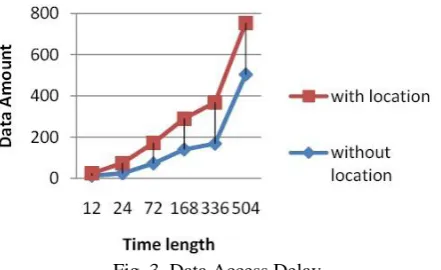
Fig. 3. Data Access Delay
The above graph shows that, the amount of data to be cached versus time required. With location based caching, the data is access in efficient manner with minimum delay. That is, the transfer rate between two nodes is reduced. So that minimum time is required for caching the data as compared with without location. By without location, it is clear that, Data can be access with maximum delay in maximum time. So that efficiency may degrade the performance of caching.
VI.CONCLUSION
Location caching scheme is constantly monitor a node or a set of moving nodes and replies to their locations and access the data efficiently in DTN with minimum delay. Application based on location-based caching in DTN, constantly monitor a node or a set of moving nodes in the network and answers queries related to their locations through the paths. It helps to access the data efficiently in DTN. Data caching techniques are particularly important for location based services. In this paper, the work propose a new scheme to support location based caching in DTNs. Data are intentionally cache at a set of NCLs, which can be easily accessed by other nodes. This approach coordinates caching nodes to optimize the trade off between data accessibility and caching overhead. The propose scheme build a network which gives efficient data accessibility from the updated routing table.
REFERENCES
1. Mikko Juhani Pitkanen, Jorg Ott Helsinki university of Technology, , Kyoto, Japan “Networking Labo”ratory Redundancy and Distributed Caching in Mobile DTNs” MobiArch07, August 2731, 2007.
2. Wei Gao, Guohong Cao, Arun Iyengar, and Mudhakar Srivatsa, Member, IEEE “Cooperative Caching for Efficient Data Access in Disruption Tolerant Networks” IEEE TRANSACTIONS ON MOBILE COMPUTING, VOL. 13, NO. 3, MARCH 2014.
3. J. Burgess, B. Gallagher, D. Jensen, and B. Levine, “MaxProp: Routing for Vehicle-Based Disruption-Tolerant Networks”, Proc. IEEE INFOCOM, 2006.
4. Balasubramanian, B. Levine, and A. Venkataramani, “DTN Routing as a Resource Allocation Problem,” Proc. ACM SIGCOMM Conf. Applications, Technologies, Architectures, and Protocols for Computer Comm., pp. 373-384, 2007.
5. V. Erramilli, A. Chaintreau, M. Crovella, and C. Diot, “Delegation Forwarding”, Proc. ACM MobiHoc, 2008.
6. E. Yoneki, P. Hui, S. Chan, and J. Crowcroft, “A Socio-Aware Overlay for Publish/Subscribe Communication in Delay Tolerant Networks,” Proc. 10th ACM Symp. Modeling, Analysis, and Simulation of Wireless and Mobile Systems (MSWiM), pp. 225-234, 2007.
7. F. Li and J. Wu, “MOPS: Providing Content-Based Service in Disruption Tolerant Networks,” Proc. Intl Conf. Distributed Computing Systems (ICDCS), pp. 526-533, 2009.
8. Hui Ding, Aravind Yalamanchi, Ravi Kothuri, Siva Ravada, Peter Scheuermann Dept. of EECS, “QACHE: Query Caching in Location-Based Services” ,Northwestern University, Oracle USA,.
9. L. Yin and G. Cao, Supporting “Cooperative Caching in Ad Hoc Networks,” IEEE Trans. Mobile Computing, vol. 5, no. 1, pp. 77-89, Jan. 2006.
ISSN(Online): 2320-9801
ISSN (Print): 2320-9798
International Journal of Innovative Research in Computer
and Communication Engineering
(An ISO 3297: 2007 Certified Organization)
Vol. 3, Issue 7, July 2015
12. P. Costa, C. Mascolo, M. Musolesi, and G. Picco, “Socially Aware Routing for Publish-Subscribe in Delay-Tolerant Mobile Ad Hoc Networks,” IEEE J. Selected Areas in Comm., vol. 26, no. 5, pp. 748- 760, June 2008.
13. Huiji Gao and Huan Liu Data Analysis on “Location-Based Social Networks” Arizona State University, Tempe, Arizona, USA.
14. T. Spyropoulos, K. Psounis, and C. Raghavendra, “Spray and Wait: An Efficient Routing Scheme for Intermittently Connected Mobile Networks,” Proc. ACM SIGCOMM Workshop Delay-Tolerant Networking, pp. 252 259, 2005.
15. V. Erramilli, A. Chaintreau, M. Crovella, and C. Diot, “Delegation Forwarding,” Proc. ACM MobiHoc, 2008.