ISSN(Online): 2320-9801 ISSN (Print): 2320-9798
I
nternational
J
ournal of
I
nnovative
R
esearch in
C
omputer
and
C
ommunication
E
ngineering
(A High Impact Factor, Monthly, Peer Reviewed Journal)
Vol. 4, Issue 1, January 2016
Analysis on Data Protection in Cloud
Computing Using Data categorization
Procedure
Ankita Parouha1*, Prof .Sapna Choudhary2, Prof .Anupam Choudhary3
M.Tech Scholar, Dept. of Computer Science Engineering, Shri Ram Group of Institutions, Jabalpur, Rajiv Gandhi
Prodyogiki Vishwavidhyalaya, Bhopal, India1*
Head of Department C, Shri Ram Group of Institutions, Jabalpur, Rajiv Gandhi Prodyogiki Vishwavidhyalaya, Bhopal,
India 2
Professor, Kala Niketan Polytechnic College, Jabalpur Rajiv Gandhi Prodyogiki Vishwavidhyalaya, Bhopal, India3
ABSTRACT: Cloud computing is well-known for delivering information technology services based on internet. Currently, organizations are concerned in affecting their huge records and computation into cloud to collect their major revenue. As cloud storage space is striking a choice for user in trust their data online, it comes with the safety threats and the challenge of defensive their data from not permitted access. Many safety measures controls have been optional by overriding bodies, industry standards etc. as strategy to be implement by cloud storage providers (CSPs) but the complete set of controls cannot be fully implemented due to several challenges such as decreasing ease of use, less user expediency, need of a strong infrastructure etc. Therefore, we anticipate the need to apply security based on category of data determined by users. Data categorization provides one of the most basic ways for organizations to determine and assign relative values to the data they possess. The process of data categorization allows organizations to categorize their stored data by compassion and business impact in order to determine the risks associated with the data. The proposed security system acclimates well for cloud environment and is also customizable and more reliant to meet the required level of security of data with different sensitivity that changes with business needs and commercial conditions
KEYWORDS:Cloud computing; Data security, cloud storage, Client side Encryption, Cryptography, Multilevel security.
I. INTRODUCTION
The cloud storage provides the facility for user requiring mainly highly scalable storage on demand and accessible globally. CSPs have been implementing controls to secure access to sensitive data in the cloud such as two-factor authentication, encryption etc [5]. making access to the data more difficult for attackers.
ISSN(Online): 2320-9801 ISSN (Print): 2320-9798
I
nternational
J
ournal of
I
nnovative
R
esearch in
C
omputer
and
C
ommunication
E
ngineering
(A High Impact Factor, Monthly, Peer Reviewed Journal)
Vol. 4, Issue 1, January 2016
Encryption is an effective and widely known as the primary solution to protect data but it is not fool-proof. Additionally, to encrypt the whole data on cloud in order to protect against unauthorized accessed will need a robust infrastructure and is greatly expensive to be enforced [3]. Therefore, it has not been consider as the best option for CSPs. Then again, an increase in security measures affects the usability of the data and therefore causing the system to be shunned by users. It is known that not all data stored in cloud storage is private or confidential. Some of the data is less important and therefore need basic protection. Most CSPs are unenthusiastic to reduce the efficiency of accessing into cloud storages because users expect an equally efficient access into a secured data as the plain text ones. We foresee the effort of protection based on an acknowledged security level of data determined by the users. Security levels for data protection can be applied as an option to protect data in cloud storage [9]. There are various ways of protecting a data such as categorizing it into several security groups having different level of protection mechanism. For an example, in the military services, several categorizations are for each category, different level of protection is applied. Imagine top secret assets are protected in-depth with multilayer of shields before the asset can be accessed [13].
II. ROLES AND RESPONSIBILITY IN CLOUD COMPUTING
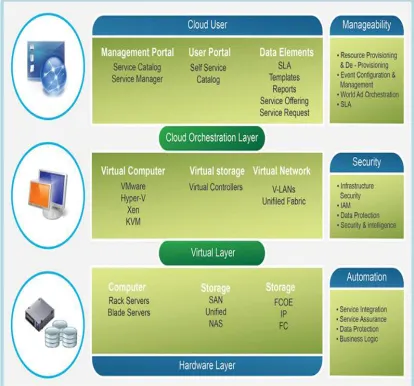
Authorization requires an essential understanding of the roles and responsibilities of organizations, cloud providers, and customers. Cloud providers must have operational practices in place to prevent unauthorized access to customer data; it’s also important to note that any compliance requirements a customer organization has must also be supported by the provider [6]. Although cloud providers can help manage risks, customers need to ensure that data categorization management and enforcement is properly implemented to provide the appropriate level of data management services. Data categorization responsibilities will vary based on which cloud service model is in place, as shown in the following figure. The three primary cloud service models are infrastructure as a service (IaaS), platform as a service (PaaS), and software as a service (SaaS). Implementation of data categorization mechanisms will also vary based on the reliance on and expectations of the cloud provider [17].
Fig 1.2 Cloud Computing Layer Responsibilities
ISSN(Online): 2320-9801 ISSN (Print): 2320-9798
I
nternational
J
ournal of
I
nnovative
R
esearch in
C
omputer
and
C
ommunication
E
ngineering
(A High Impact Factor, Monthly, Peer Reviewed Journal)
Vol. 4, Issue 1, January 2016
supports the data protection requirements mandated by their data categorization . Customers should not migrate data to a cloud provider that cannot address their data protection needs.
III. RELATED WORK
Previous researches on cloud storage have emphasis on a wide range of technical approaches over the fore mentioned concerns. Access security measures are generally considered in three steps: Authentication, Authorization and Encryption.
Some security measure includes effort to secure access based on hardening passwords [9]–[11]. Generating strong passwords and protecting them from getting stolen guarantees a password security. Researchers have established that strong passwords are necessarily long, random and hard to crack but often difficult to remember. Bang et al. suggests that security is not just a technical issue but also a behavioural issue involving users, mostly untrained ones [12]. An authorization process ensures that a person has the right to assess a certain re-sources and limits of the access unknowing of other user information. Users may have access but have a specific role or authority to do something within their scope. A paper suggested an authorization model suitable for cloud services that support hierarchical role-based access control (RBAC), path-based object hierarchies and federation [13] in multi-tenancy environment. These features provide a convenient authorization service for cloud, especially those using path-based patterns such as REST APIs. Although authorization usually supports high scalability, it is believed to improve scalability and this would hopefully enable more fine grained control on the authorization information. A comprehensive approach using encryption ranging from data-in-transit to data-at-rest have been researched widely. Mostly developed a cryptographic cloud storage system; symmetric [14], [15] and asymmetric [16]– [19]. It is a standard approach to apply encryption techniques into sensitive data to secure it. Encryption has always been seen as the ultimate security measure but it also comes with a set of difficulties. Traditional encryption is done by transferring the data files locally and decrypting it. A cryptographic cloud storage system called CS2 was amongst early research done on applying symmetric encryption techniques that ensures confidentiality, integrity and verifiability without being resource hungry [14].
Security Threats
Cloud storage is a service that comprises of benefits and also challenges. It inherent vulnerabilities, but these have never discourage users from taking advantage of its functionality and flexibilities. Cloud users are data owners that have concerns whether their data are secured and protected in the cloud. With the adoption of a cloud model, users lose control over data security. In fact, in most known cloud storage, users are sharing the resources with other users. Security threats are a possible vulnerability that may breach security and cause harm to a user or organization. These threats are potential in causing adverse impact. A threat may be happening from inside or outside of an organization or either intentional or accidental. In previous researches, it is shown many security threats are happening in the cloud. We will review security threats happening in cloud storage in this section [2]–[6].
DATACATEGORIZATION INDETERMININGSECURITYLEVELSOFPROTECTION
The cloud is a multi-tenant environment, where resources are shared. Threats can happen from anywhere; inside the shared environment or from outside of it. However, placing sensitive data in shared cloud storage is apparently risky. Accidental or due to a malicious hacker attack, data privacy, loss or leakage and unavailable for access would be a major security violation involving confidentiality, integrity and availability.
ISSN(Online): 2320-9801 ISSN (Print): 2320-9798
I
nternational
J
ournal of
I
nnovative
R
esearch in
C
omputer
and
C
ommunication
E
ngineering
(A High Impact Factor, Monthly, Peer Reviewed Journal)
Vol. 4, Issue 1, January 2016
Fig. 1.3 Protection Levels
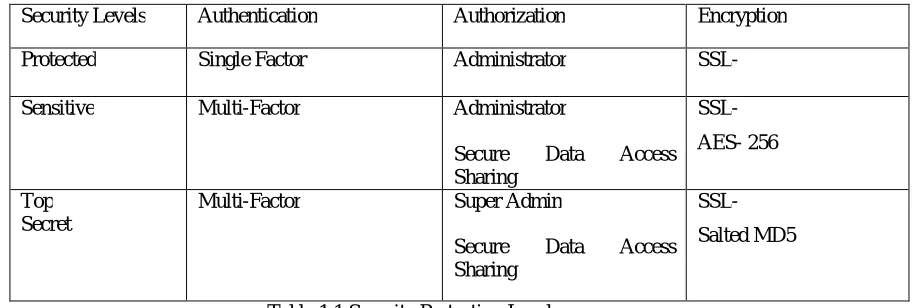
There are various ways of protecting a data such as categorizing it into several security groups having different level of protection mechanism as shown in figure above. Security categorization is known as the process of managing and organising security protection into levels and categories for its most effective and efficient application. A well-planned security categorization system makes data protection easier to implement. This can be of particular importance for risk management, legal discovery, and compliance. Assigning a security level of protection to different data categorization in cloud storage will give different level of sensitivity to classified information.
SECURITYPROTECTIONLEVELSINCLOUDSTORAGE
Security Levels Authentication Authorization Encryption
Protected Single Factor Administrator SSL-
Sensitive Multi-Factor Administrator
Secure Data Access
Sharing
SSL-
AES- 256
Top Secret
Multi-Factor Super Admin
Secure Data Access
Sharing
SSL-
Salted MD5
Table 1.1 Security Protection Levels
In this framework, we propose three levels of security categorization s: protected, sensitive and top secret. In table above, the security protection levels in cloud storage is briefly shown. These security protections for protected and sensitive levels are based on existing control and measure by some known cloud storage providers.
i. Protected (Single Factor Authentication)
Protected level involves security protection for data that is for public or free distribution. Usually this includes data and that are not critical to user needs. This categorization can also include data that has deliberately been shared to the public for use, such as marketing material. This level of protection is provided by most cloud storage provider in the market.
Single factor authentication usually involves single layer of security access such as password protected.
a. Authorization
ISSN(Online): 2320-9801 ISSN (Print): 2320-9798
I
nternational
J
ournal of
I
nnovative
R
esearch in
C
omputer
and
C
ommunication
E
ngineering
(A High Impact Factor, Monthly, Peer Reviewed Journal)
Vol. 4, Issue 1, January 2016
b. Encrypted at Rest and In Transit
A normal encryption method in a cloud storage involve protecting data in transit using Secure Sockets Layer (SSL)/Transport Layer Security (TLS) for data transfer to create a secure tunnel protected by 128/256-bit SSL security.
ii. Sensitive (Multi Factor Authentication)
Sensitive level involves security protection for data that is classified as being of medium sensitivity including data that would not have a severe impact on the user if lost or destroyed. Generally, this categorization includes data for non-public view. This categorization may include corporate data as most data that are accessed frequently or in daily use
can be classified as sensitive. Multi-factor authentication such as two-step
verification or re-entering password. Some CSP has introduced password protection as the first layer of authentication and another security codes sent to the registered mobile number or using a mobile app as the second authentication.
a. Authorization
A user is usually Administrators for their own data on cloud storage with privileges to create, edit and delete it.
b. Encrypted at Rest and in Transit
A normal encryption method in a cloud storage involve protecting data in transit using Secure Sockets Layer (SSL)/Transport Layer Security (TLS) for data transfer to create a secure tunnel protected by 128/256-bit or higher Advanced Encryption Standard (AES) encryption. Once it reaches the cloud storage, it is protected using 128-bit AES encryption at rest.
iii. Top Secret (Salted MD5)
Top secret level involves security protection for data that is classified as confidential or restricted including data that can be catastrophic to one or more user if com-promised or lost such as personal data, including personally identifiable information such as Social Security or national identification numbers (passport numbers etc.) that will encrypted with high digest algorithm SALTED MD5.
b. Authorization
In a top secret level, a user is a Super Admin with privileges to create, edit and delete data and but with highest level of access.
c. Encrypted at rest, in process, and in transit
A top secret encryption method in a cloud storage involve protecting data in transit using Secure Sockets Layer (SSL)/Transport Layer Security (TLS) for data transfer to create a secure tunnel protected by 128/256-bit or higher Advanced Encryption Standard (AES) encryption. Once it reaches the cloud storage, it is protected using 128/256-bit AES encryption at rest. The data in process (in-use) is protected using 128/256-bit AES encryption or SHA.
IV.CONCLUSION AND FUTURE WORK
ISSN(Online): 2320-9801 ISSN (Print): 2320-9798
I
nternational
J
ournal of
I
nnovative
R
esearch in
C
omputer
and
C
ommunication
E
ngineering
(A High Impact Factor, Monthly, Peer Reviewed Journal)
Vol. 4, Issue 1, January 2016
REFERENCES
[1] Gartner, “Newsroom: Consumers Will Store More Than a Third of Their Digital Content in the Cloud by 2016,” Press Release, 2012. [2] CSA, “Top Threats to Cloud Computing V1.0,” 2010.
[3] CSA, “Cloud Computing Vulnerability Incidents_: A Statistical Overview,” 2013. [4] GTISC and GTRI, “Emerging Cyber Threats Report 2014,” 2013.
[5] F. Sabahi, “Cloud computing security threats and responses,” 2011 IEEE 3rd Int. Conf. Commun. Softw. Networks, pp. 245–249, May 2011. [6] F. Bashir Shaikh and S. Haider, “Security Threats in Cloud Computing,” 6th Int. Conf. Internet Technol. Secur. Trans. Abu Dhabi, UAE, no. December, pp. 11–14, 2011.
[7] Microsoft, “CISO Perspectives: Data categorization ,” Microsoft Trust. Comput. Doc., pp. 1–5, 2014. [8] Frank Simorjay, “Data categorization for cloud readiness,” Microsoft Trust. Comput. Doc., pp. 1 – 19, 2014.
[9] M. Weir, S. Aggarwal, B. De Medeiros, and B. Glodek, “Password cracking using probabilistic context-free grammars,” in Proceedings - IEEE Symposium on Security and Privacy, 2009, pp. 391–405.
[10] P. G. Kelley, S. Komanduri, M. L. Mazurek, R. Shay, T. Vidas, L. Bauer, N. Christin, L. F. Cranor, and J. López, “Guess again (and again and again): Measuring password strength by simulating passwordcracking
algorithms,” in Proceedings - IEEE Symposium on Security and Privacy, 2012, pp. 523–537.
[11] R. Zhao and C. Yue, “Toward a secure and usable cloud-based password manager for web browsers,” Comput. Secur., vol. 46, pp. 32–47, Oct. 2014.
[12] Y. Bang, D.-J. Lee, Y.-S. Bae, and J.-H. Ahn, “Improving information security management: An analysis of ID–password usage and a new login vulnerability measure,” Int. J. Inf. Manage., vol. 32, no. 5, pp. 409–418, Oct. 2012.
[13] J. M. A. Calero, N. Edwards, J. Kirschnik, L. Wilcock, and M. Wray, “Toward a Multi-Tenancy Authorization System for Cloud Services,” no. December, 2010.
[14] S. Kamara, C. Papamanthou, and T. Roeder, “CS2_: A Searchable Cryptographic Cloud Storage System,” pp. 1–25, 2011.
[15] H. M. Al-sabri and S. M. Al-saleem, “Building a Cloud Storage Encryption ( CSE ) Architecture for Enhancing Cloud Security,” vol. 10, no. 2, pp. 259–266, 2013.
[16] S. Zarandioon, D. Yao, and V. Ganapathy, “K2C: Cryptographic cloud storage with lazy revocation and anonymous access,” in Lecture Notes of the Institute for Computer Sciences, Social-Informatics and Telecommunications Engineering, 2012, vol. 96 LNICST, pp. 59–76.
[17] R. Zhang and P. Chen, “A Dynamic Cryptographic Access Control Scheme in Cloud Storage Services,” Int. J. Inf. Process. Manag., vol. 4, no. 1, pp. 104–111, Jan. 2013.
[18] D. Koo, J. Hur, and H. Yoon, “Secure and efficient data retrieval over encrypted data using attribute-based encryption in cloud storage,” Comput. Electr. Eng., vol. 39, no. 1, pp. 34–46, Jan. 2013.
[19] R. V Agalya and K. K. Lekshmi, “A Verifiable Cloud Storage using Attribute Based Encryption and Outsourced Decryption with Recoverability,” vol. 3, no. 10, 2014
BIOGRAPHY