76 | P a g e
A USER-CENTRIC DATA SECURE CREATION
SCHEME IN CLOUD COMPUTING
M.SHUSHEELA
1, L.KIRAN KUMAR REDDY
2 1Pursuing M.Tech (CSE),
2Working as an Assistant Professor & HOD Department of CSE,
Visvesvaraya College of Engineering & Technology, Affiliated to JNTUH, TELANGANA, (INDIA)
ABSTRACT
The use of the cloud computing technology, the ownership is separated from the administration of the data in cloud and the shared data might bemi grated between different clouds, which would bring new challenges to data secure creation, especially for the data privacy protection. We propose a User-centric data secure creation scheme (UCDSC) for the security requirements of resource owners in cloud. In this scheme, a data owner first divides the users into different domains. The data owner encrypts data and defines different secure managing policies for the data according to domains. To encrypt the data in UCDSC, we present an algorithm based on Access control conditions proxy re-encryption (ACC-PRE), which is proved to be master secret secure and Chosen-cipher text attack (CCA) secure in random oracle model. We give the application protocols and make the comparisons between some existing approaches and UCDSC.
Key words — User-centric, ACC-PRE, Data creation, Master secret secure, CCA. In this paper we
use a security analysis of algorithm .In this paper we focus on how a mediator can help a social
affair of customer to totally utilize the volume markdown assessing philosophy offered by cloud
organization providers through financially savvy online resource booking.
I.INTRODUCTION
Cloud computing promotes the sharing and spreading of information in network. According to its
characteristics, the ownership is separated from the administration of the data in cloud, which does not only
provide the convenience to the users, but also bring some serious challenges to the data privacy protection at the
same time. The cloud protects confidentiality, integrality and availability of data[1] based on some
cryptographic primitives. The researches on the data security management in cloud computing focus on three
aspects, e.g., secure creation, controllable usage[2] and trusted destruction[3], in which the secure creation
supports the other two. In order to protect the data hosted in cloud, data owners will encrypt their data before
uploading generally. Attribute based encryption (ABE) has been widely used in data encryption in cloud, which
77 | P a g e
regarded as one of the most suitable technologies for data access control in cloud storage. Yang et al. designed an access control framework for multi authority systems based on CP-ABE[5]. The researches above-mentioned
could provide theoretical proofs for encryption algorithms of data secure creation.
Currently, the resource is almost encrypted and uploaded by the data owner. With the amount of data increases,
the higher computing ability of data owner is required .The Proxy re-encryption (PRE)technology could be used
to solve the problem of large calculation, which also provides the theoretical support for implementations of
ABE and Identity based encryption (IBE)[6] in cloud computing environment. For the demand of fine-grained
information management, a new scheme called type based PRE mechanism was proposed in Ref.[7]. It refines
the access control of resource by dividing plaintext into different types and encrypts it by different private keys.
Tang et al. proposed two type-based PRE schemes of Chosen- issued by owners. For example, when a patient is transferred for further treatment, the medical record will been changed between different clouds for health care,
while it will also be migrated through the clouds of health care and cloud of insurance for the management of
medical insurance. On the other hand, the CSPs might issue the data migration between public clouds for their
storing requirement. For instance, CSPi would rent a server of CSPj for data redundant backup and protection. Further more, the network sharing will also result in the data migration. example, the academic search engine
might accelerate the exchanging process of the education information cached in the clouds. In conclusion, the
reasons for data migrations mainly include data owner, CSPs and data usage in the network
.
Based on the analysis above-mentioned, the cloud data could be created by the data owner and CPSs. The
owners could classify, package, encapsulate and encrypt their data to be the specified format at first. Then they
publish it to the cloud server. CSPs could integrate, re-package or combine the data dynamically according to
the users’ requirements, and the data of combining type is produced, which depends on the data of owners and
should get their permissions
.
The CSPs is the re-creator and manager of data. Therefore, the creation scheme proposed in this paper is
designed for the data owners’ creation, and the access control conditions will be introduced to the encryptions of
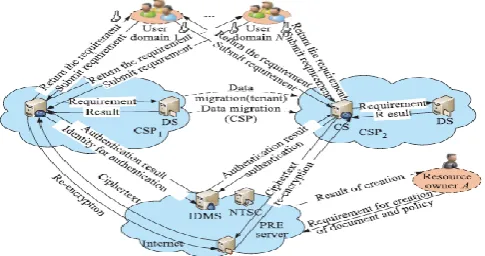
creation. The system model mainly includes the resource owners, CSPs and users, in which the servers of CSPs
include content managing server, identity authentication server, and data server. The content managing server
deals with the requirements of data creating or users’ accessing. The identity authentication server takes charge
in authenticating user’s identities. The data server is responsible for storing the encrypted data and its policies.
The resource owners are responsible for the data creation. The data includes the digital content and the
corresponding policies. Owners encapsulate the data, divide the users’ domain, and upload the encrypted data to
the data server via communication channel with the content server. general user wants to apply the permission
of accessing particular resource, he will send requirement to the current domain. The domain then sends the
user’s requirement with some other information about access when a on trot the content server for further
authentication. The content server will deal with the requirement with the identity server according to the secure
requirement of domain, e.g., identity, role, temporal state, platform, network etc.
Finally, the content server returns the result back to the user according to the policy description. It
78 | P a g e
design the server the plaintext/cipher text according to access control conditions, which is proved to
be CCA secure and master secret secure. The application protocols are based on the mature
cryptographic technologies which are able to protect the confidence and integrity of data, and prevent
hostile replay hacking. Comparisons of the proposed scheme with the current researches will be
given.
The rest of this paper is organized as follows. Section II presents the security scenario analysis and
system model of the UCDSC scheme. In Section III, the algorithm and corresponding application
protocols for the proposed scheme are presented. In Section IV, the security analysis is given. In
Section V, we make the comparisons. Finally, Section VI concludes the paper.
II. SCENARIO ANALYSIS AND SYSTEM MODEL:
1. The analysis of the cloud data migration ways and data creation types
The ownership of the data is separated from the administration in cloud. The resources, data and services are
provided to users in the form of virtualization. Due to the above situations, the problem of privacy protection
becomes more serious. It is important to analyze the ways to the data migration for the cloud data protection. It
will reflect the secure problems of and requirements for the data distribution and usage. Fig.1 illustrates a typical
application scenario of the data usage through the different clouds. Although there are a plenty of Cloud service
providers (CSPs) in clouds who construct and maintain the public clouds, there exist some private clouds in
different industries, companies and institutes, such as the clouds for healthcare, education, insurance, and
finance.
Advantages:
1. Here utilizing this (ROSA) calculation we include the cost effective framework utilizing here
straightforwardly client can choose markdown offers without cloud merchant inclusion
.
2
. Here we concentrate on how an intermediary can enable a gathering of clients to completely use the volumeto rebate cost procedure offered by cloud benefit providers(CSP) through cost-effective online asset planning
Disadvantages:
1
.This system cloud service provide different pricing strategies as you use as pay less unit for use less.79 | P a g e
III. SYSTEM ARCTECHTURE
Fig. 1. The system model for UCDSC
IV. THE CONSTRUCTION OF UCDSC:
1. Access control condition
By combining the traditional access control model with the requirements for data secure management, we
conclude the access control conditions into 2 types of subject and object. The subject types is consisted of role,
identity, time and environment. The object types include attribute, validity and lifecycle. In addition, the
conditions might involve security levels, categories, and direction of data stream for consideration of the
multi-level security. The ACC-PRE proposed in this section is mainly for the model in Fig. The conditions are
introduced for the key construction in encryption and decryption. Therefore, the conditions in this paper are
mainly focused on the subjects.
2. Algorithm description of the UCDSC scheme
1) Fundamental definition
Based on the above-mentioned analysis, the algorithm
description of the UCDSC scheme in cloud mainly includes the following 7 functions. In order to describe the
construction, let us assume that i and j denote the creator and the user of data respectively.
1 _Setup(K) → param: Given a security parameter K as input, the algorithm outputs the public security parametersparam.2 _KeyGen(param) → (ski, pki): Given param, thealgorithm outputs the public and private key pair.3 _Enc(m, pki) → Ci: Given the plaintext m and public key pki as input, the algorithm outputs the ciphertextCi.4 _ReKeyGen(ski, pkj , condition) → rk condition i→j :Given the private key, public key and condition as input, the algorithm outputs the re-encryption key on condition.5 _ReEnc(Ci, rk conditioni→j ) →
80 | P a g e
Bilinear Groups
:
G
1 and
G
2 are two multiplicative
cyclic groups of prime order
p
, and
g
is a
generator of
G
1.
e
:
G
1
×G
1
→ G
2 is a computable bilinear map with the following properties:
1
_
Bilinear: For all
a, b
∈
Z
∗
p
, we have
e
(
ga, gb
) =
e
(
g, g
)
ab
.2
_
Non-degenerate:
e
(
g, g
)
_
= 1.
V.DBDH (DECISIONAL BILINEAR DIFFIE-HELLMAN) PROBLEM
c
5 =
H
4(
c
1
c
2
c
3
c
4)
r
4 _ReKeyGen(ski, pkj , condition) → rk conditioni→j , this algorithm generates the re-encryption key based on Given _g, ga, gb, gc, e(g, g)abc_ for some a, b, c ∈
Z∗p , z = abc mod p, a polynomial- time algorithm A has advantage ε in solving the DBDH problem,
if and only if |Pr[A(g, ga, gb, gc, e(g, g)abc) = 0] − Pr[A(g, ga, gb, gc, e(g, g)z) = 0]| ≤ ε.To perfect the system above-mentioned, we will proposean ACC-PRE algorithm for UCDSC based on the
DBDH problem as follows. 1 _Setup(K) → param, this algorithm picks a K-bit prime p. G1, G2 are multiplicative cyclic groups of prime order p and g is a generator of G1. There are four hash functions
H1,H2,H3,H4 with H1 : {0, 1}∗ → G1, H2 : {0, 1}∗ → Z∗p , H3 : G2 → {0, 1}l, H4 : {0, 1}∗ → G1. It outputs public parameters param = {p,G1,G2, g,Hi(i =1, · · · , 4)}.Let us make an assumption that the access control conditions set condition = {0, 1}∗, bilinear map e :G1 × G1 → G2.2 _KeyGen(param) → (ski, pki), this algorithm picksxi, xj ∈ Z∗p , and outputs ski = xi,pki = gxi ,skj =xj ,pkj = gxj .3 _Enc(m, pki) → Ci: according to this algorithm,user i uses his public key pki to encrypt plaintext m. This algorithm picks k ∈ G2 to compute r =
H2(m k), and outputs Ci = (c1, c2, c3, c4, c5).
c1 = grc2 = k · e(pki,H1(pki))rc3 = m⊕ H3(k)
c4 = H1(pki)
condition, pkj and ski, and outputs the re-encryption key rk conditioni→j = (pkj, pkrj,H1(pkj condition) · H1(pki)ski, g−r).5 _ReEnc(Ci, rk conditioni→j ) → Cj,this algorithm outputs a cipher text Ci based on re-encryption key, where Cj = (c_1, c_2, c_3, c_4, c_5) if e(c1,H4(c1 c2 c3 c4)) =e(g, c5), otherwise, outputs the error information. The cipher text Cj can be decrypted with skj .
c_1 = c1
c_2 = c2 · e(pkrj g−r,H1(pki)−ski ) · e(pkr
j,H1(pkj condition)· H1(pki)−ski) = k · e(pkrj,H1(pkj condition))
c_3 = c3
c_4 = H1(pkj )
c_5 = H4(c_1, c_2, c_3, c_4)r
6 _Dec1(ski, Ci) → m, his algorithm recovers m by user i’s private key as follows: If e(c1,H4(c1 c2 c3 c4)) =
e(g, c5), it continues, otherwise, returns error information for integrity.
k = c2/e(c1, c4)ski m = c3 ⊕ H3(k)
r = H2(m k)
81 | P a g e
7 _Dec2(skj, Cj , condition) → m, this algorithm recovers m by user j’s private key and conditions condition
as follows: If e(c_1,H4(c_1 c_2 c_3 c_4)) = e(g, c_5), it continues, otherwise, returns errors for integrity.
k = c_2/e(c_1,H1(pkj ||condition))ski m = c_3⊕ H3(k)
r = H2(m k)
If c_1 = gr and c_2 = k · e(pkj,H1(pkj condition))r, then outputs m, otherwise, returns error.
Security Analysis:
1.Security analysis of algorithm
DBDH Assumption: We say that the DBDH assumption holds if no probably polynomial-time algorithm (A) has advantage ε in solving the DBDH problem.2) Security Model of ACC-PRE: Based on the security model of IND-PRE-CCA[13], adversary A can query theoracles such as key generation, encrypted key generation, re-encryption, decryption and so on. Our proposed scheme will be described as follows Setup: Challenger setups
system parameters param. Phase 1: Adversary can query one of the any oracles as follows: KeyGen, ReKeyGen,
ReEnc, Dec1, Dec2. During the querying of ReKeyGen, ReEnc, Dec1,Dec2, A’s private key is generated by KeyGen. Challenge: When A finishes Phase 1, the challenger picks and outputs m0,m1 ∈ M, access control condition condition∗ and a target public key pk∗ generated by KeyGen. Its corresponding private key is undisclosed. When A queries ReKeyGen with (pk∗,pk_,condition∗),the private key corresponding with pk_
should be undisclosed. Challenger picks b ∈ {0, 1} randomly and computes Cb =Enc(mb, pk∗) as the challenge to A
.
Phase 2: A is allowed to continue querying the sametypes of oracles as in Phase 1. At the end of Phase 2, wehave the following constraints.1 _If A queries ReKeyGen with (pk∗,pk_,condition∗),the corresponding private key is undisclosed.2 _If A queries ReEnc with (Cb,pk∗,pk_,condition∗),the corresponding private key is undisclosed.3 _A cannot query Dec1 with (C_b,pk∗) directly.4 _If A queries ReKeyGen with (pk∗,pk_,condition∗),
A cannot query Dec2 with C_b, where C_b is valid.Guess: A outputs a guess, if b_ = b, A will success.
Let us define the advantage of A to success as ε, whereε = |Pr[b_ = b]− 12|. If ε is negligible, A will fail. It meansthat the ACC-PRE is CCA security.
Theorem:
If DBDH assumption holds in groups (G1,G2), then the ACC-PRE is CCA secure based on random oracle model.
Proof sketch:
82 | P a g e
ε, then ε = |Pr[b_ = b] − 12| is negligible. Let us define challenging games as Gi(i = 1, · · · , 6), and challenger as B.Ti denotes the event which will happen when b_ = b in Gi._1 G0: Challenger B faithfully answers the oracle queries from A. At the same time, B initializes Hlisti (i =1, · · · , 4) by choosing π1, π4 ∈ G1, π2 ∈ Z∗p, π3 ∈ {0, 1}land setting (pki,π1),(m,k,π2),(k,π3), (c1,c2,c3,c4,π4) in
Hlisti (i = 1, · · · , 4). Let δ0 = Pr[b_ = b], then |δ0− 1
2| = ε._2 G1: Challenger B does the same as that in G0, except the following:B randomly picks τ ∈ {1, 2, · · ·,p + 1} to query H1 in τ times. When B receives A’s challenge to query H1,B aborts the game. Therefore, the probability of B to succeed is 1
p+1 at least. δ1 = Pr[b_ = b] in G1, and then
Pr[T1] = δ1p+1._3 G2: Challenger B does the same as that in G1, except the situation of Hi conflicting. The hash function sare the standard random oracles, so |Pr[T1] − Pr[T2]| is negligible.
4 G3: Challenger B does the same as that in G2, except the query of Dec2. In the oracle of Dec2 querying, if the input is (C,pk∗ ,condition∗) and A has not queried H1 with (pk∗ condition∗), then B aborts the
game, otherwise B returns the cipher text to A. Since the hash functions are the standard randomoracles and all the cryptography algorithms are certain, |Pr[T2] − Pr[T3]| is also negligible.
5 G4: Challenger B does the same as that in G3,except the query of Dec1. If A has not queried H2 with
mb k∗, there is no differences between G4 and G3. There fore,|Pr[T3] − Pr[T4]| is negligible.
6 G5: Challenger B does the same as that in G4, except the querying of ReKeyGen and ReEnc. During the query, B searches the re-encryption key list with (pki,pkj ,condition) proposed by A. If there is a result of search, B will return rkcondition i→j to A, otherwise, B will continue as follows. If user i’s private key is
corrupted,which means ski − xi, then B computes rkconditioni→j =(pkj, pkrj,H1(pkj ||condition) · H1(pki)ski, g−r)
If user i’s private key is uncorrupted, then B willpick a ∈ G1, set ski = axi, and compute rkcondition
i→j =(pkj, pkrj,H1(pkj ||condition) · H1(pki)ski, g−r).If j’s private key is corrupted, then B aborts. When ReEnc
83 | P a g e
list and re-encryption key list, and returns ciphertext to A. If pkj is not generated by KeyGen, B aborts.
|Pr[T4] − Pr[T5]| is negligible as that in Ref.[7].
7 G6: Challenger B does the same as that in G5, except the following situations. When B receives the A’s
challenging (m0,m1,condition),B will decrypt the cipher text at first time, and then pick b ∈ {0, 1} to compute k
∈ G2, r = H2(mb||k),c1 = gr, c2 = k · e(pki,H1(pki))r, c3 = m_H3(k),c4 = H1(pki), c5 = H4(c1||c2||c3||c4)r. Therefore, the difference between G6 and G5 is whether query H3 or not. The difficulty of querying H3 is based on the DBDH problem, so |Pr[T5] − Pr[T6]| is negligible. Hash functions are the random oracles, so Pr[T6] = 12(p + 1)|Pr[T1]−Pr[T6]| = |Pr[T1]− 1
2(p + 1)| is negligible base don the analysis from 1 _ to 7 _ , the Pr[T1] = δ0
p
+ 1and
|
2
δ
0
−
12(
p
+ 1)
|
=
| δ
0
−
1
2(
p
+ 1)
|
=
| ε
(
p
+ 1)
|
is negligible. There fore,
ε
is negligible. The proof is finished.
VI.CONCLUSIONS
In this paper, we proposed a UCDSC scheme in cloud, according to which the users could be divided into
different domains and the access control policies are able to be assigned for the domains. Furthermore, we
presented an ACC-PRE for the algorithm for the UCDSC scheme, which introduces the access control
conditions. to construct the re-encryption keys. The ACC-PRE can reduce the computational overhead of the user’s encryption and difficultly of key management, and satisfy the users’ requirements for dynamical
adjustment of permission descriptions as well. Then we gave the corresponding application protocols, which are
able to protect the data during storing and communicating. Finally, the result of the security analysis and
comparison with other schemes indicates that the UCDSC scheme is secure, practical and flexible in cloud.
REFERENCS:
[1] Y. Fu, S. Luo and J. Shu, “Survey of secure cloud storage systemand key technologies”, Journal of
Computer Research and Development, Vol.50, No.1, pp.136–145, 2013. (in Chinese)
[2] M. Su, F. Li, Z. Tang, et al., “An action-based fine-grained access control mechanism for structured
documents and its application”, The Scientific World Journal, Vol.2014, pp.1–13, 2014.
[ 3] J. Xiong, F. Li, J. Ma, et al., “A full lifecycle privacy protection scheme for sensitive data in cloud
computing”, Peer-to-Peer Networking and Applications, pp.1–13, 2014.
[4] G. Sun, N. Dong and Y. Li, “CP-ABE based data access control for cloud storage”, Journal on
Communications, Vol.32, No.7, pp.146–152, 2011. (in Chinese)
[5] K. Yang and X. Jia, “Attributed-based access control for multi authority systems in cloud storage”, Proc. of
the International Conference on Distributed Computing Systems, Macau, China,pp.536–545, 2012.
[6] J. Xiong, Z. Yao, J. Ma, et al., “A secure self-destruction with IBE for the internet content privacy”, Chinese
84 | P a g e
[7] Q. Tang, “Type-based proxy re-encryption and its construction”, Proc. of the International Conference on
Cryptology in India: Progress in Cryptology, Kharagpur, India, pp.130–144, 2008
[8] J. Zhao, D. Feng, L. Yang, et al., “CCA-secure type-based proxy re-encryption without pairings”, Acta
Electronic a Sinica, Vol.39, No.11, pp.2513–2519, 2011. (in Chinese) [9] X. Wang and W. Zhong, “A new
identity based proxy re encryption scheme”, Proc. of the International Conference on Biomedical Engineering
and Computer Science, Wuhan, China, pp.1–4, 2010.
[10] X. Liang, Z. Cao, H. Lin, et al., “Attribute based proxy re encryption with delegating capabilities”, Proc. of
the International Symposium on Information, Computer, and Communications Security, Sydney, Australia,
pp.276–286, 2009.
[11] J. R. Douceur, A. Adya, W. J. Bolosky, D. Simon, and M. Theimer, “Reclaiming space from duplicate files in a serverless distributed file system,” Proc. International Conference on Distributed Computing Systems
(ICDCS), pp. 617–624, 2002.
[12] S. Halevi, D, Harnik, B. Pinkas, and A. ShulmanPeleg, “Proofs of ownership in remote storage systems,”
Proc. ACM Conference on Computer and Communications Security, pp. 491–500, 2011.
AUTHOR DETAILS:
M SHUSHEELA
Pursuing M.Tech (CSE), (15BT1D5823) from VisvesvarayaCollege of Engineering & Technology, M.P. Patelguda, Ibrahimpatnam,
Hyderabad,Telangana , Affiliated to JNTUH, India.