Hybrid Renewable Energy Conversion
For Mobile Application
Yashaswi K 1, Naveen J 2
Student, Dept. of Electrical and Electronics, NMAMIT, Nitte, Udupi, Karnataka, India1
Assistant Professor, Dept. of Electrical and Electronics, NMAMIT, Nitte, Udupi, Karnataka, India 2
ABSTRACT: This paper is based on Renewable Hybrid system combining PV panels and wind Turbine Generator as a source to generate power. While travelling a long distance journey, charging a cell phone is a main factor to be dealt with. To overcome this, highly efficient inexhaustible energy is used to charge the cellphone.The power flow to the load is controlled by SEPIC converter where the input voltage can be boosted or reduced accordingly. Analysis of PV and Wind Turbine generator is done in MATLAB/SIMULINK Software.
KEYWORDS: PV panel, Wind Turbine Generator, SEPIC converter.
I. INTRODUCTION
Due to the simultaneous reduction in fossil fuels, there is an increasing demand in the Electricity. This is due to the development of Industries and changing lifestyles of people. Therefore there is the need of some evergreen renewable energy which will meet the losses caused by the electricity supply. Sun is the abundant source of energy. Through the power of sun we can meet the load demand by capturing the energy of sun using solar panels. But the radiation from the sun is not constant all the time due to the shading caused by solar radiation. Even though the solar energy is inexhaustible and renewable, there is no guarantee of continuous supply of power to the load. During the night time, there is no effect of solar energy therefore to overcome this problem; there should be some alternative source which will meet the losses caused by the solar energy [1]. So in this paper the concept of wind Energy harvesting in hybrid with solar energy is used. These two sources are combined together to get the efficient output and when there is excess output power is noted from these two sources, the battery arrangements are used. Overall this paper consists of modelling and MATLAB/SIMULINK result of PV panels and Wind turbine hybrid system with respective equations for PV/WT hybrid system.
II. BLOCK DIAGRAM OF PROPOSED HYBRID CONVERSION SYSTEM
The combination of Wind power and Solar Energy are used to generate power which is designed to charge cell phones while traveling long distance journey. When wind flow is more the wind turbine generator will generate the power and when the radiation of sun is more, solar panel will provide the solar output. Hybrid system can generate power simultaneously when both resources are available which can be given to the SEPIC converter to either increase or decrease the input.
III. PVBEHAVIOURAL MODELING
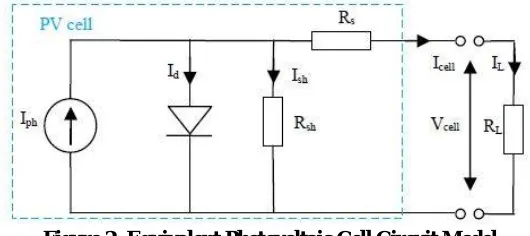
For a given Temperature of the Solar Panel and Radiance of the sun ,the behavioural PV block calculates the Voltage and the current of a Photovoltaic system also it gives the current and the voltage values to the electrical drives power limited block which injects power to the load with suitable V-I characteristics of Photovoltaic cells [2].
Figure 2: Equivalent Photovoltaic Cell Circuit Model
(1)
Equation (1) presents the ‘Kirchhoff’s current Law ‘which describes the Non –Ideal current output. (2)
Equation (2) gives the overall current of the PV cell where Gr and G are the reference and the Active Radiation. Tcr and Tc are the module reference temperature and the temperature of the module respectively. [2]
Isc represents the short circuit current, the formula for PV cell voltage is given by Equation (3) and Equation (4) [2]. (3)
(4)
Where is the Short circuit Current Temperature Coefficient and is the Open circuit voltage Temperature Coefficient. Rs is the output voltage drop of PV cell.Vr and Ir are reference taken from V-I curves [2,3].When the Photovoltaic cells are connected in parallel and series to each other Photovoltaic module is formed Equation (5)and (6) represents the current and voltage output of Photovoltaic module.
(5) (6)
Where Im represents the current output and Vm represents the voltage output. The number of series and parallel connected cells are represents by Nsc and Npc
IV.MODELING OF WIND ENERGY SYSTEM
The Simulink model of Wind Turbine Generator consist of Wind turbine which will convert the wind power to Electric power ,Synchronous Generator, and to convert AC to DC Diode bridge rectifier is used. The Wind Turbine Generator power output [4] is given by the Equation (1)
(1) Where
P isTurbine mechanical power output (W) is the Density of the Air (kg/m3) A is the Rotor blade swept area v is the velocity of the wind
Ct (λ, ) = Cp (λ, ) / = the coefficient of the Torque. = Rotor pitch angle
V. SEPIC CONVERTER
Figure 3:SEPIC Converter
The parallel output of the hybrid system is combined and given to the SEPIC converter which will either increase or decrease the input given to it and gives the output to the load which is cell phone battery or any other storing devices. Here the SEPIC converter is made to operate in boost mode to increase the input voltage given to it from the Hybrid System.
= where D is the Duty cycle of the SEPIC converter [1, 5].
VI.SIMULATION RESULTS
Figure 4: Solar module
Figure 4 shows the Simulink model of Solar Module with the Ambient Temperature taken as 24 with 1000 radiation. The result from solar module is observed and it’s given to the SEPIC converter.
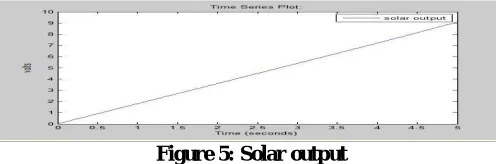
Figure 5: Solar output
Figure 5 represents 9V DC SIMULINK/MATLAB output which is observed from solar module.
Figure 6 represents the wind turbine generator model. The output from the synchronous generator is given to the Diode bridge rectifier where AC is converted to DC which is then fed as input to the SEPIC converter.
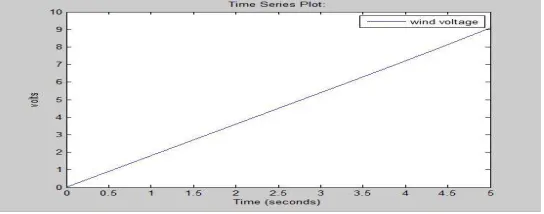
Figure 7: Output of Wind turbine Generator Model
The output of Wind Turbine Generator Model gives 9V where the result is observed in MATLAB/SIMULINK environment.
Figure 8: SEPIC Converter model
Figure 8 represents the SEPIC converter model where two Hybrid Outputs are taken as Input to the SEPIC converter.
Figure 9: Voltage Output of SEPIC Converter
Figure 10: Overall Simulink Hybrid Model
Figure 10 represents the Overall Simulink Hybrid Model to charge cellphone.
Figure 11: Output voltage of Overall Hybrid Model
Figure 11 represents the overall Hybrid output voltage of 5V for Mobile application to charge cell phone while travelling.
VII.CONCLUSION
Solar and wind Hybridizing will provide an efficient way to generate power due to its renewable form. The demand for electricity can be reduced by replacing this by Renewable Hybrid System as it is available plenty in nature. The SEPIC converter will overcome the drawbacks of BUCK-BOOST converter when it is used in the proposed system which can also increase or decrease the input voltage from hybrid system. The charging of cellphone can be done without plugging it into electrical source which is added advantage of this hybrid renewable module Operating cost is less due to the reduced components. The Hybrid model with SEPIC Converter is done in MATLAB/SIMULINK software.
REFERENCES
[1] Teena Jacob and Arun S, "Modeling of Hybrid Wind and Photovoltaic Energy System Using a New Converter Topology", International Journal (EEEIJ), Vol.1, No.2, 2012.
[2] R.P. Vengatesh, and S.E Raajan, “Investigation of cloudless solar radiation with PV module employing Matlab-Simulink”, International Conference on Emerging Trends in Electrical and Computer Technology ICETECT 11, pp. 141-147, 2011.
[3] S. Nema, R.K, and G. Agnihotri, “Matlab/Simulink based study of photovoltaic cells/modules/array and their experimental verification”, International Journal of Energy and Environmental, Vol. 1, no. 3, pp. 487-500,2010.
[4] K.V.Induji, Mr.Vinamzi Paul Samuel, “Simulation of Standalone PV/Wind Hybrid System”, International Journal of Engineering Research & Technology (IJERT), Issue 1, Vol. 3, 2014.