INVESTIGATION
ELAV-Mediated 3
9
-End Processing of
ewg
Transcripts Is Evolutionarily Conserved Despite
Sequence Degeneration of the ELAV-Binding Site
Irmgard U. Haussmann, Min Li, and Matthias Soller1 School of Biosciences, College of Life and Environmental Sciences, University of Birmingham, Birmingham B15 2TT, United Kingdom
ABSTRACTRegulation of alternative mRNA processing by ELAV (embryoniclethalabnormalvisual system)/Hu proteins is mediated by binding to AU-rich elements of low complexity. Since such sequences diverge very rapidly during evolution, it has not been clear if ELAV regulation is maintained over extended phylogenetic distances. The transcription factor Erect wing (Ewg) is a major target of ELAV in
Drosophila melanogaster and coordinates metabolic gene expression with regulation of synaptic plasticity. Here, we demonstrate evolutionary conservation of ELAV regulation ofewgdespite massive degeneration of its binding site and of associated elements in the regulated intronic 39-end processing site in distantly relatedDrosophila virilis. In this species, the RNA-binding part of ELAV protein is identical toD. melanogaster. ELAV expression as well as expression and regulation ofewgare also conserved. Usingin vitrobinding assays andin vivotransgene analysis, we demonstrate, however, that the ELAV-binding site ofD. virilisis fully functional in regulating alternative splicing ofewgintron 6 inD. melanogaster. Known features of the ELAV-binding site, such as the requirement of multiple poly(U) motifs spread over an extended binding site of150 nt and a higher affinity to the 39part of the binding site, are conserved. We further show that the 135-bp ELAV-binding site fromD. melanogasteris sufficient for ELAV recruitmentin vivo. Hence, our data suggest that ELAV/Hu protein-regulated alternative RNA processing is more conserved than anticipated from the alignment of de-generate low-complexity sequences.
A
LTERNATIVE mRNA processing is major mechanism to generate molecular diversity and organismal complex-ity from the limited number of genes present in higher eu-karyotes. Through alternative splicing and polyadenylation, more than one mRNA can be generated from a single gene that differs in the encoded protein and/or alters expression or localization of the encoded protein post-transcriptionally (Matlin et al. 2005; Soller 2006; Chen and Manley 2009; Licatalosi and Darnell 2010). In humans, alternative splicing and polyadenylation occur in 92–94% and in.50% of genes, respectively, and are particularly abundant in the brain (Licatalosi and Darnell 2006; Li et al. 2007; Wang et al. 2008; Neilson and Sandberg 2010). Our understanding of the regulation of alternative mRNA processing, however, is limited. Since RNA-binding regulators are generally wellconserved, but noncoding parts of pre-mRNAs that harbor regulatory sequences for its processing diverge very rapidly during evolution, it is not clear if and how evolutionary conservation is maintained at the sequence level.
ELAV (embryoniclethalabnormalvisual system)/Hu fam-ily proteins are prominent regulators of alternative mRNA processing in the brain and are widely used neuronal markers (Soller and White 2004; Hinman and Lou 2008). ELAV/Hu proteins are proto-type RNA-binding proteins that contain threeRNArecognitionmotifs (RRMs). The RRMs of ELAV/Hu proteins, as in many other RRM-containing proteins, are highly conserved with identities of 52–82% between human Hu andDrosophilaELAV. Despite the high sequence conservation of ELAV/Hu family proteins, however, their number varies between different clades, suggesting either highly dynamic functions or redundancy among individual family members (Samson 2008). The founding member of this family of proteins, neuron-specific ELAV from Drosoph-ila, has been shown to affect gene-specific alternative pre-mRNA processing oferect wing(ewg),neuroglian(nrg), and
armadillo (arm) (Koushika et al. 2000). The neuronally Copyright © 2011 by the Genetics Society of America
doi: 10.1534/genetics.111.131383
Manuscript received May 16, 2011; accepted for publication June 10, 2011 1Corresponding author: School of Bioscience, College of Life and Environmental
expressed human homologs HuB-C and the ubiquitously expressed HuR were initially assigned cytoplasmic func-tions, but also regulate pre-mRNA processing (Antic et al. 1999; Kasashimaet al.1999; Brennan and Steitz 2001; Zhu et al.2007, 2008). ELAV/Hu proteins preferentially bind to U-rich sequences that are abundant in introns and untrans-lated regions. Furthermore, ELAV/Hu proteins have been shown to multimerize, suggesting an important role of this feature in achieving target specificity in a complex cellular environment (Kasashimaet al.2002; Soller and White 2005; Davidet al.2007; Toba and White 2008).
The ewg gene encoding a transcriptional regulator ho-mologous to human NRF-1 is a major target of ELAV in Drosophilaasewgtransgenes can rescue post-embryonic de-velopment and viability of elav mutants (Haussmannet al. 2008). ELAV is required for splicing of the last intron 6 of
ewg that results in EWG protein expression (Soller et al. 2008). Inewgintron 6, ELAV binds distal of a poly(A) site and inhibits 39-end processingin vitroandin vivo(Soller and White 2003). At this regulated poly(A) site, ELAV-binding requires a number of short poly(U) motifs spread over an extended binding site of135 nt (Soller and White 2005). ELAV forms a defined dodecameric complexin vitro, and the importance of complex formation forewgintron 6 splicing is indicated by the requirement of multiple poly(U) motifs. These poly(U) motifs, however, can be variably positioned in the ELAV-binding site as indicated by the presence of dele-tions in very closely related species. Also, introduction of spacer sequences minimally affects ELAV regulation ofewg
intron 6 splicing. These features make it unlikely that target-specific binding depends upon the formation of a higher-order RNA structure encompassing the ELAV-binding site (Soller and White 2005; Solleret al.2010).
The ewg gene integrates multiple signaling pathways (e.g., Notch, Wnt/wingless, TGF-b, and AP-1) in coordinating neuronal metabolism and synaptic plasticity (Haussmann et al.2008; Haussmann and Soller 2010). Given the impor-tance of ELAV-mediated regulation of ewg in Drosophila melanogaster, we were wondering if the mechanism of ELAV-dependent splicing ofewgintron 6 is evolutionarily conserved in the distantly relatedDrosophila virilisthat separated40– 60 MYA, a phylogentic distance similar to mice and humans. Since the RNA-binding part of ELAV protein is identical in D. virilisELAV (Yao and White 1991), we further anticipated gaining insights into the evolution of RNA-processing signals and the underlying mechanism governing gene-specific tar-get RNA recognition by ELAV. Our analysis of ELAV and EWG expression shows evolutionary conservation inD. vir-ilissince both ELAV and EWG proteins are restricted to neu-rons and ewg transcripts are broadly expressed as in D. melanogaster. Furthermore, we identified a functional poly(A) site inD. virilisat a similar position in the regulated intron 6 as in D. melanogaster and demonstrate binding of ELAV to the vicinity of this poly(A) site. By using reporter trans-genes inD. melanogaster, we show that a 600-nt-long region containing the regulated poly(A) site fromD. virilisprovides
full functionality and is regulated in an ELAV-dependent manner in neurons. Intriguingly, however, the ELAV-binding site in ewgintron 6 diverged such that it is not recognized with sequence alignment algorithms in a genomic context due to its low complexity. The ELAV-binding site inD. virilis ewgintron 6 extends over150 nt, and as for theD. mela-nogaster sequence, multiple and spaced poly(U) motifs are required for binding and regulation of intron 6 splicing. Within this sequence the importance of the 39 part for ELAV binding in vitroand splicing regulation in vivo is also conserved. In addition, our analysis demonstrates the flexibil-ity of regulatory elements involved in 39-end processing since the distance of the cleavage site relative to the poly(A) site recognition element (AAUAAA) is not conserved. Given the massive sequence degeneration of the ELAV-binding site and the redundancy of ELAV-binding motifs at a genomic scale, it has not been clear if the 135-bp sequence identified fromD. melanogasteris sufficient to recruit ELAV for bind-ing in the natural context of Drosophila neurons. Using a number of reporter transgenes, we demonstrate that the choice of the promoter has no role in the recruitment of ELAV to its binding site in ewg and that the 135-bp sequence from D. melanogaster is sufficient for ELAV re-cruitment in a heterologous context. Our data demonstrate evolutionary conservation of pre-mRNA processing by ELAV/Hu proteins that are mediated by degenerate low-complexity sequences.
Materials and Methods
Fly genetics and recombinant DNA technology
Fly breeding, genetics and P-element-mediated transforma-tion and recombinant DNA technology were according to standard procedures as described (Soller and White 2005). For phiC31 transformation, tcgERv and tcgRm derivative con-structs were injected into embryos of the following genotype: y1 w* M{vas-int.Dm}ZH-2A; PBac{y+-attP-3B}VK00002 and y1 w* M{vas-int.Dm}ZH-2A, M{3xP3-RFP.attP}ZH-64A with
insertion sites at 28E and 64A, respectively. Insertion of tcgERv and tcgRm constructs yielded comparable rescue lev-els as obtained previously byP-element-mediated transforma-tion. The RNA null allele ofewg,ewgΔ, was generated by FLP/ FRT-mediated recombination between two transposon inser-tion lines, PBac{WH}CG3777f05779andP{XP}d08061(Parks et al.2004; Thibaultet al.2004).
(GGGCGAATTGGGTACGCGATCCTCTAGA-ewg-GCGGCCG CCACCGCGGTGGAG) when transcribing the Ecl136II (Fermentas) linearized plasmid with T7 RNA polymerase. To add the mutant ELAV-binding site to the fly transfo-mation vector, the sequence up to exon J was cloned into the previous vector using the BsrGI and NotI sites with primers virF12 KpnIMfeI (agtGGTACCaattgttttagagcaaat tttaattacgtgtaaacca) and ewg 6R3 SacII (CCGCcaCCGC GGTctatacatgcgatgactagatgg). This fragment was then PCR-amplified using primers ewg vir F16 (AAttctttgttgtt gtgattttataatttcaattttccc) or ewg vir F16 (AAttctttgttgttgt gattttataatCtcaaCtCtccc) and ewg vir J R NheI (atcggtgt agctagcTTGCTCCATTATGATTGTGTCCTCGGCCT) and cloned into a pBS SK+ containing the NotI–SpeI fragment of the final construct withXmnI and NheI in a three-way ligation and then swapped into a modified pCaSpeR transformation vector where the attB site had been added at the end of the polylinker.
Primers to amplify promoters of endoA (1.73 kb) were gacctcgagacCTGTGCACTGATGCAGGCAATGCTG and ccagt GGCGCGCCTGCTGCTGTCTCTTCTGGTTTTCTTCC; of nwk
(1.67 kb), gaCCTCGAGAAGTTCTGTTCGCTTTTGGCCAGT TC and ccagtGGCGCGCCttggggctttttctacgacaatcgggtcactc; and of Nrx-1 (2.41 kb), gacctcgagCACACGACGCCTTGTAAAGTG CACTTG and ccagtGGCGCGCCtcacacgcacggtggcactcgggcttac. Promoters were cloned with XhoI and AscI into a modified pBS KS+ containing theewgfragment of the tcgERm construct and an attB site. Transformants were identified by rescue of the lethalewgl1allele.
The elav-SP construct was made by three-way ligation of PCR fragments amplified with SP F3 Not (GGCTCGAGG CGGCCGCCGATTAGCTTGAATGTCGGTG) and SP R5 Bgl (CTAGATCTATATCTTAACATCTTCCACCCCAG), cut withNotI andBglII, and SP F5 BglNhe (GGAGATCTAGGCTAGCCTGG GGTGGAAGATGTTAAGATATGAATATTTGAGCTTAATATAAA ATAAACCCAC) and M13rev, cut with BglII and SpeI from a vector containing the SP gene and an attB site and a mod-ified pCaSpeR containing the elav promoter cut with NotI and SpeI. In this construct, BglII and NheI sites are intro-duced in the 39UTR of the sex-peptide gene. Theewg pA2 poly(A) site was PCR-amplified with primers F6i2 Bgl (CGGAGATCTGCCAAGTCAATTGCAAAAGAGGGAGAATGAA AAAGCAAC) and ewgPyextNhe (CCGCTAGCTTAAAAGAAA AGAACATAAAGTATAAAATTATAAGATAAAATGTATAATAGC) and cloned with BglII and NheI into elav-SP. RNA in situ hybridizations were done according to the Berkeley Dro-sophila Genome Project (BDGP) protocol or obtained from the BDGP web site (http://www.fruitfly.org).
Sequence alignments were done using ClustalW (DNAstar), CHAOS/DIALIGN (http://dialign.gobics.de) (Brudnoet al.2004), Lagan (http://lagan.stanford.edu) (Brudnoet al.2003), Vista (http://genome.lbl.gov/vista/index.shtml) (Mayoret al.2000), the University of California at Santa Cruz (UCSC) genome browser (http://genome.ucsc.edu) (Rhead et al. 2010), and EvoPrinter (http://evoprinter.ninds.nih.gov) (Odenwald et al. 2005).
In vitro and in vivo binding of ELAV, RT-PCR, 39RACE, antibody stainings, and RNase protection
Production of recombinant proteins, 32P-labeled in vitro
transcripts, and electrophoretic mobility shift assays (EMSAs) were done as described (Soller and White 2005). RNA extraction and RT-PCR for the analysis of ewg in D. melanogaster and D. virilis and ewg rescue constructs were done as described (Soller and White 2005). Polyacryl-amide gels from the analysis of 32P-labeled PCR products
were dried, exposed to phosphoimager screens (BioRad), and quantified with QuantityOne (BioRad). cDNAs from all ewgtranscripts were amplified with primers 4F and 5R,
eeF and eeR, 6F and 6R, or VSV-R (Koushika et al. 1999; Soller and White 2003). Primers for the amplification ofelav
were elavFhinge (CTAAGCTTGGGCAGCACCAGTAAGATCA TCCAG) and elavBamR (GTGGGATCCTTGACAATCTTTAC CG).D. virilisprimers for exons 4 and 5 were vF4 (CAGGTG GATCCTAACAATCCGATC) and vR52 (CACGGTGCCATCACT ATTCGTCTG) and for intron 6 were vF6 (ATATCCGGTCTC AGTGAGCAAT) and vR6 (GCCTGGCGAAACGGTAATGG). 39 RACE of cDNAs fromD. viriliswas done with nested primers vF4 and vF6, vF13 (GTATGCATAAAATTGAATTGCCAAGTT CCTAAAACAC) and vF14 (GTCGCGTTCGTGCTTCAATCCA AAATG), and vF10 (CCCGCCCACATGCCATTGGAGCTAG) and vF11 (GGACACCATATTTAAAAGAATATCTAAATAG) us-ing the return primer AUAP in two reactions on AP reverse-transcribed RNA as described (Soller and White 2003). Antibody stainings were done as described (Haussmann et al. 2008).
To analyzein vivobinding of ELAV, 14- to 18-hr-old em-bryos were first dechorionated and then fixed in heptane containing 5% formaldehyde (10 ml heptane, 1.75 ml 37% formaldehyde, and 1.3 ml PBS equilibrated for 30 min) for 10 min with vigorous shaking. Embryo extracts were then prepared in RIPA buffer (150 mM NaCl, 50 mM Tris–HCL, pH 7.5, 1% NP-40, 0.5% Na-deoxycholate, 0.05% SDS) in a 1-ml Dounce homogenizer. After 20–40 strokes with the tight pestil, 1 vol of immuno-precipitation (IP) buffer was added (150 mM NaCl, 50 mM Tris–HCL, pH 7.5, 0.05% NP-40). The extract was then sonified (Misonic XL2020) using a small tip in an Eppendorf vial three times for 20 sec (setting 3,20% output) and cleared by centri-fugation for 15 sec. IPs were done with the monoclonal anti-ELAV antibody 7D and protein A/G beads (SantaCruz) in IP buffer containing 7 mM CaCl2, 40 U of RNase inhibitor
with 1 min initial denaturation and 4 min final extension). Primers used were SP F3 (GGCTCGAGGCGGCCGCCGATT AGCTTGAATGTCGGTG), F6i (CGCGGAGAAATGAGTTTAC GAG), and GR3 (TTTATTTAGCATTTCAGTTTACAAAATGTAC AAGC).
Results
ELAV expression is conserved in D. virilis
Comparison of ELAV from D. melanogaster and D. virilis revealed that the RNA-binding part consisting of the three RRMs is identical (Yao and White 1991). This part of the ELAV protein has previously been termed RBD60 and fully rescues the viability of lethalelavmutants, as doesD. virilis ELAV (Yao and White 1991; Yaoet al. 1993). RBD60 also binds ewgRNAin vitrowith the same affinity as wild-type ELAV (Soller and White 2005). Consistent with its wide use as a neuronal marker, ELAV expression is also restricted to neurons in both D. melanogasterand D. virilis(Figure 1, A and B).
EWG expression is conserved in D. virilis
We next analyzed expression of EWG in D. virilis. EWG expression is also conserved and restricted to neurons (Fig-ure 1, C and D). In D. melanogaster, ewg RNA is broadly expressed, but EWG protein expression is restricted to neu-rons by ELAV-regulated splicing of the last intron 6 (Figure 1E) (Solleret al. 2008). We therefore analyzed the expres-sion of ewg RNA and splicing of intron 6 in neuron-rich heads and thorax (“HT”in Figure 1F) and compared it with the expression in neuron-poor abdomens (“A”in Figure 1F). Again, expression ofewgis conserved inD. virilisas the body of the RNA is expressed broadly (Figure 1F; compare lanes 1 and 2 with lanes 5 and 6), but splicing of intron 6 is re-stricted to neuron-rich tissue (Figure 1F; compare lanes 3
and 4 with lanes 7 and 8). We also noted that exon I is absent in D. virilis (Figure 1F). In D. melanogaster, exon I is prominently included in wing discs (Koushikaet al.2000), but exon I could not be detected in wing discs ofD. virilisby the analysis of PCR products on agarose gels or by sequenc-ing (data not shown).
D. virilis ELAV-binding site of ewg is fully functional despite massive degeneracy
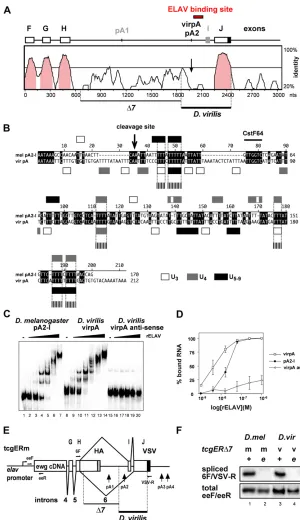
Comparative analysis of intron 6 in D. melanogaster and D. virilis revealed a considerable size difference (1722 and 2420 nt, respectively). Although seven consensus AAUAAA poly(A) signals (nt 547, 722, 1404, 1605, 1884, 2071, and 2277 relative to the start of intron 6) are present inD. virilis compared to two inD. melanogaster, 39RACE and sequenc-ing identified only a ssequenc-ingle 39-end processing site in the 39 part of intron 6 (nt 2071, termed virpA, Figure 1G and Figure 2A) compared to two 39-end processing sites in D. melanogaster(pA1 and pA2, Figures 1E and 2A). Intrigu-ingly, the distance of the cleavage site relative to the AAUAAA poly(A) signal was not conserved and increased considerably from 17 nt in D. melanogaster to 28 nt in D. virilis. No sequence conservation inD. viriliswas found at the position of exon I in D. melanogaster (Figure 2A). Conserved features of ewg intron 6 are the extension of the ORF into intron 6 (172 aa inD. melanogasterand 241 aa inD. virilisfrom the start of intron 6), but without amino acid sequence conservation. In addition, an extensive stem loop structure at the end of the ORF terminating in intron 6 is conserved in D. virilis(nt 450–507 inD. melanogaster and nt 531–596 inD. virilisfrom the start of intron 6) (data not shown).
Next, we analyzed the genomic sequence of the 39part of theewggene of the two species by alignment with various algorithms (ClustalW, CHAOS/DIALIGN, Lagan, and Vista). Figure 1 ELAV and EWG expres-sion is conserved inD. virilis. (A–
D) Expression of ELAV (A and B) and EWG (C and D) inD. mela-nogasterembryos (A and C) and
D. virilis embryos (B and D). (E) Schematic ofewgintron 6 from
D. melanogaster. ELAV-regulated splicing of intron 6 is shown as a solid line, and non-neuronal splicing of introns 6a and 6b is shown by a dashed line. The ELAV-regulated poly(A) site is underlined. Schematic position of primers used in both species for PCR or for 39RACE inD. virilis
(vF13 and vF14) are indicated by arrows. (F and G) RT-PCR ofewg
As illustrated by the alignment and visualization with Vista, these algorithms did not detect the ELAV-binding site in the genomic context (Figure 2A). Recently, sequences from 12 Drosophila species became available (Clark et al. 2007). Reanalysis with multi-alignment tools such as the UCSC browser or EvoPrinter also did not identify the ELAV-binding site (data not shown). Motif-finder algorithms to identify degenerate U-rich motifs involved in ELAV binding are not applicable due to the abundance of these motifs in introns and UTRs. Manual curation of the ELAV-binding site in D. virilis on the basis of the functional elements involved
in 39-end processing (cleavage site and GU-rich CstF64-binding site) revealed 50% conservation, but with only marginal overlap in short poly(U) motifs (Figure 2B). Although ELAV binds to multiple motifs in theewg-binding site, no repetitive elements aligned. Although some additional sequence con-servation upstream of the ELAV-regulated poly(A) site is detected in intron 6, this part is not relevant for ELAV-dependent splicing regulation and can be deleted (Figure 2A) (Soller and White 2003).
To test if the sequence 39of the poly(A) site inD. virilis binds ELAV with high affinity, we employedin vitrobinding Figure 2The ELAV-binding site in ewg intron 6 from
D. virilisis functional inD. melanogaster, but not identified by sequence alignment. (A) Sequence alignment of the 39 part of theewggene fromD. melanogasterandD. virilis. A summarized exon/intron structure and the ELAV-binding site of both species are shown at the top and features absent in D. virilis are shown in gray.D. melanogaster
pA2 corresponds toD. virilisvirpA according to a similar position in intron 6. Sequence identity is indicated on the right and identity.50% is shown in pink. The deleted part in the tcgERm transgene not required for ELAV-dependent regulation (Δ7) and the substituted part from
D. virilisare indicated at the bottom. (B) Manual sequence alignment according to mapped features in the ewg
39-end processing site. Poly(U) motifs are open (three Us), shaded (four Us), or solid (five to nine Us) boxes, and aligned poly(U) motifs between the two species longer than three nucleotides are indicated at the bottom with dashed boxes. (C). EMSA gel with RNAs from the ELAV-binding site ofD. melanogaster(pA2-I) andD. virilis(virpA) and, as control, antisense RNA fromD. virilis(virpAas) with recombinant ELAV fromD. melanogaster. Uniformly32 P-labeled RNAs (100 pM) were incubated with recombinant ELAV (1, 3.9, 15.6, and 62.5 nM and 0.25 and 1mM for pA2-I and virpA, and 3.9, 15.6, and 62.5 nM and 0.25 and 1mM for virpAas) and separated on 4% native polyacryl-amide gels. (D) Graphic representation of EMSA data from C as means with standard error from three experiments. The percentage of bound RNA (input RNA-unbound RNA/ input RNA·100) is plotted against the concentration of recombinant ELAV (in mol/Liter, M) presented as log. (E) Schematic of the tcgERm reporter construct with primers used in F depicted at the top. (F) Semiquantitative RT-PCR of intron 6 splicing using32P-labeled forward primers from
assays using EMSAs and the D. melanogaster RNA pA2-I (encompassing the sequence from pA2 to exon I) and the D. virilis RNA virpA (encoding the sequence between the sixth and the seventh AAUAAA of intron 6). Both the pA2-I and the virpA substrate RNAs from D. melanogaster and D. virilis, respectively, bind recombinant ELAV, and a similar multimeric complex is formed (Figure 2C). We also noted that ELAV binds the virpA RNA fromD. viriliswith a higher affinity [Figure 2D; dissociation constant (Kd), 4.5 nM
com-pared to 17 nM for pA2-I fromD. melanogaster]. In addition, the slope for binding to pA2-I is higher, suggesting higher co-operativity in binding, which has been observed previously for binding at lower affinity (Soller and White 2003, 2005). Binding specificity is indicated by the very low affinity of ELAV to the A-rich antisense transcript of virpA, virpAas (Figure 2, C and D).
To test if ELAV regulation of intron 6 splicing is mediated by the divergent sequences from D. virilis, we used the tcgERΔ7m reporter rescue construct, which expresses EWG under the control of the elavpromoter and which includes the genomic part of the regulated intron (Figure 2E), but contains a deletion of sequences in intron 6 not required for ELAV-dependent regulation (Δ7 in Figure 2, A and E) (Soller and White 2003, p. 2527). Since splicing generally domi-nates over 39 processing, we reasoned that additional se-quences in exon J are likely required to silence the 39 splice site of exon J such that 39processing at pA2 is favored in the absence of ELAV. We therefore included additional sequences from D. virilis up to the end of exon J and replaced the D. melanogaster sequence with the D. virilis sequence in tcgERΔ7m to generate tcgERΔ7v. Transgenes with the tcgERΔ7v construct were fully functional;e.g., the level of splicing was indistinguishable from the tcgERΔ7m construct in the presence of ELAV in photoreceptor neurons and dramatically reduced when ELAV levels were reduced in the elavedr mutants (Figure 2F). tcgERΔ7v transgenes also fully rescued viability of ewgl1 mutants (98%). Hence, the
600-nt sequence ofD. viriliscontaining the ELAV-regulated poly(A) site provides fully functional regulation despite mas-sive sequence degeneracy in the ELAV-binding site.
Multiple short poly(U) motifs in the D. virilis ELAV-binding site contribute to ELAV-dependent regulation of ewg in vivo
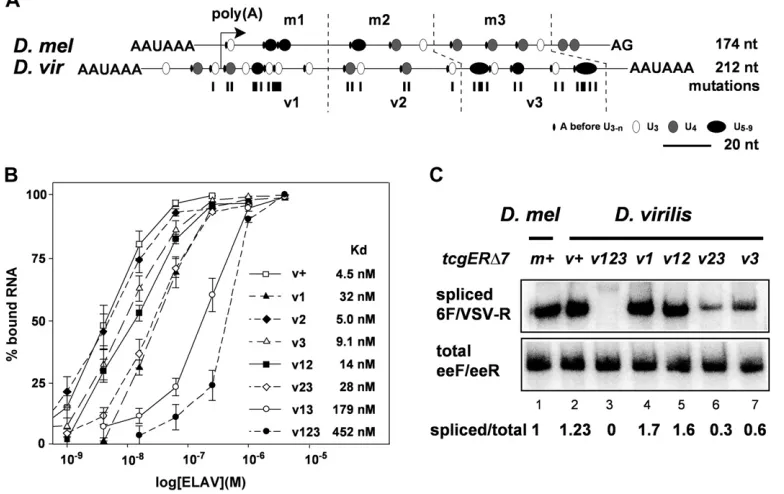
Poly(U) motifs important for ELAV binding inD. virilis ewg do not align with theD. melanogastersequence (Figure 3A). We therefore wanted to test if multiple short poly(U) motifs are also required in theD. virilisbinding site for ELAV-dependent regulation. For these experiments the D. virilis ELAV-binding site was divided into three parts (v1–3, Figure 3A), which are analogous to our previous experiments with the D. melanogaster ELAV-binding site (m1–3) (Soller and White 2005, p. 7581). Mutations introduced were U-to-C substitutions, and since these were not very effective in dis-rupting ELAV bindingin vitroto the pA2-I substrate, we also included U-to-G substitutions (seeMaterials and Methodsfor
details). In addition, the sequence after the cleavage site in D. virilis does not contain a clear GU auxiliary element in-volved in 39-end processing, and we therefore replaced this U-rich sequence with the GU auxiliary element fromD. mel-anogasterto disturb this U-rich sequence after the cleavage site.
Inin vitrobinding assays using EMSAs, mutations in one or two elements of the virpA substrate RNA had only a minimal effect on ELAV-binding affinity with the exception of mutations in v1 and v3, which greatly reduced in vitro binding (Figure 3B). The most dramatic decrease in ELAV binding was observed when mutations in all three poly(U) motif elements were combined (Figure 3B), which is analo-gous to the effect of mutations in the ELAV-binding site in D. melanogaster(Soller and White 2005).
Next, we introduced these mutations into the tcgERΔ7v construct and generated transgenes with identical insertion sites by phiC31-mediated transformation to test for in vivo regulation of ewg intron 6 splicing. Mutations in all three elements, as in thetcgERΔ7v123transgene, reduced splicing dramatically, while mutations in v3 and v23 had weaker effects that increased with the number of mutations (Figure 3C), as had been observed for the cumulative effect of muta-tions in the ELAV-binding site inD. melanogaster(Soller and White 2005). Mutations in the v1 and v12 elements of the tcgERΔ7v construct resulted in increased splicing, suggest-ing that these mutations in the v1 element, which overlap the cleavage site, weakened the strength of the 39-end pro-cessing site (Figure 3C; compare lane 2 with lanes 4 and 5). Since the combination of mutations in the v1, v2, and v3 elements resulted in a dramatic decrease of intron 6 splicing, these effects on the strength of the 39-end processing site were overruled (Figure 3C; compare lane 3 with lanes 4 and 5).
ELAV regulation of ewg intron 6 splicing is promoter-independent
Since the ELAV-binding site inD. virilisis massively degen-erate compared to the analogous site in D. melanogaster, sequence-specific recruitment of ELAV to the regulated poly(A) site could be mediated by other mechanisms. Since ELAV autoregulates (Samson 1998) and since we had used theelavpromoter in our tcgERm reporter constructs (Soller and White 2003), sequence-specific binding of ELAV could be achieved through recruitment at the promoter and de-position onto the nascent RNA. We had previously shown that, within the genomic part of tcgERΔ7m, only a single ELAV-binding site is present and that ELAV regulation is not mediated via the 39UTR (Koushika et al.2000; Soller and White 2003). Such recruitment of ELAV protein to target genes could explain the low sequence complexity needed for target-specific regulation.
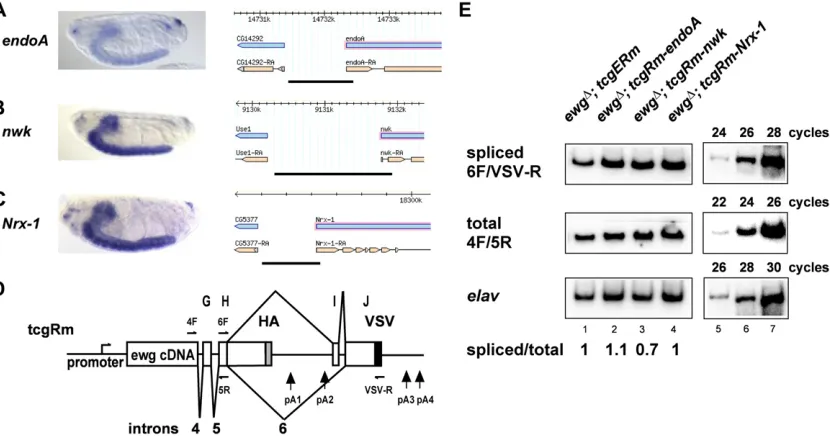
(Nrx-1, CG7050) genes, which are not differentially regu-lated in ewgl1 and elav mutants (Haussmann et al. 2008)
and thus are independent from ELAV regulation (Figure 4, A–C). From these three genes, we cloned the promoters into the tcgRm construct (Figure 4D) to generate tcgRm-endoA, tcgRm-nwk, and tcgRm-Nrx-1 constructs and established transgenic lines by phiC31-mediated transformation, which can be directly compared due to their exact same insertion site (Venkenet al.2006; Bischofet al.2007).
It had come to our attention that transcripts of theoscar gene exert functions that are required for proper localization and expression of Oscar protein (Hachet and Ephrussi 2004; Jennyet al.2006). To exclude that broadly expressed RNAs from the ewggene are involved in processing ofewgintron 6, we generated an RNA null allele of ewgby deleting the genomic region,ewgΔ. Viability and synaptic growth defects ofewgΔmutants are fully rescued byewgtransgenes, and no difference of splicing of intron 6 is found in tcgERm trans-genes compared to the protein null allele ewgl1 (data not
shown).
Analysis of intron 6 splicing of transgenes from tcgRm-endoA, tcgRm-nwk, and tcgRm-Nrx-1 in ewgΔ revealed no difference of ewg intron 6 splicing compared to tcgERm transgenes (Figure 4E). In addition, transgenes from these constructs fully rescued viability of the lethal RNA null allele ewgΔ(88, 100, and 97%, respectively). Hence, regulation of
ewg intron 6 is independent of the promoter and does not involve additional transcripts from the ewg gene, strongly
arguing that the single ELAV-binding site after pA2 in D. melanogasteris sufficient for ELAV-dependent regulation.
The 135-bp ELAV-binding site of D. melanogaster is sufficient for ELAV recruitment in vivo
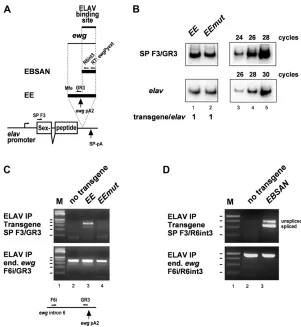
Although we had previously shown thatewgintron 6 regu-lation is mediated by a single ELAV-binding site, the body of the ewg gene could contribute to ELAV recruitment (Koushikaet al.2000; Soller and White 2003). To exclude this possibility and to identify the minimal element required for suppression of 39-end processing at ewg pA2, we ex-changed the ewgsequences with the gene coding for Sex-peptide (SP) that is not expressed in neurons (Saudan et al. 2002). In this construct, elav-SP, we placed the ELAV-regulated pA site sufficient for inhibition of cleavage in vitro (“EE,” Figure 5A), or a version with the mutated ELAV-binding site (“EEmut,” Figure 5B), or the ELAV-binding site pA-I (“EBSAN,”Figure 5A) into the 39UTR of this reporter (Soller and White 2003) and generated trans-genes by phiC31-mediated transformation at the same inser-tion site. InD. melanogaster, ELAV does not bind to sequences beyond exon I (Soller and White 2003). Since the EEmut construct differs by mutations from the EE construct, we analyzed expression levels in these transgenes. Semiquan-titative RT-PCR showed that transcript levels from the EEmut construct are not affected by the sequence varia-tions present compared to transcript levels from the EE construct (Figure 5B).
Figure 3 Requirement of multi-ple short poly(U) motives forewg
intron 6 splicing is conserved in
D. virilis. (A) Schematic of the ELAV-binding site at pA2 from
D. melanogaster and at virpA from D. virilis centered at the cleavage site. The ELAV-binding site is divided into three parts for each species: m1–3 for
D. melanogaster and v1–3 for
D. virilis. Poly(U) motifs are indi-cated as circles according to their length, starting with three Us, and A in front of the poly(U) motifs is indicated as a line. Mutations, mostly U-to-C substi-tutions, introduced into the
Immunoprecipitation of ELAV from embryonic extracts demonstratesin vivobinding of ELAV to RNA transcripts of theEEtransgene, but not to the EEmuttransgene with the mutated ELAV-binding site (Figure 5C). In vivo binding of ELAV could also be demonstrated when the shorter pA2-I sequence used inin vitro binding assays was inserted into theelav-SPtransgene (“EBSAN,”Figure 5D). Intriguingly, in this context ELAV inhibited splicing of the upstream intron, suggesting that ELAV bound to RNA also interacts with spli-ceosomal components.
Discussion
ELAV/Hu family proteins are highly conserved like many other RNA-binding proteins. They bind gene-specifically to AU-rich sequences prominently found in introns and un-translated regions. A salient feature of such low-complexity sequences is their rapid divergence through evolution. Here we demonstrate that alternative splicing regulation of the ELAV targetewgis evolutionarily conserved in distantly re-lated D. virilis despite massive degeneration of its binding site and of associated elements in the regulated intronic 39 -end processing site.
Although the ELAV-binding site fromD. melanogaster is not recognized inD. virilisby sequence alignments in a ge-nomic context, it is identified by functional analysis using transgenes. Furthermore, mutational analysis of the ELAV-binding site inD. virilis ewgrevealed a number of conserved sequence features. First, the ELAV-binding site is in close distal proximity relative to the AAUAAA consensus sequence
of the poly(A) site inewgintron 6. Second, the ELAV-binding site inewgextends over150 nt, and both sequences have
50% U content. Third, multiple and spaced U-rich se-quence motifs are important for in vitro binding and in vivo splicing regulation. Fourth, the 39part of the ELAV-binding site inewgis more important forewgsplicing regu-lation in vivoand harbors a high U content. Therefore, the v3/m3 element might initiate ELAV complex assembly in vivosimilar to sequences at the 39splice site of the HIV tatexon 3 involved in the hnRNP A1 complex assembly (Zhu et al. 2001; Okunola and Krainer 2009). Here, hnRNP A1 binds to a high-affinity site, and then the complex expands toward 59by recruiting additional hnRNP A1 proteins that bind neighboring sequences.
Potentially, more complicated scenarios of how ELAV comes into contact with its binding site in ewgcould apply, e.g., recruitment at the promoter and deposition along the nascent transcript. Placing the ELAV-binding site of ewgin a heterologous reporter transgene clearly indicates that this sequence is sufficient for ELAV binding and that ELAV rec-ognizes targets by diffusion. These results are in agreement with findings from the ELAV-regulated intron ofnrg. Here, ectopic overexpression of ELAV in non-neuronal wing-disc cells is sufficient for neuronal splicing of the minimal ELAV-regulated intron of nrg overexpressed by a heterologous ubiquitin promoter (Toba and White 2008).
Given the degeneracy of the ELAV-binding site in ewg
effect comes from two long U stretches of 8 and 9 nt in the 39part as deletion of this part inD. melanogasterresults in a dramatic reduction of ELAV binding in EMSAs (Soller and White 2005). Also, the distance of the cleavage site to the highly conserved AAUAAA hexamer involved in poly(A) site recognition by the cleavage and polyadenylation specificity factor (CPSF) increased considerably (from 17 nt inD. mel-anogaster to 28 ntD. virilis). Furthermore, the distance of the AAUAAA hexamer to the 39 splice site of intron 6 in-creased from 266 nt inD. melanogasterto 346 nt inD. virilis. In addition, the 59part of theD. virilisELAV-binding site is more important for ELAV bindingin vitrothan is its comple-mentary part in D. melanogaster (Soller and White 2005). Since this part is also directly involved in the recruitment of the cleavage stimulatory factor (CstF), thein vivorole of this element is not readily separable from affecting 39-end pro-cessing efficiency as the mutations introduced weakened the poly(A) site. Interestingly, exon I is not present inD. virilis, and the sequence diverged completely.
To allow for evolutionary conservation in a degenerate sequence context, compensatory mechanisms must exist to allow for a large degree of flexibility in the positioning of short binding motifs. A prominent feature of ELAV/Hu proteins is multimerization upon binding to RNA (Kasashima et al. 2002; Soller and White 2005; Davidet al.2007; Toba and White 2008). We demonstrated that individual mutations in the ELAV-binding site ofewghave little effect on RNA
bind-ing as well as on splicbind-ing regulation in vivo. Thus, ELAV multimerization can compensate for mutations in the binding site and allow it to diversify such that ELAV-binding sites can become refractory to detection by comparative genomics. This could also explain the divergence of the ELAV-binding sites found in other ELAV targets, e.g., innrgandelavitself, which have U-rich motifs but do not align with the ELAV-binding site inewg(Lisbinet al.2001; Borgeson and Samson 2005). Since most long noncoding RNAs also show a low degree of evolutionary conservation by sequence alignment, combinatorial binding of RNA-binding proteins in a similar way as ELAV binds toewgcould be conserved (Prasanth and Spector 2007; Mattick 2009; Pontinget al.2009).
against novel transposon inserts. In contrast toewg, where only a single ELAV-binding site is present, ELAV has been shown to bind to multiple regions spread through the entire 3.2 kb of the regulated intron of nrg (Lisbin et al. 2001). Similar to the ELAV-binding site inewg, mutations in multi-ple binding sites are required to reduce ELAV-mediated splicing of nrg, suggesting that multimerization of ELAV might be important for the regulation of this intron (Lisbin et al.2001).
In conclusion, we demonstrate that ELAV regulation of
ewg intron 6 splicing is conserved in distantly related D. virilisdespite massive degeneracy of its binding site. Since mul-timerization is an inherent feature of ELAV/Hu proteins, our results indicate that ELAV/Hu regulated post-transcriptional gene regulation is likely more conserved than currently antici-pated from genome alignments.
Acknowledgments
We thank the Bloomington and Exelixis/Harvard stock centers for fly lines, Dan Motola for initial analysis of the D. virilisintron 6, Declan Bostock for promoter analysis and cloning, and Chris Franklin for comments on the manu-script. We are indebted to Kalpana White for her support when this study was initiated. We acknowledge funding for this work from the Biotechnology and Biological Sciences Research Council.
Literature Cited
Antic, D., N. Lu, and J. D. Keene, 1999 ELAV tumor antigen, hel-N1, increases translation of neurofilament M mRNA and induces for-mation of neurites in human teratocarcinoma cells. Genes Dev. 13: 449–461.
Bischof, J., R. K. Maeda, M. Hediger, F. Karch, and K. Basler, 2007 An optimized transgenesis system for Drosophila using germ-line-specific phiC31 integrases. Proc. Natl. Acad. Sci. USA 104: 3312–3317.
Borgeson, C. D., and M. L. Samson, 2005 Shared RNA-binding
sites for interacting members of the Drosophila ELAV family of neuronal proteins. Nucleic Acids Res. 33: 6372–6383.
Brennan, C. M., and J. A. Steitz, 2001 HuR and mRNA stability. Cell. Mol. Life Sci. 58: 266–277.
Brudno, M., C. B. Do, G. M. Cooper, M. F. Kim, E. Davydovet al.,
2003 LAGAN and Multi-LAGAN: efficient tools for
large-scale multiple alignment of genomic DNA. Genome Res. 13: 721–731.
Brudno, M., R. Steinkamp, and B. Morgenstern, 2004 The
CHAOS/DIALIGN WWW server for multiple alignment of geno-mic sequences. Nucleic Acids Res. 32: W41–W44.
Chen, M., and J. L. Manley, 2009 Mechanisms of alternative splic-ing regulation: insights from molecular and genomics ap-proaches. Nat. Rev. Mol. Cell Biol. 10: 741–754.
Clark, A. G., M. B. Eisen, D. R. Smith, C. M. Bergman, B. Oliver
et al., 2007 Evolution of genes and genomes on the Drosophila phylogeny. Nature 450: 203–218.
Damgaard, C. K., T. O. Tange, and J. Kjems, 2002 hnRNP A1
controls HIV-1 mRNA splicing through cooperative binding to intron and exon splicing silencers in the context of a conserved secondary structure. RNA 8: 1401–1415.
David, P. S., R. Tanveer, and J. D. Port, 2007 FRET-detectable interactions between the ARE binding proteins, HuR and p37AUF1. RNA 13: 1453–1468.
Hachet, O., and A. Ephrussi, 2004 Splicing of oskar RNA in the nucleus is coupled to its cytoplasmic localization. Nature 428: 959–963.
Haussmann, I. U., and M. Soller, 2010 Differential activity of EWG transcription factor isoforms identifies a subset of differentially regulated genes important for synaptic growth regulation. Dev. Biol. 348: 224–230.
Haussmann, I. U., K. White, and M. Soller, 2008 Erect wing reg-ulates synaptic growth in Drosophila by integration of multiple signaling pathways. Genome Biol. 9: R73.
Hinman, M. N., and H. Lou, 2008 Diverse molecular functions of Hu proteins. Cell. Mol. Life Sci. 65: 3168–3181.
Jenny, A., O. Hachet, P. Zavorszky, A. Cyrklaff, M. D. Westonet al., 2006 A translation-independent role of oskar RNA in early Drosophila oogenesis. Development 133: 2827–2833.
Kasashima, K., K. Terashima, K. Yamamoto, E. Sakashita, and H. Sakamoto, 1999 Cytoplasmic localization is required for the mammalian ELAV-like protein HuD to induce neuronal dif-ferentiation. Genes Cells 4: 667–683.
Kasashima, K., E. Sakashita, K. Saito, and H. Sakamoto, 2002 Complex formation of the neuron-specific ELAV-like Hu RNA-binding proteins. Nucleic Acids Res. 30: 4519–4526. Koushika, S. P., M. Soller, S. M. DeSimone, D. M. Daub, and K.
White, 1999 Differential and inefficient splicing of a broadly expressed Drosophila erect wing transcript results in tissue-specific enrichment of the vital EWG protein isoform. Mol. Cell. Biol. 19: 3998–4007.
Koushika, S. P., M. Soller, and K. White, 2000 The
neuron-enriched splicing pattern of Drosophila erect wing is dependent on the presence of ELAV protein. Mol. Cell. Biol. 20: 1836–1845. Li, Q., J. A. Lee, and D. L. Black, 2007 Neuronal regulation of alternative pre-mRNA splicing. Nat. Rev. Neurosci. 8: 819–831. Licatalosi, D. D., and R. B. Darnell, 2006 Splicing regulation in
neurologic disease. Neuron 52: 93–101.
Licatalosi, D. D., and R. B. Darnell, 2010 RNA processing and its regulation: global insights into biological networks. Nat. Rev. Genet. 11: 75–87.
Lisbin, M. J., J. Qiu, and K. White, 2001 The neuron-specific RNA-binding protein ELAV regulates neuroglian alternative splicing in neurons and binds directly to its pre-mRNA. Genes Dev. 15: 2546–2561.
Martinez-Contreras, R., J. F. Fisette, F. U. Nasim, R. Madden, M. Cordeauet al., 2006 Intronic binding sites for hnRNP A/B and hnRNP F/H proteins stimulate pre-mRNA splicing. PLoS Biol. 4: e21.
Matlin, A. J., F. Clark, and C. W. Smith, 2005 Understanding alternative splicing: towards a cellular code. Nat. Rev. Mol. Cell Biol. 6: 386–398.
Mattick, J. S., 2009 The genetic signatures of noncoding RNAs. PLoS Genet. 5: e1000459.
Mayor, C., M. Brudno, J. R. Schwartz, A. Poliakov, E. M. Rubinet al., 2000 VISTA: visualizing global DNA sequence alignments of arbitrary length. Bioinformatics 16: 1046–1047.
Neilson, J. R., and R. Sandberg, 2010 Heterogeneity in mamma-lian RNA 39end formation. Exp. Cell Res. 316: 1357–1364. Odenwald, W. F., W. Rasband, A. Kuzin, and T. Brody,
2005 EVOPRINTER, a multigenomic comparative tool for
rapid identification of functionally important DNA. Proc. Natl. Acad. Sci. USA 102: 14700–14705.
Okunola, H. L., and A. R. Krainer, 2009 Cooperative-binding and splicing-repressive properties of hnRNP A1. Mol. Cell. Biol. 29: 5620–5631.
cover-age of the Drosophila melanogaster genome. Nat. Genet. 36: 288–292.
Ponting, C. P., P. L. Oliver, and W. Reik, 2009 Evolution and functions of long noncoding RNAs. Cell 136: 629–641. Prasanth, K. V., and D. L. Spector, 2007 Eukaryotic regulatory
RNAs: an answer to the‘genome complexity’conundrum. Genes Dev. 21: 11–42.
Rhead, B., D. Karolchik, R. M. Kuhn, A. S. Hinrichs, A. S. Zweig
et al., 2010 The UCSC Genome Browser database: update 2010. Nucleic Acids Res. 38: D613–D619.
Samson, M. L., 1998 Evidence for 39untranslated region-dependent autoregulation of the Drosophila gene encoding the neuronal nu-clear RNA-binding protein ELAV. Genetics 150: 723–733. Samson, M. L., 2008 Rapid functional diversification in the
struc-turally conserved ELAV family of neuronal RNA binding pro-teins. BMC Genomics 9: 392.
Saudan, P., K. Hauck, M. Soller, Y. Choffat, M. Ottiger et al.,
2002 Ductus ejaculatorius peptide 99B (DUP99B), a novel
Drosophila melanogaster sex-peptide pheromone. Eur. J. Bio-chem. 269: 989–997.
Soller, M., 2006 Pre-messenger RNA processing and its regula-tion: a genomic perspective. Cell. Mol. Life Sci. 63: 796–819. Soller, M., and K. White, 2003 ELAV inhibits 39-end processing to
promote neural splicing of ewg pre-mRNA. Genes Dev. 17: 2526–2538.
Soller, M., and K. White, 2004 Elav. Curr. Biol. 14: R53. Soller, M., and K. White, 2005 ELAV multimerizes on conserved
AU4–6 motifs important for ewg splicing regulation. Mol. Cell. Biol. 25: 7580–7591.
Soller, M., M. Li, and I. U. Haussmann, 2008 Regulation of the ELAV target ewg: insights from an evolutionary perspective. Biochem. Soc. Trans. 36: 502–504.
Soller, M., M. Li, and I. U. Haussmann, 2010 Determinants of ELAV gene-specific regulation. Biochem. Soc. Trans. 38: 1122–1124.
Thibault, S. T., M. A. Singer, W. Y. Miyazaki, B. Milash, N. A. Dompeet al., 2004 A complementary transposon tool kit for Drosophila melanogaster using P and piggyBac. Nat. Genet. 36: 283–287.
Toba, G., and K. White, 2008 The third RNA recognition motif of Drosophila ELAV protein has a role in multimerization. Nucleic Acids Res. 36: 1390–1399.
Venken, K. J., Y. He, R. A. Hoskins, and H. J. Bellen, 2006 P[acman]: a BAC transgenic platform for targeted insertion of large DNA fragments in D. melanogaster. Science 314: 1747–1751.
Wang, E. T., R. Sandberg, S. Luo, I. Khrebtukova, L. Zhanget al., 2008 Alternative isoform regulation in human tissue transcrip-tomes. Nature 456: 470–476.
Yao, K. M., and K. White, 1991 Organizational analysis of elav gene and functional analysis of ELAV protein of Drosophila melanogaster and Drosophila virilis. Mol. Cell. Biol. 11: 2994–3000.
Yao, K.-M., M.-L. Samson, R. Reeves, and K. White, 1993 Geneelav
ofDrosophila melanogaster: a prototype for neuronal-specific RNA binding protein gene family that is conserved inflies and humans. J. Neurobiol. 24: 723–739.
Zhu, H., H. L. Zhou, R. A. Hasman, and H. Lou, 2007 Hu proteins regulate polyadenylation by blocking sites containing U-rich se-quences. J. Biol. Chem. 282: 2203–2210.
Zhu, H., M. N. Hinman, R. A. Hasman, P. Mehta, and H. Lou, 2008 Regulation of neuron-specific alternative splicing of neu-rofibromatosis type 1 pre-mRNA. Mol. Cell. Biol. 28: 1240– 1251.
Zhu, J., A. Mayeda, and A. R. Krainer, 2001 Exon identity estab-lished through differential antagonism between exonic splicing silencer-bound hnRNP A1 and enhancer-bound SR proteins. Mol. Cell 8: 1351–1361.