CAN BASED ADVANCE SECURITY
SYSTEMINTERFACE FOR VEHICLE USING
ARM7 PLATFORM
B.RamRatnaker Reddy,K.P.CH.KishoreKumar,N.Tarun Kumar Reddy,AkshilaBhat Department of Electronics and Communication Engineering, SRM University
ManojVishnoi (Assistant Professor, Department of ECE, SRM University)
Abstract: This paper describes an Advance Security Interface for Vehicle with a
systemof sensors which are placed within a car to warn its driver of any dangers that may lie
ahead on the road.Some of the dangers that the sensors could pick up on include how close the
car is to other cars surrounding it, pollution control, how much its speed needs to be controlled
while going around a curve. The main aim of the project is vehicle to vehicle information
sharing system based on cloud and to notify the driver about the basic information about the
nearby automobiles when he enters into a specified area thereby he can drive the vehicle
accordingly. In this paper Monitoring driving behavior of a person is presented, which is based
on CAN and Cloud based network, driver Behavior Reporting System that works by collecting
the informationand sending actual, real time data from nearby car whenever it is being driven.
Youcan stay aware and informed, so that you can reinforce responsible driving habits, or
immediately address areas of concern. Here we provide security and privacy preserving access
control to users thatguarantees any member in a group to anonymously utilize the cloud
resource.
Index Terms:ARM 7, CAN protocol, Serial Communication, WI-FI
I.
Introduction:
Internet of vehicles is a new field of research that aims to study remote agents (people, vehicles, robots) as they interact and collaborate for sensing the environment, process the data, propagate the results and more generally share resources. But there are several untrusted zones (cloud services) were there may be chances of hacking all the private data. Consequently, there are very few approaches that will allow distributed IP or web-based applications like diagnostic services and uploading software to connect to low cost-devices as often used in car domains. The need for these applications, however, increases. Controller Area Network is one of the most commonly used network media in these domains. The CAN protocol-international standardized serial bus communication system originally developed for
automotive in-vehicle networks. It is increasingly developed in embedded control environments. The major benefits of CAN are its reliability, real time behavior, multi-master capability, broadcasting messages and most significantly, its cost effectiveness.
This paper describes how IP-based services can be adapted by simple CAN networks through communication middleware. Major challenges are identified and new service component is introduced, the Internet Gateway Service, responsible for transforming complete IP packets to CAN messages. To our knowledge, this would be first approach to transmit and re-assembling IP packets on CAN. This formation allows for enhanced innovative high-level applications, for example: - web-based diagnostic services, to be ported to CAN nodes or remote clients that access internal and
external automotive status information. It enables remote software installation too by
adjusting the Automatic standard communication to the IP world. Controller Area Network is basically a data link layer protocol. The nodes which are connected in CAN protocol communicates within the network. In our project we have taken some applications as such monitoring the vehicle parameters and updating that to a particular network. When our vehicle starts, it will initialize microcontroller and CAN transceiver (MCP2510). Our system will then check CAN bus for any data over it. Any interrupts occurring over the line can be checked. Whole system will remain in sleep mode until any interrupt is found. If it finds any thenthe system will come out from sleep mode and will perform the operations.
After real time values are sensed, CAN frame will be transmitted via CAN bus to internet gateway(WI-FI module). CAN frames will be transmitted over internet by TCP/IP tunneling. .Then our data will be sent to particular IP through internet.
II.
Scope of Work:
The extent of automation in automobile industry now-a-days requires a reliable platform for integration of subsystems within them into a single unit. CAN Bus provide a secured and reliable service for thecommunication between the systems .It also plays an important role in improvement of system performance without much software load for the controller.
In addition CAN also provide effective data transmission within frames with priority assignment and has an inbuilt arbitration mechanism to resolve the collision thus providing lossless communication. Our system also provides secure access to members of network through key distribution. Information sharing between vehicles enhances the detection of environmental and it takes the surveillance of vehicles a step ahead. Thus our system helps in providing a secure interface to vehicles to enhance surveillance and help the vehicle
drivers by providing the real time environment parameters.
III.
Hardware Description:
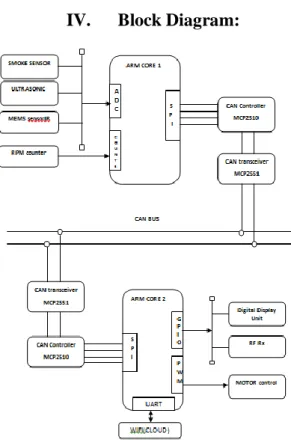
Our system as a prototype has a subsystem of sensors interfaced to ARM7. The information monitored by system of sensors interfaced with the ARM7 is constantly updated to the CAN bus using the SPI (Serial Peripheral Interface) and to a particular IP address using the Wi-Fi module (ESP8266).CAN bus is connected to another ARM7 where information it is displayed on LCD and necessary control action is then taken up.A Wi-Fi module is used to update the sensor information to a particular network which can be monitored by other vehicles in the same network to indicate them of surrounding vehicle parameters thereby providing vehicle to vehicle real time information sharing.
Ultrasonic sensor is used to measure the distance with respect to the previous car. Fore-end and rear-end collision avoiding subsystem, the available ultrasonic sensors for vehicles are adopted for approaching cars with comparatively low speed. We also include the smoke sensor in it to monitor the person in the car; if the person appears to be smoking or in case of fire, the necessary control action is taken up by the micro-controller.
We also include temperature sensor to monitor the temperature of engine and speed control of vehicle by sensor. A vibration sensor is interfaced to detect collision. An variant radio frequency receiver is interfaced to detect signal generated by RF transmitters in special jones as such school zone, wrong turn, accident prone area, speed breaker ahead etc.
The figure 3.0 shows the schematic of implementation of system of CAN bus by two sections using ARM7, CAN Controller (MCP2510), Serial communication, Wi-Fi module (ESP8266)
b. Control section
IV.
Block Diagram:
Fig 1: Block Diagram of CAN-Controller
and Transceiver Section
ARM 7
:The ARM7 processor is the industry’s most used 32-bit embedded RISC microprocessor solution. The ARM7TDMI-S core is the synthesized version of the ARM7TDMI core, available in both VERILOG and VHDL languages, ready for compilation into processes supported by commercially available libraries. Optimized for flexibility and featuring an identical feature set to the macro cell, it improves time to market by reducing development time while allowing for increased design flexibility.LPC2148 Microcontroller
:LPC2148 is an ARM7-S based high-performance 32-bit RISC Microcontroller with extensions of 512KB on-chip Flash ROM with In-System Programming and In-Application Programming, 32KB RAM,Vectored Interrupt Controller{VIC}, Two 10bit ADCs’ each has 14 channels, USB 2.0 Full Speed Device Controller, Two UARTs, one of
themis with full modem interface. 2 I2C serial interfaces, Two SPI interfaces ,Two 32-bit timers, Watchdog Timer, one PWM unit, Real Time Clock with the optional battery backup, Brown out detects the circuit General purpose I/O pins ,CPU clocks up to 60 MHz
The ARM core architecture is based on Reduced Instruction Set Computer principles, and instruction set.Related decodingmechanism is much simpler than that of micro programmed Complex Instruction Set Computers. This simplicity results in a high instruction throughout and impressive real-time interrupt response is given from a small and cost-effective processor core.
CAN Controller (MCP2510):The Microchip
MCP2510 is a Full Controller Area Network protocol implementing CAN specification V2.0. It supports CAN 1.2, CAN 2A, CAN 2BPassive, and Active version and CAN is capable of transmitting and receiving standard messages which is also capable of both acceptance filtering and message management. It includes 3 transmit buffers and 2 receive buffers that reduce the amount of microcontroller management required. The Microcontroller communication is implemented through an industrial standard Serial Peripheral Interface (SPI) with data rates up to 5 Mb/s.MCP2510 is the interface between the physical CAN bus and the MCU. It is interfaced to ARM7 using SPI. It has CAN protocol engine, control logic and SPI protocol block which has all functions to receive and transmit messages.
CAN Transceiver (MCP 2551):
MCP2551 serves interfacing between the CAN controller and the CAN local bus. It is a high speed, fault tolerable device.
It provides the transmit capability to the controller with FIFO (first in first out) registers And is compatible with ISO-11898.It also acts as a buffer between controller and the high voltage spikes that can be generated by outside Electromagnetic interference. The two differential outputs CAN_L and CAN_H are fully protected against any interference.
Fig 3: CAN Transceiver circuit
Sensors:
Gas sensor (MQ 2):Gas Sensor (MQ2)
module is useful for detection of gas leakage. It is suitable for detecting H2, LPG, CH4, CO, Alcohol, Smoke or Propane. This is a Analog output sensor. The analog output is connected to ADC channel of ARM7 to get corresponding digital voltage and it is displayed on LCD. The output voltage from the Gas sensor increases when the concentration of gas increases and thus denotes the extent of gas concentration in vehicle.Ultrasonic sensor (HC-SR04): Ultrasonic
sensor provides an easy method of distance measurement. This sensor is perfect for number of applications that requireto perform measurements between moving or stationary objects. A single I/O pin is used to trigger an ultrasonic sensor and then "waits" for the echo return pulse. The sensor measures the time consumed for the echo return, and returns thisvalue to the microcontroller as a variable-width
pulse via the same I/O pin. We use this sensor to detect obstacle distance and then display it on LCD to notify driver about the obstacle.
Mems 3-Axis Vibration Sensor: MEMS
vibration sensor is used for collision detection which is done by measuring change in the position of car by two of 3-axis i.e. x and y axis. These devices have fast response times, low current consumption, low voltage operations and a standby mode in small profile packages to detect orientation, shake, tap, double tap, fall, tilt, motion, positioning, shock or vibration.IR SensorFor RPM:An infrared sensor is an
electronic instrument which is used for sensing certain characteristics of its surroundings by either emitting and/or detecting infrared radiation. The output is interfaced to counter of ARM7.Each time the line of sight is obstructed it is incremented.In practical application these are arranged at wheel of the vehicle.As the shaft cut the line of sight the counter increments and number of cuts per minute gives the speed of vehicle. This is notified to other vehicles on the network through wifi.
Temperature sensor (LM35):The LM35
series are built-in integrated-circuit temperature sensors, whose output voltage is directly proportional to the Celsius temperature. . These sensors don’t require any external calibrations to provide typical accuracies at room temperature.Catalytic bead sensors: Smoke sensors are
used primarily to detect combustible gases. These gas mixtures will not burn until they reach an ignition temperature.V.
Applications:
1. Provides with Warning System to avoid Collision in National Highways.
2. Helps Police to Track the speed of the approaching vehicles.
3. Helps for detection of an object in Extreme conditions like Fog and misty areas.
.
VI.
Results and Discussions:
As per the objective Information sharing between two vehicles is done using two ARM 7 core with a CAN bus communication. From the engine part ARM 7 core, the sensor readings get transmitted to the dash board part ARM 7 core. In dash board, the threshold comparison will be done and in case sensor fails it is identified easily.If any hardware system is failed with in the vehicle means, by load current we can identify that fault.The dash board displayprovides trouble shooting information to the user. By this project work we can maintain the health of an automobile system to extend level.VII.
Conclusion:
This concludes Internet Protocol as a higher level communication service interfaced for external CAN connectivity. It addresses the challenges of porting the IP to CAN as imposed by the CAN transmission protocol and presented the IGS as a new middleware service component that enables new innovative IP-based services to be ported to CAN nodes. Currently, we are implementing this new approach on a restricted prototype network with three clients. In future we will extend this network to host multiple clients in order to obtain real evaluation results. Furthermore, we will integrate the IGS as a bundle in OSGI, a communication middleware that maps external to internal network communication. Moreover, we will examine the IP protocol to achieve better header compression in order to reduce the transmission overhead.
VIII.
Appendix:
CAN: A Controller Area Network is a vehicle bus standardwhich is designed to allow microcontroller and devices to communicate with each other in applications without a host computer
ARM: Advanced RISC Machine is an advanced microcontroller
WI-FI: Wireless fidelity used for communication
IX.
References:
[1] U. Lee, E. Magistretti, B. Zhou, M. Gerla, P. Bellavista, and A. Corradi,“MobEyes: Smart Mobs for Urban Monitoring with a Vehicular SensorNetwork,” IEEE Communications Magazine, vol. 13(6), pp. 52 – 57,Oct. 2006. [2] S. Kumar, L. Shi, S. Gil, N. Ahmed, D. Katabi, and Daniela, “CarSpeak:A Content-Centric Network for Autonomous Driving,” in ACMSIGCOMM, Aug. 2012.
[3] “Smart Dust Project,” http://robotics.eecs.berkeley.edu/∼pister/SmartD ust/.
[4] E.-K. Lee, Y. M. Yoo, C. G. Park, M.Kim, and M. Gerla, “Installationand Evaluation of RFID Readers on Moving Vehicles,” in ACM VANET,Sep. 2009.
[5] M. Gerla, “Vehicular Cloud Computing,” in IEEE Med-Hoc-Net, June2012.
[6] N. Fernando, S. Loke, and W. Rahayu, “Mobile Cloud Computing: ASurvey,” Elsevier Future Generation Computer Systems, vol. 29(1), pp.84 – 106, July 2013.