Implementing performance
indicators in the CRM projects
of a CRM software company
How to measure the added value of introducing CRM to your company?
Jelle Colijn S1749838 Change Management
15-Feb-17
This research paper is an overview of how to measure the added value of implementing SugarCRM to your company.
Supervisor University of Twente:
PROF. DR. M. Junger PROF. DR. C. Wilderom Supervisor CRM company: K. ter Beek
i
Abstract
This thesis focuses on a CRM company. It enables, customers (clients) to improve their customer value by implementing SugarCRM (Sugar) in the clients organizations. To continue to deliver the highest service as possible, the CRM company is evaluating their implementation process and wonders whether it is
necessary to adjust this process. The final goal of this research is to implement performance
measurement in the implementation process of CRM that is based on how clients of the CRM company experience the relative success of CRM software. In response to the goal of the research the main
question is formulated as: What are, for clients of the CRM company, the critical indicators of the success
of a CRM project, and how can these performance measures be put into effect during the implementation process of the CRM company?
Next are the most important results discussed that were obtained during the thesis. During the interviews, global indicators were mentioned by the interviewees to address the success of the implementation: customer satisfaction, financial payments, ability to monitor the users, and
predetermined feedback moments. These indicators are important for this research because they focus on global factors of the implementation. Besides global factors, there are project-specific indicators mentioned. The project-specific indicators to measure the success of the CRM software were: costs, speed of the software, predictability, user friendliness, time, accessibility of the software, adjustability, and reliability.
The abovementioned results should be implemented in the standard implementation plan of the CRM
company. The steps that are essential for the new plan of the CRM company are discussed as well. This process should start with a preliminary investigation in which one must measure the goals that were mentioned by the client. The last important aspect of the new plan are feedback sessions during and after the implementation. The interpretation of the feedback sessions is project dependent and should be discussed during the initial discussion.
A Multi-Criteria Decision Making analysis is used to indicate which Key Performance Indicators (KPIs) are the most critical for the CRM company. The best scoring KPIs are: Sales management, Customer service management, Customer loyalty, and Customer satisfaction. The three lowest scoring KPIs, according to the focus group, are: Customer share of wallet, Campaign management, Performance of applied resources.
ii
Summary
Introduction
This thesis focuses on a CRM company. They enable customers (clients) to improve their customer value by implementing SugarCRM (Sugar) in the clients’ organizations. To continue to deliver the highest service as possible, the CRM company is evaluating their implementation process and wonders whether it is necessary to adjust this process. At this moment, the added value of implementing Sugar is known at
the CRM company, but this is not yet explicitly measured. The final goal of this research is to implement
performance measurement in the implementation process of CRM that is based on how clients of the CRM company experience the relative success of CRM software. In response to the goal of the research the
next main question is formulated: What are, for clients of the CRM company, the critical indicators of the
success of a CRM project, and how can these performance measures be put into effect during the implementation process of the CRM company?
Methodology
The thesis describes step by step, from general to specific, how the research question can be answered. It starts with a literature review. The literature review shows that the top priority of CRM is to improve the customer relationship. This is possible because CRM is integrated in all the different fields of activity that are related to the client. When implemented, CRM results in the maximal customized fulfilment of the clients’ needs. However, the problem with CRM initiatives is that more than half of all the CRM initiatives fail. To indicate if a CRM implementation has failed, or on the contrary is successful, KPIs can be used. KPIs are a set of measurements focusing on those aspects of organizational performance that are the most critical for the future and current success of the organization. To operationalize the KPIs,
organisations can make use of Performance Indicators (PIs). The PIs indicate what needs to be measured to improve the performance of the firm. A disadvantage of PIs is that it is impossible to describe PIs that are generalizable for every company. This is because every company project, team and industry need different performance indicators.
To execute this research, desk-research followed by eleven interviews with employees of the CRM company was conducted. The results were double checked by having three interviews with clients of the CRM company. This was done to gain insight in what the success of the implementation of Sugar is. The results of these interviews were used to operationalize the KPIs that were mentioned in the literature. To determine which indicators are most important for the CRM company, the Multi-Criteria Decision Making (MCDM) analysis was used. This resulted in an overview of indicators that are best suitable for measuring the added value of Sugar.
iii
Results
During the interviews, global indicators were mentioned by the interviewees to address the success of the implementation: customer satisfaction, financial payments, ability to monitor the users, and predetermined feedback moments. These indicators are important for this research because they are global factors that are always of influence on the success of the project. The project specific indicators to measure the relative success of the CRM software are: costs, speed of the software, predictability, user friendliness, time, accessibility of the software, adjustability, and reliability.
By using interviews and a literature review, multiple KPIs and corresponding PIs were found to measure the success of the CRM software. These indicators were collected to come up with an overview of all the indicators that were applicable to the CRM company. This collection is placed in a library. In consultation with the clients, managers of the CRM company can select indicators from this library to measure the project’s success.
The abovementioned results should be implemented in the standard implementation plan of the CRM
company. The steps that are essential for the new plan of the CRM company will be discussed next. The implementation process should start with a preliminary investigation. By using this approach, it becomes clear what the critical points are at the start of the implementation. The next step is to measure the goals that were mentioned by the client. To do this, KPIs and PIs can be used. A base line measurement is used to define what the starting point of the measurement is. The last important aspect of the new plan are feedback sessions during and after the implementation.
As mentioned earlier, the MCDM analysis is used to indicate which KPIs are the most critical for the CRM company. The best scoring KPIs are: Sales management, Customer service management, Customer loyalty, and Customer satisfaction. The three lowest scoring KPIs according to the focus group are: Customer share of wallet, Campaign management, Performance of applied resources.
Conclusion
iv
Contents
...
Abstract ... i
Summary ... ii
Glossary ... 6
1. Introduction ... 7
1.1 Background ... 7
1.2 Objective of this research ... 7
1.3 Research questions ... 7
1.4 Report structure ... 8
1.5 Deliverables ... 8
1.6 Customer experience with the CRM company and Sugar ... 9
2. Case study ... 11
2.1 Introduction. ... 11
2.2 What does the CRM company offer? ... 11
2.3 Implementation plan of CRM ... 12
3. Theoretical framework CRM ... 13
3.1 Customer relationship management ... 13
3.2 Key Performance Indicators ... 15
3.3 Key Performance Indicators of CRM ... 16
4. Research methodology ... 18
4.1 Research design ... 18
4.2 Data collection techniques ... 19
4.3 Analysis and Diagnoses ... 21
4.4 Reliability and validity ... 22
5. Results ... 24
5.1 Indicators of the CRM company ... 24
5.2 MCDM analysis ... 26
5.3 Library of the acquired data ... 28
5.4 Customer segmentation model ... 28
5.5 Plan of action ... 30
6. Conclusion ... 34
7. Recommendations ... 36
v
Appendix 2: CRM software success indicators ... 41
Appendix 3: KPIs in the literature ... 42
Appendix 4: Customer segmentation ... 43
Appendix 5: Library the CRM company ... 44
Appendix 6: Focus group scores ... 48
Glossary
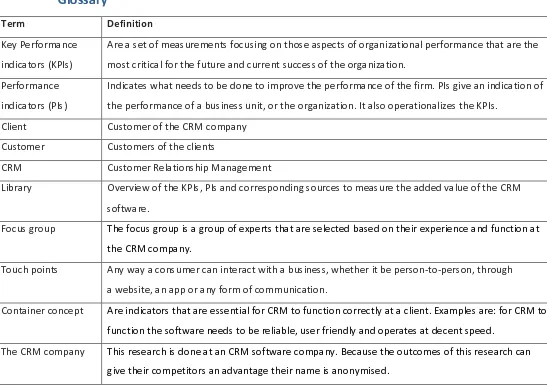
Term Definition
Key Performance indicators (KPIs)
Are a set of measurements focusing on those aspects of organizational performance that are the most critical for the future and current success of the organization.
Performance indicators (PIs)
Indicates what needs to be done to improve the performance of the firm. PIs give an indication of the performance of a business unit, or the organization. It also operationalizes the KPIs.
Client Customer of the CRM company
Customer Customers of the clients
CRM Customer Relationship Management
Library Overview of the KPIs, PIs and corresponding sources to measure the added value of the CRM software.
Focus group The focus group is a group of experts that are selected based on their experience and function at the CRM company.
Touch points Any way a consumer can interact with a business, whether it be person-to-person, through a website, an app or any form of communication.
Container concept Are indicators that are essential for CRM to function correctly at a client. Examples are: for CRM to function the software needs to be reliable, user friendly and operates at decent speed.
[image:7.595.15.562.106.493.2]The CRM company This research is done at an CRM software company. Because the outcomes of this research can give their competitors an advantage their name is anonymised.
7
1.
Introduction
1.1
Background
The CRM company helps organisations build long lasting client relationships with the support of SugarCRM software (‘Sugar’) in the clients’ organizations. In the past years, the CRM company has grown rapidly in terms of organizational size, projects, and processes. To continue to deliver the highest service as possible, the CRM company is evaluating their implementation process and wonders whether it needs adjustments. At present, the added value of implementing Sugar is known, but this is not explicitly measured (Beek4, 2016). To research what the explicit added value of implementing Sugar is, a graduate student has been hired.
1.2
Objective of this research
The objective of this research is to introduce performance measurement in the projects of the CRM company. These performance measurements are client and project dependent, but the CRM company needs a generic solution that is applicable for every client assignment of the CRM
company. Other requirement for this research are that it needs to measure the added value by using the CRM software and that it should become a part of the actual implementation plan. When the solutions for these requirements are implemented correctly, the client will be reminded at the start of the project what the end results of the project will be. This will increase the awareness of the clients, hence increase the need for a CRM strategy. Altogether this results in the final goal of this research: to implement performance measurement in the implementation process of CRM that is based on how clients of the CRM company experience success of CRM software.
1.3
Research questions
In response to the goal of the research, the next main question is formulated:
What are, for clients of the CRM company, the critical indicators of the success of a CRM project, and how can these performance measures be put into effect during the implementation process of the CRM company?
In addition to the main question, the next sub-questions are formulated to answer the main question:
Sub-question 1: What is in existing literature known about CRM and what are the outcomes for firms that implement CRM to their company?
Sub-question 2: How can the CRM company measure the KPIs of CRM software?
8
1.4
Report structure
This study consists of seven chapters.
• In the first chapter the background, objectives, and the research questions are described. • The second chapter describes the case study of this research. It gives an overview of the
services the CRM company provides to their clients and what the typical implementation plan of the CRM company is.
• The third chapter analyses the theoretical framework of this research. The definition, process and outcomes of CRM are explained. Afterwards, the performance measurements of CRM software are discussed. The output of the third chapter is an overview of the literature basis of this research.
• The fourth chapter is an overview of the research methodology. This chapter explains how the research was conducted and what the reliability and validity of this research is. • Chapter five describes the results of this paper. This chapter discusses what the best and
worst scoring indicators are to measure the project success at the client. The output of this chapter is a beta of the performance measurement tool that is carried out in the
implementation plan of the CRM company.
• In chapter six, a summary of the results of the previous chapters are given. Afterwards, the answer to the research question is discussed.
• Chapter seven is the last chapter with the recommendations of this research.
1.5
Deliverables
For this research to be a success, the following deliverables are formulated. The deliverables are answered during this research and can be used by other practitioners who deal with similar challenges.
• Approach how to formulate CRM goals and how to measure them. This deliverable is answered in sub-question one.
• A pilot and evaluation of the application approach. This deliverable is answered in sub- question two.
• Proposal embedding approach based on current methodology of the CRM company. This deliverable is answered in sub-question three.
9 • The initial problem of the CRM company is the input of the problem definition. This problem
definition is the basis of the main research question, related sub-questions and serves as the guideline for this research.
• To analyse the problem, interviews with the supervisor of the CRM company, desk
review, and informal talks with employees of the CRM company were used. During the five months of this master thesis: a literature review on CRM is
conducted alongside with eleven interviews with employees of the CRM company. Based on this, the problem is diagnosed providing an overview of the different indicators and suggestions for improving the standard implementation plan that the CRM company has. Using the MCDM method, the indicators are prioritized
based on criteria derived from literature and the business context of the CRM company. • Based on the outcomes, a plan of action is designed to implement the indicators so that the
added value of implementing CRM software can be measured.
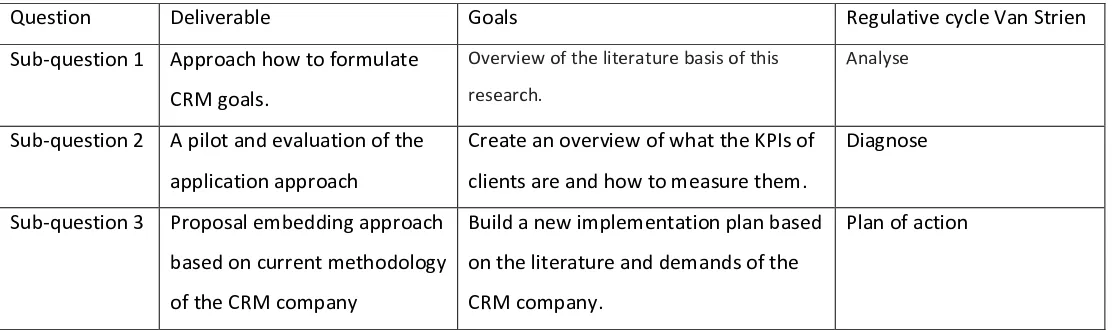
The last two phases of the regulative cycle are not used based on the time and resource constraints of this research. These last two steps should be implemented by the CRM company. An overview of the actions that are completed in this thesis are discussed in table 2.
Question Deliverable Goals Regulative cycle Van Strien
Sub-question 1 Approach how to formulate CRM goals.
Overview of the literature basis of this research.
Analyse
Sub-question 2 A pilot and evaluation of the application approach
Create an overview of what the KPIs of clients are and how to measure them.
Diagnose
Sub-question 3 Proposal embedding approach based on current methodology of the CRM company
Build a new implementation plan based on the literature and demands of the CRM company.
[image:10.595.18.574.409.574.2]Plan of action
Table 2: Overview goals and actions thesis and where these will be discussed.
1.6
Customer experience with the CRM company and Sugar
At the start of 2016, a graduate student did research on the client experience at the CRM company. The graduate student conducted eight interviews with clients to find out what their experience with the CRM company and Sugar was (Entjes, 2016). Results of the research are used in this research as starting point of this research.
Positive outcomes of the research were: • Clear implementation plan • Flexibility of the software
10 The instructions of the Implementation plan are clear and the different phases are explicit. Another significant positive aspect for the clients was the flexibility of the software. In this context, flexibility means the software and its components are easily adjustable.
Points of improvement for the CRM company were: • Progress updates during implementation • Blueprint document
• Evaluation moment
Clients of the CRM company need a status update about the progress of the implementation. During the implementation of Sugar, clients are not aware what is left of the budget, hours and other issues. To inform the clients about the progress, a progress report can be made. This report can be a daily, weekly or monthly report based on the client demands.
Some clients experienced miscommunication with the blueprint document. Some points of
improvement, that the client found important, were not included in the initial blueprint document. The clients experienced this as upselling. That is why it is important that the client involved in the development plan of the project.
11
2.
Case study
2.1
Introduction.
The CRM company is a CRM service supplier, an elite partner of SugarCRM, a Gold partner of IBM Marketing Cloud, and a partner of Drupal. The mission of the CRM company is to create happy clients by building lasting and profitable client relationships. The company was founded in 2007 and currently has approximately 40 employees. By working together with SugarCRM, IBM Marketing Cloud and Drupal, the CRM company can offer CRM and Marketing Automation solutions. Eventually this will lead to helping clients build long lasting relationships that are more in-depth and profitable with their customers (CRM3, 2016). To understand how the CRM company helps their clients, the standard implementation plan is discussed in this chapter.
2.2
What does the CRM company offer?
SugarCRMSugar is the largest software tool for open source Customer Relationship Management (CRM). The company was founded in 2004 and has approximately 7000 clients. Sugar is used, for example, to execute marketing programs, grow sales, and retain customers to create custom business
applications. At this moment, a company can choose out of multiple programs for CRM, but the advantage of Sugar is that it is an open source application. When a firm purchases the source codes, it is open for the purchaser to customize and build the program to their own wishes. Therefore, this software is applicable to many different organizations and markets (Safari books, 2016).
IBM Marketing cloud
The CRM company works together with IBM Marketing Cloud. This is a cloud-based marketing solution for e-mail marketing and lead management. By using this cloud-based software, one can get an insight in the steps a customer takes to buy something. IBM Marketing cloud offers customer data from different sources, analytical insight, and automates the process. IBM marketing Cloud uses real time data from Sugar software (CRM1, 2016).
Drupal
12
2.3
Implementation plan of CRM
The CRM company uses three different options for introducing their CRM software: ‘Quick start’, ‘Hybrid’ and the ‘CRM plus project’. Quick start is the standard approach of ten weeks for a project. Hybrid is the standard configuration added with a small custom build part. CRM Plus projects are the biggest projects with a considerable amount of custom build work for their organization and project (CRM4, 2016). According to the CRM company, the best way to implement performance measures is in the Quick start, because it is easier to implement in the standard approach (Beek, 2016).
Quick start
Quick start consists of seven phases that are implemented in approximately ten weeks. The total implementation time of the CRM software is around six to eight weeks. Before the start of implementing the software, details of the planning are discussed with the client.
• The first phase is the ‘kick-off’. In this phase the goals, planning and the process of the CRM software are discussed with the client.
• The second phase is the ‘Sugar Workshop’. This workshop is for the key-users and project members. In this workshop the basic knowledge of Sugar is discussed. Based on this knowledge the clients should define their demands for the project. The result is that the CRM company can use some Sugar modules that are important for the client and support the CRM process.
• The third phase is the ‘Blueprint’. During the blueprint workshop, the CRM processes are discussed and projected on the standard Sugar CRM functionality. The output of this phase is a blueprint document. In this document, the changes to the standard Sugar software are mentioned. These changes are graphically displayed using mock-ups. When the blueprint is approved, the next phase begins.
• The fourth phase is the ‘apparel of Sugar’. In this phase, the demands of the blueprint are implemented in Sugar. During this implementation, the data is imported and the modules are changed to the demands of the client. This is altogether produced in a test environment. • The fifth phase is the ‘user acceptance test’. During this phase, the whole test environment
is tested by the key users of the client.
• The sixth phase is the ‘training’. The training is at the clients’ location, and the duration is one day. A group of approximately eight key users will be provided with the knowledge and means to use the system in the best way possible.
13
3.
Theoretical framework CRM
During the mid-twentieth century, there were two innovations that changed the competitive market for good. These innovations were mass production and mass marketing. Before that time
shopkeepers and customers knew each other personally and they had a personal relationship. But because of those two innovations the relationship between customers and shopkeepers
fundamentally changed. Customers became a number and shopkeepers did not know what the individual needs of their customers were (Chen & Popovich, 2003).
In recent years companies are trying to re-establish the unique relationship with their clients (Alavi & Leidner, 2001). Their aim is to build a long-term relationship with their customers (Coussement & Poel, 2008; Gibbert, Leibold, & Probst, 2002). Some companies are more successful than others in achieving this, and according to Chen & Popovich this is due to the correct implementation of CRM applications (Chen & Popovich, 2003).
3.1
Customer relationship management
The CRM literature describes multiple definitions. A selection of the definitions is described next. According to Urbanskienė et al CRM means: “the start of a dialogue with a customer.It is everything what is necessary to satisfy the customers’ needs” (Urbanskienė, Žostautienė, & Chreptavičienė, 2008, p. 1). Another approach is that CRM is a “chain reaction”, caused by the new possibilities to communicate about the clients’ needs to get a higher quality of service. This is because of the elevated level of information technology development (Lee, 2001, p. 4). Another source defines CRM as: “the complex of software and technologies, automating and performing business processes in the following areas: sales, marketing, service, and client support” (Thompson, 2001, pp. 1-2). The software is a tool to support the interaction between methods in the different departments of an organization.
To summarize the definitions of CRM:
• Top priority of CRM is the development of the client relationship. This optimizes the profitability, income and meets the needs of clients.
• CRM is integrated in all technological resources used in a company and the different fields of activity that are related to the customer.
• CRM implies maximal customized fulfilment of the customers’ needs.
How does CRM work?
14
• Operational systems are used for the automation of the process and to increase the efficiency of the CRM process.
• Analytical systems are used to analyse the data of the clients.
• Collaborative systems are used to integrate communication systems and manage the interaction touch points. Touch points with customers can include: internet, e-mail, sales, direct mail, telemarketing, call centre, advertisement and papers (Eckerson & Watson, 2000).
Outcomes of CRM
The outcomes of CRM have influence on the activities, offered products and provided services of the client (Shaw, Subramaniam, Tan, & Welge, 2001; Smith & McKeen, 2005). When a client wants to introduce CRM in their organization, it is important to choose the appropriate firm and
corresponding software to do that. This is because when the clients manage their client relationship well, they obtain profit in an indirect way (Murillo & Anabi, 2002; Garcia-Murillo & Annabi, 2002). The profit is obtained through the customers of the client. When a customer is unsatisfied with the service of a client, a well-organized and successful CRM strategy will help to solve this issue. Due to such cooperation, it is eventually a win-win situation for the client and their customer because:
• The customer gets a qualitative better service / product.
• A client can more easily serve her customers because of the obtained knowledge in their database.
• The client can increase their income by having a reliable and loyal customer (Urbanskienė, Žostautienė, & Chreptavičienė, 2008).
The above-mentioned outcomes of the enhanced customer relationship are elaborated in more detail below. At this moment companies are investing more and more in CRM to analyse customer value and modelling customer behaviour (Winer, 2001). Customer value is the perceived preference of the customer when using products and services to obtain their goals and purposes (Woodruff, 1997). When the customer value is known, the client can anticipate by offering products and services based on the preferences of their customer. This can be the quality of the product or perhaps another approach of service.
The other advantage of investing in CRM is getting to know the customer behaviour. The customer behaviour is the process wherein actions leads to satisfaction of needs and demands. When the client is aware of their customer’s behaviour they can influence the process, customer needs, demands and adapt the satisfactions (Enis, 1974).
15 data of their customers, the clients can offer an increasingly customized relationship with
individualized experience. This, in turn, can increase the income of the firm, because customers prefer the firm where they have had a positive experience (Fox, 2009).
3.2
Key Performance Indicators
Two-third of all the CRM initiatives in organizations fail (Prezant, 2013; Davids, 1999). Everett et al. indicate that more than 50% of CRM projects have failed, and that most companies underestimate the costs of CRM by 40% to 75% (Everett, 2002, p. 25; Davey, 2014). But when can one say that a project is successful or not? Measuring the success of CRM in an organization can be done by key performance indicators (KPIs). KPIs are a set of measurements focusing on those aspects of organizational performance that are the most critical for the future and current success of the organization. The problem with KPIs is that very few organizations measure the KPIs relevant to the project. This is because the organizations did not explore what KPIs are, and they just have a mix of performance measures (Parmenter, 2007).
How many KPIs?
There are multiple views on the amount of KPIs a company should have. Kaplan and Norton suggest a maximum of twenty KPIs (Kaplan & Norton, 1996), but Hope and Fraser suggest fewer than ten KPIs (Hope & Fraser, 2003). Parmenter (2007) suggests that an organization should use the 10/80/10 rule. This rule indicates that in an organization there are about 10 Key Result Indicators(KRI), up to 80 Performance indicators(PIs), and 10 KPIs. The definitive number of KPIs depends on the project. There are a couple of factors that influence the number of KPIs (Kerzner, 2011):
• The number of information systems used in the organization. • Who are the stakeholders?
• Is the information easily measurable?
• The organizational process assets available to collect the information from. • What are the costs of measuring and collecting the data?
PIs versus KPIs
Every company wants to know the status of their goals. In this research PIs and KPIs are the
measurement instruments. First the definition of PIs will be given. Afterwards the relation between KPIs and PIs will be discussed.
16 When metrics give an indication of the performance of a business unit, or the organization; they are PIs. Effective PIs are developed and used for regular monitoring of the firm (Carter, 1989). The management can also adjust the PIs to bring performance back in line with expectations (Parmenter, 2007). The biggest problem with PIs is that there are hundreds of them that are firm specific. That is why it is difficult to generalize them based on the literature. The way to make a distinction between these PIs is to base them on the objectives of the firm (Carter, 1989). By doing this the PIs can be used to operationalize the KPIs. This is advised because KPIs are often abstract definitions. In contrast PIs are more easily to measure in practice. Eventually it will prevent a discrepancy between different measurements based on the wrong understanding of the definition.
3.3
Key Performance Indicators of CRM
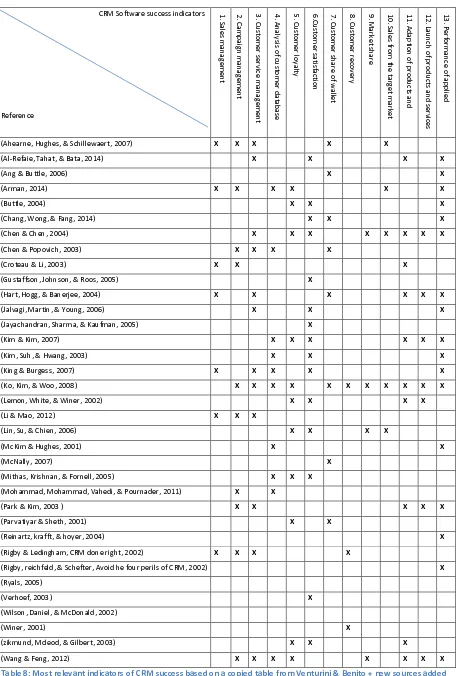
Having defined what is meant by KPIs, the following section will discuss what kind of KPIs there are (appendix 3). Afterwards, is discussed what the right KPIs for your CRM project (appendix 2) are. As was mentioned in the previous section it is impossible to describe universally generalizable
performance indicators. Therefore, every company, project and industry needs different measurement indicators (Kerzner, 2011).
CRM software success scale
The following part of this paper moves on to describe how to measure the success of software of CRM. A technique to measure the success of the CRM software is from Venturini & Benito (2015). They proposed a CRM software success scale that is based on the Balanced Score Card (BSC). The initial CRM success scale consists of three dimensions. These dimensions are operational benefits, benefits in client life cycle and benefits in performance (Venturini & Benito, 2015).
1. Operational benefits.
The operational benefits are related to the gains in productivity and operations. The gains can be achieved by having an effective management of sales campaigns, customer service and data
17 2. Customer life cycle: the customer perspective
The most important benefits of the customer life cycle with CRM software is that it improves the clients’ ability to capture, retain, satisfy, recover and secure the loyalty of the customer (Croteau & Li, 2003; Kim & Kim, 2007; Reinartz, krafft, & hoyer, 2004). These benefits contribute to an
increasing customer lifetime value and the customer equity, which are the pursued outcomes of the implementation of CRM (Kumar, Lemon, & parasuraman, 2006).
3. Firm performance: financial and innovation / learning perspectives
Another option to measure the performance of the CRM software is to measure it at an organisation that has implemented it. A good indicator of this measurement is effectiveness, efficiency and adaptability towards the customers’ needs and the market (Walker & Ruekert, 1987). The effectiveness of the company refers to the success in the sales efforts and the market share gains compared to the competition. Efficiency is the comparative measure how the company uses their available resources to create success in the market. Adaptability is the company’s ability to adjust to changing conditions and new opportunities with customers.
Most relevant CRM indicators of success
18
4.
Research methodology
In this chapter the research approach of this study is elaborated in more detail. The data collection technique, data analysis and the reliability and validity are described (Westrik, 2012). The
methodology chapter of this paper describes the specific procedure and techniques used to identify and analyse the information applied to carry out the empirical study of this project (Libguides, 2016).
4.1
Research design
This empirical study about the introduction of performance measurements in a CRM software environment is mainly following an inductive approach, although it contains deductive elements as well. The research is inductive because exploration of enablers and barriers in the CRM software is not limited to existing theory. This study is also exploratory, because it explores the area of KPIs for CRM software (Dooley, 2009). An exploratory study is a useful approach to discover what is going on, find new insights, ask questions and to find information that was not discovered earlier (Saunders, Lewis, & Thornhill, 2009). A part of the study is also descriptive, because to answer the research questions; the situation of KPIs and CRM are illustrated (Dooley, 2009).
Research approach
The research approach is based on the regulative cycle of Van Strien (1997). For this approach is chosen because it focuses on designing a solution based on theory that is specific for a
business case, allowing for a complete focus on the business problem at hand. The approach consists of five steps: identification of the problem, analysis & diagnosis phase, plan of action, intervention and evaluation. The last two steps are not implemented in this research based on the tight time schedule for this project.
1. Identification of the problem: it is the basis of the project plan and how the subsequent analysis, diagnosis and design are approached.
19 2. Analysis and diagnosis phase: Produces specific knowledge on the context and nature of the problem. To analyse the problem, the literature is examined in chapter 3. After critically reviewing the
literature, multiple interviews with employees of the CRM company were conducted. These
interviews were held to seek for information based upon their experience during projects. The data from the interviews and literature are used in the diagnose phase.
To diagnose the problem the MCDM analyse is used. This method involves the use of different weighted criteria that creates a prioritized list of KPIs. When the prioritized list of KPIs is known, there is an overview of what the most effective indicators are to measure the added value of Sugar. After the MCDM analysis the KPIs are put in a library. The library consists of all the KPIs and
corresponding PIs. This will eventually result in an overview of PIs that operationalize the KPIs. These PIs are based on a combination of theoretical (literature) and practical sources (interviews).
The last diagnose phase is to visualise what is important during the implementation in radar charts. This model is used to visually show how to approach the different clients of the CRM company based on their demands. Eventually this will create an overview of how the different customer segments should be approached during the implementation based on their preferences.
Afterwards three interviews with clients of the CRM company were held to test if the results are applicable to their company.
3. Plan of action:
In the final phase of this research a plan of action is developed to apply the outcomes of this research into the standard implementation plan of the CRM company. The plan of action consists out of the steps that the CRM company should take to implement the proposed outcomes in their projects. The plan of action gives the CRM company a starting point how the last two stages of the problem-solving cycle should be introduced. The last two phases of this cycle are: intervention and the evaluation. These two steps must be undertaken by the CRM company to find out if the results of this research are applicable in practice.
4.2
Data collection techniques
The primary data of this study is generated from observation and interviews with employees and clients of the CRM company. The secondary data comes from different sources, online data bases, reports and books.
20 Participant observation
Observation of how the employees interact with clients of the CRM company is the first technique. During the period from November until February the researcher was the observer, because the employees were familiar with the role of the researcher. The researcher was part of the team and participated in meetings and discussions. Being close to the situation is an advantage, because richer data is acquired (Saunders, Lewis, & Thornhill, 2009).
Semi – structured interviews
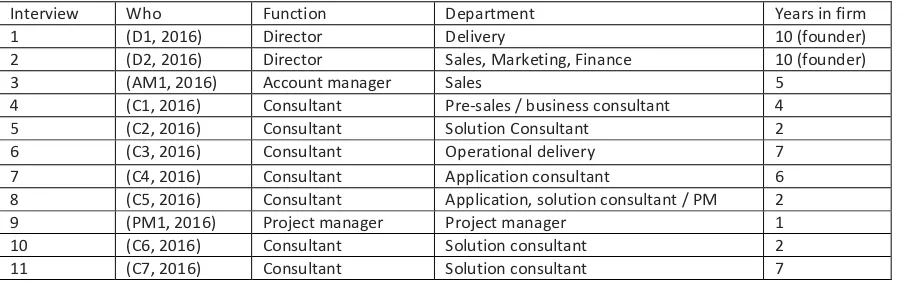
To gather the practical information; interviews were held with the employees of the CRM company (Table 3). The interviews were semi – structured. This is because the questions were determined in advance, but they were open questions. For this approach is chosen to discuss also subjects that are not directly an answer to the question. Hence, the data is of higher quality, because the interviewee can give their opinion more easily (Dooley, 2009). During the interviews the interviewer made notes, and the interview was recorded. After the interview the recording was used to elaborate the notes.
The interview questions were based upon the gaps in the research that arose from the literature review. To answer the questions, interviewees were chosen based on a list given by the supervisor. The interviewees were divided in different stakeholder groups to discover what their involvement and experience with the CRM company was. There were a total of eleven interviews conducted within a time frame of one month. After these eleven interviews the used empirical analysis was considered saturated, as additional interviews would not yield any new information (Glasser & Strauss, 2009).
Interview Who Function Department Years in firm
1 (D1, 2016) Director Delivery 10 (founder)
2 (D2, 2016) Director Sales, Marketing, Finance 10 (founder)
3 (AM1, 2016) Account manager Sales 5
4 (C1, 2016) Consultant Pre-sales / business consultant 4
5 (C2, 2016) Consultant Solution Consultant 2
6 (C3, 2016) Consultant Operational delivery 7
7 (C4, 2016) Consultant Application consultant 6
8 (C5, 2016) Consultant Application, solution consultant / PM 2
9 (PM1, 2016) Project manager Project manager 1
10 (C6, 2016) Consultant Solution consultant 2
[image:21.595.68.520.495.637.2]11 (C7, 2016) Consultant Solution consultant 7
Table 3: Overview Interviews employees the CRM company
21 Secondary data
The secondary data for this research came from written sources: papers, scientific websites, reports from graduation students and books. This paper used multiple ways of data collection, also known as triangulation. Triangulate is the: “Use of different data collection techniques within one study in order to ensure that the data are telling you what you think they are telling you (Dooley, 2009, p. 146)”. Another reason the secondary data is used to get a knowledge basis for the researcher and this report.
4.3
Analysis and Diagnoses
The data from the interviews is analysed by using the MCDM method. Using this method, the indicators that are best suitable for measuring the added value of Sugar are identified. The model will be explained below (Turskis & Zavadskas, 2011).
Multi-Criteria Decision Model
To determine which indicators are best suitable for measuring the added value of Sugar the MCDM method is applied (Turskis & Zavadskas, 2011). This tool is used to solve problems that are
characterized as a choice among alternatives. The tool helps to simplify decisions making by rating the alternative options. For this paper the different performance indicators get a rating based on the criteria/characteristics that it needs to fulfil. This model is known for its simplicity; it is easy to use in practice and the method requires relatively low amount of time per participant. The model consists of a five-step evaluation process (appendix 1):
1. Check for exclusion criteria
2. Assign weights to criteria based on their importance 3. Check for evaluation criteria and assign points
4. Calculate final points for each solution (Weight multiplied by assigned points) 5. Choose the best solution
In the first step the exclusion criteria of the CRM company are discussed. This is necessary to find out what criteria are of such importance for the CRM company, so that when a KPI matches an exclusion criterion they will be excluded from the analysis. These exclusion criteria will be discussed with the focus group. The focus group is a group of experts who are selected because of their experience and function at the CRM company. An example of an exclusion criterion is: the KPI should be compliant with the CRM company way, rules and legal aspects. When the KPI is not compliant they are excluded from the analysis.
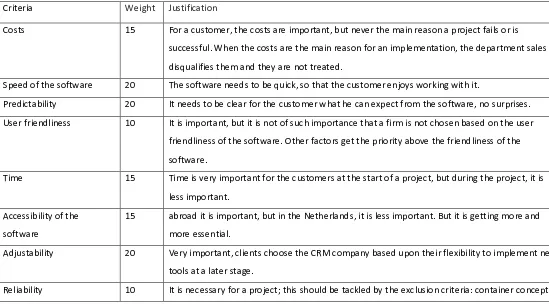
The second step is to assign weights to the criteria based on their importance. The criteria are obtained from the interviews and are the most important aspect for the client during the
22 weights distributed between the evaluation criteria vary between very important (weight: 20), important (weight: 15) and relevant (weight: 10).
The third step is to evaluate the different KPIs. This is done by the focus group. They give scores from 0 to 100 points to the different criteria. When a criterion is the best in a category it gets 100 points, when it performs the worst it gets zero points. The scores that are in-between receive a score to equal weight distribution.
The fourth step is to calculate the final points for each solution. When every focus group member has given their scores, the scores are averaged to come to a single conclusion per KPI. When the scores between the focus groups are distinct, this will be further analysed.
The fifth and final step is to analyse the data that is obtained from the MCDM analyse. It becomes clear what the best scoring KPIs are and which are the worst scoring KPIs.
Approaching the different client segments
The results from the MCDM analyse are the input for the next model: the customer segmentation model. To define which client segments the CRM company has, the client needs segmentation model was used (Simkin, 2008). This model focuses on adding extra value for the client. It links the goals of the customer to the way they should be approached. During the initial meeting with the client, the CRM company can discuss what the goals of the client are. With this information, it becomes clear how the specific customer should be approached. By using this approach, it will add value for the client because the CRM company is aware of what the focus points are during the whole project.
When the customer segments are known, the different segmentation axes are described. These axes have the same criteria as the MCDM analysis. By doing so, the model visually explains which KPIs can be used for the different customer segments. The data for the client segments and the indicators of how the customer should be approached, are obtained from the interviews.
4.4
Reliability and validity
23 Because the research is conducted in a test environment, the outcomes of this research are perhaps not applicable to some clients (Dooley, 2009).
The biggest impact of reliability comes from environmental changes. Because the research takes place in a fast-changing environment. There could be small environmental changes, during the time between measurements, which could create errors in the results. This influences the objectivity of the data (Dooley, 2009).
24
5.
Results
In chapter five the results of this research are discussed. First is discussed what the global indicators of the success of the implementation are. Afterwards are the project specific indicators introduced. These project specific indicators are the input for multiple models and analysis in this chapter. The output of this chapter is an overview of how the success of Sugar can be measured.
5.1
Indicators of the CRM company
During the interviews, global indicators were mentioned by the interviewees to address the success of the implementation. Global indicators are for this research indicators that are applicable for every project to measure the success of the implementation. These indicators are important during the implementation, because only measuring the KPIs and PIs gives a one-sided view of the problem. These global indicators are: customer satisfaction, financial payments, ability to monitor the users and predetermined feedback moments.
• Customer satisfaction
Customer satisfaction is top priority for the CRM company. It is of such importance for the CRM company that it is incorporated into their slogan: “Create happy customers”. This became clear during the interviews; the software should be implemented in such a manner that it creates value for the client.
Creating value is different for every project and employee of the client. That is why the interviewees advised to measure the customer satisfaction by conducting a research with the key users of the client. This should not be a formal research, but should be an informal phone call or meeting. During this informal talk, the CRM company must find out if the key user is satisfied. With this indicator, the CRM company can measure if the KPIs that are set at the start of a project are achieved amongst the key users of the client (C3; AM1; D2; C1). When the customer’s goals are achieved, it is assumed that customers are happy (C5).
• Financial payments
25
• Ability to monitor the users
The third global indicator is to monitor the usage of the software. The users make or break the success of the implementation. Key – users receive a training how the system should be used according to the CRM company. The “normal” users do not get this training. For CRM software to be successful all users should use the software correctly. To measure which users are using CRM software correctly, Sugar can be used: what time-period are the users online in the system, which modules do they use, which fields do they use and what is the quality of the data in the compulsory fields (C3; PM1; C2; C6).
• Predetermined feedback moments
The last approach are predetermined feedback moments with the client. These feedback sessions should be at scheduled times (C2; C6; AM1). By having a predetermined feedback session after the implementation, the employees can mention what difficulties they are facing with Sugar (C6; AM1). This can be done by sending a report to the client after the implementation is finished. In this report the monitored usage of the users are analysed. This report can be used as starting point of a
discussion wherein is discussed what the findings of the client are (C3; C5; C6).
Project specific points of interest
Next to the global indicators that were discussed above, the following section discusses what the project specific indicators for the success of the implementation. The project specific indicators are used as input for the MCDM analysis, customer segmentation model and the plan of action. This is because they determine if the project is successful for the client.
• Costs of the project are always important for the clients (C3; C5; D1; AM1; D2).
• The speed of the software is critical, but that is self-evident. That the system works at a decent speed is essential for the clients’ satisfaction (C3; PM1; C2; C6).
• For clients, it is important that the project is predictable. Predictability of the project arises from clarity of the costs, planning, quality, functionality. The project must be on time and on budget (C5; PM1; AM1; D2).
• For clients, it is important that the employees of the client can easily work with the
software. The usability is key for the employees of the client. This has as a result that every employee of the client can completely rely on the software instead of seeing constraints by using the software (C4; D1; C7; C2; C6).
26
• A new indicator that is getting more and more essential is the accessibility of the software. That the software is available on your personal mobile and that the data can be accessed wherever and whenever. A factor that correlates with this indicator is the location of where the data is stored. Is it stored locally, at the CRM company or abroad (C4; C2)?
• The software that is developed should be easily adjustable. When the client wants some changes, it should be easy to adjust the software to the clients wishes (C4; AM1).
• Reliability is also critical to the client. The system should be consistent with the results that are shown. The system should be of added value by being supportive and user friendly (C2).
5.2
MCDM analysis
To determine which KPIs are most suitable for clients of the CRM company the MCDM analysis is used. This analysis uses the thirteen KPIs from Venturini & Benito (2015) and the eight indicators (project specific) that were introduced earlier in chapter 5.1.
The MCDM analysis is executed by using exclusion criteria and evaluation criteria. In the first step is checked if the KPIs matches with the exclusion criteria. If a criterion is answered with ‘No’, the KPI will be excluded from the list. The exclusion criteria are compliance with the CRM company way / rules / legal aspects, degree of corporate culture fit and container concept. Some scores received, at the exclusion criteria, "Future” as answer from the focus group (Customer loyalty, customer share of wallet, customer recovery, market share, sales from target market, launch of products and services, performance of applied resources). With future is meant that these indicators are not (or limited) used during projects of The CRM company. This is important for this research, because all thirteen KPIs (including those whom received a future as exclusion criteria) were mentioned in the literature as important for the success of the CRM software. So, it is in the best interest of The CRM company when these KPIs are added to the implementation plan. In addition, the focus group members were enthusiastic about the added value of introducing them at the CRM company.
27
Figure 2: Distribution points per evaluation criteria of the MCDM analysis
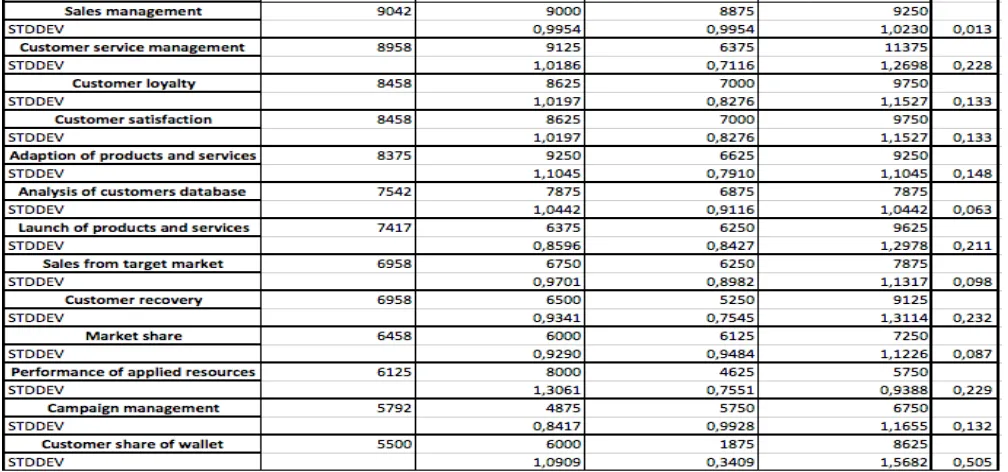
Based on the weights multiplied by the score of the evaluation criteria, the KPI receives a final overall score. An example of the calculation is: costs got the weight of 15 (important), and the KPI sales management scored 100 points (very high) = 15 * 100 = 1500. This process is done for all project specific indicator and then is the sales management KPI finished. The final score of every KPI is calculated per focus group member (table 4). These overall scores are averaged to get an overall score per KPI. Based on these averages, an overview of the best and worst scoring KPIs is created. The three best scoring KPIs according to the focus group are:
• Sales management (9042)
• Customer service management (8958)
• Customer loyalty & satisfaction (Same score: 8458).
The three lowest scoring KPIs according to the focus group are: • Customer share of wallet (5500)
• Campaign management (5792)
• Performance of applied resources (6125)
The scores of the MCDM analyse were analysed by looking at the differences between the scores of the focus group members in Table 4. This is done by using a calculation: focus group member score per criteria divided by the average focus group score. This resulted in three individual difference scores per focus group member.
To address what the differences in scoring between the focus members is, the standard deviation is used. When the standard deviation is small, the focus group members are more similar minded about the score. The focus group members were similar minded about the sales management (0,013), Market share (0,087) and the analysis of the customer database (0,063). There is the biggest difference in scores with the customer share of wallet (0,505). Based upon this, is it difficult to discover a pattern in the standard deviation. This can be related to the department (Sales & Consultancy) and experience with different projects of the focus group members.
28
5.3
Library of the acquired data
During the interviews with employees of the CRM company and the literature review, multiple KPIs and corresponding PIs were found to measure the success of the CRM software. These indicators were collected to come up with an overview of all the indicators that were applicable for the CRM company. This collection is placed in a library (Appendix 5). From this library project managers of the CRM company can choose, in consultation with the clients, indicators to measure the project
success. For this approach is chosen because performance measurements are project dependent (C7; C6; AM1). The reason that there is a meeting with the client is to manage the expectations of the client (C3; C2; AM1). During this meeting are the goals of the project discussed. If these goals are met, the implementation phase is successful (C5; C2; D2).
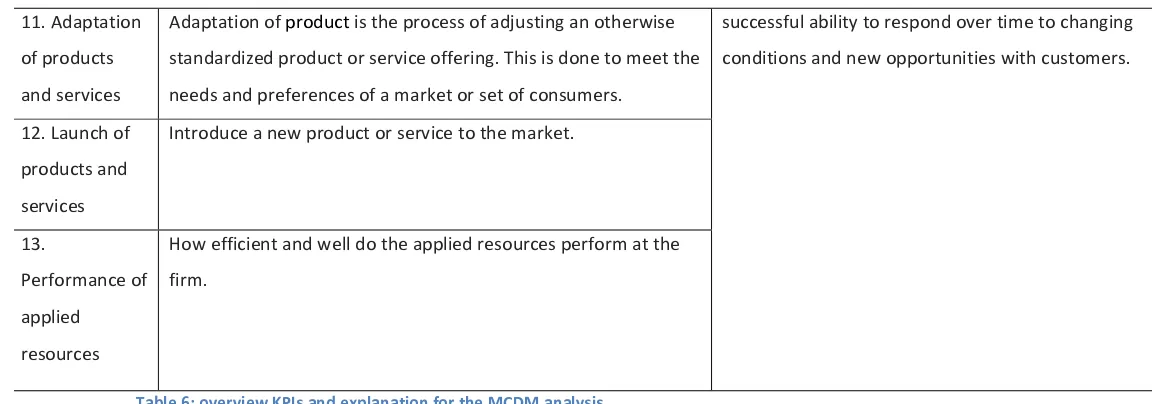
The library starts with the three main reasons why customers come to the CRM company according to the supervisor of this research: sales, marketing and service support (Beek4, 2016). The next step is to implement the thirteen KPIs of CRM software from Venturini & Benito (2015) in the library. These thirteen indicators are measured by the PIs. When an indicator was found, it was placed in the library. If an indicator was mentioned, new sources of the same indicator were not written down. The reason for this was to keep the library orderly.
5.4
Customer segmentation model
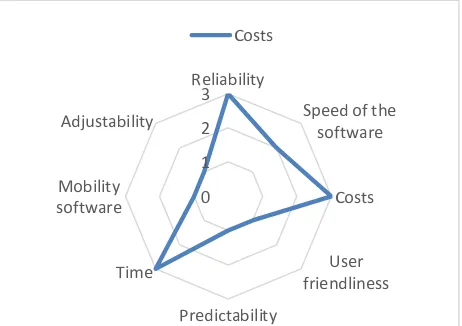
The employees of the CRM company mentioned five reasons for introducing CRM in their
[image:29.595.46.550.18.254.2]organization. To measure how the different customer segments can be measured the KPIs can be used. These KPIs are linked to the customer segments based upon the scores that the focus group gave to the indicators in the radar charts. This is done by looking at the best scoring indicators in the radar charts in appendix 6.
29 Per segment three KPIs are selected according to the scores of the focus group applicable to
measure the segment.
• Centralisation. Clients choose to implement CRM in their organization to centralize their data as part of the CRM software. In the old situation, the data is stored at multiple locations. For example, these locations can be: Excel, Outlook and Word (C3; C4; D2). The KPIs to measure this segment are: Sales management, adaption of products & services and launch of products and services.
• Sales improvement. An insight in the sales is another reason for client to introduce CRM. With insight in sales is meant; more insight in opportunities and to guarantee that the sales department are focusing on the right prospects. By doing this, the sales process will become more efficient and effective (C5; C3; PM1; D1; C2; AM1). The KPIs to measure this segment are: Customer loyalty, sales from target market and sales management.
• Costs. To implement a complete new CRM system for the clients’ organization is expensive. That is why organizations pick Sugar. By doing this, the clients have a running start by implementing CRM software in their organization. The clients can use Sugar as a basis for their upcoming projects. The advantage of using Sugar, in relation to standard build systems, is that Sugar is so flexible that you can put new additions in the software (C3; C6). The KPIs to measure this segment are: Sales management, customer loyalty and campaign
management.
• Insight own process. Extra focus on your own process is another reason for introducing CRM. Most clients have extended knowledge about their customers, but this is not complete, or it is stored in multiple systems. The clients want a 360-degree view based on their customer (C3; C4; C5; PM1; D1; D2; C7; AM1). The KPIs to measure this segment are: Customer service management, analysis of customer database and sales from target market.
• Professionalizing. The professionalizing of the client appearance is the last reason to implement CRM in the clients’ organisation. To become more professional, a CRM system is the key to standardize their process. The standardized process has influence on the
professional approach of customers and the processes of the client (C2). The KPIs to
measure this segment are: Analysis of customer database, performance of applied resources and adaption of products and services.
30 0
1 2 3 Reliability
Speed of the software
Costs
User friendliness Predictability
Time Mobility software
Adjustability
Costs
created in displayed in figure 3. These five radar charts are examples how the different customer segments can be approached. It should be used by the CRM company at the start of a project to visualize what the focus points of that specific project are.
5.5
Plan of action
In this sub-chapter the third step of the regulative cycle (Strien, 1997) is discussed: the plan of action. The result of the plan of action is the implementation of the outcomes of this research in the standard implementation plan. To implement the performance measurements at the CRM projects of the CRM company, a roadmap is set up to implement it successfully. This roadmap is based upon the literature study and interviews with employees of the CRM company. The implementation of the outcomes is key to the success of the performance measurement. When it is implemented
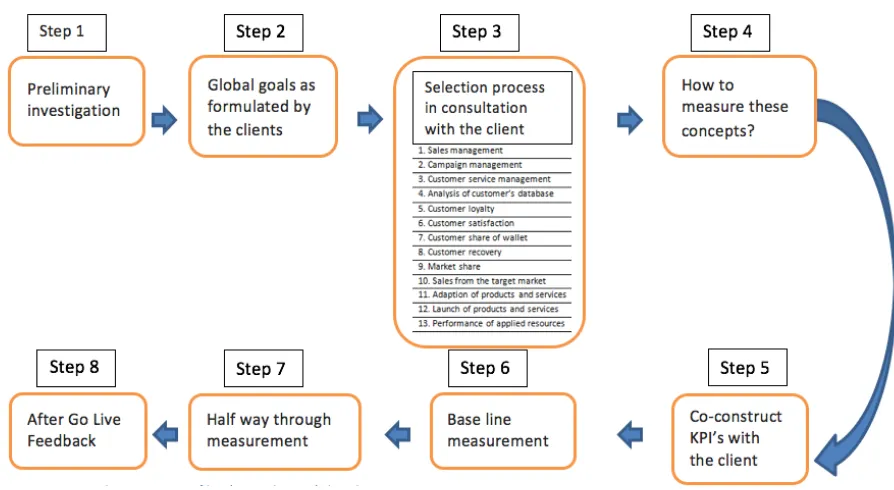
successfully; the system will be obtained and used properly by the employees of the CRM company (C2; C3). The plan of action with the corresponding steps are visually displayed in figure 4.
Plan of action
[image:31.595.65.296.137.300.2]31 1. The new implementation plan should start with a new step: a preliminary investigation of
the client. During this investigation, an employee of the CRM company can work together with the client on a case. Based on how the client solves this case, important focus points of the implementation are chosen (C4; PM1; D1; AM1). For example, the case is a
questionnaire where the client must choose between two PIs. This will result in an overview of which KPIs are important for the client. An example of this was discussed in the customer segmentation model in chapter 5.4.
2. After a preliminary investigation, the client goals for implementing CRM software should be discussed with the CRM company. Often those goals are not CRM related and should be translated during the discussion into CRM goals. During this meeting, the goals of implementing CRM software should become clear for both parties.
3. After the goals are discussed, the CRM company should take a leading role to link these goals to the KPIs of Venturini & Benito (2015). This can be done by introducing a new step in the original implementation plan (before the Sugar Workshop (chapter 2.3)). In this step are the goals, in consultation with the client, linked to the KPIs.
4. When the goals of the client are linked to the KPIs, an overview of KPIs that need to be measured for that specific project is created. The fourth step defines how these KPIs can be measured. To measure the KPIs, the CRM company can use the different PIs that are
[image:32.595.66.513.70.315.2]compiled in the library (appendix6). These indicators do not cover all the possibilities how to measure the KPIs, but are an overview of how the different KPIs can be measured.
32 5. During a new meeting with the client the different KPIs and the corresponding PIs should be
discussed. By doing this the measurements indicators are clear for both parties, and if necessary, adjustments can be made. This can be done during the third phase (blueprint phase) of the original implementation plan of the CRM company. By doing this, the CRM company takes the leading role in setting up the performance measurement, but have the clients involved in the process and reflect upon.
6. To indicate what the added value of the implementation is, a base line measurement should be done to measure what the starting point of the performance indicators is. By doing this, the CRM company can focus on these critical performance indicators during the
implementation (PM1; D1; C1).
7. Approximately halfway through the implementation a new step should be introduced. In this step, the status of the PIs should be discussed with the client. By doing this it becomes clear if there should be put more effort in the PIs, or that they are progressing according to plan. During this check employees of the CRM company should ask the clients what their
experiences with the software is and if there are any problems (AM1; D2).
8. At the end of the implementation process it becomes clear if the different goals are achieved by checking the PIs (C3; C1; D2). When the results are known, the outcomes must be discussed with the client. This is of importance, because in most projects there are no official support sessions after the implementation plan of the CRM company. This is because there is no budget addressed to it. During the implementation, the client is important, but after the “Go live” moment clients are side-lined. Afterwards, employees of the CRM company would like to discuss what the problems of the clients are, and if they have any suggestions (C4; D2; AM1).
By implementing Sugar, clients of the CRM company can make a fresh start, but the client is the only one that can make it a success.
Interviews clients of the CRM company
33 The extra evaluation moments in the plan of action should happen during and after the
implementation of the CRM company, but it must be clear what is going to be measured and what the base line measurement is.
34
6.
Conclusion
In this chapter the research question is answered. This conclusion is based on the findings from the previous chapters, especially from chapter five, introducing the results and the action plan. To answer the research question, the different sub-questions are analysed first.
Sub-question 1: What is in existing literature known about CRM and what are the outcomes for firms that implement CRM to their company?
CRM can be defined as the development of the relation with your customer. It is integrated in all technological resources used in a company and the different fields of activity that are related to the client. Thus, CRM implies the maximal customized fulfilment of the clients’ needs.
By implementing CRM to the company, this will eventually lead to profit in an indirect way. The profit can arise from effective marketing that is based on the data of the customer. This is, because a client can serve her customers more easily based upon the obtained knowledge in their database. Eventually this will lead to an increase of their income, based on a reliable and loyal customer. The last major outcome of introducing CRM to your firm, is that the firm gets a qualitative better service / product that is based on the wishes and demands of the customer.
Sub-question 2: How can the CRM company measure the KPIs of CRM?
The KPIs of CRM are broad terms that are hard to define. This has as difficulty that these KPIs can be understood incorrectly. That is why, for measurements of the KPIs, the PIs are used in this research. These measurements are collected in a library (Appendix 5). For the CRM company, this library can assist the consultant of the project to form the goals of the client. This library should be used as a reference book, not as the main solution. Because of this, the library is never complete; in the constant changing IT environment, it should be updated by new indicators regularly.
Sub-question 3: How can the performance tool of measuring KPIs of CRM be implemented in the standard implementation plan of the CRM company?
The best way to implement the outcomes of this research in the implementation plan, is to adjust the original plan. The biggest adjustments are: a preliminary investigation, determining the measurement indicators and a feedback session.
Before the start of an implementation plan, the CRM company should organize a preliminary investigation where they use cases. These cases are discussed afterwards with the client to address the critical points of the implementation. The second adjustment are the introducing measurement indicators. These are discussed in the second sub-question. After the implementation, the
35 The main research question is:
What are, for clients of the CRM company, the critical indicators of a CRM project, and how can these performance measures be put into effect during the implementation process of the CRM company?
In the next section, the principal findings of the current investigation will be presented. During the research, multiple analyses were used to find answers for the main research question. The MCDM analyse is the first method used. The model of Venturini & Benito (2015) was the basis for this analysis. There are according to this model thirteen KPIs that are critical for the success of the implementation. From this analysis, an average project of the CRM company was used as input. Based upon this analysis; there are four KPIs critical for the success of the implementation: Sales management, Customer service management, Customer loyalty & Customer satisfaction. To put the KPIs into effect during the implementation PIs are used. These PIs can be used to operationalize the KPIs, because PIs are easier to measure in practice. This resulted in a library wherein all the KPIs are elaborated by the PIs. From this library project managers of the CRM company can choose, in consultation with the clients, indicators to measure the success of the project. Implementing KPIs and PIs in the projects of the CRM company is one of the essential steps in the new implementation plan. The most important steps of this implementation plan are to introduce: a preliminary investigation, the above-mentioned indicators and multiple feedback sessions with the client.
To implement the indicators and implementation plan successfully, the CRM company should focus on what is experienced as important for the different client segments. During the research the different client segments were discovered. These segments were based upon the needs of implementing CRM in their organisation: Centralisation, costs, sales improvement, insight in their own process and reliability.
36
7.
Recommendations
Chapter seven is the last chapter with the recommendations of this research. What can further research add to this research? What are important tips for the CRM company?
The first recommendation is to introduce the last two steps of Van Strien (1997) regulative cycle: intervention and the evaluation. These two steps were not achieved during this research. But they are necessary to successfully implement the outcomes of this research. This should be done by introducing the new implementation plan at a new project. The steps that should be implemented are discussed in the plan of action. By doing this, it becomes clear for the CRM company if the outcomes of the research are implementable in practise. The results from this intervention should be discussed with the whole team to evaluate it properly.
Another recommendation is the Introduction of a no cure, no pay solution. It is a risky
recommendation, because when the CRM company does not achieve their promises, it can be a costly approach. But when the CRM company is confident in the goals that they prescribe it can result in more clients. This approach should be implemented after the software is measured for a year in multiple projects. The measurement scores of these projects can be combined and averaged. When a new potential client then comes to the CRM company, you can introduce the no cure, no pay solution. An example of a cure is: by introducing Sugar, sales will increase by 10%. When this is not obtained in 1 year It is not necessary to pay. It is important that the conditions need to be defined. This is because multiple factors influence the sales improvement.
Based upon the interviews with the clients of the CRM company, the no-cure no-pay approach was not a reason to choose earlier for the CRM company (Client1, 2017; Client2, 2017; Client3, 2017).
Based upon the results from the MCDM analysis the three lowest scoring KPIs are the Customer share of wallet, campaign management, and performance of applied resources. The scores are an overview of what clients of the CRM company find important for their CRM software
implementation. The literature has identified these three, among the other thirteen, as most important for implementing CRM software in your organisation. Based upon these figures, the CRM company should focus on these three KPIs to guarantee the successful implementation.