Original citation:
Matias, Y., Rajpoot, Nasir M. (Nasir Mahmood) and Sahinalp, S. C.. (2001) The effect of flexible parsing for dynamic dictionary based data compression. Journal of Experimental Algorithmics (JEA), Volume 6 . Article Number 10 . ISSN 1084-6654
Permanent WRAP url:
http://wrap.warwick.ac.uk/61184
Copyright and reuse:
The Warwick Research Archive Portal (WRAP) makes this work by researchers of the University of Warwick available open access under the following conditions. Copyright © and all moral rights to the version of the paper presented here belong to the individual author(s) and/or other copyright owners. To the extent reasonable and practicable the material made available in WRAP has been checked for eligibility before being made available.
Copies of full items can be used for personal research or study, educational, or not-for-profit purposes without prior permission or charge. Provided that the authors, title and full bibliographic details are credited, a hyperlink and/or URL is given for the original metadata page and the content is not changed in any way.
Publisher’s statement:
"© ACM, 2001. This is the author's version of the work. It is posted here by permission of ACM for your personal use. Not for redistribution. The definitive version was published in Image and Vision Computing, Volume 19 (Number 6). (2001)
http://doi.acm.org/10.1145/945394.945404"
A note on versions:
The version presented here may differ from the published version or, version of record, if you wish to cite this item you are advised to consult the publisher’s version. Please see the ‘permanent WRAP url’ above for details on accessing the published version and note that access may require a subscription.
The Effect of Flexible Parsing for Dynamic Dictionary
Based Data Compression
Yossi Matias
∗Nasir Rajpoot
†S¨
uleyman Cenk S.ahinalp
‡Abstract
We report on the performance evaluation of greedy parsing with a single step look-ahead (which we call flexible Parsing or FP) as an alternative to the commonly used greedy parsing (with no-lookaheads) scheme. Greedy parsing is the basis of most pop-ular compression programs including UNIX compress and gzip, however it usually results in far from optimal parsing/compression with regard to the dictionary con-struction scheme in use. Flexible parsing, however, is optimal [MS99], i.e. partitions any given input to the smallest number of phrases possible, for dictionary construction schemes which satisfy the prefix property throughout their execution.
We focus on the application ofFP in the context of the LZW variant of the Lempel-Ziv’78 dictionary construction method [Wel84, ZL78], which is of considerable practi-cal interest. We implement two compression algorithms which use (1) FP with LZW dictionary (LZW-FP), and (2) FP with an alternative flexible dictionary (FPA as in-troduced in [Hor95]). Our implementations are based on novel on-line data structures enabling us to use linear time and space. We test our implementations on a collec-tion of input sequences which includes textual files, DNA sequences, medical images, and pseudorandom binary files, and compare our results with two of the most pop-ular compression programs UNIX compress and gzip. Our results demonstrate that flexible parsing is especially useful for non-textual data, on which it improves over the compression rates ofcompressand gzip by up to 20% and 35%, respectively.
∗Department of Computer Science, Tel-Aviv University, Israel and Bell Labs, Murray Hill, USA;
[email protected]. Research supported in part by an Alon Fellowship, by the Israel Science Founda-tion founded by The Academy of Sciences and Humanities, and by the Israeli Ministry of Science.
†Department of Mathematics, Yale University, USA, and Department of Computer Science, University
of Warwick, UK;[email protected].
‡Department of Computer Science, University of Warwick, UK and Center for BioInformatics, University
1
Introduction
The most common compression algorithms used in practice are the dictionary schemes (a.k.a. parsing schemes [BCW90], or textual substitution schemes [Sto88]). Such algorithms are based on maintaining a dictionary of strings that are called phrases, and replacing sub-strings of an input text with pointers to identical phrases in the dictionary.
A dictionary can be constructed in static or dynamic fashion. Almost all practical com-pression algorithms use dynamic schemes (as introduced by Ziv and Lempel [ZL77, ZL78]) in which the dictionary is initially empty and is constructed incrementally. Most of these algorithms construct dictionaries that satisfy the prefix property for any input string: in any execution step of the algorithm, all prefixes of any given phrase are also phrases in the dictionary.
Dictionary based compression algorithms of particular interest are the LZ78 method [ZL78], its LZW variant [Wel84], and the LZ77 method [ZL77]. All three algorithms are asymp-totically optimal for a wide range of probabilistic sources. However, it has recently been demonstrated that LZ78 (as well as LZW) approaches the asymptotic optimality faster than LZ771. It is an open question why their relative performances vary in different applications.
Given a dictionary construction scheme, there is more than one way toparsethe input, i.e. choose which substrings in the input text will be replaced by respectivecodewords. Almost all dynamic dictionary based algorithms in the literature ([ZL77, ZL78, Wel84, MW85, Yok92]) use greedy parsing which is fast and can be applied on-line. However, it usually results in far from optimal parsing/compression: for the LZW dictionary method, there are strings T which can be (optimally) parsed to some m phrases, for which the greedy parsing obtains Ω(m3/2) phrases ([MS99]; a similar result for static dictionaries is in [GSS85]).
Perhaps the most fundamental question regarding dictionary compression algorithms is to find good dictionary construction schemes; i.e. schemes that enable good encoding of the input with small redundancy. Unfortunately, a simple counting argument shows that there cannot exist a single dictionary construction scheme that is superior to any other scheme for all inputs. The advantage of one dictionary construction scheme over another can only apply with regard to restricted classes of input texts.
In [Hor95] it was demonstrated that the compression achieved by LZW algorithm on some standard benchmark files can be improved by looking ahead a few steps. However, it
1
was noted that: “An optimal parsing scheme would also have to consider the possibility of matching a short first string and then a short second string in order to match a very long third string. We will however reject such possibilities as being too expensive to implement (for minimal expected gain in compression). Our non-greedy version of LZW will only look ahead by one parsed string when choosing its course of action.” In fact the algorithm proposed in [Hor95] not only changes the parsing scheme, but also constructs an entirely different dictionary from that of LZW on a given string - hence, compression improvement over LZW is not guaranteed, and the notion of optimality is not clear. The worst case running time of this algorithm is O(|T3/2|), where |T| is the input size.
Recently [MS99] resolved the issue of on-line optimal parsing in this context by showing that for all dictionary construction schemes with the prefix property, greedy parsing with a single step lookahead is optimal on all input strings - this scheme is calledflexible parsing or F P. A new data structure is also introduced in [MS99] which implements the algorithm that uses LZW dictionary construction with F P in O(|T|) time and space proportional to the number of phrases in the dictionary. The space and time complexity of this data structure is identical to that of the original LZW implementation. Hence optimal compression can be achieved without any overhead in complexity 2.
In this study, we report an experimental evaluation ofF P in the context of LZW dictio-nary construction scheme. Our implementations are based on a new data structure based on Karp-Rabin fingerprints [KR87]. We first demonstrate that optimality of F P (in the con-text of LZW dictionary construction) translates into considerable improvement over greedy parsing in practice - we denote this algorithm by LZW-F P. We compare LZW-F P with
compress, gzipand the algorithm which uses the flexible dictionary construction of [Hor95]
and F P (we call this algorithm FPA). On practical data files (including DNA/protein sequences, medical images, and files from the Calgary corpus and Canterbury corpus bench-mark suites), both LZW-F P and FPA perform better than LZW (unix compress) in terms
of compression, up to 20%. LZW-F P and FPA are also superior togzipfor most non-textual data and all types of data of size more than 1M B. For pseudo-random strings and DNA sequences, the improvement is up to 35%. On shorter text files, gzip is still the champion, which is followed by FPA and LZW-F P. Curiously, for most files the flexible dictionary construction proves to be better than the greedy (LZW) dictionary construction. We then investigate whether better asymptotic properties of LZ78 based algorithms in comparison to LZ77 translate into improved compression. We demonstrate that on pseudorandom bit streams (with various distributions), the redundancy in the outputs of each of the four
pro-2
grams approaches to the expected asymptotic behavior very fast - requiring less than 1KB for each of the different distributions; better asymptotic properties of LZW in comparison to LZ77 are very visible. For files of size 1M B,compress can improve overgzip up to 20% in compression achieved.
All the software, documentation, and detailed experimental results reported in this paper are available on the WWW [Sou].
2
The Compression Algorithms
In this section, we describe how each of the algorithms of our consideration, i.e. (1) the LZ77 algorithm (the basis for gzip), (2) the LZW variant (the basis for UNIX compress) of the LZ78 algorithm, (3) LZW-F P algorithm and (4) FPA algorithm work. Each of the algorithms fits in a general framework that we describe below.
We denote a compression algorithm by C and its corresponding decompression algorithm by C←. The input to C is a string T of n characters, chosen from a constant size alphabet
Σ; in our experiments, Σ is either ascii or is{0,1}. We denote byT[i] the ith character ofT,
and by T[i:j] the substring which begins atT[i] and ends at T[j]; notice thatT =T[1 :n]. The compression algorithm C compresses the input by reading the input characters from left to right (i.e. from T[1] to T[n]) and by partitioning it into substrings which are called blocks. Each block is replaced by a corresponding label that we call a codeword. We denote thejthblock byT[b
j :bj+1−1], or shortlyTj, whereb1 = 1. The output ofC, hence, consists
of codewordsC[1], C[2], . . . , C[k] for somek, which are the codewords of blocksT1, T2, . . . , Tk
respectively.
The algorithmC maintains a dynamic set of substrings called the dictionaryD. Initially, D consists of all possible one-character substrings. The codewords of such substrings are their characters themselves. As the input T is read, C adds some of its substrings to D and assigns them unique codewords. We call such substrings ofT phrases ofD. Each blockTj is
identical to a phrase in D: hence, C achieves compression by replacing substrings of T with pointers to their earlier occurrences in T.
The decompression algorithm C← that corresponds to C takes C[1 : k] as input and
computesT[1 :n] by replacing eachC[j] by its corresponding blockTj. Because the codeword
C[j] is a function of T[1 : bj −1] only, the decompression can be correctly performed in an
inductive fashion.
Description of the LZ77 Algorithm. The LZ-77 algorithm reads the input characters from left to right while inserting all its substrings in D. In other words, at the instance it reads T[i], all possible substrings of the form T[j : `], j ≤ ` < i are in D together with all substrings of size one. The codeword of the substringT[j :`] is the 2-tuple (i−j, `−j+ 1), where the first entry denotes the relative location of T[j : `], and the second entry denotes its size. LZ77 uses greedy parsing: themth blockT
m =T[bm :bm+1−1] is recursively defined
as the longest substring which is in D just before C reads T[bm+1−1].
Description of the LZW Algorithm. The LZW algorithm reads the input characters from left to right while inserting in D all substrings of the form T[bm : bm+1]. Hence the
phrases of LZW are the substrings obtained by concatenating the blocks of T with the next character following them, together with all possible substrings of size one. The codeword of the phrase T[bm : bm+1] is the integer |Σ|+m. Thus, the codewords of substrings do not
change in LZW algorithm. LZW uses greedy parsing as well. Hence, no two phrases can be identical in the LZW algorithm.
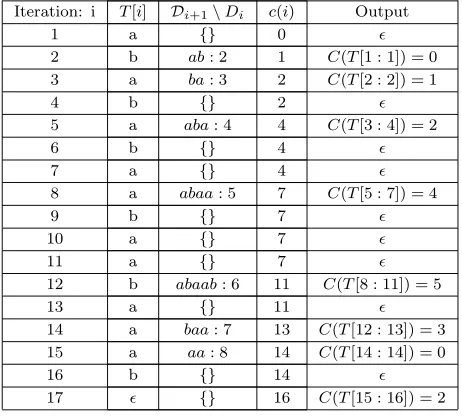
Iteration: i T[i] Di+1\Di c(i) Output
1 a {} 0
2 b ab: 2 1 C(T[1 : 1]) = 0 3 a ba: 3 2 C(T[2 : 2]) = 1
4 b {} 2
5 a aba: 4 4 C(T[3 : 4]) = 2
6 b {} 4
7 a {} 4
8 a abaa: 5 7 C(T[5 : 7]) = 4
9 b {} 7
10 a {} 7
11 a {} 7
12 b abaab: 6 11 C(T[8 : 11]) = 5
13 a {} 11
14 a baa: 7 13 C(T[12 : 13]) = 3 15 a aa: 8 14 C(T[14 : 14]) = 0
16 b {} 14
[image:6.595.191.422.343.551.2]17 {} 16 C(T[15 : 16]) = 2
Table 1: LZW compression algorithm for T = a, b, a, b, a, b, a, a, b, a, a, b, a, a, a, b. We have Σ ={a, b}, D0 ={a: 0, b : 1}, and Di+1 \ Di represent the phrases added to D in iteration
i, with its corresponding codeword. The output is: C(T[0 : 16]) = 0,1,2,4,5,3,0,2.
Description of the LZW-F P Algorithm. The LZW-F P algorithm reads the input characters from left to right while inserting in D all substrings of the form T[b0
m : b0m+1],
whereb0
m denotes the beginning location of block m, if the compression algorithm used were
string, LZW and LZW-F P build identical dictionaries. The output generated by these two algorithms however are quite different. The codeword of the phrase T[b0
m : b0m+1] is the
integer |Σ|+m, where |Σ| is the size of the alphabet Σ. LZW-F P uses flexible parsing: intuitively, the mth block T
m is recursively defined as the substring which results in the
longest advancement in the next iteration. More precisely, let the function f be defined on the characters ofT such thatf(i) =` whereT[i:`] is the longest substring starting atT[i], which is inD just beforeC readsT[`]. Then, givenbm, the integer bm+1 is recursively defined
as the integer j for which f(j) is the maximum among all j such that T[bm : j−1] is in D
just before C reads T[j −1].
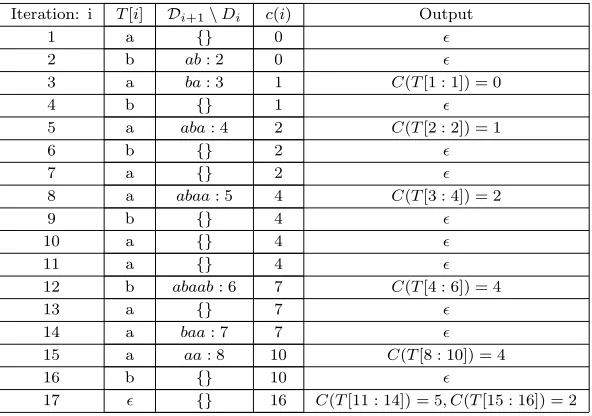
Iteration: i T[i] Di+1\Di c(i) Output
1 a {} 0
2 b ab: 2 0
3 a ba: 3 1 C(T[1 : 1]) = 0
4 b {} 1
5 a aba: 4 2 C(T[2 : 2]) = 1
6 b {} 2
7 a {} 2
8 a abaa: 5 4 C(T[3 : 4]) = 2
9 b {} 4
10 a {} 4
11 a {} 4
12 b abaab: 6 7 C(T[4 : 6]) = 4
13 a {} 7
14 a baa: 7 7
15 a aa: 8 10 C(T[8 : 10]) = 4
16 b {} 10
17 {} 16 C(T[11 : 14]) = 5, C(T[15 : 16]) = 2
Table 2: LZW-F P algorithm: We demonstrate how the flexible parser can be used with the dictionary construction of LZW . As in the example of table 2, let T = a, b, a, b, a, b, a, a, b, a, a, b, a, a, a, b, Σ = {a, b} and D0 = {a : 0, b : 1}. The output of LZW
dictionary with flexible parsing: C(T[0 : 15]) = 0,1,2,4,4,5,2. Comparing the output of LZW algorithm in table 2, we observe that theF P output is one codeword less (7 compared to 8), due to its more efficient parsing ofT[8 : 16]. Specifically, by parsing a shorter prefix of T[8 : 16] (T[8 : 10] rather than T[8 : 11]), F P parses a much larger string, T[11 : 14], later, which is represented by two codewords by greedy parsing.
Description of the FPA Algorithm. The FPA algorithm reads the input characters from left to right while inserting in D all substrings of the form T[bm : f(bm)], where the
[image:7.595.159.455.239.447.2]0 3 5 4 2 1 0 b a a a b a a b a a b a b a b a
a b a b a b a a b a a b a a a b
0 1 2 4 4
[image:8.595.174.442.77.198.2]LZWFP parsing LZWFP Output: Input: LZW Output: Input: LZW parsing 5 2
Figure 1: Comparsion of FP and greedy parsing when used together with the LZW dictionary construction method, on the input string T =a, b, a, b, a, b, a, a, b, a, a, b, a, a, a, b, used in Tables 7 and 8.
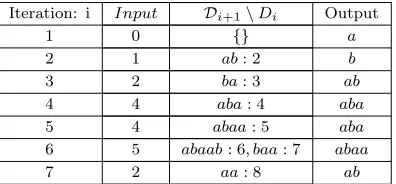
Iteration: i Input Di+1\Di Output
1 0 {} a
2 1 ab: 2 b
3 2 ba: 3 ab
4 4 aba: 4 aba
5 4 abaa: 5 aba
6 5 abaab: 6, baa: 7 abaa
7 2 aa: 8 ab
Table 3: Decompression of LZW-F P algorithm: We demonstrate the execution of our de-compression algorithm on the output of the de-compression algorithm in the previous example, C(T[0 : 15]) = 0,1,2,4,4,5,2. We show how our decompression algorithm obtains the origi-nal input to the compression. Initially i=j = 1, and the dictionary consists of charactersa and b with respective codewords 0 and 1. T =a, b, a, b, a, b, a, a, b, a, a, b, a, a, a, b. Note that the decompression at iteration 4 is possible as the algorithms knows the prefix of 4 which is necessarily ab. Hence it outputs abautomatically and re-emulates the dictionary parser.
again uses flexible parsing.
[image:8.595.209.407.265.357.2]3
Data Structures and Implementations of Algorithms
In this section we describe both the trie-reverse-trie data structure, and the new fingerprints based data structure for efficient on-line implementations of the LZW-F P, and FPA meth-ods. The trie-reverse-trie pair is a deterministic data structure, and hence guarantees a worst case linear running time for both algorithms as described in [MS99]). The new data structure based on Karp and Rabin’s fingerprintingmethod [KR87], is randomized, and guarantees an average case linear running time for the algorithm.
The two main operations to be supported by these data structures are (1) insert a phrase to D, (2) search for a phrase in D, i.e. given a substring S, check whether it is in D. The standard data structure used in many compression algorithms including LZW is the compressed trieT, which supports both operations in time proportional to|S|. A compressed trie is a rooted tree with the following properties: (1) each node with the exception of the root represents a dictionary phrase; (2) each edge is labeled with a substring of characters; (3) the first characters of two sibling edges can not be identical; (4) the concatenation of the substrings of the edges from the root to a given node is the dictionary phrase represented by that node; (5) each node is labeled by the codeword corresponding to its phrase. Dictionaries with prefix properties, such as the ones used in LZW and LZ78 algorithms, build a regular trie, rather than a compressed one. The only difference is that in a regular trie the substrings of all edges are one character long.
In our data structures, inserting a phrase S to D takes O(|S|) time as in the case of a trie. Similarly, searchingStakesO(|S|) time if no information about substringSis provided. However, once it is known that S is in D, searching strings obtained by concatenating or deleting characters to/from both ends of S takes only O(1) time. More precisely, our data structures support the following operations in O(1) time: (1) extend a phrase, and (2)
contract a phrase. Given a phrase S in D, the operation extend(S, a) for a given character a, finds out whether the concatenation of S and a is a phrase inD. Similarly, the operation contract(S), finds out whether the suffix S[2 :|S|] is in D. Notice that such operations can be performed in a suffix tree, if the phrases in D are all the suffixes of a given string as in the case of the LZ77 algorithm [RPE81]. For arbitrary dictionaries (such as the ones built by LZW), our data structures are unique in supporting contract and extend operations in O(1) time, and insertion operation in time linear with the size of the phrase, while using O(|D|) space, where |D| is the number of phrases in D.
Trie-reverse-trie-pair data structure. Our first data structure builds the trie T of phrases as described above. In addition toT, it alsh, where o constructsTr, the compressed
trie of the reverses of all phrases inserted in the T. Given a string S = s1, s2, . . . , sn,
its reverse Sr is the string s
corresponding node vr inTr which represents the reverse of the phrase h, where
represented by v. As in the case of the T alone, the insertion of a phrase S to this data structure takesO(|S|) time. Given a dictionary phraseS, and the nodenwhich represents S inT, one can find out whether the substring obtained by concatenatingSwith any character a in is D by checking out if there is an edge from n with corresponding charactera; hence, extend operation takes O(1) time. Similarly the contract operation takes O(1) time by going from n to n0, the node representing reverse of S in Tr, and checking if the parent of
n0 represents S[2 :|S|]r.
Fingerprints based data structure. Our second data structure consists of a linear hash tableHwithpentries, wherepis a randomly chosen prime number in the range{1,2, . . . , M}. Given a phrase S =S[1 :|S|], we define h(S), its hash table entry, ash(S) = (s[1]|Σ||S|−1+
s[2]|Σ||S|−2 +. . .+s[|S|]) mod p; here s[i] stands for the lexicographic order of S[i] in the
alphabet Σ [KR87]. We upper bound the probability of a collision on any given hash table entry with some arbitrarily small value , by selecting an appropriately large M.
Given string S whose hash value h(S) is already known, we can compute the hash value of its extension by any character a, with lexicographic order lex(a), as h(Sa) = (h(S)|Σ|+ lex(a))mod p, inO(1) time. Thus, starting with h(S[1]), we can iteratively computeh(S[1 : 2]), h(S[1 : 3]), . . . , h(S) inO(1) time each; hence the computation ofh(S) takes O(|S|) time. To compute the hash value of the contraction of S in O(1) expected time, we pre-compute |Σ|k mod p for all k up to the maximum phrase size. The hash value ofS[2 : |S|] can then
be computed ash(S[2 :|S|]) = (h(S)−s[1]|Σ||S|−1) mod p.
An important feature of our data structure is that it can verify whether a given hash table entry k actually represents a string S for which h(S) = k. To achieve this, we give a unique labell(S) to each phrase S in D 3, and for each such phrase S, we store the label of
its suffix S[2 :|S|] and the label of its prefix S[1 :|S| −1].
Our data structure performs extend and contract operations in expected O(1) time. Let S be a string whose label l(S) and hash value h(S) are known. To compute the extension of S with character a, we first compute the hash value h(Sa) as described above. Among the phrases whose hash value is h(Sa), the one whose prefix label matches the label of S gives the result of the extend operation. To contract S, we first compute the hash valueh00 of the
string S[2 : |S|]. Among the phrases whose hash value is h00, the one whose label matches
the suffix label of S gives the result of the contract operation. Therefore, both extend and contract operations take expected O(1) time.
Inserting a phrase in this data structure can be performed as follows. An insert operation is done only after an extend operation on some phraseS(which is in D) with some character
3
a. Hence, when inserting the phraseSainDits prefix label is already known: the label of S. Once it is decided thatSa is going to be inserted, we can spend O(|S|+ 1) time to compute the suffix label of Sa. In case the suffix S[2 : |S|]a is not a phrase in D, we temporarily insert an entry forS[2 :|S|]ain the hash table. This entry is then filled up when S[2 :|S|] is actually inserted inD. Clearly, the insertion operation for a phraseR takes expectedO(|R|) time.
A linear time implementation of LZW-F P. For any input T, LZW-F P inserts to D the same phrases with LZW. The running time for insertion in both LZW and LZW-F P (via the data structures described above) are the same; hence the total time needed to insert all phrases in LZW-F P should be identical to that of LZW, which is linear with the input size.
Letf be a function on characters ofT such thatf(i) =` for whichT[i:`] is the longest phrase in D that starts at T[i]. Let b0 = 1, and define bm inductively as the integer j for
which f(j) is the maximum among all j such that T[bm−1 :j −1] is in D.
LZW-F P works in several steps. In a given step m+ 1 there are a number of iterations. Each iteration comprises of a series of contractions followed by a series of extensions. For the first iteration considerS =T[bm :f(bm)] andS0 =T[bm :f(bm) + 1]. By definition, Sis inD
and S0 is not in D. We contract S0 character by character until it (i.e. T[b
m+i:f(bm) + 1])
is in D. Then we obtain the longest phrase in D that starts at T[bm +i] by performing a
series of extensions. This gives T[bm +i : f(bm +i)] which we set to be S. We then set
S0 =T[b
m+i:f(bm+i) + 1] and proceed with the next iteration. The stepm+ 1 is complete
oncebm+i > f(bm). The last value ofbm+i at which the last round of contracts were made
gives the value bm+1.
Running time: Notice that each character inT participates to exactly one extend and one contract operation, each of which takes O(1) time via the data structures described above. Hence the total running time for the algorithm is O(n).
A linear time implementation of FPA. Parsing in FPA is done identical to LZW-F P and hence takes O(n) time in total. The phrases inserted in D are of the form T[bm :
f(bm) + 1]. Because in parsing step m, the phrase T[bm : f(bm)] is already searched for,
it takes only O(1) time per phrase to extend it via our data structures. Hence the total running time for insertions is O(n) as well.
Linear time implementations of decompression algorithms for LZW-F P and FPA. The decompression algorithms for both methods simply emulate their corresponding com-pression algorithms, hence run in O(n) time.
4
The Experiments
In this section, we describe in detail the data sets we used, and discuss our test results verifying how well our theoretical expectations were supported.
4.1
The test programs
We used gzip, compress, LZW-F P and FPA programs for our experiments. The gzip
and compress programs are standard features of unix operating system. In our LZW-F P
implementation, we limited the dictionary size to 216 phrases, and reset it when it was full
as in the case of compress; we also experimented with the extended version of LZW-F P which allows 224 phrases. Similarly we experimented with two versions of FPA: one with 216
and the other with 224 phrases maximum.
4.2
The data sets
Our data sets come from three sources: (1) Data obtained via unix drand48()
pseudoran-dom number generator. (2) DNA and protein sequences provided by Center for BioInformat-ics, University of Pennsylvania, and CT and MR scans provided by the St.Thomas Hospital, London, UK [Sou]. (3) Text files from two data compression benchmark suites: the new Canterbury corpus and the commonly used Calgary corpus (these commonly available data sets are also provided at [Sou]).
Specifically, the first data set includes three binary files generated by theunixdrand48()
function. Each data entry is represented as a byte, although it can only take the values 0 or 1 4. The data distribution is i.i.d. with bit probabilities (1) 0.7−0.3, (2) 0.9−0.1, and (3)
0.97−0.03.
The second data set includes two sets of human DNA sequences from chromosome 23 (dna1, dna2), one MR (magnetic resonance) image of human (female) breast (mr.pgm), and one CT (computerized tomography) scan of a fractured human hip ct.pgm in uncompressed
pgm format in ASCII [Sou]. The third set includes the complete Calgary corpus 5. It also
includes all files of size > 1M B from the new Canterbury corpus: a DNA sequence from E-coli bacteria, E.coli, the complete bible bib.txt, and world192.txt.
4.3
Test results
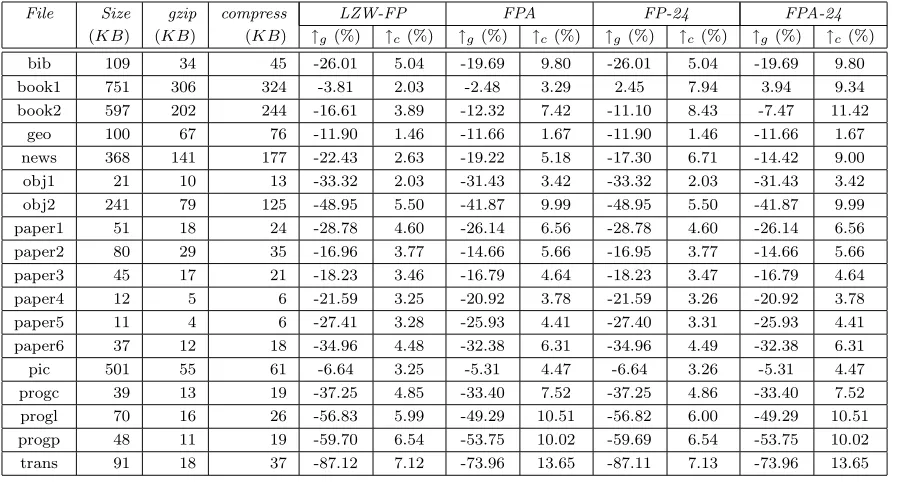
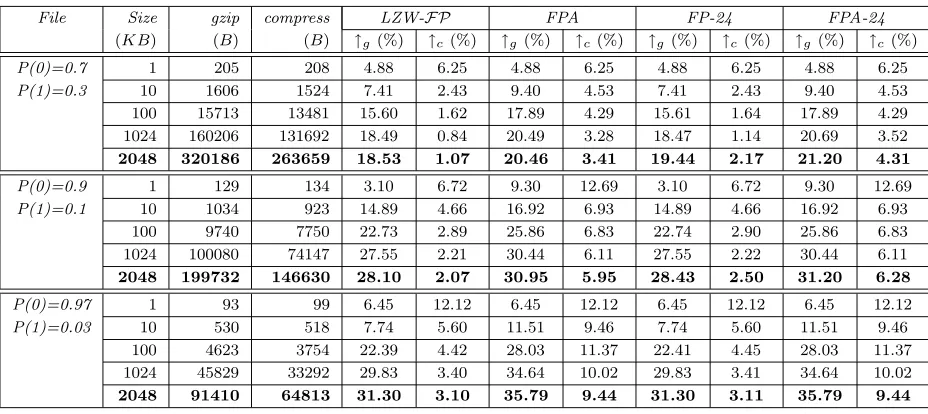
The test results for our pseudorandom and biomedical data sets as well as files from the Calgary corpus and Canterbury corpus are presented in Tables 4, 5, 6, 7 respectively. The tables compare the size of the compressed files obtained by our algorithms to those obtained
by gzip and compress by reporting the improvement as % of the uncompressed file size.6
In summary, we observed that FPA implementation with maximum dictionary size of 224
performs the best on all types of files with size > 1M B and shorter files with non-textual content; LZW-F P with the same dictionary size was usually a close second. For shorter files consisting of text, gzip performs the best as expected.
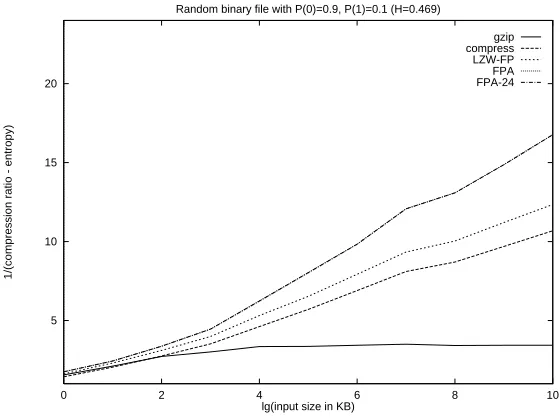
We also verified the theoretical expectations for the convergence rate in the redundancy of the output for i.i.d. data. We observed that the constants involved in the convergence rate for FPA and LZW-F P were smaller than that of LZW, and gzip was asymptotically worse than all.
Our tests on the human DNA sequences with LZW-F P and FPA show similar improve-ments over compress and gzip; with a dictionary of maximum size 216, the improvement
is about 1.5% and 5.7%, respectively. Some more impressive results were obtained by in-creasing the dictionary size to 224, which further improved the compression ratio to 9%. The
performance of LZW-F P and FPA on MR and CT test images differ quite a bit: LZW-F P was up to 4% better than compress when compared with gzip it was around 5% better, with the exception of the mr.pgm file on which gzip performed better. FPA’s improvement
4
This is for compatibility withcompressandgzipwhose initial alphabet sizes can not be altered. Thus although these compression algorithms have 256 in their dictionaries, such data lets them insert strings consisting of characters 0 and 1.
5
Which includes a bibliography file, bib, two complete books, book1, book2, two binary files geo, pic, programs inc, lisp, pascallanguagesprogc, progl, progp, and the transcript of a login session,trans
6
was about 6% and 16% overgzipandcompress, respectively, for the MR image, whereas its improvement was about 14% over both schemes for the CT image. As the image files were rather short, we didn’t observe any improvement by using a larger dictionary. One interest-ing observation is that the percentage improvement achieved by both FPA and LZW-F P increased consistently when the dictionary size was increased from 216 to 224 7. This suggests
that we can expect the algorithms to perform better in compressing massive archives by re-laxing the bound on the maximum dictionary size. This is very useful in many biomedical applications, particularly the human genome project.
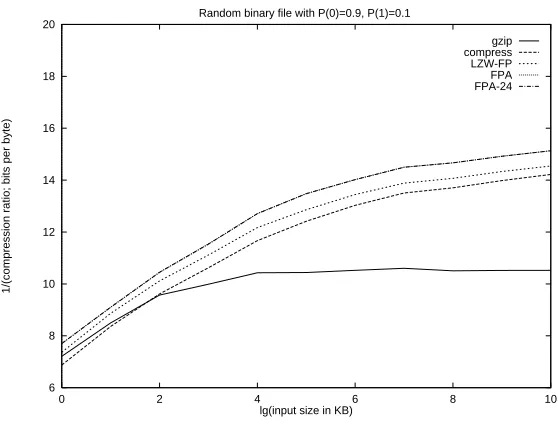
Our tests on pseudorandom sequences verified our theoretical expectations. All LZW based schemes performed asymptotically better than gzip, which is based on LZ77. We note that the x axis in the plots denote the number of input bits read by each of the com-pression algorithms in logarithmic scale with base 1.1. The y axis denote 1/(source entropy− output entropy), where the entropy for the binary source is defined to be −(P rob(0) · logP rob(0)+P rob(1)·logP rob(1)), and the output entropy is the average number of bits out-put for every inout-put bit, between the last data point and the current one. The plots show that the redundancy in the output is indeed proportional to 1/logn with the smallest constant achieved by FPA - in both cases, the constant is very close to 1.0; the constant for LZW-F P and LZW are about 1.5 and 2.0, respectively. This suggests that for on-line entropy mea-surement, FPA provides a more reliable alternative to LZ78/LZW or LZ77 (see [FNS+95]
for applications of LZW and LZ77 for entropy measurement in the context of DNA sequence analysis).
Our results on text strings varied depending on the type and size of the file compressed. For short files with long repetitions, gzip is still the champion. However, for all text files of size > 1M B, the large dictionary implementation of FPA scheme outperforms gzip by 4.7%−8.5%, similar to the tests for DNA sequences.
We believe that this curiosity can be explained as follows. When compressing English text, LZW needs process a sufficiently long prefix of the input to build an effective dictionary that captures its information content. Assuming that the average word (or word combina-tion) size in English which is likely to repeat is about 6, and assuming that the effective alphabet size in English is again 6 (derived from the empirical entropy estimates of about 2.5 bits per character), LZW requires to process a prefix of 6∗66 = 273K characters from
the input before it starts to be competitive with LZ77 approach. After this point, LZ78 may start to show its better asymptotic properties in terms of redundancy - as suggested by our experiments. Hence limiting the dictionary size (i.e. the number of phrases in the dictionary) in LZW to 216 << 273K as in the case of UNIX compress does not give the
7
The files for which the compression achieved with maximum dictionary size of 216
is equal to that with maximum dictionary size of 224
, used less than 216
chance to LZW to perform as good as or better than the LZ77 based approaches.
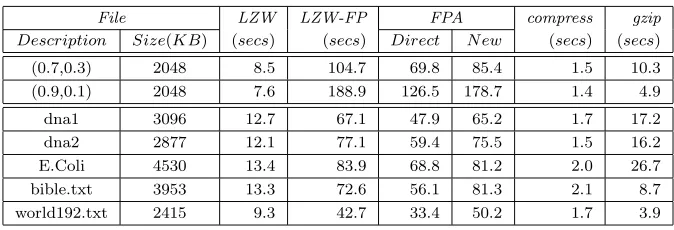
In summary, our test results demonstrate that the compression performance of LZW-F P and FPA schemes on data of practical interest are considerable. We hope that our results will encourage program developers to work on efficient implementations of our algorithms. In table 4.3, we provide some preliminary timing results in which we compare the running times of our implementations with that ofcompress and gzipon some large data files. The implementations we report on are as follows: (1) LZW is the standard trie implementation, which we use as the basis of all other implementations, (2) LZW-F P is a trie based imple-mentation, (3) FPA-Direct is again trie based, and (4) FPA-New is based on fingerprints. The first observation we make is compressis about 7 times faster than our LZW-F P imple-mentation. This is not surprising ascompressis a very popular program involving thousands of lines of code that has been under development for many years. Our LZW implementation compares well with gzip. When we compare our flexible parsing based implementations to our LZW implementation, we again see about a factor of 7 difference. Part of this (possibly up to a factor of 4) is due to more complex search involved in flexible parsing; we believe that a more efficient search routine can decrease this gap. By incorporating the implementation of the trie based data structure used in compress we may be able to further improve the running time of all flexible parsing based programs.
File Size gzip compress LZW-FP FPA FP-24 FPA-24
(KB) (KB) (KB) ↑g (%) ↑c(%) ↑g (%) ↑c(%) ↑g (%) ↑c(%) ↑g (%) ↑c(%) bib 109 34 45 -26.01 5.04 -19.69 9.80 -26.01 5.04 -19.69 9.80 book1 751 306 324 -3.81 2.03 -2.48 3.29 2.45 7.94 3.94 9.34 book2 597 202 244 -16.61 3.89 -12.32 7.42 -11.10 8.43 -7.47 11.42
[image:15.595.71.521.395.636.2]geo 100 67 76 -11.90 1.46 -11.66 1.67 -11.90 1.46 -11.66 1.67 news 368 141 177 -22.43 2.63 -19.22 5.18 -17.30 6.71 -14.42 9.00 obj1 21 10 13 -33.32 2.03 -31.43 3.42 -33.32 2.03 -31.43 3.42 obj2 241 79 125 -48.95 5.50 -41.87 9.99 -48.95 5.50 -41.87 9.99 paper1 51 18 24 -28.78 4.60 -26.14 6.56 -28.78 4.60 -26.14 6.56 paper2 80 29 35 -16.96 3.77 -14.66 5.66 -16.95 3.77 -14.66 5.66 paper3 45 17 21 -18.23 3.46 -16.79 4.64 -18.23 3.47 -16.79 4.64 paper4 12 5 6 -21.59 3.25 -20.92 3.78 -21.59 3.26 -20.92 3.78 paper5 11 4 6 -27.41 3.28 -25.93 4.41 -27.40 3.31 -25.93 4.41 paper6 37 12 18 -34.96 4.48 -32.38 6.31 -34.96 4.49 -32.38 6.31 pic 501 55 61 -6.64 3.25 -5.31 4.47 -6.64 3.26 -5.31 4.47 progc 39 13 19 -37.25 4.85 -33.40 7.52 -37.25 4.86 -33.40 7.52 progl 70 16 26 -56.83 5.99 -49.29 10.51 -56.82 6.00 -49.29 10.51 progp 48 11 19 -59.70 6.54 -53.75 10.02 -59.69 6.54 -53.75 10.02 trans 91 18 37 -87.12 7.12 -73.96 13.65 -87.11 7.13 -73.96 13.65
Table 4: Compression evaluation using files in the Calgary corpus
The original file size (with some prefixes), compressed file size by gzipandcompress, and the improvement (%) made by LZW-FP,FPA,FP-24, and FPA-24over gzip(↑g) andcompress
File Size gzip compress LZW-FP FPA FP-24 FPA-24
[image:16.595.71.546.73.136.2](KB) (B) (B) ↑g (%) ↑c(%) ↑g (%) ↑c(%) ↑g (%) ↑c(%) ↑g(%) ↑c(%) E.coli 4530 1341245 1255647 6.91 0.56 6.43 0.05 8.84 2.63 8.48 2.24 bible.txt 3953 1191063 1401885 -12.87 4.11 -7.79 8.42 0.13 15.15 4.68 19.01 world192.txt 2415 724595 987035 -31.70 3.32 -20.36 11.64 -2.38 24.84 6.54 31.39
Table 5: Compression evaluation using files in the Canterbury corpus (Large Set) The original file size, compressed file size by gzip and compress, and the improvement (%) made by LZW-FP, FPA,FP-24, and FPA-24 over gzip (↑g) and compress (↑ c).
File Size gzip compress LZW-FP FPA FP-24 FPA-24
(KB) (KB) (KB) ↑g (%) ↑c(%) ↑g(%) ↑c(%) ↑g (%) ↑c(%) ↑g (%) ↑c (%) dna1 3096 977 938 5.59 1.54 5.75 1.70 8.73 4.82 8.91 5.00 dna2 2877 846 813 4.64 0.75 4.33 0.43 6.09 2.26 5.89 2.05 mr.pgm 260 26 29 -7.23 3.60 6.38 15.84 -7.22 3.61 6.38 15.84
ct.pgm 1039 110 110 4.10 3.61 14.56 14.12 4.10 3.61 14.56 14.12
Table 6: Compression evaluation using experimental biological and medical data The original file size (with some prefixes), compressed file size by gzip and compress, and the improvement (%) made by LZW-FP, FPA, em FP-24, andFPA-24 over gzip(↑ g) and
compress (↑ c).
References
[BCW90] T. Bell, T. Cleary, and I. Witten. Text Compression. Academic Press, 1990.
[FNS+95] M. Farach, M. Noordeweir, S. Savari, L. Shepp, A. J. Wyner, and J. Ziv. The
[image:16.595.73.523.211.286.2]entropy of DNA: Algorithms and measurements based on memory and rapid con-vergence. In ACM-SIAM Symposium on Discrete Algorithms, 1995.
[GSS85] M. E. Gonzales-Smith and J. A. Storer. Parallel algorithms for data compression.
Journal of the ACM, 32(2):344–373, April 1985.
[Hor95] R. N. Horspool. The effect of non-greedy parsing in Ziv-Lempel compression methods. In IEEE Data Compression Conference, 1995.
[JS95] P. Jacquet and W. Szpankowski. Asymptotic behavior of the Lempel-Ziv parsing scheme and digital search trees. Theoretical Computer Science, (144):161–197, 1995.
[KM97] S. R. Kosaraju and G. Manzini. Some entropic bounds for Lempel-Ziv algorithms. In Sequences, 1997.
[KR87] R. Karp and M. O. Rabin. Efficient randomized pattern matching algorithms.
File Size gzip compress LZW-F P FPA FP-24 FPA-24
(KB) (B) (B) ↑g (%) ↑c(%) ↑g (%) ↑c(%) ↑g (%) ↑c(%) ↑g (%) ↑c(%)
P(0)=0.7 1 205 208 4.88 6.25 4.88 6.25 4.88 6.25 4.88 6.25
P(1)=0.3 10 1606 1524 7.41 2.43 9.40 4.53 7.41 2.43 9.40 4.53
100 15713 13481 15.60 1.62 17.89 4.29 15.61 1.64 17.89 4.29 1024 160206 131692 18.49 0.84 20.49 3.28 18.47 1.14 20.69 3.52
2048 320186 263659 18.53 1.07 20.46 3.41 19.44 2.17 21.20 4.31
P(0)=0.9 1 129 134 3.10 6.72 9.30 12.69 3.10 6.72 9.30 12.69
P(1)=0.1 10 1034 923 14.89 4.66 16.92 6.93 14.89 4.66 16.92 6.93
100 9740 7750 22.73 2.89 25.86 6.83 22.74 2.90 25.86 6.83 1024 100080 74147 27.55 2.21 30.44 6.11 27.55 2.22 30.44 6.11
2048 199732 146630 28.10 2.07 30.95 5.95 28.43 2.50 31.20 6.28
P(0)=0.97 1 93 99 6.45 12.12 6.45 12.12 6.45 12.12 6.45 12.12
P(1)=0.03 10 530 518 7.74 5.60 11.51 9.46 7.74 5.60 11.51 9.46
100 4623 3754 22.39 4.42 28.03 11.37 22.41 4.45 28.03 11.37 1024 45829 33292 29.83 3.40 34.64 10.02 29.83 3.41 34.64 10.02
[image:17.595.72.536.70.277.2]2048 91410 64813 31.30 3.10 35.79 9.44 31.30 3.11 35.79 9.44
Table 7: Compression evaluation using independent identically distributed random files con-taining only zeros and ones with different probability distributions
The original file size (with some prefixes), compressed file size by gzip and compress, and the improvement (%) made by LZW-FP, FPA, em FP-24, andFPA-24 over gzip(↑ g) and
compress (↑ c).
[LS95] G. Louchard and W. Szpankowski. Average profile and limiting distribution for a phrase size in the Lempel-Ziv parsing algorithm. IEEE Transactions on Infor-mation Theory, 41(2):478–488, March 1995.
[MS99] Y. Matias and S. C. Sahinalp. On optimality of parsing in dynamic dictionary based data compression. ACM-SIAM Symposium on Discrete Algorithms, 1999.
[MW85] V.S. Miller and M.N. Wegman. Variations on a theme by Lempel and Ziv. Com-binatorial Algorithms on Words, pages 131–140, 1985.
[RPE81] M. Rodeh, V. Pratt, and S. Even. Linear algorithm for data compression via string matching. Journal of the ACM, 28(1):16–24, January 1981.
[Sav97] S. Savari. Redundancy of the Lempel-Ziv incremental parsing rule. In IEEE Data Compression Conference, 1997.
[Sou] http://www.dcs.warwick.ac.uk/ nasir/work/fp/index.html.
File LZW LZW-FP FPA compress gzip
[image:18.595.137.474.70.185.2]Description Size(KB) (secs) (secs) Direct N ew (secs) (secs) (0.7,0.3) 2048 8.5 104.7 69.8 85.4 1.5 10.3 (0.9,0.1) 2048 7.6 188.9 126.5 178.7 1.4 4.9 dna1 3096 12.7 67.1 47.9 65.2 1.7 17.2 dna2 2877 12.1 77.1 59.4 75.5 1.5 16.2 E.Coli 4530 13.4 83.9 68.8 81.2 2.0 26.7 bible.txt 3953 13.3 72.6 56.1 81.3 2.1 8.7 world192.txt 2415 9.3 42.7 33.4 50.2 1.7 3.9
Table 8: Timing results for large data files.
File description and its size, times taken to compress by LZW, LZW-F P, two different implementations of FPA,compress, andgzip. The first three files are psuedorandom binary IID files in nature and are described by (x, y), where x=p(0) and y=p(1).
[Wel84] T.A. Welch. A technique for high-performance data compression.IEEE Computer, pages 8–19, January 1984.
[Wyn95] A. J. Wyner. String Matching Theorems and Applications to Data Compression and Statistics. Ph.D. dissertation, Stanford University, Stanford, CA, 1995.
[Yok92] H. Yokoo. Improved variations relating the Ziv-Lempel and welch-type algorithms for sequential data compression. IEEE Transactions on Information Theory, 38(1):73–81, January 1992.
[ZL77] J. Ziv and A. Lempel. A universal algorithm for sequential data compression.
IEEE Transactions on Information Theory, IT-23(3):337–343, May 1977.
4 5 6 7 8 9
0 2 4 6 8 10
1/(compression ratio; bits per byte)
lg(input size in KB) Random binary file with P(0)=0.5, P(1)=0.5
[image:19.595.164.444.105.315.2]gzip compress LZW-FP FPA FPA-24
Figure 2: The compression ratio (i.e. output entropy) attained by all five programs on random i.i.d.data with bit probabilities P(0) =P(1) =.5.
6 8 10 12 14 16 18 20
0 2 4 6 8 10
1/(compression ratio; bits per byte)
lg(input size in KB) Random binary file with P(0)=0.9, P(1)=0.1
gzip compress LZW-FP FPA FPA-24
[image:19.595.165.444.433.645.2]2 4 6 8 10 12
0 2 4 6 8 10
1/(compression ratio - entropy)
lg(input size in KB)
Random binary file with P(0)=0.5, P(1)=0.5 (H=1)
[image:20.595.164.443.107.314.2]gzip compress LZW-FP FPA FPA-24
Figure 4: The 1/redundancy of all five programs on random i.i.d.data where redundancy is de-scribed as (actual compression ratio)-(entropy). The bit probabilities are P(0) =P(1) =.5.
5 10 15 20
0 2 4 6 8 10
1/(compression ratio - entropy)
lg(input size in KB)
Random binary file with P(0)=0.9, P(1)=0.1 (H=0.469)
gzip compress LZW-FP FPA FPA-24
[image:20.595.164.444.435.644.2]