Privacy and security perceptions between
different age groups while searching online
Author: Alena Fiona Kaiser
University of Twente P.O. Box 217, 7500AE EnschedeThe Netherlands
ABSTRACT
Purpose – The purpose of this research is to find out whether there is a difference in privacy and security perceptions between age groups while searching online. The Internet is incorporated in almost every aspect in our day-to-day actions and makes the lives of the user easier. Searching is the number one action online and search engine operators take advantage of the users’ levity when browsing online. Entire digital lives of users are recorded and through this privacy and security issues arise.
Methodology – With a cross-sectional survey a sample size of 257 was attained through convenience sampling. The data obtained was assessed through several statistical tests such as (Univariate) Analysis of Variance and Cluster Analysis.
Findings – The insights gained through the research revealed that there is a difference in privacy and security perception of different age groups when searching online. The younger age groups perceive more privacy than older users but engage less in security practices to protect their data compared to older age groups.
Practical Implications – Search engine operators and marketers can utilize the findings of the research to make their campaigns and search results more relevant on basis of the data being saved, shared and sold to third parties. They can include privacy and security measures tailored to the age groups to make their digital environment experience more successful.
Theoretical Implications – This research contributes to the growing body of literature dealing with the privacy and security perception between different age groups while searching online. There is demand for more research in the field of online search behavior on basis of privacy/security and especially more demand for studies between generations.
Originality – The literature is not based on standardized instrument. To answer the posed research questions measures and items have been self-constructed through creativity inspired by research.
Supervisors: PhD(c) I. (Raja) Singaram
Second Supervisor: Dr. Efthymios Constantinides
Keywords
Privacy, Security, Online Search Behavior, Age, Millennials
Permission to make digital or hard copies of all or part of this work for personal or classroom use is granted without fee provided that copies are not made or distributed for profit or commercial advantage and that copies bear this notice and the full citation on the first page. To copy otherwise, or republish, to post on servers or to redistribute to lists, requires prior specific permission and/or a fee.
7th IBA Bachelor Thesis Conference, July 1st, 2016, Enschede, The Netherlands.
1.
INTRODUCTION
The World Wide Web was created 1989 and two decades later it has become a major information pool with an enormous influence on our day-to-day lives. Practically everyone (in Western countries) uses the Internet daily as a main source of information and communication (Roelofs, 2007). Searching on the web is placed on the top of the list of online activities; 92% of online adults use search engines of which 59% use search engines on a daily basis (Purcell, 2011). Online search engines are making our lives easier by filtering certain desired information from an excessive amount of data. The Internet is dominated by search engines and according to Tene (2007) the most important actor in the World Wide Web. A search engine can be described as “a program that searches for and identifies items in a database that correspond to keywords or characters specified by the user, used especially for finding particular sites on the World Wide Web” (Oxford Dictionaries, 2016). People use search engines for different purposes and goals. Users of search engines unintentionally share their ‘interests, needs, desires, fears, pleasures and intentions’ (Tene, 2007). Rose and Levinson (2004) argue that users of search engines search for navigational, informational and resource purposes. Everybody uses search engines and takes great value from the results because they are easily accessible and available for us. But according to Tene (2007) it comes at a great cost to search targets’ privacy. No matter how useful these tools of search engines seem they “pose a privacy threat to the users: web search engines profile their users by storing and analyzing past searches submitted by them” (Castellà-Rocaa, Herrera-Joancomartíc, & Viejoa, 2009, p. 1541). The data made available by the searcher is stored and can be analyzed in such a way that the users’ identity can be disclosed for various purposes for targeted marketing or governments. The entire digital lives of users of search engines are recorded. The data of an online search engine user can be saved through ‘cookies’. Cookies are text files that are written on the users’ hard disk without them noticing. The search engine can identify users and make profiles based on the saved data. With this web technology profiles can be developed which relate to the individuals interests and activities (Gauthronet & Nathan, 1999).
The AOL privacy debacle in August 2006 showed how the data of customers and online search engines users is abused. AOL initially planned to share its customers search queries for academic research purposes but soon came to the conclusion that the data was too revealing. The incident showed how sloppy huge companies like AOL treat their user’s data and how much data is actually saved. Furthermore it is shocking how much insight one can gain from ‘just’ having access to the search queries of users. Even though the search records were anonymized the New York Times showed how easily identifiable the actual identity of the AOL users were (Barbaro & Zeller, 2006).
“The general public has identified privacy as a major concern about the digital world at the beginning of the twenty-first century” (Iliffe, Sturges, & Teng, 2001, p. 364). Users are exposed to monitoring and profiling the second they surf on the Web and “[…] the UCLA Internet Report found that 63.6 per cent of Internet users and 76.1 per cent of non-users agreed with the statement that ‘people who go online put their privacy at risk” (Lebo, 2000, p. 6).But what does privacy actually mean to Internet users or to the general public. The perception of privacy differs from user to user and is influenced by a number of factors in digital environments (Barbaro & Zeller, 2006).
This research will deal with the difference of perceptions in privacy and security while searching online. The difference within this study will be based on age groups and compared throughout. Firstly, I will compare two specific age groups, namely Millennials (25-35), the generation born after 1980 (Raines, 2002), and Internet users aged 50 and older, which is described as Generation X (Murnane, 2016). Thereafter the difference in privacy and security perception while searching online will be investigated between age groups ranging from 18-24, 25-35. 36-49 and 50+.
In the following, I will introduce already existing literature, which forms the basis of the analyses. I will explain relevant theories for this research paper and state the applied methodology. The main insights gained from the analysis are included in the results. The following conclusion section summarizes and discusses the main findings.
2.
ACADEMIC AND PRACTICAL
RELEVANCE
The online environment has become a great part of our everyday lives and is a field that is constantly and rapidly growing. Due to the sudden and crucial changes research tends to become outdated and more so incomplete very quickly. After reviewing the literature for the topic ‘Security and privacy perceptions of Millennials vs. Non-Millennials in digital environments – What are the differences between age groups in the perceptions on security and privacy associated with (online/web) Search behavior?’ it becomes clear that extensive research has not been done yet. The existing literature is mostly describing privacy and security perceptions exclusively from the age groups, especially when one is focusing on privacy within the search behavior. Comparing how the two age groups perceive the security when searching online will be revealing and will be of practical use for profiling firms and search engine operators. I for myself are very aware that my data is saved and used within the digital environment but how do other people my age perceive it – do they know that there is a reason behind the ads on the sidebars that match their recent searches? And is there a difference of the perception between the age groups?
3.
THEORETICAL FRAMEWORK
The literature does not provide standardized instruments to investigate the difference of privacy and security perception between age groups while searching online; therefore I analyzed existing literature concerning every single component of the research question. The components privacy, security and search behavior are critically reviewed and connected. Furthermore, I analyzed the component age. The literature review creates the basis for the examination of the research question.
Based on the single components a framework was developed by me to find existing scales and studies to measure the difference in perception of privacy and security while searching online and then compared between age groups. Finally I took three studies in the fields of the digital environment, shopping behavior and general study of privacy/security online into account. This research focuses on parts of each of the studies, which results in a new research model. To my best knowledge, no research has adapted and combined these studies’ specific parts and applied them to online search behavior.
3.1
Online Search Behavior
search engines of which 59% use search engines on a daily basis (Purcell, 2011). The anticipation of going online to find information can be driven by multiple intentions. Internet users go online with the anticipation of purchasing a product but also just to browse and to obtain general information for their personal use. The World Wide Web and especially search engines have obtained a large variety and volume of information, which is made available to the user at any time. I assessed the online search behavior in this research on basis of the survey by Purcell et al. (2012). They screened users on basis of the frequency, perception and awareness in order to examine their search behavior. For this study only the frequency and effectiveness of the users is taken into consideration, because the search behavior is assessed through an online survey in a tight time frame and not in observational settings.
3.2
Privacy
Privacy is a term not clearly defined by literature. Scholars do not come to one sound agreement in their definition. I took the following literature into account. Tavani (2007) argues that privacy is often confused and described with liberty and autonomy. Also, privacy is a construct in society that is constantly diminished, violated and lost. Privacy deals with the collection and handling of personal data. Before the Internet was introduced privacy was defined based on spatial understandings. It was described a non-intrusion, which meant being let alone and seclusion meaning being alone (Preibusch, 2013). Nowadays the definitions of privacy have shifted to an information privacy, which stems from the access and protection of personal data (Tavani, 2007) Fellow researches even go to the extent to have three levels “privacy as hiding (confidentiality), “privacy as control” (informational self-determination) and “privacy as practice” (identity construction) (Gürses, 2010 and Preibusch, 2013). Privacy can be seen as the expression of the core value of security (Moor, 1997).
3.3
Security
“Security refers to the freedom from danger, risks or doubts during the service process” (Li & Suomi, 2009, p. 6). The improper use of customers’ personal data in the virtual environment is greatly feared by users of digital environments. Security is therefore intruded and concerned with how safe the site of their choice is from intrusion (Stiakakis & Georgiadis, 2009). Belanger et al. (2002) argue that security is the protection from “(1) economic hardship encompasses damages to privacy (loss of information) as well as theft, for example, of credit information and (2) authentication issues for consumers will be reversed; as in whether the Web site is ‘real’ rather than whether the purchaser’s identity is real” (Belanger, Hiller, & Smith, 2002, p. 249).
3.4
Age
Aside from the concepts privacy and security I will take age into account. As stated above the study will investigate age groups 18-24, 25-35, 36-49 and 50 and older. The age groups are divided into generations, which in this research will be Millennials (18-35) and Non-Millennials. (36+). This division is only used within a subsequent part of the analysis.
The Millennials include the generation born after 1980 and they are the first generation growing up in a digital world where personal computers are the norm and the Internet is a constant influencer (Taylor, 2012). Scholars do not agree on the definition of the exact birth years. For Howe and Strauss (2009) the generation Millennials include people born after 1982. For this research I will include people who are up to the age of 35 today as Millennials. Raines, C. (2002) states that they are often called ‘Internet Generation, Echo Boomers, the Boomlet,
Nexters, Generation Y, the Nintendo Generation, the Digital Generation’ and that the Millennials are sociable, open-minded and well educated. To ensure a coherent report I will only refer to the term Millennials. Since the Millennials grew up within a heavily digital environment literature suggests that they do not care about privacy and security online. Because the generation is so used to being digitally engaged and constantly sharing, they are deemed to have a low priority for privacy and security but as research showed they do care about their personal data being shared on the Internet (Peters, 2015). The Non-Millennials can be divided into Generation X (35-44) and the baby boomers (45+). The Forbes article “How The Boomers Differ From Everybody In Their Approach To Online Privacy And Security” stated that baby boomers were least confident while being on the internet and did not assume to be protected from a range of security threats. They also argue that baby boomers are most likely to use techniques to protect their data such as security programs and encryption (Murnane, 2016).
3.5
Survey Framework
protection in different life stages. The research examines the individuals that are described as ‘vulnerable Internet users’ on basis of a privacy boundary management approach. Further, the study was based on three measures: Facebook use, privacy concern and privacy protection. I will only assess the relevant measures which will be used in latter sections of this research, namely privacy concern and privacy protection. The first measure important for this research is the privacy concern, which just as in the first study assessed through the IUIPC. The respondents filled out the scale, which included 21 items on a 7-point Likert-scale and examined privacy concern on the Internet. The second measure, which was deemed as important, is the privacy protection. Privacy protection was measured through assessing different aspects of privacy protection on Facebook. The respondents were asked questions regarding the frequency of the use of privacy protection practices, the knowledge of these privacy settings and finally the use of technological privacy tools. Van den Broeck et al. (2015) found significant differences in terms of privacy concern between the age groups. The youngest age group experienced the least concern and the middle age group the most. This is supported by the findings of the study because the youngest age group also had most knowledge of privacy protection.
Finally, I gained inspiration from the study researching how different young adults differ from older adults when it comes to information privacy attitudes and policies. The study was one of the first quantitative studies conducted to evaluate privacy between age groups. Hoofnagle et al. (2010) argue that society claims that young people “are less concerned with maintaining privacy than older people are”. The research answers the research question based on three measures. The survey conducted, included questions regarding privacy practices, levels of concern and privacy knowledge to examine the difference between age groups when it comes to privacy attitudes and policies. For my research the measure of privacy practice was especially important because I plan to use the scale in order to assess privacy perceptions. Privacy practice was assessed through questions such as if privacy policies are read and browser cookies are erased. The study showed that the younger age groups have an aspiration for privacy even though they engage in digital environments, which are intended to obtain personal data surreptitiously.
Furthermore I checked existing literature for a suitable guideline to setup the research survey. Many scholars have used online surveys when studying the privacy and security of Internet users. The previous literature review shows that online surveys are of great effectiveness because you reach the focus group that you desire to investigate because they are already active on the World Wide Web. I chose Yang et al.’s (2004) research as an appropriate guideline because the study intends to analyze all stages of the online purchasing cycle. The research identifies the key online service quality dimensions, namely (1) perceptions of overall online service quality and individual quality dimensions’ for my research being transferred to privacy and security perception; (2) general information of the user such as demographics and lastly (3) computer and internet usage information which was applied to search behavior (Yang, Minjoon, & Peterson, 2004). Yang et al.’s survey construction is used as the basis for my survey to investigate the difference in privacy and security perception between age groups while searching online.
4.
RESEARCH MODEL
Users of online search engines are unaware of how much personal data they share unintentionally. The search terms they plug into the search bar can reveal a lot about that person and
our data is put out into the digital environment and easily accessible by third parties. Therefore privacy and security while searching online has become such a pressing issue (Roelofs, 2007). The generation of Millennials grew up in a world dominated by technology and the Internet (Weiler, 2004). The research question “does the privacy and security perception of different age groups (Millennials versus Non-Millennials) differ when using search engines?” will be investigated and is visually displayed in figure 1.
Figure 1 Research Model
4.1
Research Questions
RQ1 Does the privacy and security perception of different age groups (Millennials versus Non-Millennials) differ when using search engines?
RQ2 Does the age of the user influence the perception of privacy and security when searching online?
RQ3 To what extent are users of different age groups (Millennial versus Non-Millennial) aware of the use of their private data whilst searching online by search engine operators and companies for marketing purposes?
Based on existing literature and scholar review I gained insight into the topic and this allowed me to pose assumptions. One would expect the source of the differences to be the generation gap and the infused technological influence the Millennials (younger age groups) are experiencing (Taylor, 2012).
A1 Younger age groups are more aware of privacy issues and perceive less privacy while searching online. A2 Younger age groups have more knowledge and
engage more in practices to secure their data (refusing to reveal data online, reading privacy policies etc.) than older age groups because they want to perceive mre security.
5.
METHODOLOGY
5.1
Design
We conducted a survey, in a team of two, to answer what the differences between age groups in the perceptions on security and privacy associated with (online/web) search behavior are. The survey was active from the 16th of May 2016 until the 1st of
Five questions with multiple choice answering mechanisms made up the demographic section. I measured the remaining two sections on a Likert scale consisting of respective 8 and 16 questions. A proportion of 19 questions had a 7 point scale Likert ranging from ‘Never to always, strongly disagree to strongly agree, extremely unaware to extremely aware, extremely skilled to extremely unskilled and extremely bad to extremely good’. As the measurement I chose a Likert scale because it attempts “to improve the levels of measurement […] through the use of standardized response categories in survey questionnaires, to determine the relative intensity of different items” (Babbie, 2010).
The other answering styles included constant sum in Qualtrics for the purpose of searching online and the search engine preference. All items were set to force response except the last text box, which invited participants to share their experiences while using search engines.
The survey consisted of questions regarding the respondent’s behavior, experience and opinion. The behavioral questions such as ‘Would you refuse to give information to an online search engine, if you think it is too personal?’ intended to objectively measure the the respondents actions in regard to a certain scenario to predict future results. Furhter, the experience questions such as ‘Have you, personally, ever noticed advertisements online that are directly related to things you have recently searched for or sites you have recently visited?’ intended to subjectively evaluate characteristics of the user’s background in the Internet. Finally, we designed opinion questions such as ‘If a search engine kept track of what you search for, and then used that information to personalize your future search results, how would you feel about that?’ as a means to how a participant would react to certain internet scenarios (College Grad, 2016).
5.2
Measures
The nature of the research is correlational and this study is therefore designed to investigate the relationship of privacy and security in regard to search behavior with the factor of age groups and especially within Millennials and Non-Millennials. The independent variables are accordingly privacy and security; search behavior is the dependent variable.
The present study consisted of three sets of measures. The first section assessed the age, gender, nationality, education and the current occupation.
The second section of the survey investigated search behavior including four dimensions: (1) frequency of usage, (2) goal or purpose of the online search, (3) effectiveness of the participant and (4) the preference for particular search engines. Survey questions examples are ‘How often do you use online search engines? and Can you always find the information you need, while using search engines on the Internet?’ This section consisted of 8 items out of which 5 were measured on a 1-7 point Likert scale. The remaining 3 items used a total sum measurement, where the respondent was asked to allocate a total of 100 to their preferred search engine and goal (entertainment, research and shopping) for searching online. In order to assess the search behavior of the user I selected 3 items, namely SB1_1, SB5_1 and SB8_1, see Appendix B for item overview. In order to achieve a Cronbach’s alpha of (α = .60) for the dependent variable search behavior I deleted items. SB4_1, SB6_1 and SB7_1 were detected with the ‘delete if’ option within the Cronbach’s mechanism and the author deemed it to be appropriate to limit the search behavior to frequent and skilled searches on the web. Precisely, the dependent variable in this study is measured on the frequency of search engine usage and the effectiveness of the user.
The third section assessed perception of privacy and security. This section consisted of 14 items.
As stated in the theoretical framework section the literature does not provide standardized instruments to measure the components of the posed research questions; measures and items have been self-constructed to some extent. They have been developed through research and common sense. I constructed a pool of scales and measurements available for privacy and security in digital environments based on extensive literature review. The pool of measures consisted of control, collection, awareness of privacy practices, privacy concerns, trust, risk and finally privacy/security protection. Based on these measurements and scales I developed the survey questions and adapted them from existing studies.
I assessed this pool of potential measurements through the definition of privacy and security. To reiterate, the essence of privacy is the collection and handling of personal data and security is defined as the protection of that personal data from unwanted intruders. The author grouped the items based on these definitions but taking into account the scales from literature, an overview of the variable grouping and sources can be found in Appendix B.
I chose Cronbach’s Alpha to ensure the reliability of the items on which this study is based. This is a well-known method intended to measure the internal consistency of test or scale (Cronbach, 1951). The outcome can be a number between 0 and 1 with the following implications; Excellent (α>0.9), Good (0.7<α<0.9), Acceptable (0.6<α<0.7), Poor (0.5<α<0.6), Unacceptable (α<0.5) (George & Mallery, 2003, p. 231). Table 1 shows that the constructs Search behavior and security are within acceptable range. Unfortunately privacy perception is below the acceptable 0.5.
Table 1
Model Reliability Index: Cronbach’s Alpha Construct Cronbach's Alpha Number of items
Privacy Perception .42 5
Security Perception .63 9
Search Behavior .60 3
5.3
Data Collection
We collected the participants through convenience sampling. This was deemed to be appropriate by the author because the study is based on research on the World Wide Web. Ferber (1977) argues that the sample must be highly relevant to the study; in other words it does not make sense to conduct interviews face to face with older generations if they do not use the WWW at all. The respondents were easy to reach through Facebook and Email. This way I made sure that the respondents use the Internet.
The data collection triggered a slight snowball effect because friends shared the Qualtrics link further with their friends on Facebook.
The respondents participated on a voluntary basis and the greatest proportion was reached via Facebook. We posted the link of the survey on the Facebook feed visible for 749 users, which we invited to share it further. Moreover, we made an additional Post in a Facebook group with a crowd of 418 members. Furthermore we sent 30 emails in order to reach the older generation and about 227 direct messages personally phrased were sent to friends. Based on this I can assume a response rate of approximately 18% excluding the further sharing of friends and family.
5.4
Participants
The survey had a total of 257 participants of which 55% are males and 45% are females with a mean age of 32.37 (SD = 13.82). The young millennial group ranged from 18 to 24 years old (n = 125), the older millennial age group ranged from 25 to 35 (n = 51), the young non-millennial age group ranges from 36 to 49 (n = 41), the older non-millennial group is 50 years and older (n = 40). 53% of the sample were students and 38% were self-/employed. The remaining 9% of the 257 participants are unemployed. The greatest proportion of the respondents were Dutch with 49%, 33% were German and 18% filled in other for example Brazilian, New Zealand and Indonesian.
Furthermore, I accounted for straight lining to assure that the participants filled out the survey honestly and to their best knowledge without threatening the data quality. Only one participant had to be eliminated. I checked the standard deviation of the answers given per item via SPSS.
5.5
Procedure
In the beginning of the survey we gave a brief introduction about the purpose of the research and the assurance of confidential handling of data. We set all items to force response
except for the last text box. The last text box invited participants to share their experiences about the usage of search engines. At the end of the survey we invited participants to disclose their emails address (which is handled anonymously) to be sent the results of the present research if so desired.
5.6
Analysis
Qualtrics is the software we used to collect the data from the respondents. The online program is a private research software used to design and save the survey’s data. All data will be analyzed using International Business Machines Corp. (IBM) SPSS, version 23. Fortunately Qualtrics can transcribe the data into a SPSS file and this can easily be plugged into SPSS Statistics for further analysis. The knowledge from the book Stats: Data and Models (2011) by De Veaux acted as grounds for the following analyses. In order to investigate if search behavior is influenced by the privacy and security perception and how this differs between age groups a correlation analysis will be performed. For all analyses an alpha of .05 is handled as cut-off for statistical significance. Additional descriptive statistics will be stated and used as the basis for further examination.
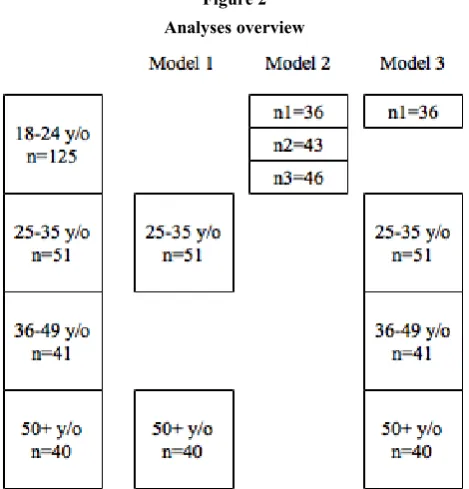
Figure 2 Analyses overview
Firstly, I grouped the participants of the survey according to the age groups defined in previous sections. Age group 1 included respondents aged 18-24, age group 2 consisted of ages 25-35, age group 3 of 36-49 and finally age group 4 included 50 years and older participants, see figure 2 for an analyses overview. In order to investigate if search behavior influences the privacy and security perception and how this differs between different age groups I conducted one ANOVA with search behavior as dependent, Millennials (25-35) vs Non-Millennials (50+) as factor, and privacy and security perception as covariates (Model 1). To determine the direction of factors, Bonferroni corrected confidence intervals are calculated, while for covariates parameter estimates are used.
Randomly selected 3 groups within 125 young Millennials (n1= 36, n2 = 43, n3 = 46) and checked via ANOVA if they differ on all relevant variables within these 3 groups (Model 2). I chose Bonferroni to determine the direction of factors.
interesting to investigate. Therefore, I conducted an additional ANOVA with n1 of young Millennials and all other age groups (25-35, 36-49, 50+) and direction of factors determined by Bonferroni (Model 3).
Afterwards I clustered the data via a two-step cluster analysis as a means to reveal natural clusters that would otherwise not be visible in the dataset (IBM Corporation 1989, 2012).
5.7
Sub-Analysis of dataset
Finally, I executed sub-analyses with the data set. I made a comparison between privacy and security perception on basis of the search goal of the user. Does the privacy and security perception change when using search engines only for entertainment, research – or does it change when shopping is the ultimate goal including providing private data and credit card information.
Furthermore, I compiled specific items answering the research question ‘To what extent are users of different age groups (Millennial versus Non-Millennial) aware of the use of their private data whilst searching online by search engine operators and companies for marketing purposes’ into one variable and compared these between Millennials and Non-Millennials. The new variable awareness consists of 3 items, namely PS8_1, PS9_1, PS10_1. The items for awareness displayed an acceptable Cronbach’s alpha (α = .61).
Moreover, since we invited the participants of the survey to share their own experiences made while using search engines I
assessed some of the most striking and interesting statements retrieved from the Qualtrics output.
6.
RESULTS
6.1
Descriptives
Table 2 below displays the results of the descriptive analysis. 257 valid answers (N=257) were extracted from the Qualtrics output and taken into account.
In order to get a grasp of the dataset the author analyzed the descriptives shown in table 2. The output reveals the mean, which is the center or the average of the numbers in the dataset. The means of privacy, security and search behavior range from 3.65 to 5.86 all being measured on a Likert scale from 1 to 7. The mean age of all 257 participants is 32.37 years old. Additionally I assessed the standard deviation and it shows that the responses do not deviate greatly with the highest standard deviation of .77. Table 2 also shows the correlation measuring the strength and direction of the relationship between the independent and dependent variables and is taking into account the control variables gender and age. I used Spearman’s rho to calculate the correlations because Pearson’s correlation is only used for interval and ratio variables. Table 2 reveals that privacy positively correlates with search behavior (rs = .16, p =
.01).. Further both control variables age correlating negatively with privacy (rs = -.28, p < .01) and security perception (rs =
-.29, p < .01); gender correlating positively with search behavior
(rs = -.15, p = .15).
Table 2
Spearman’s rho correlation Matrix and Descriptives Sample
size
Mean Standard
Deviation
1 2 3 4 5
1 Privacy Perception 257 5.28 0.72 1
2 Security Perception 257 3.65 0.77 -.06 1
3 Search Behavior 257 5.86 0.72 .16** .07 1
4 Gender 257 n/a n/a -.10 .08 .15* 1
5 Age 257 32.37 13.82 -.28** .29** -.03 .04 1
**. Correlation is significant at the 0.01 level (2-tailed). *. Correlation is significant at the 0.05 level (2-tailed).
6.2
Model 1
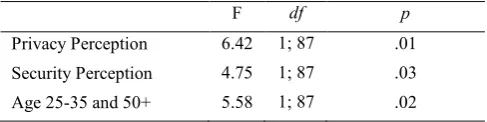
Next I conducted another univariate ANCOVA with search behavior as dependent and age group, privacy perception, and security perception. The ANCOVA showed that age group, privacy perception, and security perception have statistically significant effects on search behavior (Table 3). A post-hoc Bonferroni corrected confidence interval revealed that the age group 25 – 35 scored higher on search behavior than the age group 50+ (95% CI = [0.07; 0.77]). In other words, Millennials search more frequent and more effective on the Internet than Non-Millennials. Moreover, ANOVA showed that there is no significant difference between Millennials and Non-Millennials perception of privacy (F(1;89) = 2.13; p = .15). The security perception does not differ significantly between the 25-35 year olds and the 50 and older aged participants (F(1;89) = 2.63; p = .11).
[image:7.595.304.548.561.622.2]Post-hoc confidence intervals of parameter estimations revealed positive associations between privacy perception and search behavior (95% CI = [0.07; 0.58]). Further, post-hoc confidence intervals of parameter estimations revealed positive associations between security perception and search behavior (95% CI = [0.02; 0.45]). In other words, the higher a person scores on privacy and security the more that person searches on the Internet.
Table 3
Search behavior of Millennials vs. Non-Millennials corrected for security and privacy perceptions
F df p
Privacy Perception 6.42 1; 87 .01 Security Perception 4.75 1; 87 .03
Age 25-35 and 50+ 5.58 1; 87 .02
6.3
Model 2
Moreover, I conducted three ANOVAs with search behavior, privacy, and security as dependent and the three random groups of 18-24 year olds as independent. No statistically significant difference between the three random groups of 18-24 year olds could be found for search behavior, privacy, or security (F(2;122) = 1.39; p = .25; F(2;122) = 2.90; p = .06; F(2;122) = 0.56; p = .58). In other words, the randomization produced three groups that scored equally on all relevant variables.
6.4
Model 3
Finally, I examined search behavior, privacy, and security as dependent and throughout all age groups as independent variables via three additional ANOVAs. To balance the amount of participants within the different age groups I chose the first group of the three random groups of 18-24 year olds as representative of the youngest age group in the sample and compared them to the other age groups.
The SPSS output showed a slight difference for search behavior between the age groups (F(3;164) = 2.78; p = .04). Age group 25-35 scores slightly higher on frequency and effectiveness in search behavior than age group 50+ (95% CI = [0.00; 0.84]). However, the results showed statistically significant differences between the age groups for privacy and security (F(3;164) = 7.17; p < .05; F(3;164) = 3.68; p < .05). Post-hoc Bonferroni corrected confidence intervals revealed that the age group 18 – 24 scored the highest on privacy with a mean of 5.69 (SD=0.12). The age group 18-24 scores are closest to the scores of age group 25 – 35 (95% CI = [0.06; 0.88]), higher on privacy than the age group 36 – 49 (95% CI = [0.20; 1.06]) and higher than the age group 50+ (95% CI = [0.25; 1.11]). The analysis did not detect further differences between the groups. In other words, 18 – 24 year olds engage more in privacy protection practices while interacting with the Internet than people aged 36 or older, because they are aware of that their data is recorded and used further by search engine operators and third parties. Therefore they perceive less privacy than older age groups. Post-hoc Bonferroni corrected confidence intervals revealed that the age group 18 – 24 scored lower on security than the age group 50+ (95% CI = [-1.08; -0.12]). Further differences were not detected between the groups. In other words, 18 – 24 year olds engage more in practices to secure their personal data online than people aged 50 or older. Based on this the younger age groups is less conscious and tries less to limit the data that is recorded. This means that Internet Users aged 50 years or older engage more in securing their data because they feel unsafe online and perceive less security.
6.5
Cluster Analysis
In a next step I analyzed the data with a cluster analysis, which allows to cluster participants together based on multiple variables. The clusters are evaluated based on the dependent variable search behavior and the independent factor age, and the covariates privacy and security perception. The cluster function in SPSS grouped the data into four clusters with a ratio size below 2 meaning that no cluster is two times as large as another, which makes comparison more appropriate. All clusters were essentially based on security and Appendix C shows that the youngest cluster 1 with a mean age of 26.84 years old has the highest scores on privacy perception high but the lowest security perception. Compared to Cluster 4, which is the oldest with a mean of 37.19 years one can see that the older the lower the scores on security but higher on privacy. Cluster 2 and 3 have a difference of 4 years in age but score equally on privacy. Cluster 3 has the highest frequency and effectiveness in search behavior.
6.6
Sub-Analysis of dataset
When comparing privacy and security between goals while searching online such as entertainment, research and shopping the results show that 201 participants out of N=257 use search engines for research; research not being further defined into detail. 32 respondents state to use it mainly for entertainment and 24 use it for shopping. There is no significant difference within the goals and the security perception. However, a significant difference is found between goals to the privacy perception (F(2;254) = 4.70; p < .05). Post-hoc Bonferroni corrected confidence intervals revealed that the Internet users, which mainly use search engines for entertainment score significantly higher on privacy perception than Internet users, which mainly use search engines for shopping (95% CI = [1.12; 1.04]). Further differences were not detected between the groups.
Furthermore, I compared the awareness between the age groups 25-35 and 50+. The author cannot report a significant difference between the age groups’ awareness of security and privacy issues of search engines, respectively (F(1;89) = .11; p = .74). The statements I retrieved from the respondents were very interesting to look at. The younger participants often stated that they did not encounter any security or privacy incidents while searching online that concerned them. Most answers ranged from “no I did not encounter any incidents” or some just answered “none”. Interestingly one 20 year old answered, “I'm not concerned about anything. I know that their business is selling my personal information but I'm fine with that. As far as I know I have nothing to hide”. I found this statement very interesting, because it seems as if young users of the Internet just do not care about their private data anymore. They just endure the data stealing and recording. This is different from the findings by Peters (2015), who states that young people do share a bit more than older generations but they still care and are concerned with their private information. A lot of respondents complained about the ads showing even after several days of searching an item, which makes them uncomfortable and gives the feeling of constant observation. Finally, one participant made a great point in supporting a side purpose of this study. The 56-year-old respondent answered “I cannot think of any serious incidents right now, but taking part in this investigation makes me realize that I might be a little naive and I shall be more on the alert from now on”. This is a great contribution to the practical implications of the study of making Internet users aware of the privacy and security issues they face unintentionally while searching online.
7.
DISCUSSION
This section begins with a discussion on the theoretical and practical implications of the findings of this study. I conclude this research by stating the limitations of this study and suggesting directions for further research.
This research investigated the difference between the age groups’ (18-24, 25-35, 36-49 and 50+) perception of privacy and security while searching online. The study intended to answer the research questions, whereas RQ1 is the main research question and RQ1-RQ2 are sub questions:
RQ1 Does the privacy and security perception of different age groups (Millennials versus Non-Millennials) differ when using search engines?
RQ2 Does the age of the user influence the perception of privacy and security when searching online?
engine operators and companies for marketing purposes?
The author set out three measures within the survey to answer the research questions. Three models and an additional cluster analysis analyzed the (1) Demographics, (2) Search Behavior and (3) Privacy and Security Perception.
The first research question is confirmed because there is a significant difference within the privacy and security perception differs between different age groups while searching online. The research revealed that the youngest age group 18-24 scored higher on privacy perception compared to the older age groups 25-35, 36-49 and 50+. However, I cannot report a significant difference between Millennials (25-35) and Non-Millennials (50+). Additionally, the cluster analysis also showed that the first cluster aged the youngest with an average of 26.84 has the highest privacy perception. In essence 18 – 24 year olds perceive less privacy when interacting with the Internet than people aged 36 or older, because they are more aware of the fact that their data is recorded, shared and sold to third parties such as profiling companies and marketing firms. Concerning security perception, the study showed that the youngest age group 18-24 engage less in security practices when interacting with the Internet than older users. Older users feel less secure and would refuse to give out data more than younger aged users. This was again confirmed by the cluster analysis where the youngest cluster of 26.84 years old had the lowest score on security.
The second research question can also be answered on the basis of the outcome of the study. Age has a significant influence on the perception of privacy and security while searching online. Although age correlates with the privacy and security perception there is only a slight difference to be reported on search behavior between the age groups. It appears that all participants in the study search similarly no matter to which age group they belong.
Finally, the third research question revealed that search engine users of Millennials (25-35) and Non-Millennials (50+) admit to be well aware of the use and sharing with third parties of their private data. Furthermore they accept that their private data is sold and used for advertising based on prior searches. There is no significant difference between the age groups meaning that both deem themselves aware of the privacy and security issues they face while using search engines.
A1 Younger age groups are more aware of privacy issues and perceive less privacy while searching online. A2 Younger age groups have more knowledge and
engage more in practices to secure their data (refusing to reveal data online, reading privacy policies etc.) than older age groups because they want to perceive more security.
Based on the findings on this study I can validate the first assumption because younger age groups perceive less privacy than older age groups. They are more conscious of privacy issues. However, I have to de-validate the second assumption based on the outcome of this study. It turns out that older age groups engage more in practices to secure their personal data while searching online.
In summary the author can state, on basis of the evidence gained through the research, that there is a difference in privacy and security perception of different age groups when using search engines.
8.
THEORETICAL IMPLICATIONS
Despite the limitations above, the findings laid out in this study have important theoretical and practical implications, which can be of benefit for search engine operators and the users themselves.
The online environment has become a great part of our everyday lives and is a field that is constantly and rapidly growing. Due to the sudden and crucial changes research tends to become out-dated and more so incomplete very quickly. After reviewing the literature for the topic ‘Security and privacy perceptions of Millennials vs. Non-Millennials in digital environments – What are the differences between age groups in the perceptions on security and privacy associated with (online/web) Search behaviour?’ it becomes clear that extensive research has not been done. The existing literature is mostly describing privacy perception exclusively from the age groups, especially when one is focusing on privacy within the search behaviour. Comparing how the two age groups perceive the security when searching online will be revealing and will be of practical use for marketing purposes for firms. I for myself are very aware that my data is saved and used within the digital environment but how do other people my age perceive it – do they know that there is a reason behind the ads on the sidebars that match their recent searches?
The study contributes to the growing body of literature concerning the privacy and security perception when searching online. The current literature does not take different age groups into account. The research gives new insight to the perception of privacy and security between two age groups and puts these into relationship with search behavior. Throughout the literature review no such paper was found and this study can therefore be called unique.
9.
PRACTICAL IMPLICATIONS
Since search engine operators and marketers use the recorded private data for their benefit this study plays into their hands. The marketers can utilize the findings of the research to make their campaigns and search results more relevant on basis of the data being saved, shared and sold to third parties. They can include privacy and security measures tailored to the age groups to make their digital environment experience more successful. This study could be of use for marketing companies and especially for profiling companies online. It is important to take the users’ perception of privacy and security into account to provide them the best service possible. Since most search engines are available throughout age groups they have to be design them appropriately for all users of any age. This study can contribute to the analyses for search engines. The different age groups are assessed throughout and internally this gives insight to their perception when browsing online. Marketers have to be aware that Internet is constantly changing and with new developments new privacy and security issues arise. The Search engine operators and marketers have to identify these new risks and warn the users. Operators have to make users aware of what is done with their data Operators have the responsibility to see more than their own benefit from recording the personal data plugged into the search engine. They have to understand the risks for the user and protect them from these risks rather than exploit the users.
users. They can make aware of the privacy and security issues collectively and ensure that their data is handled confidentially and that data is not recorded extensively.
10.
LIMITATIONS
This study is subject to several relevant limitations. Since this research was conducted within the TOM study system (Twents Onderwijs model), as a bachelor thesis, it had a strict time frame and limited resources. The study is based on the survey, which was designed based on the different constructs and defined by taking literature and passed studies into account but also using own experience and common sense. It was difficult to generalize the items since the literature did not decide on clear definitions. Therefore a new model to assess the research question was developed. Since the items were not assessed by standardized instruments one can pose the limitation of misinterpreted questions. This means that the items asked in order to assess the constructs search behavior; privacy and security could be designed wrongly. The items were constructed to best knowledge and intend but each participant could interpret the questions differently and this can bias the study. One can see that the Cronbach’s alpha reflects this limitation. The reliability of the construct privacy (.421) is below the accepted value. The basis of this problem is that privacy is defined differently and perceived differently by users. “Older users may perceive privacy as protecting personal data from outside intrusion, but there are signs that younger people have notions of the idea” (Bradbury, 2015). Moreover, the specificity of the measure which were used in the study are of some concern, because the existing studies and literature was based on different digital environments and then adapted to the search behavior of users. This poses the concern of errors in the framework. Especially the grouping of the different items assessing privacy and security perception could be a threat to the validity of this study. Further, the dependent variable search behavior included the frequency and effectiveness of the user and this was estimated by the participant him or herself which means that there might be difference in perception or that the respondent over estimates his or her own abilities. Although the participants are trusted to have answered to their best knowledge this has to be taken into account as a limitation of this study. For further research one can erase this limitations by running a pilot study with a smaller sample beforehand in order to assure the reliability of the model. Further, the language of the survey was English and the participant’s nationality was distributed 49% Dutch, 33% German and 18% other; one would trust the English skills of the respondents but there is the possibility of misunderstandings or misinterpretations due to language barriers.
In addition to the above the sample size (N=257), if larger, could reveal different results. Due to the tight time frame more extensive data collection was not possible but this can be a point of improvement in future studies. Furthermore, it should be noted that the data for was collected from a convenience sample on Facebook, through direct messages and emails. This might have led to bias in results and misrepresentation of data because the survey was distributed within the author’s personal environment. Due to the convenience sampling the sizes of age groups differed in proportions. But this was taken care of by the author in randomly selecting a third of the number of respondents to even out the members in the age groups.
11.
DIRECTIONS FOR FURTHER
RESEARCH
The framework, as well as the results of this study, leave directions and suggestions to be further investigated. The suggestions stem from the limitations this study was subject to.
The variables, on which the perception of privacy, security perception and search behavior was measured, were self-constructed through creativity inspired by research. This means that the measurement construct is yet to be validated by peers because it was never applied in this combination. Thus, further research can use this newly developed framework as a basis and can built a generalized model or scale on which the privacy and security perception while searching online can be measured. Moreover, the causal relationship of the variables has to be addressed in future research. Is change in search behavior the consequence of perceived privacy and security or is the way in which one searches on the web the antecedent of the perception. The framework of this study has to be tested and further adapted to become a generalized model. Hereby, standardized instruments could be developed from the generalized model to ensure that the intended variable to be measured is actually assessed. Since the privacy and security on online search engine is a controversial topic and just emerging, as users come to understand what is done with their personal data, more aspects such as penalties for violating a user’s privacy might come to attention. Furthermore, future studies could include the feelings of the users or their opinion when they are aware of that their data is recorded. Future research of this topic could include more variables that narrow down the privacy and security perception by using questions phrased “If a website violates its privacy policy, it means that you have the right to sue the website for violating it” (Hoofnagle, King, Li, & Turow, 2010, p. 17), to be answered with yes/no which tests their knowledge of privacy obligations of a firm. Moreover, it would be interesting to include how the counterpart of the story reacts upon the perceived privacy and security. This study did not include search engine operator’s side of the story, which would most likely be beneficial for this topic. Finally, age played an important role in this research and because it was a cross sectional study only one point in time is assessed. The author would suggest a longitudinal study to examine the different age groups again over time because it would be interesting to investigate if there are patterns in the differences of privacy and security perceptions while searching online.
12.
CONCLUSION
This research reveals that there are differences in the perception of privacy and security between different age groups. The scales and measures intended to assess the perceptions of Internet users and the findings show that less privacy is perceived by younger age groups. They are more aware than their older fellows. Surprising is that although they are aware of privacy issues they do not engage in protecting their data online as much as age groups 50+. The study by Moar Consulting (2015) showed “while most people want more internet security and privacy, they do very little to make use of the tools and techniques that are available to give them what they want”. My thesis supports this statement. There is a “striking disconnect between what people want and what they do” (Morar Consulting, 2015).
13.
ACKNOWLEDGEMETNS
Firstly, I would like to express my sincere thanks and appreciation to my supervisors I. (Raja) Singaram and Dr. Efthymios Constantinides for their advice and feedback throughout the process of writing my thesis. Furthermore, I am very grateful for the peer reviews and feedback of Denise Althaus.
I would like to thank my family and friends for all their constant support during the entire bachelor’s program.
14.
CAREER ORIENTATION AND
FUTURE PERSPECTIVES
After my Bachelor degree I will follow the Marketing Management Program at the Rotterdam Business School. I am very interested in the Marketing field since I followed the digital marketing elective in quartile 7. I would like to work in the field of digital marketing for a company operating in the fast moving consumer goods industry.
“We don’t have a magic recipe to ensure your digital success, […] every business has to ‘bake’ its own unique strategy.” (Ryan, 2012, S. 25) I want to help a company find the magic recipe to reach and convert visitors to customer. My thesis can contribute to my future career in the way that I have the chance to understand how users perceive security and privacy when they search online. When setting up a digital marketing strategy I will have knowledge about how users perceive the security and privacy online. This will help me to set out the strategy in such a way that users will trust the firm I will work for. Also I will gain insight to the distinct parts of my research such as search behavior and security/risk perception as a single construct, which will gives me useful background knowledge for my future career. Since I am considering writing a doctor thesis in the very far future I can gain real life research skills, which I utilize after I have experiences in the professional field
15.
BIBLIOGRAPHY
Babbie, E. (2010). The practice of social research. Belmont: Wadsworth.
Barbaro, M., & Zeller, T. (2006, August 9). A Face Is Exposed for AOL Searcher No. 4417749, , Aug. 9, 2006. NY TIMES, 1-3.
Belanger, F., Hiller, J. S., & Smith, W. J. (2002). Trustworthiness in electronic commerce: The role of privacy, security, and site attributes. The Journal of Strategic Information Systems, 245-270.
Bradbury, D. (2015, January 19). Teenage privacy online: confronting the web's privacy boundaries. Retrieved June 20, 2016, from Engineering and Technology Magazine:
http://eandt.theiet.org/magazine/2015/01/the-kids-are-alright.cfm
Brenner, J., Purcell, K., & Rainie, L. (2012). Search Engine Use 2012. Washington, D.C.: Pew Research Center’s Internet & American Life Project.
Castellà-Rocaa, J., Herrera-Joancomartíc, J., & Viejoa, A. (2009). Preserving user’s privacy in web search engines. Elsevier, 1541–1551.
College Grad. (2016, n/a n/a). The Eight Types of Interview Questions. Retrieved April 29, 2016, from College Grad LLC.
Cronbach, L. J. (1951, September). Coefficient aplpha and the internal structure of tests. Psychometrika, 297-334. De Veaux, R. D., Velleman, P., & Bock, E. (2011). Stats: Data
and Models. Boston: Pearson Education.
Dritsas, S. (2005). Protecting privacy and anonymity in pervasive computing: trends and perspectives. Elsevier, 196–210.
Ferber, R. (1977). Research by convenience. Journal of Consumer Research, 57-58.
Garfinkel, S., & Spafford, E. H. (1997). Web Security & Commerce. Sebastopol: O'Reilly.
Gauthronet, S., & Nathan, F. (1999). On-line Services and Data Protection and the Protection of Privacy, Office for Official Publications of the European Communities,. Luxembourg.
George, D., & Mallery, M. (2003). Using SPSS for Windows step by step: a simple guide and reference. n/a: Allyn & Bacon.
Gürses, S. (2010). Multilateral privacy requirements analysis in online social networks. Belgium: KU Leuven. Hodkinson, C., Kiel, G., & Mccoll-Kennedy, J. R. (2000).
Consumer web search behaviour: diagrammatic illustration of wayfinding on the web. Brisbane: Academic Press.
Hoffman, D. L., Novak, T. P., & Peralta, M. (1999). Building consumer trust online. . Communications of the ACM, 80-85.
Hoofnagle, C., King, J., Li, S., & Turow, J. (2010). How Different are Young Adults From Older Adults When it Comes to Information Privacy Attitudes & Policies? . Pennsylvania: University of Pennsylvania, Annenberg School for Communication.
Howe, N., & Strauss, W. (1991). Generations: The History of America's Future, 1584 to 2069. New York: NY: William Morrow and Company.
Howe, N., & Strauss, W. (2009). Millennials rising: The next great generation. New York: Vintage.
IBM Corporation 1989. (2012, n/a n/a). TwoStep Cluster Analysis. Retrieved June 8, 2016, from IBM
Knowledge Center:
https://www.ibm.com/support/knowledgecenter/SSL VMB_21.0.0/com.ibm.spss.statistics.help/idh_twoste p_main.htm
Iliffe, U., Sturges, P., & Teng, V. (2001). User privacy in the digital library environment: a matter of concern for information professionals. Library Management, pp. 364 - 370.
Jarvenpaa, S. L., Tractinsky, N., & Saarinen, L. (1999). Consumer trust in an internet store: a cross‐cultural validation. Journal of Computer‐Mediated Communication, n/a.
Juárez, M., & Torra, V. (2013). Toward a Privacy Agent for Information Retrieval. International Journal of Intelligent Systems, 606–622.
Lebo, H. (2000). Surveying the Digital Future. UC Regents. Li, H., & Suomi, R. (2009). A proposed scale for measuring
e-service quality. International Journal of u-and e-Service, 1-10.
Malhotra, N. K., Kim, S. S., & Agarwal, J. (2004). Internet users' information privacy concerns (IUIPC): The construct, the scale, and a causal model. . Information systems research, 336-355.
Mayer, R. C., Davis, J. H., & Schoorman, F. D. (1995). An integrative model of organizational trust. Academy of management review, 709-734.
Miyazaki, A. D., & Fernandez, A. (2000). Internet privacy and security: An examination of online retailer disclosures. Journal of Public Policy & Marketing, 54-61.
Moor, J. (1997). Towards a Theory of Privacy in the Information Age. Dartmouth College Computersand Society, 27-32.
Morar Consulting. (2015). The dangers of our digital lives. n/a: Hide My Ass!
Murnane, K. (2016, April 18). How The Boomers Differ From Everybody In Their Approach To Online Privacy And Security. Retrieved 06 10, 2016, from Forbes: http://www.forbes.com/sites/kevinmurnane/2016/04/1 8/how-the-boomers-differ-from-everybody-in-their-
approach-to-online-privacy-and-security/#490eddde3e01
Oxford Dictionaries. (2016, n/a n/a). Oxford University Dictionaries. Retrieved April 21, 2016, from Oxford
University Press:
http://www.oxforddictionaries.com/definition/english/ search-engine
Peters, S. (2015, October 13). Believe It Or Not, Millennials Do Care About Privacy, Security. Retrieved 06 15, 2016,
from Dark Reading:
http://www.darkreading.com/endpoint/believe-it-or- not-millennials-do-care-about-privacy-security/d/d-id/1322622
Peterson, R. A., & Merino, M. C. (2003). Consumer information search behavior and the Internet. Psychology & Marketing, 99-121.
Preibusch, S. (2013). Guide to measuring privacy concern: Review of survey and observational instruments. Int. J. Human-Computer Studies 71, 1133–1143.
Purcell, K. (2011, August 9). Search and email still top the list of most popular online activities. Retrieved April 6, 2016, from Pew Research Center: http://www.pewinternet.org/2011/08/09/search-and- email-still-top-the-list-of-most-popular-online-activities/
Raines, C. (2002). Managing millennials. In C. Raines, Connecting Generations: The Sourcebook (p. n/a). California: Crisp Learning.
Roelofs, W. (2007). The AOL Scandal An Information Retrieval View. N/a: N/a.
Rose, D. E., & D., L. (2004). Understanding user goals in web search. Proceedings of the 13th international conference on World Wide Web (pp. 13-19). New York: ACM.
Ruback, T. (2015, June 5). Understanding the Differences Between Privacy and Security Online. Retrieved June
2, 2016, from Ghostery:
https://www.ghostery.com/intelligence/business- blog/privacy/understanding-the-differences-between-privacy-and-/
Ryan, D. (2012). Understanding Digital Marketing. London. Stiakakis, E., & Georgiadis, C. K. (2009). E-service quality:
comparing the perceptions of providers and customers. Managing Service Quality: An International Journal, 410-430.
Tavakol, M., & Dennick, R. (2011). Making sense of Cronbach's alpha. International journal of medical education, 53-55.
Tavani, H. (2007, January 4). Philosophical theories of privacy: Implications for an adequate online privacy policy. Metaphilosophy, pp. 1-22. Retrieved from Tavani, H. T. (2007). . Metaphilosophy, 38(1), 1-22.
Taylor, A. (2012). A study of the information search behaviour of the millennial generation. New Jersey: College of Business Administration, Rider University.
Tene, O. (2007). What Google Knows: Privacy and Internet Search Engines. Forthcoming: Utah Law Review. Van den Broeck, E., Poels, K., & Walrave, M. (2015). Older
and wiser? Facebook use, privacy concern, and privacy protection in the life stages of emerging, young, and middle adulthood. Social Media+ Society, n/a.
Weiler, A. (2004). Information-Seeking Behavior in Generation Y Students: Motivation, Critical Thinking, and Learning Theory. The Journal of Academic Librarianship, 46–53 .