http://wrap.warwick.ac.uk
Original citation:
Sun, S., Joy, Mike and Griffiths, Nathan (2005) An agent-based approach to dynamic
adaptive learning. In: Agent Based Systems for Human Learning (ABSHL) Workshop,
the Fourth International Joint Conference on Autonomous Agents and Multi Agent
Systems (AAMAS), Utrecht, Netherlands, 25-29 Jul 2005 pp. 48-58.
Permanent WRAP url:
http://wrap.warwick.ac.uk/61439
Copyright and reuse:
The Warwick Research Archive Portal (WRAP) makes this work by researchers of the
University of Warwick available open access under the following conditions. Copyright ©
and all moral rights to the version of the paper presented here belong to the individual
author(s) and/or other copyright owners. To the extent reasonable and practicable the
material made available in WRAP has been checked for eligibility before being made
available.
Copies of full items can be used for personal research or study, educational, or not-for
profit purposes without prior permission or charge. Provided that the authors, title and
full bibliographic details are credited, a hyperlink and/or URL is given for the original
metadata page and the content is not changed in any way.
A note on versions:
The version presented here may differ from the published version or, version of record, if
you wish to cite this item you are advised to consult the publisher’s version. Please see
the ‘permanent WRAP url’ above for details on accessing the published version and note
that access may require a subscription.
An Agent-Based Approach to Dynamic Adaptive Learning
Shanghua Sun, Mike Joy, and Nathan Griffiths
Department of Computer Science
University of Warwick
Coventry CV4 7AL
{S.Sun, M.S.Joy, N.E.Griffiths}@warwick.ac.uk
ABSTRACT
Dynamic adaptive learning and teaching strategies are increasingly demanded in order to improve the efficiency and effectiveness of the education process, but few learning systems exist which are dynamic and able to satisfy individual students. In an attempt to overcome these limitations, we propose a multi-agent architecture that provides the key functions of a dynamic and adaptive learn-ing system. Learnlearn-ing style schemes are used to adapt to students’ individual needs, and learning objects provide effective reuse and structuring of material. The incorporation of agents and learning objects is based on learning style — a pedagogic foundation for adaptivity — and this is one of the main contributions of this re-search. The system has been analysed through several functional experiments, and the analysis of a simulation study indicates that the approach is able to handle individual students’ requirements and improve the dynamic adaptivity in education systems.
Categories and Subject Descriptors
J.1 [Computer Applications]: Administrative data processing—
Education
General Terms
Design
Keywords
Adaptive learning, pedagogical agent system, learning objects, learn-ing style
1.
INTRODUCTION
Advanced information technologies are increasingly used in higher education to facilitate learning and teaching, but inadequacies ex-ist in current systems, materials, and pedagogy. The application of similar learning strategies to all students in a class can be in-effective. For example, a failure to include design skills in intro-ductory modules may become apparent later in a student’s course. Students often tend to treat a course as a series of mechanical exer-cises rather than systemic concepts [32], and a specific framework to support the change process is often lacking [26]. Currently, much
of the courseware and software resources used in higher education are unstructured and are isolated from each other.
People learn in different ways. It is important to be aware of the differences between learners, and this is especially relevant during the current expansion of tertiary education to a greater proportion of the population. New delivery mechanisms are required, includ-ing online, open and distance learninclud-ing [4]. These issues can be partially resolved by providing student-centred, self-paced, highly interactive teaching materials and introducing automatic and asyn-chronous teaching methods. Although there are many educational technology projects, both stand-alone learning systems and Web-based tools using techniques such as multimedia interaction, learn-ing models and asynchronous learnlearn-ing, there is as yet no integrated approach to the design of pedagogic information architectures [32].
Such intelligent learning systems must be adaptive, able to learn and dynamic [29]. Agent technology can provide a dynamic adap-tation not only of domain knowledge, but also of the behaviour of individual learners, and so can be used to address the challenges of modern day education [2]. In this paper, we propose an agent-based architecture that is student-centred, adaptive, able to learn and dynamic. Our solution takes a multi-disciplinary approach, combining learning theory with agent-based systems. Thus, at the conceptual level, adaptivity is achieved by the use of learning style schemes to tailor the presentation of learning objects to individ-ual students. Conversely, at the practical level, this adaptivity is achieved through a set of agents that use a combination of pre-built and acquired knowledge to determine the learning styles and learn-ing objects that are appropriate for individual students.
In the remainder of this paper, we begin by introducing the founda-tional concepts on which our proposed architecture is based. Sec-tion 3 describes our proposed approach in detail. A prototype sys-tem is discussed in Section 4, and finally we offer our conclusions in Section 5.
2.
RELATED TECHNOLOGIES
Our work is based upon three key concepts: agent technology, learning objects, and learning style theories. In this section we in-troduce these concepts and the work related to these technologies.
2.1
Agent Technology
their interactions to reflect these [20]. It is generally accepted that an agent is an entity that is capable of carrying out flexible au-tonomous activities in an intelligent manner to accomplish tasks that meet its design objectives, without direct and constant inter-vention and guidance of humans.
Multi-agent systems contain many agents that communicate with each other. Each agent has control over certain parts of the en-vironment, so they are designed and implemented as a collection of individual interacting agents. Luck et al. remark that, “Multi-agent systems provide a natural basis for training decision mak-ers in complex decision making domains [in education and train-ing]” [23]. Furthermore, multi-agent systems can substantially con-tain the “spread of uncercon-tainty”, since agents typically process in-formation locally [14]. In the context of our education system ar-chitecture, agents provide a means to manage the complexity and uncertainty of the domain.
2.2
Learning Objects
Many learning materials are distributed using Web technologies, and most materials are currently developed for a specific purpose. For example, courseware is usually for a specific module, and its contents will probably not be reused or will only be reused infre-quently. To address the issue of reuse, from both the perspective of educators and learners, the concept of a learning object has been proposed.
A learning object is a “self-standing, reusable, discrete piece of content that meets an instructional objective” [1]. Learning objects may be tagged with metadata so that their identity and content are available to other systems. The decomposition of educational con-tent into learning objects is analogous to an object-oriented decom-position of a program, and permits an individual learning object to be used in a variety of educational contexts. Learning objects can form individual learning paths for students, to achieve a student-centred adaptive learning environment [30].
2.3
Learning Style Theories
Individuals learn in different ways. The concept of learning style has been introduced by educationalists, and is the subject of in-creasing research interest. The term is used as a “description of the attitudes and behaviours that determine our preferred way of learn-ing” [17]. Learning styles depend on a variety of factors, and are individual to different people. Even for an individual, their learning style can change over time. Learning styles may also differ accord-ing to gender, age, and cultural background [6]. In this paper, we restrict our view of learning styles to those applicable for students in higher education.
There are several existing models that are used to classify students’ learning styles including Kolb’s Learning Style Inventory [21], Gard-ner’s Multiple Intelligences [12], and the Felder-Silverman Learn-ing Style Model [11]. Our proposed architecture does not dictate the model of learning styles used, however, in the system described in Section 4 the Felder-Silverman Learning Style Model is adopted. This model situates a student’s learning style preference within a four-dimensional space, with the following four independent de-scriptors [11]:
• “sensing (concrete thinker, practical, oriented toward facts and procedures) or intuitive (abstract thinker, innovative, ori-ented toward theories and underlying meanings);
• visual (prefer visual representations of presented material,
such as pictures, diagrams, flow charts) or verbal (prefer written and spoken explanations);
• active (learn by trying things out, enjoying working in groups)
or reflective (learn by thinking things through, prefer work-ing alone or with a swork-ingle familiar partner);
• sequential (linear thinking process, learn in small
incremen-tal steps) or global (holistic thinking process, learn in large leaps)”.
The reasons for choosing this model are that it has been validated by pedagogy research [11, 41], and that the number of dimensions of the model is constrained, improving the feasibility of its imple-mentation.
2.4
Adaptive e-learning systems
Adapativity can be achieved in different ways from various per-spectives. In [8] Brusilovsky and Peylo point out that Web-inspired technologies used in adaptive learning applications can be divided into five groups: adaptive hypermedia, for example KBS-Hyper-book [16]; adaptive information filtering, for example MLTutor [33]; intelligent class monitoring, for example HyperClassroom [27]; in-telligent collaborative learning such as, COLER [10]; and intelli-gent tutoring such as, ELM-ART [39]. It is common in these e-learning systems, for several intelligent technologies to be used to achieve adaptivity and intelligence, whereas non-web based learn-ing systems, usually focus on a slearn-ingle intelligent technology. This enhances the adaptivity albeit on a specific type or aspect of web-based learning, i.e. adaptive presentation, assisting students to nav-igate themselves in learning materials, emphasizing on relatively small amount of learning contents, helping collaborative learning, or introducing a learning companion instead of a tutor, etc.
Due to the new requirements for web-based e-learning systems, new intelligent technologies are increasingly incorporated into other technologies [8]. Learning objects increase personalization, inter-operability, and flexibility [22]. People have their own preferences of how they can learn effectively, and to support a personalized learning strategy the differences between learners must be recog-nized [19]. Customizing learning materials as learning objects can support students with different learning styles. Although this idea has been proposed elsewhere [34], the incorporation of learning objects and learning style theories to support adaptivity is still a research problem. Agent technology gives a dynamic support for distributed learning applications, and deals well with crucial issues [38]. In this paper, to enhance the system adaptivity provided by these three key technologies, we present an adaptive e-learning sys-tem, which incorporates these advanced e-learning technologies to facilitate achieving the adaptivity.
the learning materials are more or less preset for a certain type of learning style or preference, and will not be changed or adjusted ac-cording to a change of learning style of the user over time. The ped-agogy that incorporates learning objects and learning style, which we have used in the system, is able to dynamically organise and de-liver learning materials to satisfy individual learning requirements, and agent technology gives dynamic support.
2.5
Pedagogical Agent Systems
In the context of adaptive education, agent technology can provide a dynamic adaptation not only of domain knowledge but also of the behaviour of individual learners, and has already been used in a number of educational tools. However, most systems incorporating agent technology, such as [3, 7, 25, 29, 31], have decoupled the agents from the pedagogic foundations of the system. Existing sys-tems tend to emphasise a particular aspect, such as training, group work, or human resources requirements. Beer and Whatley report the initial design of agents to support students undertaking group projects in health care education [3]. For each group of students, they provide a local agent to monitor the project, and enhance the communication between members of the group. The use of agents is emphasised as providing dynamic support for synchronous col-laboration.
Each of the current approaches has its individual ways of organ-ising the learning materials, and few have considered the effect of different learning styles. For example, in Shang et al.’s system, the students’ learning styles are stored in personal agents at the beginning of a student’s use of the system, and are not changed dynamically during the learning process [31]. However, learning styles will change during the time students are using the system. In our proposed multi-agent system, students’ learning styles are updated during the learning process. Shang et al. organise agents according to different courses [31], while Boicu et al. use agents that are implemented according to specific learning topics [7]. In our system, however, the agents are decomposed by their function in the teaching and learning process. The use of learning objects in such systems is rare, although the technology has begun to be used in non-adaptive training software. Garro and Palopoli’s system is designed to assist finding appropriate employees and measuring the skill gaps between the employee and the requirements of the organ-isation from a human resources perspective [13].
The functionality of current intelligent learning systems used for adaptive education can be classified as follows:
Student aspect which includes communication and information
storage,
Teaching and learning aspect which includes the modelling of
stu-dents and their learning requirements, and methods of organ-ising learning materials, and
System aspect which includes the system communication and
qual-ity control of the output.
We have developed a novel multi-agent approach to the problem of dynamically supporting adaptive learning, that distinguishes be-tween these three aspects [37].
3.
THE MULTI-AGENT APPROACH
From a technical viewpoint, the adaptivity requirement suggests that the set of interactions and communications within the system should be dynamic. The use of intelligent agents allows us to ab-stract data at a higher level than that which would be appropriate for conventional software technologies, and enables us to concep-tualise the system in a natural fashion.
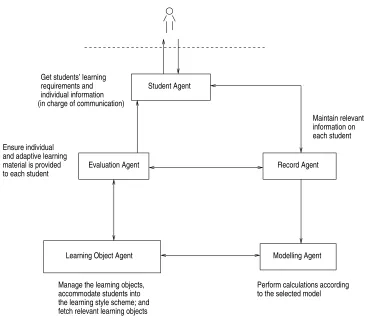
Our proposed multi-agent based learning system is functionally constructed by five agents, as shown in Figure 1: the Student Agent, Record Agent, Modelling Agent, Learning Object Agent, and Eval-uation Agent. Each agent is designed to satisfy a certain functional requirement that contributes to the purpose of the overall learning system, namely to provide dynamic and adaptive learning materi-als to individual users. Agents allow the system to be functionally divided, since each agent in the multi-agent system is autonomous and has its own social ability. Agent autonomy (the ability to take charge of its own actions and internal states) also increases system maintainability. The architecture of each agent can be looked at as a plug-in mechanism; according to the specific environment, the architecture can be updated to the most appropriate type. The re-activity and pro-activeness characters give the multi-agent system maximum flexibility and compatibility for different situations.
The Student Agent is responsible for communicating with students; the Record Agent maintains information about each student; the Modelling Agent creates models of students’ skills and learning objectives; the Learning Object Agent manages the set of learning objects; and the Evaluation Agent ensures that learning objects are presented in individual and adaptive learning paths to each individ-ual student. In the remainder of this section, we describe each of these agents in more detail, and discuss how students interact with the system.
3.1
Student Agent
The Student Agent is responsible for communicating with students, and provides the interface between the system and human users. The function of the agent is to fulfil the communication and data collection requirements, and to provide information from the user to other agents in the system.
When a student first logs in to the system, the Student Agent pro-vides an initial questionnaire to ascertain the student’s knowledge level, and to obtain information about their learning requirements (such as module details or the specific subject that the student wishes to study). During the time that the student is logged in to the sys-tem, the Student Agent records all of their actions, including the time they spend engaged in each activity presented to them, click-ing times, whether they are active or not, etc.
information on each student
Perform calculations according to the selected model Manage the learning objects,
accommodate students into the learning style scheme; and fetch relevant learning objects Get students’ learning
(in charge of communication)
Student Agent
Evaluation Agent
Modelling Agent Learning Object Agent
Record Agent individual information
requirements and
Ensure individual and adaptive learning material is provided
Maintain relevant
[image:5.595.117.482.72.391.2]to each student
Figure 1: Overall System Architecture.
Communication with the other agents. Interface to students. Interactions with students.
Record Agent Output to Student information
from Record Agent Evaluation AgentInput from
[image:5.595.156.464.459.671.2]BDI repository and Plan Library.
Thus, not all of the desires can be necessarily be achieved, since the choice of intention may be based on inaccurate information.
The Student Agent is implemented as a BDI-based agent [14], which makes decisions according to its knowledge, and is able to reason about its actions. It comprises the three main components shown in Figure 2: a communication interface to students; a repository of beliefs, desires, intentions, and a plan library, together with com-munication with the other agents within the system. The Student Agent uses means-ends reasoning to determine an appropriate plan for how to achieve a particular goal [40]. Given a goal, the current state of the environment (its beliefs), and the actions available to the agent, it will update its beliefs, determine an appropriate goal to achieve, use means-ends reasoning to find a plan to achieve the goal from its plan library, and finally will execute the plan. For ex-ample, the answers to the questionnaire will first be analysed, and then be immediately sent to the Record Agent. In general, require-ments and intentions from students are first mapped to beliefs, and then a course of action is determined and executed. The inputs and outputs for the Student Agent are as follows.
Inputs: Dialogue with students (including answers to questions,
comments on learning materials, etc.) and series of learning objects from the Evaluation Agent. Student data from the Record Agent.
Outputs: Questionnaire and learning objects to the student, and
student feedback to the Record Agent.
3.2
Record Agent
The Record Agent maintains all of the information about each stu-dent. It is the main data storage centre of the system; most of the data contained in the system is stored within this agent, in particular it encompasses:
• answers to questionnaires,
• feedback from students during the learning process,
• the series of learning objects sent to students, and
• the times of logging in, clicking times and the length of time in each stage, communication times, whether the student is active, etc.
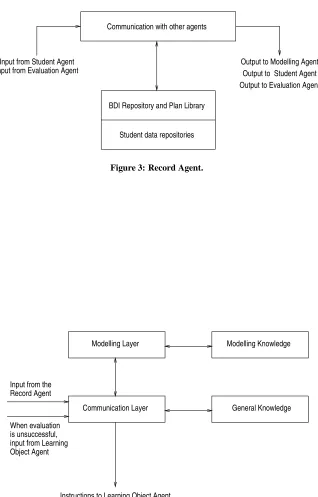
Similarly to the Student Agent, the Record Agent must also rea-son toward a course of action, and so is also a BDI-based agent (as shown Figure 3). Both the Student Agent and the Record Agent monitor their environment and, according to their beliefs (which in-clude information received from other agents), perform actions in order to change the environment. The Record Agent is more than simply a database — it is able to process and draw inferences from the data provided by other agents, and can intelligently provide other agents with information in response to its reasoning, even without information being requested. For example, after the Record Agent categorises the data from student, and realises that the stu-dent has spent almost one hour on each single learning unit, which is supposed to finish in 20 minutes, then this record will be sent to the Evaluation Agent without being requested. Data received from the Student Agent or the Evaluation Agent is incorporated into the Record Agent’s beliefs. Changes in these beliefs give rise to desires and subsequently to adopted intentions, that cause the communica-tion of suitable informacommunica-tion to the Modelling Agent, the Student
Agent, or the Evaluation Agent. The function of the Record Agent includes processing data from the other agents and making infer-ences based on this to update its own beliefs. For example, regard-less of the knowledge level the student has provided themselves, it will develop its own beliefs about a student’s knowledge by making inferences from the data provided by the other agents. The inputs and outputs for the Record Agent are as follows.
Inputs: Information from the Student Agent, feedback from
stu-dent via the Stustu-dent Agent, and the series of learning objects from the Evaluation Agent. After the first time a student uses the system, when they subsequently log in again the Student Agent will request the student’s data from the Record Agent. Prior to performing any evaluation, the Evaluation Agent re-quests the Record Agent to provide the relevant student data.
Outputs: The filtered student data is sent to the Modelling Agent,
and on request to the Evaluation Agent.
The Student Agent and the Record Agent each make decisions ac-cording to their individual knowledge, and their reasoning is di-rected toward actions, and so a BDI-based approach [14] is natu-ral. A deductive reasoning agent, was also considered, however it is doubtful whether such logic-based agents can react effectively within our time-constrained environment.
There are several reasons why the Student Agent and Record Agent are separated into two agents. Firstly, the Student Agent is respon-sible for communication, while data repositories are the focus of the Record Agent. If they were combined together into a single agent, there would be two major functional parts, of reasonable in-dependence of each other. Secondly, these BDI-based agents use mean-ends reasoning to select their actions, and if they were com-bined into a single agent, their plan libraries would also be joined, leading to a significant increase in the complexity of plan selection and reduced maintainability of the plan libraries. Since the data repositories of the system as a whole are fairly large, it is worth-while assigning a single agent to its management.
3.3
Modelling Agent
The Modelling Agent is responsible for performing calculations ac-cording to the general pedagogical modelling approach, and pro-viding the student models required by the Learning Object Agent. In addition to student specific information, the Modelling Agent utilises knowledge about how to perform modelling tasks, this mod-elling knowledge is stored in its own knowledge base. The Mod-elling Agent models individual students’ needs and their knowl-edge background, based on its selection of suitable data for the model from the information provided by the Record Agent. Once constructed, the resulting models are stored by the Record Agent (although the information contained in them can be subsequently obtained and updated in the future by the Modelling Agent).
Student data repositories
Output to Modelling Agent Output to Student Agent Output to Evaluation Agent Input from Student Agent
Input from Evaluation Agent
Communication with other agents
[image:7.595.148.466.118.615.2]BDI Repository and Plan Library
Figure 3: Record Agent.
Input from the Record Agent
Instructions to Learning Object Agent
Modelling Layer Modelling Knowledge
General Knowledge Communication Layer
[image:7.595.158.460.446.609.2]Object Agent input from Learning is unsuccessful, When evaluation
(as required for input to the pedagogical model) to the communi-cation layer of the Modelling Agent, which in turn maps relevant data to the general knowledge component. Based on this infor-mation the Modelling Agent can determined suitable goals (within the communication layer), that correspond to the information that should be sent to the modelling layer. When the modelling layer receives information, it is mapped to its modelling knowledge and the goals in the modelling layer, using Bayesian networks to per-form its calculations. The results of modelling, such as the index of each student’s relative knowledge level, and suggestions for the level of learning materials to be sent to the student, are passed via the communication layer to the Learning Object Agent. The infor-mation and functionality required by the modelling layer is separate to that required by the communication layer, and the separation of-fered by a layered approach provides a more manageable solution than a single-layered approach. The Modelling Agent’s inputs and outputs are as follows.
Inputs: Student information for the modelling process (provided
by the Record Agent), and where the series of learning ob-jects are not suitable for the student, the re-model instruction and student information is provided by the Learning Object Agent.
Outputs: Results of modelling, e.g. index of student’s relative
kno-wledge level, and the difficulty level of learning materials to the Learning Object Agent.
3.4
Learning Object Agent
The Learning Object Agent manages the learning objects, which are organised according to the learning style scheme. In response to instructions from the Modelling Agent, the Learning Object Agent provides different learning style students with relevant learning ob-jects. The function of the Learning Object Agent is to organise the adaptive learning materials for users based on the information that the system has collected.
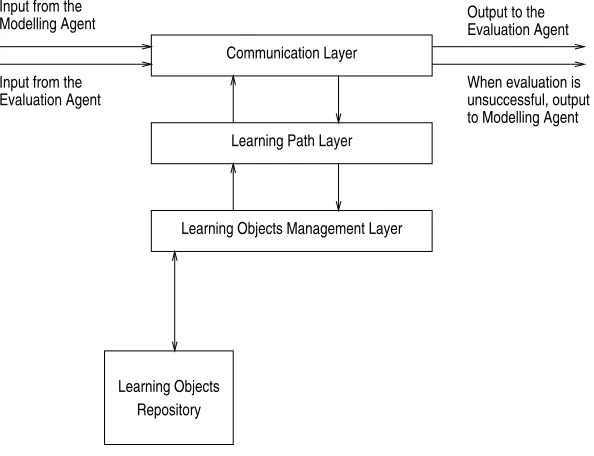
The Learning Object Agent is a hybrid agent, and has an architec-ture in which its subsystems are arranged into a hierarchy of layers as shown in Figure 5. The results from the Modelling Agent are transferred to the learning path layer by the communication layer, which in turn maps them to an appropriate learning path for a stu-dent. The Learning Object Agent communicates with the other agents through its communication layer. Decisions are sent to the learning object’s management layer, which is in charge of manag-ing all of the learnmanag-ing objects in its repository. The learnmanag-ing objects repository is organised into different levels, according to the learn-ing style scheme. Finally, the learnlearn-ing objects management layer selects a series of learning objects, which are transmitted to the Evaluation Agent through the communication layer.
The layered architecture ensures that the Learning Object Agent can be reactive when it is necessarily to respond to changes in the environment, and deliberative to achieve its goals, whilst maintain-ing a separation between the knowledge and functionality embod-ied by each layer. The learning path layer is responsible for accom-modating the student within a learning style and organising learn-ing materials accordlearn-ing to the student’s learnlearn-ing style description. The learning objects management layer has specific knowledge of the learning objects. Thus, while these two layers and the commu-nication layer are distinct from each other, they are able to exchange their information. All three of these layers cooperate together, to achieve the functionality of the Learning Object Agent.
The learning path layer adopts the Felder-Silverman Learning Style Model [11] to organise learning objects to fulfil different students’ requirements. The learning objects in the repository are categorised by the learning style model. Organisation of the learning materials as learning objects, based on a pedagogic learning style scheme in an agent environment, is a distinct characteristic of this archi-tecture which distinguishes it from existing pedagogic agent-based systems. The Felder-Silverman Learning Style Model categorises learning schemes according to four distinct dimensions, each of which has four layers. The inputs and outputs for the Learning Object Agent are as follows.
Inputs: Instructions from the Modelling Agent and evaluation
re-sults from the Evaluation Agent. If the evaluation is suc-cessful, the Learning Object Agent will simply be informed of this, otherwise it will receive the unsuccessful results, in-structions to rearrange the learning objects, and information about the student.
Outputs: A series of learning objects suitable for the student are
sent to the Evaluation Agent, or when the Learning Object Agent is informed that the evaluation is unsuccessful, it will give the data for this student from the Evaluation Agent to the Modelling Agent, and request it to model again.
3.5
Evaluation Agent
The Evaluation Agent ensures that learning objects are presented in an individual and adaptive learning path to each student. This is achieved by using the student data contained in the system to eval-uate the learning objects which are sent to students. The Modelling Agent uses the information from the Record Agent according to the modelling knowledge and functionality contained in its modelling layer. Thus, it is constrained by modelling specific knowledge. The Evaluation Agent helps to ensure that the best use is being made of the student data available in the system. If the selected learning objects are evaluated as appropriate for the student, the series of learning objects are sent to the Student Agent directly, otherwise the Evaluation Agent requests the Learning Object Agent to resend learning materials, or if more information is required, then relevant actions will be given to the student first, then the result will be eval-uated again. For example, if the student spends a very short period of time in a specific learning unit, compared to the expected time, then the Evaluation Agent will initiate a dialogue about whether the learning materials are too easy for the student, then depending on the answer, further action and decisions will be taken. If learn-ing objects need to be reorganised then the Learnlearn-ing Object Agent will ask the Modelling Agent to model again by using additional data and suggestions from the Evaluation Agent. At the same time, the knowledge of these agents and the student’s profile will be up-dated in order to dynamically adapt to student’s change in learning behaviour.
Repository Learning Objects
Learning Objects Management Layer Learning Path Layer Communication Layer
to Modelling Agent unsuccessful, output When evaluation is Evaluation Agent Output to the
[image:9.595.148.445.79.307.2]Evaluation Agent Input from the Modelling Agent Input from the
Figure 5: Learning Object Agent.
Record Agent Input from the Learning Object Agent
Output to Student Agent
Before evaluation, request data from Record Agent
When evaluation is successful, send learning objects to Record Agent
When evaluation is successful, inform Learning Object Agent; otherwise, inform Learning Object Agent to rearrange learning objects and transfer its data to it Input from the
Information Interface
Communication Knowledge & Information from other agents
Evaluation Knowledge
[image:9.595.152.448.377.668.2]Communication Layer Evaluation Layer
Agent comprises an information interface, along with communica-tion and evaluacommunica-tion layers, as shown in Figure 6. Each layer has its own knowledge base of information. The lower (communication) layer deals with interactions with other agents, and maps its cur-rent goal and knowledge base to new goals; the higher (evaluation) layer deals with analysing the information and making final evalua-tions for each student. The layers are naturally decomposed by the agent’s functionality. The Evaluation Agent’s inputs and outputs are as follows.
Inputs: Student information from the Record Agent, and a series
of learning objects from the Learning Object Agent.
Outputs: Results of evaluating, given to the Learning Object Agent
and the Student Agent. When evaluation is successful, the series of learning objects is sent to the Student Agent and the Record Agent. The Learning Object Agent also will be informed. Otherwise if the evaluation is unsuccessful, the Evaluation Agent will send its data about the student and in-structions for rearranging learning objects to the Learning Object Agent.
3.6
Using the system
When a student first logs in to the system, the Student Agent enters into a dialogue with the student to ascertain the student’s learn-ing requirements. After initially analyslearn-ing the results, the Record Agent is informed of the student’s learning requirements together with a suggested knowledge level for the student. These items of information are recorded and then passed to the Modelling Agent, which then sends results and instructions to the Learning Object Agent. This in turn arranges the first batch of learning objects to be sent to the Student Agent according to the results of learning style analysis (which occurs in the learning path layer) and dif-ficulty level of the learning objects, which are also organised ac-cording to the learning style scheme. These learning objects are first sent to the Evaluation Agent, which checks the student’s data from the Record Agent to evaluate whether the learning objects are suitable for this student. If the evaluation is successful, the series of learning objects is sent to the Student Agent (and then to the student) and recorded by the Record Agent. Otherwise, the Evalu-ation Agent asks the Learning Object Agent to provide alternative learning objects. After the student has used the learning objects, re-sponse data is returned to the Student Agent, which transmits them to the Record Agent.
4.
EVALUATION
Before implementation, several case studies have been used to ver-ify the consistency of the proposed architecture, including consid-eration of several first year undergraduate programming topics such as introductory Java programming and UNIX shell programming.
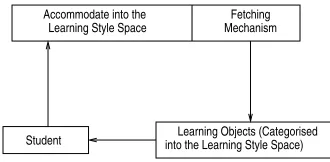
A prototype of the system has been developed using JADE [5]. Prior to the implementation of the complete multi-agent system, the Learning Object Agent has been evaluated. As mentioned above, in order to deliver the learning objects according to different learning styles, its evaluation is divided into three parts: accommodating students into the learning style scheme, categorising learning ob-jects according to the learning style scheme, and delivering Learn-ing Objects. TakLearn-ing an abstract view, this functionality can be structured as shown in Figure 7.
We have chosen an algorithm, which has been evaluated by com-paring the results for a sample of students with those generated by
Learning Objects (Categorised Student
Accommodate into the
Mechanism Learning Style Space Fetching
[image:10.595.352.517.52.133.2]into the Learning Style Space)
Figure 7: Abstract Method of the Learning Object Agent.
Felder and Silverman’s original questionnaire [35], to accommo-date students into the learning style scheme. A Spearman’s rank correlation coefficient statistical analysis has been performed on the normalised data, and indicates a strong correlation between the two data sets. This suggests that our algorithm is sufficient to cate-gorise a student’s learning style.
The learning objects stored in the repository of the Learning Object Agent are also organised into the learning style space, the granular-ity of the categorisation is pragmatically determined, and seems ap-propriate for the learning objects available to us, but may be refined in the light of future experience.
The multi-agent adaptive learning system stores each student’s cur-rent learning style (which may change over time) and the style at-tributes of each learning object as co-ordinates into the learning style space. The algorithm used to deliver learning objects to stu-dents involves matching the style attributes of (appropriate) learn-ing objects to the current style preferences of the individual stu-dent. In the Learning Object Agent, this is supported by the learn-ing path layer to realise the algorithm and implement the process. The learning object management layer will then search the reposi-tory of learning objects, to fetch appropriate learning objects with similar (but not necessarily identical) descriptions. The selected objects are then presented to the student, and the subsequent inter-actions between the student and these learning objects may be used to modify the student’s learning style attributes. It should be noted that both the categorisation of a learning object and the assignment of a learning style to a student are necessarily approximate.
Since it is almost impossible to find students with all possible com-binations of the learning style scheme, a simulation has been run on the system. The simulation has covered all of the possibilities — four dimensions, each on a five-point scale (54 = 625), and the
evaluation indicates that our approach is capable of delivering dif-ferent learning objects to difdif-ferent students according to the learn-ing style category.
5.
CONCLUSIONS AND FUTURE WORK
In this paper, we have presented a multi-agent based adaptive learn-ing system which incorporates reusable learnlearn-ing objects and uses a learning style scheme as the pedagogic foundation for adaptivity to dynamically adapt to individuals in education. A prototype of the system has been developed, and the Learning Object Agent has been evaluated. In addition to the implementation of the complete system, future work also includes optimising the architecture, and an evaluation of the system effectiveness and efficiency.
6.
REFERENCES
objects?, 2002.
url: http://adlcolab.uwsa.edu/lo/what.htm (accessed Dec. 2003).
[2] L. Aroyo and P. Kommers. Special issue preface, Intelligent agents for educational computer-aided systems. Interactive
Learning Research, 10(3/4):235–242, 1999.
[3] M. Beer and J. Whatley. A multi-agent architecture to support synchronous collaborative learning in an international environment. In Proceedings of the 1st
International Conference on Autonomous Agents, pages
505–506, 2002.
[4] H. Beetham. Understanding e-learning. e-tutoring for effective e-learning, 2002.
url:http://www.ics.ltsn.ac.uk/pub/elearning/ (accessed Nov. 2002).
[5] F. Bellifemine, G. Caire, A. Poggi, and G. Rimassa. Jade — a white paper, Sept. 2003.
url: http://jade.tilab.com/.
[6] J. Blackmore. Learning styles: Telecommunications for remote work and learning, 1996.
url: http://www.cyg.net/ jblackmo/diglib/styl-a.html (accessed May 2004).
[7] M. Boicu, G. Tecuci, B. Stanescu, D. Marcu, M. Barbulescu, and C. Boicu. Design principles for learning agents. In
Proceedings of AAAI-2004 Workshop on Intelligent Agent Architectures: Combining the Strengths of Software Engineering and Cognitive Systems, 2004.
[8] P. Brusilovsky and C. Peylo. Adaptive and intelligent web-based educational systems. International Journal of
Artificial Intelligence in Education, Special Issue on Adaptive and Intelligent Web-based Educational Systems,
13(2–4):159–172, 2003.
[9] C. A. Carver, R. A. Howard, and W. D. Lane. Enhancing student learning through hypermedia courseware and incorporation of student learning styles. IEEE Transactions
on Education, 42(1):33–38, 1999.
[10] M. A. Constantino Gonzalez, D. Suthers, and J. G. Escamilla De Los Santos. Coaching web-based collaborative learning based on problem solution differences and participation.
International Journal of Artificial Intelligence in Education,
13(2–4):261–294, 2003.
[11] R. M. Felder and J. E. Spurlin. Applications, reliability, and validity of the index of learning styles. International Journal
of Engineering Education, 21(1):103–112, 2005.
[12] H. Gardner. Multiple Intelligences: The Theory in Practice. Basic Books, 1993.
[13] A. Garro and L. Palopoli. An XML multi-agent system for e-learning and skill management, 2002.
url: http://www.netobjectdays.org/pdf/02/papers/malceb/-0623.pdf (accessed Feb.
2003).
[14] M. Georgeff, B. Pell, M. Pollack, M. Tambe, and
M. Wooldridge. The belief-desire-intention model of agency. In J. M¨uller, M. P. Singh, and A. S. Rao, editors, Proceedings
of the 5th International Workshop on IntelligentAgents V : Agent Theories, Architectures, and Languages, pages 1–10,
1999.
[15] J. E. Gilbert and C. Y. Han. Arthur: A personalized instructional system. Journal of Computing in Higher
Education, 14(1), 2002.
[16] N. Henze and W. Nejdl. Adaptation in open corpus hypermedia. International Journal of Artificial Intelligence
in Education, 12(4):325–350, 2001.
[17] P. Honey. Honey and Mumford Learning Styles
Questionnaire. PeterHoney Learning, 2001.
url: http://www.peterhoney.com/ (accessed Apr. 2004). [18] H. Hong and Kinshuk. Adaptation to student learning styles
in web based educational systems. In ED-MEDIA 2004, pages 491–496, 2004.
[19] T. Jenkins. On the difficulty of learning to program. In
Proceedings of the 3rd Annual Conference of the LTSN Centre for Information and Computer Sciences, pages
53–58, 2002.
[20] N. R. Jennings and M. Wooldridge. Applications of intelligent agents. In Agent Technology Foundations,
Applications, and Markets. Springer-Verlag, 1998.
[21] D. A. Kolb. Experiential Learning: Experience as the Source
of Learning and Development. Prentice-Hall, 1984.
[22] W. Longmire. A primer on learning objects, learning circuits, ASTD’s source for e-learning.
url: http://www.learningcircuits.org/mar2000/primer.html. (accessed Mar. 2003).
[23] M. Luck, P. McBurney, and C. Preist. Agent Technology:
Enabling Next Generation Computing A Roadmap for Agent Based Computing. AgentLink, 2003.
[24] J. P. M¨uller. A cooperation model for autonomous agents. In
Proceedings of the 3rd International Workshop on Intelligent Agents — Theories, Architectures, and Languages, volume
1193, pages 245–260, 1997.
[25] T. J. Norman and N. R. Jennings. Constructing a virtual training laboratory using intelligent agents. International
Journal of Continuous Engineering Education and Life-Long Learning, 12(1–4):201–213, 2002.
[26] M. B. Nunes and M. McPherson. Managing change in continuing professional distance education (CPDE) through action research. In Proceedings of the 3rd Annual
Conference of the LTSN Centre for Information and Computer Sciences, pages 20–25, 2002.
[27] T. Oda, H. Satoh, and S. Watanabe. Searching deadlocked Web learners by measuring similarity of learning activities. In Proceedings of Workshop “WWW-Based Tutoring” at 4th
International Conference on Intelligent Tutoring Systems,
1998.
[28] P. Paredes and P. Rodriguez. Considering learning styles in adaptive web-based education. In Proceedings of the 6th
[29] M. A. Razek, C. Frasson, and M. Kaltenbach. Toward more cooperative intelligent distance learning environments. In
Software Agents Cooperation Human Activity. 2002.
url: http://www-perso.iro.umontreal.ca/˜abdelram (accessed Feb. 2003).
[30] P. Semmens. The potential for learning objects to support flexible learning in higher education. In Technology
newsletter, IEEE Computer Society Technical Committee on Learning Technology, pages 23–27, 2004.
[31] Y. Shang, H. Shi, and S. Chen. An intelligent distributed environment for active learning. In Proceedings of the 10th
International Conference on World Wide Web, pages
308–315, 2001.
[32] H. Shi, Y. Shang, and S. Chen. A multi-agent system for computer science education. In Proceedings of the 5th
annual SIGCSE/SIGCUE ITiCSE Conference on Innovation and technology in computer science education, pages 1–4,
2000.
[33] A. S. G. Smith and A. Blandford. MLTutor: An application of machine learning algorithms for an adaptive web-based information system. International Journal of Artificial
Intelligence in Education, 13(2–4):233–260, 2003.
[34] R. smith. Guidelines for authors of learning objects. url: http://www.nmc.org/guidelines/. (accessed Jul. 2004). [35] B. A. Soloman and R. M. Felder. Index of learning styles.
url: http://www.ncsu.edu/felder-public/ILSpage.html (accessed Apr. 2004).
[36] M. Specht and R. Oppermann. ACE adaptive courseware environment. The New Review of Hypermedia and
Multimedian, 4:141–161, 1998.
[37] S. Sun, M. Joy, and N. Griffiths. The use of learning objects and learning styles in a multi-agent education system. In
Proceedings of ED-MEDIA 2005 - World Conference on Educational Multimedia, Hypermedia &
Telecommunications, 2005.
[38] P. van Rosmalen, F. Brouns, C. Tattersall, H. Vogten, J. van Bruggen, P. Sloep, and R. Koper. Towards an open framework for adaptive, agent-supported e-learning. url: http://dspace.learningnetworks.org/retrieve/94/. (accessed Jan. 2005).
[39] G. Weber and P. Brusilovsky. ELM-ART: An adaptive versatile system for web-based instruction. International
Journal of Artificial Intelligence in Education,
12(4):351–384, 2001.
[40] M. J. Wooldridge and N. R. Jennings. Intelligent agents: Theory and practice. The Knowledge Engineering Review, 10(2):115–152, 1995.
[41] M. S. Zywno. A contribution to validation of score meaning for felder-soloman’s index of learning styles. In Proceedings