University of Warwick institutional repository: http://go.warwick.ac.uk/wrap
This paper is made available online in accordance with
publisher policies. Please scroll down to view the document
itself. Please refer to the repository record for this item and our
policy information available from the repository home page for
further information.
To see the final version of this paper please visit the publisher’s website.
Access to the published version may require a subscription.
Author(s): Janine Dretzke, Clare Davenport, Emma Frew, Jane Barlow,
Sarah Stewart-Brown, Sue Bayliss, Rod S Taylor, Josie Sandercock and
Chris Hyde
Article Title: The clinical effectiveness of different parenting programmes
for children with conduct problems: a systematic review of randomised
controlled trials
Year of publication: 2009
BioMedCentral
Child and Adolescent Psychiatry and
Mental Health
Open Access
Review
The clinical effectiveness of different parenting programmes for
children with conduct problems: a systematic review of randomised
controlled trials
Janine Dretzke
1, Clare Davenport*
1, Emma Frew
2, Jane Barlow
3,
Sarah Stewart-Brown
3, Sue Bayliss
1, Rod S Taylor
4, Josie Sandercock
1and
Chris Hyde
1Address: 1Unit of Public Health, Epidemiology and Biostatistics, University of Birmingham, Edgbaston, Birmingham, B15 2TT, UK, 2Unit of Health
Economics, University of Birmingham, Edgbaston, Birmingham, B15 2TT, UK, 3Health Sciences Research Institute, Warwick Medical School,
University of Warwick, Coventry, CV4 7AL, UK and 4PenTAG, Institute for Health Services Research, Peninsula Medical School, Noy Scott House,
Royal Devon and Exeter Hospital, Exeter EX2 5DW, UK
Email: Janine Dretzke - [email protected]; Clare Davenport* - [email protected]; Emma Frew - [email protected]; Jane Barlow - [email protected]; Sarah Stewart-Brown - [email protected]; Sue Bayliss - [email protected]; Rod S Taylor - [email protected]; Josie Sandercock - [email protected]; Chris Hyde - [email protected]
* Corresponding author
Abstract
Background: Conduct problems are common, disabling and costly. The prognosis for children with conduct problems is poor, with outcomes in adulthood including criminal behaviour, alcoholism, drug abuse, domestic violence, child abuse and a range of psychiatric disorders. There has been a rapid expansion of group based parent-training programmes for the treatment of children with conduct problems in a number of countries over the past 10 years. Existing reviews of parent training have methodological limitations such as inclusion of non-randomised studies, the absence of investigation for heterogeneity prior to meta-analysis or failure to report confidence intervals.
The objective of the current study was to systematically review randomised controlled trials of parenting programmes for the treatment of children with conduct problems.
Methods: Standard systematic review methods were followed including duplicate inclusion decisions, data extraction and quality assessment. Twenty electronic databases from the fields of medicine, psychology, social science and education were comprehensively searched for RCTs and systematic reviews to February 2006.
Inclusion criteria were: randomised controlled trial; of structured, repeatable parenting programmes; for parents/carers of children up to the age of 18 with a conduct problem; and at least one measure of child behaviour. Meta-analysis and qualitative synthesis were used to summarise included studies.
Results: 57 RCTs were included. Studies were small with an average group size of 21. Meta-analyses using both parent (SMD -0.67; 95% CI: -0.91, -0.42) and independent (SMD -0.44; 95% CI: -0.66, -0.23) reports of outcome showed significant differences favouring the intervention group.
Published: 4 March 2009
Child and Adolescent Psychiatry and Mental Health 2009, 3:7 doi:10.1186/1753-2000-3-7
Received: 28 November 2008 Accepted: 4 March 2009
This article is available from: http://www.capmh.com/content/3/1/7
© 2009 Dretzke et al; licensee BioMed Central Ltd.
There was insufficient evidence to determine the relative effectiveness of different approaches to delivering parenting programmes.
Conclusion: Parenting programmes are an effective treatment for children with conduct problems. The relative effectiveness of different parenting programmes requires further research.
Review
Introduction
Conduct problems are common and disabling. Based on a survey by the Office of National Statistics (UK) from 1999[1], 5.3% of all children and adolescents between the ages of 5–15 had clinically significant conduct problems, the commonest reason for referral for psychological and psychiatric treatment in childhood [2]. The prognosis for children with conduct problems is poor, with outcomes in adulthood including criminal behaviour, alcoholism, drug abuse, domestic violence, child abuse and a range of psychiatric disorders [3-6].
Conduct problems are costly[7] due to the trauma and psychological problems caused to others who are victims of crime, aggression or bullying, together with the finan-cial costs of services for treatment of both the condition and its long-term sequelae. Services include community youth justice services, prison services, social services, psy-chiatric, general practice and A&E services, and the costs of unemployment and other benefits. A recent UK study[8] covering a limited selection of these costs suggested that by age 28, costs for individuals with a clinical diagnosis of conduct disorder were 10.0 times higher than for those with no problems (CI: 3.6 to 20.9) and costs for those with conduct problems not meeting diagnostic criteria were 3.5 times higher (CI: 1.7 to 6.2).
Treatment for conduct problems
Various interventions have been used to treat conduct dis-order including behaviour therapy, residential treatment, drugs, family therapy, multisystemic therapy and pro-grammes which aim to improve parenting. The latter are unique in that they are structured, short-term interven-tions (average of two-hourly weekly sessions over 10–12 weeks) provided in a variety of settings (hospital, commu-nity, clinic/office or home) with a group or with individ-ual parents (face-to-face or via telephone). They are directed at parents and reflect an increasing recognition that aspects of parenting such as boundary setting, posi-tive discipline and warm and affectionate relationships are key in the prevention of behaviour problems [9].
A range of professionals can deliver the programmes, including psychologists, therapists/counsellors, social or community workers. In self-administered courses parents are encouraged to view videotapes or read training mate-rials (books and leaflets). In some programmes the index
child attends as well as the parents allowing parents to rehearse new skills or therapists to coach parent-child interaction. Some parenting programmes cover additional components such as stress or anger management.
There has been a rapid expansion of group based parent-training programmes over the past 10 years [10] and the provision of parenting programmes is central to the UK governments' social inclusion agenda. A systematic review of existing reviews of the effectiveness of parent training for conduct disorder that were judged to be of high quality using a recognised checklist [11] suggested that parenting programmes are an effective intervention for children with behaviour problems.
Two of these reviews produce summary measures suggest-ing parent trainsuggest-ing programmes have a significant positive effect in crime prevention [12] and for non-compliant children [13] although this latter review does not provide any indication of the uncertainty of the effect estimate. One review reports a summary measure suggesting a non significant trend favouring parent training in children 0– 3 years [14]. Two reviews do not report summary meas-ures of effectiveness but suggest that parent training has a positive effect on children's behaviour problems, parental well-being and social outcomes [15] and a positive effect for young children with conduct disorder [16].
In addition two recent reviews have investigated modera-tors of effectiveness of parenting programmes on disrup-tive child behaviour [17] and on child externalizing behaviour problems [18]. Variables such as socioeco-nomic status, the inclusion of children in the parenting programme, maternal mental health and individual ver-sus group approaches to delivery moderated effectiveness although these effects tended to be modest.
Child and Adolescent Psychiatry and Mental Health 2009, 3:7 http://www.capmh.com/content/3/1/7
conduct problems. Further no existing reviews have attempted to compare the relative effectiveness of differ-ent types of programmes.
The objective of the current study was therefore to system-atically review randomised controlled trials (RCTs) of parenting programmes for the treatment of children (≤ 18 yrs) with conduct problems to investigate i) the overall effectiveness of parenting programmes, and; ii) the rela-tive effecrela-tiveness of different approaches to delivery.
Methods
Search strategy
Twenty electronic databases (including PsycInfo, MEDLINE, EMBASE and the Cochrane Library) from the fields of medicine, social science and education, and the National Research Register Issue 1 (2006) were searched up to February 2006. There were no language restrictions. In addition citations from previous reviews and included studies were searched and information was requested from manufacturers and experts.
Inclusion and exclusion
Studies were included if: (a) they were RCTs, (b) the pop-ulation comprised parents/carers of children up to the age of 18 where at least 50% had a conduct problem (defined using objective clinical criteria, the clinical cut-off point on a well validated behaviour scale or informal diagnostic criteria), (c) the intervention was a structured, repeatable (manualised) parenting programme (any theoretical basis, setting or mode of delivery) and (d) there was at least one standardised outcome measuring child behav-iour. Studies where children accompanied their parents to all or some of the sessions were included providing the main focus of treatment was on the parents (i.e. children were present for parental skill rehearsal or assessment). Inclusion of studies was not restricted by child or parental co-morbidity or by type of comparator (e.g. wait list con-trol, different parenting programme or other treatment).
Studies were excluded where the intervention (a) was aimed at prevention rather than treatment; (b) was aimed specifically at children, the whole family as a unit or at teachers; or (c) was non-structured, such as an informal support group or unstructured home visits.
Quality assessment and data extraction
Potential threats to internal study validity (selection bias, detection bias, performance bias, attrition bias) were assessed using Cochrane Collaboration [19] criteria. Appropriateness of statistical analyses was critically appraised by statisticians. Inclusion and exclusion of stud-ies, data extraction and quality assessment were under-taken in duplicate, with discrepancies being resolved by a third reviewer.
Data analysis and synthesis
Studies that had used a child-behaviour measure (reported in at least 20% of all studies) and where there was sufficient statistical information were synthesised quantitatively (n = 24 studies). All meta-analyses were undertaken in Stata™ 7.0. Standardised mean differences were derived to take account of the variety of behavioural outcome measures included and random effect models adopted in view of variability of the intervention and tar-get populations across studies. Tests for publication bias (Egger and Begg tests) were also undertaken.
Planned subgroup analyses involved comparisons between different approaches to delivery for four key char-acteristics: group or individual or self-administered, length of programme (same or different), index child involvement or adjunctive treatment.
In order to look at the evidence from all relevant studies a vote-counting exercise was undertaken to assess the results of included studies that had not used one of the predominant child-behaviour measures or had not pro-vided enough statistical information to be included in the meta-analysis. For the vote-counting exercise a statistically significant (p ≤ 0.05) difference in favour of the interven-tion was considered a positive outcome, a statistically sig-nificant difference in favour of control was considered a negative outcome and no statistically significant differ-ence was considered a neutral outcome. Thirty eight stud-ies reporting 170 child-behaviour outcome measures were included in the vote-counting exercise.
Ethics approval
Ethics approval was not required.
Results
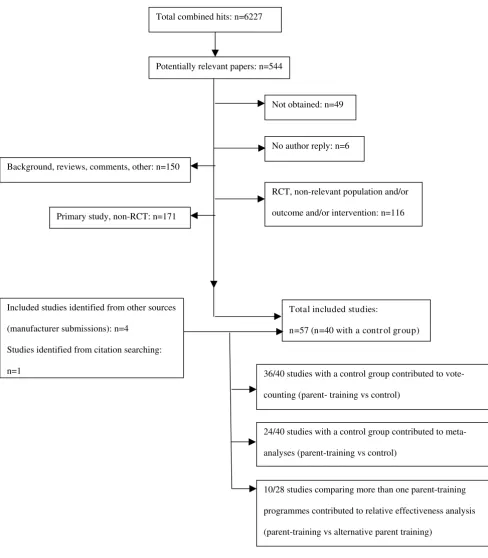
Figure 1 shows the inclusion and exclusion process. Fifty seven studies were included of which 40 included a con-trol comparison group (no treatment). Twenty eight stud-ies compared parent training with an alternative form of parent training: 17 of these compared parent training with an alternative form of parent training only (no control comparison group) and 11 studies compared parent train-ing with alternative parent traintrain-ing and a control compar-ison group.
Intervention characteristics (57 included studies)
24) investigated group programmes, of these 23 focussed on parents only. Twenty studies investigated individual based programmes, 15 of which involved index children at some level. The remaining studies investigated self-administered programmes (n = 5) or combinations of
group, individual and self-administered programmes (n = 8). Adjunctive treatment such as partner support training, friendship liaison or treatment of depression, was included in the intervention in 8/28 studies comparing two or more parenting programmes. In 3 studies, children
[image:5.612.58.546.84.642.2]Inclusion and Exclusion of Studies
Figure 1
Inclusion and Exclusion of Studies. Background, reviews, comments, other: n=150
Primary study, non-RCT: n=171
RCT, non-relevant population and/or
outcome and/or intervention: n=116 Not obtained: n=49
No author reply: n=6
Total included studies:
n=57 (n=40 with a contr ol gr oup)
24/40 studies with a control group contributed to
meta-analyses (parent-training vs control)
36/40 studies with a control group contributed to
vote-counting (parent- training vs control)
10/28 studies comparing more than one parent-training
programmes contributed to relative effectiveness analysis
(parent-training vs alternative parent training) Included studies identified from other sources
(manufacturer submissions): n=4
Studies identified from citation searching:
n=1
Child and Adolescent Psychiatry and Mental Health 2009, 3:7 http://www.capmh.com/content/3/1/7
were receiving medication for ADHD, all other studies either specifically excluded children receiving concurrent treatment or did not give details of concurrent treatment. No studies comparing parenting programmes with a con-trol group evaluated outcomes past 6 months and only a minority (n = 5) compared 2 alternative interventions between 1 and 3 years.
Concerning 102 parent training programmes and within study variations of these programmes across 57 studies. The majority of programmes (51) were conducted over 10 sessions or less; 17 programmes were 11–20 sessions in length and 10 programmes were greater than 20 sessions in length. For 24 programmes the number of sessions was unclear or not stated. Interventions that were not self-administered (93) were delivered by a variety of profes-sionals: 40 programmes were delivered by psychologists, 1 each delivered by a teacher and a psychiatric nurse and in 51 programmes the professional background of the person delivering the programme was unclear. Social workers were jointly involved in 7 programmes. The great majority of programmes (86) were based on behavioural approaches, 8 on relationship approaches and 4 on both approaches. For 4 programmes the underlying principle was not clear or not stated.
Population characteristics
Recruitment of populations was via self-referral, media advertisement or fliers in 44 studies; through health pro-fessionals or organisations in 10 studies and in 3 studies there was no information on recruitment.
Index children were aged 12 and under or had a mean age < 12 in 49/57 studies and 68% of the agregated study pop-ulation were male.
Diagnostic criteria (DSM [23]or clinical cut-off on a behavioural scale such as the Eyeberg Child Behaviour Inventory [24]) were used to recruit populations in 48 studies and in 9 studies parent or professional description of child behaviour was used.
In 10 studies some or all children had a diagnosis of Attention Deficit Hyperactivity Disorder (ADHD).
Of 22 studies reporting ethnicity > 70% of study popula-tions were white Caucasian families.
Of the 26 studies reporting family structure more than 30% of index children were in single parent households.
Quality of research
Few studies reported sufficient information to assess all aspects of quality, and in particular lacked detail about methods of randomisation and allocation concealment. Further detail is provided in [Additional file 1]. No studies
were completely bias free, but 4 studies were considered to be of good quality on the basis of only one threat to validity out of a total possible of five [25-28].
No evidence of publication bias was found.
Effectiveness results Parent-report of outcome
A total of 24 studies contributed a parent-report measure of outcome [25,26,29-50]. Details of these studies can be found in [Additional file 1]. Two instruments were used – Eyberg Child Behaviour Inventory (ECBI): Intensity (n = 20) and the Child Behaviour Checklist (CBCL) (n = 4). The ECBI is a parental report of conduct behavioural problems in children and adolescents that measures the number of difficult behaviour problems (intensity) and the frequency with which they occur [24].
The CBCL is a device by which parents or other individu-als who know the child well, rate a child's problem behav-iours and competencies [51].
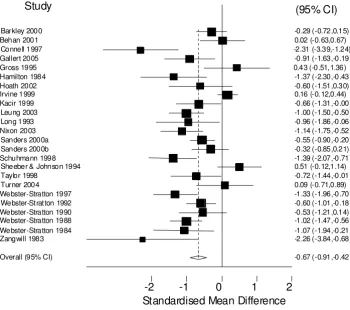
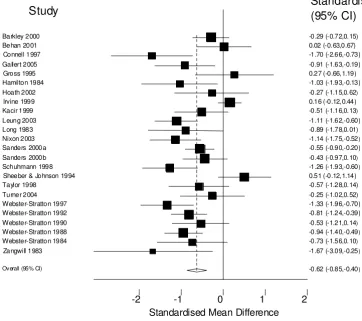
The results were combined using a random effects model, and the combined results (see Figures 2 and 3) show a sig-nificant standardised mean difference favouring the inter-vention group of -0.67 (95% CI: -0.91, -0.42). The results were similar (SMD -0.62 95% CI: -0.85, -0.40) where the frequency scale (i.e. as opposed to the Intensity scale) of the Eyberg Child Behaviour Inventory was used as the main outcome.
Independent assessment of outcome
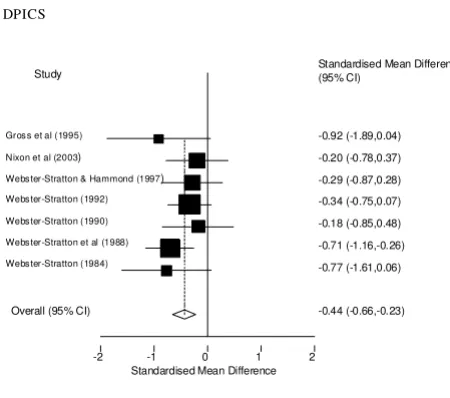
Only 7 studies provided independent assessments of out-comes all of which were undertaken using the Dyadic Par-ent Interactive Child Scale (DPICS). DPICS is designed for use in assessing the quality of parent-child social interac-tion. Interaction between parent and child in three stand-ard situations that vary in the degree to which parental control is required is observed and coded by an independ-ent observer behind a two-way mirror [52]. DPICS scores were combined using a random effects model and the combined data (see Figure 4) show a significant standard-ised mean difference favouring the intervention group of SMD -0.44 (95% CI: -0.66, -0.23).
Vote Counting
The results of the vote-counting supported the results of the meta-analysis.
Relative effectiveness of different approaches to delivery
28 included RCTs compared one parenting programme with another. Most studies were small and none of the studies reported a power calculation to estimate the number of individuals required in order to detect a signif-icant difference in effect for the outcomes measured. Only 10 studies directly compared programmes that differed in only one of the four key characteristics: delivery approach (group, individual or self-administered), length of pro-gramme, child involvement and adjunctive treatment (or none)[21,22,39,47,48,53-57]. Comparisons possible were: 3 studies with treatment arms differing only in the approach (group, individual or self-administered), 2
stud-ies differing only in number of sessions and 5 studstud-ies dif-fering only in adjunctive treatment. Of 26 behavioural measure comparisons used across these 10 studies only 4 were reported as significantly different. These are detailed in [Additional file 2].
Discussion
These results show that using both parent-report and independent observations of outcome, parenting pro-grammes are effective in improving conduct problems. Independent observations of change were on the whole smaller than parent-report (SMD of 0.4 compared with
[image:7.612.73.423.133.443.2]Meta-analysis ECBI Intensity
Figure 2
Meta-analysis ECBI Intensity.
ECBI I (n=20), then ECBI F (n=0), then CBCL (n=4)
Standardised Mean Difference
-2
-1
0
1
2
Study
Standardised Mean Difference
(95% CI)
-0.29 (-0.72,0.15) Barkley 2000
0.02 (-0. 63,0.67) Behan 2001
-2.31 (-3.39,-1.24) Connell 1997
-0.91 (-1.63,-0.19) Gallert 2005
0.43 (-0.51,1.36) Gross 1995
-1.37 (-2.30,-0.43) Hamilton 1984
-0.60 (-1.51,0.30) Hoath 2002
0.16 (-0. 12,0.44) Irvine 1999
-0.66 (-1.31,-0.00) Kacir 1999
-1.00 (-1.50,-0.50) Leung 2003
-0.96 (-1.86,-0.06) Long 1993
-1.14 (-1.75,-0.52) Nixon 2003
-0.55 (-0.90,-0.20) Sanders 2000a
-0.32 (-0.85,0.21) Sanders 2000b
-1.39 (-2.07,-0.71) Schuhmann 1998
0.51 (-0. 12,1.14) Sheeber & Johnson 1994
-0.72 (-1.44,-0.01) Taylor 1998
0.09 (-0. 71,0.89) Turner 2004
-1.33 (-1.96,-0.70) Webster-Stratton 1997
-0.60 (-1.01,-0.18) Webster-St rat ton 1992
-0.53 (-1.21,0.14) Webster-Stratton 1990
-1.02 (-1.47,-0.56) Webster-Stratton 1988
-1.07 (-1.94,-0.21) Webster-Stratton 1984
-2.26 (-3.84,-0.68) Zangwill 1983
-0.67 (-0.91,-0.42) Overall (95% CI)
Heterogeneity chi-squared = 90.86 (d.f. = 23) p = 0.000
Estimate of between-study variance Tau-squared = 0.2582
Child and Adolescent Psychiatry and Mental Health 2009, 3:7 http://www.capmh.com/content/3/1/7
0.7), and very few (7/25) of the included studies had pro-vided an independent assessment of outcome.
There was insufficient evidence to show clear superiority of any one approach to delivery. Many of the comparisons that were undertaken were invalidated by the fact that more than one of the four key characteristics (i.e. group versus one to one, length; child involvement; adjunctive treatment) was varied. Of the ten studies that compared programmes, which varied in only one of the key charac-teristics, few differences were identified. This is most likely to be due to inadequate power in this analysis.
There may be some restrictions in terms of the generalisa-bility of these findings, due to the involvement in many studies of parents who had self-referred. Similarly, due to the case-mix in many trials there is also some uncertainty regarding the families that would most benefit from this form of treatment.
Our review was restricted to a limited number of behav-ioural outcomes and we were unable to exploit the full range of behavioural outcome measures used across included studies and for some studies reporting of multi-ple measures of child behaviour in the meta-analysis.
[image:8.612.70.432.127.448.2]Meta-analysis ECBI Frequency
Figure 3
Meta-analysis ECBI Frequency.
ECBI F (n=20), then ECBI I (n=0), then CBCL (n=4)
Standardised Mean Difference
-2 -1 0 1 2
Study
Standardised Mean Difference
(95% CI)
-0.29 (-0.72,0.15) Barkley 2000
0.02 (-0.63,0.67) Behan 2001
-1.70 (-2.66,-0.73) Connell 1997
-0.91 (-1.63,-0.19) Gallert 2005
0.27 (-0.66,1.19) Gross 1995
-1.03 (-1.93,-0.13) Hamilton 1984
-0.27 (-1.15,0.62)
Hoath 2002
0.16 (-0.12,0.44) Irvine 1999
-0.51 (-1.16,0.13)
Kacir 1999
-1.11 (-1.62,-0.60) Leung 2003
-0.89 (-1.78,0.01) Long 1983
-1.14 (-1.75,-0.52)
Nixon 2003
-0.55 (-0.90,-0.20) Sanders 2000a
-0.43 (-0.97,0.10)
Sanders 2000b
-1.26 (-1.93,-0.60)
Schuhmann 1998
0.51 (-0.12,1.14) Sheeber & Johnson 1994
-0.57 (-1.28,0.14) Taylor 1998
-0.25 (-1.02,0.52) Turner 2004
-1.33 (-1.96,-0.70) Webster-Stratton 1997
-0.81 (-1.24,-0.39) Webster-Stratton 1992
-0.53 (-1.21,0.14)
Webster-Stratton 1990
-0.94 (-1.40,-0.49)
Webster-Stratton 1988
-0.73 (-1.56,0.10)
Webster-Stratton 1984
-1.67 (-3.09,-0.25)
Zangwill 1983
-0.62 (-0.85,-0.40) Overall (95% CI)
Heterogeneity chi-squared = 77.39 (d.f. = 23) p = 0.000
Estimate of between-study variance Tau-squared = 0.2050
Other reviews have suggested that parenting programmes can have a significant impact on parent psychosocial well-being including stress and self-esteem[58], and that there may be some benefit of such programmes irrespective of ethnic group[59].
Further RCTs comparing different approaches are still needed, focusing in particular on those features that are likely to influence cost as well as effect, such as group ver-sus individual programmes. There is also a need to com-pare the effectiveness of different programmes in primary studies.
Uncertainty remains regarding the importance of the improvements in child behaviour scores and how these improvements translate into clinically meaningful out-comes. Those who remain sceptical that the demonstrated changes in conduct problems translate into important gains in health and quality of life will point to the need for research quantifying the relationship between change in child behaviour scores and health utility in the index child as well as parents, siblings and peers. Research addressing the long-term impact of parenting programmes is also required.
Work on cost-effectiveness carried out as part of the previ-ous HTA report on this topic[60] and by the Decision Sup-port Unit at the National Institute for Health & Clinical
Excellence (NICE) [61] suggests that group-clinic based parenting programmes are likely to be cost-effective or may lead to cost-savings through avoidance of alternative treatment.
Limitations of the review
While we conducted the review using established criteria [62] it is impossible to exclude certain sources of bias, par-ticularly the possibility of having overlooked eligible stud-ies. Furthermore, as a result of the data available it was not possible to incorporate the findings from all of the studies into the meta-analyses. As noted above, there was also a lack of independent assessments of the presence and size of improvements in conduct problems. Our application of strict inclusion criteria with respect to the structured and repeatable nature of the parenting programme inter-ventions included in this review aimed to ensure that included interventions were similar enough in nature to be pooled in a meta-analysis. In addition the sub-group analysis did not demonstrate any measurable difference in effectiveness according to some aspects of intervention delivery. Nevertheless we cannot rule out the possibility that variation in effectiveness of individual programmes has not been detected.
Conclusion
We conclude that on balance, parenting programmes are an effective treatment for children with conduct prob-lems. The relative effectiveness of different parenting pro-grammes requires further research.
Summary points
• Conduct problems among children and adolescents are associated with high psychological and financial costs and with poor prognosis if left untreated
• Parenting programmes are short-term, structured inter-ventions, which have in previous reviews been shown to be effective in treating conduct problems in certain groups of children
• Our systematic review identified 57 randomised con-trolled trials, which compared parenting programmes to a wait list control or to an alternative form of parenting pro-gramme or other treatment
• There was a consistent trend across all studies showing a benefit from parenting programmes; meta-analysis of the most commonly reported child behaviour outcomes showing statistically significant improvements
• There was insufficient evidence to directly determine the relative effectiveness of one type of parenting programme delivery approach over another
[image:9.612.60.285.88.287.2]Meta-analysis DPICS
Figure 4
Meta-analysis DPICS. DPICS
Standardised Mean Difference
-2 -1 0 1 2
Study Standardised Mean Difference(95% CI)
-0.92 (-1.89,0.04)
Gros s et al (1995)
-0.20 (-0.78,0.37)
Nixon et al (2003)
-0.29 (-0.87,0.28)
Webs ter-Stratton & Hammond (1997)
-0.34 (-0.75,0.07)
Webs ter-Stratton (1992)
-0.18 (-0.85,0.48)
Webs ter-Stratton (1990)
-0.71 (-1.16,-0.26)
Webs ter-Stratton et al (1988)
-0.77 (-1.61,0.06)
Webs ter-Stratton (1984)
-0.44 (-0.66,-0.23) Overall (95% CI)
Heterogeneity chi-squared = 4.65 (d.f. = 6) p = 0.589
Estimate of between-study variance Tau-squared = 0.0000
Child and Adolescent Psychiatry and Mental Health 2009, 3:7 http://www.capmh.com/content/3/1/7
• Parenting programmes are an effective treatment for children with conduct problems
Abbreviations
RCT: randomised controlled trial; SMD: standardised mean difference.
Competing interests
The authors declare that they have no competing interests.
Authors' contributions
All authors contributed to protocol development. SB con-tributed to the development and running of search strate-gies. JD, CD, EF, CH, JB contributed to inclusion and exclusion of studies. JD, CD, EF, JB, RT, JS contributed to data extraction. JD, CD, RT, CH, JS, JB, SS-B contributed to clinical effectiveness analysis. JD, CD, CH, JB, EF, SS-B contributed to interpretation of effectiveness data and dis-cussion. RT, JS gave statistical advice. JB, SS-B gave clinical advice. CH is the guarantor.
Additional material
Acknowledgements
This report was commissioned by the NHS R&D HTA programme. It was one component, which fed into the National Institute of Health and Clinical Excellence's (NICE) appraisal process on this topic. The author's work was independent of the funders.
References
1. Office for National Statistics: The mental health of children and
adolescents in Great Britain. . Access date: 28 Oct. 2003.
2. Kazdin AE: Conduct disorders in childhood and adolescence.
2nd edition. London: SAGE Publications; 1996.
3. Moffit TE, Caspi A, Dickson N, Silva P, Stanton W: Childhood-onset versus adolescent-onset antisocial conduct problems in
males: Natural history from ages 3 to 18 years. Development
and Psychopathology 1996, 8(2):399-424.
4. Rutter M: Connections between child and adult psychopathol-ogy. European Child & Adolescent Psychiatry 1996, 5(S1):4-7. 5. Champion LA, Goodall G, Rutter M: Behavior problems in
child-hood and stressors in early adult life: 1. A 20 year follow-up
of London school children. Psych Med 1995, 25(2):231-246.
6. Offord DR, Bennett KJ: Conduct disorder: long-term outcomes
and intervention effectiveness. [Review]. Journal of the American
Academy of Child & Adolescent Psychiatry 1994, 33(8):1069-1078. 7. Robins LN: Epidemiological approaches to natural history
research: Antisocial disorders in children. Journal of the
Ameri-can Academy of Child Psychiatry 1981, 20:566-680.
8. Scott S, Knapp M, Henderson J, Maughan B: Financial cost of social exclusion: follow up study of antisocial children into adult-hood. British Medical Journal 2001, 323(7306):191.
9. Patterson GR, DeBaryshe BD, Ramsey E: A developmental
per-spective on antisocial behaviour. American Psychologist 1989,
44(2):329-335.
10. Pugh G, De'Ath E, Smith C: Confident parents, confident chil-dren: Policy and practice in parent education and support.
National Children's Bureau 1994.
11. Oxman AD, Guyatt GH: Guidelines for reading literature reviews. Canadian Medical Association Journal 1988, 138:697-703. 12. Farrington DP, Welsh BC: Family-based prevention of
offend-ing: A meta-analysis. Australian and New Zealand Journal of Criminol-ogy 2003, 36(2):127-151.
13. Serketich WJ, Dumas JE: The effectiveness of behavioural par-ent-training to modify antisocial behaviour in children: a meta-analysis. Behaviour Therapy 1996, 27:171-186.
14. Barlow J, Parsons J: Group-based parent-training programmes for improving emotional and behavioural adjustment in 0–3 year old children. The Cochrane Library 2002.
15. Dimond C, Hyde C: Parent education programmes for chil-dren's behaviour problems, medium to long term
effective-ness. Birmingham: West Midlands Development and Evaluation
Service; 1999.
16. Richardson J, Joughin C: Parent-Training Programmes for the Management of Young children with Conduct Disorders.
Findings from research. Gaskell 2002.
17. Lundahl B, Risser HJ, Lovejoy MC: A meta-analysis of parent
training: Moderators and follow-up effects. Clinical Psychology
Review 2006, 26(1):86-104.
18. Reyno S, McGrath P: Predictors of parent training efficacy for child externalizing behavior problems – a meta-analytic review. Journal of Child Psychology and Psychiatry 2006, 47(1):99-111. 19. The Cochrane Collaboration: Cochrane Handbook for
System-atic Reviews of Interventions 4.2.5. 2005.
20. Barrett PM, Turner C, Rombouts S, Duffy A: Reciprocal Skills Training in the treatment of externalising behaviour
disor-ders in childhood: A preliminary investigation. Behaviour
Change 2000, 17(4):221-234.
21. Pfiffner LJ, Jouriles EN, Brown MM, Etscheidt MA: Effects of prob-lem-solving therapy on outcomes of parent training for
sin-gle-parent families. Child & Family Behavior Therapy 1990,
12(1):1-11.
22. Sanders MR, McFarland M: The treatment of depressed mothers with disruptive children: A controlled evaluation of cognitive
behavioural family intervention. Behavior Therapy 2000,
31(1):89-112.
23. American Psychiatric Association: Diagnostic and statistical man-ual of mental disorder. Washington 4th edition. 1994.
24. Eyberg SM, Pincus D: Eyeberg Child Behaviour Inventory and Sutter-Eyeberg Student Behaviour Inventory – Revised.
Odessa, Fl: Psychological Assessment Resources 1999.
25. Barkley RA, Shelton TL, Crosswait C, Moorehouse M, Fletcher K, Barrett S, Jenkins L, Metevia L: Multi-method psycho-educational intervention for preschool children with disruptive behavior: preliminary results at post-treatment. Journal of Child Psychology & Psychiatry & Allied Disciplines 2000, 41(3):319-332.
26. Connell S, Sanders MR, Markie-Dadds C: Self-directed behavioral family intervention for parents of oppositional children in
rural and remote areas. Behavior Modification 1997,
21(4):379-408.
27. Luk ES, Staiger P, Mathai J, Field D, Adler R: Comparison of treat-ments of persistent conduct problems in primary school
chil-Additional file 1
Characteristics of 24 RCTs included in the meta-analysis. The table pro-vides information about study population characteristics; details of inter-vention and control groups; main results; quality assessment of studies and the outcome measure contributing to the meta-analysis.
Click here for file
[http://www.biomedcentral.com/content/supplementary/1753-2000-3-7-S1.doc]
Additional file 2
Relative effectiveness of parenting programmes. The table provides infor-mation about 10 studies directly comparing parenting programmes differ-ing in only one of 4 key characteristics (delivery approach; programme length; child involvement and adjunctive treatment). Information includes type of comparison; child behaviour outcome measures demon-strating a significant difference between comparison groups; numbers of children in each comparison group.
Click here for file
Publish with BioMed Central and every scientist can read your work free of charge
"BioMed Central will be the most significant development for disseminating the results of biomedical researc h in our lifetime."
Sir Paul Nurse, Cancer Research UK
Your research papers will be:
available free of charge to the entire biomedical community
peer reviewed and published immediately upon acceptance
cited in PubMed and archived on PubMed Central
yours — you keep the copyright
Submit your manuscript here:
http://www.biomedcentral.com/info/publishing_adv.asp
BioMedcentral
dren: a preliminary evaluation of a modified cognitive-behavioural approach. Australian & New Zealand Journal of Psychia-try 1998, 32(3):379-386.
28. Webster-Stratton C, Reid MJ, Hammond M: Treating Children with Early-Onset Conduct Problems: Intervention
Out-comes for Parent, Child, and Teacher Training. Journal of
Clin-ical Child and Adolescent Psychology 2004, 33(1):105-124.
29. Behan J, Fitzpatrick C, Sharry J, Carr A, Waldron B: Evaluation of
the Parenting Plus Programme. The Irish Journal of Psychology
2004, 22(3–4):238-256.
30. Gallart SC, Matthey S: The effectiveness of Group Triple P and
the impact of the four telephone contacts. Behaviour Change
2005, 22(2):71-80.
31. Gross D, Fogg L, Tucker S: The efficacy of parent training for
promoting positive parent-toddler relationships. Res Nurs
Health 1995, 18:489-499.
32. Hamilton SB, MacQuiddy SL: Self-administered behavioral par-ent training: Enhancempar-ent of treatmpar-ent efficacy using a time-out signal seat. Journal of Clinical Child Psychology 1984,
13(1):61-69.
33. Hoath FE, Sanders MR: A Feasibility Study of Enhanced Group Triple P – Positive Parenting Program for Parents of
Chil-dren with Attention-deficit/Hyperactivity Disorder. Behaviour
Change 2002, 19(4):191-206.
34. Irvine AB, Biglan A, Smolkowski K, Metzler CW, Ary DV: The effec-tiveness of a parenting skills program for parents of middle school students in small communities. Journal of Consulting & Clinical Psychology 1999, 67(6):811-825.
35. Kacir CD, Gordon DA: Parenting Adolescents Wisely: The Effectiveness of an Interactive Videodisk Parent Training Program in Appalachia. Child & Family Behavior Therapy 1999:22. 36. Leung C, Sanders MR, Leung S, Mak R, Lau J: An outcome
evalua-tion of the implementaevalua-tion of the Triple P-Positive
Parent-ing Program in Hong Kong. Family process 2003, 42:531-544.
37. Long N, Rickert VI, Ashcraft EW: Bibliotherapy as an adjunct to stimulant medication in the treatment of attention-deficit
hyperactivity disorder. Journal of Pediatric Health Care 1993,
7(2):82-88.
38. Nixon RD, Sweeney L, Erickson DB, Touyz SW: Parent-child inter-action therapy: a comparison of standard and abbreviated
treatments for oppositional defiant preschoolers. Journal of
Consulting & Clinical Psychology 2003, 71:251-260.
39. Sanders MR, Markie-Dadds C, Tully LA, Bor W: The triple P-posi-tive parenting program: a comparison of enhanced, stand-ard, and self-directed behavioral family intervention for
parents of children with early onset conduct problems.
Jour-nal of Consulting & Clinical Psychology 2000, 68(4):624-640.
40. Sanders MR, Montgomery DT, Brechman-Toussaint ML: The mass media and the prevention of child behavior problems: the evaluation of a television series to promote positive
out-comes for parents and their children. Journal of Child Psychology
& Psychiatry & Allied Disciplines 2000, 41(7):939-948.
41. Schuhmann EM, Foote RC, Eyberg SM, Boggs SR, Algina J: Efficacy of parent-child interaction therapy: interim report of a
rand-omized trial with short-term maintenance. Journal of Clinical
Child Psychology 1998, 27(1):34-45.
42. Sheeber LB, Johnson JH: Evaluation of a temperament-focused, parent-training program. Journal of Clinical Child Psychology 1994,
23(3):249-259.
43. Taylor TK, Schmidt F, Pepler D, Hodgins C: A comparison of eclectic treatment with Webster-Stratton's Parents and Children Series in a children's mental health center: A rand-omized controlled trial. Behavior Therapy 1998, 29(2):221-240. 44. Turner KMT, Sanders MR: Help when it's needed first: A
con-trolled evaluation of brief, preventive behavioral family
intervention in a primary care setting. Behavior Therapy 2006,
37(2):131-142.
45. Webster-Stratton C, Hammond M: Treating children with early-onset conduct problems: a comparison of child and parent training interventions. Journal of Consulting & Clinical Psychology
1997, 65(1):93-109.
46. Webster-Stratton C: Individually administered videotape par-ent training: "Who benefits?". Cognitive Therapy & Research 1992,
16(1):31-52.
47. Webster-Stratton C: Enhancing the effectiveness of self-admin-istered videotape parent training for families with
conduct-problem children. Journal of Abnormal Child Psychology 1990,
18(5):479-492.
48. Webster-Stratton C, Kolpacoff M, Hollinsworth T: Self-adminis-tered videotape therapy for families with conduct-problem children: comparison with two cost-effective treatments and a control group. Journal of Consulting & Clinical Psychology 1988,
56(4):558-566.
49. Webster-Stratton C: Randomized trial of two parent-training
programs for families with conduct-disordered children.
Jour-nal of Consulting & Clinical Psychology 1984, 52(4):666-678.
50. Zangwill WM: An evaluation of a parent training program.
Child & Family Behavior Therapy 1983, 5(4):1-16.
51. Achenbach TM, Rescoral LA: Manual for the ASEBA School-Age Forms & Profiles. Burlington VT: University of Vermont, Research Center for Children, Youth and Families; 2001.
52. Eyberg SM, Robinson EA: Dyadic Parent-child interaction
cod-ing system (DPICS): A manual. Psychological Documents 1983,
13(2):24.
53. Raue J, Spence SH: Group versus individual applications of rec-iprocity training for parent-youth conflict. Behaviour Research & Therapy 1985, 23(2):177-186.
54. Sanders MR, Christensen AP: A comparison of the effects of child management and planned activities training in five parenting environments. Journal of Abnormal Child Psychology 1985,
13(1):101-117.
55. Dadds MR, McHugh TA: Social support and treatment outcome
in behavioral family therapy for child conduct problems.
Jour-nal of Consulting & Clinical Psychology 1992, 60(2):252-259.
56. Dadds MR, Schwartz S, Sanders MR: Marital discord and treat-ment outcome in behavioral treattreat-ment of child conduct
dis-orders. Journal of Consulting & Clinical Psychology 1987,
55(3):396-403.
57. Wahler RG, Cartor PG, Fleischman J, Lambert W: The impact of synthesis teaching and parent training with mothers of
con-duct-disordered children. Journal of Abnormal Child Psychology
1993, 21(4):425-440.
58. Barlow J, Coren E, Stewart-Brown S: Meta-analysis of the effec-tiveness of parenting programmes in improving maternal
psychosocial health. British Journal of General Practice 2002,
52:223-233.
59. Barlow J, Shaw R, Stewart-Brown S: The effectiveness of
parent-ing programmes for ethnic minority parents. York: Joseph
Rowntree Foundation; 2004.
60. Dretzke J, Frew E, Davenport C, Barlow J, Stewart-Brown S, Sander-cock J, Bayliss S, Raftery J, Hyde C, Taylor R: The effectiveness and cost-effectiveness of parent training/education programmes for the treatment of conduct disorder, including opposi-tional defiant disorder, in children. Health Technol Assess 2005,
9(50):. iii, ix–x, 1–233
61. The National Institute for Health & Clinical Excellence (NICE): Final appraisal determination: conduct disorder in
children-par-ent training/education programmes. [http://www.nice.org.uk/
nicemedia/pdf/Parent_training_FAD.pdf]. Access date: 15 Jan. 2008 62. Moher D, Cook D, Eastwood S, Olkin I, Drummond R, Stroup D:
Improving the quality of reports of meta-analyses of
ran-domised controlled trials: the QUOROM statement. The