http://wrap.warwick.ac.uk/
Original citation:
Snyder, Lori A. S., Loman, Nicholas J., Linton, James D., Langdon, Rebecca R.,
Weinstock, George M., Wren, Brendan W. and Pallen, Mark John. (2010) Simple
sequence repeats in Helicobacter canadensis and their role in phase variable expression
and C-terminal sequence switching. BMC Genomics, Volume 11 (Number 1). Article
number 67.
Permanent WRAP url:
http://wrap.warwick.ac.uk/58277
Copyright and reuse:
The Warwick Research Archive Portal (WRAP) makes this work of researchers of the
University of Warwick available open access under the following conditions.
This article is made available under the Creative Commons Attribution- 3.0 Unported
(CC BY 3.0) license and may be reused according to the conditions of the license. For
more details see
http://creativecommons.org/licenses/by/3.0/
A note on versions:
The version presented in WRAP is the published version, or, version of record, and may
be cited as it appears here.
R E S E A R C H A R T I C L E
Open Access
Simple sequence repeats in
Helicobacter
canadensis
and their role in phase variable
expression and
C
-terminal sequence switching
Lori AS Snyder
1,2*, Nicholas J Loman
1, James D Linton
3, Rebecca R Langdon
4, George M Weinstock
5,
Brendan W Wren
4, Mark J Pallen
1Abstract
Background:Helicobacter canadensisis an emerging human pathogen and zoonotic agent. The genome ofH. canadensiswas sequenced previously and determined to contain 29 annotated coding regions associated with homopolymeric tracts.
Results:Twenty-one of the repeat-associated coding regions were determined to be potentially transcriptionally or translationally phase variable. In each case the homopolymeric tract was within the predicted promoter region or at the 5’end of the coding region, respectively. However, eight coding sequences were identified with simple sequence repeats toward the 3’end of the open reading frame. In these cases, the repeat tract would be too far into the coding region to be mediating translational phase variation. All of the 29 coding region-associated homopolymeric tracts display variability in tract length in the sequencing read data.
Conclusions:Twenty-nine coding regions have been identified in the genome sequence ofHelicobacter canadensisstrain NCTC13241 that show variations in homopolymeric tract length in the bacterial population, indicative of phase variation. Five of these are potentially associated with promoter regions, which would lead to transcriptional phase variation. Translational phase variation usually switches expression of a gene ON and OFF due to the repeat region being located sufficiently close to the initiation codon for the resulting frame-shift to lead to a premature termination codon and stop the translation of the protein. Sixteen of the 29 coding regions have homopolymeric tracts characteristic of translational phase variation. For eight coding sequences with repeats located later in the reading frame, changes in the repeat tract length would alter the protein sequence at the C-terminus but not stop the expression of the protein. This mechanism ofC-terminal phase variation has implications for stochastic switching of protein sequence in bacterial species that already undergo transcriptional and
translational phase variation.
Background
The gastric pathogen Helicobacter pylori was the first identified Helicobacter species, was first cultured in 1984, and is associated with peptic ulcers, mucosa-asso-ciated lymphoid tissue lymphomas, chronic active gastri-tis, chronic atrophic gastritis and subsequent carcinomas, persistent diarrhoea, and increased suscept-ibility to other diseases [1-3]. Since 1984, over 20 further
Helicobacterspecies have been identified, many of which
have been implicated as animal pathogens, but in gen-eral these remain poorly characterised.
4To date, threeH. pylorigenome sequences have been published, one each isolated from cases of gastritis [4], duodenal ulcer [5], and chronic atrophic gastritis [6]. Five additional genome sequences, not yet completed and pub-lished, are from three cases of gastric carcinoma, one from gastric ulcer, and one from a remote Amazonian village. But humans are not the only species plagued by gut pro-blems associated with these bacteria;Helicobacter acinony-chis, the genome sequence of which was published in 2006 [7], is believed to contribute to the severe gastritis experi-enced by cheetahs and other big cats that can lead to * Correspondence: [email protected]
1Centre for Systems Biology, School of Biosciences, University of Birmingham, Edgbaston, Birmingham, B15 2TT, UK
premature death of these felines in captivity [8,9]. At the other end of the mammalian spectrum, mice colonies with increased incidence of liver tumours were found to be colonized withHelicobacter hepaticus[10,11], for which strain ATCC 51449 has been genome sequenced [11]. In addition, theHelicobacteraceaeincludesWolinella succi-nogenes, a non-pathogen that can be isolated from the rumen of cattle [12] and considered to be phylogenetically an intermediate betweenHelicobacterandCampylobacter
[13]. A genome sequence is available forW. succinogenes
strain DSM1740 [14].
Some isolates which might have previously been taken for knownHelicobacterspp. orCampylobacter spp. are instead novel Helicobacter species [15].Helicobacter pullorum has been repeatedly isolated from chickens and detected in chicken faeces by molecular methods [16-21]. This species is also found in humans [18,20,22-25], where it is associated with gastroenteritis, liver disease, diarrhoea, and gall bladder disease [20,24-26].H. pullorum differs from most other Helico-bacter spp. in that it lacks a flagellar sheath and is unable to hydrolyze indoxyl acetate [20]. It is this later phenotype that eventually revealed that some of the iso-lates being classified as H. pullorum were actually a novel species,Helicobacter canadensis [18,20,24] which is indoxyl acetate positive [24]. Labelled an emerging pathogen as a zoonotic agent [27],H. canadensis has been isolated from geese [27], rodent faeces [28], swine [29], and humans, where it has been associated with diarrhoea and bacteraemia [30,31].
During the annotation of the complete genome sequence ofH. canadensisstrain NCTC13241 [32], simple sequence repeats were sought and a repertoire of 29 homopolymeric tract-associated coding regions was identi-fied. Five candidates for transcriptional phase variation and 16 candidates for translational phase variation were identi-fied. The remaining eight annotated coding sequences were identified with long poly-G tracts (≥10 bp) toward the end of the annotated coding region. These represent a novel mechanism for phase variation in which stochastic switching of simple sequence repeat tract lengths mediates changes in expressed protein sequence. This is distinct from transcriptional phase variation, in which the distance and facing of promoter elements are altered, and from translational phase variation, in which frame-shifts result-ing from repeat tract length changes lead to premature termination. We propose that thisC-terminal phase varia-tion may also be found in other species employing tran-scriptional and translational phase variation.
Results and Discussion
Search for phase variable genes
Given the presence of an extensive repertoire of phase variable genes in otherHelicobacterspp. [4,5,11,33,34],
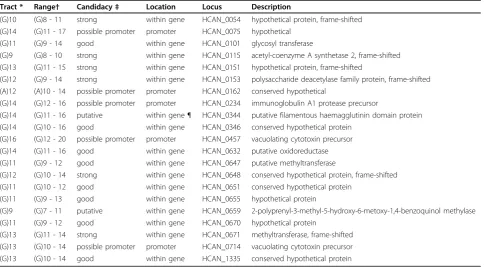
simple sequence repeats were sought in theH. canaden-sisstrain NCTC13241 genome sequence data. If repeats were discovered to be within the context of a predicted coding region or predicted promoter such that they had the potential to mediate phase variation, then that fea-ture was annotated as potentially phase variable (Table 1).
Based on previous investigations [33-35], searches were made of the genome sequence data for homopoly-meric tracts greater than or equal to (G)7, (C)7, (A)9, and (T)9 and for dinucleotide repeat tracts with five or more copies of the dinucleotide. No potential dinucleo-tide-mediated phase variable CDSs were identified in the H. canadensisgenome sequence data. For all homo-polymeric tracts the context of the repeat, tract length, and presence of a frame-shift were assessed to deter-mine that the H. canadensisgenome sequence contains 21 potential phase variable genes (Table 1). Of these, six are strong candidates, eight are good candidates, and two are putative candidates for translational phase varia-tion, while five are possibly promoter-associated, med-iating transcriptional phase variation. Strong candidates contained frame-shift mutations or long tract lengths (>9), or both. Good candidates contained long tracts in the appropriate position to mediate translational switch-ing. One of the putative candidates (HCAN_0659) con-tained a shorter (G)9 tract length and no frame-shift, while the other (HCAN_0344) would be considered a strong candidate if an alternative initiation codon 5’ of the repeat were chosen rather than that annotated.
It is interesting to note that in all cases the transla-tional phase variation is mediated by poly-G tracts, whereas candidates with poly-C, -A, -T, -GA, -CT, -TC, -AT, and -AG tracts have been reported in other Helico-bacter spp. [4,5,11,33,34]. The sole occurrence of a poly-A tract potentially involved in phase variation in thisH. canadensis is in the putative promoter region of HCAN_0162, a conserved hypothetical gene.
C-terminal phase variation
In addition to the potentially phase variable genes iden-tified, eight CDSs were found to contain homopolymeric tracts at the 3’ end (Table 2) of the reading frame. In this location these could not be mediating phase variable expression of the CDS as most of the mRNA would be translated before reaching the late homopolymeric tract and subsequent termination codon. In most cases, an alteration in the reading frame at that point would change the length of the encoded protein by only a few amino acids (Table 2).
It is interesting to note that, like the transcriptional and translational phase variable CDSs, all of these
C-terminal variation CDSs contain poly-G tracts and all are (G)10 or more (Table 2). Given the strength in poly-G tracts in the transcriptionally and translationally
Snyderet al.BMC Genomics2010,11:67 http://www.biomedcentral.com/1471-2164/11/67
phase variable genes (Table 1) and the length of these tracts (Table 2), this data supports a role for the instability of these tracts at the end of the gene, as well as at the beginning and within the promoter.
One of these, flaG (HCAN_0914) contains a (G)11 tract five bases before the termination codon and altera-tion of the tract length would lead to slight changes in the length of the encoded protein. As annotated, there are two amino acids before the termination codon. In
the other two frames there would be 16 amino acids or no amino acids before the termination codons in those frames (Table 2). FlaG has been shown to affect flagellar length and adherence to Hep-2 cells in Aeromonas[36]. Thus it is intriguing that changes in the length of this homopolymeric tract would alter the C-terminus of this protein.
[image:4.595.57.542.100.367.2]For HCAN_0660, a change in reading frame could result in a merger of this CDS and the next downstream
Table 1 Phase variable gene candidates inH. canadensisstrain NCTC 13241.
Tract * Range† Candidacy‡ Location Locus Description
(G)10 (G)8 - 11 strong within gene HCAN_0054 hypothetical protein, frame-shifted (G)14 (G)11 - 17 possible promoter promoter HCAN_0075 hypothetical
(G)11 (G)9 - 14 good within gene HCAN_0101 glycosyl transferase
(G)9 (G)8 - 10 strong within gene HCAN_0115 acetyl-coenzyme A synthetase 2, frame-shifted (G)13 (G)11 - 15 strong within gene HCAN_0151 hypothetical protein, frame-shifted
(G)12 (G)9 - 14 strong within gene HCAN_0153 polysaccharide deacetylase family protein, frame-shifted (A)12 (A)10 - 14 possible promoter promoter HCAN_0162 conserved hypothetical
(G)14 (G)12 - 16 possible promoter promoter HCAN_0234 immunoglobulin A1 protease precursor
(G)14 (G)11 - 16 putative within gene ¶ HCAN_0344 putative filamentous haemagglutinin domain protein (G)14 (G)10 - 16 good within gene HCAN_0346 conserved hypothetical protein
(G)16 (G)12 - 20 possible promoter promoter HCAN_0457 vacuolating cytotoxin precursor (G)14 (G)11 - 16 good within gene HCAN_0632 putative oxidoreductase (G)11 (G)9 - 12 good within gene HCAN_0647 putative methyltransferase
(G)12 (G)10 - 14 strong within gene HCAN_0648 conserved hypothetical protein, frame-shifted (G)11 (G)10 - 12 good within gene HCAN_0651 conserved hypothetical protein
(G)11 (G)9 - 13 good within gene HCAN_0655 hypothetical protein
(G)9 (G)7 - 11 putative within gene HCAN_0659 2-polyprenyl-3-methyl-5-hydroxy-6-metoxy-1,4-benzoquinol methylase (G)11 (G)9 - 12 good within gene HCAN_0670 hypothetical protein
(G)13 (G)11 - 14 strong within gene HCAN_0671 methyltransferase, frame-shifted (G)13 (G)10 - 14 possible promoter promoter HCAN_0714 vacuolating cytotoxin precursor (G)13 (G)10 - 14 good within gene HCAN_1335 conserved hypothetical protein
* Tract length from accession number CM000776 [32].
†Range is the range of repeat copy number observed in the sequence read data (see Additional Files files 1, 2, 3, 4, 5, 6, 7, 8, 9, 10, 11, 12, 13, 14, 15, 16, 17, 18, 19, 20 and 21).
‡Candidacy is based on the presence of a frame-shift and the length of the repeat tract.
¶This would be a strong candidate for phase variation if an alternative initiation codon 5’of the repeat was chosen rather than that annotated.
Table 2C-terminal phase variable gene candidates inH. canadensisstrain NCTC 13241.
Tract * Range† Frame 1‡ Frame 2‡ Frame 3‡ CDS length in amino acids
Locus TagG ene Description
(G)14 (G)11 - 17 4 1 18 322 HCAN_0165 rfbB NAD-dependent epimerase/ dehydratase
(G)13 (G)10 - 16 17 4 2 267 HCAN_0641 3-oxoacyl-[acyl-carrier-protein] reductase
(G)11 (G)8 - 14 17 18 22 317 HCAN_0643 Methionyl-tRNA Formyl-transferase (G)12 (G)10 - 14 5 1 50 429 HCAN_0653 hypothetical protein
(G)13 (G)11 - 16 14 104 25 382 HCAN_0660 hypothetical protein
(G)10 (G)8 - 12 1 35 2 243 HCAN_0665 conserved hypothetical protein (G)11 (G)9 - 13 2 0 16 155 HCAN_0914 flaG flagellar proteinG
(G)12 (G)10 - 13 17 19 30 445 HCAN_1332 conserved
* Tract length from accession number CM000776 [32].
†Range is the range of repeat copy number observed in the sequence read data (see Additional Files 22, 23, 24, 25, 26, 27, 28 and 29).
[image:4.595.56.540.567.707.2]CDS, HCAN_0661 encoding 82 amino acids. Although both CDSs are currently hypothetical, such an arrange-ment suggests that the protein sequences may have roles that can alternatively be filled as individual pro-teins or jointly as one protein. This finding, that a phase variation event can determine whether two proteins are made separately or are translated as one protein, is per-haps unprecedented. It may be that degeneration events have disrupted similar fusions in this or other bacterial species, which are not now apparent from sequence data.
Population-level variation within homopolymeric tracts
Previous studies into phase variable genes of the Helico-bacterspp. have indicated that phase variable switching of a gene can be demonstrated at the population level through DNA sequencing. It has been shown that varia-tions in the lengths of homopolymeric tracts are attribu-table to variations in the DNA template population and are not an artefact of the sequencing process, although this may be influenced by the length of repeat and the experimental conditions [33].
When the read data from the genome sequencing was analyzed for variations in homopolymeric tract length, it was found that all of the repeats investigated showed some degree of variation (Tables 1 &2). While it is known that homopolymeric tracts can be proble-matic for this sequencing technology (454, Roche), the results are consistent with the level of variation that would be expected at the population level. Phase vari-able bacteria are known to have dynamically changing populations undergoing phase variation events that lead to intra-population diversity and, in some cases, visible differences on culture plates, including colony sectoring [37]. Variation in repeat lengths at the sequence level should therefore be expected. In each case the range of the repeat lengths observed here is indicated in Tables 1 &2 and the alignments of the read data is available in Additional files 1, 2, 3, 4, 5, 6, 7, 8, 9, 10, 11, 12, 13, 14, 15, 16, 17, 18, 19, 20, 21, 22, 23, 24, 25, 26, 27, 28 and 29).
This level of variation is suggestive evidence of phase variation of these coding regions, indicating that each of these coding regions warrants further study. This evidence is particularly important for those that are putative candidates (Table 1) and those that contain
C-terminal repeats (Table 2). In all of the translational phase variation candidates the repeat lengths would correspond to both ON and OFF states of full-length gene expression. The highest degree of variability is seen in HCAN_0457, encoding the vacuolating cyto-toxin precursor, with 12 to 20 copies of the poly-G repeat.
Potential structural consequences ofC-terminal phase variation
Each of the eight CDSs identified as containing a homo-polymeric tract at the C-terminal end of the reading frame were translated and compared against the NCBI Conserved Domain Database (CDD). In each case where structural data was available, the Cn3D model was assessed to determine what the potential structural con-sequences would be of alterations in the length and sequence of the C-terminus.
TheC-terminal structures available for proteins which share similarity with HCAN_0165 (rfbB) all have ana -helix at theC-terminus. This is potentially eliminated in the shorter forms of this CDS in frames 1 and 2, mediated by a poly-G tract.
The structures of proteins with similar conserved domains to HCAN_0641 and HCAN_0914 suggest that changes in the length of this CDS would alter the C -terminal b-sheet. HCAN_0914 is flaG, therefore this potential change inb-sheet structure may have an effect on theH. canadensisflagella.
Changes in the poly-G repeat within HCAN_0643 would not alter the length of this protein, however changes would alter the sequence. In this case, the structure of CDD similar protein Fmt suggests that this would be within a largely unstructuredC-terminus.
For the remaining four CDSs, there were either no CDD hits (HCAN_0653) or none that were full-length (HCAN_0660, HCAN_0665, and HCAN_1332).
Distribution of phase variable genes
When the H. canadensis strain NCTC13241 genome sequence was investigated to identify novel CDSs not found in otherHelicobactergenome sequences, only one example of a contiguous cluster longer than 5 genes was found (HCAN_0630 to HCAN_0663). This region is nota-ble for possessing three copies ofasnB, encoding aspara-gine synthetase (HCAN_0654, HCAN_0657, and HCAN_0662). A fourth copy ofasnB(HCAN_0730) is 69 kb outside this cluster adjacent to one of the two STT3 domain-containing PglB copies (HCAN_0729 and HCAN_0930) [32]. Most of the other coding sequences in the region are of unknown function, lacking significant matches in GenBank. Notably, a high frequency of poten-tially phase variation-mediating homopolymeric tracts were detected in and around this region, with eight out of 21 identified candidate phase variable genes (Table 1) and five out of eightC-terminal variable genes (Table 2) being within or near this cluster. These encode a putative oxi-doreductase (HCAN_0632), a 3-oxoacyl-[acyl-carrier-pro-tein] reductase (HCAN_0641), a methionyl-tRNA formyltransferase (HCAN_0643), two putatitive methyl-transferases (HCAN_0647 and HCAN_0671), a 2-polypre-nyl-3-methyl-5-hydroxy-6-metoxy-1,4- benzoquinol methylase (HCAN_0659), three conserved hypothetical
Snyderet al.BMC Genomics2010,11:67 http://www.biomedcentral.com/1471-2164/11/67
proteins (HCAN_0648, HCAN_0651, and HCAN0665), and four hypothetical proteins (HCAN_0653, HCAN_0655, HCAN0660, and HCAN_0670). This cluster of repeat tracts within the CDSs may suggest that this region of the chromosome is a particular hot-spot for the presence of phase variable tracts. This may have functional consequences for the interaction of these gene products or their regulatory controls.
The genome of H. canadensisNCTC13241 contains a capsular polysaccharide export locus (HCAN_0144 to HCAN_0149, HCAN_0150) encoding orthologues of KpsS, KpsD, KpsE, KpsT, KpsM, and KpsC from C. jejuni. This is the first evidence of a polysaccharide cap-sule in theHelicobacterspp. and, like inC. jejuni, this was only revealed once the genome had been sequenced. The presence of an annotated sialyltransferase just out-side of this locus (HCAN_0152, siaD) suggests capsule sialylation, which is known to be an important virulence factor inNeisseria meningitidis [38] and group B Strep-tococcus[39]. In C. jejuni, however, only LOS has been shown to be sialylated [40]. Two strong, frame-shifted candidates for translational phase variation (HCAN_0151 and HCAN_0153) flank this sialyltransfer-ase CDS, encoding a hypothetical protein and a polysac-charide deacetylase family protein, respectively.
Conclusion
H. canadensisstrain NCTC13241 contains five candidate transcriptional phase variable CDSs, 16 candidate transla-tional phase variable CDSs, and eight candidateC-terminal phase variable CDSs. In all cases the read data is indicative of repeat tract length variation in the bacterial population pool collected for DNA extraction and sequencing. A pre-vious study of bacterial genome sequences has suggested that due to their instability, repeat tracts are selected against in coding sequences. When they are present, there is a demonstrated bias toward homopolymeric tracts within the first one-fifth of the coding region [41], the location expected for translational phase variation. This data also shows that there are a higher proportion of homopolymeric tracts in the final one-fifth of the coding region than in the internal three-fifths, which may support
C-terminal variation in other bacterial species [41]. Alter-nations of the tract length in the candidateC-terminal phase variableH. canadensisCDSs would result in differ-ences in theC-terminus of the encoded proteins, which may impact the function, specificity, and/or antigenicity of the products. Similarly placed repeats have been identified in theNeisseriaspp. (Snyder, previously unreported perso-nal observation), which extensively utilizes phase variation for transcriptional and translational expression switching. Indeed, the potential for 3’ repeats to generate gene fusions, as seen here between HCAN_0660 and HCAN_0661, has been previously speculated [41]. Such
genes containing stochastic switches late in the coding region warrant further investigation in the laboratory. In addition, the genome sequence data from other species that employ phase variation should be re-investigated in light of this finding inH. canadensis.
Methods
Using the DNA sequence search facility within the GenDB annotation software [42], simple sequence repeats greater than or equal to (G)7, (C)7, (A)9, and (T)9 were identified. In addition, dinucleotide repeats greater than or equal to four copies were found. Tan-dem repeats in the genome sequence data were identi-fied using Tandem Repeats Finder [43]. The context of identified repeats was investigated within GenDB and associated CDSs were annotated as described previously [32]. The NCBI BLASTP search was used to access the Conserved Domain Database and associated links to Cn3D structural data files, which were visualized using Cn3D version 4.1 available from the NCBI.
Additional file 1: HCAN_0054. Alignment of the sequencing read data associated with the homopolymeric tract within HCAN_0054.
Click here for file
[ http://www.biomedcentral.com/content/supplementary/1471-2164-11-67-S1.TXT ]
Additional file 2: HCAN_0075. Alignment of the sequencing read data associated with the homopolymeric tract within HCAN_0075.
Click here for file
[ http://www.biomedcentral.com/content/supplementary/1471-2164-11-67-S2.TXT ]
Additional file 3: HCAN_0101. Alignment of the sequencing read data associated with the homopolymeric tract within HCAN_0101.
Click here for file
[ http://www.biomedcentral.com/content/supplementary/1471-2164-11-67-S3.TXT ]
Additional file 4: HCAN_0115. Alignment of the sequencing read data associated with the homopolymeric tract within HCAN_0115.
Click here for file
[ http://www.biomedcentral.com/content/supplementary/1471-2164-11-67-S4.TXT ]
Additional file 5: HCAN_0151. Alignment of the sequencing read data associated with the homopolymeric tract within HCAN_0151.
Click here for file
[ http://www.biomedcentral.com/content/supplementary/1471-2164-11-67-S5.TXT ]
Additional file 6: HCAN_0153. Alignment of the sequencing read data associated with the homopolymeric tract within HCAN_0153.
Click here for file
[ http://www.biomedcentral.com/content/supplementary/1471-2164-11-67-S6.TXT ]
Additional file 7: HCAN_0162. Alignment of the sequencing read data associated with the homopolymeric tract within HCAN_0162.
Click here for file
[ http://www.biomedcentral.com/content/supplementary/1471-2164-11-67-S7.TXT ]
Additional file 8: HCAN_0234. Alignment of the sequencing read data associated with the homopolymeric tract within HCAN_0234.
Click here for file
Additional file 9: HCAN_0344. Alignment of the sequencing read data associated with the homopolymeric tract within HCAN_0344.
Click here for file
[ http://www.biomedcentral.com/content/supplementary/1471-2164-11-67-S9.TXT ]
Additional file 10: HCAN_0346. Alignment of the sequencing read data associated with the homopolymeric tract within HCAN_0346.
Click here for file
[ http://www.biomedcentral.com/content/supplementary/1471-2164-11-67-S10.TXT ]
Additional file 11: HCAN_0457. Alignment of the sequencing read data associated with the homopolymeric tract within HCAN_0457.
Click here for file
[ http://www.biomedcentral.com/content/supplementary/1471-2164-11-67-S11.TXT ]
Additional file 12: HCAN_0632. Alignment of the sequencing read data associated with the homopolymeric tract within HCAN_0632.
Click here for file
[ http://www.biomedcentral.com/content/supplementary/1471-2164-11-67-S12.TXT ]
Additional file 13: HCAN_0647. Alignment of the sequencing read data associated with the homopolymeric tract within HCAN_0647.
Click here for file
[ http://www.biomedcentral.com/content/supplementary/1471-2164-11-67-S13.TXT ]
Additional file 14: HCAN_0648. Alignment of the sequencing read data associated with the homopolymeric tract within HCAN_0648.
Click here for file
[ http://www.biomedcentral.com/content/supplementary/1471-2164-11-67-S14.TXT ]
Additional file 15: HCAN_0651. Alignment of the sequencing read data associated with the homopolymeric tract within HCAN_0651.
Click here for file
[ http://www.biomedcentral.com/content/supplementary/1471-2164-11-67-S15.TXT ]
Additional file 16: HCAN_0655. Alignment of the sequencing read data associated with the homopolymeric tract within HCAN_0655.
Click here for file
[ http://www.biomedcentral.com/content/supplementary/1471-2164-11-67-S16.TXT ]
Additional file 17: HCAN_0659. Alignment of the sequencing read data associated with the homopolymeric tract within HCAN_0659.
Click here for file
[ http://www.biomedcentral.com/content/supplementary/1471-2164-11-67-S17.TXT ]
Additional file 18: HCAN_0670. Alignment of the sequencing read data associated with the homopolymeric tract within HCAN_0670.
Click here for file
[ http://www.biomedcentral.com/content/supplementary/1471-2164-11-67-S18.TXT ]
Additional file 19: HCAN_0671. Alignment of the sequencing read data associated with the homopolymeric tract within HCAN_0671.
Click here for file
[ http://www.biomedcentral.com/content/supplementary/1471-2164-11-67-S19.TXT ]
Additional file 20: HCAN_0714. Alignment of the sequencing read data associated with the homopolymeric tract within HCAN_0714.
Click here for file
[ http://www.biomedcentral.com/content/supplementary/1471-2164-11-67-S20.TXT ]
Additional file 21: HCAN_1335. Alignment of the sequencing read data associated with the homopolymeric tract within HCAN_1335.
Click here for file
[ http://www.biomedcentral.com/content/supplementary/1471-2164-11-67-S21.TXT ]
Additional file 22: HCAN_0165. Alignment of the sequencing read data associated with the homopolymeric tract within HCAN_0165.
Click here for file
[ http://www.biomedcentral.com/content/supplementary/1471-2164-11-67-S22.TXT ]
Additional file 23: HCAN_0641. Alignment of the sequencing read data associated with the homopolymeric tract within HCAN_0641.
Click here for file
[ http://www.biomedcentral.com/content/supplementary/1471-2164-11-67-S23.TXT ]
Additional file 24: HCAN_0643. Alignment of the sequencing read data associated with the homopolymeric tract within HCAN_0643.
Click here for file
[ http://www.biomedcentral.com/content/supplementary/1471-2164-11-67-S24.TXT ]
Additional file 25: HCAN_0653. Alignment of the sequencing read data associated with the homopolymeric tract within HCAN_0653.
Click here for file
[ http://www.biomedcentral.com/content/supplementary/1471-2164-11-67-S25.TXT ]
Additional file 26: HCAN_0660. Alignment of the sequencing read data associated with the homopolymeric tract within HCAN_0660.
Click here for file
[ http://www.biomedcentral.com/content/supplementary/1471-2164-11-67-S26.TXT ]
Additional file 27: HCAN_0665. Alignment of the sequencing read data associated with the homopolymeric tract within HCAN_0665.
Click here for file
[ http://www.biomedcentral.com/content/supplementary/1471-2164-11-67-S27.TXT ]
Additional file 28: HCAN_0914. Alignment of the sequencing read data associated with the homopolymeric tract within HCAN_0914.
Click here for file
[ http://www.biomedcentral.com/content/supplementary/1471-2164-11-67-S28.TXT ]
Additional file 29: HCAN_1332. Alignment of the sequencing read data associated with the homopolymeric tract within HCAN_1332.
Click here for file
[ http://www.biomedcentral.com/content/supplementary/1471-2164-11-67-S29.TXT ]
Abbreviations
CDD: the NCBI Conserved Domain Database.
Acknowledgements
Nick Loman is supported by BBSRC grant BBE111791. Lori Snyder was previously supported by BBSRC grant BBE111791.
Author details
1
Centre for Systems Biology, School of Biosciences, University of
Birmingham, Edgbaston, Birmingham, B15 2TT, UK.2School of Life Sciences, Kingston University, Kingston upon Thames, KT1 2EE, UK.3Faculty of Life Sciences, University of Manchester, Michael Smith Building, Oxford Road, Manchester, M13 9PT, UK.4Pathogen Molecular Biology Unit, London School of Hygiene and Tropical Medicine, Keppel Street, London, WC1E 7HT, UK. 5The Genome Center, Washington University School of Medicine, St. Louis, Missouri, USA.
Authors’contributions
All authors contributed to the original genome sequencing project [32] and have read and approved the final manuscript. LS and NL conducted the homopolymeric tract searches. LS analyzed the repeats in their context and wrote the manuscript.
Received: 27 October 2009
Accepted: 27 January 2010 Published: 27 January 2010 Snyderet al.BMC Genomics2010,11:67
http://www.biomedcentral.com/1471-2164/11/67
References
1. Clemens J, Albert MJ, Rao M, Qadri F, Huda S, Kay B, van Loon FP, Sack D, Pradhan BA, Sack RB:Impact of infection byHelicobacter pylorion the risk and severity of endemic cholera.J Infect Dis1995,171(6):1653-1656. 2. Cover TL, Blaser MJ:Helicobacter pyloriinfection, a paradigm for chronic
mucosal inflammation, a pathogenesis and implications for eradication and prevention.Adv Intern Med1996,41:85-117.
3. Marshall BJ, Warren JR:Unidentified curved bacilli in the stomach of patients with gastritis and peptic ulceration.Lancet1984,
1(8390):1311-1315.
4. Tomb JF, White O, Kerlavage AR, Clayton RA, Sutton GG, Fleischmann RD, Ketchum KA, Klenk HP, Gill S, Dougherty BA,et al:The complete genome sequence of the gastric pathogenHelicobacter pylori.Nature1997,
388(6642):539-547.
5. Alm RA, Ling LS, Moir DT, King BL, Brown ED, Doig PC, Smith DR, Noonan B, Guild BC, deJonge BL,et al:Genomic-sequence comparison of two unrelated isolates of the human gastric pathogenHelicobacter pylori.Nature1999,397(6715):176-180.
6. Oh JD, Kling-Backhed H, Giannakis M, Xu J, Fulton RS, Fulton LA, Cordum HS, Wang C, Elliott G, Edwards J,et al:The complete genome sequence of a chronic atrophic gastritisHelicobacter pyloristrain: evolution during disease progression.Proc Natl Acad Sci USA2006,
103(26):9999-10004.
7. Eppinger M, Baar C, Linz B, Raddatz G, Lanz C, Keller H, Morelli G, Gressmann H, Achtman M, Schuster SC:Who ate whom? Adaptive
Helicobactergenomic changes that accompanied a host jump from early humans to large felines.PLoS Genet2006,2(7):e120.
8. Eaton KA, Dewhirst FE, Radin MJ, Fox JG, Paster BJ, Krakowka S, Morgan DR:
Helicobacter acinonyxsp. nov., isolated from cheetahs with gastritis.Int J Syst Bacteriol1993,43(1):99-106.
9. Munson L, Nesbit JW, Meltzer DG, Colly LP, Bolton L, Kriek NP:Diseases of captive cheetahs (Acinonyx jubatus jubatus) in South Africa: a 20-year retrospective survey.J Zoo Wildl Med1999,30(3):342-347.
10. Boutin SR, Shen Z, Rogers AB, Feng Y, Ge Z, Xu S, Sterzenbach T, Josenhans C, Schauer DB, Suerbaum S,et al:DifferentHelicobacter hepaticusstrains with variable genomic content induce various degrees of hepatitis.Infect Immun2005,73(12):8449-8452.
11. Suerbaum S, Josenhans C, Sterzenbach T, Drescher B, Brandt P, Bell M, Droge M, Fartmann B, Fischer HP, Ge Z,et al:The complete genome sequence of the carcinogenic bacteriumHelicobacter hepaticus.Proc Natl Acad Sci USA2003,100(13):7901-7906.
12. Wolin MJ, Wolin EA, Jacobs NJ:Cytochrome-producing anaerobicVibrio succinogenes, sp. n.J Bacteriol1961,81:911-917.
13. Vandamme P, Falsen E, Rossau R, Hoste B, Segers P, Tytgat R, De Ley J:
Revision ofCampylobacter,Helicobacter, andWolinellataxonomy: emendation of generic descriptions and proposal ofArcobactergen. nov.Int J Syst Bacteriol1991,41(1):88-103.
14. Baar C, Eppinger M, Raddatz G, Simon J, Lanz C, Klimmek O, Nandakumar R, Gross R, Rosinus A, Keller H,et al:Complete genome sequence and analysis ofWolinella succinogenes.Proc Natl Acad Sci USA2003,
100(20):11690-11695.
15. Melito PL, Woodward DL, Bernard KA, Price L, Khakhria R, Johnson WM, Rodgers FG:Differentiation of clinicalHelicobacter pullorumisolates from relatedHelicobacterandCampylobacterspecies.Helicobacter2000,
5(3):142-147.
16. Ceelen LM, Decostere A, Chiers K, Ducatelle R, Maes D, Haesebrouck F:
Pathogenesis ofHelicobacter pulloruminfections in broilers.Int J Food Microbiol2007,116(2):207-213.
17. Ceelen LM, Decostere A, Bulck Van den K, On SL, Baele M, Ducatelle R, Haesebrouck F:Helicobacter pullorumin chickens, Belgium.Emerg Infect Dis2006,12(2):263-267.
18. Gibson JR, Ferrus MA, Woodward D, Xerry J, Owen RJ:Genetic diversity in
Helicobacter pullorumfrom human and poultry sources identified by an amplified fragment length polymorphism technique and pulsed-field gel electrophoresis.J Appl Microbiol1999,87(4):602-610.
19. Miller KA, Blackall LL, Miflin JK, Templeton JM, Blackall PJ:Detection of
Helicobacter pullorumin meat chickens in Australia.Aust Vet J2006,
84(3):95-97.
20. Stanley J, Linton D, Burnens AP, Dewhirst FE, On SL, Porter A, Owen RJ, Costas M:Helicobacter pullorumsp. nov.-genotype and phenotype of a
new species isolated from poultry and from human patients with gastroenteritis.Microbiology1994,140(Pt 12):3441-3449.
21. Zanoni RG, Rossi M, Giacomucci D, Sanguinetti V, Manfreda G:Occurrence and antibiotic susceptibility ofHelicobacter pullorumfrom broiler chickens and commercial laying hens in Italy.Int J Food Microbiol2007,
116(1):168-173.
22. Ceelen L, Decostere A, Verschraegen G, Ducatelle R, Haesebrouck F:
Prevalence ofHelicobacter pullorumamong patients with gastrointestinal disease and clinically healthy persons.J Clin Microbiol2005,
43(6):2984-2986.
23. Ceelen LM, Haesebrouck F, Favoreel H, Ducatelle R, Decostere A:The cytolethal distending toxin amongHelicobacter pullorumstrains from human and poultry origin.Vet Microbiol2006,113(1-2):45-53.
24. Fox JG:The expanding genus ofHelicobacter: pathogenic and zoonotic potential.Semin Gastrointest Dis1997,8(3):124-141.
25. Young VB, Chien CC, Knox KA, Taylor NS, Schauer DB, Fox JG:Cytolethal distending toxin in avian and human isolates ofHelicobacter pullorum.J Infect Dis2000,182(2):620-623.
26. Fox JG, Dewhirst FE, Shen Z, Feng Y, Taylor NS, Paster BJ, Ericson RL, Lau CN, Correa P, Araya JC,et al:HepaticHelicobacterspecies identified in bile and gallbladder tissue from Chileans with chronic cholecystitis.
Gastroenterology1998,114(4):755-763.
27. Waldenstrom J, On SL, Ottvall R, Hasselquist D, Harrington CS, Olsen B:
Avian reservoirs and zoonotic potential of the emerging human pathogenHelicobacter canadensis.Appl Environ Microbiol2003,
69(12):7523-7526.
28. Goto K, Jiang W, Zheng Q, Oku Y, Kamiya H, Itoh T, Ito M:Epidemiology of
Helicobacterinfection in wild rodents in the Xinjiang-Uygur autonomous region of China.Curr Microbiol2004,49(3):221-223.
29. Inglis GD, McConville M, de Jong A:AtypicalHelicobacter canadensis
strains associated with swine.Appl Environ Microbiol2006,72(6):4464-4471. 30. Fox JG, Chien CC, Dewhirst FE, Paster BJ, Shen Z, Melito PL, Woodward DL,
Rodgers FG:Helicobacter canadensissp. nov. isolated from humans with diarrhea as an example of an emerging pathogen.J Clin Microbiol2000,
38(7):2546-2549.
31. Tee W, Montgomery J, Dyall-Smith M:Bacteremia caused by a
Helicobacter pullorum-like organism.Clin Infect Dis2001,33(10):1789-1791. 32. Loman NJ, Snyder LA, Linton JD, Langdon R, Lawson AJ, Weinstock GM,
Wren BW, Pallen MJ:Genome sequence of the emerging pathogen
Helicobacter canadensis.J Bacteriol2009,191(17):5566-5567. 33. Salaun L, Linz B, Suerbaum S, Saunders NJ:The diversity within an
expanded and redefined repertoire of phase-variable genes in
Helicobacter pylori.Microbiology2004,150(Pt 4):817-830.
34. Saunders NJ, Peden JF, Hood DW, Moxon ER:Simple sequence repeats in theHelicobacter pylorigenome.Mol Microbiol1998,27(6):1091-1098. 35. Snyder LA, Butcher SA, Saunders NJ:Comparative whole-genome analyses
reveal over 100 putative phase-variable genes in the pathogenic
Neisseriaspp.Microbiology2001,147(Pt 8):2321-2332.
36. Rabaan AA, Gryllos I, Tomas JM, Shaw JG:Motility and the polar flagellum are required forAeromonas caviaeadherence to HEp-2 cells.Infect Immun2001,69(7):4257-4267.
37. Wisniewski-Dye F, Vial L:Phase and antigenic variation mediated by genome modifications.Antonie Van Leeuwenhoek2008,94(4):493-515. 38. Estabrook MM, Christopher NC, Griffiss JM, Baker CJ, Mandrell RE:Sialylation
and human neutrophil killing of group CNeisseria meningitidis.J Infect Dis1992,166(5):1079-1088.
39. Wessels MR, Rubens CE, Benedi VJ, Kasper DL:Definition of a bacterial virulence factor: sialylation of the group B streptococcal capsule.Proc Natl Acad Sci USA1989,86(22):8983-8987.
40. Linton D, Karlyshev AV, Hitchen PG, Morris HR, Dell A, Gregson NA, Wren BW:Multiple N-acetyl neuraminic acid synthetase (neuB) genes in
Campylobacter jejuni: identification and characterization of the gene involved in sialylation of lipo-oligosaccharide.Mol Microbiol2000,
35(5):1120-1134.
41. van Passel MW, Ochman H:Selection on the genic location of disruptive elements.Trends Genet2007,23(12):601-604.
42. Meyer F, Goesmann A, McHardy AC, Bartels D, Bekel T, Clausen J, Kalinowski J, Linke B, Rupp O, Giegerich R,et al:GenDB–an open source genome annotation system for prokaryote genomes.Nucleic Acids Res
43. Benson G:Tandem repeats finder: a program to analyze DNA sequences.
Nucleic Acids Res1999,27(2):573-580.
doi:10.1186/1471-2164-11-67
Cite this article as:Snyderet al.:Simple sequence repeats in
Helicobacter canadensisand their role in phase variable expression and
C-terminal sequence switching.BMC Genomics201011:67.
Publish with BioMed Central and every scientist can read your work free of charge
"BioMed Central will be the most significant development for disseminating the results of biomedical researc h in our lifetime."
Sir Paul Nurse, Cancer Research UK
Your research papers will be:
available free of charge to the entire biomedical community
peer reviewed and published immediately upon acceptance
cited in PubMed and archived on PubMed Central
yours — you keep the copyright
Submit your manuscript here:
http://www.biomedcentral.com/info/publishing_adv.asp
BioMedcentral
Snyderet al.BMC Genomics2010,11:67 http://www.biomedcentral.com/1471-2164/11/67