Open Access
Research
Case studies in Bayesian microbial risk assessments
Marc C Kennedy*
1, Helen E Clough
2and Joanne Turner
3Address: 1Food and Environment Research Agency, Sand Hutton, York, YO41 1LZ, UK, 2National Centre for Zoonosis Research, University of
Liverpool, Leahurst, Neston, South Wirral, CH64 7TE, UK and 3Department of Veterinary Clinical Science, University of Liverpool, Leahurst,
Neston, South Wirral, CH64 7TE, UK
Email: Marc C Kennedy* - [email protected]; Helen E Clough - [email protected]; Joanne Turner - [email protected] * Corresponding author
Abstract
Background: The quantification of uncertainty and variability is a key component of quantitative risk analysis. Recent advances in Bayesian statistics make it ideal for integrating multiple sources of information, of different types and quality, and providing a realistic estimate of the combined uncertainty in the final risk estimates.
Methods: We present two case studies related to foodborne microbial risks. In the first, we combine models to describe the sequence of events resulting in illness from consumption of milk contaminated with VTEC O157. We used Monte Carlo simulation to propagate uncertainty in some of the inputs to computer models describing the farm and pasteurisation process. Resulting simulated contamination levels were then assigned to consumption events from a dietary survey. Finally we accounted for uncertainty in the dose-response relationship and uncertainty due to limited incidence data to derive uncertainty about yearly incidences of illness in young children. Options for altering the risk were considered by running the model with different hypothetical policy-driven exposure scenarios. In the second case study we illustrate an efficient Bayesian sensitivity analysis for identifying the most important parameters of a complex computer code that simulated VTEC O157 prevalence within a managed dairy herd. This was carried out in 2 stages, first to screen out the unimportant inputs, then to perform a more detailed analysis on the remaining inputs. The method works by building a Bayesian statistical approximation to the computer code using a number of known code input/output pairs (training runs).
Results: We estimated that the expected total number of children aged 1.5-4.5 who become ill due to VTEC O157 in milk is 8.6 per year, with 95% uncertainty interval (0,11.5). The most extreme policy we considered was banning on-farm pasteurisation of milk, which reduced the estimate to 6.4 with 95% interval (0,11). In the second case study the effective number of inputs was reduced from 30 to 7 in the screening stage, and just 2 inputs were found to explain 82.8% of the output variance. A combined total of 500 runs of the computer code were used.
from Joint Environment and Human Health Programme: Annual Science Day Conference and Workshop Birmingham, UK. 24-25 February 2009
Published: 21 December 2009
Environmental Health 2009, 8(Suppl 1):S19 doi:10.1186/1476-069X-8-S1-S19
<supplement> <title> <p>Proceedings of the Joint Environment and Human Health Programme: Annual Science Day Conference and Workshop</p> </title> <editor>Michael N Moore and Pamela D Kempton</editor> <sponsor> <note>Publication of this supplement was made possible with support from the Natural Environment Research Council (NERC), Environment Agency (EA), Department of the Environment & Rural Affairs (Defra), Ministry of Defence (MOD), Medical Research Council (MRC), The Wellcome Trust, Economic & Social Research Council (ESRC), Biotechnology and Biological Sciences Research Council (BBSRC), Engineering and Physical Sciences Research Council (EPSRC) and Health Protection Agency (HPA).</note> </sponsor> <note>Proceedings</note> <url>http://www.biomedcentral.com/content/pdf/1476-069X-8-s1-info.pdf</url> </supplement>
This article is available from: http://www.ehjournal.net/content/8/S1/S19
© 2009 Kennedy et al; licensee BioMed Central Ltd.
Conclusion: These case studies illustrate the use of Bayesian statistics to perform detailed uncertainty and sensitivity analyses, integrating multiple information sources in a way that is both rigorous and efficient.
Background
Quantitative Microbial Risk Assessment (QMRA) is a model-based tool for managing food chain risks and enhancing the science behind food safety regulations. QMRA models commonly describe complex farm-to-fork food production chains, involving uncertain parameters and processes. Interest concerns the impact that tainty in model inputs and structure can have on uncer-tainty in model outputs (estimates of "risk"). Bayesian statistics provides a unified approach for handling uncer-tainty and variability: by contrast with classical approaches it describes uncertainty probabilistically, per-mits strengthening of inference via incorporation of expert opinions, and synthesizes multiple types of uncer-tainty in a mathematical framework. Recent develop-ments in Bayesian statistics, such as elicitation of expert opinions [1], Monte Carlo methods [2], and sensitivity analyses [3], have been applied in other fields and have great potential within QMRA.
Methods
We present two new case studies as examples. The first quantifies the risk from Vero-cytotoxigenic E. coli (VTEC) O157 in pasteurised milk. The second illustrates an effi-cient Bayesian sensitivity analysis of a complex simulation model that estimates the prevalence of VTEC O157 within a managed dairy herd.
Case study 1: dietary exposure to VTEC O157 from milk products
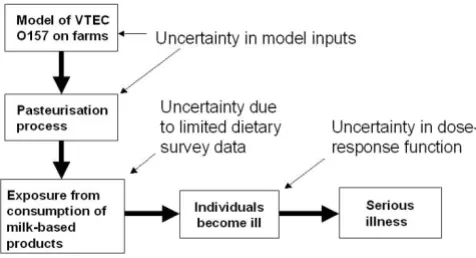
As part of a collaboration with the RELU-RISK project [4], investigating stakeholder involvement in food chain risks, the processes leading to illness from VTEC O157 contam-inated milk products were modelled (Figure 1). To esti-mate the rate of contamination in purchased milk products we used a process-based model of VTEC O157 prevalence in dairy herds and simulation models for pas-teurisation failure in on- and off-farm pasteurisers. The contamination model, documented in [5], starts at the farm, with various inputs (herd prevalence, herd size, fae-ces amount per animal, proportion of animals lactating, prevalence in lactating animals, number of VTEC O157 colony forming units (cfu) per gramme in the faeces of infected animals, pasteurisation failure rate). The output of interest is the estimated number of cfu in a typical con-tainer of milk at point of sale. Variability between farms and animals is represented by stochastic simulation from probability distributions for herd size (negative bino-mial), faeces amount (gamma) and cfu/g of faeces
(weibull). Parameters of these distributions were selected to approximately match available data.
To complete the exposure assessment data was taken on daily consumption of milk products of 1858 UK toddlers (aged 1.5-4.5) from the National Diet and Nutrition Sur-vey (NDNS) [6] to be representative of the UK toddler population. The consumption and contamination models were linked by randomly assigning consumption events in the NDNS to either on- or off-farm contamination lev-els (cfu/ml), in proportion to the estimated market share of both types. As the market share for on-farm pasteurised milk is very small (around 0.16%), we separately gener-ated results for the entire UK toddler population and for a 'high-risk' subpopulation of toddlers consuming milk only from on-farm pasteurisers. Sufficient milk contami-nation levels were generated to match the number of con-sumed items by running the code repeatedly, to represent the distribution of between-item variability. The total daily exposure Ei was then calculated for each toddler together with the illness probability p = 1 - (1 + Ei/β)-α[7]. Illness events were simulated using a Bernoulli distribu-tion with probability p. Finally, approximate scaling fac-tors were used to scale up from the NDNS-based incidences to the relevant populations.
Bayesian methods were used to quantify uncertainties due to limited information about some of the model inputs. For example, starting from uninformative beta(1,1) prior distributions for many of the rate and proportion inputs
Risk analysis model for Case Study 1
Figure 1
listed above, the posterior distributions were also beta dis-tributed, after updating them using a sample of observed 'true' and 'false' outcomes. In each case, the amounts of data used in the updates determined the strength of infor-mation in the respective posterior distributions. The implied uncertainty in incidences was calculated via Monte Carlo simulation. The chain of models described above was repeated 1000 times with values for the uncer-tain inputs generated from their probability distributions. This included the posterior distribution of (α, β) derived in [7], so that a different relationship between dose and illness probability was used in each iteration.
Management options and how we modelled them
Key questions addressed by the study were whether on-farm pasteurisers present a particular problem, and if so what action should be recommended to reduce the risk. The modelling process was repeated for the following hypothetical scenarios, representing outcomes from pos-sible management options.
1. Status Quo. The existing level of risk was estimated, based on current consumption levels and farming practice;
2. Ban on-farm pasteurisation, so that all consumed milk is assumed to come from off-farm pasteurisers;
3. Test more post-pasteurisation batches leaving a small dairy, effectively reducing the amount of con-taminated milk by an amount depending on the accu-racy of the test and the proportion of batches tested;
4. More training for on-farm pasteurisers. We assume that the ratio of human errors to mechanical errors (ordinarily assumed to be around 4:1) can be reduced through training down to 2:1 or 1:1, altering the off-farm pasteurisation failure rate accordingly. Risk man-agers could then decide how much reduction is desir-able and practical.
Case study 2: sensitivity analysis of a model for VTEC O157 transmission in a UK dairy herd
Our next case study used a deterministic SIR-type (Suscep-tible/Infective/Recovered) model to simulate the trans-mission of VTEC O157 within a typical UK dairy herd [8]. To capture the flow of infection around this structured population, the model included 4 interacting sub-groups (unweaned, weaned, dry and lactating), demographic processes and direct, indirect and pseudovertical (occur-ring in the first 24-48 h after birth) transmission. The result was a complex computer model containing 39 inde-pendent parameters. The aim was to identify key parame-ters related to prevalence of infection and suggest strategies for its reduction. The output of interest was
prev-alence of VTEC O157 in the weaned group, 150 days after the introduction of infection, as in [9].
eliciting expert opinions [1] could be employed to obtain more detailed distributions, but this was not available in our study.
Results
Case study 1: dietary exposure to VTEC O157 from milk products
Each of the alternative management options considered is assumed to reduce the probability of a pasteurisation fail-ure at an on-farm dairy and therefore reduce the probabil-ity of contamination in any single consumed item. Estimated yearly incidences are shown in Table 1. Uncer-tainty intervals for all scenarios include zero incidences. Although actual incidences in a given year may indeed be zero, the true expected annual incidence is greater than zero. Zeros arise from rounding errors and from the lim-ited number of iterations in the simulation.
Case study 2: sensitivity analysis of a model for VTEC O157 transmission in a UK dairy herd
Of the initial 30 inputs, only 7 were found to contribute more than 0.5% to the total output variance. This screen-ing of important input parameters meant that a more detailed investigation could be carried out at the second stage. A smaller input design was created, using 100 code runs but now allowing the 'common' inputs to vary inde-pendently. For example, the restriction from Stage 1 was relaxed so that the weaned and unweaned group were assumed to have distinct recovery rates. The new emulator was built using only the 8 sensitive inputs with the remaining inputs fixed at their default values. The uni-form distributions were unchanged from the first stage. The effects of just 2 inputs, including the interaction effect based on this pair, explained 82.8% of the output vari-ance. The inputs are recovery rate (i.e. the inverse of the duration of infection), which contributed 54%, and con-centration of VTEC O157 in faeces, which contributed 22.6%. Both inputs have an impact on the level of indirect transmission (i.e. transmission via the environment). The joint effect contribution was 6.2%. The implication is that efforts to reduce prevalence in the weaned group should
focus on changing the values of these parameters. Meas-ures such as vaccination [12] and dietary management [13,14] can reduce the level and duration of shedding of VTEC O157 in cattle. Our results suggest that these should be more successful than alternative control measures (e.g. improving hygiene). A more conventional sensitivity analysis of this model, using partial rank correlation coef-ficients, is reported in [9], and was based on 1000 runs of the model. Our 2-stage Bayesian approach achieved simi-lar results based on a total of 500 runs.
Conclusion
The case studies presented here have demonstrated some of the potential uses for Bayesian approaches in QMRA to integrate information sources in an efficient, rigorous way. In Case Study 1, multiple sources of uncertainty are propagated through a farm-to-fork model to produce uncertainty in the exposures for the population. This is coupled with uncertainty derived from a Bayesian dose-response model to produce uncertainty intervals for health outcomes that are relevant to policy-makers and other stakeholders (Table 1). Case Study 2 showed how Bayesian sensitivity analysis could be used to understand the influence of uncertain inputs, in a way that is far more efficient than conventional Monte Carlo simulation.
Competing interests
The authors declare that they have no competing interests.
Authors' contributions
MK carried out statistical analyses for both case studies, contributed to the design of the risk analysis model and drafted the manuscript. HC contributed to the design of the risk analysis model, implemented the simulation model and organised the stakeholder workshops for Case Study 1. JT contributed to the design and implementation of Case Study 2. All authors read and approved the final manuscript.
Table 1: Risk estimates for Case Study 1
Toddler group & scenario Estimated incidence (per year) 95% credible intervals
Current UK toddlers 8.6 0 11.5
Ban on-farm 6.4 0 11
Consumers of on-farm milk products only
Current UK toddlers 1.7 0 7.3
Testing (50% reduction) 0.8 0 4.7
Training (40% reduction) 1 0 5.3
Training (60% reduction) 0.6 0 1.9
Publish with BioMed Central and every scientist can read your work free of charge "BioMed Central will be the most significant development for disseminating the results of biomedical researc h in our lifetime."
Sir Paul Nurse, Cancer Research UK
Your research papers will be:
available free of charge to the entire biomedical community
peer reviewed and published immediately upon acceptance
cited in PubMed and archived on PubMed Central
yours — you keep the copyright
Submit your manuscript here:
http://www.biomedcentral.com/info/publishing_adv.asp
BioMedcentral
Note
The peer review of this article can be found in Additional file 1.
Additional material
Acknowledgements
This work was funded under the joint Environment and Human Health Pro-gramme (grant NE/E008526/1), which is supported by the Natural Environ-ment Research Council (NERC), the EnvironEnviron-ment Agency, the DepartEnviron-ment for Environment, Food and Rural Affairs (Defra), the Ministry of Defence, Medical Research Council, The Wellcome Trust, Economic and Social Research Council (ESRC), Biotechnology and Biological Sciences Research Council (BBSRC), Engineering and Physical Sciences Research Council and Health Protection Agency. Norval Strachan and Peter Teunis provided information about the dose-response model in Case Study 1. We are also grateful to Clare Bailey, Simon French and Andy Hart from the RELU-RISK team, for their involvement in Case Study 1. RELU-RISK (RES 224-25-0090) is funded jointly by ESRC, BBSRC and NERC, with additional funding from Defra and the Scottish Executive Environment and Rural Affairs Depart-ment.
This article has been published as part of Environmental Health Volume 8 Supplement 1, 2009: Proceedings of the Joint Environment and Human Health Programme: Annual Science Day Conference and Workshop. The full contents of the supplement are available online at http://www.ehjour nal.net/supplements/8/S1.
References
1. O' Hagan A, Buck CE, Daneshkhah A, Eiser JE, Garthwaite PH, Jenkin-son DJ, Oakley JE, Rakow T: Uncertain Judgements: Eliciting Expert Prob-abilitiesWiley, Chichester; 2006.
2. Robert CP, Casella G: Monte Carlo Statistical Methods second edition.
New York: Springer-Verlag; 2006.
3. Oakley JE, O'Hagan A: Probabilistic sensitivity analysis of com-plex models: a Bayesian approach. Journal of the Royal Statistical Society (Series B) 2004, 66:751-769.
4. RELU-RISK [http://www.relurisk.org.uk]
5. Clough HE, Clancy D, French NP: Quantifying exposure to Vero-cytotoxigenic Escherichia coli O157 in milk sold as pasteur-ized: a model-based approach. International Journal of Food Micro-biology 2009, 131:95-105.
6. Gregory J, Collins DL, Davies PSW, Hughes JM, Clarke PC: National Diet and Nutrition Survey: children aged 1 1/2 to 4 1/2 years: Report of the diet and nutrition surveyVolume 1. London: HMSO; 1995.
7. Teunis PFM, Ogden ID, Strachan NJC: Hierarchical dose response of E. coli O157:H7 from human outbreaks incorporating het-erogeneity in exposure. Epidemiol Infect 2008, 136:761-770. 8. Turner J, Begon M, Bowers RG, French NP: A model appropriate
to the transmission of a human food-borne pathogen in a multigroup managed herd. Preventative Veterinary Medicine 2003,
57:175-198.
9. Turner J, Bowers RG, Begon M, Robinson SE, French NP: A semi-stochastic model of the transmission of Escherichia coli O157 in a typical UK dairy herd: Dynamics, sensitivity analysis and intervention/prevention strategies. Journal of Theoretical Biology
2006, 241:806-822.
10. O'Hagan A: Bayesian analysis of computer code outputs: a tutorial. Reliability Engineering and System Safety 2006, 91:1290-1300. 11. GEM-SA, Version 1.1. Software: Gaussian Emulation Machine for Sensitivity Analysis [http:// www.ctcd.group.shef.ac.uk/gem.html]
12. Potter AA, Klashinsky S, Li YL, Frey E, Townsend H, Rogan D, Erick-son G, Hinkley S, Klopfenstein T, Moxley RA, et al.: Decreased shedding of Escherichia coli O157: H7 by cattle following vac-cination with type III secreted proteins. Vaccine 2004,
22:362-369.
13. Van Baale MJ, Sargeant JM, Gnad DP, DeBey BM, Lechtenberg KF, Nagaraja TG: Effect of forage or grain diets with or without monensin on ruminal persistence and fecal Escherichia coli O157:H7 in cattle. Applied and Environmental Microbiology 2004,
70:5336-5342.
14. Schamberger GP, Phillips RL, Jacobs JL, Diez-Gonzalez F: Reduction of Escherichia coli O157: H7 populations in cattle by addition of colicin E7-producing E-coli to feed. Applied and Environmental Microbiology 2004, 70:6053-6060.
Additional file 1
Peer review. Click here for file