Millennials vs. non-millennials: the impact of
their different privacy and security perceptions
on Facebook behavior
Author: Jelmer Pepping
University of Twente P.O. Box 217, 7500AE Enschede
The Netherlands
ABSTRACT
Nowadays, every second there are five new Facebook profiles created. Around April 2016, there are over 1.65 billion monthly active Facebook users and this number is increasing with approximately 15 percent every year. This means that Facebook is becoming more and more popular. This has of course implications for businesses. In research privacy on social networking sites is becoming more important. Do people care about their privacy and security on Facebook? This study builds on earlier research and looks at the differences of privacy perceptions and security perceptions between millennials and non-millennials. Furthermore, we looked at how those perceptions influence behavior on Facebook. The findings show that there is not a significant influence between the privacy and security perceptions of millennials and non-millennials. However, we found that more than half of a person’s behavior on Facebook can be predicted by the interaction between the user’s age and the user’s privacy and security perceptions.
Supervisors:
I. Singaram, MSc
Dr A.H. van Reekum
Keywords
Facebook, Privacy, Security, Facebook behavior, M illennials, Non-millennials
Permission to make digital or hard copies of all or part of this work for personal or classroom use is granted without fee provided that copies are not made or distributed for profit or commercial advantage and that copies bear this notice and the full citation on the first page. To copy otherwise, or republish, to post on servers or to redistribute to list s, requires prior specific permission and/or a fee.
7th IBA Bachelor Thesis Conference, July 1st, 2016, Enschede, The Netherlands.
1.
INTRODUCTION
1.1
Situation and complication
Investigating user’s behavior on Facebook is important because Facebook is becoming an increasingly important part of people’s lives. The popularity of Facebook is giving rise to privacy and security problems. “Privacy leakage is one of the biggest problems of social networking as many users do not always understand the implications of revealing personal information online” (Asif & Khan, 2012). As many users do not always understand the privacy and security implications of using Facebook, it is important to investigate why users do not understand this and how they perceive privacy and security on Facebook in a certain way. Non-millennials spend less time on Facebook and have less friends on Facebook than millennials (M cAndrew & Jeong, 2012). They are also less likely to post personal information on Facebook than millennials (Christofides, M uise, & Desmarais, 2011). This says that there is a difference in Facebook behavior regarding the age of the user. As age is influencing Facebook behavior, it is interesting to find out if age is also influencing privacy and security perceptions.
There is a research gap regarding the influence of age on privacy and security perceptions on Facebook. This research will be focused on this influence. It will try to find out what the difference is between millennials and non-millennials in privacy and security perceptions of Facebook. Ultimately, it will look at how the difference in privacy and security perceptions is influencing the behavior of the users on Facebook.
1.2
Research goal
The research goal is to find the difference on privacy and security perceptions of Facebook between millennials and non-millennials and to investigate how this difference affects the behavior of the user on Facebook.
1.3
Research questions
The research goal leads to the general research question:
What is the effect of age on privacy and security perceptions of Facebook, and how do these perceptions affect behavior on Facebook?
To answer this question, it is divided into two sub-questions:
1. What is the difference in privacy and security perceptions on Facebook between millennials and non-millennials?
2. How do these perceptions affect behavior on Facebook?
1.4
Relevance
This research is relevant for the academic world as well as for organizations.
1.4.1
Academic relevance
A lot of research has been done about perceptions of privacy and security on Social Network Sites. Several characteristics have been identified that influence those perceptions. However, none of them has researched the influence of age on the perceptions of privacy and security on Facebook. Neither has someone investigated how those perceptions influence Facebook behavior. This is the gap this research tries to fill. By adding the moderator variable ‘age’ to the model of Shin (2010), this research will come up with new evidence. The outcome might change the practice of organizational science, as new relations between the variables will be found. In future research, this research can be elaborated on to understand why people behave in a certain way. It can also be used to elaborate further on the influence of privacy and security perceptions on a user’s behavior on Facebook. This can for example be very interesting for researchers in the area of marketing. If they elaborate more
on this research, they can better understand why people behave in a certain way on Facebook. Nowadays, I think that one of the core issues of studies in marketing areas is understanding why users or consumers are behaving a certain way online and how this behavior can be influenced.
1.4.2
Practical relevance
First of all, Facebook can find the privacy and security perceptions of different age groups of their users. This can help them to make their education about the security and privacy policies more specific to the individual users. They can also see if their privacy and security policies are lacking clearance or are contrary to the wishes of its users.
Furthermore, companies are using Facebook to connect with their customers. It is relevant for them to know how the age of their customers influences their customer’s perceptions of privacy and security on Facebook. When companies know how those perceptions are influencing a user’s behavior on Facebook, this can result in more specific campaigns. It is for a company more relevant to use Facebook campaigns for customers that perceive themselves as private and secure on Facebook.
1.5
Outline
In the following chapter the theoretical framework will be described. Arguments will be given based on what previous literature has found. These arguments will result in the general research question of this study.
In chapter 3 the methodology will be explained. First, we describe how the new data is collected. Furthermore, we will say some things about the participants of the survey and the design of the questionnaire. Lastly, we will explain in detail how the gathered data is analyzed and we will outline the reliability of this study.
The results of this study are presented in chapter 4. We will talk about correlations and regression to see if there are relations between the variables and how those variables are predicting each other.
In the last chapter the results will be discussed and we give an answer on the research questions. Furthermore, the implications of this study for the academic world and organizations will be presented. Lastly, the limitations of the study are described and we will give some suggestion for future research.
2.
THEORETICAL FRAMEWORK
In this chapter we will define the key concepts of this study, we will outline some prior research and tell why those prior research has led to this study. If we talk about millennials in this study, we mean people that are aged between 25 and 35 years. If we talk about non-millennials in this study, we mean people that are over 50 years old.
2.1
Privacy perceptions
Previous research has found that the online privacy perceptions of a user are negatively associated with self-disclosure on Facebook (Young & Quan-Haase, 2009). The more a user perceives himself as private on Facebook, the more he is likely to disclose more personal information on Facebook.
As people are getting older, they tend to perceive privacy in a different way (Petronio, 2002). The older a person is, the more relationships are developed and the more life responsibilities a person has. Previous research focused mainly on millennials and their perceptions of privacy on social network sites (e.g. Boyd & Hargittai, 2010; Lewis et al., 2008). This makes it difficult to compare the age groups. Lastly, there seems to be conflicting evidence on how millennials and non-millennials have different privacy perceptions (Litt, 2013).
In this study, when we talk about privacy we mean the following: “Privacy in SNS context can be defined as control over the flow of one’s personal information, including the transfer and exchange of that information.” (Shin, 2010, p. 430).
2.2
Security perceptions
Previous research describes eight security factors which can be associated with Facebook: (1) Privacy & Confidentiality, (2) Authentication & Identity Theft, (3) Intellectual Property Theft, (4) Vandalism, Harassment & Stalking, (5) Defamation & Disparagement, (6) Spam & Cybersquatting, (7) Payment and Transaction Integrity, and (8) M alwares and Computer Virus (Leitch & Warren, 2009).
[image:3.596.54.288.423.512.2]In this study we use the following definition when we talk about security: “In SNS, security refers to users’ perception on security, that is perceived security, which is defined as the extent to which a user believes that using a SNS application will be risk-free.” (Shin, 2010, p. 430).
Figure 1. Research model 1
Privacy and security perceptions of Facebook are widely researched. Several indicators have been found that influence those perceptions. The first part of this study will focus on the influence of age on the privacy and security perceptions of Facebook users. See also figure 1. To measure the influence of age we compared the two age groups using descriptive statistics and the one-way analysis of variance (ANOVA). The ANOVA tests whether there are significant differences between the means of independent groups.
2.3
Facebook behavior
First of all, Facebook is world’s largest social network site and those are defined as “web-based services that allow individual to
(1) construct a public or semi-public profile within a bounded system, (2) articulate a list of other users with whom they share a connection, and (3) view and traverse their list of connections and those made by others within the system. The nature and nomenclature of these connections may vary from site to site” (Boyd & Ellison, 2007, p. 2)
Previous research has found differences in Facebook behavior between adolescents and adults. Older people are more likely to spend less time on Facebook and have less connections than younger people (M cAndrew & Jeong, 2012). Furthermore, it was found that Facebook usage differs between millennials and non-millennials, because interpersonal relationships are shaped by the social roles and social structures found within each age group (Ryan, Hummert, & Boich, 1995). Furthermore, while comparing Facebook profiles of millennials and non-millennials , it was found that both groups differ in terms of communication via Facebook (Arjan, Pfeil, & Zaphiris, 2008). These findings are interesting, but has this only something to do with their age? Or tend older people to have different privacy and security perceptions of Facebook and are those perceptions influencing this different behavior?
Out of prior research, researchers developed a privacy -trust model that describes the relation between privacy perceptions and information sharing. The privacy concerns, trust in the social network site and trust in other members on the social network site are influencing self-disclosure on the social network site (Dwyer et al., 2007). Therefore, we use trust as one of the operating variables to measure a user’s behavior on Facebook.
Attitude toward a behavior is describing a person’s feeling about an action (Shin, 2010). This attitude can be influenced by peers, beliefs and evaluations of the behavior. Research has found that a user’s attitude towards Facebook is influencing the intention to use Facebook (Shin, 2010) and therefore we use attitude as one of the operating variables to measure a user’s behavior on Facebook.
Besides trust and attitude, we will add self-disclosure as the third and last operating variable to measure Facebook behavior. Self-disclosure can be defined as what kind of, and how much personal information is a user sharing on Facebook.
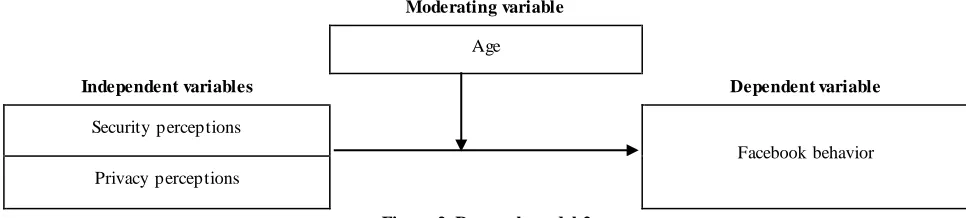
Connections between privacy and security perceptions and trust and attitude have been found (Shin, 2010). The second part of this study will focus on the influence of the interaction between a user’s age and his or her privacy and security perceptions on his or her Facebook behavior. See also figure 2. In this research model, age is a moderating variable because it changes the relationship between the privacy and security perceptions and the Facebook behavior. We use Pearson’s correlations test and spearman’s who correlation test to check for linear relationships between the variables. Additionally, several multiple regression analyses were carried out to check for predictors. With the regression analyzes we can find out to what extent the interaction of age and privacy and security perceptions is predicting a user’s behavior on Facebook.
Independent
variable Dependent variables
Age
Security perceptions
Privacy perceptions
Moderating variable
Age
Independent variables Dependent variable
Security perceptions
Facebook behavior Privacy perceptions
[image:3.596.62.545.665.774.2]3.
METHODOLOGY
First of all, the literature need for this study was gathered online using Google Scholar and Scopus. Furthermore, a survey was carried out to collect new data.
The variable Facebook behavior is operationalized with three variables. First of all, we measured a user’s trust in Facebook. Secondly, we measured how positive or negative a user’s attitude towards Facebook is. Lastly, we measured how much personal information a user is disclosing on Facebook.
3.1
Data collection
The empirical data needed for this study was collected by means of an online survey. The survey was conducted using Qualtrics, an online questionnaire building tool. The questionnaire was made together with five fellow students that were in the same bachelor thesis circle. This made it easier to get a higher number of responses, as we were all recruiting respondents. The higher number of responses makes this study more reliable. Study participants send personal messages to their social networks and posted calls for the survey on their social media profiles. The survey was open for 13 days in the beginning of M ay 2016.
To estimate the response rate on the survey we estimated the number of people who saw our calls for the survey. The first call was shared through sixteen social media profiles with a total number of 6.408 connected people. The second call was shared by six social media profiles with a total number of 5.934 connected people. As we assume that the total number of 12.342 connected people have not all seen the call, we estimate that approximately 6.000 people have seen the call for our survey. As there were 448 responses in total, the response rate is estimated by 7.5%.
3.2
Participants
In total 448 participants filled in the survey. From those 448 responses there were 337 valid complete responses. Uncomplete responses are removed and some responses were removed using straight lining. Of the 337 valid responses, 52 belong to the millennials group (between 25 and 35 years old) and 69 belong to the non-millennials group (older than 50 years). To get groups with the same sample size, we used SPSS to randomly choose 52 responses out of the 69 responses in the non-millennials group. Participants were not compensated for their participation.
3.3
Survey design
As explained earlier, a survey was used to collect data. At the beginning of the survey the purpose of the study was explained. Furthermore, participants were ensured that there were no risks involved by participating and that their answers will remain confidential. All this information was given to convince people to participate in the survey.
The survey was divided into five blocks. First of all, demographical questions were asked to identify what kind of person the participant is. Demographic measures were nationality, age, gender and education. Secondly, participants were asked nine questions about how they perceive privacy and security on Facebook. Third, there were four questions asked about the participant’s usage of Facebook. This has the purpose of identifying how active the user is on Facebook. Fourth, the participants were asked to answer eight questions about their trust in Facebook and about their attitude towards Facebook. At the end, we asked the open question if the participant had negative experiences with Facebook. The whole questionnaire can be found in the appendix.
3.4
Data analysis
To make the date analyzable we coded the responses. M ost of the questions were scored on a seven p oint Likert scale: 1 = strongly disagree till 7 = strongly agree. The demographical questions and questions about the user’s usage of Facebook were coded in a logical manner. It was mandatory to answer all questions, except for the last open question about negative experiences with Facebook.
To make it easier to carry out the statistical tests we took for every respondent the mean score from the questions asked per variable. This resulted in a new variables called perceived privacy, perceived security, trust and attitude. For the variable self-disclosure we summed up all the items they disclosed on Facebook. This results in a score from one to eleven. The demographic variables, also called control variables, were not adjusted.
3.5
Reliability of the data
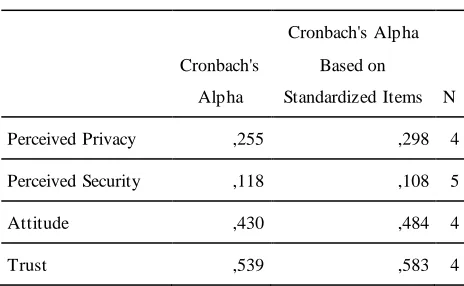
[image:4.596.310.542.320.463.2]To check if the collected data is reliable we used the Cronbach’s Alpha test. The results of this reliability analysis are shown in table 1.
Table 1. Reliability statistics
Cronbach's
Alpha
Cronbach's Alpha
Based on
Standardized Items N
Perceived Privacy ,255 ,298 4
Perceived Security ,118 ,108 5
Attitude ,430 ,484 4
Trust ,539 ,583 4
All of the four variables have a bad internal consistency. This can be seen as a limitation of this study. As the reliability cannot be much enhanced by removing one or more questions per variable we did not do so. Worth mentioning is that most of the questions measuring the variables have been used before by a widely respected and cited researcher (Shin, 2010) and have proven to measure the variables well.
4.
RESULTS
4.1
The effect of age on perceptions
Table 2 presents the calculated descriptive statistical measures on perceived privacy and perceived security for both the millennials and the non-millennials.
Table 2. Descriptive statistics privacy & security
M ean Std. Deviation
Perceived
Privacy
M illennials 3,3462 1,13019
Non-M illennials 3,6346 1,01636
Total 3,4904 1,07933
Perceived
Security
M illennials 4,4962 ,86364
Non-M illennials 4,7346 ,73321
Total 4,6154 ,80614
Regarding perceived privacy, the non-millennials score higher (M = 3.63, SD = 1.02) than the millennials (M = 3.35, SD = 1.13). These findings suggest that age influences the perceived privacy on Facebook of the user. However, the ANOVA test proves that there is not a significant effect of age on privacy perceptions at the p<.05 level for the three conditions [F (1, 102) = 1.87, p = 0.17]. Generally, we can state that people do not perceive a lot of privacy on Facebook (M = 3.49, SD = 1.08) as the score ranges from one to seven.
For perceived security, the millennials score again lower (M = 4.50, SD = 0.86) compared to the non-millennials (M = 4.73, SD
= 0.73). These findings suggest that age is besides influencing perceived privacy also the perceived security on Facebook. However, the ANOVA test proves again that there is neither a significant effect of age on security perceptions at the p<.05 level for the three conditions (F (1, 102) = 2.30, p = 0.13].Worth mentioning is that the perceived security is generally (M = 4.62,
SD = 0.81) more than a point higher than the perceived privacy on Facebook. We can conclude that overall people feel more secure than private on Facebook.
The findings suggest that there are small differences between the millennials and non-millennials in terms of a user’s perceived privacy on Facebook and a user’s perceived security on Facebook. However, the ANOVA test proves for both measurements that there is no significant effect of the age of the user on the perceived privacy and security of the user.
4.2
Differences in Facebook behavior
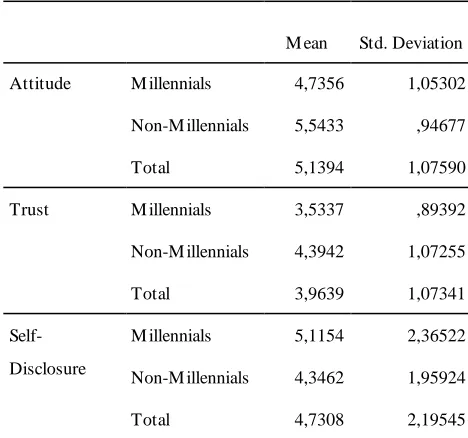
Table 3 presents the calculated descriptive statistical measures on a user’s trust in Facebook, a user’s attitude towards Facebook and self-disclosure from the user on Facebook.
Regarding attitude, the non-millennials have a more positive attitude towards Facebook (M = 5.54, SD = 0.95) than non-millennials (M = 4.74, SD = 1.05). The findings suggest that age influences a user’s attitude towards Facebook. This is reinforced by the ANOVA test from which one can conclude that age has a significant effect on attitude at the p<.05 level for the three conditions [F (1, 102) = 16.92, p = 0.00]. The Pearson’s
correlation test reinforces this even more by concluding that there is a weak positive linear relationship between age and attitude. This means that the older a person is, the more likely it is that the person has a more positive attitude towards Facebook. Overall
people have a fairly positive attitude towards Facebook (M = 5.14, SD = 1.08).
The next operationalization variable for Facebook behavior is trust. The non-millennials score again higher (M = 4.39, SD = 1.07) than the millennials (M = 3.53, SD = 0.89). The findings suggest that age influences a user’s trust in Facebook. This is reinforced by the ANOVA test from which we can conclude that age has a significant effect on trust at the p<.05 level for the three conditions [F (1, 102) = 19.76, p = 0.00]. Pearson’s correlations
test proves even more that there is an effect between age and trust. From the test can be concluded that there is a weak positive linear relationship between age and trust. This means that the older a user is, the more he or she trusts Facebook.
[image:5.596.55.286.140.298.2]It is striking that for the last variable the millennials score higher (M = 5.12, SD = 2.37) than the non-millennials (M = 4.35, SD = 1.96). The findings suggest again that age is influencing the variable, this time self-disclosure. The ANOVA test proves this from which we can conclude that age has a significant effect on self-disclosure at the p<.1 level for the three conditions [F (1, 102) = 3.26, p = 0.07].
Table 3. Descriptive statistics behavior
M ean Std. Deviation
Attitude M illennials 4,7356 1,05302
Non-M illennials 5,5433 ,94677
Total 5,1394 1,07590
Trust M illennials 3,5337 ,89392
Non-M illennials 4,3942 1,07255
Total 3,9639 1,07341
Self-Disclosure
M illennials 5,1154 2,36522
Non-M illennials 4,3462 1,95924
Total 4,7308 2,19545
4.3
Perceptions & Facebook behavior
To see which variables are predicting Facebook behavior we carried out three different multiple regression analyses. First we tested if the control variables predicted behavior. Secondly, we tested if the independent variables perceived privacy and perceived security predicted behavior. Lastly, we looked at the interaction between age and the two independent variables and tested if this predicted user’s behavior on Facebook.
4.3.1
Control variables and behavior
The control variables of this study are nationality , age, gender and education. Table 4 presents the calculated statistical results of the multiple regression analysis to test if the control variables significantly predicted participant’s Facebook behavior.
[image:5.596.309.543.308.527.2]Table 4. Multiple regression analysis
DV R R2 F Sig.
Attitude ,520a ,270 9,162 ,000a
Trust ,474a ,225 7,179 ,000a
Self-Disclosure ,282a ,080 2,140 ,081a
a. Predictors: (Constant), Nationality, Age, Gender, Education
Furthermore, multiple regression analysis was used to test if the demographic variables significantly predicted participants' trust in Facebook. The results of the regression indicated the four predictors explained 57,4% of the variance (R2 =.23, F (4, 99) = 7.179, p < .001. It was found that age significantly predicted trust (β = .45, p < 0.01).
Finally, multiple regression analysis was used to test if the demographic variables significantly predicted participants' self-disclosure on Facebook. The results of the regression indicated the four predictors explained 28,2% of the variance (R2 =.08, F
(4, 99) = 2.140, p > .05. None of the demographic variables significantly p redicted self-disclosure.
4.3.2
Independent variables and behavior
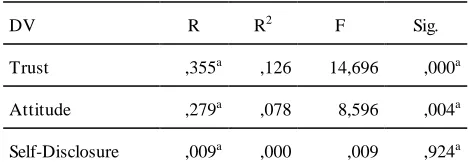
[image:6.596.309.543.248.332.2]Table 5 presents the calculated statistical results of the multiple regression analysis to test if the independent variables perceived privacy and security significantly predicted participant’s Facebook behavior.
Table 5. Multiple regression analysis
DV R R2 F Sig.
Trust ,355a ,126 14,696 ,000a
Attitude ,279a ,078 8,596 ,004a
Self-Disclosure ,009a ,000 ,009 ,924a
a. Predictors: (Constant), Perceived Privacy & Security
M ultiple regression analysis was used to test if the independent variable perceived privacy and security significantly predicted participants' attitude towards Facebook. The results of the regression indicated the predictor explained 27,9% of the variance (R2 =.08, F (4, 99) = 8.596, p < .005. It was found that the privacy and security perceptions significantly predicted attitude (β = .28, p < 0.01).
To test if the independent variable perceived privacy and security significantly predicted participants' trust in Facebook multiple regression analysis was used. The results of the regression indicated the predictor explained 35,5% of the variance (R2 =.13,
F (4, 99) = 14.969, p < .001. It was found that the privacy and security perceptions significantly predicted trust (β = .36, p < 0.01).
Furthermore, multiple regression analysis was used to test if the independent variable perceived privacy and security significantly predicted participants' self-disclosure on Facebook. The results of the regression indicated the predictor explained 0,9% of the variance (R2 =.00, F (4, 99) = 0.009, p > .05. It was found that the privacy and security perceptions did not significantly predicted self-disclosure.
4.3.3
Independent variables, age and behavior
To predict a user’s Facebook behavior even better we looked at the interaction between the independent variable perceived privacy and security and the age of the user. Table 6 presents the calculated statistical results of the multiple regression analysis to test if this interaction significantly predicted participant’s Facebook behavior.
M ultiple regression analysis was used to test if the interaction between age and perceived privacy and security significantly predicted participants' trust in Facebook. The results of the regression indicated the predictor explained 51,6% of the variance (R2 =.26, F (4, 99) = 36.974, p < .001. It was found that the interaction of age and privacy and security perceptions significantly predicted trust (β = .52, p < 0.01).
Table 6. Multiple regression analysis
DV R R2 F Sig.
Trust ,516a ,266 36,974 ,000a
Attitude ,414a ,172 21,138 ,000a
Self-disclosure ,108a ,012 1,195 ,277a
a. Predictors: (Constant), Perceived Privacy & Security * Age
To test if the interaction between age and perceived privacy and security significantly predicted participants' attitude towards Facebook multiple regression analysis was used. The results of the regression indicated the predictor explained 41,4% of the variance (R2 =.17, F (4, 99) = 21.138, p < .001. It was found that the interaction of age and privacy and security perceptions significantly predicted attitude (β = .41, p < 0.01).
Furthermore, multiple regression analysis was used to test if the interaction between age and perceived privacy and security significantly predicted participants' self-disclosure on Facebook. The results of the regression indicated the predictor explained 10,8% of the variance (R2 =.01, F (4, 99) = 1.195, p > .05. It was found that the interaction of age and privacy and security perceptions did not significantly predict self-disclosure.
5.
DISCUSSION & IMPLICATIONS
In this chapter we will discuss the outcome of this study. Furthermore, we will outline the theoretical and practical implications that this study has. Lastly, we will talk about the limitations of this study and give some suggestions for future research.
5.1
Discussion of the results
Looking at the first sub-question of this study ‘What is the difference in privacy and security perceptions between millennials and non-millennials?’ we can conclude fairly fast. The results of the different statistical tests which have been carried out prove that there is not a significant difference in the privacy and security perceptions on Facebook between millennials and non-millennials. Worth mentioning is that there is a slight difference as the non-millennials perceive themselves as more private and more secure on Facebook than millennials do.
[image:6.596.53.287.418.502.2]To answer the general research question, we need to combine both sub-questions. The interaction between the age of the user and his or her perceived privacy and perceived security predicted more than half of the variance talking about a user’s trust in Facebook. The same applies for a user’s attitude towards Facebook, which can be predicted for more than 40% of the variance when looking to the interaction between a user’s age and his or her perceived privacy and security on Facebook. Unfortunately, there is no relation between the interaction of age and perceived privacy and security versus self-disclosure. This study does not focus on why there is not a relation between those, but it would be an interesting question for future research.
5.2
Theoretical implications
The findings of this study have several implications for internet security researchers and marketing researchers. Nowadays, I think that one of the core issues in marketing research is predicting how people will behave in a certain way online and how this behavior can be influenced. This paper contributes to a better understanding of privacy and security perceptions of users of Facebook and adds important information to the understanding of the reasons for differences in behavior on Facebook.
M ost importantly, this study expanded on the research of Shin (2010). In his research, he looked at the influence of the privacy and security perceptions of the user on his or her Facebook behavior. This study adds the variable age to the model of Shin (2010) and therewith found new evidence. The understanding of the influence of age is important, because this makes the research more specific.
Previous studies on privacy and security had found the role of privacy and security perceptions in trust in and attitude towards Facebook (e.g. Shin, 2010), but most of the research focused only on millennials (e.g. Boyd & Hargittai, 2010; Lewis et al., 2008). None of them looked at the influence of age on those perceptions. This study extends on previous research on privacy and security on Facebook including age as a moderating variable and comparing two age groups.
Previous research found already that older people perceive privacy in general in a different way (Petronio, 2002). However, this study found that speaking of privacy on Facebook, there are no significant differences between older and younger people. Differences in user’s behavior on Facebook were already found by previous research (M cAndrew & Jeong, 2012). This study reinforces those findings. Additionally, it extends on the prior research, by finding that the differences in behavior are partly predicted by the interaction between the user’s age and the user’s privacy and security perceptions. M ainly a user’s trust in Facebook and a user’s attitude towards Facebook can predicted by the interaction of the age of the user and the privacy and security perceptions of the user.
This study proves that age is influencing user’s behavior on Facebook. There was a significant effect of age on attitude and the study also showed that there was a significant effect of age on trust. Interesting is that millennials have on average a more negative attitude towards Facebook than non-millennials . Additionally, non-millennials also trust Facebook more than millennials do. However, millennials disclose more personal information than non-millennials do. An interesting question for future research would be why millennials disclose more personal information than non-millennials despite the finding of this study that they trust Facebook less than non-millennials and have a more negative attitude towards Facebook than non-millennials.
5.3
Practical implications
Also for industry, this study has several important implications. First of all, Facebook as a company can draw important conclusions from this study. The positive linear relationships between privacy perceptions and trust, and security perceptions and attitude, show that there is a relation between those perceptions and behavior on Facebook. The regression analyses executed makes this more precise. The interaction between a user’s age and his or her perceptions explains 51,6%, respectively 41,4% of the user’s trust in Facebook and his or her attitude towards the social network site.
Facebook can use this information to change their user’s behavior. Now they know that behavior is influenced by perceptions, it is easier to change this behavior. They can use different campaigns or strategic plans for the different age groups in order to let their users perceive themselves more private and secure on Facebook. Ones they perceive Facebook as more private and secure, they will trust Facebook more and have a more positive attitude towards Facebook. The outcome of this study proves that different age groups perceive things different and therefore need a different approach.
Besides Facebook as a company itself, a lot of other companies are using Facebook as well. They interact with their customers via the social network platform. This study provides an accurate outline of how people perceive the privacy and security when they interact with companies via Facebook. For example, a company focusing on millennials should know that this particular customer group has a lower trust in Facebook than millennials and have a more negative attitude. This might change their perception about the company using Facebook as well. However, millennials score higher on self-disclosure than non-millennials . This is interesting when companies are asking for personal information via Facebook instant messaging.
5.4
Limitations & future research
There are several limitations that to this research apply. As this study is carried out as a bachelor thesis it had a time constraint of ten weeks. Due to this time constraint, not all relevant literature could be read. Additionally, the study would be more reliable if the sample sizes would consist of a larger amount of people. Future research can reinforce this study by testing the variables for a larger amount of participants.
Furthermore, the data is gathered from the social networks of me and my fellow students. M ost of the respondents are Dutch and not native English speakers. It is possible that not all respondents understood the survey questions in the way it was meant. We can conclude that reliability and validity is limited for this study and can be seen as a weakness. M y advice to future researchers would be to use a more different population for the survey. The bad internal consistency of the four variables perceived privacy, perceived security, trust and attitude are a limitation of this study. In future research, when there is more time, the questionnaire should be tested before the actual questionnaire will be send out to the participants. In that way, the researchers can see which questions are bad for the internal consistency. It might be a better option than to take those questions out or replace them by other questions.
6.
REFERENCES
Arjan, R., Pfeil, U., & Zaphiris, P. (2008). Age differences in online social networking. CHI’08 Extended Abstracts
on Human Factors in Computing Systems, 2739-2744. Asif, Z. & Khan, M. (2012). USER’S PERCEPTIONS ON
FACEBOOK’S PRIVACY POLICIES. Journal of Systems and Software, 2, 119-125.
Boyd, D., & Ellison, N. (2010). Social network sites: definition, history, and scholarship. IEEE Engineering Management Review, 3(38), 16-31.
Boyd, D. & Hargittai, E. (2010). Facebook privacy settings: Who cares?. First Monday, 15(8).
Christofides, E. M uisc, A., & Desmarais, S. (2011). Hey M om, What’s on Your Facebook? Comparing Facebook Disclosure and Privacy and Adolescents and Adults.
Social Psychological and Personality Science, 3(1), 48-54.
Clark, L. A., & Roberts, S. J. (2010). Employer’s use of social networking sites: A socially irresponsible practice.
Journal of Business Ethics, 95(4), 507-525.
Dwyer, C., Hiltz, S., & Passerini, K. (2007). Trust and privacy concern within social networking sites: A comparison of Facebook and M ySpace. AMCIS 2007 proceedings,
339.
Leitch, S., & Warren, M . (2009). Security issues challenging Facebook. Australian Information Security Management Conference.
Lewis, K., Kaufman, J., Gonzalez, M ., Wimmer, A., & Christakis, N. (2008). Tastes, ties, and time: A new social network dataset using Facebook.com. Social networks, 30(4), 330-342.
Litt, E. (2013). Understanding social network site users’ privacy tool use. Computers in Human Behavior, 29(4), 1649-1656.
M cAndrew, F. T., & Jeong, H. S. (2012). Who does what on Facebook? Age, sex, and relationship status as predictors of Facebook use. Computers in Human Behavior, 28(6), 2359-2365.
O’Brien, D., & Torres, A. M. (2012). Social networking and online privacy: Facebook users’ perceptions. Irish Journal of Management, 31(2), 63-97.
Petronio, S. (2002). Boundaries of privacy. State University of New York Press.
Ryan, E. B., Hummert, M . L., & Boich, L. H. (1995). Communication predicaments of aging patronizing behavior toward older adults. Journal of Language and Social Psychology, 14(1-2), 144-166.
Shin, D. H. (2010). The effects of trust, security and privacy in social networking: A security -based approach to understand the pattern of adoption. Interacting with computers, 22(5), 428-438.
7.
APPENDICES
7.1
Survey
You are being invited to participate in a research study. This survey is part of bachelor theses from students of the University of Twente.
The survey will take you approximately 5 minutes to complete. Your participation in this study is entirely voluntary and you can withdraw at any time. We ask you kindly to complete the whole survey.
By participating in this research study are no risks involved. Your answers in this survey will remain confidential.
Thank you for participating in this survey!
Please only fill in this survey if you are a Facebook user and 18 years or older.
1. What’s your nationality? o Dutch
o German
o Other (please fill in below)
2. What’s your age? o Age:
3. What’s your gender? o M ale
o Female
4. What’s your highest level of completed education? o Did not complete high school
o High school
o Trade / technical / vocational training
o Some college o Bachelor’s degree o Master’s degree
o Advanced graduate work or PhD.
7.1.1 Perceived privacy & security
The following statements are about the privacy and security of Facebook. Please indicate to what extent you agree or disagree with the statements.
PP1: I am confident that I know all the parties who collect the information I provide during the use of Facebook.
PP2: I am aware of the exact nature of information that will be collected during the use of Facebook.
PP3: I am not concerned that the information I submit ted on Facebook could be misused.
PP4: I believe there is an effective mechanism to address any violation of the information I provide to Facebook.
PS1: I believe the information I provide with Facebook will not be manipulated by inappropriate parties.
PS2: I am confident that the private information I provide with Facebook will be secured.
PS3: I believe inappropriate parties may deliberately view the information I provide with Facebook.
PS4: I have adjusted my privacy settings on Facebook in order to make my post visible to a specific group of people. PS5: I make use of the private group function of Facebook.
7.1.3 Facebook usage
USE: How often do you use Facebook?
o Less than once a week
o Once a week
o At least once a day
o 11-20 times a day
o M ore than 20 times a day
TIM : About how much time do you spend on Facebook a week?
o 0-5 hours
o 5-10 hours
o 10-15 hours
o 15-20 hours
o 20+ hours
DEV: On which devices do you use Facebook? You can give multiple answers.
o Desktop computer
o Laptop computer
o Smartphone
o Tablet
o Other (please fill in below)
ADD: Which of the following have you added to Facebook, even when it is not visible to all users? You can give multiple answers.
o Photographs of yourself
o Real name
o Hometown
o Email Address
o Phone number
o Relationship status
o Sexual orientation
o Work
o Religion
o Political preference
o Education
7.1.4 Trust & Attitude
The following statements are about Facebook in general. Please indicate to what extent you agree or disagree with the
statements.
TR1: Facebook is a trustworthy social network.
TR2: I can count on Facebook to protect my privacy.
TR4: I never read Facebook’s privacy policies.
AT1: I would have positive feelings towards Facebook in general.
AT2: The thought of using Facebook is appealing to me.
AT3: Facebook has become part of my daily routine.
AT4: The facts that my posts on Facebook may be viewed by other individuals in my social environment influences my behavior on Facebook.
7.1.6 Experiences
NEX: Do you have any negative experiences with Facebook? Please explain.
Please submit your responses by clicking on the next button!
7.2
ANOVA Tests
ANOVA
M odel 1 M odel 2 M odel 3
F Sig. F Sig. F Sig.
Control
variables
Education 4,934 ,029 4,934 ,029 4,934 ,029
Gender ,000 1,000 ,000 1,000 ,000 1,000
Nationality 2,827 ,096 2,827 0,96 2,827 ,096
Independent
variables
Privacy perceptions 1,873 ,174 1,873 ,174
Security perceptions 2,304 ,132 2,304 ,132
Attitude 16,917 ,000*
Trust 19,755 ,000*
Self-Disclosure 3,262 ,074
7.3
Correlations ordinal variables
Correlations
Gender Nationality
Spearman's rho Gender Correlation Coefficient 1,000 ,086
Sig. (2-tailed) . ,383
N 104 104
Nationality Correlation Coefficient ,086 1,000
Sig. (2-tailed) ,383 .
7.4
Correlations continuous variables
Correlations
Age
Perceived
Privacy
Perceived
Security Attitude Trust Self-Disclosure Education
Age Pearson Correlation 1 ,123 ,145 ,353** ,396** -,139 -,140
Sig. (2-tailed) ,213 ,142 ,000 ,000 ,160 ,156
N 104 104 104 104 104 104 104
Perceived
Privacy
Pearson Correlation ,123 1 ,417** ,209* ,363** ,090 -,243*
Sig. (2-tailed) ,213 ,000 ,033 ,000 ,363 ,013
N 104 104 104 104 104 104 104
Perceived
Security
Pearson Correlation ,145 ,417** 1 ,271** ,216* -,102 -,093
Sig. (2-tailed) ,142 ,000 ,005 ,028 ,304 ,346
N 104 104 104 104 104 104 104
Attitude Pearson Correlation ,353** ,209* ,271** 1 ,515** ,101 ,212*
Sig. (2-tailed) ,000 ,033 ,005 ,000 ,306 ,031
N 104 104 104 104 104 104 104
Trust Pearson Correlation ,396** ,363** ,216* ,515** 1 ,186 -,040
Sig. (2-tailed) ,000 ,000 ,028 ,000 ,058 ,688
N 104 104 104 104 104 104 104
Self-Disclosure Pearson Correlation -,139 ,090 -,102 ,101 ,186 1 ,053
Sig. (2-tailed) ,160 ,363 ,304 ,306 ,058 ,594
N 104 104 104 104 104 701 104
Education Pearson Correlation -,140 -,243* -,093 ,212* -,040 ,053 1
Sig. (2-tailed) ,156 ,013 ,346 ,031 ,688 ,594
N 104 104 104 104 104 104 104
**. Correlation is significant at the 0.01 level (2-tailed).