Tomas de Ruijsscher May, 2016
Author:
T. (Tomas) de Ruijsscher, BSc.
Master Student Construction Management & Engineering s0201634
Version:
Master Thesis - Final Public
Institution:
University of Twente, Faculty of Engineering Technology Enschede
Clients:
VolkerInfra, Vianen SAAone, Diemen
Place and date:
Enschede, May 29, 2016Cover photo:
DutchUAV: SAAone, steel rail bridge
Graduation committee:
University of Twente: prof. dr. ir. J.I.M. (Joop) Halman University of Twente: dr. S.H.S. (Saad) Al-Jibouri VolkerInfra & SAAone: ir. D. H. (Hans) Hulst
3 Before you lies a report on the research into the risk identification process on large infrastructure projects. The research has been executed on behalf of VolkerInfra and SAAone. It serves two purposes: on the one hand to answer the initiated research question and on the other hand to conclude my master Construction Management and Engineering at the University of Twente.
The motivation for this research is the recent attention for risk management in the construction industry due to some extreme examples the past year. This led to the goal of VolkerInfra to further develop their risk management expertise and knowledge. This research will contribute to that goal by analyzing the risk identification process and provide recommendations for further development.
I would like to take this opportunity to thank VolkerInfra for giving me the opportunity to execute my graduation research for their company. I would like to personally thank Hans Hulst for his daily guidance, advice and substantive input. Furthermore, Jan Ruitenberg, Joop Halman and Saad Al-Jibouri for their guidance, substantive input and constructive criticism. Furthermore, I would like to thank the interviewed risk managers and colleagues of VolkerInfra and SAAone for their time and input where necessary.
Tomas de Ruijsscher May 29, 2016
Enschede
Due to government austerity, governmental agencies are downsizing and the contractors in the construction industry are increasingly responsible for more phases and tasks within construction projects. Not only have they become responsible for the construction phase itself, but also for design, maintenance and in some cases even finance. Furthermore, they are required to provide complete services, which means the combining of different disciplines in a single contract. These increased responsibilities also lead to an increase in risks for which the contractor is responsible. Together with the pressure on turnover in the infrastructure sector specifically, these cause contractors to improve their project management expertise and all relating processes. Recent examples in the industry illustrate the need for a high level of expertise of risk management. These developments led to the goal of VolkerInfra to improve their risk management expertise and knowledge.
The research is based around six case studies. These concern six large infrastructure projects of VolkerInfra, of which two are still in construction and four have been recently completed. This approach was chosen because of to the strong project focus of VolkerInfra. To measure success on these projects, usually a set of objectives is developed that the project hopes to accomplish. Part of these objectives are the traditional operational objectives of cost, time and quality. Of these three, cost is the most obvious and consistent measure of project success and therefore this measure is chosen as initial assessment parameter for the effectiveness of risk management.
However, an initial review of the cases revealed that there is limited data available on the cases. The data that is available on all cases however, is the amount of identified risks, in both the tender phase and the execution phases of the cases. These revealed that most risks are identified after tender, while ideally they should be identified during the tender phase to prevent surprises when going down the project life-cycle. Due to the limited available other data, a further analysis of cost data was only limited possible. Furthermore, a literature revealed that there was limited attention for the risk identification part of the risk management process. For these reasons it was decided to focus on risk identification. This led to the following objective in the research: "Develop recommendations for the further development of the risk identification process and identify and classify top risks on VolkerInfra projects to enable generic oversight to assist in risk identification on future VolkerInfra projects.”.
Interviews were held with the six risk managers of the six cases to determine their preferred risk identification approaches. These interviews revealed that each risk manager has their own preferred approach to risk identification and that this approach developed little over time. It also revealed that there is no company guideline on how to perform risk identification. The approaches of the risk managers were divided in the tender phase and the execution phase. During the tender phase, personal interviews, brainstorm sessions and work groups led by the risk manager were the preferred methods for risk identification. During the execution phase, only the personal interviews were preferred, while few other methods were applied.
5 most valuable information to enable reflective learning from these records. These are however only available on three of the six cases.
To be able to maintain an overview of these records, a classification has been developed. This classification consists of a number of criteria, each with a number of underlying categories. Each risk is assigned a category per criterion. The classification will then enable oversight over the projects of the most prevalent classes of risk and thus the identification of the most important points of improvement. Due to the time consuming process of categorizing risks, only the most important occurred risks have been classified. The top fifteen (based on the calculated value, which is an estimate of the financial consequences) occurred risks of the three available cases is classified, giving a total dataset of 45 risks.
The most important criteria are the phase identified, nature of the risk and the source of origin criteria. The classification revealed that 27 of the 45 risks was identified after tender. However, further analysis revealed that 15 of these 45 are due to an insufficient risk identification process. The other 12 were attributable to unforeseen scope changes, overarching risks that were identified sooner (so called container risks) and a force majeure and therefore not culpable to a faulty risk identification process. Further it revealed that most risks are of a technical nature, with process and managerial having a lot less risks in the top fifteen occurred. The source of origin criterion revealed that there are a number of risks present due to opportunistic behavior in the form of commercial decisions and a number of risks occurred as a consequence of another risk occurring. Based upon this research it can be concluded that there is a lack of guidelines for risk identification. Furthermore, a lack of data prevents further analysis of the effectiveness of the risk management process. There is also some ambiguity regarding the definition of certain concepts relating to risk management.
Preface ... 3
Management summary ... 4
Contents ... 6
Abbreviations ...10
Figures & tables ...11
Figures ...11
Tables ...12
1. Introduction...13
VolkerInfra ...13
SAA & SAAone ...14
The research ...14
Part I - Research Approach ...16
2. Industry dynamics ...17
External developments ...17
Internal response ...19
Overview ...20
3. Research design ...21
Scope ...21
3.1.1. VolkerInfra: A project focus ...21
3.1.2. Integrated Construction Organizations ...22
3.1.3. Project success ...27
3.1.4. The relevance of risk management ...28
3.1.5. The risk management process ...30
3.1.6. Initial findings: Point of departure ...32
Problem definition ...35
Research objective ...37
Research questions...38
Methodology & strategy ...39
Phase I – Set up ...39
Phase II – Initial data collection ...39
3.5.1. Research methods ...41
Part II - Theoretical background ...43
4. Risk management ...44
Risk ...44
7
4.1.3. Strength of knowledge ...46
Black Swans and the new perspective on risk ...48
4.2.1. Criticism ...48
4.2.2. Further categorization ...49
4.2.3. Research context ...49
Concluding remarks ...50
5. Frameworks ...51
ISO 31000...52
COSO ERM ...53
RISMAN ...55
Concluding remarks ...56
6. Risk identification ...57
Aspects of identification ...58
Methods and techniques ...59
6.2.1. Advantages and disadvantages ...60
Concluding remarks ...61
7. Risk classification ...62
Nature of risk ...62
Source of origin ...63
Timing of occurrence ...68
Control measures ...68
Concluding remarks ...70
Part III - Empirical results ...71
8. Initial results: available data ...72
Tender values ...72
Identified risks ...73
Occurred risks...74
Cost data: estimates – actual costs ...76
Concluding remarks ...78
9. Results risk identification ...79
Quantitative results ...79
Qualitative results ...81
Discussion ...82
Concluding remarks ...83
10. Results risk classification ...84
10.1.2. Main- and sub-object ...85
10.1.3. Discipline ...86
10.1.4. Nature of risk ...86
10.1.5. Source of origin ...87
10.1.6. Phase of occurrence ...88
10.1.7. Control measure ...89
10.1.8. Allocation ...89
Results ...90
10.2.1. Phase identified ...90
10.2.2. Main- and sub-object ...91
10.2.3. Discipline ...92
10.2.4. Nature of risk ...92
10.2.5. Source of origin ...93
10.2.6. Phase of occurrence ...94
10.2.7. Control measures ...94
10.2.8. Allocation ...95
Concluding remarks ...95
Part IV – Synthesis ...97
11. Conclusions ...98
General conclusions ...98
11.1.1. Data ...98
11.1.2. Definitions ...99
Risk identification ...99
Risk classification ... 100
12. Recommendations ... 102
12.1.1. Record data ... 102
12.1.2. Define risk management concepts ... 103
12.1.3. Defining the purpose ... 103
12.1.4. Prevent opportunism ... 103
12.1.5. Linking conditional risks ... 104
12.1.6. Risk identification process ... 104
12.1.7. Historic records as risk identification tool ... 105
12.1.8. Apply historic rate of risk occurrence to budget calculation ... 105
12.1.9. Trigger questions ... 106
12.1.10. Risk identification flow chart ... 107
B&U - Building & Utility construction sector
CBS - Centraal Bureau voor de Statistiek
COSO - Committee of Sponsoring Organizations of the Treadway Commission
DBFM - Design-, Build-, Finance-, Maintain-
DBFMO - Design-, Build-, Finance-, Maintain-, Operate-
D&C - Design & Construct
EMVI - Economisch Meest Voordelige Inschrijving, see MEAT
EPC - Engineering, Procurement and Construction
EPCM - Engineering, Procurement, Construction and Maintenance
ERM - Enterprise Risk Management
GWR - Ground-, Water- and Road construction sector
HRO - High Reliability Organization
IF - Integrated Framework
ISO - International Organization for Standardization
MEAT - Most Economically Advantageous Tender
N/A - Not Available
RISMAN-method - RISk MANagement-method
RMM - Risk Maturity Method
RWS - Rijkswaterstaat
SAA - Schiphol Amsterdam Almere
SPC - Special Purpose Company
SPV - Special Purpose Vehicle
VISE - VolkerInfra Systems Engineering
VOF - Vennootschap Onder Firma, a General Partnership
VVU - Voertuig Verlies Uur, Lost Vehicle Hour
WBS - Work Breakdown Structure
11
F
IGURES
Figure 1.1 - Reading guide: chapter overview ...15
Figure 2.1 - Diagram external and internal developments in time ...20
Figure 3.1 - Project phases and construction organization forms, with the scope highlighted in red ...26
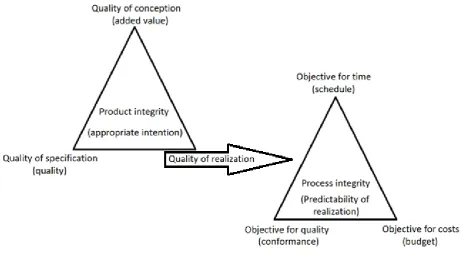
Figure 3.2 - Double triangle project success, derived from Winch (2010) ...28
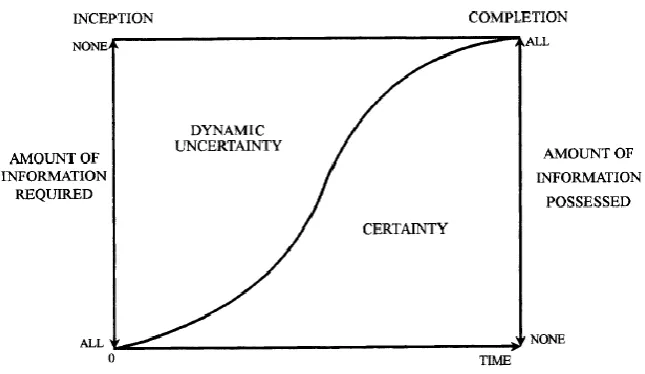
Figure 3.3 - Information and uncertainty in the project life-cycle (Winch et al., 1998) ...30
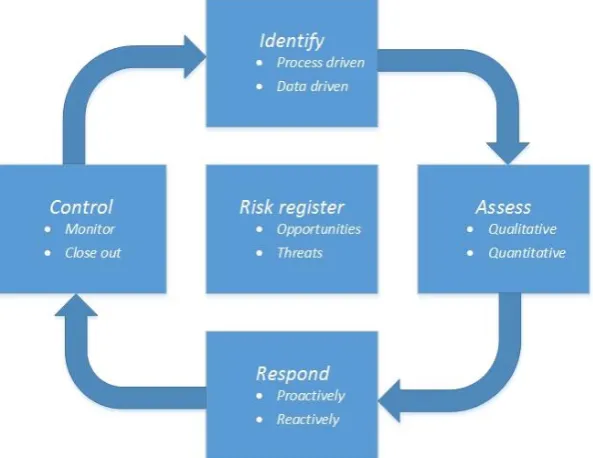
Figure 3.4 - Generic risk management process (Winch G. M., 2010) ...31
Figure 3.5 - General overview of risk management process and unidentified risks relating to total project risk through tender and execution phases ...35
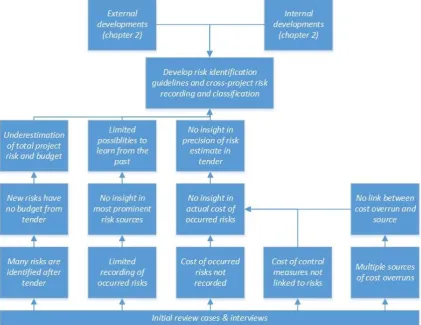
Figure 3.6 - Causality diagram of problem definition ...35
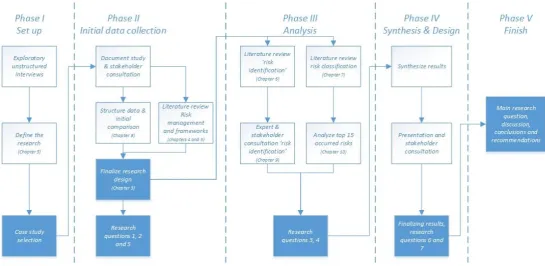
Figure 3.7 - Overview of research strategy ...40
Figure 4.1 - Risk through time (Winch G. M., 2010) ...49
Figure 5.1 - Connection between principles, framework and process for risk management from ISO 31000, as stated in Dali & Lajtha (2012) ...52
Figure 5.2 - COSO ERM Integrated Framework (COSO, 2004) ...54
Figure 5.3 - Cyclical risk management framework (Van Well-Stam et al., 2004) ...55
Figure 8.1 - Plot of reserved risk budget as a percentage of the contract value ...73
Figure 8.2 - Comparison identified risks: tender - to date ...74
Figure 10.1 - Integration between disciplines and project phases ...86
Figure 10.2 - Results of phase defined aspect of phase identified criterion for top fifteen occurred risks...90
Figure 10.3 - Results of main object criterion for top fifteen occurred risks ...91
Figure 10.4 - Results of sub object criterion for top fifteen occurred risks ...91
Figure 10.5 - Results of discipline criterion for top fifteen occurred risks ...92
Figure 10.6 - Results of nature of risk criterion for top fifteen occurred risks ...92
Figure 10.7 - Results of source of origin criterion for top fifteen occurred risks ...93
Figure 10.8 - Results of phase of occurrence criterion for top fifteen occurred risks ...94
Figure 10.9 - Results of control measure criterion for top fifteen occurred risks ...94
Table 3.1 - Overview of selected case studies ...22
Table 7.1 - Risk breakdown structure by Chapman (2001) ...64
Table 7.2 - Risk breakdown structure by Ebrahimnejad et al. (2010)...65
Table 7.3 - Risk breakdown structure by Tah et al. (1993) ...66
Table 7.4 - Risk breakdown structure by El-Sayegh (2008) ...67
Table 8.1 - Initial values of identified risks in the tender phase of the cases ...72
Table 8.2 - Overview of identified risks in tender - execution phases and available risk budget ...73
Table 8.3 - Overview of the available data on occurred risks on the case studies ...75
Table 8.4 - Separation values risks identified tender phase - identified later ...75
Table 8.5 - Overview of risk budget, calculated value occurred risks and actual costs occurred risks...76
Table 9.1 - Applied risk identification methods by risk managers ...80
Table 10.1 - Classification control measures in tender ...89
Table 10.2 - Control measures per risk in nature categories ...95
13
1.
I
NTRODUCTION
The Dutch government is the most important client for large infrastructure projects in the Netherlands. Within this market, Rijkswaterstaat (RWS, Directorate-General of Public Works), is a large actor as they are a large direct client for construction companies for putting large infrastructure projects on the market. Due to governmental austerity these organizations have been downsizing and therefore required the market to take over certain tasks, such as design, asset management, risk management etc. The role of the construction companies therefore changed to provide more services for a smaller governmental client than solely providing the execution of the work itself for which they were traditionally only responsible. Pressure on rates and prices, a slow recovery of the financial crisis and a decreased workload have increased pressure on the market further and increased competition. These developments increase complexity for the contractors and requires them to ensure a greater variety of in-house expertise and knowledge. This means a shift in their attention from traditional execution work to gaining a higher level of proficiency in these other fields. More clients in the construction industry also require contractors to engage in long term, integrated contracts, for example Design- Build- Finance- Maintain (DBFM) contracts, which also put a larger share of involved risks with contractors. These factors combined cause contractors to think differently about their risk management processes. That is why risk management needs to be an important and integral part of core business processes and culture of modern construction companies.
These developments have led to the demand of VolkerInfra to investigate their current risk management practices and design strategies for improvements and has subsequently led to the motivation for this research project. This report describes the research project, which will serve as Master Thesis project and conclusion of my Construction Management & Engineering Master at the University of Twente.
V
OLKER
I
NFRA
VolkerInfra is a relatively young organization, founded by four operating companies of the VolkerWessels concern: KWS Infra, Van Hattum en Blankevoort, Vialis and VolkerRail. VolkerWessels is the parent company of a large network of international construction companies that design, develop, build, manage and operate construction projects in the Netherlands, Belgium, the United Kingdom, the United States and Canada. They employ over 15.000 employees worldwide. The concern is active in the construction-, mobility-, energy- and communications- industries. The concern is mainly characterized by the amount of, mostly independently working, operating companies. These companies are managed locally as much as possible, each with their own responsibilities.
SAA & SAAONE
SAA stands for Schiphol-Amsterdam-Almere and is a major road expansion program of Rijkswaterstaat. This program is intended to improve the traffic flow, travel time and quality of life between the aforementioned three major centers in the northern part of the urban agglomeration ‘de Randstad’. This program consists of five projects:
A10/A1 highway between junctions Amstel – Watergraafsmeer and Diemen, which was completed in 2014
A1/A6 highway between junctions Diemen – Muiderberg and A6 exit Almere Havendreef, which is currently under construction
A9 highway between junctions Diemen and Holendrecht, which is currently under construction
A6 highway between exit Almere Havendreef to exit Almere Buiten-Oost, which has recently been tendered
A9 highway between junctions Holendrecht and Badhoevedorp
The second, the trajectory between the junction ‘Diemen’ of the A1/A9 highways and the new A6 exit ‘Almere Havendreef’, was awarded to the SAAone consortium in 2012. SAAone consists of VolkerWessels, Hochtief, Boskalis and DIF. For a more detailed description of the project see chapter 3 and appendix B. SAAone is an organization in itself and its four partners have entered into a general partnership (VOF). The project is organized in a DBFM- construction organization, meaning the consortium is responsible for four project phases. From design to build and maintain for 25 years. It also includes the financing of the project. SAAone is used by VolkerInfra as example project to invest in innovations and test them. These innovations mostly concern organizational processes and systems and is therefore in that capacity also a client for this research project.
T
HE RESEARCH
This research project is aimed at exploring the risk management practice of VolkerInfra and specifically at providing insight into their risk identification process. Due to the project focus of VolkerInfra, the research is done via six case studies, which will provide insight into their risk management practice. Furthermore, an extensive literature review revealed that risk identification itself receives little attention in research but is considered one of the most important aspects of the risk management process. An initial exploration via preliminary interviews and a review of available case-data indicated a high increase in identified risks after the project was won in tender. For these reasons it was decided to focus on the risk identification aspect of risk management. These concepts and the research design itself will be further explained in this report. It will contribute to the risk management, and specifically risk identification, expertise of VolkerInfra. Furthermore, it will provide a basis for further expanding the knowledge on risk identification.
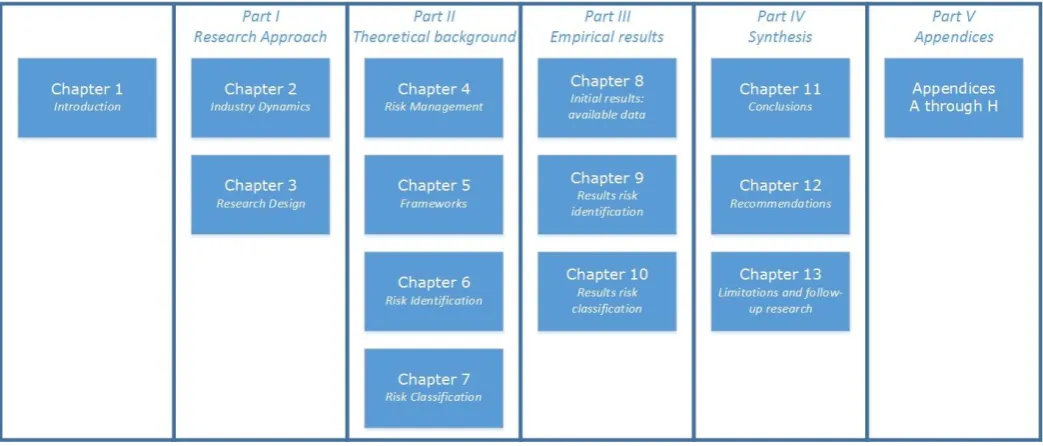
15 discusses three prevalent risk management frameworks. Chapter 6 discusses common risk identification methods and techniques. Chapter 7 discusses four manners of classifying risks that were derived from the literature review. The third part provides the results of the empirical research part of the research. This part contains three chapters. Chapter 8 contains an overview of the initial findings on the six case studies, resulting from an exploration of available data on the case studies. These mainly relate to occurred risks and actual costs. Chapter 9 discusses the empirical results of the interviews that were held in relation to risk identification, which explore the applied risk identification methods by risk managers of VolkerInfra. Chapter 10 follows with empirical results on the risk classification that was made for a number of high-profile risks on the case studies. The fourth part of the research consists of three chapters. Chapter 11 provides an overview of the conclusions that can be made based upon this research. These lead to a number of recommendations that can be made towards VolkerInfra, which are given in chapter 12. The last chapter discusses the limitations of the research, which lead to an advice for follow-up research. The final part contains the appendices, which are numbered A through H. An overview of these chapters is shown in Figure 1.1.
Part I - Research Approach
This part contains a description of all aspects belonging to the research setup; a chapter explaining the current industry dynamics leading to the motive for this research. This is
17
2.
I
NDUSTRY DYNAMICS
This chapter describes the developments and current dynamics in the construction industry that have indirectly led to this research project. It is divided into two sections. The first section describes the external developments in the market, which have an effect on all organizations in the construction industry and specifically for risk management with contractors. The second section describes the subsequent consequences for VolkerWessels and how the external changes have affected their organization and led to the demand of VolkerInfra for an increased focus on risk management.
E
XTERNAL DEVELOPMENTS
The latest quarterly report (Q4, 2015) from the 'Centraal Bureau voor de Statistiek' (Central Bureau for Statistics, CBS) about the 'Kwartaalmonitor bouw' (Quarter monitor of the construction sector) shows a fifth consecutive quarter with increased production in the construction industry as a whole. It also shows an increase in turnover of more than 5% average compared to a year earlier (Centraal Bureau voor de Statistiek, 2016). However, the prospects in the infrastructure sector specifically are much worse. They have an expected decrease in workload of 17%, even up to 55% in the province of Drenthe (Zwaga, 2015). At the same time prices in the ground- water- and road construction (GWR) sector are decreasing, which pressures the, already low, pricing in that sector. The prices have practically been stable since the beginning of 2012 and current prices are even slightly below that price level (Centraal Bureau voor de Statistiek, 2015). This puts even more pressure on the turnover of companies in that sector and increases competition. This resulted in more bankruptcies and less jobs in the sector and a decrease in turnover in the GWR-sector of 9% (Centraal Bureau voor de Statistiek, 2016). It also resulted in a workload decrease of GWR-companies of 27% compared to a year earlier (Doodeman, 2016). This is partly due to the slow recovery of the financial crisis in the construction industry and due to budget cuts in all layers of the government and the following decrease in governmental investments in infrastructure.
Another development in the construction industry entails the increasing transfer of risks from clients to the contractors. The largest governmental client in the construction industry in the Netherlands, Rijkswaterstaat, is facing budget cuts and has to slim down their organization. Due to these budget cuts and the ambition to better respond to the market, Rijkswaterstaat has introduced the 'Markt tenzij' ('Market unless') - principle, by which they increasingly transfer tasks and responsibilities, and thus corresponding risks to the market (Rijkswaterstaat, 2015). Anything that can be done by the market, should be done by the market is the philosophy, resulting in the phrase 'the market is responsible unless…'. Another large public client, ProRail, is increasingly working with long-term maintenance contracts that also transfer most risks and responsibilities to the market for a longer period of time, 10 years in the latest performance-based maintenance contracts (SpoorPro.nl, 2014).
are required to deliver complete products, not only the road itself, but a complete product in the form of the road, road markings, installations, lightning, roadsides etc. This requires the integration of multiple disciplines. For the large projects that VolkerInfra manages even more so, these are often combinations of large GWR works and civil constructions. Many of the specific tasks included in large projects (for example piling and braiding of reinforcements) are executed by sub-contractors, adding an extra layer in the organization and increasing the management tasks and responsibilities and thus the risks.
The increased contract durations and integration of project phases and work in large construction organizations motivate contractors to make specific investments for projects to reduce overall costs. It also offers opportunities for the contractors to develop innovative solutions in early stages of the project, since the longer project duration makes that worth it. This increased duration and complexity however, also means that risks are increasingly transferred to the market as well, which is not necessarily a good thing. It requires more knowledge with contractors and close monitoring of project progress in order to successfully manage projects. It is not guaranteed that contractors are ready for these changing market conditions in the short-term. When unforeseen events do happen, the consequences are often costly and will require long-term experience to manage effectively. There is a recent example in the construction industry that illustrates the possible negative consequences. Contracting company Ballast Nedam got into deep financial problems, mainly due to unexpected cost overruns on two large infrastructure projects, the A2 Passage Maastricht (Design & Construct) and the A15 Maasvlakte-Vaanplein (DBFM) (ANP, 2015). The A-Lanes-A15 consortium only recently reached agreement on a settlement between them and Rijkswaterstaat after a lengthy discussion on the matter (Battes, 2016). Ballast Nedam had to resort to an international takeover by the Turkish construction company Renaissance. They were forced to accept an extremely low offer of only € 6 million for 95% of the company’s shares in order to survive, penalizing other shareholders that saw the value of their shares decrease by over 91% (Dobber, 2015).
These problems go hand in hand with the pressure on prices in the industry and the financial crisis from which the construction industry has only recently started to recover. Construction companies currently often tender below the normal market prices in order to sustain enough turnover to survive in the first place (Profnews, 2015), while at the same time they have to bear increased risks and responsibilities (Battes, Staat speelt bouwsector genadeloos uiteen, 2015).
19 by RWS (Battes, Rijkswaterstaat maakt knieval voor bouwers, 2015). Furthermore, to prevent future conflicts between contractors and Rijkswaterstaat on large infrastructure projects, a common ‘market vision’ has been developed by Rijkswaterstaat and their most important contractors. This market vision contains a number of principles to improve relations between the client and the contractors and increase transparency on risks and problems (Clahsen, Rijkswaterstaat en bouwsector lanceren nieuwe werkwijze om 'vechtcontracten' uit te bannen, 2016). This means for example that the price is subordinate to quality, meaning that contractors are involved in the entire preparation phase of projects and potential candidates are selected based on their added value to the project and not on price. For example, for the Nijkerkerbrug renovation, the price was not determined until only one candidate was left for the tendering of the project, indicating a focus on quality and added value (Clahsen, Nieuwe werkwijze Rijkswaterstaat wordt langzaam tastbaar, 2016).
These market developments show that the modern construction industry requires a high level of proficiency of, among others, risk management. It also shows that effectively managing and monitoring these risks is more important than ever.
I
NTERNAL RESPONSE
As stated in the introduction, VolkerInfra is a relatively young project management company, founded in 2006. The company was founded in part due to the changing demands from the market and the increased use of large, integrated contracts by important clients. Due to the historically fragmented and independent nature of the operating companies of VolkerWessels, some of the operating companies struggled with the relatively new and large integrated contracts in the industry. The need arose for some of the operating companies to combine their knowledge and expertise in project management, in order to enable them to deal with larger, integrated contracts.
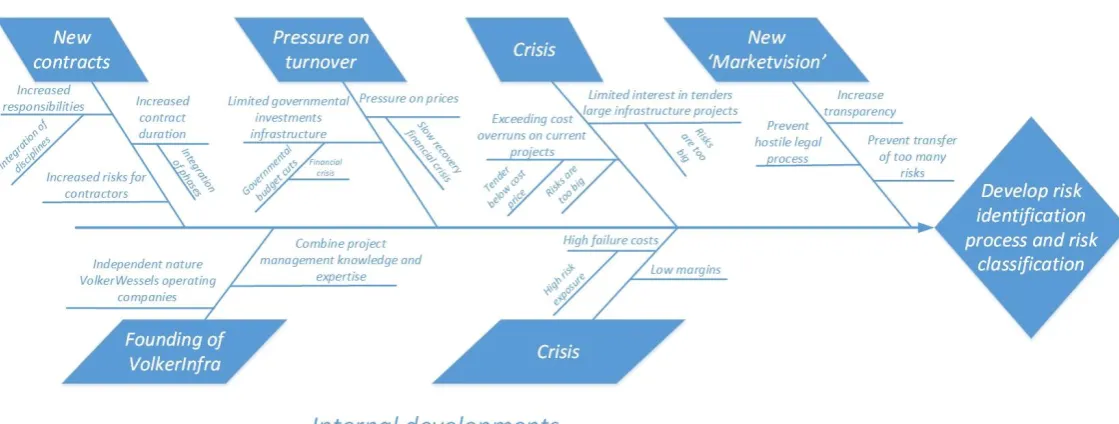
Figure 2.1 - Diagram external and internal developments in time
[image:20.595.20.580.144.356.2]OVERVIEW
21
3.
R
ESEARCH DESIGN
This chapter describes the research design for the master thesis project. It starts by delimiting the scope of the research, after which the specific research problem is defined. Furthermore the research objective and research questions are stated. Finally the applied research methodology is described.
SCOPE
This section defines the research in terms of its intended scope. The delimitation of the scope is done in a comprehensive manner, step-by-step in the subsequent sub-sections. It is the result of an extensive preparation period, which was required since the specific research focus and scope was not yet clearly defined at the start of this research. The preparation period consisted of gathering preliminary case-data and a series of exploratory interviews with experts within VolkerInfra. This exploratory process is further described in the research methodology in section 3.5. The research is done for VolkerInfra and their scope as a company is the starting point of this research.
VolkerInfra’s task within the VolkerWessels concern consists of project- and process- management and related tasks on large infrastructure projects. Their target market within the construction industry consists of two focuses. The first lies with large-scale integrated construction projects, in which the integral aspect is the central characteristic. Either or both different disciplines (e.g. GWR and Civil) or project phases (e.g. design and construct) have to be integrated in a single project for VolkerInfra to become involved. These projects are therefore generally long-term and high value. They generally concern the initial preparations of the tender until the end of the execution or even longer when a maintenance phase for the project is included. The second lies with long-term maintenance only projects, in which VolkerInfra is responsible for the maintenance of infrastructure objects or assets for a longer period of time. These projects are mainly related to the asset management activities of VolkerInfra.
As was made clear in the previous chapter, the construction industry currently struggles with the responsibilities that accompany the execution of large-scale infrastructure projects. The focus of this research is therefore not on the maintenance projects of VolkerInfra, but on their integrated, large-scale execution projects. There are a number of integrated disciplines and objects present in each of these projects, which will be described in the subsequent sub-sections in order to further limit the scope of this research. Firstly however, the project focus will be further illustrated in the first sub-section.
3.1.1.VOLKERINFRA:A PROJECT FOCUS
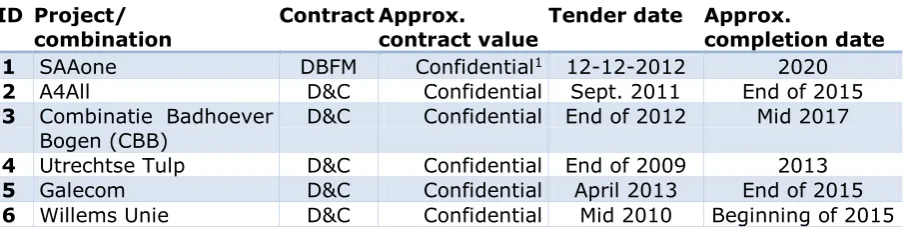
In consultation with VolkerInfra, six projects, either recently completed or still in the execution phase, have been selected to serve as case studies for this research. These have been used to obtain relevant data and make comparisons between them. An overview of the selected case studies is shown in Table 3.1.
Table 3.1 - Overview of selected case studies
ID Project/
combination Contract Approx. contract value Tender date Approx. completion date
1 SAAone DBFM Confidential1 12-12-2012 2020
2 A4All D&C Confidential Sept. 2011 End of 2015 3 Combinatie Badhoever
Bogen (CBB) D&C Confidential End of 2012 Mid 2017 4 Utrechtse Tulp D&C Confidential End of 2009 2013 5 Galecom D&C Confidential April 2013 End of 2015 6 Willems Unie D&C Confidential Mid 2010 Beginning of 2015
More details on each of the six cases included in this research are given in appendix B. The central case study in this research is the SAAone project. The SAAone project has its own organizational structure, a VOF, as shortly introduced in the introduction. SAAone is being used by VolkerInfra as a pilot project, where innovations can be invested in and tested and in that capacity SAAone is also client for this research. Rijkswaterstaat is, or has been the client for all of these projects. All of them are executed by a combination of multiple contractors, in which VolkerInfra also participates. These combinations are organized in specific integrated construction organizations, which are discussed in the following sub-section.
3.1.2.INTEGRATED CONSTRUCTION ORGANIZATIONS
The third column in the overview of case studies in Table 3.1 shows that VolkerInfra provides its services in different contracts. These contracts relate to the form in which the project is organized and is called construction organization forms. These are organizational structures that establish the responsibilities of the contractor. The organizational forms that VolkerInfra is involved in are integrated construction organizations. These are construction organizations in which the contracting party is responsible for multiple phases of the project, which is subsequently legally established, hence the term ‘contract’2. These construction organizations are embedded in fully operational organizational structures, in the form of separate companies or combinations. These construction organizations are often also responsible for combining multiple disciplines, e.g. GWR and civil (concrete construction), in one project, which adds an additional dimension of interfaces and responsibilities. Traditional construction organizations consisted of a specification of the entire project in detail and there were separate contracts for design and construction phases of a project. Integrated construction organizations combine these phases and responsibilities in a single organization and contract for a single contracting party or combination of parties.
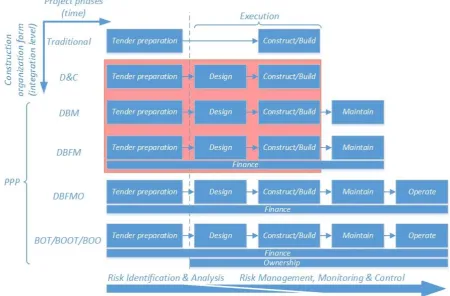
There are a number of different integrated construction organization forms, with increasing integration of project phases and responsibilities. This research focuses on Design & Construct (D&C)3 and DBFM construction organization forms, since these currently are the
1 Confidential values
2 Construction organization forms and contract forms are often confused and therefore discussed here.
3 The concepts Design & Construct (D&C) and Design & Build (D&B) are interchangeable, but in practice used for
23 main focus of VolkerInfra and are the organizational forms used in the chosen case studies. Design-, Build- and Maintain- (DBM) projects are not very common in infrastructure projects in the Netherlands, but some examples can be found, e.g. the older Westerscheldetunnel construction project. These are not part of the scope of this research.
There are also Design-, Build-, Finance-, Maintain-, and Operate- (DBFMO) – construction organizations. In these organizations, the ‘operation’ part means that the contractor is also responsible for exploiting the network through network management to generate income to earn back the initial investment. This means that the contractor is given a concession to exploit the network to generate income, which is the main difference with DBFM- organizations (Vlaams Kenniscentrum PPS, 2009). In the Netherlands this is generally only applied for some building & utility projects, e.g. the National Military Museum in Soest. This type of construction organization is generally not applied for infrastructure projects in the Netherlands. This is because the operation of infrastructure is more of a public service and because it is part of a larger network and is therefore difficult to split up. For example, the traffic service operation, which guides the matrix signs above the highway, need to be operated from a central location, since decisions on one part of the road influence the others in the network. Operating buildings for example is more separable than part of a road. In Dutch infrastructure projects, the operation task therefore generally remains a strictly public responsibility. Income for the private partners is generated by the public body and the private partners earn back their investment through availability payments during the projects’ life-cycle, depending on availability of the infrastructure facility (Lenferink, Tillema, & Arts, 2013) (Jansen, 2009). Initial funding usually comes from a combination of banks, private investors and the contractors themselves, which is then earned back over time.
In other countries there are some other organizational forms that are commonly used, that are comparable to DBFMO. Examples are Operate-Transfer (BOT) projects, Build-Own-Operate-Transfer (BOOT) projects and Build-Own-Operate (BOO) projects. Aside from the concession to generate income from the network, these differ from DBFM in that they also transfer ownership of the network to the contractor for the duration of the contract (Kenniscentrum PPS, 2008). This transfer of ownership is not used in the Netherlands, since the government wants to have unrestricted control over the object in the event of bankruptcy of the contractor (Kenniscentrum PPS, 2008). These are therefore not part of the research scope since they are not applied in the Netherlands and thus not part of the target market of VolkerInfra.
Some of the construction organizations discussed above can be grouped under the heading Public-Private-Partnership (PPP). For the Dutch national government, PPP projects are the DBFM and DBFMO projects (Rijksoverheid, sd). These will be applied when the contract value of infrastructure projects is above € 60 million and the two tools Public-Private-Comparator and Public-Sector-Public-Private-Comparator indicate that a form of PPP is more effective than traditional procurement methods. Sometimes also DBM projects are considered under the PPP-heading as a ‘light’ variant (PPS Netwerk Nederland, sd). Generally speaking the PPP-heading indicates a high level of transparency between the client and the contractor and a close cooperation between them.
DBFM
DBFM, as integrated construction organization forms, are part of the target market of VolkerInfra and will therefore be an important type of organizational form in their activities. DBFM is an integrated construction organization in which a private party (or combination of private parties) is responsible for design, construction4, financing and maintenance of a project and in this research relevant: for an infrastructure project. A DBFM construction organization is mainly different from other types of integrated construction organization forms because the 'finance' and ‘maintenance’ phases are included in the contract. This can be a good solution when the client itself does not have enough initial capital available, while private funding still ensures that the project can be executed (Jansen, 2009). It also reduces the number of involved parties and therefore the number of interfaces and corresponding complexities and risks. Furthermore it is characterized by the transfer of risks and responsibilities to the party that is the most able to control and bear these risks, which generally means the contractor, combination or consortium responsible for the project. Some specific risks may however remain with the client, depending on the specific arrangements made. The combination or consortium usually sets up a Special Purpose Vehicle (SPV) or Special Purpose Company (SPC), in which the participating companies are the shareholders and which is specifically designed as a separate legal entity for the project. The SPC has the task of handling the financing of the project, but is usually only used as a service-hatch that transfers the other phases of the project to an Engineering, Procurement and Construction (EPC) or Engineering, Procurement, Construction and Maintenance (EPCM) company, designated for the execution of the project. This, in theory, keeps the SPC itself free of project execution risks.
D&C
The second type of integrated construction organization form that VolkerInfra mainly deals with is D&C. In a D&C construction organization, the contracting party is responsible for the design and construction phases of a project. Because of its integrated form, there is also only one party responsible for the design and construction phase of the project. This gives the same interface advantages as for the DBFM construction organization described above and improves the alignment of the design and construction phases. However, maintenance and finance are not part of the agreement, which has advantages for the contracting party. In a D&C construction organization, risks are not all transferred to the contracting party and the client usually specifies the object that is to be built in a functional way. This leaves room for innovations by the contracting party, while still ensuring that the project meets the functional requirements set by the client. Additional advantage for the contractor is that payment for the project does not depend on availability of the project, as is the case with DBFM construction organizations in the Netherlands. The D&C agreement still transfers the design responsibilities to the contracting party, whom therefore still is legally responsible for those and the project keeps its integrated character.
4 In this research the term 'construction phase' will apply for the build phase of a DBFM. This is done to prevent
25 Project phases
As well as differing responsibilities in integrated construction organizations, a number of corresponding phases can be identified in these projects. The research focuses on specific phases of construction projects, which are described below and shown in Figure 3.1.
The first part consists of the tender preparation phase, which considers the internal preparation of the contractor for a tender bid. This part also considers the link between the tender- and execution-phase (the design and construct phases combined5). With the link between the tender phase and the execution phase, it is meant, how the tender phase influences the execution phase. This link is valuable for this research since errors in the transition between both phases can have severe consequences for the project objectives and thus for the 'best for project' philosophy of VolkerInfra. For example when risks are incorrectly transferred from the initial risk register (tender phase) to the final risk database in the execution phase (for further information, see sub-section 3.1.6). This phase also sets the basis on which the rest of the project is carried out, see chapter 6 on the importance of early risk management.
The second part consists of the execution phase itself. The focus lies on the execution phase itself, because that phase usually has the highest turnover (the phase in which the money is spent) and has the highest failure costs. This phase determines the final quality of the end-product and therefore also determines the corresponding required maintenance strategy. This phase relates to the actual execution and control of the project, which needs to comply with decisions made during the tender phase.
The phase that is not included in this research is the maintenance phase:
The maintenance phase of the long-term projects is not included in the scope of this research. This is because the first DBFM infrastructure projects have only recently been completed and there is little experience with that phase of projects in the Netherlands. Furthermore, during long-term maintenance phases, there is a cycle that is repeated every year or every few years, with a corresponding recurring cycle in budget and a learning curve over time. Therefore the maintenance phase is substantially different from the rest of the project execution. The quality of work during the execution phase partly determines the required work during the maintenance phase. Furthermore, the interest generated over the longer time period during the maintenance phase generates a different type of turnover, requiring different management strategies and is therefore not included.
5 The design and construction phases in large contracts often partly run parallel, as well as part of the design
Advantages & Disadvantages
One of the major theoretical advantages of these large integrated construction organizations is that they offer room for the client to profit from the innovation capabilities of the market. Because the contractor is involved from the beginning of the project, it is possible to make use of the innovation capability of the market. The contractor is able to invest in innovations and thus provide better solutions, since he has a better understanding and a longer connection to the project. For example, innovative design solutions can save money during the execution phase of the project. It becomes possible to profit from these investments in the long run since the longer contract durations allow for an improved cost recovery model. These innovations may be costly in the beginning, but because of improved future prospects these can be profitable, thereby providing an incentive for the contractors. This should give a boost to the innovation capacity of the construction industry, promote the distinctiveness of construction companies and lead to cheaper solutions for large infrastructure projects. However, whether this goal is achieved, is difficult to say. Because of increased risks with contractors due to increased responsibilities and complexities, the projects not always turn out to be cheaper. Increased complexity is the main disadvantage of these organizations. It emphasizes the importance of proper management on these projects.
[image:26.595.71.522.80.376.2]Another advantage includes that the client only has to deal with one contracting party, which is responsible for the entire project. This reduces interface risks between traditionally separated project phases and disciplines since only one party is responsible. It also reduces coordination tasks and thus costs. Furthermore combining project phases in one construction organization usually results in a shorter overall project duration. Risks are for the most part transferred to the contracting party as well. Exceptions can be made for specific subtasks in the contract itself, but these are not part of the scope of this research,
27 since they are too specific. Major disadvantage of these integrated construction organizations is the high increase in transaction costs when the contractor is found inadequate and another has to be selected.
3.1.3.PROJECT SUCCESS
Generally a project is designed to achieve a strategic objective, which in the construction industry is mostly developed by the client, for example ‘improve the traffic flow between A and B’. These objectives tend to be politically tinted, e.g. when the Secretary of Infrastructure promises the public to ‘tackle congestion’. Operational objectives are often represented by a certain budget and time frame within which the project needs to be completed. The operational objectives are more prone to influence from the contractor as they can have direct influence on it by expenditure and quality of the executed work etc. These operational objectives will therefore serve as the set of project objectives relevant for this research, while the strategic objective is not part of the research scope.
Research presented by B. Flyvbjerg, M.K.S. Holm and S.L. Buhl over the last decade has shown significant cost escalation on large infrastructure transportation projects. Their initial publication (Flyvbjerg et al., 2003) analyzed a sample of 258 projects divided over 20 nations and five continents, with an approximate total value of $ 90 billion. Their statistical analysis showed substantial cost escalation for rail projects (45%), fixed links (34%) and roads (20%). Furthermore, a separate study showed that delays on these large infrastructure projects are very costly, on average leading to 4,64% cost increase per year of delay, after the decision to build (Flyvbjerg et al., 2004). In terms of operational objectives, this indicates a structural tendency for large infrastructure projects to overrun on their operational objectives of budget, time and performance (Flyvbjerg et al., 2009). Flyvbjerg focuses his research on the governance aspect, policy making and planning of large infrastructure projects, which is oriented towards the client side to get approval for funding. His identified causes lie with strategic misrepresentation and optimism bias regarding misinformation about costs, benefits and risks of large infrastructure projects (Flyvbjerg, 2007). But while the client side of project promoting is also important, it doesn’t fully explain the extent to which these objectives are overrun. Therefore, research into the contractor side is needed, to which this research will contribute.
projects that are used as case studies in this research are integrated contracts, these also look towards a more complete life-cycle analysis of the infrastructure and therefore not only the traditional triangle of project objectives applies, but also other objectives of stakeholder satisfaction, safety, environment and sustainability. Winch places the project mission at the heart of the definition of success and combines the traditional iron triangle with a second triangle. The first triangle stands for product integrity, meaning managing the entire project life cycle with appropriate intent. The three points are the quality of conception, concerning the adding of value in the life cycle, the quality of specification concerns the fitness for purpose of the product and the quality of realization, which refers to a second triangle. The second triangle captures the traditional operational objectives of the project, and stands for process integrity which includes management of the process of realization within the project constraints. These are represented by the objectives for time, budget and conformance. Conformance then includes conformance to safety, quality and environmental impact. Achieving both triangles minimizes client surprise and achieves project success. The triangles are shown in Figure 3.2.
Figure 3.2 - Double triangle project success, derived from Winch (2010)
3.1.4.THE RELEVANCE OF RISK MANAGEMENT
Based on the literature review in section 4.1, risk in a project management context is, in this research, defined as:
“Risk is the positive or negative effect of uncertainty on one or more objectives, as determined by its likelihood, consequence and strength of knowledge".
This relation to objectives on projects is also reflected in the different risk management frameworks available in literature, as discussed in chapter 5. Therefore, risk management partly determines the extent to which objectives on projects are met and thus the extent to which project success is achieved. Consequently, this research also needs to assess the effect of risk management on objectives to be able to critically evaluate it.
29 depends on their influence on the project objectives, their relationship with the client or whether it requires an integral approach. Furthermore, VolkerInfra uses the RISMAN (RISk MANagement)-method in their projects to enable quantification of risks by categorization in terms of effects on the project objectives of cost, time and quality and in some projects the additional ones of safety and/or environment and/or image/stakeholder satisfaction that are also mentioned above. The RISMAN-method itself is explained from a theoretical point of view in chapter 5. The way to assess risk management logically relates to all the objectives that are actually used on the projects. This way, risk management can be made tangible and the associating numbers enable the building of a foundation on which conclusions and further research can be based.
However, after initial interviews and an initial analysis of the obtained documents and risk registers from the cases, it is clear that some of the quantified objectives in the RISMAN method differ per project and some are not used consistently for each risk, while they are included in the analysis. The only metrics that are consistently being used for each risk are the probability of the risk occurring, and a quantification of the cost and time for the consequences of that risk. The other objectives are often blank or are covered by other project management aspects:
Safety is a separate process in its own right in most of the projects and has multiple concern-wide campaigns. For example: Wees Alert! Veiligheid Eerst! (WAVE, meaning Be alert! Safety first!) and: No Injuries, No Accidents (NINA). Specific safety risks have their own database on the projects and are therefore not included in the scope of this research.
Stakeholder satisfaction is achieved by short communication lines with the stakeholders, including them early in the project, information evenings/letters and, as for the client, including them in the entire process through specific requirements of auditing, improvement management, systems engineering and regular meetings. Furthermore stakeholder management is, as is safety, a separate process in its own right with dedicated stakeholder managers employed on all of the projects and not included in the scope of this research.
Environmental impact is accommodated in the Milieu Effect Rapportage (MER, meaning Environmental impact study) in early phases of the project and, when applicable, stated in the Economisch Meest Voordelige Inschrijvings –criteria (EMVI, meaning Most Economically Advantageous Tender, MEAT-criteria) during the tender. This usually contains requirements for the CO2-performance-ladder and life cycle analysis. However, this currently has no further role in the risk management process and is therefore not included in the scope of this research.
the performance of risk management has the support of risk managers across VolkerInfra, as it was conceived in joint discussions. It will allow for increased insightfulness of the consequences and thus enable them to convince others of importance of risk management and thus attitude towards risk.
3.1.5.THE RISK MANAGEMENT PROCESS
To define risk management, first management itself is defined. Winch (2010) has based his definition on the context of the management of construction projects and is therefore applicable to this research. He defines management in a project context as: “…moving through the project life cycle is essentially structured sense making”. This is derived from his perception of the main challenge for managers, which he essentially defines as the management of information in the face of uncertainty and in which uncertainty is defined similar as in section 4.1.1. (a state of deficiency of information). Applied to projects, this entails that project managers make decisions in response to the availability of information, while trying to achieve the project objectives. These decisions then yield further information on which future decisions can be made and progressively reduce uncertainty during the project life cycle. The progressive reduction of uncertainty is shown in Figure 3.3. This effect is limited in organizations, as they are not subjective to a life-cycle and is therefore an additional challenge in projects.
[image:30.595.73.396.342.529.2]There are a number of readily available definitions for risk management from differing viewpoints. For example, the ISO 31000:2009 standard defines risk management from an organizational viewpoint: "coordinated activities to direct and control an organization with regard to risk" (Dali & Lajtha, 2012, p. 8). From the viewpoint of decision makers in organizations, risk management may be termed as: "…a comprehensive, systematic process that assists decision-makers in identifying, analyzing, evaluating and treating all types of risks, both internal and external to the organization." (Shortreed et al., 2000, p. 14). From the project management viewpoint, risk management can be defined as: "the entire set of activities and measures that are aimed at dealing with risks in order to maintain control over a project." (Van Well-Stam et al., 2004, p. 1). The two recurring aspects are: coordinated and well thought out activities and maintaining control. Thus, risk management comes down to giving thought beforehand on events that might occur, so that decisions can be made to take early action and develop control measures, while monitoring this process to reduce negative impacts or exploit positive opportunities.
31 ‘Structured’ is used to indicate that sense making is facilitated through structured routines, e.g. standard frameworks and processes. These processes generally consist of the following generic aspects:
Risk identification
Risk analysis (in some works referred to as risk assessment) Risk response
Monitoring and control
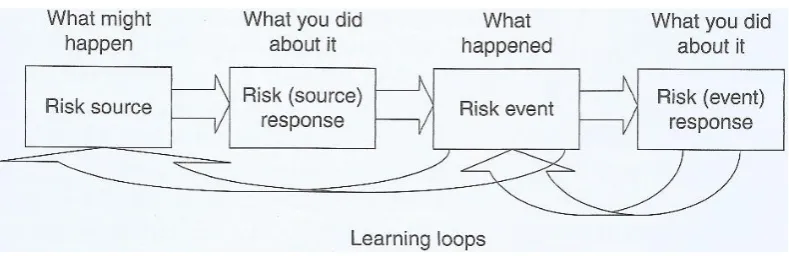
They are often applied in a cyclical manner during the project execution, as is shown in Figure 3.4. These aspects are also mentioned in a similar way by many researchers in this field, e.g.: Bandyopadhyay et al. (1990), Al-Bahar & Crandall (1999), Shortreed et al. (2000), Pipattanapiwong (2004) and Winch (2010). Furthermore, they appear similarly in the frameworks that are reviewed in chapter 5. The generic aspects will be further explained in the following few paragraphs.
Risk identification
This is usually the first step in the risk management process after the project context itself has been established. Risks are identified in relation to the project objectives. This aspect is usually performed by the risk manager, for which several methods and tools can be applied to help this step. These are discussed in more detail chapter 6. This risk identification step results in a risk dossier in which all identified risks are recorded.
Risk analysis
[image:31.595.230.527.183.412.2]After a risk is identified, it is analyzed. This usually means a probability of occurrence, the consequences and other required knowledge are estimated. Consequences are usually divided on the effect on different objectives, depending on which objectives are required on that specific project. As indicated in the previous sub-section, these are usually expressed in time and cost, but some additional objectives may be defined. The analysis can be made quantitative or qualitative, but it is argued that a semi-quantitative approach is most applicable to the construction industry. This is reflected in the proposed approach to risk in the theoretical review in section 4.1 and for example also suggested by Winch (2010) and Chapman (2001). The data that is required for an objective quantitative approach is simply not available, especially in the early stages of a project when the analysis is initially required and available information is limited and uncertainty is high. Therefore a mixed approach is often used, in which data is solicited from experts and therefore subjective. After the subjective data has been obtained for each risk, a probability analysis is done, for example through a Monte Carlo simulation, in which the overall risk profile for the project is established.
Risk response
After the risks have been analyzed, a response can be determined. It will depend on the severity of the risk what kind of action is required and how much will be invested to implement control measures to reduce that risk. The proposed measure needs to reduce the risk with more in terms of costs, than it costs to implement the control measures. I.e.: if a measure is too expensive in relation to the value of the risk itself, it isn’t worth it to implement the control measure. These control measures are aimed at reducing the overall risk profile.
Monitoring and control
After the risk response has been determined and the control measures have been established, the risks need to be monitored and controlled. This mostly means that the project will be monitored by the risk managers. New risks need to be identified when applicable and they need to be added to the risk database. In that case, the identification and analysis steps are repeated. Similarly, when risks can no longer occur, they need to be eliminated from the actual risk profile. The risk manager then needs to keep higher management informed on the actual risk exposure of the project. Furthermore, risks that are being monitored are controlled and the right people need to be informed on the risk exposure.
3.1.6.INITIAL FINDINGS:POINT OF DEPARTURE
As was stated in sub-section 3.1.3, VolkerInfra applies the RISMAN method as main guideline for their risk management practice. However, the complete process per project is more extensive and complex than just the RISMAN method. A generic process has been developed by VolkerInfra, which, theoretically speaking, serves as guideline for the risk management process that is done on projects. This process is schematically shown in appendix C. It contains elements of the generic aspects discussed in the previous sub-section. Details of this process can be changed to comply with specific client demands on different projects. This process is used by different risk managers of VolkerInfra, who are free to interpret this process in a way they see fit on different projects. For example, the exact manner in which the process step ‘identifying risks’ is executed can differ per project and per risk manager, according to client demands and/or preferences of the responsible risk manager.
The generic process more or less prescribes the tasks and/or responsibilities of the risk manager and the interfaces with other main processes step by step. This process can be related to the concept of total project risk. After the preliminary analysis of the six case studies, the process that is used in practice, in the tender and execution phase, can be related to the concept of total project risk. This is shown in Figure 3.5, which shows the relation between the most important aspects of the risk management process and the total project risk and the relative unidentified and identified parts, during the two consecutive project phases. This process in practice is very dynamic, but the figure suffices as an initial, general overview. A few notions on this figure will be made below, based on the analysis of case study data so far, which will be the point of departure for this research.
33 Unidentified risks can occur, in which case they are surprises, since they were
unknown up to that point. They can also not occur, in which case any knowledge that could have been achieved remains unknown. Unidentified need to be divided further, in order to analyze the effectiveness of the risk identification process. Because risks can be unidentified for varying reasons, they are not always the fault of an insufficient risk identification process:
o Risks that could have been identified, but for varying reasons it was not identified, e.g. a lack of knowledge, a lack of resources dedicated to identification, or an insufficient risk identification process. In these cases, the fact that the risk remains unidentified is usually attributable to the contractor.
o Risks that were not identified but resulted from a change of the project scope, e.g. because of changing client demands. These are therefore unable to be identified sooner, in which case they are not attributable to the contractor.
Identified risks can occur, in which case the estimation of the consequences can either be right or wrong. The reserved budget can therefore be sufficient or insufficient. They can also not occur, in which case they are well managed or controlled.
During both relevant phases, the unidentified risks gradually decrease and the identified risks gradually increase. This is represented by the white line that runs through Figure 3.5. The identified risks generally increase faster right after the project has been won in tender than during the tender phase itself, which results in more risks being identified during the execution phase than during the tender phase. This was identified during the preliminary analysis of the case studies and the corresponding results are discussed in chapter 8.
After the risks are identified during tender, they are analyzed. This means that specific numbers in the RISMAN categories (cost, time and sometimes environmental, safety and quality, as discussed in sub-section 3.1.3) are assigned to the risks. These numbers represent the consequences of that risk, if that risk were to occur. For the probability of occurrence, a number is assigned as well. These numbers represent corresponding categories, usually one to five, one being the lowest and five being the highest. Each corresponding category represents a value or range that enables the quantification of the risk. An example of these numbers and their corresponding value ranges is shown in appendix D.
Monte-Carlo simulation. This simulation is used to calculate the final risk budget that will be added to the tender bid price, based on a statistical analysis of the input variables of every identified risk. This statistical analysis is based around two values:
The calculated value, which is the value that is derived from the RISMAN categories. So in the example above, risk X scored 3 on financial consequences, which means that the calculated value is in the € 250,000 - € 500,000 range, see appendix D. For statistical analysis, a specific value or distribution may be required. In practice, this means that either the average value, top value or a triangulation between bottom, mid and top values is used as input. A complete distribution is usually not available and is considered unreliable to use in practice, due to the inherent uncertainty of the assessment. The choice between which specific value is applied, depends on the preference of the risk manager or the requirements on the specific project. This means that either € 375,000 or € 500,000 or a triangulation can be used for risk X.
The expected value, which is the value that is obtained by multiplying the calculated value with the probability of occurrence. So for risk X, it would mean that, if the mid values are used, the expected value is: € 375,000 x 7.5% = € 28,125.
In theory, if a risk occurs, the costs of that risk will equal the calculated value. The expected value is required to generate an indication of the required risk budget. If for each risk the expected value is determined and added together, this should translate into an indication of the budget that covers the likely risks to occur. Because a number of risks will occur and a number of risks will not occur, the combined expected values should in theory be sufficient in most scenarios. However, if any of the input variables are wrong or more of the major risks occur than expected, it can lead to a budget shortfall. This can be caused by the inherent uncertainty that is present when assessing the risks. Therefore, on projects of VolkerInfra, a Monte Carlo simulation is applied. This means that every risk that was identified and assessed is entered. The Monte Carlo simulation then performs a number of runs, for example 10,000. In each run, each risk that was entered has a chance to occur, equal to its probability of occurrence. Each run then has a number of risk occurring and a number of risks not occurring. Because this is done 10,000 times, an indication can be made of the statistical likeliness of different scenarios in which different combinations of risk can occur. Depending on the specific requirements of the project, the final risk budget is determined to be sufficient for anywhere between 70 % and 80 % of the runs that were generated by the Monte Carlo analysis. I.e.: the reserved budget is sufficient for 70%-80% of the runs that were generated by the Monte Carlo analysis. This value is generally higher than the sum of the expected values and therefore a safer and better informed solution.