The Journal of Experimental Biology
ABSTRACT
Infection is an important source of mortality for avian embryos but parental behaviors and eggs themselves can provide a network of antimicrobial defenses. Mound builders (Aves: Megapodiidae) are unique among birds in that they produce heat for developing embryos not by sitting on eggs but by burying them in carefully tended mounds of soil and microbially decomposing vegetation. The low infection rate of eggs of one species in particular, the Australian brush-turkey (Alectura lathami), suggests that they possess strong defensive mechanisms. To identify some of these mechanisms, we first quantified antimicrobial albumen proteins and characterized eggshell structure, finding that albumen was not unusually antimicrobial, but that eggshell cuticle was composed of nanometer-sized calcite spheres. Experimental tests revealed that these modified eggshells were significantly more hydrophobic and better at preventing bacterial attachment and penetration into the egg contents than chicken eggs. Our results suggest that these mechanisms may contribute to the antimicrobial defense system of these eggs, and may provide inspiration for new biomimetic anti-fouling surfaces.
KEY WORDS: Megapodes, Egg infection, Incubation, Eggshell cuticle, Antimicrobial surface, Bacterial attachment
INTRODUCTION
Eggs of all organisms are at risk of infection by microbes, which are ubiquitous and colonize any surface that has nutrients, heat and water available for growth (Singleton and Harper, 1998). Eggs contact microbes through the substrate on which they are laid, through materials in the nest (Mennerat et al., 2009) or directly from the parents’ integument (Bruce and Drysdale, 1994). Bird parents typically maintain their eggs at a stable temperature and humidity during incubation, as these conditions are essential for normal embryonic development (Deeming, 2002). However, most microbes grow optimally under similar conditions (Madigan and Martinko, 2005); thus, avian nests during incubation provide an ideal environment for bacterial proliferation.
Diverse sets of pathogenic and non-pathogenic microorganisms have been identified on feathers and nests (Shawkey et al., 2005; Shawkey et al., 2006; Shawkey et al., 2009), including some of biomedical importance like Staphylococcus, Bacillus, Salmonella,
Klebsiella, Enterococcus and Enterobacter(Literák et al., 1995; Singleton and Harper, 1998; Mills et al., 1999; Berger et al., 2003;
RESEARCH ARTICLE
1Department of Biology and Integrated Bioscience Program, University of Akron, Akron, OH 44325-3908, USA. 2Environmental Futures Centre, Griffith University, Nathan, QLD 4111, Australia. 3Institut des Molécules et Matériaux du Mans, UMR CNRS 6283, Université du Maine, Faculté des Sciences, Avenue Olivier Messiaen, 72085 Le Mans Cedex 9, France.
*Author for correspondence ([email protected])
Received 13 October 2013; Accepted 19 November 2013
Peralta-Sánchez et al., 2012). Pathogens pose a threat to egg integrity, as infection decreases embryonic viability (Cook et al., 2005a; Cook et al., 2005b), and are considered one of the main causes of embryonic death (Davies and Baggott, 1989; Pinowski et al., 1994; Deeming, 1995; D’Alba et al., 2011).
Because they impose severe costs and decrease their host fitness, microbes have selected for a diverse set of parental defense mechanisms. Two primary components constitute typical eggs’ natural defenses against microbes: the eggshell, a physical barrier, and a system of chemicals that includes endogenous antibacterial proteins in the egg white and eggshell membranes (Board and Tranter, 1995; Hincke et al., 2008). Critically, incubation itself also strongly decreases bacterial growth on eggs (Cook et al., 2003; Cook et al., 2005b; Shawkey et al., 2009), either through activation of antimicrobial peptides in the shell (Wellman-Labadie et al., 2008) or through active drying of the eggshells during incubation (D’Alba et al., 2010a).
Although the eggshell presents a considerable barrier to microbial passage, it is permeated by thousands of microscopic pores that allow gas and water exchange (Balkan et al., 2006), in turn providing a pathway for bacterial contamination of egg contents (Board and Tranter, 1995). Thus, infections can occur through changes in the incubation environment (Cook et al., 2003). For example, increases in nest humidity and/or sudden fluctuations in temperature can enhance the risk of contamination through an increase in total bacterial load (Messens et al., 2005; De Reu et al., 2006).
Eggs of the family Megapodiidae potentially face one of the highest risks of egg infection among birds, because their eggs are not parentally incubated (Booth and Jones, 2002) and instead are laid in large mounds where the heat for incubation is produced by microbial decomposition of organic matter (Jones, 1988a). Despite incubating their eggs in these conditions, only about 9% of Australian brush-turkey (Alectura lathami, Gray) eggs become infected (Jones, 1988b). This remarkably low infection rate suggests either that the majority of bacteria in these mounds are non-pathogenic or that these eggs have a potent antimicrobial defense that is, to our knowledge, unstudied.
The proportions of pathogenic and non-pathogenic bacteria in megapode mounds have not yet been investigated, but known egg pathogens like Pseudomonas, Enterobacter, Klebsiellaand Serratia
are generally abundant in compost and soil (Beffa et al., 1996; Boulter et al., 2002; Santamaría and Toranzos, 2003). Evidence of defense mechanisms has been found previously (Board et al., 1982), where the presence of an unusual outer layer of calcium phosphate spheres outlining the cuticle in eggs of the megapode species Malleefowl (Leipoa ocellata) was briefly noted. The authors speculated that this layer was an adaptation to avoid microbial colonization of the eggs, but this hypothesis has never been tested and no other attempt has been made to elucidate the antimicrobial defense system in megapodes.
Antimicrobial properties of a nanostructured eggshell from a
compost-nesting bird
The Journal of Experimental Biology
Here, we describe the structure of brush-turkey eggshells and testthe hypothesis that their topography is responsible for decreasing bacterial attachment and/or penetration. Additionally, we test whether these eggs have high concentrations of antimicrobial proteins in their albumen as additional protection against infection.
RESULTS
Physical and chemical properties of the eggs
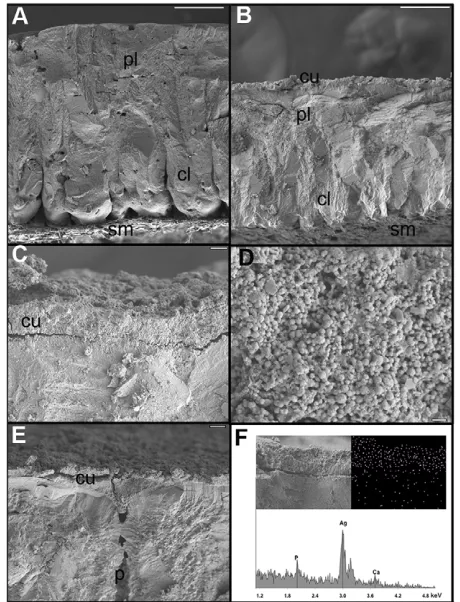
Brush-turkey eggshells are 1.5 times thinner than chicken eggshells (t=39.2, d.f.=18, P<0.001; Fig. 1A,B). Moreover, they show a
distinctive morphology and arrangement of nanospheres on the cuticle. The spheres are on average 340±11.24 nm in diameter and form a layer 16.7±0.73 μm thick (Fig. 1C,D). The spheres often plug the shell pores (Fig. 1E). Energy-dispersive X-ray spectroscopy (EDX) analysis detected a peak concentration of phosphorus in the spheres layer (Fig. 1F).
We recorded a pH of 9.4 and 9.2, respectively, in chicken and brush-turkey albumen. Lysozyme concentration in brush-turkey eggs (2.15±0.17 mg ml−1) did not differ from that in chicken eggs
(2.58±0.31 mg ml−1) (t=1.23, P=0.23).
Brush-turkey eggs approached superhydrophobicity, with a contact angle nearly twice that of chicken eggs (135.28±2.65 versus 66.55±3.20 deg, t=16.51, P<0.001; Fig. 2A). Hysteresis of brush-turkey shells was on average 27.49 deg and did not differ from hysteresis of chicken shells (t=0.38, P=0.73; Fig. 2B).
Antimicrobial efficacy
A significantly larger number of Pseudomonas aeruginosa and
Escherichia colicells were attached to chicken shells than to brush-turkey shells (Table 1; Fig. 3). The total count and density of
Staphylococcus aureuscells on chicken and brush-turkey shells (Table 1; Fig. 3) did not significantly differ.
Bacteria penetrated the eggshell of chickens after only 2 days, and the peak of penetration occurred between days 4 and 6 of the 12 day assay. Overall, chicken eggs had higher penetration rates than brush-turkey eggs (P. aeruginosa, χ2=22.03, d.f.=1, P<0.01; E. coli,
χ2=5.38, d.f.=1, P=0.02; Fig. 4). The risk of penetration increased
with time and was 88% and 68% higher (P. aeruginosaand E. coli, respectively) for chicken eggs than for brush-turkey eggs (P. aeruginosa, Wald=10.57, P=0.01: E.coli, Wald=3.98, P=0.04;
A
B
150
100
50
0
Contact angle (deg)
Contact angle hysteresis (deg)
60
50
40
30
20
10
Chicken Brush-turkey Chicken Brush-turkey
Fig. 1. Cross-sectional scanning electron micrographs (SEMs) of chicken (A) and brush-turkey (B–F) eggshells.(A) Full cross-section of chicken eggshell, (B) full cross-section of brush-turkey eggshell; scale bars, 100 μm. (C) Sphere layer covering the palisade layer of shells; scale bar, 10 μm. (D) Detail of spheres on the surface of freshly laid eggs; scale bar, 1 μm. (E) Pore canal plugged by sphere layer; scale bar, 10 μm. (F) Graphic representation of net peak intensities generated by EDAX analysis of sphere layer; upper panels show phosphorous dot map. pl, palisade; cu, cuticle; cl, cone layer; sm, shell membrane; p, pore canal.
[image:2.612.56.286.60.361.2]Fig. 2. Comparison of hydrophobicity and contact angle hysteresis of chicken and brush-turkey eggs. (A) Hydrophobicity (measured as contact angle, θc) of chicken and brush-turkey eggshells. (B) Contact angle hysteresis of eggshells was measured as the difference between advancing and receding angles of the water drop. Pictures in B show droplets on egg surfaces when tilted at 90 deg.
Table 1. Results from attachment assays: comparison of bacterial count and density on chicken and brush-turkey eggshells
Total cell count Cell density (cells μm–2)
Pseudomonas aeruginosa
Chicken 493 6.29E–02
Brush-turkey 124** 2.24E–02** Escherichia coli
Chicken 2718 1.29E–02
Brush-turkey 882* 2.79E–03 Staphylococcus aureus
Chicken 11 1.28E–03
Brush-turkey 12 1.37E–03
[image:2.612.312.567.84.193.2] [image:2.612.45.422.584.741.2]The Journal of Experimental Biology
Fig. 4.). There was no effect of trial number on penetration rate bythe two bacterial strains (P>0.05).
No eggshells were penetrated by S. aureusin any of the two trials.
DISCUSSION
Australian brush-turkeys incubate their eggs through microbial decomposition of organic material, leading to extremely high bacterial abundance near their eggs. Here we showed that the surface topography of brush-turkey eggs, determined by the presence of nanoscale spheres composed of calcium phosphate, renders the eggs hydrophobic, decreases bacterial attachment and is most likely the major component preventing trans-shell penetration.
Elemental analysis showed high concentrations of phosphorus on the layer of spheres of the brush-turkey cuticle, which likely corresponds to the presence of calcium phosphate (Board, 1982). A cuticle composed of calcium phosphate is rare compared with the more common calcium carbonate (vaterite) or the most ubiquitous organic cuticle (glycoprotein), and has only been found in eggshell cuticles of greater flamingos and guinea fowl (Tullett et al., 1976), grebes (Board et al., 1984) and Mallee fowl (Board et al., 1982). Unlike glycoproteins and vaterite, calcium phosphate does not dissolve in water and thus would not be easily destroyed by exposure to rain or mud in the nest. More importantly, unlike
organic cuticles, an inorganic composition could resist digestion by bacteria or fungi, which are common under conditions of high humidity (Board et al., 1979) and likely prevalent in megapode mounds.
The surface of brush-turkey eggs approaches superhydrophobicity, similar to that which imparts self-cleaning properties in lotus-leaves, on which water forms droplets and rolls off the surface (Feng et al., 2002). However, unlike lotus leaves, brush-turkey eggs have high hysteresis, meaning that the water droplets remain pinned to the surface and thus do not roll off. Similar effects have recently been found in rose petals [the ‘petal effect’ (Feng et al., 2008)] and other plants (Chang et al., 2009), which the authors attribute to trapping of the water droplet (‘Cassie impregnating wetting state’) by micropapillae on the surface or hydrophobic chemicals (Chang et al., 2009). The petal effect on brush-turkey shells may trap condensed water at discrete points, preventing it from spreading uniformly over the surface and thereby inhibiting biofilm formation (Shawkey et al., 2009). Additionally, the geometry of a droplet ensures that little water is in direct contact with the shell surface, effectively isolating bacteria above it. Chicken eggshells showed high hysteresis in addition to hydrophilicity, meaning that water droplets spread to larger extents and remain adhered to the surface. Thus, bacterial mobility and
A
B
C
8060
40
20
0
1000
800
600
400
200
0
4
3
2
1
0
Cell count
E. coli
P. aeruginosa
S. aureus
Chicken Brush-turkey
The Journal of Experimental Biology
associated opportunity to encounter pores for penetration into theeggshell is more limited in brush-turkey than in chicken eggshells. This modified surface also appears to limit bacterial adhesion, as Gram-negative bacteria P. aeruginosa and E. coliattached with greater frequency to chicken shells than to brush-turkey shells. As with hydrophobicity, both eggshell topography and eggshell chemistry could contribute to this effect. Several studies have shown that the hydrophobicity and topography of a surface, e.g. an increased roughness (Arnold and Bailey, 2000) or nanostructural arrangements (Schumacher et al., 2007), decrease bacterial attachment in man-made and natural materials (Busscher and Weerkamp, 1987; Margel et al., 1993; Prime and Whitesides, 1993; Taylor et al., 1997; Wiencek and Fletcher, 1997). Thus, the eggshell topography of brush-turkeys may represent a way to prevent bacterial growth and potentially microbial infection without the use of chemicals, providing a new method for prevention of fouling on surfaces. Future work will determine the exact mechanism of attachment restriction by the spheres in megapode eggs through both characterization and biomimicry.
By contrast, S. aureusshowed very low attachment to both kinds of eggshells. Staphylococci are known for their preferential ability to attach to certain surfaces like plastic and human tissues where proteins such as fibrinogen or fibronectin are found (Otto, 2008). Differences in bacterial attaching capabilities depend on several factors, including the presence of filamentous pili on the surface of the cell that are directly involved in the initial attachment to abiotic surfaces. Pili are present inP. aeruginosaand E.colibut not in S. aureus(Proft and Baker, 2009), potentially limiting their adhesive ability.
Finally, and most importantly, in all cases P. aeruginosaand E. coli(highly mobile infectious strains) penetrate chicken eggs more frequently and rapidly than brush-turkey eggs. Although gram-positive bacteria are the dominant flora of eggshells (Board, 1995), gram-negative bacteria are the most common contaminants of egg
contents (Clay and Board, 1991; Board, 1995). Thus, the defense system of brush-turkey eggs, largely based on a modified eggshell surface, may help to prevent what would otherwise be a common cause of embryo mortality.
By contrast, lysozyme concentrations did not differ from those found in chicken eggs, suggesting that the brush-turkey albumen might have a similar or at least not more potent bactericidal capacity. A few studies have quantified antimicrobial proteins in eggs of birds in the wild and have reported a wide range of lysozyme concentrations, e.g. 0.65±0.76 μg ml−1in blue tits (D’Alba et al.,
2010b) compared with 5.91 mg ml−1in the green-rumped parrotlet
(Forpus passerinus) (Shawkey et al., 2008). It has been hypothesized that concentration of antimicrobial proteins in the eggs should increase with the risk of egg infection (Shawkey et al., 2008; D’Alba et al., 2010b). However, only one study so far has identified a pattern consistent with this hypothesis, i.e. the presence of more potent antimicrobial proteins in the eggshells of cavity-nesting versus open cup-nesting Anseriform species (Wellman-Labadie et al., 2008). Deposition of antimicrobial proteins in eggs is not a costly investment for mothers (Shawkey et al., 2008); however, it is possible that an increase in their content conflicts with the existence of different developmental demands of the embryos, including optimal water uptake, gas exchange, mobilization of nutrients within the egg and structural support to growing embryos (Board and Fuller, 1974). Inhibiting growth of pathogenic bacteria on the outer surface of the egg might be a more efficient way to prevent infection without compromising the properties of albumen.
Eggshell cuticles containing vaterite nanospheres have been noted (but not studied) on eggshells of six species including the double-crested cormorant (Phalacrocorax auritus), emperor penguin (Aptenodytes forsteri), great frigatebird (Fregata minor), hamerkop (Scopus umbreta) and smooth-billed ani (Crotophaga ani) (Mikhailov, 1997). The majority of these species incubate eggs in wet environments, where microbial abundance is likely high,
A
B
C
D
20
15
10
5
0
2.5
2.0
1.5
1.0
0.5
0
0.8
0.6
0.4
0.2
0
Count
Cumulative penetration risk
Brush-turkey Chicken Brush-turkey Chicken
2 4 6 8 2 3 4 5 6 Time (days)
20
15
10
5
0
The Journal of Experimental Biology
suggesting that they may perform a similar function. Comparativework on eggs of other species in high-risk nesting habitats and biomimicry of this potentially useful structure will be a fertile ground for research.
MATERIALS AND METHODS Egg sampling
We collected 10 eggs from different Australian brush-turkey mounds located at suburban sites in Brisbane, Australia, during September 2011. Mound excavation and egg collection were performed under license by the Queensland Department of Environment and Heritage. We candled eggs at mounds to ensure that they were at early stages of development. We transported the eggs to the laboratory at Griffith University and kept them at 4°C. We used domestic chicken eggs (obtained directly from nests at Brunty Farms, Akron, OH, USA) as controls in all tests because (a) their cuticles lack nanospheres, (b) their microbiology is well understood (e.g. Board and Fuller, 1994) and (c) mechanical and chemical removal of the cuticle from brush-turkey shells compromised the integrity of the remaining shell.
We opened the eggs under sterile conditions within 24 h of collection. Egg
contents were separated and a 4 ml sample of the albumen was poured into
glass vials for use in antimicrobial tests. Only one egg showed any sign of
embryonic development and, based on its ~0.5 cm size, was estimated to be
10 days of age (Wong, 1998). We cleaned the empty eggshells by rinsing
them 5 times with water and once with 70% alcohol, then allowed them to
dry for at least 24 h. We then cut 10 squares (1 cm2) from the equatorial
region of each of the empty shells using a diamond-tipped circular saw (Turbo carver, LLC, WA, USA) to ensure that the structural integrity of the shell was retained. These shell pieces were used to test the bacterial attachment and eggshell penetration (see below).
Physical and chemical properties of the eggs
We used scanning electron microscopy (SEM) to measure eggshell thickness and the dimensions of the cuticle and spheres on the surface of the eggs. We mounted a small piece of shell from each egg on an aluminium stub, sputter-coated it with silver and viewed it on an SEM (JSM7401F, JEOL, Japan) fitted with an energy-dispersive analyzer (EDX). Five measurements of shell thickness and at least 10 of sphere diameter were taken per sample and averaged using ImageJ software (available for download at http://rsb.info.nih.gov/nih-image/index.html). We analyzed the elemental composition of the brush-turkey shell cuticle using EDX. This standard method uses X-rays emitted from the sample during bombardment by an electron beam to characterize the elemental composition of materials.
For lysozyme concentrations we used a modified version of the lyso-plate
method (Osserman and Lawlor, 1966). Briefly, we added 25 mg dried
Micrococcus lysodeikticus(Sigma, St Louis, MO, USA) to 50 ml 1% agar (Difco, Detroit, MI, USA) and kept the suspension at a temperature of
50–60°C. Then 150 μl of this suspension was added to each 10 μl albumen
sample in a 96-well plate. We obtained a standard curve by adding the bacterial suspension to serial dilutions of a standard lysozyme solution. Plates were incubated overnight at room temperature and absorbance was
measured with a Versamax microplate reader at 850 nm. The concentration
of lysozyme in each sample was calculated by comparison of absorbance values to those in the standard curve. A detailed description of this method is given elsewhere (Shawkey et al., 2008).
Eggshell wettability
Because water is required by most microbes and is essential for biofilm formation (Costerton et al., 1999; Hall-Stoodley et al., 2004), non-wetting surfaces could limit microbial growth. Wettability describes the behavior of a liquid on a solid substrate and depends on the substrate’s hydrophobicity. We quantified hydrophobicity of each shell using contact angle goniometry.
We measured the contact angle (θc) of 10 μl droplets of deionized water
placed on each eggshell surface. Contact angles were measured by the sessile drop method, using a microscope with a commercial contact angle
goniometer. A surface is considered hydrophilic if θc<90 deg, hydrophobic
if θc>90 deg and superhydrophobic if θc>150 deg (Zhang et al., 2008). A
second component of wettability is the tendency of water droplets to slide off a surface or stick to it. To quantify the level of attachment of drops to eggshells, we measured contact angle hysteresis using the tilting base method (Eral et al., 2013). We placed a droplet on each shell piece while
attached to the goniometer. We then tilted the eggshell from 0 deg to 90 deg
and measured the receding (separating from surface) and advancing (approaching to the surface) angles of the drop. The difference between these two angles is the contact angle hysteresis. Thus, poorly wetted surfaces are considered to be hydrophobic (liquid does not spread out) and have low contact angle hysteresis (the liquid shows low adhesion to the surface).
Antimicrobial efficacy
To test whether the sphere layer prevents bacterial attachment, we performed
cell-attachment assays. We immersed small squares (1 cm2) of brush-turkey
and chicken eggshells into suspensions of a known concentration [determined by serial decimal dilution, plating out on tryptic soy agar (TSA)
and incubation overnight at 37°C] of Pseudomonas aeruginosa,
Staphylococcus aureusor Escherichia coli. These strains were chosen so
that both gram-positive (S. aureus) and gram-negative (E. coli, P.
aeruginosa) bacteria were tested. After 3 h, we rinsed the shells with deionized water and counted the number of bacteria attached to the shell surface using SEM. We performed bacterial cell counts on five random locations across each shell piece. To control for variation in sampling area,
we also calculated bacterial density per μm2of shell surface.
We then used a modified version of a technique developed previously (Board and Board, 1967) to test the effectiveness of the eggshell at
preventing microbial trans-shell penetration. We filled 4 ml sterile VIS
macro cuvettes (Spectrecology, GA, USA) with molten TSA containing
1 g l−12,3,5-triphenyl tetrazolium chloride (TTC; Sigma-Aldrich, Bornem,
Belgium). Once the agar set, we covered the cuvettes with the square eggshell pieces and sealed all four edges with silicone. Where penetration occurred, TTC was reduced to red formazan, making quantification of
bacterial penetration possible. We inoculated eggshells with 10 μl of
bacterial solution and incubated them for 12 days at 33°C and 90% relative
humidity to mimic conditions in the mound (Jones and Goth, 2008). For each brush-turkey and chicken shell sample, we recorded the time (days) it took to first observe bacterial penetration. This assay was repeated twice.
Statistical analyses
Continuous data on eggshell thickness and lysozyme concentration met the
assumptions of normality (visual inspection of Q–Qplots) and hence were
analyzed using t-tests. Data from the bacterial attachment assays were not
normal, so we used non-parametric comparisons (Mann–Whitney) of cell count and bacterial density. We used Cox regression to describe how the risk of penetration changes over time in chicken and brush-turkey eggs. All parametric statistical tests were two-tailed.
Acknowledgements
We thank members of the Shawkey Lab for and two anonymous reviewers for their comments on earlier versions of the manuscript.
Competing interests
The authors declare no competing financial interests.
Author contributions
L.D. and M.D.S. conceived, designed and carried out experiments. D.N.J., C.E. and H.T.B. performed data collection and logistic support. All authors performed manuscript writing and revision.
Funding
This work was supported by Human Frontier Science Program Young Investigator’s grant RGY-0083 and AFOSR FA9550-13-1-0222, both to M.D.S.
References
Arnold, J. W. and Bailey, G. W.(2000). Surface finishes on stainless steel reduce bacterial attachment and early biofilm formation: scanning electron and atomic force microscopy study. Poult. Sci.79, 1839-1845.
The Journal of Experimental Biology
Beffa, T., Blanc, M. L., Lott Fischer, J., Lyon, P. F. and Arangno, M.(1996).Taxonomic and metabolic microbial diversity during composting. In The Science of Composting(ed. M. de Bertoldi, P. Sequi, B. Lemmes and T. Papi), pp. 149-161. London: Blackie Academic & Professional.
Berger, S., Disko, R. and Gwinner, H.(2003). Bacteria in starling nests. J. Ornithol.
144, 317-322.
Board, R.(1982). Properties of avian egg shells and their adaptive value. Biol. Rev.57, 1-28.
Board, R. T. HS.(1995). The microbiology of eggs. In Egg Science and Technology(ed. W. J. C. Stadelman and O. J. Cotterill), pp. 177-179. New York, NY: Haworth Press. Board, P. A. and Board, R. G.(1967). A method of studying bacterial penetration of
the shell of the hen’s egg. Lab. Pract.16, 471-472, passim.
Board, R. G. and Fuller, R.(1974). Non-specific antimicrobial defences of the avian egg, embryo and neonate. Biol. Rev. Camb. Philos. Soc.49, 15-49.
Board, R. G. and Fuller, R.(1994). Microbiology of the Avian Egg. New York, NY: Springer.
Board, R. and Tranter, H.(1995). The microbiology of eggs. In Egg Science and Technology, Vol. 4 (ed. W. J. Stadelman and O. J. Cotterill), pp. 81-104. New York, NY: Food Products Press; The Haworth Press, Inc.
Board, R. G., Loseby, S. and Miles, V. R.(1979). A note on microbial growth on hen egg shells. Br. Poult. Sci.20, 413-420.
Board, R., Perrott, H., Love, G. and Seymour, R.(1982). A novel pore system in the eggshells of the mallee fowl, Leipoa ocellata. J. Exp. Zool.220, 131-134. Board, R., Perrott, H., Love, G. and Scott, V.(1984). The phosphate-rich cover on
the eggshells of grebes (Aves: Podicipitiformes). J. Zool.203, 329-343.
Booth, D. and Jones, D.(2002). Underground nesting in the megapodes. In Avian Incubation: Behaviour, Environment and Evolution(ed. D. Deeming), pp. 192-206. Oxford: Oxford University Press.
Boulter, J. I., Trevors, J. T. and Boland, G. J.(2002). Microbial studies of compost: bacterial identification, and their potential for turfgrass pathogen suppression. World J. Microbiol. Biotechnol.18, 661-671.
Bruce, J. and Drysdale, E. M.(1994). Trans-shell transmission In Microbiology of the Avian Egg(ed. R. G. Board and R. Fuller), pp. 63-91. London: Chapman and Hall. Busscher, H. J. and Weerkamp, A. H.(1987). Specific and non-specific interactions
in bacterial adhesion to solid substrata. FEMS Microbiol. Lett.46, 165-173. Chang, F.-M., Hong, S.-J., Sheng, Y.-J. and Tsao, H.-K.(2009). High contact angle
hysteresis of superhydrophobic surfaces: Hydrophobic defects. Appl. Phys. Lett.95, 064102.
Clay, C. E. and Board, R. G.(1991). Growth of Salmonella enteritidisin artificially contaminated hens’ shell eggs. Epidemiol. Infect.106, 271-281.
Cook, M. I., Beissinger, S. R., Toranzos, G. A., Rodriguez, R. A. and Arendt, W. J. (2003). Trans-shell infection by pathogenic micro-organisms reduces the shelf life of non-incubated bird’s eggs: a constraint on the onset of incubation? Proc. Biol. Sci.
270, 2233-2240.
Cook, M., Beissinger, S., Toranzos, G., Rodriguez, R. and Arendt, W.(2005a). Microbial infection affects egg viability and incubation behavior in a tropical passerine. Behav. Ecol.16, 30-36.
Cook, M. I., Beissinger, S. R., Toranzos, G. A. and Arendt, W. J.(2005b). Incubation reduces microbial growth on eggshells and the opportunity for trans-shell infection.
Ecol. Lett.8, 532-537.
Costerton, J. W., Stewart, P. S. and Greenberg, E. P.(1999). Bacterial biofilms: a common cause of persistent infections. Science284, 1318-1322.
D’Alba, L., Oborn, A. and Shawkey, M. D. (2010a). Experimental evidence that keeping eggs dry is a mechanism for the antimicrobial effects of avian incubation.
Naturwissenschaften97, 1089-1095.
D’Alba, L., Shawkey, M. D., Korsten, P., Vedder, O., Kingma, S. A., Komdeur, J. and Beissinger, S. R.(2010b). Differential deposition of antimicrobial proteins in blue tit (Cyanistes caeruleus) clutches by laying order and male attractiveness.
Behav. Ecol. Sociobiol.64, 1037-1045.
D’Alba, L., Spencer, K. A., Nager, R. G. and Monaghan, P.(2011). State dependent effects of elevated hormone: nest site quality, corticosterone levels and reproductive performance in the common eider. Gen. Comp. Endocrinol.172, 218-224. Davies, A. K. and Baggott, G. K.(1989). Egg-laying, incubation and intraspecific nest
parasitism by the Mandarin duck Aix galericulata. Bird Study36, 115-122. De Reu, K., Grijspeerdt, K., Messens, W., Heyndrickx, M., Uyttendaele, M.,
Debevere, J., Herman, L., Debevere and Herman (2006). Eggshell factors influencing eggshell penetration and whole egg contamination by different bacteria, including Salmonella enteritidis. Int. J. Food Microbiol.112, 253-260.
Deeming, D. C.(1995). Factors affecting hatchability during commercial incubation of ostrich (Struthio camelus) eggs. Br. Poult. Sci.36, 51-65.
Deeming, C.(2002). Avian Incubation: Behaviour, Environment and Evolution. Oxford: Oxford University Press.
Eral, H. B., ’t Mannetje, D. J. C. M. and Oh, J. M.(2013). Contact angle hysteresis: a review of fundamentals and applications. Colloid Polym. Sci.291, 247-260. Feng, L., Li, S., Li, Y., Li, H., Zhang, L., Zhai, J., Song, Y., Liu, B., Jiang, L. and
Zhu, D.(2002). Super-hydrophobic surfaces: from natural to artificial. Adv. Mater.14, 1857-1860.
Feng, L., Zhang, Y., Xi, J., Zhu, Y., Wang, N., Xia, F. and Jiang, L.(2008). Petal effect: a superhydrophobic state with high adhesive force. Langmuir24, 4114-4119.
Hall-Stoodley, L., Costerton, J. W. and Stoodley, P.(2004). Bacterial biofilms: from the natural environment to infectious diseases. Nat. Rev. Microbiol.2, 95-108. Hincke, M. T., Wellman-Labadie, O., McKee, M. D., Gautron, J. l., Nys, Y. and
Mann, K.(2008). Biosynthesis and structural assembly of eggshell components. In
Egg Bioscience and Biotechnology(ed. Y. Mine), pp. 97-128. Hoboken, NJ: John Wiley & Sons.
Jones, D. N.(1988a). Construction and maintenance of the incubation mounds of the Australian brush-turkey Alectura lathami. Emu88, 210-218.
Jones, D. N. (1988b). Hatching success of the Australian brush-turkey Alectura lathamiin south-east Queensland. Emu88, 260-262.
Jones, D. and Goth, A.(2008). Mound-Builders. Collingwood, VIC: Csiro Publishing. Literák, I., Cízek, A. and Smola, J.(1995). Occurrence of Salmonellae in the laughing
gull (Larus ridibundus). Epidemiol. Mikrobiol. Imunol.44, 118-120.
Madigan, M. T. and Martinko, J. M. (2005). Brock Biology of Microorganisms. Lebanon, IN: Prentice Hall.
Margel, S., Vogler, E. A., Firment, L., Watt, T., Haynie, S. and Sogah, D. Y.(1993). Peptide, protein, and cellular interactions with self-assembled monolayer model surfaces. J. Biomed. Mater. Res.27, 1463-1476.
Mennerat, A., Mirleau, P., Blondel, J., Perret, P., Lambrechts, M. M. and Heeb, P. (2009). Aromatic plants in nests of the blue tit Cyanistes caeruleusprotect chicks from bacteria. Oecologia161, 849-855.
Messens, W., Grijspeerdt, K. and Herman, L. (2005). Eggshell penetration by
Salmonella: a review. Worlds Poult. Sci. J.61, 71-86.
Mikhailov, K. E. and British Ornithologists’ Club (1997). Avian Eggshells: An Atlas of Scanning Electron Micrographs. London: British Ornithologists’ Club.
Mills, T. K., Lombardo, M. P. and Thorpe, P. A.(1999). Microbial colonization of the cloacae of nestling tree swallows. Auk116, 947-956.
Osserman, E. F. and Lawlor, D. P.(1966). Serum and urinary lysozyme (muramidase) in monocytic and monomyelocytic leukemia. J. Exp. Med.124, 921-952.
Otto, M.(2008). Staphylococcal biofilms. In Bacterial Biofilms(ed. T. Romeo), pp 207-228. Berlin; Heidelberg: Springer-Verlag.
Peralta-Sánchez, J. M., Martín-Vivaldi, M., Martín-Platero, A. M., Martínez-Bueno, M., Oñate, M., Ruiz-Rodríguez, M. and Soler, J. J.(2012). Avian life history traits influence eggshell bacterial loads: a comparative analysis. Ibis154, 725-737. Pinowski, J., Barkowska, M., Kruszewicz, A.H. and Kruszewicz, A. G.(1994). The
causes of the mortality of eggs and nestlings of Passerspp. J. Biosci.19, 441-451. Prime, K. L. and Whitesides, G. M.(1993). Adsorption of proteins onto surfaces
containing end-attached oligo(ethylene oxide): a model system using self-assembled monolayers. J. Am. Chem. Soc.115, 10714-10721.
Proft, T. and Baker, E. N.(2009). Pili in Gram-negative and Gram-positive bacteria – structure, assembly and their role in disease. Cell. Mol. Life Sci.66, 613-635. Santamaría, J. and Toranzos, G. A.(2003). Enteric pathogens and soil: a short
review. Int. Microbiol.6, 5-9.
Schumacher, J. F., Carman, M. L., Estes, T. G., Feinberg, A. W., Wilson, L. H., Callow, M. E., Callow, J. A., Finlay, J. A. and Brennan, A. B.(2007). Engineered antifouling microtopographies – effect of feature size, geometry, and roughness on settlement of zoospores of the green alga Ulva. Biofouling23, 55-62.
Seymour, R., Vleck, D., Vleck, C. and Booth, D.(1987). Water relations of buried eggs of mound building birds. J. Comp. Physiol. B157, 413-422.
Shawkey, M. D., Mills, K. L., Dale, C. and Hill, G. E.(2005). Microbial diversity of wild bird feathers revealed through culture-based and culture-independent techniques.
Microb. Ecol.50, 40-47.
Shawkey, M., Hussain, M., Strong, A., Hagelin, J., Vollmer, A. and Hill, G. E. (2006). Use of culture-independent methods to compare bacterial assemblages on feathers of crested and least auklets (Aethia cristatellaand Aethia pusilla) with those of passerines. Waterbirds29, 507-511.
Shawkey, M., Kosciuch, K., Liu, M., Rohwer, F., Loos, E., Wang, J. and Beissinger, S.(2008). Do birds differentially distribute antimicrobial proteins within clutches of eggs? Behav. Ecol.19, 920-927.
Shawkey, M. D., Firestone, M. K., Brodie, E. L. and Beissinger, S. R.(2009). Avian incubation inhibits growth and diversification of bacterial assemblages on eggs.
PLoS ONE4, e4522.
Singleton, D. R. and Harper, R. G.(1998). Bacteria in old house wren nests. J. Field Ornithol.69, 71-74.
Taylor, G. T., Zheng, D., Lee, M., Troy, P. J., Gyananath, G. and Sharma, S. K. (1997). Influence of surface properties on accumulation of conditioning films and marine bacteria on substrata exposed to oligotrophic waters. Biofouling11, 31-57. Tullett, S., Board, R., Love, G., Perrott, H. and Scott, V.(1976). Vaterite deposition
during eggshell formation in the cormorant, gannet and shag, and in ‘shell-less’ eggs of the domestic fowl. Acta Zool.57, 79-87.
Wellman-Labadie, O., Picman, J. and Hincke, M. T.(2008). Antimicrobial activity of the Anseriform outer eggshell and cuticle. Comp. Biochem. Physiol.149B, 640-649. Wiencek, K. M. and Fletcher, M. (1997). Effects of substratum wettability and molecular topography on the initial adhesion of bacteria to chemically defined substrat. Biofouling11, 293-311.
Wong, S.(1998). Estimating the hatch dates of Australian brush-turkey embryos by candling. Wildl. Res.25, 669-676.