Literature review: Understanding the
needs of people with mental health
conditions and/or learning disabilities
and the implications for the Pension,
Disability and Carers Service
by
Andrew Butters, Mike Webster and Matt Hill
This literature review was commissioned to understand the needs, preferences and
experiences of people with mental health conditions and learning disabilities when accessing benefits, specifically Disability Living Allowance (DLA) and Attendance Allowance (AA).
The main objectives of the review were to understand the existing evidence related to: • needs and expectations;
• service provision and access; • networks;
• channel preferences.
The Pension, Disability and Carers Service (PDCS) is keen to identify the particular needs of these groups and any barriers they may face when accessing PDCS services. This report presents the key findings and implications.
If you would like to know more about DWP research, please contact: Paul Noakes, Commercial Support and Knowledge Management Team, 3rd Floor, Caxton House, Tothill Street, London SW1H 9NA
http://research.dwp.gov.uk/asd/asd5/rrs-index.asp
Research Report No. 654
ISBN 978-1-84712-772-3
DWP Research Report No. 654
Literatur
e r
eview: Understanding the needs of people with mental health conditions and/or
lear
n
ing disabilities and the implications for the Pension, Disability and Car
Literature review
Understanding the needs of people
with mental health conditions and/
or learning disabilities and the
implications for the Pension,
Disability and Carers Service
Andrew Butters, Mike Webster and Matt Hill
First Published 2010.
ISBN 978 1 84712 772 3
Contents
Acknowledgements ... vii
The Authors ...viii
Abbreviations ... ix
Summary ...1
1 Introduction ...7
1.1 Background and policy context ...7
1.2 Disability Living Allowance and Attendance Allowance ...8
1.3 Scope of this review ...10
1.4 Research objectives ...11
1.5 Methodology ...12
2 Understanding needs ...13
2.1 Understanding needs: overarching themes ...13
2.2 Understanding needs: people with mental health conditions ...14
2.3 How needs change with age ...15
2.4 Understanding needs: people with learning disabilities ...19
2.5 Needs relating to advice on and access to benefits ...19
2.6 The role and extent of use of advocacy ...20
2.7 Chapter 2 summary – understanding needs ...22
2.7.1 Key findings ...22
3 Service provision and access ...25
3.1 Gaps in service provision ...25
3.2 Good practice in providing services ...27
3.3 Barriers to increased take-up of benefits ...30
3.3.1 Lack of awareness ...32
3.3.2 Barriers to access ...32
3.3.3 Complexity of the application process ...34
3.3.4 Barriers resulting from assessment, appeal and award processes ...34
3.4 Chapter 3 summary – understanding service provision and access ....35
3.4.1 Key findings ...35
3.4.2 Recommendations ...35
4 Networks, partners and links ...37
4.1 Networks, partners and links ...37
4.2 Chapter 4 summary – understanding networks used ...40
4.2.1 Key findings ...40
4.2.2 Recommendations ...41
5 Customer satisfaction and channel preferences ...43
5.1 Satisfaction with the Pension, Disability and Carers Service...43
5.2 Channel preferences: mental health ...44
5.3 Channel preferences: learning disabilities ...45
5.4 Use of electronic communications: mental health...46
5.5 Use of electronic communications: learning disabilities ...47
5.6 Chapter 5 summary – understanding satisfaction and channel preferences ...48
5.6.1 Key findings ...48
5.6.2 Recommendations ...49
6 Conclusions and key implications for PDCS ...51
7 Next steps ...53
Tables
Table 2.1 Needs relating to advice on and access to benefits ...17
Table 2.2 Advocacy models ...20
Table 3.1 Hard-to-reach groups...26
Table 3.2 Good practice in communicating with people with learning disabilities ...30
Table 3.3 Barriers to take-up during the customer journeys ...31
Table 4.1 Formal and informal networks, partners and links ...37
Table 4.2 Key venues ...39
Table 4.3 Preferred sources of mental health information ...39
Table 7.1 Recommended next steps ...54
Figures
Figure 1.1 Key themes in New Horizons ...8Figure 1.2 Customer journey in claiming for DLA or AA ...9
Acknowledgements
The Authors
Andrew Butters, an associate director with Frontline. Andrew is an experienced manager with 18 years experience of working at board level in both the public and the private sector. His experience includes project management, operational management and strategic planning and implementation in healthcare, local authorities, construction, transport, warehousing and property. Prior to joining Frontline, Andrew worked at board level in a range of NHS organisations, including as Chief Executive of Manchester Mental Health and Social Care Trust.
Mike Webster, an associate director with Frontline. Mike has over 20 years experience in a range of areas including evidence-based strategy and policy development, option appraisal, evaluation, cost-benefit analyses and stakeholder engagement/consultation. He has led multidisciplinary teams on projects for a range of public sector clients including the Audit Commission, Department of Health, Environment Agency, Food Standards Agency, Health and Safety Authority, Health and Safety Executive, Land Registry, Metropolitan Police Service, National Audit Office and Office of Rail Regulation.
Abbreviations
AA Attendance Allowance
CAMHS Child and Adolescent Mental Health Services
DCLG Department for Communities and Local Government
DCS Disability and Carers Service (former name of service)
DH Department of Health
DLA Disability Living Allowance
DWP Department for Work and Pensions
ICT Information and Communications Technology
PDCS Pension, Disability and Carers Service
SCIE Social Care Institute for Excellence
Summary
This report contains the findings of a review of the literature on the needs, preferences and experiences of people with mental health conditions and/or learning disabilities when accessing benefits, specifically Disability Living Allowance (DLA) and Attendance Allowance (AA).
Needs of people with mental health conditions and/or
learning disabilities (Chapter 2)
People with mental health conditions and/or learning disabilities are two heterogeneous groups which cover people with a very diverse range of needs and preferences (Section 2.1). Good practice services therefore deliver a personalised approach built around the needs of the individual.
Mental health influences and is influenced by a broad and complex range of factors cutting across a range of different spheres of life – such as health (both physical and mental), employment, housing, leisure and social networks – and therefore a strong multi-agency approach is required which addresses needs holistically (Section 2.1). People in these groups, particularly those with more severe conditions and those of older age, are more liable to experience social exclusion and this presents significant barriers to them acquiring information and advice about eligibility for benefits and accessing any support they need to make a claim. For example:
• people with learning disabilities often have very limited friendship groups and may have limited contact with family – two of the channels through which many people hear about DLA and AA (Section 2.4);
• conditions such as dementia frequently go undiagnosed, possibly making it less likely that the person will become aware of their potential eligibility for benefits (Section 2.3);
The role and extent of use of advocacy (Section 2.6)
Advocates play an important role in ensuring that the needs of individuals in these groups are met, including facilitating access to services. The evidence shows that advocacy is effective in reducing barriers faced by vulnerable people, and the Pension, Disability and Carers Service (PDCS) may wish to consider how it can improve access to, or provide directly, such support for its customers. Advocacy can take many forms on a spectrum from formal to informal, and the literature presents a range of different models of support. There has been an increase in advocacy provision following the emphasis placed on this in Valuing People but the literature suggests that provision remains patchy – both from a geographical perspective and from the perspective of meeting the needs of particular groups. For example, one piece of research found ‘serious gaps’ in provision for African and Caribbean men, who have higher prevalence of mental health conditions.
Gaps in service provision (Section 3.1)
There is limited coverage in the literature regarding gaps in services for these groups, but some themes emerge.
Missed or inaccurate diagnosis
For example, only about a third of people with dementia receive a formal diagnosis at any time in their illness.
Hard-to-reach groups
The literature identifies a number of groups that, as a result of the complexity of their need, often receive a poor service from statutory agencies and experience greater social exclusion, for example drug and alcohol misusers and the homeless who often have mental health problems.
Lack of joined-up working
This causes particular problems for children, older adults, and those with complex needs such as mental health conditions and/or learning disabilities.
Good practice in providing services (Section 3.2)
There is a strong body of literature on good practice in providing services for people with mental health conditions and/or learning disabilities, particularly from the field of social care. A key over-arching theme is the emphasis on personalised services: giving individuals more choice and control over the services they receive and how they access them.
of a move towards this from a PDCS perspective is the London pilot work on streamlining the AA assessment with the social care assessment.
There is good practice available from other agencies such as the Audit Commission on improving take-up of benefits for those who are eligible from vulnerable and excluded groups. Much of the learning is translatable and the PDCS should consider how this can be applied in the context of DLA and AA.
Good practice in communicating with people with mental health conditions and/ or learning disabilities includes:
• user consultation and involvement in design;
• flexibility in when, where and how communications take place; • continuity of case handling;
• presenting information in a way that aids comprehension.
Barriers to increased take-up of benefits (Section 3.3)
People with mental health conditions have particular problems with navigating the benefits system and there is concern in the literature that many people with disabilities who are eligible for DLA are not claiming the benefit. A number of barriers to take-up are identified:
Lack of awareness
People may be unaware of their potential eligibility for benefits as a result of a range of factors, including a lack of formalised routes for informing people about eligibility, such as signposting from other agencies.
Barriers to access
This includes communication channels and formats that do not meet the needs of people with mental health conditions and/or learning disabilities. They may also take the form of inflexibilities in the way communications with these groups are handled by the Department for Work and Pension’s (DWP’s) staff, or aspects of the process that make it difficult for customers to disclose their condition and express their communication needs.
Complexity of the application process
Networks, partners and links (Chapter 4)
The literature review identified the key networks, partners and links for PDCS in meeting the needs of people with mental health conditions and/or learning disabilities. These may be:
• Formal – with a person’s key worker being an important focal point. Also health
professionals such as GPs (especially important for older people), other doctors, community psychiatric teams and occupational therapists. Social workers are also an important link and play a key role in informing people about DLA and AA.
• Informal – including family members (especially important for people with
learning disabilities), voluntary organisations (for example, day centres, help lines and websites), peer support networks and work colleagues.
There may be opportunities for the PDCS to work more closely with its partners. The literature suggests an increased presence in primary care settings may be of help in reaching people with mental health conditions, although further research is required to demonstrate this unequivocally. There may also be potential to strengthen partnerships with secondary care, for example a more joined-up approach to providing information about the full range of services and support available to people with mental health conditions and/or learning disabilities, including benefits advice.
Satisfaction with the Pension, Disability and Carers Service
(Section 5.1)
Research has identified that people with mental health conditions ‘often have problems’ using PDCS services. Based on the DCS Customer Service Survey 2008, they are less likely to be satisfied with the claims process than are customers in general. There is little information currently published on satisfaction levels for people with learning disabilities.
Channel preferences and digital inclusion (Chapter 5)
People with mental health conditions and/or learning disabilities are both more likely to correspond in writing than customers in general. Some will prefer face-to-face contact but the literature suggests customers are not consistently made aware the availability of this option. The key advantages of face-to-face communication are that it enables non-verbal communication, and increases the opportunity for staff to build rapport with the customer and to identify their communication needs. It may also enable an advocate to be present. A disadvantage of face-to-face communication for some is that busy or loud contexts might aggravate their mental health condition (Sections 5.2 and 5.3).
People with mental health conditions and/or learning disabilities reflect the wider population in that there is a wide range of experience and level of comfort with electronic communications, and in broad terms it decreases for older age groups (Sections 5.4 and 5.5). The majority of people with a learning disability have access to a computer, but many with mental health conditions do not. The web is becoming an increasingly important and trusted source of mental health information in general, but customers in this group are more likely to lack confidence and proficiency in Information and Communications Technology. The design and format of written and electronic communications, including websites, is crucial, particularly so for people with learning disabilities and cognitive impairment. Users with mental health conditions should be involved in the design process so that channels and materials make it easy for them to find and understand the information they need.
Recommended next steps
1 Introduction
1.1
Background and policy context
Many of us will experience a mental health problem at some point in our lives. It is estimated that one in six adults has a mental health problem of varying severity at any given point in time (Department of Health (DH), 2007a). Problems range from mild depression and anxiety through to psychosis and severe personality disorders. Problems may be temporary or long term, or may fluctuate in incidence and severity during the course of a person’s lifetime.
The prevalence of mental ill-health is not evenly distributed across the country. (DH, 2009a, p14). There are strong links between mental health conditions and social exclusion (ibid, p68). People with mental health problems tend to have fewer qualifications, find it harder to get work, have lower incomes, and live in areas with higher socio-economic deprivation (ibid, p14). Linked to this, they are also more likely to experience difficulties in accessing services and receiving a full range of support in line with their needs (ibid, p22).
In July 2009 the DH launched New Horizons, a consultation on a new vision for mental health and wellbeing. New Horizons is focused on the promotion of mental health and wellbeing across the population, and improving the quality and accessibility of services. Of its key themes (summarised in Figure 1.1), tackling stigma and discrimination, social inclusion and personalisation are particularly pertinent to this literature review and emerge as key strands in the discussion. Around 1.5 million people in the United Kingdom have a learning disability1. This
equates to around three in every 100 people. Of these, an estimated 65,000 children and 145,000 adults have severe or profound learning disabilities2. A
learning disability affects someone’s ability to understand new or complex things and to cope independently. Most develop before a child is born, during birth, or because of a serious illness in early childhood.
1 Department for Communities and Local Government: Digital Exclusion Profiling of Vulnerable Groups: Adults with Learning Disabilities
Figure 1.1 Key themes in New Horizons
In common with people with mental health problems, people with learning disabilities also face many forms of disadvantage. They are more likely to experience health problems, to be unemployed, and to have limited friendships and relationships. They face particular barriers when accessing services – particularly related to communicating their needs, and making sense of the information they are presented with – and many will need some form of advocate or intermediary to help with this.
Valuing People Now, published by the Department of Health (DH) in January
2009, is the three-year strategy for people with learning disabilities. Based on a consultation in 2008, it sets out how people with learning disabilities and their families will be supported. It picks up key themes around ensuring the diverse needs of different groups are met, personalisation, improving health care, improving opportunities for work and education, advocacy and safeguarding. Many of these strands are picked up in this report.
1.2
Disability Living Allowance and Attendance Allowance
Disability Living Allowance (DLA) and Attendance Allowance (AA) are tax-free benefits for children and adults who need help with personal care or have difficulties in getting around because they are physically or mentally disabled. DLA is for children and working-age adults, whereas AA covers those aged 65 or over. DLA and AA awards are not affected by a person’s income or savings, or whether they are in work.
Figure 3: The Guiding Values
PERSONALISA TION REC O V ERY & H O P E SU PP O RT SKI LLE D HIG H-Q UA LIT Y PR EV EN TI O N SO CIA L TACK
LING S
TIGMA FO R FA M IL IE S CO MPA SSI ON ATE CA RE & EA R LY INC LU SIO N &DI SCRIM INATION & C A R ER S WO RKF ORC E IN TE RV EN TI O N BEING IN CO N TRO L VA LU IN G REA CH IN G O U R EQ UA LITY
, JUS
TICE OF O UR LIV ES R EL AT IO NSH IPS FU LL PO TE N TI A L
& H
UM AN RIGHTS B U ILD
ING MENTALH EA LT H & W EL L-BE IN G
• address individual needs and choices • address the related inequalities
in physical health outcomes for people with poor mental health.
Social exclusion is both a cause and a consequence of mental health problems. Excluded people have poorer mental health outcomes, less access to services, less involvement in decisions about their own care and treatment and less information about what services are available to them. Social exclusion drives inequality.
There is strong evidence of inequalities between (among others) rich and poor, men and women, young and old, and between the white population and black and minority ethnic groups. The AESOP
study,32 for example, suggests that the incidence of psychosis among African Caribbean communities in England is nine times higher than for white people – even though the incidence in the Caribbean is comparable to the overall rate in the UK.
People with learning disabilities and older people with mental health problems deserve the same access to care and high-quality services as others.
People with severe mental health problems experience inequalities in their physical health that can reduce their average life expectancy by several years.
SOCIAL INCLUSION | EQUALITY, JUSTICE & HUMAN RIGHTS | TACKLING STIGMA & DISCRIMINATION
AA can be paid at a lower or a higher rate, whereas DLA consists of two components: • A care component that can be paid at three rates: low, middle or high.
• A mobility component that can be paid at two rates: low or high.
People with mental health conditions and/or learning disabilities may be eligible for the care component if their condition impacts on their daily life, for example making it difficult to remember to take medication, eat properly and regularly, wash regularly, deal with forms and letters and communicate with others.
They may also be eligible for the mobility component. For people with mental health conditions this is likely to be because they need someone with them when in unfamiliar places, for example because of panic attacks, anxiety, hearing voices, paranoia or risk of self-harm. People with learning disabilities may be eligible for the mobility component at the higher rate if they are getting the care component at the highest rate, are severely mentally impaired and have severe behavioural problems needing constant supervision.
To claim for DLA the person must have been needing help in their daily activities for at least three months, and such help must be expected to be needed for at least a further six months. To claim for AA the person must have been needing help for at least six months.
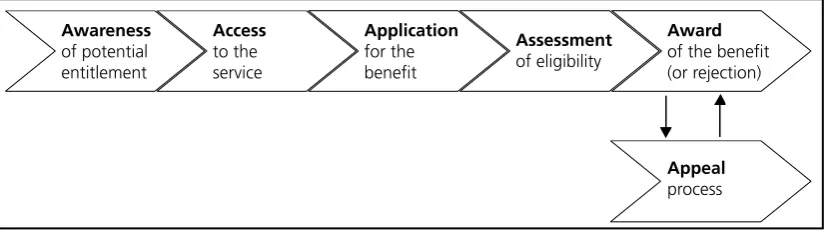
[image:20.595.93.507.644.759.2]Making a claim for either DLA or AA involves completing a form which enables the Pension, Disability and Carers Service (PDCS) to assess the claim against its eligibility criteria, which include a range of factors related to the person’s condition and their ability to carry out day-to-day tasks independently. Eligibility for DLA and AA is not based on medical diagnosis but on needs arising from the disability. However, healthcare professionals responsible for the person are sometimes required to provide a statement as part of the claim form. In some instances, an independent medical examination is also required to assess eligibility. An appeals process is built into the system for those who wish to challenge their claim decision. Figure 1.2 summarises the customer journey involved from initially becoming aware of their potential eligibility for DLA or AA through to award being granted or declined.
Figure 1.2: Customer journey in claiming for DLA or AA
Awareness of potential entitlement
Access to the service
Application for the benefit
Assessment of eligibility
Award of the benefit (or rejection)
1.3
Scope of this review
The focus of this literature review is on understanding the needs of those with mental health conditions and/or learning disabilities, and the implications of this for the PDCS. PDCS is keen to identify the particular needs of these groups and any barriers they face in accessing the PDCS service, to ensure that processes do not disadvantage them.
Carers (and Carer’s Allowance) fall outside the scope of this review, unless the carer themselves have a mental health condition or learning disability.
Whilst we could not identify an authoritative definition for ‘mental health condition’, we will assume this to incorporate both mental health problems and mental illness, defined as follows:
Mental health problem
‘Mental health problems generally refer to difficulties we may experience with our mental health that affect us in our everyday lives. Mental health problems can affect the way we feel, the way we think and the way we function. Mental health problems include conditions described as personality disorders and also dementia. They can be mild or serious, fleeting or long-lasting.’
(DH 2009a, p10)
Mental illness
‘Mental illness refers to more serious mental health problems that often require treatment in specialist services. Someone with a serious mental illness may have long periods when they are well and are able to manage their illness. Many people with mild and serious mental health problems are able to live productive, fulfilling lives.’
(DH 2009a, p10)
The review covers all those falling within these definitions, regardless of whether they have been formally diagnosed, or are accessing professional support or treatment for their condition.
We define a learning disability according to the three core components identified by the DH:
• ‘a significantly reduced ability to understand new or complex information, to learn new skills (impaired intelligence), with
• a reduced ability to cope independently (impaired social functioning) • which started before adulthood, with a lasting effect on development’
The review covers the full age range. Where it has been possible from the literature, the needs of different age groups have been segmented as follows:
• children (age 15 and under); • working-age adults;
• older adults (age 65 and over).
The review covers both those who are claiming DLA/AA and those who are not. Where possible from the literature, the discussion segments the client groups by those receiving DLA/AA and those not receiving DLA/AA.
1.4
Research objectives
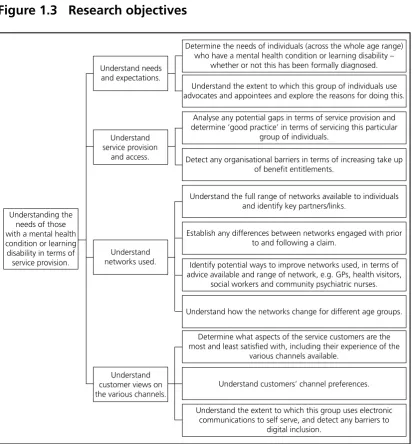
[image:22.595.93.507.338.783.2]The research objectives are shown in Figure 1.3.
Figure 1.3 Research objectives
Determine the needs of individuals (across the whole age range) who have a mental health condition or learning disability –
whether or not this has been formally diagnosed.
Understand the extent to which this group of individuals use advocates and appointees and explore the reasons for doing this.
Analyse any potential gaps in terms of service provision and determine ‘good practice’ in terms of servicing this particular
group of individuals.
Detect any organisational barriers in terms of increasing take up of benefit entitlements.
Understand the full range of networks available to individuals and identify key partners/links.
Establish any differences between networks engaged with prior to and following a claim.
Identify potential ways to improve networks used, in terms of advice available and range of network, e.g. GPs, health visitors,
social workers and community psychiatric nurses.
Understand how the networks change for different age groups.
Determine what aspects of the service customers are the most and least satisfied with, including their experience of the
various channels available.
Understand customers’ channel preferences.
Understand the extent to which this group uses electronic communications to self serve, and detect any barriers to
digital inclusion. Understand service provision and access. Understand networks used. Understand needs and expectations. Understand customer views on the various channels. Understanding the
needs of those with a mental health condition or learning disability in terms of
The objectives have been grouped according to four key categories which we identified and agreed with PDCS before the start of the review:
• needs and expectations • service provision and access • networks
• channel preferences
1.5
Methodology
We ensured a systematic approach to meeting the research objectives by developing an issue tree, setting out the key questions that needed to be answered from the literature to satisfy each objective. Following the set up meeting for the project, we agreed the issue tree with PDCS.
The literature search comprised three main elements:
• Web-based search
A web-based literature search was carried out using the key words from the issue tree via a range of search engines to identify a range of published literature available online.
• Database search
We accessed a range of literature databases via the Scottish Health library, which includes access to a vast range of publications including those held by the British Library. Again, a search was carried out using defined key terms from the issue tree.
• Internal document search
We asked PDCS to search internally for any unpublished documents of relevance to the review.
We reviewed the literature against the following criteria: • Relevance – is the literature relevant to this study? • Credibility – has a sound approach been used? • Objectivity – have the biases been addressed? • Applicability – are the findings applicable to PDCS?
• Balance – is the literature balanced and based on evidence? A full reference section can be found at the back of the report.
We pulled together the findings from the review and presented these in interim form to the PDCS on 10 November 2009.
2 Understanding needs
2.1
Understanding needs: overarching themes
There is a reasonably large body of literature identifying the generic needs of those with mental health conditions and/or learning disabilities. These two groups of people are generally dealt with separately in the literature since they are viewed as having very different sets of needs. This is also reflected in service provision within health and social care, where these two groups would often be accessing different services and professionals – although clearly there are significant areas of overlap. For example, people with learning disabilities are considerably more likely than the general population to have a mental health condition (Department for Communities and Local Government (DCLG), 2008b, p13). Both groups may well be accessing some form of support from social services, but the nature of that support may differ significantly.
An important starting point when understanding the needs of these groups is that people with mental health conditions and/or learning disabilities do not constitute homogenous groups. The literature reveals very clearly that within these two very broad groups, there is substantial variety in the types of condition people have, what their experience of this condition is, and the manner in which their condition impacts on their day-to-day life (Wiggan and Talbot, 2006). Good practice services understand this variety and respond effectively to the needs of different users. This is strongly reflected in the literature related to personalisation of services, which we explore in more detail in Section 3.2.
A key theme within the literature is the need to approach the needs of these groups holistically. The Department of Health’s (DH’s) view is that ‘Employment, housing and a strong social network are as important to a person’s mental health as the treatment they receive’ (DH, 2007b). In particular, there are strong links between mental problems, unemployment and social deprivation:
lower incomes, may well be homeless and are more likely to live in areas of high socio-economic deprivation. Fifteen per cent of children in the lowest socio-economic group develop mental health problems, compared with just 5 per cent of children in the highest.’
(DH, 2009, p14)
The literature also points to the inter-relationships between physical and mental health conditions and the likelihood that many people with mental health conditions will also be experiencing physical health problems.
Physical health affects our mental health, and vice versa. The most mentally healthy people also have the lowest rates of cardiovascular disease. Conversely, people with a physical illness are more likely to develop a mental health problem – an estimated 70 per cent of general hospital beds are occupied by older people, of whom up to a half are assessed as suffering from cognitive problems and a third with depression. People with severe mental health problems die younger than other people. Some studies have shown that on average it is 25 years earlier. Such people also develop illnesses such as strokes and coronary heart disease before the age of 55 more often. They can also find it harder to access screening services and other primary care services. (DH, 2009, p15)
Therefore mental health conditions and/or learning disabilities cannot be viewed in isolation from wider issues of social exclusion and inequality. Those with mental health conditions are more likely than others to have a wide-ranging and complex set of physical, social and economic needs, and to experience greater barriers in accessing services (explored in Section 3.3). In this context, services provided by a range of government departments and agencies (including the Department for Work and Pensions (DWP)) are of equal importance to the health service in sustaining and improving people’s mental health and enabling them to live long and fulfilled lives, and strong multi-agency working is required.
2.2
Understanding needs: people with mental health
conditions
In Managing Mental Health and Employment (DWP, 2008) the DWP identify a
range of factors that service users described as contributing to a better state of mental health. These are:
• prescribed medications, counselling or therapy and the coping strategies acquired from these;
• workplace factors and the benefits of work itself;
• life-style factors, including maintaining good physical health, religious or spiritual involvement and a healthy ‘work-life balance’;
• development of personal insight and understanding of their mental health. This work by the DWP forms part of an emerging body of literature focused on the links between mental health and employment. Employment rates for people with mental health conditions are considerably lower than the population average (DH, 2009a, p68). Work in itself is widely recognised as being beneficial to a person’s mental health and to supporting social inclusion. A particular concern relating to Disability Living Allowance (DLA) is that many people currently receiving DLA fear that starting work would trigger a review of their entitlement and could lead to them losing the benefit. Even though this is an inaccurate perception, this represents a barrier to those with mental health conditions entering the workplace that needs to be addressed (DWP, 2008).
Social inclusion is related to various other factors alongside unemployment and is a key strand running through the literature. New Horizons (DH, 2009, p22) identifies that people with mental health conditions may find it difficult to discuss their condition with others – often due to the stigma that is sometimes attached to mental health conditions. This can exacerbate mental health problems through leading to poorer engagement with social networks and hampering access to services. Tackling stigma has become a major priority for health services in recent years.
The literature also explores the financial needs of those with mental health conditions. For example, people with mental health conditions are nearly three times more likely to be in debt, and one in four tenants with mental health problems has rent arrears and is at risk of losing their home (DCLG, 2008a). Receiving DLA or Attendance Allowance (AA) can make a significant difference to a person’s financial position, and therefore it is important that all those who are entitled to DLA and AA receive it.
2.3
How needs change with age
Since retirement brings a reduction in income for the majority of older people, some older people struggle financially and there are indications that debt may become more common for this age group (DH, 2009a, p84). Access to good financial and benefits advice will therefore become increasingly important.
Older people are more at risk of social isolation in general, and this can be exacerbated by mental health problems. Older people may have less regular contact with family and friends. Also the stigma of a mental health condition can potentially compound the stigma associated with old age and lead to increased isolation (DH, 2009a, p81). Older people are more likely to visit their GP regularly and those with mental health conditions view a sympathetic and understanding GP as being very important (DH, 2009a, p87). Advice and information received from a GP about other services (including potential eligibility for AA) may therefore be critical.
Children with mental health conditions are also likely to have particular areas of need which are related to their age. The National Child and Adolescent Mental Health Services (CAMHS) Review found a need to improve services for children with mental health conditions so that they become more holistic and child centred: so that their mental health needs are assessed alongside all their other needs, and they receive an individualised package of care which is driven by their personal circumstances (DH, 2008, p11). Clearly this can not be delivered by health services alone. One key aspect of this holistic approach is identified as ensuring that children have access to information about the full range of services available locally to help them, supplied in a range of formats to suit their preferences (ibid, p10). The Connexions service is one of the available networks for young people in providing such information in a one-stop shop (www.connexions-direct.com).
Good web-based help and information is likely to be of increased
importance for the younger audience (DCLG, 2008a and 2008b) and sites
need to be designed so they are child-friendly. Parents and carers play a particularly important role for this age group and many children will hear
about benefits through this route (DWP, 2009) so communications need to
reflect their needs and preferences also.
Table 2.1
Needs r
elating to advice on and access to benefits
A
war
eness of potential entitlement
Access to the service
Application for the benefit
Adults with mental health conditions
•
Some evidence that incr
eased benefits
information in primary car
e may incr
ease
awar
eness.
•
Incr
easing use of ICT for information and
social networking.
•
Telephone will be pr
eferr
ed means of
access for most.
•
Some will need face-to-face contact because of condition.
•
Channel pr
efer
ences may vary by point in
time for same person.
•
Incr
easing use of inter
net to self serve.
•
May need flexibility in timing or length of contact, e.g. ‘bite-sized chunks’.
•
Most find the DLA forms difficult to complete and would like them simplified.
•
Some find the forms ar
e not gear
ed
towar
ds people with mental health
pr
oblems.
Children with mental health conditions
•
Key networks likely to be friends, family
,
car
ers, key worker
, GP
.
•
Multi-agency working impr
oving for
childr
en but ther
e may still be gaps.
•
Mor
e confident than adults with use of
ICT
.
•
Overall services could be mor
e
child-friendly
.
•
Mor
e likely to need help fr
om car
er or
appointee.
•
May need help with application pr
ocess
fr
om family or car
er
.
Older adults with mental health conditions
•
May be in hospital or r
esidential car
e.
•
Incr
eased chance of social exclusion.
•
Condition may not have been diagnosed e.g. dementia or depr
ession.
•
GP plays an important r
ole.
•
Less likely to use ICT
.
•
L ess likely to hear about benefits thr
ough informal channels.
•
Physical conditions may compound access difficulties, e.g. hearing on the telephone.
•
Less likely to use inter
net to self serve.
•
W
ebsites should be tailor
ed for ease of
navigation for the cognitively impair
ed.
•
AA forms consider
ed very complex and
difficult to complete.
Table 2.1
Continued
A
war
eness of potential entitlement
Access to the service
Application for the benefit
People with severe mental health conditions
•
Likely to be in r
egular contact with
secondary car
e services.
•
Key worker plays a crucial r
ole in helping
to navigate the system.
•
Inter
net may pr
ovide a ‘safe’ way of
accessing information.
•
Unlikely to be in work.
•
May have multiple barriers, e.g. homeless, drug users, prison.
•
May be specific access barriers r
elating to
their condition, e.g. ‘hearing voices’ on the telephone or anxiety in public places.
•
May be specific times when contact is easier
, e.g. to fit with medication, mood.
•
Most find the DLA forms difficult to complete and would like them simplified.
•
Some find the forms ar
e not gear
ed
towar
ds people with mental health
pr
oblems.
People with learning disabilities
•
Mor
e likely to find out about benefits
fr
om family or car
er
.
•
Limited contact with friends.
•
Most have access to computer and many use the inter
net, e.g. for social
networking, but may need adaptations to make use of this technology
.
•
Likely to need support fr
om an advocate
or appointee to ensur
e needs met.
•
Telephone pr
eferr
ed channel for most
– but ar
e barriers, e.g. lack of visual
pr
ompts.
•
Combining visual and verbal methods can aid understanding.
•
W
ritten communications and websites
should use plain English, plain backgr
ounds and use of pictur
es to aid
understanding.
•
Interactive material can aid understanding.
•
Forms need to use plain English and visual pr
[image:29.595.105.449.112.789.2]2.4
Understanding needs: people with learning
disabilities
In common with people with mental health conditions, people with learning disabilities are likely to have a varied and complex set of needs and it is important to assess the needs of each person individually (DCLG, 2008b, p13). They are likely to find some everyday activities, such as reading, writing and speaking, significantly more challenging (DCLG, 2008b, p13) and this may cause significant barriers when they are accessing services (explored in more detail in Section 3.3).
They may need help with time keeping and remembering things – which clearly has implications in terms of meeting pre-planned appointments
with services. They are less likely to have regular contact with friends and family,
although peer support groups are an important social activity for some (DCLG, 2008b, p21). They are much more likely to be reliant on others for some aspects of daily living; for example over half of people with learning disabilities say someone else decides how much money they can spend each week (DCLG, 2008b, p7).
Therefore for some, claiming and spending DLA or AA will require support from a carer, intermediary or advocate.
People with learning disabilities may be marginalised within the community and suffer negative attitudes from others. Less than ten per cent of adults with learning disabilities are in work (DCLG, 2008b, p7). They are also potentially more vulnerable to bullying and manipulation (DCLG, 2008b, p12) and services should be designed to counteract this. Advocates and appointees may play an important role in ensuring their voice is heard and their needs met (explored in more detail in Section 2.6). The literature points to transition points in terms of both age and events (DCLG,
2008b, p29). A key transition point in terms of age is that from childhood (pre 16) to
young person (16 plus). This transition throws up many questions; for example around whether the young person will continue with education or move into employment, and what role day services will play. The evidence shows that if suitable support and opportunities are made available at this stage then the life opportunities of people with learning disabilities can be significantly improved as well as their sense of inclusion (DCLG, 2008b, p29). Event-based transitions might include changing accommodation or finding employment. Again, effective interventions by services at these points can significantly improve the life opportunities of the individual by putting more choice and control in their hands (ibid, p29).
2.5
Needs relating to advice on and access to benefits
2.6
The role and extent of use of advocacy
The Independent Advocacy Campaign defines advocacy as ‘taking action to help people say what they want, secure their rights, represent their interests and obtain services they need’ (Lewington and Clipson, 2004, p11). There is a strong body of literature setting out good practice in advocacy and why and how it can be helpful to service users, particularly those with mental health conditions and/or learning disabilities. Barnes et al. (2002) identify the core purposes of advocacy as:
• to help to safeguard the rights of service users – both rights under mental health policy and law, and rights as citizens;
• to empower service users to make informed decisions about their care and treatment and to take greater control over their lives;
• to support service users to get their views heard; • to represent the views of service users;
• to support service users in seeking resolution to issues which concern them; • to protect service users who are particularly vulnerable for reasons of their illness
or lack of capacity to make informed decisions;
• to feedback issues raised by service users to service providers so that services can be constantly improved.
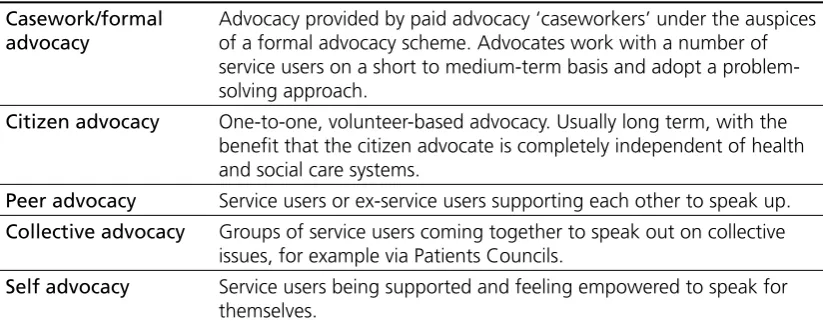
Table 2.2 Advocacy models
Casework/formal
advocacy Advocacy provided by paid advocacy ‘caseworkers’ under the auspices of a formal advocacy scheme. Advocates work with a number of service users on a short to medium-term basis and adopt a problem-solving approach.
Citizen advocacy One-to-one, volunteer-based advocacy. Usually long term, with the benefit that the citizen advocate is completely independent of health and social care systems.
Peer advocacy Service users or ex-service users supporting each other to speak up. Collective advocacy Groups of service users coming together to speak out on collective
issues, for example via Patients Councils.
Self advocacy Service users being supported and feeling empowered to speak for themselves.
Source: Henderson and Pochin, 2001.
[image:31.595.92.504.487.649.2]The literature describes the increase in the profile, funding and provision of advocacy over the last 20 to 30 years, and particularly within the last ten years (Social Care Institute for Excellence (SCIE), 2009; Hussein et al., 2006). The emphasis placed on advocacy in Valuing People (DH, 2001) and Valuing People Now (DH, 2007) together with the introduction of a statutory right to advocacy for some groups under the Mental Health Act (from 2005) have been key drivers of this. There are now many hundreds of small, local mental health advocacy schemes around the country. Many of these are entirely independent and often user-led, whilst others are run and managed by larger charities such as Mind, Rethink and the Richmond Fellowship (Henderson, 2003, p8).
Whilst it is clear that the extent of advocacy provision has significantly increased in recent years, there is little coverage in the literature regarding the extent to which those with mental health conditions and/or learning disabilities are accessing these services, and their experience of using them. Although our review uncovered a number of local area evaluations of advocacy commissioned by local authorities, we did not find any national reviews of advocacy services within the last few years. However, going back a little further, Henderson reported in 2003 that ‘despite the large number of schemes, advocacy provision remains patchy, with some areas well served and others lacking’. Lewington and Clipson (2004) also identified a number of shortcomings in provision of and access to advocacy services, particularly for those with physical, sensory, communication, and profound and multiple impairments. Their work found that, although these groups were likely to benefit from the support of an independent advocate, there was inadequate provision for them, and where provision was being accessed it was not always meeting their needs. The main causes of this were identified as lack of funding and lack of appropriate skills and experience with working with these groups. More recently, the SCIE have identified ‘serious gaps’ in the provision of advocacy services for African and Caribbean men, despite their over-representation in the mental health system (Newbigging et al., 2007).
Research indicates that customers are more likely to be successful in their claim for DLA if they receive professional or ‘informed’ assistance with the application form itself (Banks and Lawrence, 2005, p303). It is therefore critical that the PDCS ensure that those who face particular barriers to access as a result of their mental health condition or learning disability have access to the full range of support that they need in communicating their needs and navigating the application process – whether from advocates or otherwise. Because advocacy plays such an important role in overcoming these barriers particularly for the most excluded groups, we suggest that the PDCS will need to work closely with its partners to ensure access to advocacy services.
2.7
Chapter 2 summary – understanding needs
2.7.1 Key findings
• People with mental health conditions and/or learning disabilities do not represent homogenous groups.
• They are more liable to experience wider factors associated with social exclusion and this can present barriers to them accessing information and support.
• The literature advocates a strongly personalised approach to service provision for them.
• Receiving DLA or AA can make a significant difference to a person’s financial position, and therefore it is important that all those who are entitled to DLA and AA receive it.
• There is concern in the literature that some people receiving DLA or AA fear that entering employment may trigger a review of their eligibility to receive the benefit, even though this is not actually the case.
• Parents and carers play a particularly important role for the under 16s and many children will hear about benefits through this route.
• Good web-based help and information is likely to be of increased importance for the younger audience.
• People in these groups may need help with timekeeping and remembering things – which has implications in terms of meeting pre-planned appointments with services.
• Advocates can play an important role in removing some of these barriers, but advocacy provision is patchy, both geographically and in terms of meeting the needs of particular groups.
2.7.2 Recommendations
• Ensure staff have the training to understand the impact of mental health conditions and/or learning disabilities.
• Increase staff awareness of the different communication needs of these groups. • Ensure good web-based information is available, tailored to the needs and
preferences of different age groups.
• Ensure that awareness-raising communications reach parents and carers as well as potential customers.
• Communicate clearly that entitlement for DLA/AA is not related to income or employment status.
3 Service provision and
access
3.1
Gaps in service provision
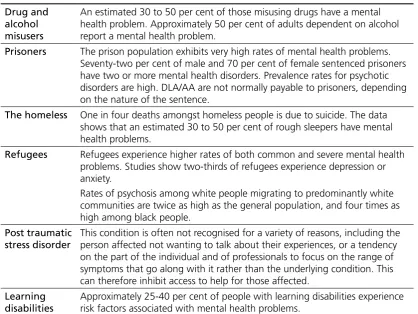
Table 3.1 Hard-to-reach groups
Drug and alcohol misusers
An estimated 30 to 50 per cent of those misusing drugs have a mental health problem. Approximately 50 per cent of adults dependent on alcohol report a mental health problem.
Prisoners The prison population exhibits very high rates of mental health problems. Seventy-two per cent of male and 70 per cent of female sentenced prisoners have two or more mental health disorders. Prevalence rates for psychotic disorders are high. DLA/AA are not normally payable to prisoners, depending on the nature of the sentence.
The homeless One in four deaths amongst homeless people is due to suicide. The data shows that an estimated 30 to 50 per cent of rough sleepers have mental health problems.
Refugees Refugees experience higher rates of both common and severe mental health problems. Studies show two-thirds of refugees experience depression or anxiety.
Rates of psychosis among white people migrating to predominantly white communities are twice as high as the general population, and four times as high among black people.
Post traumatic
stress disorder This condition is often not recognised for a variety of reasons, including the person affected not wanting to talk about their experiences, or a tendency on the part of the individual and of professionals to focus on the range of symptoms that go along with it rather than the underlying condition. This can therefore inhibit access to help for those affected.
Learning
disabilities Approximately 25-40 per cent of people with learning disabilities experience risk factors associated with mental health problems.
Source: DCLG, 2008a.
Thirdly, the literature points to instances of a lack of joined up working between agencies to meet individual needs (DCLG, 2009a). This applies across a range of areas but is particularly pertinent in the case of people with complex needs (such as the groups listed in the first column of Table 3.1), together with older people and also children. New Horizons stresses that addressing the complex and often broad-ranging needs of older people with mental health conditions:
‘...requires multi-agency interventions at multiple levels. Local authorities, health services, third sector agencies and communities all have a role to play in tackling the barriers to continued mental health and well-being into older age.’
(DH, 2009a)
Similarly, the final report of the National Child and Adolescent Mental Health Services (CAMHS) Review identified that:
‘Administrative and legal processes, unhelpful thresholds for access to services and some entrenched professional views can ‘parcel up’ children into individual services and prevent their needs being met in a holistic, flexible and responsive way, or leave their needs unaddressed.’
(DH, 2008)
[image:37.595.90.509.138.452.2]3.2
Good practice in providing services
There is a strong body of literature which highlights good practice in providing services for people with mental health conditions and/or learning disabilities, particularly from the field of social care.
One of the strong over-arching themes is the emphasis on personalising services. This includes giving individuals more choice and control over what support and help they access and how they access it. It also includes providing more flexible and coordinated support which is tailored to the needs of the individual.
One of the key mechanisms for achieving this, in a health context, will be the introduction of personal budgets for some people with mental health conditions. Personal budgets have been used for some time in a social care context and are currently being piloted in the health service.
Strongly related to this are person-centred approaches which are defined as:
‘...a systematic way to generate understanding of a person with developmental disability as a contributing community member.’
(Lewington and Clipson, 2004)
Again this has grown largely out of the social care literature, and relates in particular to planning for the needs of people with learning disabilities, but it clearly has applicability to others services also. For example, Sanderson (2004) argues that the person-centred approach is about:
‘...listening, learning and focusing on what is important to the person and working with others to act on this and make things happen.’
(Sanderson, 2004)
Taking a person-centred approach, by implication, means that multiple agencies
must work together effectively to deal with the needs of the individual in a
holistic manner. Support should be integrated across different life domains, such as health, employment and social. In the case of children, the National CAMHS Review emphasised the importance of children’s mental health needs ‘being assessed alongside all their other needs, no matter where the need is initially identified’ (DH, 2008). This should result in an ‘individualised package of care’ which addresses both their care and wider support needs, tailored to their personal circumstances.
One of the key implications of personalisation and joined up working for benefits services is that, as far as possible, single assessments should be carried out and information shared between agencies to avoid individuals having to supply
the same information about their circumstances to different agencies. DH
social care assessment. The results have been positive, showing significant benefits for both customers and the agencies involved. The new approach was found to improve access, reduce duplication and increase the speed of the process (DWP, 2008).
The Audit Commission website (2009) identifies good practice in increasing take-up of those eligible for benefits, particularly for vulnerable and excluded grotake-ups, as implemented by local councils. Although this comes from a different context to DLA and AA, many of the principles may be transferable. The review found that
‘tailored promotional work designed to suit the profile of the community
can help to increase the success of take-up campaigns’. They found that
successful take-up campaigns included:
• producing flyers and posters and distributing them across a range of venues including leisure facilities, doctors’ and dentists’ surgeries, landlords, voluntary sectors agencies and religious centres;
• placing articles in the local newspaper, including ‘entitlement checkers’; • producing bulletins to raise awareness;
• good web-based information;
• mail shots to households in more deprived areas.
The Audit Commission also identifies the importance of working innovatively with partners to increase benefit take-up. For example, one council worked with The Pension Service, attending ‘flu-jab clinics and community centres to encourage pensioners to take up benefits. Another acted on feedback from local voluntary organisations and the Citizen’s Advice Bureau regarding lack of accessibility for local elderly residents, and set up a targeted outreach team to address this.
This research also found that the design of the benefits claim form can
improve take-up. They found that ‘a well designed form helps to reduce the
barriers to making a claim, encourages customers to give better information and helps to reduce claim processing times’ (Audit Commission, 2009).
Some of the literature highlights good practice in communicating with people with mental health conditions and/or learning disabilities. Some of the key principles are:
• User involvement and consultation in design
This is critical in ensuring that communication channels meet the needs of people with learning disabilities and mental health conditions. Mencap and Young Active People (YAP) (now young.Mencap) are cited as good practice websites that have been designed in consultation with users to meet their communication needs (DCLG, 2008b, p35). It is important that this consultation actually shapes the design of communications and is not seen as tokenistic (Allen, 2007).
• Flexibility
Research into Jobcentre Plus found that staff working in the service should not be bound by rigid scripts, time limits or specific communication methods (Department for Work and Pensions (DWP) 2007). Some of this learning may be transferable to PDCS. For example, some customer’s conditions may mean that it is easier for them to have several ‘bite-sized’ telephone calls or meetings rather than doing it all in one go (DWP 2007, p32). Some customers prefer to arrange a time to be called back which fits with their daily routine, others might prefer to choose a time which suits them and how they are feeling at that point. Also, due to the fluctuating nature of many mental health conditions, the same person may want to engage differently with the same service
at different points in time.
• Using a range of communication channels
People with mental health conditions and/or learning disabilities are not homogenous groups and channel preferences vary markedly, some related to the person’s condition and some to other factors such as age and personality. This is explored in more detail in Sections 5.2 – 5.4.
• Continuity of case handling
This enables staff to develop rapport with the customer. In instances where the case needs to be passed to another colleague, staff should capture and share information on any communication needs which have been disclosed or identified (DWP, 2007, p46).
Table 3.2 Good practice in communicating with people with learning disabilities
Use of videos, pictures and interactive DVDs
Use of videos and pictures can facilitate communication and
comprehension among customers who find text-based communication challenging. Interactive DVDs support customers in working at their own pace, in their own time.
Appropriate use
of technology This could include specially designed hardware and software, such as voice recognition and voice dictation software, and specialised keyboards. Clear written
communications Inserting symbols and pictures into text can aid comprehension, for example to illustrate situations and events. Written communication should be in simple, clear text, using easy-to-read fonts on a plain background colour.
Clear verbal communications
Presence of an advocate where desired by the customer, taking longer to explain questions where appropriate.
Source: DCLG, 2008b.
3.3
Barriers to increased take-up of benefits
There is concern in the literature that many people with disabilities who are eligible for DLA do not claim the benefit (Banks and Lawrence, 2005, p302). The extent to which this applies to people with mental health conditions and/or learning disabilities is not known, is difficult to approximate, and is not within the scope of this literature review. The DWP may wish to explore this issue further.
Some portions of the literature explore the organisational barriers which people with mental health conditions and/or learning disabilities face when accessing benefits. Wiggan and Talbot (2006) highlight that mental health users have particular problems with the complexity of the benefits system, exacerbated by rapid and ongoing changes in their circumstance and compounded by a
lack of awareness about how to access appropriate advice (Wiggan and
Talbot, 2006).
Some of the key organisational barriers relate to agencies not working effectively together, and the barrier of securing ownership and support from other agencies to a common agenda. For example, Banks and Lawrence (2005) found that if other partners and agencies provide advice and assistance around DLA, the ‘financial implications in terms of the amount of time that social workers, voluntary organisations, welfare rights officers and health professionals spend on providing this assistance must be considerable’ (Banks and Lawrence, 2005, p313). They note that GPs are particularly wary of having such advice services based out of their practices.
(DH, 2009a, p81). Meanwhile, the National CAHMS Review found that ‘children and young people say that services are not as well known, accessible, responsive or child-centred as they should be’ (DH, 2007). The PDCS will need to work ever more closely with its partners in delivering support to individuals that is built around the needs of the person rather than the convenience of organisations.
The PDCS Equality Scheme provides particular insight into some of the specific barriers that people with mental health conditions encounter when engaging with the service:
‘We talked to customers with mental health disabilities. They told us about
these things that can make things hard for them. They often have problems
using our services. They said our leaflets are hard to understand. They
said our claim forms are scary because they are very long and hard to
understand. Most want us to contact them by telephone, not by letter. Many have a care plan from their care worker, but they did not know this is
important and should be sent in with their claim. It may be hard for them
to tell us about their needs and how their mental health disability
affects them. Sometimes they do not understand the letters we send them
showing our decision on their claim. As a result, they do not understand
our decision.’
(PDCS Equality Scheme 2008-11, emphasis mine)
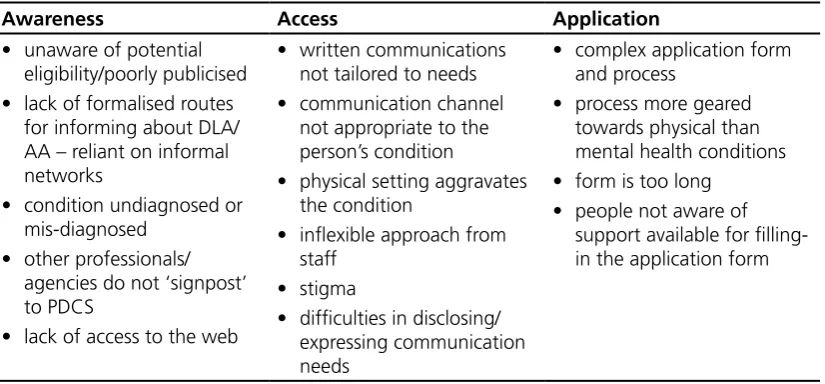
These organisational barriers may be experienced at various points throughout the customer journey from becoming aware of their potential eligibility for the benefit through to decision on award. Table 3.3 summarises the key barriers identified from the literature, and these are explored in more detail in the narrative that follows.
Table 3.3 Barriers to take-up during the customer journeys
Awareness Access Application
• unaware of potential eligibility/poorly publicised • lack of formalised routes
for informing about DLA/ AA – reliant on informal networks
• condition undiagnosed or mis-diagnosed
• other professionals/ agencies do not ‘signpost’ to PDCS
• lack of access to the web
• written communications not tailored to needs • communication channel
not appropriate to the person’s condition
• physical setting aggravates the condition
• inflexible approach from staff
• stigma
• difficulties in disclosing/ expressing communication needs
• complex application form and process
• process more geared towards physical than mental health conditions • form is too long
[image:42.595.94.507.565.757.2]3.3.1 Lack of awareness
Banks and Lawrence report that ‘lack of information regarding the existence of the benefit and ignorance or misconceptions concerning the criteria for eligibility are the first notable barriers to application’ (Banks and Lawrence, 2005, p302). They go on to analyse this, identifying that the most frequently cited sources of information about the benefit are ‘casual sources’ such as friends and relatives, with less than ten per cent of claimants having heard about the benefit from their GP or GP’s surgery. This is likely to cause particular barriers to awareness for people with mental health conditions and/or learning disabilities because, as identified in Section 2.2, they may be more likely to experience social exclusion, have more limited networks of friends and family, and potentially be more reliant on professionals such as their GP or key worker. Whilst of course GPs are not expected to be providers of