ENHANCE QUALITY OF SERVICES IN COMMON RADIO RESOURCE MANAGEMENT IN
HETEROGENIOUS NETWORK BY USING
Professor, MGI
ARTICLE INFO ABSTRACT
Radio Resource Management refers to a group of mechanisms that are collectively responsible for efficiently utilizing a Radio Access Technology
RRM mechanisms contains Power Control, Handover Control, Packet Scheduling or Congestion Control, and Admission Control
independently in each
RRM strategy only considers that situation of one particular RAT. CRRM strategy is also known as Multi-access RRM (MRRM) has been proposed. In this paper focus on JCAC algorithm h presented. Considering four different simulation results are obtained and compared. Result show joint management of radio resources and bandwidth adaptation reduce call blocking or dropping probability in heterogeneous cellular networks
Copyright © 2016, Dr. Jadhao. This is an open access article distributed under the Creative Commons Att distribution, and reproduction in any medium, provided the original work is properly cited.
INTRODUCTION
The boom of 3GPP networks was accompanied by an increased usage of Wireless Local Area Networks (WLAN) and nowadays there are an increasing number of places where cellular and WLAN networks co-exist and are interconnected. These places are known as hotspots. Today it is easy to imagine that anyone can leave home carrying his device (e.g., a Personal Digital Assistant (PDA), a mobile station or a portable computer) connected to a WLAN, and that it swit to a cellular system automatically. This concept is known as seamless connection, and it is characterized by a technology change imperceptible to the user. Next Generation cellular networks from one generation to another has deployment of multiple radio access technologies such as 2G/2.5G/3G/4G in the same or different geographical area. This scenario is heterogeneous cellular networks. When the radio resources are jointly managed through a joint call admission control algorithms are needed for making radio access technology selection decisions. This paper gives a study of joint call admission control in heterogeneous cellular networks. It then presents a new model of load-based joint call admission control algorithm. Four different scenarios of call ad
control in heterogeneous various cellular networks are
*Corresponding author: Dr. C. M. Jadhao Professor, MGI-COET, Shegaon-444203(MS)
ISSN: 0975-833X
Article History: Received 23rd January, 2016 Received in revised form 15th February, 2016 Accepted 10th March, 2016 Published online 26th April,2016
Key words:
AC, CRRRM, RAT, RRM, JCAC, HC, QOS etc.
Citation: Dr. C. M. Jadhao, 2016. “Enhance quality of services in common radio resource management in Algorithm”,International Journal of Current Research
RESEARCH ARTICLE
ENHANCE QUALITY OF SERVICES IN COMMON RADIO RESOURCE MANAGEMENT IN
HETEROGENIOUS NETWORK BY USING JCAC ALGORITHM
*
Dr. C. M. Jadhao
Professor, MGI-COET, Shegaon-444203(MS)
ABSTRACT
Radio Resource Management refers to a group of mechanisms that are collectively responsible for efficiently utilizing a Radio Access Technology to provide services with an acceptable level of QoS. RRM mechanisms contains Power Control, Handover Control, Packet Scheduling or Congestion Control, and Admission Control. Radio Resource Management new strategies are implemented independently in each RAT. RRM strategies is suitable for the heterogeneous network, because each RRM strategy only considers that situation of one particular RAT. CRRM strategy is also known as
access RRM (MRRM) has been proposed. In this paper focus on JCAC algorithm h presented. Considering four different simulation results are obtained and compared. Result show joint management of radio resources and bandwidth adaptation reduce call blocking or dropping probability in heterogeneous cellular networks
is an open access article distributed under the Creative Commons Attribution License, which reproduction in any medium, provided the original work is properly cited.
The boom of 3GPP networks was accompanied by an increased usage of Wireless Local Area Networks (WLAN) and nowadays there are an increasing number of places where and are interconnected. These places are known as hotspots. Today it is easy to imagine that anyone can leave home carrying his device (e.g., a Personal Digital Assistant (PDA), a mobile station or a portable computer) connected to a WLAN, and that it switches to a cellular system automatically. This concept is known as seamless connection, and it is characterized by a technology change imperceptible to the user. Next Generation cellular networks from one generation to another has deployment of io access technologies such as 2G/2.5G/3G/4G in the same or different geographical area. This scenario is heterogeneous cellular networks. When the radio resources are jointly managed through a joint call admission control radio access technology selection decisions. This paper gives a study of joint call admission control in heterogeneous cellular networks. It then based joint call admission control algorithm. Four different scenarios of call admission control in heterogeneous various cellular networks are
analyzed and compared with the help of simulations and results are given to show that the effectiveness of c admission control in the different scenarios. The concept of common radio resource is to efficiently manage the common pooling of radio resources that are available in each of the existing radio access technologies In heterogeneous cellular networks, the radio resource consists of resources that are available in a set of cells under the control of a radio network controller.
Related Work
Literature Survey
Sachs et al. (2009) presented a framework for integrating
different access systems into a
selecting the best suitable access network for users. They proposed a utility-based approach for evaluating different access allocation choices, which is based on user and network policies, the performance of access bearers, and
of access resources. Hasib and Fapojuwo
analysis of common radio resource management scheme for end-to-end QoS support in heterogeneous wireless networks. Gelabert et al. (2008) presented a Markovian approach to RAT selection in heterogeneous wireless networks. They developed an analytical model for RAT selection algorithms in a heterogeneous wireless network comprising GSM/EGDE and
International Journal of Current Research Vol. 8, Issue, 04, pp.29403-29407, April, 2016
INTERNATIONAL
Enhance quality of services in common radio resource management in Heterogenious International Journal of Current Research, 8, (04), 29403-29407.
ENHANCE QUALITY OF SERVICES IN COMMON RADIO RESOURCE MANAGEMENT IN
JCAC ALGORITHM
Radio Resource Management refers to a group of mechanisms that are collectively responsible for to provide services with an acceptable level of QoS. RRM mechanisms contains Power Control, Handover Control, Packet Scheduling or Congestion Radio Resource Management new strategies are implemented RAT. RRM strategies is suitable for the heterogeneous network, because each RRM strategy only considers that situation of one particular RAT. CRRM strategy is also known as access RRM (MRRM) has been proposed. In this paper focus on JCAC algorithm has been presented. Considering four different simulation results are obtained and compared. Result show joint management of radio resources and bandwidth adaptation reduce call blocking or dropping
ribution License, which permits unrestricted use,
analyzed and compared with the help of simulations and results are given to show that the effectiveness of call admission control in the different scenarios. The concept of common radio resource is to efficiently manage the common pooling of radio resources that are available in each of the existing radio access technologies In heterogeneous cellular he radio resource consists of resources that are available in a set of cells under the control of a radio network
presented a framework for integrating different access systems into a multi-access system and for selecting the best suitable access network for users. They based approach for evaluating different access allocation choices, which is based on user and network policies, the performance of access bearers, and the availability Hasib and Fapojuwo (2008) presented an analysis of common radio resource management scheme for end QoS support in heterogeneous wireless networks. presented a Markovian approach to RAT lection in heterogeneous wireless networks. They developed an analytical model for RAT selection algorithms in a heterogeneous wireless network comprising GSM/EGDE and
INTERNATIONAL JOURNAL OF CURRENT RESEARCH
UMTS. The proposed algorithm selects just one RAT for each call. Song and Zhuang (2009) proposed a load-sharing call admission control scheme for voice and data services in an integrated cellular/WLAN network. In the proposed scheme, voice calls are preferably admitted to the cellular network, whereas data calls are admitted into both cellular and WLAN. Falowo and Chan (2007) proposed an adaptive JCAC and bandwidth management scheme for heterogeneous wireless networks with collocated cells. They developed an analytical model for the proposed scheme and evaluated its performance in terms of new call blocking probability (NCBP), handoff call dropping probability, and resource utilization.
Objective
Guarantee the QOS requirements (data rate, delay, and packet loss) of accepted calls.
Minimize number vertical handoffs, uniformly distribute
network load as much as possible,
Minimize call blocking/dropping probability,
Maximize operators’ revenue,
Maximize radio resource utilization
Motivation
These motivations are (1) limitation of a single radio access technology (2) users’ demand for advanced services and
complementary features of different Radio Access
Technology, and (3) Evolution of a new wireless technology. Every RAT is limited in one or more of the following: data rate, coverage, security levels, types of services and quality of service it can provide
Problem Statement
The coexistence of different cellular networks in the same and different geographical area necessary Common radio resource management for enhanced quality of service provisioning and efficient radio resource utilization. The concept of CRRM arises in order to efficiently manage the common pool services radio resources that are available in each of the existing radio access technologies RAT. In heterogeneous cellular networks, the radio resource consists of resources that are available in a set of cells under the control of a radio network controller and a base station controller.
Existing system
A new wireless networks are used radio resource management algorithms are responsible for efficient and effective utilization of the air interface resources in order to integrated guarantee of quality services maintain the planned coverage area, and offer high capacitive. In distributed cellular networks, radio resource can be independently managed as shown in Figure 1. Jointly managed as shown in Figure 2. Joint management of radio resources enhances quality of service and improves overall radio resource utilization in heterogeneous cellular networks. With joint radio resource management in heterogeneous cellular networks, mobile users will be able to communicate through any of the available radio access
[image:2.595.358.511.84.191.2]technologies (RATs) and roam from one RAT to another, using multi-mode terminals.
[image:2.595.356.512.227.322.2]Fig. 1. Independent RRM in heterogeneous wireless networks
Fig. 2. Common RRM in heterogeneous wireless networks
Fig. 3. A typical two-RAT heterogeneous cellular network with co-located cells
Availability of multi-mode terminals is very crucial for efficient radio resource management in heterogeneous wireless networks. A mobile terminal can be single-mode or multi-mode. A single-mode terminal has just a single RAT interface, and therefore can be connected to only one RAT in the heterogeneous wireless network. A multi-mode terminal has more than one RAT interface, and therefore can be connected to any of two or more RATs in the heterogeneous wireless network. As show in Figure 3, a subscriber using a two-mode terminal will be able to access network services through either of the two RATs. However, a subscriber using a single-mode terminal will be confined to a single RAT, and cannot benefit from joint radio resource management in the heterogeneous wireless network. In heterogeneous cellular networks, radio resources are managed by using algorithms such as joint call
admission control algorithms, joint scheduling algorithms,
[image:2.595.315.553.352.516.2]
This paper focuses on joint call admission control (JCAC) algorithms in heterogeneous cellular networks.
Movement from cell to cell
In a cellular system, as the distributed mobile transceivers move from cell to cell during an ongoing continuous communication, switching from one cell frequency to a different cell frequency is done electronically without interruption and without a base station operator or manual switching. This is called the handover typically, a new channel is automatically selected for the mobile unit on the new base station which will serve it. The mobile unit then automatically switches from the current channel to the new channel and communication continues. The exact details of the mobile system's move from one base station to the other varies considerably from system to system. Fig 4 for how a mobile phone network manages handover. A service provider usually has limited coverage. Neighboring service providers can provide extended coverage through a roaming contract, enabling to have access to communication and to be reached where there is no coverage from its home service provider.
Figure 4. Handover direction Joint Call Admission Control in Heterogeneous cellular networks
Proposed Algorithm
[image:3.595.321.542.310.535.2]JCAC algorithm is one of the JRRM algorithms, which decides whether an incoming call can be accepted or not. It also decides which of the available radio access networks is most suitable to accommodate the incoming call. Figure 5 shows call admission control procedure in heterogeneous cellular networks.
Fig. 5. Call admission control procedure in heterogeneous cellular networks
A multi-mode mobile terminal wanting to make a call will send a service request to the JCAC algorithm. The JCAC scheme, which executes the JCAC algorithm, will then select the most suitable RAT for the incoming call.
Proposed Methodology
RAT selection approaches used in JCAC algorithms
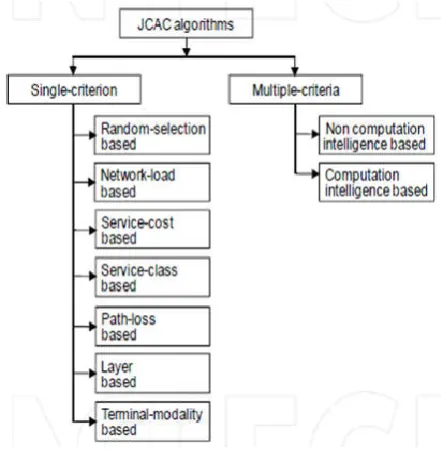
RAT selection approaches have been proposed in this paper JCAC algorithms in heterogeneous cellular networks. Broadly classified as single or multiple criteria. Single-criterion for JCAC algorithms make call admission decisions considering one criterion, such as network load services cost and services class, random selection, path loss measurement, RAT layer and terminal. On the other hand side multiple criteria of JCAC algorithms used for RAT selection decisions based on combination of single or multiple criteria. The multiple criteria are combined using computational intelligent technique (such as fuzzy logic, Fuzzy-neural, Fuzzy MADM or non-computational intelligent technique (such as cost function). Figure 5 the different approaches for different RAT selection decisions by JCAC algorithms.
Fig 6. RAT selection decisions by JCAC algorithms
JCAC Algorithm
A joint call admission control (JCAC) algorithm is used for making call admission decisions. A number of JCAC algorithms have been proposed for heterogeneous wireless networks, and a review of these JCAC algorithms given in [4]. However, these JCAC algorithms block/drop an incoming call when none of the available individual RATs in the heterogeneous network has enough bandwidth to support the call. Consequently, high bandwidth-demanding calls are easily blocked or dropped in the network, especially during the peak hours.
CRRM Methodology
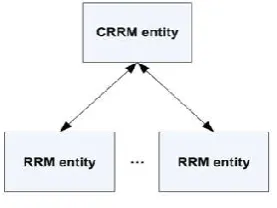
[image:3.595.62.262.312.469.2] [image:3.595.76.249.600.732.2]in Fig 7. The RRM entity is located at the lower tier and manages RRU within a RAT. The CRRM entity is at the upper tier of the two tier RRM model. It controls a number of RRM entities and can communicate with other CRRM entities. Based on the information gathered from different controlling RRM entities, the CRRM entity is able to know the RRU availability of multiple RATs technology and allocate a user to the most suitable RAT. The interactions between RRM and CRRM entities used two basic functions. The first function is referred to as the information reporting function, which allows RRM entities to access relevant information to their controlling CRRM entity. The information reporting can be performed either periodically triggered by an event. The reported information contains static cell information cell relations, capabilities and capacities provide efficient quality of sevices, maximum bit rate for a given services and dynamic cell information cell load or received power level, transmit power level, and interference measurements, etc.
Fig. 7. Two-tier RRM model
In the JCAC schemes reviewed above, the possibility of splitting scalable calls and selecting multiple RATs for scalable calls in heterogeneous wireless networks were not considered. Therefore, this article focuses on the above topic.
The proposes a JCAC scheme that reduces call
blocking/dropping probability by selecting multiple RATs for an incoming call when none of the available single RATs has enough bandwidth to accommodate the incoming call. The JCAC algorithm is designed to simultaneously achieve the following objectives in heterogeneous wireless networks.
Select a single RAT or multiple RATs for each call in the
heterogeneous wireless.
Degrade ongoing adaptive call(s) to the allowable
minimum basic bandwidth unit, if necessary, to admit an incoming call.
Reduce call blocking/dropping probability through multiple
RAT selection.
Prioritize handoff calls over new calls, and
Guarantee the QoS requirement of all admitted calls.
In wireless networks, dropping an ongoing call is more annoying to users than blocking a new call. Therefore, handoff calls are usually prioritized over new calls. The proposed JCAC algorithm prioritizes handoff calls over new calls by using different rejection thresholds for new and handoff calls. The contributions of this article are twofold. First, a JCAC algorithm for reducing call blocking/dropping probability in heterogeneous wireless networks is proposed. Second, an analytical model is developed for the proposed scheme, and its performance is evaluated in terms of NCBP and handoff call dropping probability. To the best of authors’ knowledge, this is the first JCAC scheme using multiple RAT selection and scalable call splitting for reducing call blocking/dropping probability in heterogeneous wireless networks. Figure 8 shows the stages of the proposed JCAC algorithm. For a non-adaptive call, the proposed JCAC algorithm attempts to admit the call into a single RAT (Fig 8). If the call cannot be admitted into any of the available RATs because of insufficient bbu, the JCAC algorithm attempts to degrade some ongoing adaptive call(s) (to the allowable minimum bbu) in order to free some bbu for the incoming call. If there is no sufficient bbu to accommodate the incoming call in any of the available RATs after degrading the ongoing new calls to the allowable minimum bbu, the JCAC algorithm rejects the incoming call.
Conclusion
Now a day’s coexistence of multiple cellular networks in the same geographical area has enabled more efficient utilization of radio resources and enhanced quality services and provide through joint radio resource management. Joint call admission
[image:4.595.82.526.465.658.2]control in heterogeneous and distributed cellular networks has been given in this paper. Different approaches for selecting RATs in heterogeneous cellular networks name as: random selection, network load, service-class, path loss, layer, terminal modality, computational intelligence or non-computational intelligence techniques have been proposed to solve this problem. Considering new four different simulation results are obtained and compared. Proposed results show that joint management of radio resources and bandwidth reduce call blocking/dropping probability in heterogeneous cellular networks.
Future Enhancement
Future work can be continued by exploring several other topics that can be investigated in the future. Examples of these topics are proposed below.
Analysing new scenarios, e.g., motorways impact on
results, by exploring MTs’ high speed and evaluate handovers impact on QoS.
Another approach can be changing others parameters, like
the number of BSs, their Inter-site distance, and installation (e.g., antennas configuration, BS and buildings height relation). Scenarios can be further analysed, like the train station, such as mobility investigation and interaction with surrounding BSs/RATs.
REFERENCES
Chen, H., Kumar, S. and Jay Kuo, C.C. 2002. Dynamic Call Admission Control Scheme for QoS Priority Handoff in Multimedia Cellular Systems, Proceedings of IEEE Wireless Communications and Networking Conference, Orlando, vol. 1, March, 2002, pp. 114-118.
Falowo, O.E., Chan, H.A. 2007. Adaptive bandwidth management and joint call admission control to enhance system utilization and QoS in heterogeneous wireless
networks. EURASIP J. Wireless Communications and
Networking. (11): July 2007 10.1155/2007/34378.
Falowo, O. E. and Chan, H. A. 2010. Joint Call Admission Control Algorithm for Fair Radio Resource Allocation in
Heterogeneous Wireless Networks Supporting
Heterogeneous Mobile Terminals, 7th Annual IEEE
Consumer and Communication & Networking Conference
(IEEE CCNC), Las Vegas, Nevada, USA, 9- 12 January, 2010.
Falowo, O. E. and Chan, H. A. 2007. Adaptive Bandwidth Manage ment and Joint Call Admission Control to Enhance System Utilization and QoS in Heterogeneous Wireless
Networks. EURASIP Journal on Wireless Communications and Networking, Vol. 2007, Article ID 34378, 11 Pages, 2007,DOI:10.1155/2007/34378, 2007.
Fettweis, G. 2009. Current Frontiers in Wireless
Communications: Fast & Green & Dirty, IEEE Wireless Communications & Networking Conference (WCNC), Budapest, Hungary, April 5-8, 2009.
Gelabert, X., Perez-Romero, J., Sallent, O., Agust, R. 2008. A Markovian approach to radio access technology selection in
heterogeneous multiaccess/multiservice wireless networks.
IEEE Trans. Mob. Computing, 7(10):1257-1270. October Gelabert, X., Pe´ rez-Romero, J., Sallent, O. and Agustı´, R.
2008. A Markovian Approach to Radio Access Technology Selection in Heterogeneous Multiaccess/Multiservice
Wireless Networks. IEEE Transactions on Mobile
Computing, Vol. 7, No. 10, October 2008.
Hasib, A., Fapojuwo, A.O. 2008. Analysis of common radio resource management scheme for end-to-end QoS support
in multiservice heterogeneous wireless networks. IEEE
Trans. Veh. Technology, 57(4):2426-2439.
Ho, C. and Lea, C. 1999. Improving Call Admission Policies in Wireless Networks. Wireless Networks, Vol. 5, issue 4, 1999, pp. 257-265.
Holma H. and Toskala, A. 2001. WCDMA for UMTS. John
Wiley & Sons, New York, NY,USA, 2nd Edition, 2001. Hong and, D. and Rappaport, S. S. 1986. Traffic Model and
Performance Analysis of Cellular Radio Telephony Systems with Prioritized and Non-prioritized Handoff
Procedures. IEEE Transaction of Vehicular Technology,
Vol. 35, August. 1986.
Lee, S., Sriram, K., Kim, K., Kim, Y. and Golmie, N., 2009. Vertical Handoff Decision Algorithms for Providing Optimized Performance in Heterogeneous Wireless
Networks. IEEE Transactions on Vehicular Technology,
Vol. 58, No. 2, February 2009.
Niyato, D., and Hossain, E. 2008. Noncooperative Game-Theoretic Framework for Radio Resource Management in
4G Heterogeneous Wireless Access Networks. IEEE
Transactions on Mobile Computing, Vol. 7, No. 3, March 2008.
Sachs, J., Prytz, M., Gebert, J. 2009. Multi-access management
in heterogeneous networks. Int. J. Wirel. Personal
Communications 2009, 48(1):7-32. January
10.1007/s11277-007-9431-8.
Song, W., Zhuang, W. 2009. Multi-service load sharing for resource management in the cellular/WLAN integrated
network. IEEE Trans. Wireless Communication February
2009, 8(2):725-735.