The London School of Economics and Political Science
Modeling individual preferences towards nuclear energy
Davide Contu
Declaration
I certify that the thesis I have presented for examination for the PhD degree of the London School of Economics and Political Science is solely my own work with the following exceptions: chapter 3 is 90% my own work.
The copyright of this thesis rests with the author. Quotation from it is permitted, provided that full acknowledgement is made. This thesis may not be reproduced without my prior written consent. I warrant that this authorisation does not, to the best of my belief, infringe the rights of any third party.
Acknowledgements
Abstract
This thesis investigates preferences for nuclear energy and the determinants of its social acceptance, through a combination of methods from Environmental Economics and Environmental Psychology.
In particular, we use stated preference surveys to investigate the social costs of nuclear energy in three different contexts: 1) Italy, a country that currently has no nuclear power plants in operation, and twice expressed its disapproval through referenda; 2) United Kingdom (UK), a country with nuclear energy; and 3) the United Arab Emirates (UAE), a country that plans to introduce nuclear energy by 2020. The determinants of social acceptance of nuclear energy are assessed in each of these different contexts. We investigate preferences for current nuclear technology as well as preferences for a new advanced 4th generation nuclear energy technology. In addition, we analyse the effects of having a transient population on support for nuclear energy.
Moreover, this thesis investigates a number of methodological issues pertaining to stated preference methods: 1) heuristics in choice modeling; 2) combination of choice modeling and structural equation modeling; and 3) links between propensity to contribute in contingent valuation questions and choices within the choice experiment tasks.
Table of Contents
List of tables ... 10
List of Figures ... 14
List of abbreviations ... 17
Chapter 1 ... 18
Introduction ... 18
1.1 Background: The controversial nature of nuclear energy ... 19
1.2 Research aims and objectives... 22
1.3 The countries selected ... 23
1.3.1 Case study 1: Italy ... 24
1.3.2 Case study 2: The UK ... 25
1.3.3 Case study 3: The United Arab Emirates (UAE) ... 26
1.4 Saliency in choice experiments ... 27
1.5 Summary of contributions ... 27
References ... 30
Chapter 2 ... 38
Review of core studies and methodology ... 38
2.1 Stated preferences and attitudes ... 39
2.1.1 The Stated preferences method ... 39
2.1.2 Stated preferences towards nuclear energy ... 41
2.1.3 Psychological determinants of acceptance of nuclear energy ... 44
2.2 Data ... 46
2.2.1 Survey flow ... 46
2.2.2 Survey pilots ... 49
2.2.3 Key questions, scales, information presented ... 50
2.2.3.1 Life satisfaction and transiency of residence ... 50
2.2.3.2 Questions on preferences towards energy sources ... 52
2.2.3.3 Egoistic, Altruistic, Biospheric values ... 52
2.2.3.4 Perceived risks and benefits of nuclear energy ... 54
2.2.3.5 Questions on climate change ... 55
2.2.3.6 Information treatment... 56
2.2.3.7 Information on IV generation nuclear energy ... 58
2.2.3.8 Acceptance of nuclear energy ... 60
2.2.3.9 Introduction to choice experiments ... 61
2.2.4 Sampling and survey mode ... 63
2.3 Core econometric models ... 64
2.3.1 Econometric models for choice experiment data ... 64
2.3.2 Experimental design for choice experiments ... 69
2.3.3 Econometric models for psychometric data ... 72
2.3.4 Notes on models’ estimation ... 73
References ... 75
Chapter 3 ... 87
Modeling individual preferences for energy sources: The case of IV generation nuclear energy in Italy ... 87
3.1 Introduction ... 89
3.2 Survey design ... 91
3.2.1 Choice experiments: Experimental design ... 91
3.2.2 Questionnaire design and information provision ... 96
3.2.3 Data collection ... 99
3.3 Statistical and econometric models ... 100
3.3.1 Analysis of psychometric variables ... 100
3.3.2 Bivariate probit model... 102
3.4 Descriptive statistics... 103
3.4.1 Sample characteristics ... 103
3.4.2 Attitudes towards energy sources ... 104
3.4.3 Views on fourth generation nuclear energy ... 108
3.5 Choice experiments results ... 113
3.5.1 MNL and RPL models ... 113
3.5.2 Latent class model ... 118
3.5.3 Effect of prior knowledge and information treatment... 124
3.6 Conclusions ... 132
Appendix ... 136
References ... 140
Chapter 4 ... 149
Complementing choice experiment with contingent valuation data: Individual preferences and views towards IV generation nuclear energy in the UK ... 149
Abstract ... 150
4.1 Introduction ... 151
4.2 Methodology ... 153
4.2.1 Choice Experiments ... 154
4.2.2 Contingent Valuation ... 155
4.3 Statistical and econometric models ... 156
4.3.1 Analysis of contingent valuation data ... 156
4.3.2 Analysis of psychometric variables ... 157
4.3 Descriptive statistics... 158
4.3.1 Sample characteristics ... 158
4.3.2 Attitudes towards energy sources ... 159
4.3.3 Views on fourth generation nuclear energy ... 163
4.4.4 Views on climate change ... 165
4.5 Statistical and econometric model results ... 166
4.5.1 Structural equation model ... 166
4.5.2 Factor analysis applied to climate change statements ... 172
4.5.3 Choice experiment data: MNL and RPL models ... 173
4.5.4 Choice experiment data: Latent class model ... 178
4.5.5 Analysis of contingent valuation data ... 181
4.6 Multivariate analysis ... 186
4.6.1 Correspondence between CE and CV data ... 186
4.6.2 Stated WTP by increasing concern towards climate change ... 188
4.6.3 Sensitivity to information ... 189
References ... 196
Appendix ... 202
Chapter 5 ... 208
Individual preferences for nuclear energy in the UAE: Exploring the effect of transient residency and life satisfaction ... 208
Abstract ... 209
5.1 Introduction ... 210
5.2 Public attitudes towards nuclear energy and life satisfaction in the UAE ... 213
5.3 Methodology ... 214
5.3.1 Experimental design ... 214
5.3.2 Questionnaire design and data collection ... 217
5.4 Descriptive statistics... 218
5.4.1 Sample characteristics ... 218
5.4.2 Views towards climate change ... 221
5.4.3 Preferences towards different energy sources ... 224
5.4.4 Perceived risks and benefits of nuclear energy ... 226
5.4.5 Life satisfaction ... 230
5.5 Statistical and econometric model results ... 232
5.5.1 Factor analysis ... 232
5.5.2 MNL and RPL models ... 234
5.5.3 RPL model with heterogeneity decomposition ... 238
5.5.4 Latent class model ... 240
5.6 Conclusion ... 243
References ... 247
Appendix ... 253
Chapter 6 ... 256
Salient attributes in choice experiments: empirical applications in the context of preferences towards nuclear energy ... 256
Abstract ... 257
6.1 Introduction ... 258
6.2 Background ... 261
6.3 Econometric models ... 264
6.3.1 Salient attributes: a mixture model ... 264
6.4 Empirical applications: Introduction of case studies ... 267
6.4.1 Case study 1-Italy ... 267
6.4.2 Case study 2-UK ... 268
6.4.3 Case study 3-UAE ... 269
6.5 Empirical applications: Descriptive statistics ... 270
6.5.1 Case study 1-Italy ... 270
6.5.2 Case study 2-UK ... 272
6.5.3 Case study 3-UAE ... 273
6.6 Empirical applications: Results ... 274
6.6.1 Case study 1-Italy ... 275
6.6.2 Case study 2-UK ... 284
6.6.3 Case study 3-UAE ... 292
Appendix ... 297
References ... 300
Chapter 7 ... 311
Concluding remarks ... 311
7.1 Views on nuclear energy ... 312
7.1.1 Nuclear versus other energy sources ... 312
7.1.2 IV generation nuclear energy ... 313
7.2 Perceived risks and benefits of nuclear energy ... 314
7.3 Monetary valuations ... 317
7.3.1 Monetary valuations: overview ... 317
7.3.2 Latent Class models-class membership probability ... 321
7.4 Sensitivity to information ... 322
7.5 Salient attributes ... 324
7.6 Summary of conclusions ... 325
List of tables
Chapter 2………...38 Table 2.1. Thesis’ objectives and related data 49
Chapter 3………...87
Table 3.1. Attributes and levels of the choice experiment 92 Table 3.2. Egoistic, Altruistic and Biospheric items 97
Table 3.3. Place attachment items 98
Table 3.4. Confidence items 98
Table 3.5. Perceived risks and benefits items 99 Table 3.6. Socio-demographic characteristics 104 Table 3.7. Answers to the risks, benefits and confidence’s statements 107 Table 3.8. Factor loadings and uniqueness-Factor analysis 110 Table 3.9. Structural measurement equations: coefficients 112 Table 3.10. MNL and RPL models. Dependent variable: Choice 115 Table 3.11. RPL model (WTP space). Dependent variable: Choice 117 Table 3.12. Latent class model. Dependent variable: Choice 121 Table 3.13. Bivariate Ordered probit model-Equation 1 125 Table 3.14. Bivariate Ordered probit model-Equation 2 126 Table 3.15.Bivariate ordered probit model: variables in Tables 3.13-3.14 127 Table 3.16. RPL model-Information Treatment. Dependent variable: Choice 130 Table 3.17. Mean and S.D. of latent constructs 131 Table 3.A1. Variables used in the CE econometric models 136 Table 3.A2. Latent class model. Dependent variable: Choice 137
Table 3.A3. Experimental Design 138
Chapter 4………149
Table 4.3. Socio-demographic characteristics 159 Table 4.4. Answers to the risks, benefits and confidence’s statements 162 Table 4.5. Answers to the confidence and trust statements 164 Table 4.6. Perceived risks and benefits items 168
Table 4.7. Confidence items 169
Table 4.8. Trust items 169
Table 4.9. Factor loadings and uniqueness 170 Table 4.10. Structural Equation model-Measurement equations' coefficients 171
Table 4.11. Climate change items 172
Table 4.12. Factor loadings and uniqueness 173 Table 4.13. MNL and RPL models. Dependent variable: Choice 175 Table 4.14. RPL model. Dependent variable: Choice 177 Table 4.15. Latent class model. Dependent variable: Choice 179 Table 4.16. Contingent valuation data: OLS and QR models 184 Table 4.17. Analysis of CV data: Variables employed in Table 4.16 185 Table 4.18: Stated WTP by segment (£ unless % specified) 187 Table 4.19. Mean and S.D. of the score factors of the construct ‘Worried’ by preference
for energy source and WTP 189
Table 4.20. RPL-Information Treatment. Dependent variable: Choice 190 Table 4.A1. Variables used in the CE econometric models 202 Table 4.A2. Latent class model. Dependent variable: Choice 203
Table 4.A3. Experimental Design 205
Chapter 5………208
Table 5.2. Sample structure by socio-demographic variables 219 Table 5.3. Descriptive statistics: Income 221 Table 5.4. How concerned are you, as individual, about climate change ? 222 Table 5.5. Attitudes towards climate change 222 Table 5.6. In your opinion, how much should the UAE invest in ? 224 Table 5.7. How likely are the following risks associated with nuclear energy? 227 Table 5.8. How likely are the following benefits? 229 Table 5.9. Perceived Risks and Benefits: Factor loadings and uniqueness 233 Table 5.10 Mean and S.D. of net perceived benefits by group 234 Table 5.11. MNL and RPL models. Dependent variable: Choice 236 Table 5.12. RPL model (WTP space). Dependent variable: Choice 238 Table 5.13. RPL model with heterogeneity decomposition. 239 Table 5.14. Latent class model. Dependent variable: Choice 241 Table 5.A1. Variables used in the CE econometric models 253
Table 5.A2 Experimental Design 254
Chapter 6………...256
Table 6.7: Parameters’ estimates-Case study 1 (Italy). LC 2 & saliency 279 Table 6.8: Monetary valuations-Case study 1 (Italy). LC 2 & saliency 280 Table 6.9: Parameters’ estimates-Case study 1 (Italy). LC 3 & saliency 283 Table 6.10: Monetary valuations-Case study 1 (Italy). LC 3 & saliency 284 Table 6.11: Parameters’ estimates-Case study 2 (UK). MNL & saliency 285 Table 6.12: Monetary valuations-Case study 2 (UK). MNL & saliency 286 Table 6.13: Parameters’ estimates-Case study 2 (UK) LC 2 & Saliency 288 Table 6.14: Parameters’ estimates-Case study 2 (UK) LC 2 & Saliency 289 Table 6.15: Parameters’ estimates-Case study 2 (UK) LC 3 & Saliency 291 Table 6.16: Parameters’ estimates-Case study 2 (UK) LC 3 & Saliency 292 Table 6.17: Parameters’ estimates-Case study 3 (UAE). MNL & Saliency 293 Table 6.18: Monetary valuations-Case study 3 (UAE). MNL & Saliency 294 Chapter 7………...311
List of Figures
Chapter 2………...38
Figure 2.1: Survey flow across case studies 48 Figure 2.2: Questions to measure transiency 51 Figure 2.3: Questions on preference towards energy sources 52 Figure 2.4: Questions on Egoistic, Altruistic, Biospheric values 53 Figure 2.5: Questions on perceived risks of nuclear energy 54 Figure 2.6: Questions on perceived benefits of nuclear energy 55 Figure 2.7: Questions on climate change (UAE) 56 Figure 2.8: Questions on climate change (UK) 56 Figure 2.9: Information treatment part A 57 Figure 2.10: Information treatment part B 58 Figure 2.11: Intro to IV generation nuclear energy 59 Figure 2.12: Confidence towards IV gen goals & trust towards nuclear energy
stakeholders 60
Figure 2.13: Acceptance of nuclear energy 61
Figure 2.14: Introduction to Choice Experiment 62 Chapter 3………...87
Figure 3.1: Example of a choice task 95
Figure 4.1: Example of a choice task 155 Figure 4.2: Views towards different energy sources 160 Figure 4.3: Opinion towards energy policy in the UK 161 Figure 4.4: Views towards climate change 166 Figure 4.5: Structural equation model: Path diagram 171
Figure 4.6: Share of ‘None’ chosen 174
Figure 4.7: Distribution of stated WTP 182
Chapter 5………...208
Figure 5.1: Example of choice task 216
Figure 5.2: Life Satisfaction question 217
Figure 5.3: Sample % by nationality 200
Figure 5.4: Perceived benefits of nuclear energy in the UAE 230 Figure 5.5: Perceived risks of nuclear energy in the UAE 230 Figure 5.6: How satisfied are you, overall, with your life in the UAE? 231 Figure 5.7: Difference between life satisfaction in general and in the UAE-Expatriates
232 Figure 5.8: Views towards nuclear energy in the UAE by segment 243 Chapter 6………...256
Figure 7.1: Map showing the location of nuclear plants in Europe 323 Figure 7.2: Google searches of the term ‘Fukushima’ by country-Google Trends data
List of abbreviations
AED: United Arab Emirates Dirham
ANA: Attribute non-attendance
ASC: Alternative Specific Constant
CE: Choice experiment
CFI: Comparative fit statistic
CV: Contingent valuation
ESB: Environmentally significant behavior
EU: European Union
FG: Fourth Generation
GBP: British Pound
GCC: Gulf Cooperation Council
GHG: Greenhouse Gas
GIF: Generation IV International Forum
GW: Gigawatt
LC: Latent Class
LL: Log-Likelihood
MNL: Multinomial Logit
MV: Monetary valuations
OLS: Ordinary least squares
QR: Quantile regression
R&D: Research and development
RP: Revealed Preferences
RPL: Random Parameters Logit
SP: Stated preferences
UAE: United Arab Emirates
VBN: Value Belief Norm
WTA: Willingness to accept
The following images have been redacted as the copyright is owned by another organisation.
Page 57 image
Page 58 map
Chapter 1
1.1 Background: The controversial nature of nuclear energy
Nuclear technology exploits the enormous energy released by splitting the atoms of particular elements and it is argued it does not emit CO2 whilst generating electricity
(Apergis et al. 2010; Knapp et al. 2010; Srinivasan and Gopi Rethinaraj 2013; Hayashi and Hughesm 2013; Wang et al. 2013; Samseth 2013; Van der Zwaan 2013; Huhtala and Remes 2017). This can contribute to curb climate change in parallel with fossil fuel consumption reduction (COM 2011; 2007; EC 2009; UNFCCC 1992). In addition, nuclear energy can support the enhancement of energy diversification and the mitigation of energy security risks (Watson and Scott 2009). Further, while renewable energy tends to present intermittency issues in electricity generation (Cany et al. 2016; Waterson 2017), nuclear plants routinely provide base-load energy, namely a reliable minimum amount of power (Huhtala and Remes 2017). Yet, major risks are associated with nuclear energy, including the possibility of accidents, the production of radioactive waste disposal, the risk of nuclear proliferation and the uncertainties about construction time and highly expensive capital costs. This makes its implementation undoubtedly contentious (Kassides 2010; Kassides 2012; Vander Beken et al. 2010), and generally surrounded by unfavourable public opinion (Eurobarometer 2007; Globescan 2005; OECD 2010; Schneider et al. 2016; van de Graaff 2016).
Public acceptance has a critical role in the siting and building of new nuclear power plants (Hammond 1996; Ansolabehere et al. 2003; Weisser et al. 2008; Schneider et al. 2016).1
Since the 1970s, public attitudes towards nuclear power seem to be more negative than
1 Acceptability of energy technologies refers to how acceptable a proposed new technology is to the individual, namely
positive when compared to other energy sources (Rosa and Freudenburg 1993; Eiser et al 1995). The level of opposition, however, is different between and within countries (Slovic 1987, Slovic et al. 1991; Rosa et al. 2000; Slovic et al. 2000). Also, support for nuclear energy seems to have increased over time with fluctuations around various worldwide disasters (Knight 2005; Grove-White et al. 2006; OECD 2010; He et al. 2014). Years after the Chernobyl disaster of 1986 and prior to the 2011 Fukushima accident, acceptance was on the rise around the world (OECD 2010) and in 2009 there were 52 countries considering nuclear power implementation (Jewell 2011). However, after the Fukushima accident, polls conducted in 23 countries by the same company used in the OECD (2010) study show that people were significantly more opposed to building new nuclear reactors than they were in 2005. Only 22% agreed that ‘nuclear power is relatively safe and an important source of electricity, and we should build more nuclear power plants’ (Globescan 2011). Even in the United States of America, a country with generally favourable public opinion towards nuclear power, this worsening trend was observed. A 2015 Gallup poll in the USA found support for nuclear power at 51%, with 43% opposing its usage for electricity. This was the lowest level of support for nuclear power in the past 20 years and significantly lower than the 2010 peak of 62% in favour, versus 33% against (Riffkin 2015). In general, public acceptance appears to be hard to improve and easy to worsen.
accident, in 2008 the UK government declared nuclear power to be a lucrative opportunity for investors, yielding economic benefits to the country (BERR 2008). Such position did not change following Fukushima. In a context where most the country’s existing nuclear plants are expected to be closed by the end of 2020s, 14 GW of new nuclear energy are projected by 2035 (NAO 2016). In addition, public opinion in the UK did not seem to have deteriorated following Fukushima (Poortinga et al. 2014). Recently, more countries have been investing in nuclear energy notwithstanding the Fukushima accident. As of January 2017, there were 55 reactors under construction in 13 countries (Bulletin of the Atomic Scientist 2017). An interesting case is that of the UAE, aiming to become ‘a role model for nuclear energy development worldwide’ (ENEC 2014): four nuclear reactors are under construction in the country and scheduled to be completed by 2020. But on the whole, the worldwide share of nuclear electricity generated is declining: it was 10.7% in 2015 vis-à-vis 17.6% in 1995. Furthermore, over 70% of the global nuclear electricity was generated in just five countries: US, France, China, Russia, South Korea (Schneider et al. 2016).
needed to dispose and store the nuclear waste; iv) to increase the cost competitiveness compared to other energy sources; v) to increase the protection against terrorist attacks;and vi) to increase passive security. These so-called fourth generation (FG) nuclear energy systems can be thought of as revolutionary if compared to current nuclear technology (Brook 2012; Grape et al. 2014). The first nuclear plants belonging to the fourth generation are forecasted to be available after 2030 (Locatelli et al. 2013). This technology remains majorly underdeveloped (Murty and Charit 2008). For instance, there are currently no materials which can bear the pressure and temperatures planned for the ‘Very high temperature reactors’ project (Abram and Ion 2008; Locatelli et al. 2013). The technology costs are the other issue of concern as they are currently undetermined (Kessides 2012; Kosenius and Ollikainen 2013). As such, FG nuclear energy implementation needs to rise to technological and economic challenges, as well as social acceptability2.
In a nutshell, this thesis contributes to the literature on preferences towards and social acceptability of nuclear energy.The next sections introduce the aims and objectives of the thesis, the empirical case studies described in each of the thesis main chapters, and the contribution to knowledge. Finally, the outline of the following chapters is presented.
1.2 Research aims and objectives
This thesis aims to contribute to the literature on preferences towards potentially controversial energy projects using stated preference methodologies, whilst presenting policy-relevant empirical valuation models in the context of nuclear energy3. The thesis addresses these aims through empirical research chapters. The overarching aim is assessing
2 There are also great expectations from research in the area of nuclear fusion (Ongena and Ogawa 2016).
3 It is worth remarking that the thesis focuses on individual preferences, not on macroeconomic or geopolitical
aspects related to nuclear energy. It does not aim to assess whether nuclear energy should be implemented in
and evaluating preferences and attitudes towards nuclear energy post the Fukushima events. The key objectives are as follows:
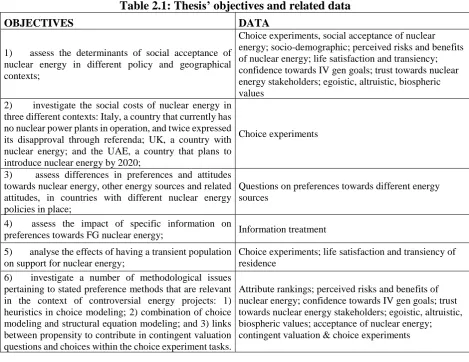
1) assess the determinants of social acceptance of nuclear energy in different policy and geographical contexts;
2) investigate the social costs of nuclear energy in three different contexts: Italy, a country that currently has no nuclear power plants in operation, and twice expressed its disapproval through referenda; UK, a country with nuclear energy; and the UAE, a country that plans to introduce nuclear energy by 2020;
3) assess differences in preferences and attitudes towards nuclear energy, other energy sources and related attitudes, in countries with different nuclear energy policies in place; 4) assess the impact of specific information on preferences towards FG nuclear energy; 5) analyse the effects of having a transient population on support for nuclear energy; 6) investigate a number of methodological issues pertaining to stated preference methods
that are relevant in the context of controversial energy projects: 1) heuristics in choice modeling; 2) combination of choice modeling and structural equation modeling; and 3) links between propensity to contribute in contingent valuation questions and choices within the choice experiment tasks.
The contribution to knowledge of each of the thesis’ four studies are detailed in Section 1.5.
1.3 The countries selected
whilst building new ones, whereas there is no plan of reintroducing nuclear energy in Italy. With regards to the UAE, the building of new nuclear plants is well under way (ENEC 2014). Hence, this thesis covers one country without nuclear plants in operation (Italy), one country with nuclear plant in operation (the UK), and one country which is building nuclear plants (the UAE). Second, with respect to the energy consumption mix, all of the three countries heavily rely on fossil fuels, especially oil and gas. But while Italy has to import almost all of the fossil fuels it consumes (IEA 2009; ENEA 2013), the UK has an extremely low level of energy import dependency (European Commission 2011); instead, the UAE is one of the world’s largest exporters of fossil fuels (IEA 2014). Furthermore, these three nations differ in terms of the political process: Italy and the UK are respectively a parliamentary republic and a parliamentary monarchy, whereas the UAE is a federal presidential absolute monarchy. Finally, the UAE is characterized by an extraordinarily vast share of expatriate residents, amounting to around 85% of the population in 2010 (National Bureau of Statistics UAE 2013). These residents normally do not have access to citizenship and usually are in the country for only part of their lives (Koch 2016).
1.3.1 Case study 1: Italy
Social acceptance of IV generation nuclear energy in Italy is investigated in this study. A nation-wide online survey was conducted for this purpose. The rich dataset obtained includes choice experiment and psychometric data. Further, information treatments were administered to a random sub-set of respondents. This allows us to test the extent to which results concerning social acceptance of nuclear energy are sensitive to the information provided. From a methodological point of view, this study offers a robust framework given by the combination of discrete choice models applied to choice experiment data and structural equation modeling applied to psychometric data.
1.3.2 Case study 2: The UK
The UK is a pioneer of nuclear energy. The country has had nuclear plants in operation since the 1960s. Currently, 15 nuclear reactors are in operation, and 21% of the electricity is generated by means of nuclear power (WNA 2017; National Statistics 2017). However, most of the existing nuclear reactors are scheduled to be closed down by 2030. In 2013, the government laid out a plan to prepare their replacement, envisaging 16 GW of nuclear power by 2030, and up to 75 GW in the following twenty years (HP 2014). The strategy foreseen in order to expand the domestic generation of electricity from nuclear, during the post 2030 phase, includes a mix of generation III+, IV and Small Modular Reactors-SMRs (HM 2013).
with nuclear power plants in operation. The dataset built includes choice experiment, contingent valuation and psychometric data. Further, considering the methodological contribution, this study complements choice experiments with contingent valuation data, with the aim of testing the internal validity of results and gaining a richer insight on individual preferences.
1.3.3 Case study 3: The United Arab Emirates (UAE)
The UAE is on track to be the first Arab country to generate electricity from nuclear energy. The continued growth in energy demand, the forecasted reduction of fossil fuels availability and the attention to climate change, led the country to resolutely invest in nuclear. Four nuclear reactors are expected to be in operation by 2020, located in the emirate of Abu Dhabi. These are expected to deliver 5.6 GW of nuclear energy, contributing to around 20% of domestic power demand (Masdar/IRENA 2015).
1.4 Saliency in choice experiments
A common element across the three empirical studies discussed above is the administration of choice experiments, a stated preference technique (Hanley et al. 2001). That is, individuals were asked to choose between hypothetical projects describing the construction of nuclear plants. In the context of nuclear energy, some attributes that characterize these scenarios might evoke particularly strong reactions including fear (Hartmann et al. 2013). In turn, this might lead the respondents to disproportionally focus on this information when making their choices. Namely, the decision processing strategy might be affected by the particular good under evaluation. The thesis also aims to contribute to the literature on decision processing strategies in choice modeling. In a separate chapter, we test the following behavioral assumption: in some choice situations, respondents fail to compare all of the attributes between alternatives and base their choices on the presence (or absence) of the attribute’s level that they consider to be the most relevant, or that captures their attention. From an econometric modelling point of view, this chapter implements a constrained latent class model in which it is possible to isolate probabilistically whose choice sequence is best approximated by a fully compensatory model, or otherwise.
1.5 Summary of contributions
In terms of policy contributions, the thesis includes works that:
1) to the best of our knowledge, open the stream of research on investigating the social acceptance of IV generation nuclear energy and its determinants (Chapters 3, 4);
3) add to the literature on the impact of providing additional information when assessing preferences and attitudes towards nuclear energy, in the context of FG nuclear energy technology (Chapters 3, 4, 7);
4) provide comparative evidence on preferences and attitudes towards nuclear energy, other energy sources and related attitudes (Chapters 3, 4, 5, 7), whilst presenting the first study to asses individual stated preferences for energy sources in the UAE (Chapter 5);
5) to the best of our knowledge, investigate for the first time the impact of transiency of residence and life satisfaction on acceptance of nuclear energy (Chapter 5);
With regards to methodological contributions, the thesis offers:
1) an original combination of discrete choice modeling and structural equation modelling (Chapters 3), presenting both applications with the same set of respondents;
2) an original connection of choice experiments and contingent valuation data, showing links between WTP towards R&D of FG nuclear energy and WTA the building of new nuclear plants (Chapter 4);
3) a novel approach to model choices in a context where the good under valuation might affect the decision strategy of the respondents (Chapter 6).
1.4 Outline
References
Abram T, Ion S (2008) Generation IV nuclear power: A review of the state of the science. Energy Policy 36:4323-4330
Apergis N, Payne J E, Menyah K, Wolde-Rufael Y (2010) On the casual dynamics between emissions, nuclear energy, renewable energy, and economic growth. Ecological Economics 69(11):2255-2260
Ansolabehere S, Deutch J, Driscoll M, Gray P, Holdren J, Joskow P, Lester R, Moniz E, Todreas N, Beckjord E (2003) The future of nuclear power: an interdisciplinary MIT study. Retrieved from http://web.mit.edu/nuclearpower/pdf/nuclearpower-full.pdf
BERR-Department for Business Enterprise and Regulatory Reform (2008) A white paper on nuclear power
Brook W B (2012) Could nuclear fission energy, etc., solve the greenhouse problem? The affirmative case. Energy Policy 42:4-8
Bulletin of the Atomic Scientists (2017) http://thebulletin.org/global-nuclear-power-database
Cany C, Mansilla C, Da Costa P, Mathonnière G, Duquesnoy T, Baschwitz A (2016) Nuclear and intermittent renewables: Two compatible supply options? The case of the French power mix. Energy Policy 95:135-146
Eiser J R, van Der Pligt J, Spears R (1995) Nuclear neighborhoods: Community responses to reactor siting: University of Exeter Press
European Commission (2009) Directive of the European Parliament and the Council of the European Union 2009/28/EC of 23 April 2009 on the promotion of the use of energy from renewable sources and amending and subsequently repealing Directives 2001/77/EC and 2003/30/EC. Strasbourg, EU
ENEA (2013) Rapporto Energia e Ambiente. Scenari e strategie 2013. Retrieved from http://www.enea.it/it/produzione-scientifica/pdf-rea/REAScenariestrategie2013.pdf
ENEC (2014) ENEC to host open public forums in Abu Dhabi and Silla. Retrieved from
http://www.enec.gov.ae/media-centre/news/content/enec-to-host-open-public-forums-in-abu-dhabi-and-silla
Esposto S (2008) The possible role of nuclear energy in Italy. Energy Policy 36(5):1584-1588
Eurobarometer (2007) Energy Technologies: Knowledge, Perception, Measures. Special Eurobarometer 262. Retrieved from
http://ec.europa.eu/public_opinion/archives/ebs/ebs_262_en.pdf
European Commission (2011) Communication from the commission to the European Parliament, the council, the European Economic and Social Committee and the Committee of Region. A roadmap for moving to a competitive low carbon economy in 2050. COM (2011) 112
GIF (2014) GIF Annual report 2014. Retrieved from https://www.gen-4.org/gif/jcms/c_74053/gif-annual-report-2014
Globescan (2005) Global Public Opinion on nuclear issues and the IAEA. Final report from 18 countries. Retrieved from
Globescan (2011) Opposition to nuclear energy grows: Global Poll. Retrieved from
http://www.globescan.com/news-and-analysis/press-releases/press-releases-2011/94-press-releases-2011/127-opposition-to-nuclear-energy-grows-global-poll.html
Grape S, Svӓrd S J, Hellesen C, Janson P, Lindell M A (2014) New perspective on nuclear power-Generation IV nuclear energy systems to strengthen nuclear non-proliferation and support nuclear disarmament. Energy Policy 73:815-819
Grove‐White R, Kearnes M, Macnaghten P, Wynne B (2006) Nuclear futures: assessing public attitudes to new nuclear power. The Political Quarterly 77(2):238-246
Hammond G (1996) Nuclear energy into the twenty-first century. Applied Energy 54(4):327-334
Hanley N, Mourato S, Wright R E (2001) Choice modelling approaches: a superior alternative for environmental valuation? Journal of economic surveys 15(3):435-462 Hartmann P, Apaolaza V, D’Souza C, Echebarria C, Barrutia J M (2013) Nuclear power threats, public opposition and green electricity adoption: Effects of threat belief appraisal and fear arousal. Energy Policy 62:1366-1376
Hayashi M, Hughes L (2013) The policy responses to the Fukushima nuclear accident and their effect on Japanese energy security. Energy Policy 59:86-101
He G, Mol A P J, Zhang L, Lu Y (2014) Nuclear power in China after Fukushima: understanding public knowledge, attitudes, and trust. Journal of Risk Research 17(4):435-451
Houses of Parliament (2014) New nuclear power technologies. Houses of Parliament, Parliamentary office of science and technology. Number 457 2014
Huhtala A, Remes P (2017) Quantifying the social costs of nuclear energy: Perceived risk of accident at nuclear power plants. Energy Policy 105:320-331
IEA (2009) Energy Policies of IEA countries-ITALY. Retrieved from http://www.iea.org/publications/freepublications/publication/italy2009.pdf
IEA-International Energy Agency (2014) World Energy Investments. Retrieved from http://www.iea.org/publications/freepublications/publication/WEIO2014.pdf
Jewell J (2011) Ready for nuclear Energy? An assessment of capacities and motivations for launching new nuclear power programs. Energy Policy 39:1470-1055
Kessides I N (2010) Nuclear Power: Understanding the economic risks and uncertainties. Energy Policy 38:3849-3864
Kessides I N (2012) The future of the nuclear industry reconsidered: Risks, uncertainties, and continued promise. Energy Policy 48:185-208
Knapp V, Pevec D, Matijević M (2010) The potential of fission nuclear power in
resolving global climate change under the constraints of nuclear fuel resources and once-through fuel cycles. Energy Policy 38:6793-6803
Knight R (2005) What do the polls tell us? Nuclear Engineering International 50(609):24-25
Koch N (2016) Is nationalism just for nationals? Civic nationalism for non-citizens and celebrating National Day in Qatar and the UAE. Political Geography 54:43-53
renewable energy sources. Energy Policy 62:1148-1156
Locatelli G, Mancini M, Todeschini N (2013) Generation IV nuclear reactors: Current status and future prospects. Energy Policy 61:1053-1520
Masdar Institute/IRENA (2015) Renewable energy prospects: United Arab Emirates. Remap 2030 analysis. IRENA, Abu Dhabi. www.irena.org/remap
Murty K L, Charit I (2008) Structural materials for Gen IV nuclear reactors: Challenges and opportunities. Journal of Nuclear Materials 383(1-2):189-195
National Audit Office (2016) Nuclear power in the UK. Retrieved from https://www.nao.org.uk/wp-content/uploads/2016/07/Nuclear-power-in-the-UK.pdf
National Bureau of Statistics UAE (2013) Population estimates 2006-2010. Retrieved from http://www.uaestatistics.gov.ae/ReportPDF/Population%20Estimates%202006%20-%202010.pdf
National Statistics (2017) UK energy statistics, 2016 & Q4 2016. Department for Business, Energy & Industrial Strategy
OECD (2010) Public attitudes to nuclear power. Retrieved from https://www.oecd-nea.org/ndd/reports/2010/nea6859-public-attitudes.pdf
Ongena J, Ogawa Y (2016) Nuclear fusion: Status report and future prospects. Energy Policy 96:770-778
Poortinga W, Pidgeon N, Capstick S, Aoyagi M (2014) Public attitude to nuclear power and climate change in Britain two years after the Fukushima accident. Synthesis Report (UKERC: London)
Riffkin R (2015) U.S. Support for nuclear energy at 51%. Gallup poll. Retrieved from
http://www.gallup.com/poll/182180/support-nuclear-energy.aspx?g_source=nuclear+energy&g_medium=search&g_campaign=tiles
Rosa E A, Freudenburg W B (1993) The Historical Development of Public Reactions to Nuclear Power: Implications for Nuclear Waste Policy. In Public reactions to nuclear waste: Citizens' views of repository siting, edited by Dunlap R E, Kraft M E, Rosa E A.
Rosa E A, Matsuda N, Kleinhesselink R R (2000) The Cognitive Architecture of Risk: Pancultural Unity or Cultural Shaping? In O. Renn & B. Rohrmann (Eds.), Cross-Cultural Risk Perception: A Survey of Empirical Studies (pp. 185-210). Boston, MA: Springer US Samseth J (2013) Will the introduction of renewable energy in Europe lead to CO2 reduction without nuclear energy? Environmental Development 6:130-132
Schneider M, Froggatt A, Hazemann J, Katsuta T, Ramana M V, Fairlie I, Maltini F, Thomas S (2016) The world nuclear industry Status Report 2016
Slovic P, Flynn J, Mertz C K, Poumadere M, Mays C (2000): Nuclear Power and the Public A Comparative Study of Risk Perception in the United States and France. In: O. Renn & B. Rohrmann (eds.): Cross-Cultural Risk Perception: A Survey of Empirical Studies. Dordrecht and Boston. pp. 55–102
Slovic P (1987) Perception of risk. Science 236:280-285
Slovic P, Peters E, Finucane ML, MacGregor DG (2005) Affect, risk, and decision making. Health Psychology 24(4):S35-S40
Srinivasan T N, Gopi Rethinaraj T S (2013) Fukushima and thereafter: Reassessment of risks of nuclear power. Energy Policy 52:726-736
UNFCCC-United Nations Framework Convention on Climate Change (1992) Retrieved from http://unfccc.int/not_assigned/b/items/1417.php
Van der Graaff S (2016) Understanding the nuclear controversy: An application of cultural theory. Energy Policy 97:50-59
Vander Beken T, Dorn N, Van Daele S (2010) Security risks in nuclear waste management: Exceptionalism, opaqueness and vulnerability. Journal of Environmental Management 91:940-948
Van der Zwaan B (2013) The role of nuclear power in mitigating emissions from electricity generation. Energy Strategy Reviews 1(4):296-301
Wang Q, Chen Xi, Yi-Chong Xu (2013) Accident like the Fukushima unlikely in a country with effective nuclear regulation: Literature review and proposed guidelines. Renewable and Sustainable Energy Reviews 71:126-146
Waterson M (2017) The characteristics of electricity storage, renewables and markets. Energy Policy 104:466-473
Watson J, Scott A (2009) New nuclear power in the UK: A strategy for energy security? Energy Policy 37(12):5094-5104
Weisser D, Howells M, Rogner H (2008) Nuclear power and post-2012 energy and climate change policies. Environmental Science and Policy 11:467-477
from http://www.world-nuclear.org/information-library/country-profiles/countries-t-z/united-kingdom.aspx
Chapter 2
This chapter introduces the Stated Preferences (SP) framework and the techniques implemented in this thesis: choice experiments (CE) and contingent valuation (CV). Next, we discuss the core literature on stated preferences studies on nuclear energy. Subsequently, we present key findings concerning attitudes towards nuclear energy arising from the environmental psychology literature. It is then introduced the main econometric framework employed in the empirical chapters. Finally, we discuss the choice of online data collection, common across the case studies.
2.1 Stated preferences and attitudes
2.1.1 The Stated preferences method
The aim of the thesis is to investigate the economic value of IV generation nuclear energy, in Italy and UK, and of current generation nuclear energy in the UAE. We assess the willingness to accept (WTA) new nuclear power plants in each of these three countries. Also, we measured the willingness to pay (WTP) for further research and development of IV generation nuclear energy technology as part of the UK case study. Economic values are determined with the aid of preference-based techniques, which can be broadly divided into Stated Preferences (SP) and Revealed Preferences (RP) techniques.
preferences can be inferred from related existing markets. Examples of RP methods include the hedonic price and the travel cost method4 (Pearce 2002). However, RP studies are limited to the markets available and to a given technology structure. Instead, SP techniques thrive in scenarios where technological changes are part of the evaluation (Louviere et al. 2000).
SP methods include contingent valuation (CV) and choice experiments (CE). CV consists of questions that invite respondents to directly state their WTP or WTA for a given good or service. Respondents are presented with hypothetical scenarios in which one key characteristic of the good varies: its monetary value. Such scenarios should be carefully designed to be perceived by the respondents as comprehensible, plausible and meaningful (Mitchell and Carson 1989). Moreover, research suggests to include follow up questions so as to distinguish between genuine answers and protests (Strazzera et al. 2003; Meyerhoff and Liebe 2006; Meyerhoff and Liebe 2008), warm glow-driven choices (Chilton and Hutchinson 2000; Nunes and Schokkaert 2003), as well as preference uncertainty (Akter et al. 2008).
Choice experiments (CE) are a stated preference technique that has become a popular alternative to contingent valuation (Bateman et al. 2002; Hanley et al. 2001; Louviere et al. 2000). In a choice experiment, respondents are presented with a series of scenarios, each composed of different attributes, varying at different levels. Respondents are then requested to choose their most preferred scenario. If a monetary attribute is included, the implicit
4 In the case of hedonic price method, the focus is on observed price changes. For instance, a change in
environmental quality that affects housing prices. The travel cost method instead focuses on the quantity. For
instance, the number of observed visits to a recreational site. These visits are linked to the respective time and
price of each of the other attributes (i.e. marginal WTP or WTA) can be calculated, as well as the total welfare change provided by various scenario options. Grippingly, although widely used in the environmental valuation field, specific applications of CE to the valuation of nuclear energy are uncommon.
There are potentially two distinct advantages of using CE for the valuation of preferences for nuclear energy. First, CE are particularly well suited to value changes that are multidimensional (with scenarios being presented as bundles of attributes) and where trade-offs between the various dimensions are of particular interest. Second, WTP or WTA is inferred implicitly from the stated choices, avoiding the need for respondents to directly place a monetary value on scenario changes. This latter characteristic has led to suggestions that CE formats may be less prone to protest responses than contingent valuation as attention is not solely focused on the monetary attribute but on all the attributes (Hanley et al. 2001). This is particularly relevant when dealing with nuclear energy-related scenarios that may be particularly inclined to protests, given the notoriously strong views held towards nuclear energy by many people. On the negative side, complex CE can pose a significant cognitive burden to respondents leading to non-utility maximizing strategies and choice errors (Bateman et al. 2002; Hanley et al. 2001; DeShazo and Fermo 2002; Caussade et al. 2005, Bech et al. 2011). Hence, it is recommended that the CE should be carefully piloted so as to make the presentation of the choice tasks engaging, realistic and understandable.
2.1.2 Stated preferences towards nuclear energy
preferences for green electricity without reference to the energy sources that make up the green power mix. Fimereli’s (2011) review of the topic concludes that the public tends to be supportive of green power and that willingness to pay is generally positive. In terms of specific attributes of energy sources, the public seems to attach a high value to reductions in GHG emissions, while proximity of energy plants to the place of residence is negatively viewed (Fimereli 2011). Furthermore, there appears to be the need for direct economic benefits to the host communities (Van der Horst 2007). However, support for clean energy sources in general can mask substantial differences between specific clean energy technologies (Borchers et al. 2007; Walker 1995).
al. (2015), and Cicia et al. (2012). The latter seems to be the only published choice experiment study on this topic conducted in Italy.
Stated preferences towards nuclear energy have not been receiving much attention in the UK, an exception being the work of Fimereli (2011). The study investigated English and Scottish respondents’ preferences for wind, biomass and nuclear power. Although respondents prefer an increase in low-carbon energy sources compared to the status quo, both English and Scottish respondents favour wind energy over nuclear power. In addition, it was found that both groups of respondents would prefer power plants away from their area of residence; and they would particularly value emissions’ reductions. When it comes to the case of the United Arab Emirates, there appears to be no evidence of stated preference study conducted in the field of acceptance of nuclear energy. More broadly, it appears scant the literature on stated preferences towards energy sources in the GCC states.
2.1.3 Psychological determinants of acceptance of nuclear energy
The way individuals perceive risks and benefits can be affected by a multitude of factors. One of these is represented by trust towards regulatory agencies, as investigated by Ansolabehere and Konisky (2009), Greenberg (2009), Siegrist and Cvetkovich (2000), Siegrist et al. (2000), Greenberg and Truelove (2011), Bronfman et al. (2012). Additionally, the role of values appears to be of paramount importance as far as nuclear energy is concerned (De Groot et al. 2013). These are defined as determinants of ‘beliefs and intentions related to ESB [Environmentally Significant Behavior]’ (De Groot and Steg 2008, p.331) and have been detected extensively in a number of empirical studies (Schwartz 1992; Schwartz 1994; Schwartz and Bardi 2001; Schwartz and Huismans 1995; Schwartz and Sagiv 1995). More generally, values serve as guiding principles in one’s life (Schwartz 1992) and they form part of the Value Belief Norm (VBN) theory (Stern et al. 1999; Stern 2000). According to De Groot et al. (2013), perceived risks and benefits mediate the relationship between egoistic, altruistic and biospheric values, and acceptance of nuclear energy. Individuals with greater egoistic value orientation tend to consider risks and benefits of nuclear mostly for themselves; those who predominately have an altruistic value orientation instead, tend to consider risks and benefits for other people; biospheric-led individuals are expected to focus on the effects for the biosphere. Besides, individual perception might be affected by protected values (Visschers and Siegrist 2014); that this, values that cannot be negotiated. In the context of nuclear energy, some respondents might not want to negotiate any compensation.
place/place attachment (Kovacs and Gordelier 2009; Venables et al. 2012), concern towards climate change (Visschers et al. 2011; Ertör -Akyazi et al. 2012).
Media coverage in times of nuclear crisis appears to be framed mostly in a negative way (Koerner 2014). In this respect, the role of information has been shown to be crucial in shaping nuclear acceptance (Jun et al. 2010; Peters and Slovic 1996; Slovic 1987; Slovic et al. 1991; Slovic et al. 2005; Zhu et al. 2016). Moreover, information seems to be important within the broader context of social acceptance of energy sources (Hobman and Ashworth 2013). For instance, Strazzera et al. (2012) show the significant effect of information on consumers’ willingness to pay for electricity generated by solar versus coal-fired power plants. Drawing on this literature, in order to test the effect of detailed information provision on willingness to accept for FG nuclear power, we conducted a split-sample experiment with an information treatment.
2.2 Data
This section presents the data collected as part of the different case studies, along with its links with the thesis’ objectives. Furthermore, it discusses survey implementation and limitations across the three case studies.
2.2.1 Survey flow
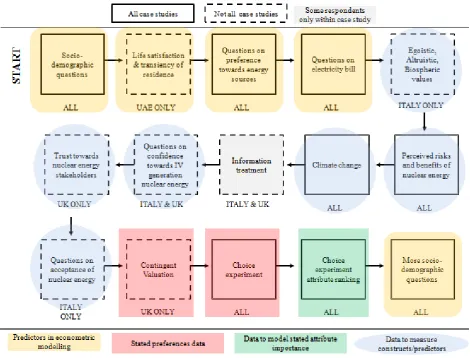
The stated preference part of the survey, key for objectives 1, 2, 5, and 6 (Table 2.1), was introduced only after respondents had the time to answer questions related to nuclear energy and energy more broadly. Respondents were exposed to questions and information to introduce topics such as electricity bill expenditure, risks and benefits of nuclear energy, climate change, attitudes towards different energy sources.
Closer to the choice experiment, in the Italy and UK case studies, all respondents were shown a section describing goals and principles of IV generation nuclear energy. Questions were also asked to measure confidence towards the achievement of such goals. Furthermore, in these two case study, a random set of respondents were treated with additional information, displaying a map of Europe with nuclear plants in operation, planned, shut down, as well as information on the Fukushima’s and Chernobyl’s accidents. This information treatment has been placed before the stated preference exercises to assess whether choices would differ significantly between treated versus non-treated respondents, thereby providing insights into whether and to what extent choices could be sensitive to the information provided. Following the choice experiment exercise, individuals were presented with an attribute ranking exercise. This data is needed to model saliency in choice experiments as explored in Chapter 6.
Figure 2.1: Survey flow across case studies
Values have been explored extensively within the Italy case study, where data has been collected to measure egoistic, altruistic and biospheric values5. In the empirical studies which focus on fourth generation nuclear energy technology (Italy and UK), we hypothesized that confidence that this new generation will achieved its proposed goals, together with perceived risks and benefits, would affect public acceptance6. Hence, scales to measure confidence towards the IV generation goals were presented to the respondents. Finally, the role of transiency and life satisfaction has been explored as part of the UAE
5 As part of this section in the Italy case studies, place attachment values were also measured, but not found to
be worthy of inclusion in the final econometric models.
6 Note that confidence in the FG nuclear technology reaching its intended goals, as used in this study, is related to but distinct from trust. In the context of nuclear energy, Siegrist et al. (2000) defined trust as ‘the willingness to rely on those who have
the responsibility for making decisions and taking actions related to the management of technology […]’ (Siegrist
case study, in the particular setting of a country with transient residents. Given the type of data collected, the following main modelling needs arise: discrete choice modelling, factor analysis and structural equation modelling; these will be discussed in section 2.3.
Table 2.1: Thesis’ objectives and related data
OBJECTIVES DATA
1) assess the determinants of social acceptance of nuclear energy in different policy and geographical contexts;
Choice experiments, social acceptance of nuclear energy; socio-demographic; perceived risks and benefits of nuclear energy; life satisfaction and transiency; confidence towards IV gen goals; trust towards nuclear energy stakeholders; egoistic, altruistic, biospheric values
2) investigate the social costs of nuclear energy in three different contexts: Italy, a country that currently has no nuclear power plants in operation, and twice expressed its disapproval through referenda; UK, a country with nuclear energy; and the UAE, a country that plans to introduce nuclear energy by 2020;
Choice experiments
3) assess differences in preferences and attitudes towards nuclear energy, other energy sources and related attitudes, in countries with different nuclear energy policies in place;
Questions on preferences towards different energy sources
4) assess the impact of specific information on
preferences towards FG nuclear energy; Information treatment
5) analyse the effects of having a transient population on support for nuclear energy;
Choice experiments; life satisfaction and transiency of residence
6) investigate a number of methodological issues pertaining to stated preference methods that are relevant in the context of controversial energy projects: 1) heuristics in choice modeling; 2) combination of choice modeling and structural equation modeling; and 3) links between propensity to contribute in contingent valuation questions and choices within the choice experiment tasks.
Attribute rankings; perceived risks and benefits of nuclear energy; confidence towards IV gen goals; trust towards nuclear energy stakeholders; egoistic, altruistic, biospheric values; acceptance of nuclear energy; contingent valuation & choice experiments
2.2.2 Survey pilots
Also, they were probed after answering or reading the questions to confirm their understanding. In a subsequent phase, the survey was prepared for online administration in Qualtrics, and tested with 60 students from the University of Cagliari. These students were invited in a room with laptops and observed whilst taking part in the survey. These tests were needed to check that the randomizations in the flow (information treatment and choice tasks presented) were working seamlessly, whilst also providing room for a group discussion to further gather feedback on the survey.
The survey for the UK case was also prepared in Qualtrics, following a face to face pilot with 20 students from the London School of Economics. Both surveys (for Italy and UK case studies) were administered to panels provided by Toluna. Finally, the UAE survey was prepared in Gryphon, survey programming tool used by YouGov, and made available in both English and Arabic. 10 face to face pilots were conducted to test the flow and content. The finalized survey was initially soft-launched with 50 respondents to check for lack of bugs in the survey flow and subsequently fully launched. All the surveys’ views were optimized for both laptop and mobile view.
2.2.3 Key questions, scales, information presented7
This section presents key questions used in the three case studies. Answers to these questions were used to measure latent constructs, both in a confirmatory and exploratory approach, or to support in multivariate analysis as well as serve as predictors.
2.2.3.1 Life satisfaction and transiency of residence
7When survey snapshots are shown for Italy, these contain text that was translated from Italian to English
Considering the UAE case study, the questions on life satisfaction and transiency of residence are of paramount importance. Two questions on life satisfaction were asked. Respondents were presented with a scale ranging from 1 to 10, where 1 meant ‘Not at all satisfied’ and 10 ‘Extremely satisfied’. They were asked to rate thinking about how satisfied they were with their life in general and, separately, with their life in the UAE. This can be defined as the evaluative account of wellbeing (Dolan and Metcalcfe 2012); whilst it can be affected by recall bias, it seems an apt indicator of whether the individual is satisfied in relation to her life in the country, as a whole. In order to measure transiency, we opted for a single question asking the following: ‘How long are you planning to stay in the UAE?’. Possible options were presented as intervals, from ‘less than 3 months’ to ‘more than 10 years’. The minimum was set to take into account the possibility of respondents about to leave the Country due to, for instance, job loss (notice period in the UAE is a minimum of a month according to UAE Labor Law, article 117). We kept the upper option to ‘more than 10 years’ to maintain the list short and reasonable in terms of time period considered.
2.2.3.2 Questions on preferences towards energy sources
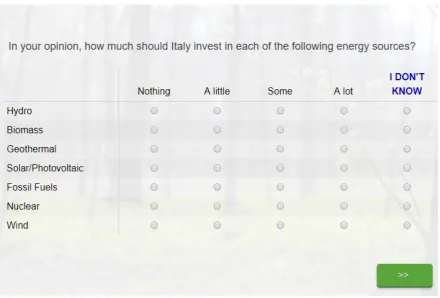
[image:53.595.84.525.251.549.2]Across the three case studies, respondents were asked to state how much the country they reside in should invest in different energy sources (Figure 2.3 shows the screen for Italy). This question is adapted from Pidgeon et al. (2008)8, where instead of an agreement and disagreement scale respondents were asked to pick between invest ‘nothing’ and invest ‘a lot’. Following the pilots, this format seemed to be easier for the respondents to grasp.
Figure 2.3: Questions on preference towards energy sources
2.2.3.3 Egoistic, Altruistic, Biospheric values
8 To what extent do you agree or disagree that the following energy sources will make a substantial
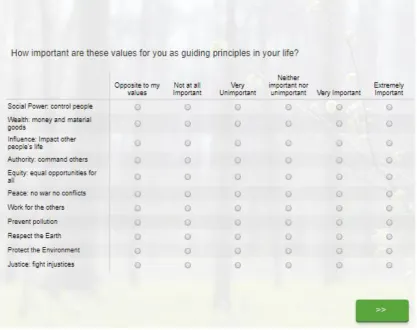
The questions to measure egoistic, altruistic and biospheric values are presented in figure 2.3. These items and scales were developed following Stern et al. (1999) and De Groot and Steg (2007). We retained 4 items each to measure the constructs Egoistic and Altruistic, whereas 3 were kept to measure the construct Biospheric. The item ‘unity with nature’, used in De Groot and Steg (2007), was removed from the list of items to measure the construct Biospheric as the pilots conducted shown individuals were questioning the clarity of such item. Also, following pilots, a 5 points scale was chosen, rather than a 7 points scale, to reduce the cognitive effort required by the respondents.
Figure 2.4: Questions on Egoistic, Altruistic, Biospheric values, Italy case study
2.2.3.4 Perceived risks and benefits of nuclear energy
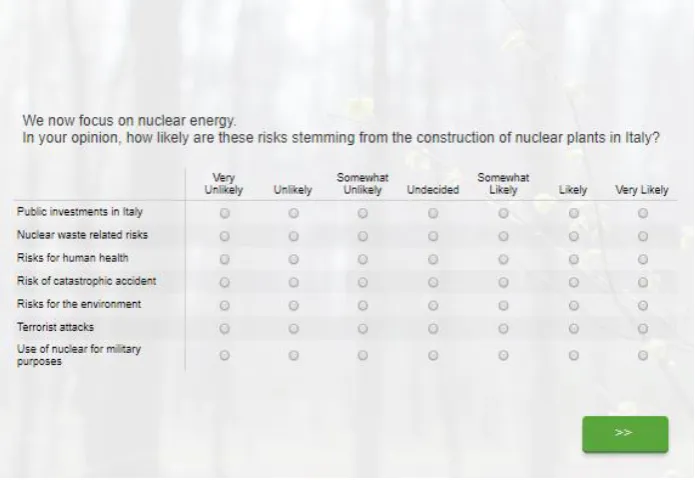
Perceived risks and benefits of nuclear energy were assessed across all the three case studies. Figures 2.5 and 2.6 show the corresponding screen shown as part of the Italy case study. These were finalized following literature review on the matter (as discussed in Section 2.1.3) as well as considering the feedback from cognitive interviews. A few differences between the three case studies need to be outlined: the UK survey did not include the item ‘Public investments’ as specific to Italy9. In the UAE case study,
[image:55.595.84.432.435.675.2]respondents answered the set of questions on risks and benefits twice: once whilst thinking about nuclear energy in general, and then considering nuclear energy in the UAE. 7 points scales were provided for both Italy and UK, whereas 5 points scales for the UAE. This reduction was chosen, again, to limit the amount of information to process, given the that respondents were asked to answer twice each set.
Figure 2.5: Questions on perceived risks of nuclear energy, Italy case study
Figure 2.6: Questions on perceived benefits of nuclear energy, Italy case study
2.2.3.5 Questions on climate change
Figure 2.7: Questions climate change, UAE case study
Figure 2.8: Questions climate change, UK case study
In both the Italy and UK case studies, a random half of the respondents starting the survey were presented with: a) additional information on the Chernobyl and Fukushima’s accidents10 (Fig. 2.9); and b) information on where nuclear plants are in Europe (Fig. 2.10), together with symbols indicating reactors in operation (green), not in operation (red), under construction (yellow) and planned (blue)11.
Figure 2.9: Information treatment part A
10 The information presented on the two accidents was based on IAEA (2006), Steinhauser et al. (2014), and
UNSCEAR (2013).
Figure 2.10: Information treatment part B
2.2.3.7 Information on IV generation nuclear energy
Figure 2.12: Confidence towards IV gen goals & trust towards nuclear energy stakeholders, UK case study
2.2.3.8 Acceptance of nuclear energy
Figure 2.13: Acceptance of nuclear energy, Italy case study
2.2.3.9 Introduction to choice experiments
2.2.4 Sampling and survey mode
Data collection has been conducted online for all of the case studies presented in this thesis. A number of reasons lead to the choice of the online survey administration mode. First, this is less expensive than face to face or telephone interviews and quicker to implement. In addition, online surveys do not suffer from interviewer bias and are less prone to social desirability bias (Tourangeau and Yan 2007). At the same time, they allow to answer sensitive or difficult questions privately. Researchers can also take advantage of this survey instrument to foster respondents’ engagement with the survey. For instance, graphical representations can be used, as well as a tailored survey flow. This appears particularly important when dealing with the valuation of environmental goods, some of which respondents might have scarce understanding (Colombo et al. 2015).
Centre, South respectively, against population shares of 46%, 20% and 34%; samples share for gender are 46% males against 49% for the population; finally, sample age average of 44 against population average of 48 years old (DemoIstat 2013). With regards to the UK case study, a quota on the share of residents in England versus rest of the UK was placed. Of the 887 sampled respondents, 68.5% of reside in England, 16% in Scotland, 11% in Wales and 4.5% in Northern Ireland, against population shares of 84% for England, 8.3% for Scotland, 4.8% for Wales and 2.9% for Northern Ireland (ONS 2014). Finally, for the UAE study, a quota on the share of nationalities was set to obtain 11.5% of UAE nationals12.
Of the sampled 1961 respondents, we achieved 10% Emiratis.
2.3 Core econometric models
2.3.1 Econometric models for choice experiment data
The choice experiment method is based on Lancaster’s theory of value (Lancaster 1966) and on the Random Utility theory (McFadden 1974). According to this theoretical framework, respondents choose the option which provides the greatest level of utility. Acknowledging the impossibility of fully characterizing the utility function, this is decomposed into a deterministic and a stochastic part. Formally, for each individual (i) and alternatives (j), the utility function is expressed as:
𝑈𝑖𝑗 = 𝑉𝑖𝑗 + 𝜀𝑖𝑗 (1)
where 𝑉𝑖𝑗 and 𝜀𝑖𝑗 are the deterministic and stochastic components, respectively. In choice experiments, respondents take part in a sequence of T choices. In such context, the deterministic component is a function of the matrix of attributes x and the vector of coefficients 𝛃:
12
𝑉𝑖𝑡,𝑗 = f(𝐱𝑖𝑡,𝑗′ 𝛃) (2)
A linear specification would entail 𝑉𝑖𝑡,𝑗 = 𝐱𝑖𝑡,𝑗′ 𝛃. To define the stochastic component, the basic assumption is that the error terms are independently and identically distributed. Furthermore, assuming a Gumbel distribution, the Multinomial Logit model (MNL) is obtained, whose choice probabilities are given by:
𝑃𝑖𝑗𝑡 = exp (𝐱𝑖𝑡,𝑗
′ 𝛃)
∑ exp (𝐱𝑗 𝑖𝑡,𝑗′ 𝛃) (3)
This model was estimated using the command CLOGIT in STATA. The MNL presents a number of limitations. It assumes independence of irrelevant alternatives (IIA), whereas there might be correlation between groups of similar alternatives. In the context of this work, respondents might choose the ‘none’ option without seriously considering the scenario attributes, but rather just because the scenarios refer to nuclear energy options. This is an example of how protest behavior might influence results in choice experiments (Adamowicz et al. 1998; Meyerhoff and Liebe 2008). Respondents might also choose none of the projects for reasons including loss aversion (Kahneman et al. 1991), task complexity (Boxall et al. 2009; Day et al. 2012; Moon 2004), lack of credibility of the survey (Kataria et al. 2012) or alternatives perceived to be too similar (Haaijer et al. 2001). An alternative modeling strategy is represented by a Nested Logit (NL) (Ben-Akiva and Lerman 1985, Hensher et a. 2005), which allows the relaxation of the IIA assumption, although homogeneity in preferences is still in place.