ELECTRONIC LOCATOR FORAMINAL WAS EFFICIENT AND RELIABLE: COMPARATIVE STUDY
1
Isis Almela Endo Hoshino,
1Paula Nunes Tozato,
1,2
Elias Naim Kassis, *
,2Idiberto José Zotarelli Filho
1
University Center North Paulista (Unorp)
2Post Graduate and Continuing Education
ARTICLE INFO ABSTRACT
Background:
are employed to measure this length, including, tactile sensitivity, x foraminal.
Objective:
relation to the three locators third generation electronic foraminalNovApex, Gnatus and Apex Locator in determining root canal length of 0.0 millimeters (mm) and 1.
radiographic evidence. Methods:
predictors were the locatorsforaminal Electronics Gnatus, Apex Locator and NovApex. The response was the predi
Results:
predictors Gnatus, Apex Locator and NovApex both 0.0 mm that there was no sta
locatorsforaminal diverged little from the exact value. Conclusion:
when compared to other indicated.
Copyright©2016, Isis AlmelaEndo Hoshino et al.This
unrestricted use, distribution, and reproduction in any medium, provided the original work is properly cited.
INTRODUCTION
The endodontic therapy is a sequence of interdependent operative steps, it is important to control the infection and recontamination prevention of the root canal system, which will be achieved with the precise determination of Odontometry, which establishes the actual length of the root canal for execution proper instrumentation and root canal filling within the length limit, favoring thus the repair and / or
regeneration of periapical tissues (Jain et al
et al., 2013; Lucisano et al., 2009 and Maachar
The Odontometry hardly established correctly, only measures the length of the root canal. Although the apical foramen limits the root canal, the ideal is the apical constriction, being as the
*Corresponding author: Idiberto José Zotarelli Filho
2
Post graduateandcontinuingeducation (Unipos), Street Ipiranga, 3460, São José do Rio Preto SP, Brazil 15020-040
ISSN: 0975-833X
Article History:
Received 16th May, 2016
Received in revised form
21st June, 2016
Accepted 20th July, 2016
Published online 20th August,2016
Key words:
Electronics Locators Foraminal, Pre-Molar Teeth,
Root Length, Precision.
Citation: Isis AlmelaEndo Hoshino, Paula Nunes Tozato, Taylane Soffener Berlanga de Araújo, Elias Naim Kassis, Idiberto José Zotarelli Fábio Pereira Linhares-de-Castro.2016. “Electronic locator foraminal was efficient and reliable: Comparative study
Current Research, 8, (08), 35992-35996.
RESEARCH ARTICLE
ELECTRONIC LOCATOR FORAMINAL WAS EFFICIENT AND RELIABLE: COMPARATIVE STUDY
Paula Nunes Tozato,
1,2Taylane Soffener
Idiberto José Zotarelli Filho and
1,2Fábio Pereira Linhares
University Center North Paulista (Unorp) - São José do Rio Preto –
Education (Unipos), Street Ipiranga, 3460, São José do
Brazil 15020-040
ABSTRACT
Background: The endodontic therapy establishes the actual length of the root canal various methods are employed to measure this length, including, tactile sensitivity, x
aminal.
Objective: To evaluate the electronic foramen locator Root ZX in terms of accuracy and reliability in relation to the three locators third generation electronic foraminalNovApex, Gnatus and Apex Locator in determining root canal length of 0.0 millimeters (mm) and 1.
radiographic evidence.
Methods: A total of 15 pre-molars of 15 patients donated by Term of Free Consent. The continuous predictors were the locatorsforaminal Electronics Gnatus, Apex Locator and NovApex. The response was the predictor Locator Foraminal Electronic Root ZX.
Results: After nonparametric correlation between the response predictor Root ZX and continuous predictors Gnatus, Apex Locator and NovApex both 0.0 mm -1.0 mm as in the apex, it was observed that there was no statistically significant difference with p> 0.05, given that the measured values locatorsforaminal diverged little from the exact value.
Conclusion: the measurements Locator Foraminal Electronic Root ZX were accurate and reliable when compared to other locators of this study and compared with published results, and strongly indicated.
This is an open access article distributed under the Creative Commons Att use, distribution, and reproduction in any medium, provided the original work is properly cited.
The endodontic therapy is a sequence of interdependent operative steps, it is important to control the infection and recontamination prevention of the root canal system, which will be achieved with the precise determination of s the actual length of the root canal for execution proper instrumentation and root canal filling within the length limit, favoring thus the repair and / or
et al., 2012; Koçak
2009 and Maachar et al., 2008).
The Odontometry hardly established correctly, only measures the length of the root canal. Although the apical foramen limits root canal, the ideal is the apical constriction, being as the
Idiberto José Zotarelli Filho
Post graduateandcontinuingeducation (Unipos), Street Ipiranga, 040
point of smallest diameter of the root canal, usually located in cementum dentine junction formed by a cone of dentin with base side facing the coronal part of the tooth and a cone formed by cement based toward the apex of the tooth. This constriction is on average 1 mm from the apical foramen and may also vary its position from 0.0 to 2.0 mm
2009; Maachar et al., 2008
Various methods are employed to measure this length, including, tactile sensitivity, x
foraminal (Ugur et al., 2015). The most widely used is still the
X-ray technique, however, the electronic fora
becoming a definitive assist feature in endodontic therapy, due to the limitations of radiographs and its numerous advantages of electronic system such as clinical time savings, reduction of dose and patient exposure to ionizing radiation
handling (Irfana, 2014 and Khursheed, 2014
have stimulated the development of new electronic locators foraminal, which are often launched on the market, which
International Journal of Current Research Vol. 8, Issue, 08, pp.35992-35996, August, 2016
INTERNATIONAL
Isis AlmelaEndo Hoshino, Paula Nunes Tozato, Taylane Soffener Berlanga de Araújo, Elias Naim Kassis, Idiberto José Zotarelli
Electronic locator foraminal was efficient and reliable: Comparative study
ELECTRONIC LOCATOR FORAMINAL WAS EFFICIENT AND RELIABLE: COMPARATIVE STUDY
Berlanga de Araújo,
Fábio Pereira Linhares-de-Castro
– SP, Brazil
(Unipos), Street Ipiranga, 3460, São José do Rio Preto SP,
The endodontic therapy establishes the actual length of the root canal various methods are employed to measure this length, including, tactile sensitivity, x-rays and electronic locators
To evaluate the electronic foramen locator Root ZX in terms of accuracy and reliability in relation to the three locators third generation electronic foraminalNovApex, Gnatus and Apex Locator in determining root canal length of 0.0 millimeters (mm) and 1.0 mm below the apex with
molars of 15 patients donated by Term of Free Consent. The continuous predictors were the locatorsforaminal Electronics Gnatus, Apex Locator and NovApex. The response
After nonparametric correlation between the response predictor Root ZX and continuous 1.0 mm as in the apex, it was observed tistically significant difference with p> 0.05, given that the measured values of
the measurements Locator Foraminal Electronic Root ZX were accurate and reliable locators of this study and compared with published results, and strongly
is an open access article distributed under the Creative Commons Attribution License, which permits
point of smallest diameter of the root canal, usually located in cementum dentine junction formed by a cone of dentin with
facing the coronal part of the tooth and a cone formed by cement based toward the apex of the tooth. This constriction is on average 1 mm from the apical foramen and
may also vary its position from 0.0 to 2.0 mm (Lucisano et al.,
and Guimarães et al., 2014).
Various methods are employed to measure this length, including, tactile sensitivity, x-rays and electronic locators The most widely used is still the ray technique, however, the electronic foraminal locators is becoming a definitive assist feature in endodontic therapy, due to the limitations of radiographs and its numerous advantages of electronic system such as clinical time savings, reduction of dose and patient exposure to ionizing radiation and easy Khursheed, 2014). These factors have stimulated the development of new electronic locators foraminal, which are often launched on the market, which
INTERNATIONAL JOURNAL OF CURRENT RESEARCH
Isis AlmelaEndo Hoshino, Paula Nunes Tozato, Taylane Soffener Berlanga de Araújo, Elias Naim Kassis, Idiberto José Zotarelli Filho,
according to its manufacturers make greater accuracy and reliability in measurements, overcoming such limitations
(Lucisano, 2009 and Leonardo et al., 2005). However still
needs more study to prove. The aim of this study was to evaluate the electronic foramen locator Root ZX in terms of accuracy and reliability in relation to the three electronic foraminal locators third generation NovApex (Technologies Forum, Israel), endus (Gnatus, Ribeirão Preto, Brazil) and Apex Locator (New Ys-RZ-B, China) in the determination of root canal length of 0.0 millimeters (mm) and 1.0 mm below the apex with radiographic evidence.
MATERIALS AND METHODS
Participants
In this study were used 15 pre-molars of 15 patients donated by Term of Free Consent to the patient and after extraction they will be stored in sodium hypochlorite solution 2.5%. After disinfection of the same they will be clean of calculus, soft tissue, and debris with a curette McCall 15-16 and stored in distilled water, and subjected to a pre-selection (inclusion and exclusion), radiographic initial examination to be held to assist in the selection.
Eligibility
As inclusion criteria, was selected healthy teeth, uniradicular, Anatomy and straight favorable- root morphology, complete formation of the root apex, teeth with equal or higher 22mm length, corresponding apical foramen patency to file instrument K # 15 (Dentsply- Maillefer). Exclusion criteria, was selected anatomy and morphology unfavorable- sharp bends, open apex, Pathologies or anomalias- internal or external resorption, fracture lines, punctures, lacerations and calcifications, treatments prévios- endodontic treatment or restoration, presence of foreign objects or fragments of broken instruments in the root canal.
Continuous Predictors
The continuous predictors were the Electronics Locators Foraminal Gnatus, Apex Locator and Nov Apex.
Response Predictor
The response was the predictor Electronic Locator Foraminal Root ZX.
Experimental Design
Measures to check the teeth were performed using a digital caliper (PD 150 capacity 0-150 mm / 0-6 ", Resolution 0.01 mm / 0.005") and endodontic ruler (Microdont) if a tooth does not meet the requirements the selection will be discarded. The same group of teeth (n = 15) will be used for the measurement with all electronic locators foraminal, Group I- Root ZX, Group II- Gnatus, Group III and Group IV Apex Locator NovApex. Sectioned up the crowns in cementum junction level with a diamond disk (Disk diamond double face- DHPRO, Green Land Technology (daliab) Intl. Ltd. - China) with
cooling water and air, to allow access to the root canal and to provide a stable reference for all measurements of 16 millimeters. To confirm the actual length has entered a K file # 15 (MailleferDentsply-) under increased xxx times of a surgical microscope (DF Vasconcelos) where you can view the actual output of the foramen by adjusting the tip of the instrument in this area, ensuring that to adjust to the same walls. The silicone cursor tool was adapted to coronary flat surface. After the instrument was measured in endodontic ruler and the actual length of noted tooth. The roots were stabilized in a cool alginate mold (Alginate Hydrogum 5 Zhermack, Germany LOT. 230900) in a 3X3X3X0,2 cm sized acrylic square container (width / length / height / thickness), to simulate the periodontal ligament, as recommended by some
authors-Aydin et al. (2015), Katz et al. (1996), Lipski M
(2013), Kolanu et al. (2014), Saatchim et al. (2015). In this
container with fresh alginate will be held two holes, one in the center, for the placement of the tooth and the other side to the lip clip insertion. The channels will not be irrigated with no solution and your measurements will be carried out dry. For electronic measurements in 0.0 mm (apical constriction) and 1.0 mm short of the apical constriction, the lip clip is inserted into the alginate, so with the file inserted into the root canal and then connected devices and the other electrode connected on file. Then, the instrument will be introduced smoothly with oscillatory motion in a clockwise direction, observing the beginning of the movement of the bars fill the upper hemiarch in the Group I-Root ZX display device. Since then the instrument has been moved in the apical direction until the word "APEX" flashing then beep. To get this marking, the operator proceeded to dial the working length by sliding the cursor to the reference point chosen. The electrodes are disconnected from Group I, without moving the file, connected in Group II, III and IV, checking the values assigned by these locators, and again in Group I. Respectively, confirming the accuracy of the procedure. Any error or abnormal value was recalculated every procedure. The values were recorded for later comparisons and followed by a digital radiography (Gnatus Times-70) with exposure of 0.20 for registration and verification.For measurements taken at 1.0 mm from the apex, the same experiment was carried out. However, the file has been moved to the marking 1.0 mm apical constriction. Followed by a radiographic procedure and measurement with endodontic ruler for each group.
RESULTS
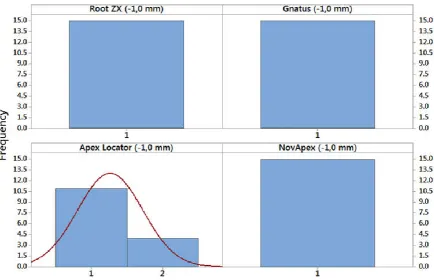
statistically significant difference, p> 0.05, there view that the measurement values of locators foraminal little diverged from the exact value. However, only the foraminal Locator Apex Locator presented four discrepant events, as shown in Figure 2.
DISCUSSION
[image:3.595.86.521.117.402.2]Based on results of this study and in accordance with the best accuracy of measurement of root length using the Root ZX,
Figure 1. Precision measurements of the comparison between the Electronics Locators Foraminal Root ZX, Gnatus, Apex Locator and NovApex to 0.0 mm, where 1 = coincided and 2 = non-coincided
[image:3.595.87.522.451.731.2]several methods for determining such length have been described in the literature, the most used is the radiographic technique (Lucisano, 2009; Maachar, 2008 and Guimarães 2014). Usually, the radiographic method has limitations due to its two-dimensional image overlapping anatomical structures such as the zygomatic arch, the maxillary sinus and positioning of the apexes on the side surfaces of the roots (ElAyouti, 2001 and Khattak, 2014).
Resulting in distorted images, difficult radiographic
interpretation by professional and non-display of the apical
foramen and apical constriction in (Jain, 2012; Koçak et al.,
2013; Lucisano et al., 2009; Maachar et al., 2008; Guimarães
et al., 1981; Irfana et al., 2014 and Khattak et al., 2014)
radiograph. Because of these limitations, we began the search for more accurate methods for determining the length of root canal. Introduced the first electronic system, Custer, and improved in 1958 by Sunada, with the invention of the first foraminal electronic locators, with the help of Suzuki research in 1942, which determined that the electrical resistance between the periodontal ligament and in vivo mucosa adds a
constant value of 6.5 kW (Khattak, 2014; Diwanji et al., 2014 ;
Pishipati et al., 2013and Puri, 2013). Since then, different
generations of electronic locators foraminal have been developed and their main concern is the accuracy of
measurements (Puri et al., 2013 and Venturi et al., 2007). The
first generation of locators foraminal's principle electrical resistance, a method that provides inaccurate and unstable measurements in the presence of moisture inside the channel, either irrigation strain or body fluids [1.15]. The second generation of locators foraminal introduced in 1972, has as its first impedance being a measure of the ability of a circuit resistance to the flow of a given electrical current. Therefore, an alternating electrical current used in measuring the value of the electrical resistance of the periodontal ligament.
This device obtains measurements in the presence of moisture inside the channel, however, requires a complex learning to interpret the measure [1.15]. Moreover, for its implementation may require special insulation endodontic instrument, except the end of the file due to possibly cause discomfort the patient
(Maachar et al., 2008 and Guimarães et al., 2014). The third
generation of electronic locators foraminal been developed for greater accuracy and reliability than its predecessors, under the principle of simultaneous two currents alternate ( "ratio method"), calculated from two different frequencies (0.4 kHz and 8 kHz ) of a wider section and a narrower channel, may be linked by difference (Jain, 2012 and Irfana, 2014). The reading of the electric potential difference of tissues provides the implementation of electronic measures. The dental wall demonstrates low electrical conductivity when more approaches the apical, smaller the thickness of dentin, which results in loss of electrical insulation capability. This gradual reduction is performed electrically as a decrease in impedance of the dentine (capacity that materials exhibit to resist the passage of electric current). Thus, allowing the instrument tip at the location of the apical foramen Approximately 1 mm and / or apical constriction (Leonardo, 2005). In addition, these devices are able to make accurate measurements in dry and humid conditions, even in the presence of electrolytes
(Lucisano et al., 2009 and Venturi et al., 2007). Several studies
(Jain et al., 2012; Koçak et al., 2013; Mancini et al., 2011 and
Saatchi et al., 2015), demonstrated the effectiveness of
electronic locators foraminal in measuring the actual length of the tooth, in all surveys the device Root ZX J. Morita, Tokyo, Japan, was used as a comparison with the control other locators. The author (Koçak, 2013), demonstrated satisfactory results and similar to other electronic locators foraminal even
in research carried out in vivo compared to in vitro. Although
the authors (Ebrahim, 2006 and Briseño-Marroquín, 2008), state that the in vitro study provides results with greater accuracy than in vivo, which has an objective assessment and greater number of samples. Thus allowing repeated measurements in different lengths and with different diameters file, acquiring an analysis more reliable statistics.
Furthermore, in some situations there is physiological or pathological changes as open apex and the presence of resorption of deciduous and permanent tooth, which complicates the implementation of both radiographic measurements as electronic (Leonardo, 2005) Even the presence of irrigating solutions can interfere with the accuracy of measurement. Numerous studies are found in the literature obtained satisfactory results in the length 0 mm and 1 mm short of the apical foramen, they said that all tested devices were able, with no significant difference (Koçak, 2013; Lucisano 2009 and Maachar, 2008). Even in the presence of root
resorption the authors Leonardo et al., (Leonardo et al., 2005)
showed that the Root ZX II device is capable and was not affected in conditions. Just as the author did not find different results when compared with other electronic locatorsforaminal
devices. However, the authors Saatchi et al. (2015) found
different results in the length 0.0 mm, in which the electronic foramen locator Root ZX is more accurate than the other devices used in research, especially in shorter teeth than the teeth longer. This also occurred in lengths of 1.0 mm and 0.5
mm below the apical constriction, in which the authors Jain et
al. (2012) showed that electronic locators foraminal tested were
not as effective and accurate in measurements with the Root ZX locator. Same numerous studies demonstrating the effectiveness of the Root ZX, when there is tooth with open
apex, the authors Akisue et al. 2014, Herrera et al. 2011
showed that the accuracy of this unit try to decrease, however the results did not show statistically significant difference. However, this difference becomes significant when the author compares Root ZX with locators other devices, in which the
results show that the Root ZX is more accurate (Ugur et al.,
2015 and Leonardo, 2005). Even when there is the presence of irrigating solutions, demonstrated its efficacy relative to other locators tested (Jain, 2012).
Conclusion
It was concluded in this study that the measurements Electronic Locator Foraminal Root ZX were accurate and reliable when compared to other locators of this study and compared with published results, and strongly indicated.
Competing Interests
REFERENCES
Akisue, E., Gratieri, S.D., Barletta, F.B., Caldeira,
C.L., Grazziotin-Soares, R., Gavini, G. 2014. Not all electronic foramen locators are accurate in teeth with enlarged apical foramina: an invitro comparison of 5
brands. J Endod., 2014 Jan;40(1):109-12. doi:
10.1016/j.joen.2013.09.032.
Aydin, U., Karataslioglu, E., Aksoy, F., Yildirim, C. 2015. In vitro evaluation of Root ZX and Raypex 6 in teeth with different apical diameters.J ConservDent. v. 18, n. 1, p. 66-69, Jan- Feb. doi: 10.4103/0972-0707.148899.
Briseño-Marroquín, B., Frajlich, S., Goldberg,
F., Willershausen, B. 2008. Influence of instrument size on the accuracy of different apex locators: an in vitro study. J
Endod. Jun; 34(6): 698-702. doi:
10.1016/j.joen.2008.02.019.
Diwanji, A., Rathore, A.S., Arora, R., Dhar, V., Madhusudan, A Doshi, J. 2014. Working Length Determination of Root Canal of Young Permanent Tooth:
An In vitro Study. Ann Med Health Sci Res. V. 4, N. 4, P.
554-558, Jul-Aug, doi: 10.4103/2141-9248.139314.
Ebrahim, A.K., Wadachi, R., Suda, H. 2006. Ex
vivo evaluation of the ability of four different electronic apex locators to determine the working length in teeth with
various foramen diameters. Aust Dent J., Sep;51(3):258-62.
ElAyouti, A.; Weiger,R.; Perdeu, C. Frequency of
overinstrumentation with an acceptable radiographic working length.J Endod.v.27, n.1,p.49-52, Jan. 2001. Guimarães B.M.; Marciano, M. A.; Amoroso-Silva P. A.;
Alcalde M. P.; Bramante, C. M.; Duarte, M. A. H.; O uso dos localizadores foraminais na endodontia: Revisão de literatura. The use of apex locator in endodontics: A literature review. Rev Odontol Bras Central, v.23, n.64, 2014; ISSN 1981-3708.
Herrera M, Ábalos C, Lucena C, Jiménez-Planas A, Llamas R. Critical diameter of apical foramen and of file size using the Root ZX apex locator: an in vitrostudy. J Endod. 2011 Sep;37(9):1306-9. doi: 10.1016/j.joen.2011.05.007.
Irfana K. I.;Bansa, R. l.; Bansal, T. Singh, Preet, H. P .;
Yadav, M. Reddy, K. J. A comparative evaluation of working length with digital radiography and third generation apex locator (ProPex) in the presence of various intracanalirrigants: An in vivo/ex vivo study. Dent Res J (Isfahan). v. 11 n.1,p. 56-60, Jan-Feb 2014.
Jain, S .; Kapur, R.; Comparative evaluation of accuracy of two electronic apex locators in the presence of various irrigants: An in vitro study. ContempClin Dent.V.3, N.2, P. 140-145, Sep. 2012. doi: 10.4103/0976-237X.101068. Katz A.; Mass E.; Kaufman A.Y.Electronic apex locator: a
useful tool for root canal treatment in the primary dentition.ASDC J DentChild. v. 63, n. 6, p. 414-417, Nov-Dec. 1996.
Khattak, O. ,Raidullah, E. Francis, M. L.; A comparative assessment of the accuracy of electronic apex locator (Root ZX) in the presence of commonly used irrigating solutions. J ClinExp Dent. V. 6, N. 1 P.. 41-46, Feb,2014. doi: 10.4317/jced.51230.
Khursheed I.; Bansal R.; Bansal T.; Singh H. P.; Yadav M.; Reddy K.J.; A comparative evaluation of working length with digital radiography and third generation apex locator (ProPex) in the presence of various intracanalirrigants: An in vivo/ex vivo study. Dent Res J (Isfahan). V. 11, n. 1, p. 56-60, Jan 2014.
Koçak, S.; Koçak,M. M.; Sağlam, B. C. J; Efficiency of 2 electronic apex locators on working length determination: A clinical study. ConservDent.V. 16,N. 3, P. 229-232, May-Jun. 2013. doi: 10.4103/0972-0707.111320.
Kolanu S.K.;Bolla N.; Varri S.; Thummu J.; Vemuri S.;
Mandava P.Evaluation of Correlation
Between apical Diameter and File Size Using PropexPixi Apex Locator. J ClinDiagn Res. v. 8, n.12, p. ZC18-20, Dec. 2014. doi: 10.7860/JCDR/2014/9307.5247.
Leonardo MR. Comprimento real de trabalho fundamentos e técnicas (localizadores eletrônicos foraminais). In: Ramos CAS, Bramante CM. Endodontia. Tratamento de canais radiculares- princípios técnicos e biológicos. São Paulo: Artes Médicas; 2005. v.1,p.945-76.
Lipski M.;Trąbska-Świstelnicka M.; Woźniak K.; Dembowska E.; Droździk
A.Evaluation of alginate asa substitute for
root-surrounding tissues in electronic root canal measurements. AustEndod J. v. 39, n.3, p.155-158, Dec. 2013.doi: 10.1111/j.1747-4477.2012.00367.
Lucisano, M.P.; Leonardo, M.R.; Nelson-Filho, P.; Silva, R.A.B.; Utilização de localizadores eletrônicos foraminais na determinação da odontometria em dentes decíduos. Electronic apex locators to root canal lenght determination, in primary teeth. CiencOdontol Bras, v.12, n. 2, p. 73-81, Abr./Jun 2009.
Maachar D.F.; Silva P.G.; Barros R. M. G.; Pereira K. F. S. Evaluation of the accuracy Novapex apex locator: in vitro study. RevOdontolUNESP.v. 37, n.1, p. 41-46, 2008. Mancini M, Felici R, Conte G, Costantini M, Cianconi L.
Accuracy of three electronic apex locators in anterior and posterior teeth: an ex vivo study. J Endod. V.37, N.5, P. 684-687, May, 2011. doi: 10.1016/j.joen.2011.02.011. Pishipati, K. V. C. An In Vitro Comparison of Propex II Apex
Locator to Standard Radiographic Method. Iran Endod J.V. 8, N. 3, P.114-117, 2013.
Puri N. Chadha, R.; Kumar, P. ; Puri, K.; An in vitro comparison of root canal length determination by DentaPort ZX and iPex apex locators. J ConservDent.V. 16 N. 6 P. 555-558; Nov-Dec 2013 16(6): 555–558. doi: 10.4103/0972-0707.120953.
Saatchi M.; Rahimi I.; Khademi A.; Farhad A.R.; Nekoofar M.H.; Dummer P.M. Influence of tooth length on the accuracy of the Root ZX electronic apical foramen locator: an ex vivo study. ActaOdontol Scand. v.73, n.2, p.101-106, Feb. 2015. doi: 10.3109/00016357.2014.956144.
Ugur A.; Emrah K.; Fatih A.; Cihan Y.; In vitro evaluation of
Root ZX and Raypex 6 in teeth with different apical diameters. J Conserv Dent, v.18, n. 1, p. 66-69, Jan-Feb 2015.doi: 10.4103/0972-0707.148899.
Venturi M.; Breschi L.A.; Comparison between two electronic apex locators: An ex vivo investigation. IntEndod J., v. 40, p. 362-373, 2007.