Guidelines Based Software Engineering for Developing
Software Components
Muthu Ramachandran
Faculty of Arts, Environment and Technology, School of Computing and Creative Technologies, Leeds Metropolitan University, Leeds, UK.
Email: [email protected]
Received October 20th, 2011; revised November 25th, 2011; accepted December 10th, 2011
ABSTRACT
Software guidelines have been with us in many forms within Software Engineering community such as knowledge, ex-periences, domain expertise, laws, software design principles, rules, design heuristics, hypothesis, experimental results, programming rules, best practices, observations, skills, algorithms have played major role in software development. This paper presents a new discipline known as Guidelines Based Software Engineering where the aim is to learn from well-known best practices and documenting newly developed and successful best practices as a knowledge based (could be part of the overall KM strategies) when developing software systems across the life cycle. Thereby it allows reuse of knowledge and experiences.
Keywords: Software Reuse; Software Guidelines; Software Design Knowledge; CBSE; GSE
1. Introduction
The term Software Engineering was coined by F. L. Bauer the chairman of 1968 NATO Software Engineer- ing conference held in Garmisch, Germany to promote a disciplined approach to developing software. The term Software is meant a list of machine instructions where as the Engineering is meant the use of disciplined appro- aches and laws when building software systems. This pa- per would argue that the term Software should include best practices which are the laws due to the nature and the age of software as a science compared with Science and Engineering where the laws have been proved and established. In the world of software our principles are out current practices and are continue to emerge as we speak. Later, the term algorithm has emerged to provide a structured step by step programmable instructions/so- lution to a software problem. Best practices provide a step by step instructions/solution to software problem across the life cycle and are based on the successful use in real world.
Guidelines provide a precise set of steps based on un-derlying software design principles which help us to fol-low any course of disciplined set of activities. The term guidelines are defined in the dictionary as follow:
A recommended approach, parameter, etc. for condu- cting an activity or task, utilizing a product, etc.;
A statement of desired, good or best practice;
Advice about how to design an interface;
A document used to communicate the recommended procedures, processes, or usage of a particular busi-ness practice;
A recommendation that leads or directs a course of action to achieve a certain goal;
A written statement or outline of a policy, practice or conduct. Guidelines may propose options to enable a user to satisfy provisions of a code, standard, regula-tion or recommendaregula-tion.
Software Engineering is a set of disciplined activities that are based on well defines standards and procedures. In Software Design we use guidelines that help us to identify a suitable design criterion when faced with de- sign decisions. Therefore software guidelines summarises expert knowledge as a collection of design judgements, rationales, and principles. This can be used by students/ engineers when learning about new principles with ex-amples and experts alike.
2. Guidelines Based Software Engineering
prac-tices should support knowledge and wisdom that has em- erged from many years of successful use across several projects, products, programs, and portfolios. Software as a profession, we must also include a list of recommended conduct and ethical activities when developing software product or research. Once we accept the term Software Guidelines as a new discipline that provide well estab-lished principles and rules that are successful in practice and thus also provide knowledge and wisdom. This way we can also tell the world proudly, we are Engineers since we follow principles strictly and ethically. Where do we start?
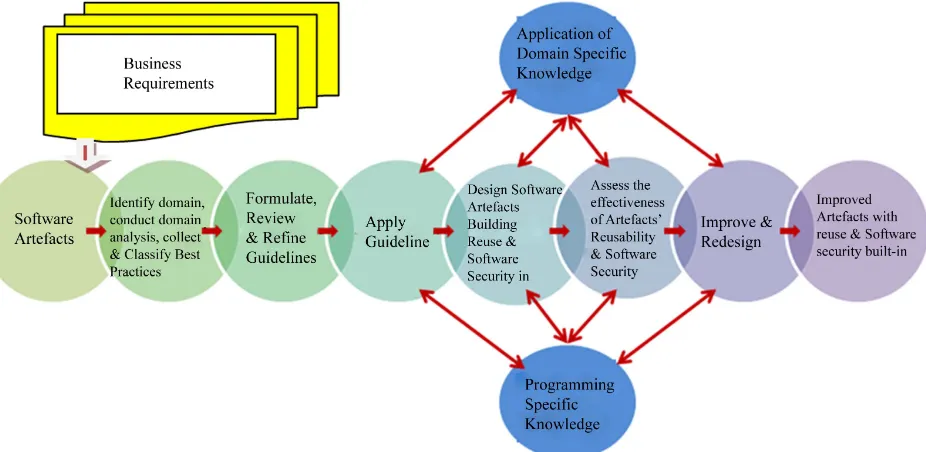
In practice we are not sure of the process by which to apply those principles. Therefore, our work on software guidelines have started on specifically on software com- ponents [3-5], extended to concurrency, software process improvement, agile methods, and software product line based development (aimed on good practice requirements guidelines). Therefore, we prefer to call Guidelines Based Software Engineering (GSE) which aimed to collect best practices and experiences as guidelines from many years of wealth of knowledge and wisdom in Software Engi- neering and apply them wherever possible across all arte- facts of software development. Guidelines provide ratio- nale for making a solution that has worked well and suc- cessfully in previous applications, environment, and in people. Figure 1 shows the process view of guidelines based software engineering.
The process states start with gathering domain knowl-edge, classify domain, classify best practice design, tify artefacts (components, patterns, frameworks), iden-tify and classify best practice design guidelines on vari-ous aspect of their design (for example how well re-quirements have been represented as use cases and how well use case have been used effectively and their fea-tures, how well OCL specifications have been used to document and describe the model). Building the domain knowledge is crucial for success of using software guide-lines or GSE. We can define domain analysis is an activ-ity for identifying a key set of software artefacts that can be ready-made for reuse. There are numerous approaches to this end which can conclude by summarising a com-mon set of domain analysis process as follow:
1) Setting Domain principles: Select a domain, defini-tions, business analysis, scope and boundaries and plan-ning.
2) Data collection—learn more about the domain, cover success and failures, and collect guidelines, dis-cover abstractions, review literature extensively, inter-view and discuss with domain experts, and develop sce-narios.
3) Data analysis—the aim is to identify entities, ob-jects, models, sub-domains, related classes and models, events, operations, relationships amongst all of them, tacit
knowledge, analyse similarities and variabilities, analyse combinations and trade-offs, cost-benefit analysis, modu- lar decompositions and design decisions.
4) Classification—the aim during this phase is to de-scribe domain classes, models, and components, conduct cluster analysis and HIPO chart, describe artefacts, clas-sify models and components, generalize artefacts de-scriptions, conduct domain vocabulary.
5) Evaluation of domain models—the aim in the last phase is to evaluate the findings systematically—use ex- pert meeting, reviews, discussions, and review interviews.
In case if the artefacts are represented in any pro-gramming language, then identify and classify best de-sign constructs that can be used for expressing various design factors such as reuse, flexibility, security, and so on. Guidelines fall into several categories such as good practice guidelines on requirements engineering (Som-merville and Sawyer [6]), RE methods-specific guide-lines such on UML, Use Case driven modelling, design (OO, generic design principles), quality and SQA proce-dures and best practices, software development (good program design and language-specific guidelines), and good test process guidelines, and guidelines on software process improvement. The first step in building guide-lines based SE is to devise a classification system/mecha- nism for collating guidelines which the useful for finding an appropriate guideline. A number of guidelines, best practices, projects, and knowledge engineering support for software development life cycles are presented by Ramachandran [7].
Best practice guidelines on components based soft-ware engineering (CBSE) fall into a number categories such as definitions, process, methods, techniques, models, design, implementation, domain engineering, and deve- lopment for component reuse, component security, com- ponent testing, validation, certification, and QSA. Iden- tifying software components from your application mo- dels is a human intensive activity. This comes from do- main expertise. However, Pressman [8] has identified a few self-assessment questions to identify components from your design abstracts as given below:
Is component functionality required on future imple-mentations?
How common is the component’s function within the domain?
Is there duplication of the component’s function with- in the domain?
Is the component hardware-dependent?
Does the hardware remain unchanged between imple- mentations?
Can the hardware specifics be removed to another component?
Figure 1. The process of guidelines based software engineering.
Can we parameterize a non-reusable component so that it becomes reusable?
investment (RoI), and possible implementation effort required along with cost-benefit analysis.
Is the component reusable in many implementations
with only minor changes?
3. Guidelines, Observations, Empirical
Studies to Laws and Theories
Is reuse through modification feasible?
Can a non-reusable component be decomposed to
yield reusable components? Guidelines form principles from observations, laws, and theories. Observations, in software terms, mean to visu- ally able to see changes or results of an experiment/software tools used by people, etc. However, these observations may not be a repeatable event. A law can be defined as repeatable observations according to Endres and Rom-bach [9]. For example, a rainy season, symptoms of a widespread disease, etc. Theories can help to explain and order our guidelines, observations, and laws. Theories can also help it predict new facts from existing guidelines, observations and laws. The diagram shown in Figure 3
illustrates the relationships amongst guidelines, observa-tions, law, and theory. Guidelines also add human per-spective to observations, laws, and theories as it adds knowledge and experiences.
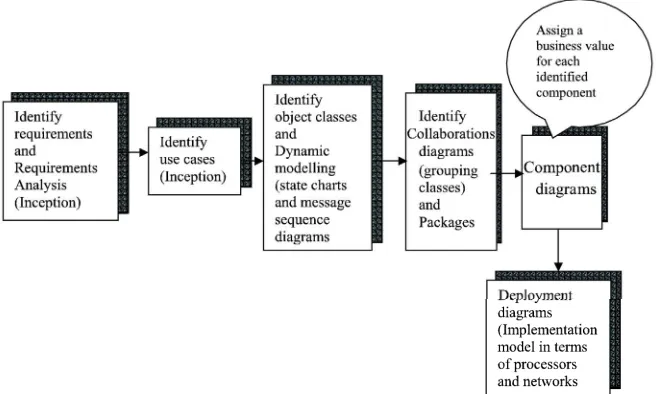
How valid is component decomposition for reuse? Example of a Process Guideline for Component Iden- tification: One rule of thumb can be use here is to iden- tify a group of related object classes to make up a self- independent component. UML view of component iden- tification process is depicted in the following diagram (Figure 2). UML process starts with identifying use cases, class modeling, dynamic modeling (state transition and message sequence models), collaboration models (grouping related classes), packaging, components, and deployment/implementation models (processors and net- work architectures) where components and packages will be placed in the expected processors.
Implementation effort and Return on Investment (RoI): This is an initial step in CBSE and it is therefore vital to identify a component which will have a longer life in your application domain and hence high returns on in-vestment. Therefore it is absolutely essential to have a business view to each identified components with do-main experts.
Process guidelines have also helped us to identify common processes and patterns across CBSE and reuse. Knowledge about commonly occurring patterns in a pro- cess helps to save cost. Therefore, for each guideline, it is important to present a description, illustration, return on
Figure 2. UML view of component identification.
Figure 3. Guidelines, observations, laws, and theories.
Component testing, validation, certification, security and SQA
CBSE Guidelines
CBSE definition
CBSE process, methods, techniques
CBSE design, modelling, implementation
CBSE Domain Engineering, Case studies
Development for Component reuse, Case studies
[image:4.595.159.432.531.720.2]Organisational & managerial
validation, certification, and QSA.
Each of these guidelines has been followed against va- rious models for Helpdesk management systems. There were 15 software component identified and their relevant interfaces. Each of these guidelines can also be used to conduct a systematic inspection against use case models, class diagrams, and component diagrams. Therefore, it allows us to achieve fine tuned models that can be further checked against guidelines during implementation as there are plenty of guidelines developed for JavaBeans and C# components. Similar best practices have been presented by many authors [10-21], all of them can be encoded as a knowledge base.
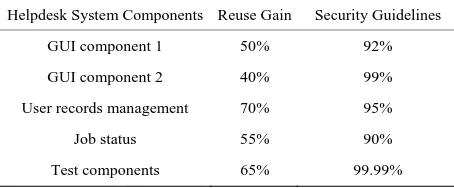
Our earlier results have shown components designed with guidelines seem to have improved reuse and easy to re-design (more than 70% reusability gain has been achieved) for a simple help desk management system. The Table 1 shows an example of a list of components and their reusability gain in percent.
Reuse gain represents the percent of reusability which is measured against percent of guidelines met. The GUI component 1 consists of a large component for Helpdesk system for the front-end consisting of more than 100 in- terfaces that can be served to other components. This component has met 50% of the best practice guidelines therefore reusability gain is 50%. Guidelines become highly useful for building software security. This is a new are for research and hence formulating best practice guidelines can help to achieve software security early in the life cycle. According the above data we can see the percent of security-specific design guidelines that have been met. The security design guidelines are further clas-sified into a set of language-specific features (when not to use some features found in most programming prac-tices) and design principles that help to design compo-nents for software security built in rather than as add ons.
[image:5.595.58.285.636.730.2]Our future work includes designing automated tool to predict developing high quality software components that are designed for reuse and quality. This can be achieved by encoding guidelines as knowledge to assess, review and improve components development right from analy- sis. This will improve component based development with less effort and cost and can be manufactured as a
Table 1. Component reusability gain & security guidelines met.
Helpdesk System Components Reuse Gain Security Guidelines
GUI component 1 50% 92%
GUI component 2 40% 99%
User records management 70% 95%
Job status 55% 90%
Test components 65% 99.99%
mass production that has been seen in other industry. Due to current improvement in knowledge based techno- logies, this is will be possible to encode domain knowle- dge thereby best practice guidelines can be implemented efficiently.
4. Conclusion
Guidelines based SE can create best practices as guide- lines to be followed when developing software artefacts. Guidelines provide knowledge and wisdom that has emerged from several years of best practice and experi-ences in previous projects successfully. This can save time, cost, and effort with quality that we all seek. Our work has shown increase in reuse gains to the maximum of 70%. The security factor can be achieved up to 99%. Thus, we believe, attributes such as reuse and security factors can be improved significantly which results in achieving high quality of the software systems and redu- cing software development costs.
REFERENCES
[1] L. Parnas, “Good Program Design,” Prentice-Hall, Upper Saddle River, 1979.
[2] E. W. Dijkstra, “Selected Writings on Computing: A Personal Perspective,” ACM Classic Books Series, 1982. [3] T. Hoare, “Concurrent Programs,” Prentice-Hall, Upper
Saddle River, 1979.
[4] M. Ramachandran and Sommerville, “Software Reuse Assessment,” First International Workshop on Software
Reuse, Germany, 1992.
[5] M. Ramachandran, “Software Components: Guidelines and Applications,” Nova Publishers, New York, 2008. https://www.novapublishers.com/catalog/product_info.ph p?products_id=7577
[6] I. Sommerville and P. Sawyer, “Requirements Engineer-ing: Good Practice Guide,” Addison Wesley, Boston, 1999.
[7] M. Ramachandran, “Knowledge Engineering for Soft-ware Development Life Cycle,” IGI Global, Hershey, 2011. doi:10.4018/978-1-60960-509-4
[8] Pressman, “Software Engineering,” 6th Edition, McGraw Hill, New York, 2005.
[9] A. Endres and D. Rombach, “A Handbook of Software and Systems Engineering,” Addison Wesley, Boston, 2003.
[10] W. A. Brown and K. C. Wallnau, “The Current State of CBSE,” The Current State of CBSE, IEEE Software, Vol. 15, No. 5, 1998.
[11] M. Broy, et al., “What Characterizes a Software Compo-nent?” Software—Concepts and Tools, Vol. 19, No. 1, 1998, pp. 49-56. doi:10.1007/s003780050007
[13] D’Souza and Wills, “Objects, Components and Frame-works with UML,” Addison Wesley, Boston, 1999. [14] G. Eddon and H. Eddon, “Inside Distributed COM,”
Mi-crosoft Press, Washington, 1998.
[15] G. T. Heineman and W. T. Councill, “Component-Based Software Engineering,” Addison Wesley, Boston, 2001. [16] IEEE SW, “Special Issue on Software Components,”
IEEE Software, Vol. 15, No. 5, 1998.
[17] I. Jacobson, et al., “Software Reuse: Architecture, Process and Organisation for Business Success,” Addison Wesley, Boston, 1997.
[18] K.-K. Lau and Z. Wang, “A Taxonomy of Software Com-ponent Models,” Proceedings of the 31st EUROMICRO Conference on Software Engineering and Advanced
Ap-plications, 2005.
[19] O. Rob Van, et al., “The Koala Component Model for Consumer Electronics Software,” IEEE Computer, 2000. [20] R. Sessions, “COM and DCOM,” Wiley, New York,
1998.